
The Weight of the Threshold
You stand at the edge of a room that has no name in English. The Bengali word for it — antahpur, the inner place — already tells you everything about what this architecture believes you are: something interior, something that belongs inside, something whose edges must not leak into the world beyond the courtyard wall. The year is somewhere in the 1880s. The light comes in at an angle that has always come in at exactly this angle, filtered through carved wooden screens that your grandmother’s grandmother also looked through, also breathed through. You are not imprisoned. This is important to understand first. You are held, which is a different grammar entirely, and one that is far more difficult to refuse.

The cotton of your sari is heavy with the morning. Your feet know every tile. The distance between where you sleep and where you eat and where you pray is a circuit so familiar it has stopped registering as movement and become instead a kind of stillness. Confinement, when it is old enough, begins to feel like home — and home, when it is confinement, begins to feel like the only possible shape of the world. The zenana was not a cell. It had rooms, hierarchies, economies, alliances, entire systems of meaning that existed nowhere else. Women governed it. Women enforced it. And that is perhaps the most unsettling fact about any structure of oppression refined over centuries: it learns to grow its own wardens from inside.
Outside this compound, colonial Calcutta was a city producing contradictions at industrial scale. The East India Company had formalized its territorial control after 1757, and by the time the British Crown assumed direct governance in 1858, Bengal had become the nerve center of an empire that exported cotton, opium, indigo, and ideology simultaneously. The city was printing newspapers and building railways and opening schools — almost exclusively for men. The 1881 census recorded a female literacy rate in Bengal of under two percent. That number is not a symbol. It is a door, and it was locked from a specific direction, by specific hands, for specific reasons that had everything to do with who benefits when half a population cannot read its own contracts.
And yet the world outside the antahpur was not simply freer. It was differently encaged. The colonial administration managed a peculiar moral geometry: it condemned certain Hindu practices as barbaric precisely when condemning them consolidated British authority, and it preserved others as cultural heritage precisely when disruption would have cost too much political capital. Sati had been outlawed under Lord William Bentinck in 1829, less because the colonial state had suddenly developed a feminist conscience and more because, as the historian Lata Mani argued in Contentious Traditions, published in 1998, the debate was never primarily about women — it was about the nature of Hindu scripture, the authority of Brahmin texts, and which power held the right to interpret them. Women were the ground on which men argued about men.
This is the trap that makes the 1880s so difficult to inhabit honestly: the reformers were also implicated. Rammohun Roy, who campaigned against sati decades earlier with genuine moral urgency, still operated within a framework that positioned women as the passive objects of male enlightenment rather than its subjects. Reform and control share a grammatical structure that is easy to miss when you are focused on the kindness of the intention. The woman standing at the threshold of the antahpur was not waiting to be rescued by either tradition or progress. She was already thinking. She was already reading, in households that allowed it, by whatever light came through whatever screen. She was already understanding, with the particular clarity available only to those whom history has decided to overlook, that the walls around her were not natural formations.
Thirsty
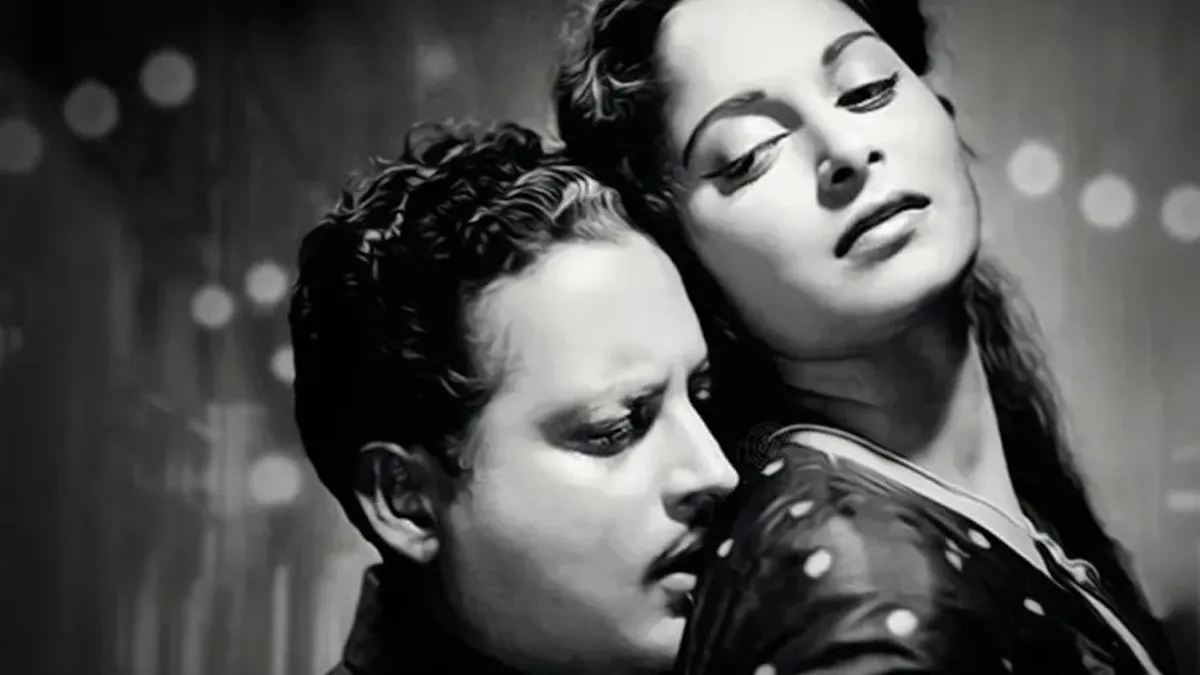
Drama, musical, by Guru Dutt, India, 1957
Thirsty is the heartbreaking story of Vijay, a young poet living in Calcutta who dreams of giving voice to the suffering and injustice of the world through his verses. Idealistic and sensitive, Vijay clashes with a society that despises his art because it is not profitable and does not cater to the tastes of the public. His brothers consider him a failure, the woman he loves leaves him for a marriage of convenience, and his poems are ignored by publishers. Only Gulabo, a prostitute with a pure heart, recognizes the beauty and truth of his words. When a misunderstanding leads everyone to believe Vijay is dead, his name and poetry suddenly become famous, exposing the hypocrisy of those who had previously rejected him.
Watching Thirsty means immersing oneself in a work that goes beyond melodrama, blending poetry, music, and imagery into a profound reflection on the human soul and the value of art. Guru Dutt, director and protagonist, creates one of the most intense and poetic films in world cinema, where black-and-white cinematography, expressive framing, and evocative lyrics produce an atmosphere of poignant melancholy. It is a film about the misunderstanding of the artist, pure love, and society’s hypocrisy, but also a universal critique of materialism and opportunism. Even today, Thirsty moves and provokes thought because it sincerely tells the story of the need to remain true to oneself in a world that measures people’s worth solely by their success.
LANGUAGE: Hindi
SUBTITLES: English, Spanish, French, German, Portuguese
Purity as Infrastructure
You are sitting in a room where two men argue about whether you should live or die, and neither of them is speaking to you. The argument is heated, detailed, scholarly even — one invokes scripture, the other invokes civilization — and the object of their dispute is your body, your grief, the particular geometry of how you might be consumed by fire. You are not a participant in this conversation. You are its occasion.
This is not a metaphor constructed for rhetorical effect. It is the precise structure that Lata Mani identified in 1998 when she examined the colonial archive surrounding sati in British India. In Contentious Traditions, Mani demonstrated through meticulous reading of administrative records, parliamentary debates, and reformist tracts that the abolition of sati in 1829 — championed by Governor-General William Bentinck and framed as humanitarian rescue — was never organized around the question of what women wanted, feared, or suffered. The debates were organized around a far more urgent question for the men involved: whose interpretation of Hindu tradition was authoritative, and therefore whose power was legitimate. Women entered these documents as evidence, not as witnesses.
What makes this finding so structurally disturbing is that it implicates not only the colonizers but the reformers who opposed them. Ram Mohan Roy, celebrated as the father of modern India and a genuine opponent of the practice, constructed his anti-sati arguments primarily by locating the true meaning of Sanskrit texts — contesting Brahminical readings on their own terrain. His intervention was philological before it was humanitarian. The widow’s experience was instrumentalized to establish that educated Hindu men, not British administrators, held the correct interpretive keys to Indian tradition. Rescue was a byproduct of a battle over scriptural authority. The woman at the pyre was, in both cases, the medium through which competing claims to intellectual sovereignty were transmitted.
What Mani’s framework exposes is that purity was never a private spiritual condition. It was infrastructure — a regulatory technology that organized the boundaries of community, legitimacy, and law. A widow’s body carried meaning that exceeded her entirely: it indexed caste honor, family integrity, and the metaphysical coherence of the Hindu household. The British understood this perfectly and exploited it with precision. By positioning themselves as protectors of Indian women against Indian custom, they manufactured consent for colonial governance among a portion of the reformist elite while simultaneously encoding the idea that Indian civilization required external correction. The protection of women became the alibi for the permanence of empire.
The trap is almost elegant in its construction. To accept British intervention was to accept the premise that Indian men had failed their women. To reject British intervention was to be seen defending a practice that killed grieving widows. Indian reformers were forced to argue on terms they had not chosen, in a discourse that had already decided what the stakes were. Every position available to them was a concession to the colonial framing. The only exit from the trap would have required centering women as speaking subjects rather than symbolic objects — a move that almost no one, on any side, was prepared to make.
The year 1829 is frequently cited in Indian historiography as a progressive watershed, evidence of the colonial administration’s civilizing function. But the Sati Regulation XVII that Bentinck signed into law generated no systematic inquiry into widows’ economic circumstances, no redistribution of the property that widows were legally barred from inheriting, no infrastructure for women who had been made destitute by the very social system that then rendered them burdens. The law removed one lethal mechanism while leaving intact the entire apparatus that made death comprehensible to the women it threatened. What changed was the optics of empire, not the material conditions of widowhood. And the discourse of purity that had organized the debate simply migrated, intact, into the next arena where women’s bodies were needed as contested terrain.

The Census and the Disappeared
You fill out a form at a government office, and in the space marked “occupation” you write nothing, because the word that describes what you do every day — the weaving, the trading, the managing of credit and grain — has no box assigned to it. The form moves on without you. What the form cannot hold, it erases.
The first serious attempt to enumerate the population of British India at scale arrived in 1881, under the direction of W.C. Plowden, who coordinated census operations across provinces still absorbing the administrative shock of Crown rule following 1857. The exercise was framed as a triumph of rational governance — a grid laid over a subcontinent, assigning every human being a legible identity. What it actually produced was a vast machinery of disappearance. The census categories for women collapsed an enormous range of economic activity into the single rubric of “dependent,” a classification that required no evidence of dependency and admitted no evidence against it. A widow who had run a textile operation for two decades, supplying thread to three villages, appeared in the columns as someone who did nothing. The ledger called her invisible, and invisibility became her legal reality.
This was not bureaucratic sloppiness. Herbert Risley, who shaped the 1901 census with an almost missionary intensity, believed that social classification was an act of scientific discipline, that naming was knowing, and that the categories imported from English administrative and moral culture were simply the natural containers into which Indian social life would eventually settle. His project, detailed in The People of India published in 1908, treated caste and gender as fixed coordinates on a map — not as lived arrangements constantly renegotiated through labor, kinship, and survival. When the 1901 figures showed Indian women participating in formal economic activity at rates far below European women, the conclusion drawn was not that the measurement instrument was broken. The conclusion was that Indian women were naturally withdrawn from productive life. The data confirmed the theory because the theory had designed the data.
What vanished inside those columns was staggering in its concrete specificity. The weaving communities of Bengal — particularly among lower-caste women in Murshidabad and Nadia districts — had for generations maintained autonomous roles in the production and sale of fine muslin and cotton cloth. These were not auxiliary contributions to a male enterprise; they were the enterprise. Yet the census logic that tied occupation to formal wage payment and contractual labor rendered their work statistically mute. Similarly, in the market towns of the Deccan plateau, women from trading castes had long operated as creditors to small farmers, extending seasonal loans against future harvests. Dharma Kumar’s research in Land and Caste in South India, published in 1965, documented the persistence of female economic agency in precisely these registers — agency that the colonial administrative apparatus had spent decades transcribing into absence.
The widow occupies a particularly brutal position in this architecture of erasure. After the Hindu Widows’ Remarriage Act of 1856 and the intensifying reformist debates around sati and widow property rights, the colonial state developed a contradictory posture: rhetorically invested in the widow’s suffering, administratively committed to her economic nullity. The 1881 census counted widows as a discrete demographic category — their marital status was visible, their labor was not. They appeared as a social problem to be managed rather than as economic actors to be measured. The categories did not merely reflect a pre-existing reality; they manufactured one. A widow who could not be seen working in the census could not be seen working in court, could not inherit on the basis of economic contribution, could not make a legal claim rooted in productive participation.
There is a particular violence in being counted while being erased — in having your existence acknowledged by the state precisely in the form that confirms your powerlessness.
What Reformers Could Not See
You are standing at the edge of a pyre in 1829, and the man who saves you will never ask your name.
Ram Mohan Roy spent years constructing the legal and theological scaffolding that led the colonial administration to ban sati through Regulation XVII, and the architecture of his argument is worth examining with the cold patience it deserves. He did not argue that a widow was a person whose desire to live required no further justification. He argued, from within Sanskrit textual tradition, that the scriptures had been misread — that authentic Hinduism did not sanction the practice. The widow’s body remained the terrain of competing male interpretations; what changed was which interpretation won. Her interiority, her terror or grief or rage, was not the axis on which the debate turned. The axis was hermeneutic authority: who could read the sacred texts correctly, and whether that authority would be Hindu reformers or British administrators.
Tanika Sarkar’s 2001 work Hindu Wife, Hindu Nation performs an act of intellectual surgery on exactly this structure. Sarkar is not writing hagiography, and she is not writing simple condemnation either. She is tracking something more unsettling: the way in which the reformer’s social power was constituted through the very condition he claimed to be dismantling. A woman who could speak for herself, who could represent her own suffering and articulate her own demands, would not need Ram Mohan Roy. She would make him redundant. The reform project was therefore, structurally, invested in a version of female incapacity that it publicly lamented. The lament and the investment were not contradictions — they were the same gesture.
This is not a psychological accusation about what Roy secretly wanted. It is a description of how reform discourse operates as a system. The nineteenth-century Bengali bhadralok reformers constructed a new Hindu modernity that required women to be simultaneously elevated and contained — educated enough to be companions to modern men, but never educated toward independence, toward the refusal of the companionship itself. The nationalist imagination needed the reformed Hindu woman as a symbol of civilizational dignity against colonial condescension, which meant she had to signify, had to carry meaning for a project that was not hers. Her subjecthood was always conditional, always instrumental, always pointing toward something else.
The colonial state participated in this instrumentalization from its own direction. The 1829 Regulation was not simply a humanitarian intervention; it was a governance technology. Abolishing sati allowed the British administration to position itself as the protector of Indian women against Indian men, which consolidated imperial legitimacy at exactly the moment when other forms of resistance to colonialism were growing. Lata Mani’s research, particularly her 1998 Contentious Traditions, documented with archival precision how colonial debates about sati almost never centered women’s experiences. The debates centered tradition — what was authentic, what was aberrant — and women were the occasion for that debate rather than its participants. Mani’s finding is structural, not incidental: the archive literally does not contain the widow’s voice because no institutional mechanism existed to record it as evidence.
What this means is that 1829 marks both a genuine legal threshold — women’s bodies were no longer legally immolable — and a profound epistemological closure. The moment the reform succeeded, it also foreclosed the more dangerous question of what women themselves would have demanded if they had been asked, if asking had been imaginable, if the entire social grammar had not been organized around the assumption that the question was unanswerable. And what is foreclosed at the moment of apparent liberation does not disappear. It goes underground, into the structure of domesticity that the same reformers were busy constructing as the proper container for the woman they had just rescued — the zenana made modern, the threshold moved inward but not removed.
The Vernacular Insurgency
You pick up a text published in Pune in 1882 and the first thing you notice is that it is angry. Not rhetorically angry, not performing outrage for a sympathetic audience — it is angry the way a person is angry when they have been lied to for a very long time and have only recently understood the specific shape of the lie. Tarabai Shinde wrote Stri Purush Tulana in Marathi, in a single sustained outburst, after a lower-caste widow was sentenced to death for infanticide while the man who had impregnated her faced no legal consequence whatsoever. She did not write a petition. She did not address a reform committee. She addressed the entire architecture of male moral authority directly, by name, in the vernacular, and she dismantled it argument by argument with a precision that colonial administrators and Brahmin scholars alike found equally inconvenient.
What made these texts structurally dangerous was not their content alone but the epistemological claim embedded in their form. Western philosophical tradition had spent centuries debating whether women possessed the rational faculty necessary for abstract thought — Aristotle’s formulation in the Politics that the deliberative faculty in women “lacks authority” found its echo in Hegel’s 1821 Philosophy of Right, where women are assigned to the family as their natural ethical sphere, incapable of the universal reasoning demanded by civic life. The British colonial administration carried a version of this assumption into every policy it formulated about Indian women: they were subjects of reform, objects of uplift, never agents of analysis. When a woman sat down and produced a systematic philosophical critique of gender asymmetry in her own language, addressing her own society, using the rhetorical conventions of that society against itself, the act itself was the argument. The medium was already the rupture.
Pandita Ramabai had converted to Christianity by the time she published The High-Caste Hindu Woman in 1887, and her English-language audience in the United States read the book as confirmation of what they already believed about Hindu patriarchy. They were reading it wrong. Ramabai was not offering testimony for Western consumption — she was constructing a forensic record. She documented with sociological precision the legal disabilities imposed on widows, the child marriage rates among Brahmin communities, the denial of Sanskrit education to women, the use of religious scripture as administrative code. She had studied Sanskrit in defiance of explicit prohibition, trained herself in the textual tradition that had been used to exclude her, and then turned that training into a tool of exposure. By the time she established the Mukti Mission in Kedgaon in 1898 — eventually housing over 1,500 women, many of them famine survivors and child widows — she had moved from theory to institution, which is perhaps the most radical act of all.
The Bengali literary world was undergoing its own seismic shift in the same decades. Women writing in Bengali between 1860 and 1910 were operating inside a language that was itself being modernized, standardized, and politically charged through the same nationalist energies that were simultaneously trying to fix women into roles as ideal wives and mothers. Krishnabhabini Das traveled to England in 1882, spent years there, and returned to write Englande Bangamahila — a comparative account of women’s lives that refused both uncritical admiration for the West and defensive celebration of Indian tradition. She was doing something that the nationalist movement found structurally uncomfortable: thinking comparatively without surrendering the right to criticize both sides of the comparison.
The printing press had reached Bombay in the late eighteenth century, but it was not until the vernacular press expanded through the 1850s and 1860s that women gained even partial access to publication. By 1887, journals like Arya Mahila were being edited by women, for women, in languages those women actually spoke at home. The significance of this is not sentimental. Language is not simply a vehicle for ideas — it is the field in which certain thoughts first become thinkable, where a woman writing in Marathi is not translating herself for another audience but thinking inside her own inherited conceptual world and finding that world suddenly insufficient to contain what she knows.
A vision curated by a filmmaker, not an algorithm
In this video I explain our vision
Education as Double Bind

You sit at a wooden desk in a room that smells of chalk and kerosene, and for the first time in your life someone is teaching you to read — not scripture recited by rote, not household accounting passed down by imitation, but actual letters forming actual words that open outward into the world. You feel, with some precision, that something is changing. You are not wrong. You are also not entirely right about what is changing.
The Bethune School opened in Calcutta in 1849, founded by John Elliot Drinkwater Bethune with the active support of reformers including Ishwar Chandra Vidyasagar, and it represented the first sustained institutional attempt to bring formal education to upper-caste Bengali women. Within two decades, it had become a symbol — celebrated by nationalists, cited by colonial administrators, photographed and documented as evidence of civilizational progress. What neither camp advertised was the extraordinary precision of its purpose. The school was not built to produce thinkers. It was built to produce women who could think just enough to raise thinking men.
Partha Chatterjee, in The Nation and Its Fragments published in 1993, identifies the structural logic underneath this generosity with devastating clarity. The nationalist project of nineteenth-century Bengal divided the world into two domains: the material, which belonged to the West and which Indians could borrow from without loss of identity, and the spiritual, which was distinctly Indian and had to be protected at any cost. Women were assigned to guard the spiritual domain — the home, the language, the ritual, the emotional texture of culture — while men moved through the contaminated but necessary material world outside. Female education was not a contradiction of this arrangement. It was its refinement. A woman who could read Bengali literature, discuss philosophy at the dinner table, and write letters in elegant prose was a more capable custodian of the inner life, not a threat to its boundaries.
This is the double bind in its purest form: the tool of liberation is handed to you with a lock already built into the handle. Literacy without professional access. Philosophy without public voice. The capacity to understand your condition with no sanctioned mechanism to change it. When Kailashbashini Debi published her 1863 essay Hindu Mahilaganer Hinabastha, which translates roughly as The Miserable Condition of Hindu Women, she was using exactly the literacy the reform movement had championed — and she used it to describe the cage that same movement had failed to dismantle. She named child marriage, enforced widowhood, and the deliberate suppression of female intellect with a directness that made her male contemporaries deeply uncomfortable. That discomfort was diagnostic.
What the colonial encounter introduced into this structure was an additional layer of pressure that has rarely been named honestly. British administrators used the condition of Indian women as evidence of Indian civilizational inferiority, and Indian nationalists responded not by questioning the premise but by accepting the terms of the debate. The reform of women became a performance staged partly for a colonial audience — a way of demonstrating that India could manage its own modernization without British tutelage. The woman being reformed was, in this transaction, a symbolic currency rather than a subject with her own stakes in the outcome. Her literacy was an argument in someone else’s conversation.
The girls who graduated from Bethune and its successors, who went on to study at the Bethune College established in 1879, who eventually produced the first women to sit university examinations in India — Kadambini Ganguly and Chandramukhi Basu receiving their degrees in 1883 — did not always accept the role scripted for them. But the script’s grip was visible in how their achievements were received: celebrated as evidence of Indian cultural elevation, immediately redirected back into domestically legible narratives, their intellect praised in proportion to how unthreatening it remained to the architecture of the home.
A Room That Was Not Woolf's
She sits cross-legged on a reed mat in Pune, the year somewhere around 1893, a widow of perhaps forty whose name the reformist register recorded only as a caste designation followed by a husband’s surname she can no longer legally use. The primer in her hands was written by a man. The curriculum was designed by men who believed, with genuine tenderness and genuine certainty, that they knew precisely which thoughts she needed to think first.
Pandita Ramabai had opened Sharada Sadan in 1889 partly as a rescue operation and partly as an argument — a living demonstration that the high-caste Hindu widow was not intellectually vacant, only institutionally starved. The project was radical enough to provoke denunciation from orthodox quarters and anxious surveillance from British administrators who worried about what a Christian convert running a Sanskrit scholar’s institution might produce. But the interiority being cultivated inside those walls was still being curated. The texts chosen, the languages prioritized, the sequence in which a woman was permitted to encounter her own reasoning — all of it passed through a gatekeeping logic that believed liberation was a syllabus someone else had already written.
Virginia Woolf‘s famous argument, made in 1929, assumed a continuous self who merely lacked material conditions — five hundred pounds and a room. What it could not account for was the woman whose self had been interrupted, redistributed, colonized not only by poverty or male proximity but by the very institutions offering her repair. The forty-year-old widow in Pune was not simply deprived of a room; she was handed a room whose walls had already been painted by someone else’s theology, someone else’s vision of what a reformed Indian woman should eventually become. Liberation offered as administered curriculum is not liberation withheld — it is something more structurally confusing, because its kindness is real and its constraint is also real, and the woman receiving it has no clean language to refuse what is simultaneously saving her life.
This is where colonial reformism and its Indian male nationalist counterpart converged in a way neither party admitted. Both agreed that the Indian woman needed to change. Both disagreed violently about who should supervise that change. The British civilizing mission and the Hindu reform movement fought each other bitterly over the body and mind of the Indian woman — the Age of Consent debates of 1891 being merely the most legible battlefield — while the woman herself remained the contested territory rather than a participant in the dispute. Tarabai Shinde had already demonstrated in 1882, in Stri Purush Tulana, that Indian women could produce scorching social critique without British prompting and without male mentorship, addressing the hypocrisy of a society that mourned widow immolation in the abstract while ensuring widows remained socially annihilated in practice. But Shinde’s text circulated narrowly, left almost no institutional trace, and was rediscovered largely by academic feminism in the late twentieth century — which is itself a data point about whose awakening gets archived and whose gets quietly composted.
The forty-year-old woman on the mat is learning to decode a script. This is not a small thing. The cognitive act of literacy at forty, surrounded by girls a third her age, in a body that has spent decades being defined entirely by its relationship to a dead man — this is genuine rupture. And yet the rupture is occurring inside a container whose shape was not negotiated with her. She has been given access to language, but the first sentences that language will be used to think have already been selected. The question no one inside that room could quite articulate was whether the self that eventually emerges from a borrowed curriculum is a liberated self or a successfully administered one — and whether, at a certain threshold of hunger, the distinction could any longer be meaningfully drawn.
The Nation Needs Her Silent

You march because he asked you to. Not with a command — with a gaze, a framing, a carefully constructed moral architecture in which your willingness to suffer publicly becomes the proof that the nation deserves to be free. The salt marches, the boycotts, the prison terms accepted with folded hands and lowered eyes: these were not incidental to the independence movement. They were its aesthetic. And you were its medium.
Gandhi’s mobilization of women into mass civil disobedience between 1930 and 1942 was tactically brilliant and, in a specific sense that has taken decades to name clearly, structurally predatory. Not predatory in the register of individual malice, but in the deeper register that Mrinalini Sinha excavates in Specters of Mother India — the colonial and nationalist imagination had long converged on a single figure: the Indian woman as the repository of authentic civilization, the untouched interior that foreign rule had failed to corrupt. To bring that figure into the streets was to weaponize her symbolic capital while simultaneously reinforcing the very terms of her captivity. A woman marching for the nation was still marching as the nation’s soul, not as a citizen negotiating her own claims. The distinction is not semantic. It determines everything that comes after.
What gets produced in this moment is a peculiar inversion that looks like liberation from the outside and operates as a more refined enclosure from the inside. Kamaladevi Chattopadhyay organized, traveled, wrote, and argued across decades for women’s political participation, yet the dominant narrative of nationalist history consistently reabsorbed her work into the larger frame of collective sacrifice — her agency made legible only insofar as it served a cause larger than herself. Sarojini Naidu was celebrated as the Nightingale of India, a title that tells you exactly how her voice was meant to function: beautifully, inspirationally, in service of something that was not hers to define. A nightingale does not negotiate. It sings.
The colonial administration had spent considerable energy, particularly after the controversy surrounding Katherine Mayo’s 1927 polemic Mother India, constructing Indian womanhood as evidence of civilizational deficiency — a population too oppressed to govern itself. The nationalist response was not to dismantle the premise that women’s condition was the measure of a civilization’s worth. It was to contest the measurement while keeping the scale. Indian reformers and leaders countered Mayo not by arguing that women’s lives were irrelevant to political legitimacy, but by insisting that those lives were improving, that the nation was capable of self-correction, that the proper judges were Indian men rather than British observers. The woman remained the terrain of the argument. She was never invited to hold the pen.
There is a particular violence in being made sacred. Sanctification removes a person from the ordinary circuits of negotiation, complaint, and self-interest where political subjectivity actually lives. When a woman becomes the symbol of a nation’s spiritual resilience — its purity, its endurance, its capacity to suffer without being broken — she is simultaneously elevated and disappeared. Her concrete grievances, her property claims, her body’s autonomy, her desire for education or movement or refusal, all of these become vulgar in the shadow of what she has been asked to represent. The independence movement did not invent this logic; it inherited it from centuries of Brahmanical and colonial discourse and refined it into something that felt, to many of the women living inside it, like dignity.
India gained formal independence in August 1947. The Constitution of 1950 granted women equal rights under law. And yet the question that the entire preceding century had been circling without ever directly addressing remained suspended in the new nation’s founding air: whether a woman who has been consecrated as the moral proof of a civilization’s worth can ever step down from that altar and simply, irreducibly, belong to herself.
🪔 Voices Silenced, Worlds Awakened
The story of women in colonial India cannot be told without understanding the literary, spiritual, and social currents that surrounded them. These related articles illuminate the forces of oppression, resistance, and cultural identity that shaped an era of extraordinary awakening.
Ismat Chughtai: The Writer Who Challenged India’s Modesty
Ismat Chughtai dared to write about female desire, domestic confinement, and social hypocrisy at a time when such subjects were considered scandalous and unfit for a woman’s pen. Her work stands as a direct literary rebellion against the patriarchal codes that governed colonial Indian society. Reading her is to understand how fiction became a weapon of emancipation for women who had no other public voice.
GO TO THE SELECTION: Ismat Chughtai: The Writer Who Challenged India’s Modesty
Devadasi: History and Indian Culture
The Devadasi system represents one of the most complex and contested institutions in Indian cultural history, interweaving religious devotion, artistic mastery, and the systematic exploitation of women’s bodies. Under colonial rule, this tradition became a battleground between reformers, nationalists, and defenders of heritage, exposing deep tensions about gender, caste, and power. Understanding the Devadasi is essential to grasping how Indian women were simultaneously celebrated and subjugated within their own culture.
GO TO THE SELECTION: Devadasi: History and Indian Culture
Rabindranath Tagore: Life and Works
Rabindranath Tagore‘s vision of womanhood was revolutionary for his time, portraying female characters with interiority, moral agency, and spiritual depth rarely granted to women in the literature of colonial Bengal. His writing engaged directly with questions of education, marriage, and freedom, making him both a product and a critic of his social moment. Tagore’s women are not merely victims of oppression but complex figures navigating an awakening consciousness.
GO TO THE SELECTION: Rabindranath Tagore: Life and Works
Woolf’s A Room of One’s Own: Feminism and Writing
Virginia Woolf‘s landmark essay explored how the denial of physical space, economic independence, and intellectual freedom kept women from realizing their creative potential across centuries and cultures. Though rooted in the British experience, her arguments resonate powerfully with the situation of educated women in colonial India who were similarly barred from the rooms where thought, art, and power were born. Her analysis of systemic exclusion remains one of the sharpest tools for understanding how oppression functions beneath the surface of polite society.
GO TO THE SELECTION: Woolf’s A Room of One’s Own: Feminism and Writing
Discover the Films That Tell These Stories
The struggles and awakenings explored in these articles have found their most honest and courageous expression in independent cinema. On Indiecinema streaming you will find the films that dare to tell these stories without compromise — voices from the margins, images born from freedom, and cinema that changes the way you see the world.
👉 EXPLORE THE CATALOG: Watch Indie Films in Streaming
A vision curated by a filmmaker, not an algorithm
In this video I explain our vision

