
The Face Beneath the Painted Grin
You are watching someone who no longer exists. The body on the stage moves, gestures, contorts, bellows — but the man who once lived behind those eyes has been replaced, thoroughly and without protest, by something older and more efficient than a human being. The mask has done its work. You feel it in the audience before you understand it intellectually: a faint vertigo, as if the stage has tilted slightly and the creature before you is not performing a character but has been consumed by one. The painted grin does not waver. It cannot. That is precisely the point.

Northern Italy in the mid-sixteenth century was a continent of fractures — political, economic, moral — held together by the performance of social order rather than its reality. The city-states of Lombardy and the Veneto were grinding machines: merchants hoarding grain while artisans starved, lawyers constructing labyrinths of Latin to obscure what was simply theft, old men purchasing the obedience of young women through marriage contracts written in the language of property law. Into this landscape, sometime around the 1550s, the first documented professional troupes of Commedia dell’Arte appeared — the Gelosi, the Accesi, the Confidenti — and what they brought to the piazzas and courtyards of Venice and Milan was not escape from social reality but its precise anatomical rendering. These were not fairy tales. They were mirrors tilted at a cruel angle.
The masks themselves were never artistic inventions in the romantic sense of a genius reaching inward for expression. They were sociological instruments. Pantalone — the miserly Venetian merchant, hook-nosed, hunched, clutching his purse with the tenderness he withholds from every human being in his life — was drawn directly from the merchant class that had made Venice the commercial capital of the Mediterranean and then watched that empire slowly contract through the sixteenth century, leaving behind only the habits of accumulation without the justification of growth. His mask was not a caricature. It was a diagnosis. Il Dottore, the Bolognese pedant who speaks in torrents of Latin and understands nothing, arrived at precisely the moment when the University of Bologna, founded in 1088 and the oldest in Europe, had calcified into an institution that reproduced credentials rather than thought. The mask did not mock a type of person. It mapped a systemic failure of knowledge onto a body, gave it a silhouette, made it undeniable.
What makes this history genuinely disorienting is the mechanism of fixity. The character types of Commedia dell’Arte were called maschere fisse — fixed masks — and the fixity was not a theatrical limitation but the entire argument. A human face can lie, can soften, can renegotiate its expression in response to a moral challenge. The leather mask cannot. Arlecchino, the servant from Bergamo — desperately hungry, acrobatically resourceful, morally flexible in all the ways poverty teaches you to be — wore a face that would never register guilt, never record shame, because guilt and shame are luxuries available only to those whose survival is not in constant negotiation. His patchwork costume, later romanticized into the diamond-pattern harlequin suit familiar from a thousand decorative tiles, was originally a deliberate accumulation of rags, each patch a different fabric because no single cloth could be afforded whole. The comedy of his hunger was never really comedy. It was hunger, rendered in a form that audiences could witness without the obligation to intervene.
What the sixteenth-century crowd understood, standing in the piazza in the cold Venetian air, was that they were watching themselves sorted and labeled and set into permanent motion. The merchant would always hoard. The pedant would always speak without knowing. The servant would always be hungry and brilliant and expendable. The masks promised that nothing would change — and the audience laughed, because laughter is sometimes the only available response to a truth that has been handed to you without a door marked exit.
Arte
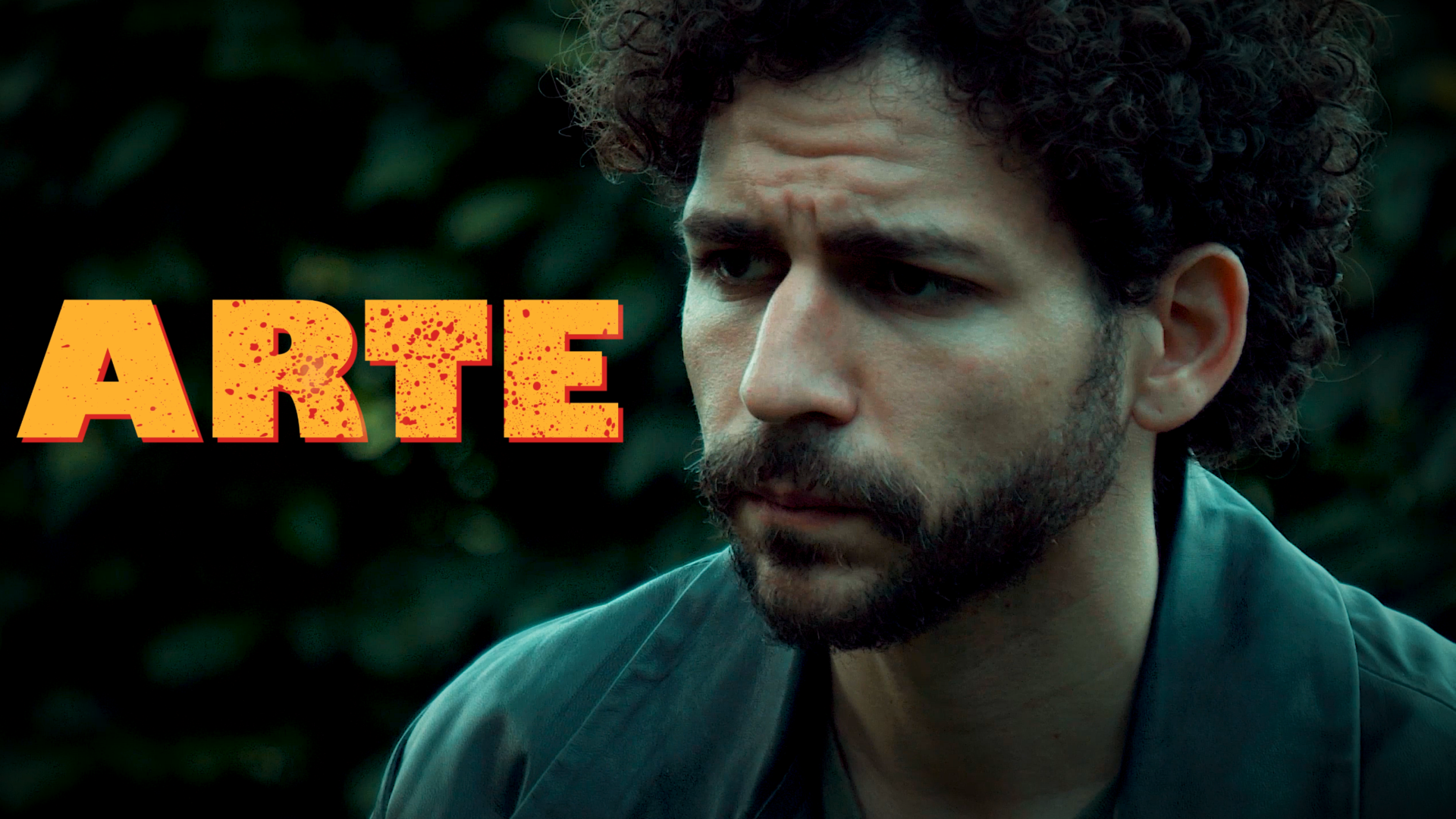
Drama, thriller, by Stefano Scala, Simone Arcidiacono, Italy, 2023.
In a secret and fascinating world, four people meet every week at the mysterious "The Circle" for a gripping game, knowing nothing about each other. However, fate has a different plan for them. As the game progresses, their lives begin to intertwine in unpredictable ways. The boundaries between the game and reality start to blur, revealing buried secrets and creating unthinkable connections. In the heart of "The Circle," the masks fall, and the players' lives will be forever changed.
LANGUAGE: Italian
SUBTITLES: English, Spanish, French, German Portuguese
When Character Precedes Person
You walk into a room where you know no one, and within four seconds you have already decided who you are going to be. Not consciously — the decision happens below language, below intention, in the same reflex that adjusts your posture when a stranger’s gaze holds yours a beat too long. You perform yourself before you can think yourself, and the audience receives that performance as if it were fact.
Erving Goffman published “The Presentation of Self in Everyday Life” in 1959, and what made sociologists uncomfortable was not the argument’s originality but its accuracy. He proposed that social interaction is fundamentally dramaturgical — that every encounter involves a front stage managed for observers, and a backstage where the performance is prepared and occasionally dropped. The book sold widely not because it was flattering to read but because it described something the reader already knew and had never heard named. We are all, Goffman argued, managing impressions at every conscious moment, and the management itself becomes invisible through repetition until we mistake the role for the self.
What Goffman described in sociological prose, the Commedia dell’Arte actor had already understood at the level of the body centuries earlier, and with consequences far more destabilizing than academic discomfort. A performer who took on Arlecchino did not simply adopt a costume. They submitted to a discipline that could last a decade or more — repeating the same physical logic, the same rhythmic impulses, the same reactive patterns until Arlecchino’s nervous system, so to speak, began to colonize their own. The mask in Commedia was not a covering. It was a training device for cognitive replacement. The tilt of the head, the particular quality of hunger in the stance, the speed at which the character processed threat and dissolved it into laughter — these were rehearsed until they fired faster than the actor’s own responses. Scholars of the tradition, including those who worked to reconstruct its pedagogy in the twentieth century, noted that experienced Commedia players often reported a disorientation between performances: not knowing, in ordinary social moments, whether a response belonged to them or to the character whose logic they had internalized so completely.
This is the point where philosophy stops being decorative. If identity is not a stable interior thing but rather an iterative performance that reshapes the performer through repetition — if you become, neurologically and behaviorally, what you enact often enough — then the self is not the source of the performance. It is the residue. The philosophical tradition from Descartes onward has insisted on an inner subject who chooses, authors, and inhabits experience from a position of relative sovereignty. The Commedia actor, in their disciplined submission to a single mask, enacted a direct refutation of that model long before it was theorized as such. They demonstrated that character is not expressed by a person. Character, rehearsed with sufficient intensity, produces the person who appears to express it.
The danger is not that this makes identity fragile — it is that it makes identity indistinguishable from habit. Aristotle in the “Nicomachean Ethics” wrote that we become just by doing just acts, and this was intended as moral encouragement. What the Commedia tradition reveals is the same mechanism operating without moral supervision: we become whatever we rehearse, regardless of whether it was chosen deliberately or absorbed through circumstance. The social roles assigned by class, gender, or profession in early modern Europe were not merely external constraints. They were masks worn long enough to become faces. The servant who performed deference for thirty years was not merely acting — the deference had reorganized their reflexes, their anticipatory posture, the speed at which they processed authority as a signal requiring response.
Which leaves the question that no amount of sociological or theatrical theory fully closes: if the mask’s logic can overtake the actor’s own, what exactly is left when the mask is finally removed?

The Mask as Social Contract
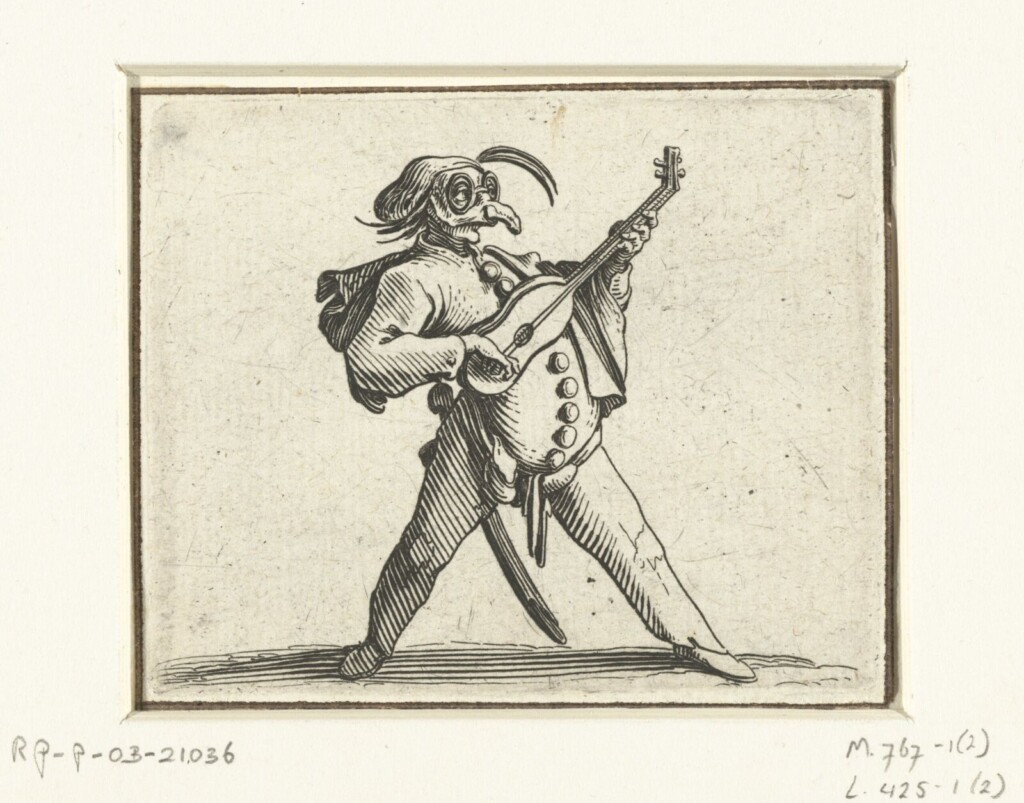
You arrive at the theatre before the performance begins, and you already know who will humiliate whom. You know the merchant will be greedy, the servant will be clever, the young lovers will suffer beautifully and resolve nothing on their own. You paid for exactly this. The comfort is not incidental — it is the entire transaction.
The troupes of sixteenth-century Italy were not artistic collectives in any romantic sense. They were small commercial enterprises operating on razor-thin margins, crossing Alpine passes and ducal borders with carts full of costumes, props, and a handful of actors who had spent years perfecting a single role. The Gelosi, founded around 1568 and patronized intermittently by the Medici and the Valois court, survived not because they were experimental but because they were reliable. An audience in Ferrara and an audience in Lyon both needed to recognize Pantalone the moment he walked onstage — the long black coat, the red trousers, the hooked nose of the leather mask — before a single word was spoken. Recognition was the product being sold. Novelty would have been a liability.
This is where Pierre Bourdieu‘s concept of habitus becomes something more than academic shorthand. In his 1980 work Le sens pratique, Bourdieu argued that social structures do not primarily operate through conscious rules or explicit commands but through the body itself — through posture, gesture, speech rhythm, and the sense of what feels natural in a given space. The habitus is history made flesh, a set of dispositions so deeply internalized that the individual experiences them not as constraints but as personality. What Commedia understood intuitively, two centuries before any sociology existed to name it, is that an audience does not simply observe a habitus performed onstage — it recognizes its own. Pantalone was not a caricature of some abstract greed. He was the specific greed of the Venetian merchant class, the man who counted coins at the table while his daughter aged in a locked room, and every person in that piazza had either lived under such a man or feared becoming him.
The mask, in this light, is not a concealment but an acceleration. It strips the social role down to its skeletal logic and presents it without the softening friction of individual psychology. The actor wearing the half-mask of Il Dottore — the Bologna-trained pedant who speaks in garbled Latin and mistakes verbosity for wisdom — is not playing a character. He is playing a function, the function that institutions of learning have always served when they transform knowledge into social armor rather than genuine understanding. The University of Bologna, founded in 1088 and the oldest in the Western world, had by the sixteenth century already developed the recognizable pathology that Il Dottore embodies: the credentialed man who uses citation the way a duelist uses a sword, not to illuminate but to wound and to exclude.
What made the system economically durable was precisely its social accuracy. Audiences returned because they found something true, not in spite of the exaggeration but through it. The lazzi — the improvised comic routines that punctuated every performance — worked only when they landed on a shared nerve. A servant outwitting a master was funny because the power differential was real and daily and unresolved. The laughter was not liberation. It was the pressure valve on a container that was never going to be opened any other way. When historians of popular culture like Peter Burke, writing in 1978 in Popular Culture in Early Modern Europe, describe the carnivalesque as a form of sanctioned transgression, they are pointing at something the Commedia troupes had already monetized: the performance of rebellion that leaves every hierarchy exactly where it found it.
The actor who spent forty years playing Arlecchino did not choose a character. He accepted a position within a system that was larger than his talent, older than his birth, and entirely indifferent to whatever he privately believed himself to be.
Arlecchino's Hunger Is Not Metaphor
You have seen Arlecchino before — not in a theater, but on a greeting card, on the wrapper of a chocolate box, on the painted sign of a restaurant that calls itself “rustic.” He is grinning, mid-leap, his diamond-patterned suit a riot of primary colors, his wooden stick raised in mock menace. He looks like joy itself has been given a costume. That image has been reproduced so many times, in so many contexts of commercial cheerfulness, that it has ceased to be a representation of anything and has become instead a visual sedative — something you register without seeing, like elevator music you stop hearing three seconds after it begins.
What has been erased from that image is hunger. Not hunger as a literary device, not hunger as a philosophical condition of the modern subject, not the metaphorical emptiness that existentialists would later build entire careers upon. Actual hunger. The kind that makes the stomach contract visibly, that curves the spine, that changes the way a person walks and holds their hands. Arlecchino emerged from the servant class of Bergamo, a northern Italian city whose peasant population in the sixteenth century faced chronic food insecurity that was not a periodic crisis but a structural condition. The character was not invented by a playwright sitting at a desk imagining the psychology of the dispossessed. He was shaped by bodies that had actually lived inside deprivation — bodies that moved in specific ways because malnutrition had made them move that way.
Dario Fo understood this with a precision that most theater historians have preferred to avoid. In his Nobel lecture of 1997, accepting the prize in literature, Fo did not speak about artistic innovation or theatrical lineage in the conventional sense. He traced the physical grammar of popular performance — the falls, the somersaults, the grotesque distortions of posture — directly to the biomechanics of poverty. The zanni, those servant-clown figures of whom Arlecchino is the most famous descendant, moved the way they moved because their bodies had been shaped by carrying heavy loads, by sleeping on cold floors, by the particular kind of muscle fatigue that comes not from exertion but from insufficient caloric intake. The acrobatics were not a stylistic choice layered onto a character. They were the character, legible to audiences who recognized in those movements a precise social reality they themselves inhabited.
This is the mechanism that later centuries, in their enthusiasm for the aesthetic beauty of commedia dell’arte, systematically stripped away. When the form was revived by bourgeois theater reformers in the eighteenth and nineteenth centuries, the class specificity of those bodies was replaced by a generalized idea of folk vitality — something timeless, earthy, universal. The poverty became picturesque. Carlo Goldoni, in his reform of Venetian comedy in the 1750s, was already in the process of civilizing Arlecchino, giving him interiority and moral complexity, which sounds like an enrichment but was actually a domestication. The character who had encoded famine in his movements was being upgraded into someone the emerging merchant class could find sympathetic rather than threatening.
What Fo grasped, and what the chocolate box cannot accommodate, is that the lazzo — the recurring physical gag that structures so much of Arlecchino’s performance — often centered obsessively on food. Not as comic relief but as the actual stakes. Arlecchino steals food, guards food, dreams about food, grieves when food is taken from him with an intensity that no contemporary audience can read as purely comic unless they have already been educated to see it that way. The grief is too specific. The body language surrounding the presence or absence of a meal carries a weight that trained theatrical convention alone cannot explain. It had to have been rehearsed in life before it was rehearsed on stage, passed between performers who knew that particular gravity from somewhere other than imagination.
The Tyranny of the Recognizable
You are in the middle of your third performance review in two years, and when your manager asks how you feel about the lateral move they are proposing, you hear yourself say exactly the right thing — measured enthusiasm, calibrated openness, a precise note of ambition tempered by collegial humility — and somewhere beneath the fluency of it you reach for what you actually feel, and find nothing distinct enough to name. Not suppressed feeling. Not hidden feeling. Simply no gap between what you would say and what you are saying, because the optimization has gone all the way down.
This is not hypocrisy. Hypocrisy at least preserves the architecture of a private interior that contradicts the public one. What happens in that conference room is stranger and more complete: the instrument of self-presentation has been sharpened so relentlessly, calibrated across so many performance cycles and feedback loops and LinkedIn-ready narratives of professional growth, that it no longer functions as a tool held by a person. It has become the person who is available for use. The role has not replaced the self. It has dissolved the conditions under which a self could offer resistance.
Donald Winnicott, writing in 1960 in his paper “Ego Distortion in Terms of True and False Self,” identified something clinically precise that most of his contemporaries were not equipped to see: that the False Self is not pathological vanity or deliberate deception, but a protective organization built in early infancy when the environment demands compliance before the psyche has the resources to negotiate. The infant whose gestures are not met — whose spontaneous impulse is systematically overridden by the mother’s own needs — learns to substitute reaction for initiation. The False Self becomes a caretaker of the True Self, shielding it from a world that cannot receive it. The tragedy Winnicott identified is not that the False Self lies. It is that it succeeds. It functions so well socially, professionally, institutionally, that the person living behind it loses practical access to the interior it was built to protect.
What the modern professional context adds to Winnicott’s clinical portrait is scale and velocity. The feedback mechanisms available to someone building a career in 2024 are incomparably more granular, more continuous, and more rewarding than anything the mid-century consulting room had encountered. Engagement metrics, performance quartiles, peer reviews, brand audits of the self — these are not simply pressures from outside. They become internalized syntaxes, grammars of self-description that operate prior to reflection. By the time a person sits in that conference room and reaches for an authentic reaction, the architecture has already processed it. What arrives at the surface has been pre-approved.
The Commedia dell’Arte performer wearing Pantalone’s mask understood something that the contemporary professional does not: that the constraint was external, visible, shared. The audience saw the mask. The performer felt its edges against their skin. There was a friction between face and function that remained legible to everyone in the space, and that friction was where the art lived. Remove the friction — sand the mask until it fits so perfectly it moves when the face moves, breathes when the lungs breathe — and you have not liberated the performer. You have simply made the performance invisible to its own author.
Winnicott was careful to note that no human being operates from the True Self exclusively, that some degree of False Self organization is not only normal but necessary for social existence. The clinical crisis arrives at a specific threshold: when the individual can no longer distinguish, in real time, between a spontaneous impulse and a managed presentation of one. And that threshold, which Winnicott located in the most severe dissociative presentations he encountered in private practice, now appears to be the ordinary ambient condition of a recognizable professional life, available to anyone who has been sufficiently rewarded for being easy to read.
A vision curated by a filmmaker, not an algorithm
In this video I explain our vision
Laughter as Containment Technology

You are sitting in a wooden square in sixteenth-century Ferrara, pressed between a wool merchant and a woman selling roasted chestnuts, and the man in the hooked mask and black coat is being publicly humiliated by his own servant. The crowd howls. Something releases — some held breath, some throttled resentment — and for a moment the old miser up there on the boards is every landlord who ever raised the rent, every father who counted his coins while his children went cold. The laughter feels like power.
It was not power. It was the pressure valve on a boiler that nobody was permitted to dismantle.
Mikhail Bakhtin argued in his 1965 study of Rabelais that the carnivalesque represented a genuine inversion of official culture — a temporary liberation of the body, of vulgarity, of the low against the high, operating as a kind of counter-world where hierarchies dissolved and the people momentarily became sovereign. He was describing something real. The energy was real. The laughter was real. But Bakhtin was also, perhaps inevitably, a man writing under Soviet censorship, and there is something in his account that strains toward hopefulness more than the historical record will quite support. The carnival was not licensed because power feared it. It was licensed because power understood it.
The critical word is licensed. Every Commedia performance existed within a framework of permissions — from the local signore, from the guild, from the Church calendar that authorized festivity at particular moments and then withdrew that authorization with the same bureaucratic hand that had extended it. Laughter at Pantalone did not imperil the institution of mercantile wealth; it metabolized resentment toward it. The audience left the square not radicalized but relieved, their hostility toward the hoarding class converted into an afternoon’s entertainment, their energy spent on mockery rather than accumulation for actual resistance. The mask absorbed the violence that might otherwise have required a genuine target.
What makes this mechanism genuinely unsettling is how structurally elegant it is — not as conspiracy but as drift. Nobody designed the Commedia as a containment system. The performers wanted to eat. The audiences wanted to laugh. The patrons wanted order maintained at minimal cost. The form evolved into a pressure release precisely because everyone in the arrangement was following their own interests without needing to coordinate. Norbert Elias, charting the civilizing process across his two-volume 1939 work, noted how the monopolization of force by emerging state structures ran parallel with the internalization of behavioral controls — people stopped needing to be physically restrained because they learned to restrain themselves. Comedy did something adjacent: it taught people to discharge aggression through spectatorship rather than action, to locate their grievances in a theatrical effigy and laugh it into harmlessness.
The pedantry of il Dottore is worth pausing on here, because he represents a slightly different circuit. His target is not wealth but knowledge deployed as domination — the Bolognese university man who buries every human situation under an avalanche of Latin citations and misremembered Aristotle. His mockery should, logically, have destabilized the authority of learned institutions. Instead it functioned as a kind of inoculation. By placing the absurdity of scholastic pedantry in full view, in the most grotesque and obvious form, Commedia made the audience feel sophisticated enough to see through it — and that feeling of sophistication substituted for any actual interrogation of why those institutions held power, who they served, what they excluded. Laughter at the caricature made the real thing easier to tolerate.
The mask came off at the end of every performance. The actors ate their supper. The square emptied. And the structures that had generated Pantalone’s greed, the Doctor’s institutional pomposity, the Capitano’s military vanity, stood exactly where they had stood that morning, now additionally protected by an audience that had already spent its contempt on a wooden stage and gone home feeling, obscurely, that something had been said.
The Actor Who Forgot How to Stop
You have been playing the same character for so long that the audition ended decades ago, and no one told you, and you kept performing anyway into rooms that had already emptied.
The commedia tradition made a precise clinical observation long before the clinical vocabulary existed to name it: that a mask worn long enough stops being something held against the face and becomes the face itself. The Dottore who lectures without listening, the Pantalone who hoards without enjoying, the Zanni who scrambles without arriving — these were not satirical exaggerations of human types but accurate portraits of what happens when a behavioral repertoire, initially chosen as a survival strategy, gradually forecloses every other option. The mask was always a technology of adaptation. The pathology begins when adaptation stops and the mask continues.
Robert Lifton, in his 1993 work The Protean Self, described a mode of modern psychological survival built on radical flexibility — a self capable of dissolving and reforming, of holding contradictory identities without collapsing under the weight of inconsistency. Lifton saw this not as fragmentation but as resilience, the psyche’s answer to a world of relentless discontinuity. The protean self was his argument for why fluidity is not weakness. But the case he was countering, the case he named only partially, is the one worth examining here: the self that cannot move, that responds to the same world of discontinuity by calcifying rather than flowing, by gripping the original role so tightly that the hands eventually lose sensation.
In 1973, the psychologist David Rosenhan published the results of his study “On Being Sane in Insane Places,” in which participants feigned psychiatric symptoms to gain admission to psychiatric hospitals, then immediately ceased all simulated behavior upon admission. What followed was not recognition of their normalcy but the opposite — staff interpreted everything the participants did, including note-taking and ordinary social behavior, through the diagnostic frame already assigned. The performed self had been administratively crystallized, and no subsequent behavior could dissolve it. The institution had taken the mask and nailed it down. But Rosenhan’s study, disturbing as it is, describes a coercion from outside. The more invisible version is the coercion from inside, when it is the person themselves who has done the nailing.
There is a category of historical figure who does not survive the end of the war that gave them their identity. Soldiers, revolutionaries, ideological combatants of every variety — people who organized themselves entirely around a conflict and then found themselves standing in peacetime with a complete architecture of self that had no function. The role was not abandoned; the theater simply closed around them while they continued to perform. Erik Erikson, examining the veteran cases he encountered in clinical work after 1945, noted that the difficulty was never the absence of identity but its excess — a self so thoroughly organized around one context that recontextualization felt like annihilation. The mask had not just stuck; it had become the load-bearing wall.
What the commedia understood, structurally, is that the fixed types are funny precisely because the audience can see what the character cannot: the gap between the role being performed and the situation actually unfolding. Pantalone haggling over a dowry he will never live to spend, the Dottore citing authorities on a subject that has already been resolved by events he missed — the comedy is always about a lag, a failure of update, a self running on instructions written for a world that has since changed its terms. The audience laughs from the outside of that lag. The tragedy, which commedia never quite permitted itself to become, would be to follow the character home after the performance, to watch them in the silence of a room where no one is laughing, still speaking in the cadences of their type, still waiting for a cue that the play stopped sending.
Truth as the Mask's Final Achievement
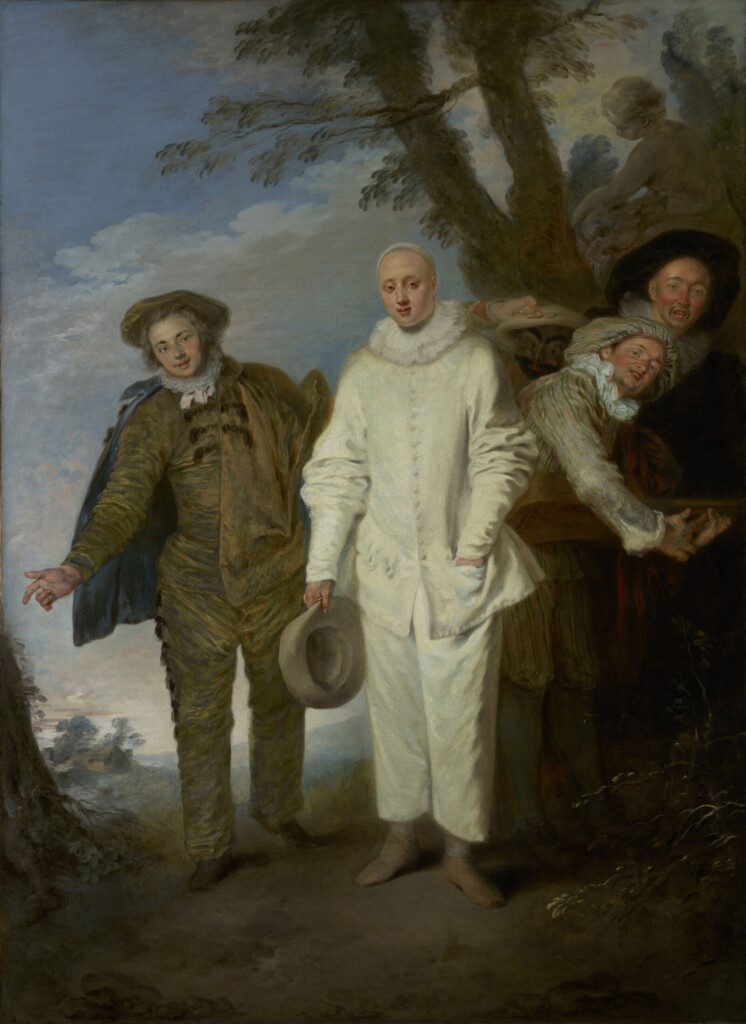
You have worn the same face for so long that you can no longer find the seam where it was fastened. This is not a metaphor about dishonesty. It is a structural fact about how human beings come to exist as coherent entities at all — through repetition, through the hardening of gesture into habit, through the slow calcification of performance into what we eventually call a person.
Judith Butler argued in Gender Trouble in 1990 that identity is not expressed through performance but constituted by it — that there is no original self waiting behind the curtain of social presentation, because the curtain is load-bearing. She was writing about gender, but the mechanism she exposed is far older and far wider than any single category of identity. What she described is the grammar of selfhood itself: the self does not pre-exist its enactments, it is their residue. Which means the mask is not a distortion of the face — the mask is the process by which a face becomes possible at all.
The commedia troupes who toured the Italian peninsula in the sixteenth and seventeenth centuries understood something about this that their audiences did not have language to articulate. When an actor spent twenty years playing Arlecchino — refining the timing of the tumble, sharpening the pitch of the voice, learning exactly how long to hold a beat of confusion before the laugh — something irreversible occurred. The role did not recede at the end of the performance. It reorganized the musculature, the reflexes, the way the body moved through ordinary space. The distinction between the man who played Arlecchino and the man who was Arlecchino became, at a certain point, a distinction without a difference that anyone, including the actor himself, could locate.
This is where Butler’s argument becomes not a liberation but a trap door. If identity is constituted through repetition, then authenticity — the thing you were supposed to be protecting by refusing the mask — has no stable address. The question of what you truly are beneath your performances is not a question that leads inward to some bedrock self. It leads to an infinite regress of prior performances, each one having shaped the one that followed, with no original gesture at the bottom of the stack. The self that feels most nakedly real to you — the one you retreat to in private, the one you believe you are when no one is watching — is itself the product of a rehearsal so long and so thorough that you have forgotten the audition.
What destabilizes this further is not philosophy but neuroscience. When a pattern of behavior is repeated consistently enough, the neural pathways encoding that behavior become structurally indistinguishable from pathways encoding what we call temperament or character. The brain does not file performance separately from identity. It files them together, under the same heading, eventually erasing the metadata that would have indicated which came first. By the time you notice that you have become something, the becoming is already complete and the evidence of the process has been quietly overwritten.
The commedia mask, made of leather and worn close against the skin, was designed to warm with the actor’s body heat until it conformed to the contours beneath it. Over years of use, the mask and the face became approximate mirrors of each other. Craftsmen who made replacement masks for veteran actors would sometimes ask to study not a model or a mold but the old worn mask itself, because by that point the mask was the more reliable record of the face. What the tradition preserved in this detail is a truth too uncomfortable for most theories of selfhood to accommodate: that the instrument of concealment can become, across sufficient time and sufficient commitment, the most precise document of what was never being concealed at all.
🎭 Behind the Mask: Identity, Performance, and the Self
Commedia dell’Arte has always explored the thin boundary between the role we play and the truth we hide beneath it. These related articles trace how theater, literature, and philosophy have grappled with masks, identity, and the paradox of truth revealed through performance.
Luigi Pirandello: Life and Works
Luigi Pirandello spent his entire literary career obsessed with the same question that haunts Commedia dell’Arte: who are we when the performance ends? His theater dismantles the certainty of fixed identity, showing how every social interaction is itself a form of masking. Reading Pirandello alongside the Commedia tradition reveals how deeply Italian culture has interrogated the gap between face and persona.
GO TO THE SELECTION: Luigi Pirandello: Life and Works
Pirandello’s One Nobody and One Hundred Thousand: Analysis
In One, Nobody and One Hundred Thousand, Pirandello pushes his theatrical obsession into the novel form, following a man who discovers he has no stable self beneath the masks others project onto him. The novel reads almost as a philosophical treatise on the Commedia’s central paradox: the more masks accumulate, the closer we approach an unbearable truth. This analysis unpacks the psychological and existential layers of one of Italian literature’s most unsettling masterpieces.
GO TO THE SELECTION: Pirandello’s One Nobody and One Hundred Thousand: Analysis
Antonin Artaud: Life and Thought
Antonin Artaud‘s visionary concept of the Theater of Cruelty sought to strip away all theatrical artifice and reach the raw, convulsive truth beneath performance — a radical rethinking of what masks and roles can do to an audience. His ideas stand in fascinating tension with Commedia dell’Arte, which used fixed masks not to destroy illusion but to reveal universal human types through it. Artaud’s work remains essential reading for anyone interested in theater as a transformative and even dangerous act.
GO TO THE SELECTION: Antonin Artaud: Life and Thought
The Strange Case of Dr Jekyll and Mr Hyde: Analysis
The Strange Case of Dr Jekyll and Mr Hyde translates the theatrical logic of the mask into Gothic fiction, asking whether the hidden face is more authentic than the public one we choose to wear. Stevenson’s novella belongs to the same cultural lineage as the Commedia’s Pulcinella and Arlecchino, where the disguise ultimately tells more truth than the face it conceals. This analysis explores how the double became one of Western literature’s most enduring metaphors for the divided self.
GO TO THE SELECTION: The Strange Case of Dr Jekyll and Mr Hyde: Analysis
Discover the Theater of Truth on Indiecinema
If these reflections on masks, identity, and performed truth have stirred something in you, Indiecinema is the streaming platform where independent cinema continues this ancient conversation. From experimental theater films to psychological portraits of fractured selves, our catalog invites you to keep watching beyond the obvious.
👉 EXPLORE THE CATALOG: Watch Indie Films in Streaming
A vision curated by a filmmaker, not an algorithm
In this video I explain our vision

