
The Confession Booth You Never Left
You know the pause. The half-second before you say something true, when your mouth has already opened and the thought is already formed and then something else — something older than you, older than your name — reaches in and adjusts it. Not silences it entirely. Just softens it. Rounds the edges. You say “I might be wrong, but…” before a sentence you are completely certain about. You say “no offense” before naming something that genuinely offended you. You preface, you hedge, you apologize in advance for occupying the space your opinion requires. And afterward you feel a faint residue of shame — not for what you said, but for having wanted to say more.

This is not timidity. This is not politeness, though it wears politeness like a coat. This is a technology of the self, and it was engineered with extraordinary precision over several centuries, beginning in the middle of the sixteenth century in Rome, spreading outward through schools and confessionals and pulpits and eventually through the nervous systems of populations who never set foot in a church and who would not recognize the Council of Trent if you handed them the documents.
The Counter-Reformation — that vast institutional response the Catholic Church mounted against the Protestant movements that had fractured European Christendom after 1517 — is typically taught as a chapter in religious history. A bounded event. Something that began with the Council of Trent in 1545, accelerated through the founding of the Jesuits under Ignatius of Loyola, and concluded somewhere in the late seventeenth century when the religious wars finally exhausted themselves. You learn it as you learn the dates of battles. You take the exam. You move on.
But Michel Foucault, writing in Discipline and Punish in 1975 and then in the first volume of The History of Sexuality, traced something more unsettling: the way that Catholic confession — formalized and systematized as a sacramental obligation for all Catholics by the Fourth Lateran Council in 1215, and then massively reinvested and elaborated by the Counter-Reformation church — became a prototype for all modern practices of interior surveillance. The confessional box is not just a piece of furniture. It is a structure for producing a particular kind of subject: one who monitors their own thoughts, who rehearses their own transgressions before an authority demands an account, who has internalized the examiner so thoroughly that the examination never stops. Foucault called this the production of the confessing animal. He meant you.
What the Counter-Reformation did — and this is the part that never makes it into the textbook summary — was not simply defend doctrine. It reorganized the relationship between interiority and authority. It insisted, with institutional force and architectural ingenuity, that the inside of a person was a jurisdiction. That thoughts had the same moral weight as actions. That silence was not neutrality but potential guilt. The Jesuit practice of the Examen, the daily self-interrogation Loyola prescribed in the Spiritual Exercises of 1522, was not a meditation technique in the contemporary wellness sense. It was a method for making the self permanently legible to a supervising gaze — and crucially, for making that gaze your own.
What you feel in the half-second before you speak is not neurological accident. It is the long echo of a system that decided, five centuries ago, that the unspoken thought was already evidence. You have inherited a confessional architecture built into the rhythm of conversation, into the way you compose a message and delete three drafts before sending the fourth, into the particular exhaustion of spending an entire day in the company of others and feeling, somehow, that you have been watched the whole time — even when no one was watching.
The booth was never just wood and curtain. And you never really left it.
Rome Strikes Back: The Historical Machinery of the Counter-Reformation
What happened after Luther nailed his theses to the door in Wittenberg in 1517 was not, as the comfortable version of history would have it, a slow defensive retreat by a wounded institution. What happened was a reconquest. Methodical, architecturally precise, and aimed not at the borders of territory but at something far more intimate: the interior life of every baptized person in Europe.
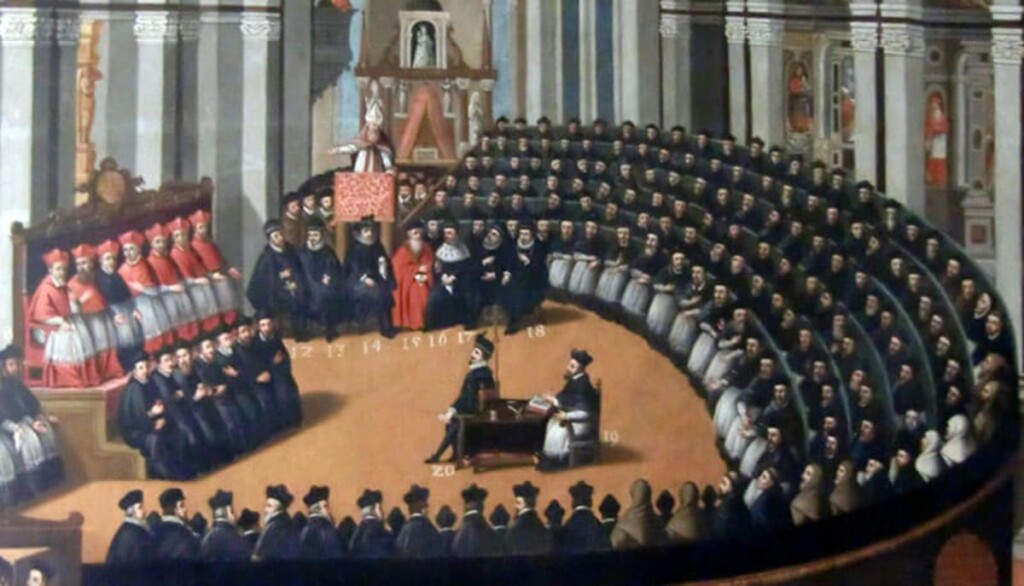
The Council of Trent, which convened for the first time in December 1545 and would not close its final session until 1563, was less a theological debate than a war council. Eighteen years of deliberation produced not concession but consolidation — the doctrine of justification hardened against Protestant notions of faith alone, the authority of tradition reaffirmed against Scripture alone, the seven sacraments defended as the irreplaceable machinery of grace. But what makes Trent remarkable is not what it said about God. It is what it said about control. The Church emerged from those sessions with a bureaucratic architecture for governing belief that had no precedent in its own history. Every bishop would reside in his diocese. Every priest would be trained in a seminary. Every sermon would be accountable to a chain of authority that ran unbroken to Rome.
Three years before Trent even opened, in 1542, Pope Paul III had already moved on a different front. The Roman Inquisition — reorganized, centralized, and given the formal title of the Supreme Sacred Congregation of the Roman and Universal Inquisition — was designed to do what local tribunals had done haphazardly for centuries, now with systematic efficiency. This was no longer about hunting heretics at the margins. This was about making heterodox thought structurally impossible at the center. The Index Librorum Prohibitorum, first published in 1559 under Paul IV, extended that logic into the domain of reading itself. To control what a person reads is to control the grammar of their inner life, the vocabulary available to their doubt.
And then there were the Jesuits. Ignatius of Loyola received papal approval for his Society of Jesus in 1540, five years before Trent convened, and what he had founded was something the Church had never quite possessed before: an intellectual militia. Not monks retreating from the world, but men trained to enter it — universities, courts, confessionals, the drawing rooms of princes, the classrooms of children. The Spiritual Exercises, Loyola’s manual of interior navigation, asked the practitioner to imagine hell with sensory precision, to see its fires, smell its sulfur, feel its heat. This was not metaphor. This was a technology of conscience, designed to make the inner life itself a theater of submission. By the end of the sixteenth century, the Jesuits operated over two hundred colleges across Europe and had planted missions from Japan to Brazil. The reconquest was global.
What is easy to miss, reading this as a sequence of institutional dates, is the anthropological ambition underneath it all. The Protestant Reformation had, whatever its failures, proposed something genuinely radical: that the individual stood alone before God, that no priest, no sacrament, no hierarchy mediated that encounter. The Counter-Reformation’s answer was not to ignore this claim but to colonize it. Yes, you have an interior life. Yes, your conscience matters. Now let us tell you, in exhaustive detail, what your conscience should contain. The confessional became not a place of relief but a place of audit. The examination of conscience, practiced daily, weekly, before every communion, turned the self into a surveillance subject — not watched from outside, but trained to watch itself, to report to an authority that had moved indoors.
Michel Foucault would write, centuries later in Discipline and Punish, about how modern power operates not through spectacle but through internalization. He was describing the nineteenth century. He could have been describing Trent.

The Art of Beautiful Control: Baroque as Propaganda
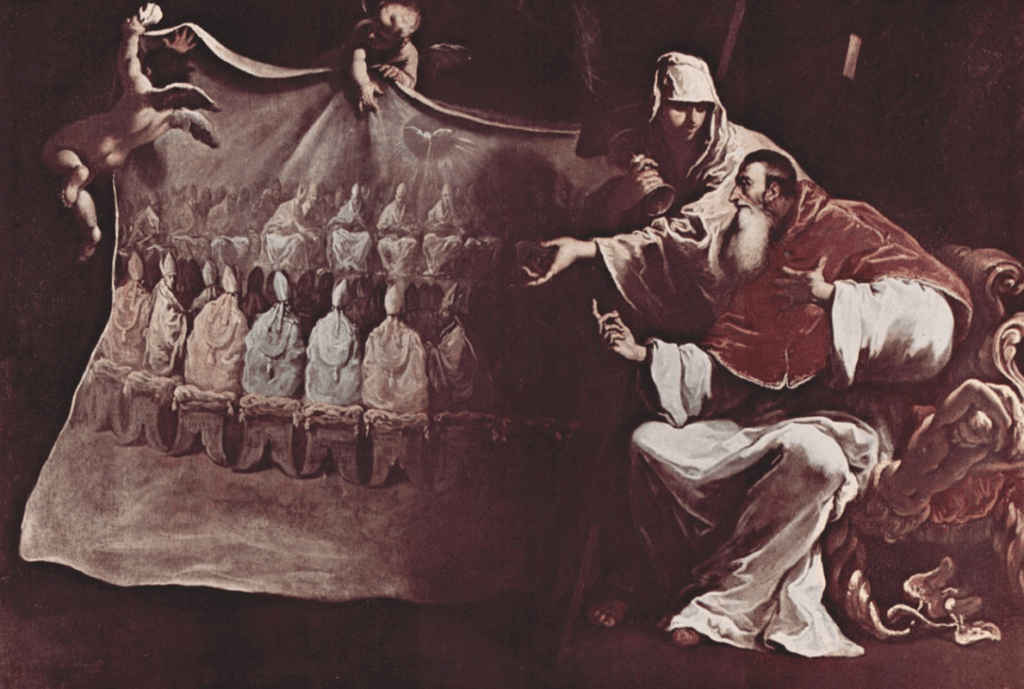
You walk into the building and something happens to your body before your mind catches up. The ceiling pulls your eyes upward against your will. The columns are too wide, the light falls at an angle that seems designed rather than natural, the gold catches it in ways that feel almost predatory. You meant to think clearly in here. You meant to ask a question, hold a position, remain yourself. Instead you find your shoulders dropping, your breath slowing, your voice — if you speak at all — coming out softer than you intended. You feel, without anyone having told you to feel it, small. And then, strangely, grateful for your smallness. As if the architecture has already answered the question you hadn’t yet asked.
This is not an accident. This is a program.
The Baroque did not emerge from a surplus of creative energy looking for expression. It emerged from a deficit of theological authority looking for enforcement. After the Council of Trent concluded in 1563, the Catholic Church sat with a set of doctrinal clarifications that needed to reach people who could not be argued into submission — people who had already heard Luther, who had already tasted the idea that they might read scripture themselves, interpret themselves, save themselves. Argument had failed. Spectacle would have to succeed where logic could not.
Michel Foucault, writing in Discipline and Punish in 1975, described how power inscribes itself not through brute force but through the organization of space, visibility, and sensation. He was writing about prisons and hospitals and schools, but he was also, without naming it, writing about Baroque churches. The disciplinary gaze operates through architecture as much as through surveillance. The body placed inside a correctly designed space begins to discipline itself. It straightens. It quiets. It orients toward the prescribed focal point. No guard is needed when the room itself commands.
Caravaggio understood this viscerally before anyone theorized it. His canvases from the late 1590s onward take sacred figures and drench them in physical reality — the feet of pilgrims are dirty, the Virgin’s body has weight and mortality, the light comes not from heaven but from somewhere just above the viewer’s left shoulder, theatrical and sourceful and slightly violent. This was not realism for realism’s sake. It was an emotional technology designed to collapse the distance between the miraculous and the viewer’s own body. You could not remain intellectually detached from a Caravaggio. It reached through your eyes and grabbed something biological. That was the Counter-Reformation method in paint: not argument, sensation. Not theology, experience.
Bernini perfected the same logic in three dimensions. The Ecstasy of Saint Teresa, completed in 1652, stages divine rapture as something so physically overwhelming that the distinction between spiritual transport and erotic surrender becomes genuinely, deliberately unstable. Golden rays descend like a stage set. The marble breathes. The saint’s face reads as agony and pleasure simultaneously. And it sits inside a chapel where the design ensures that you, the viewer, are always slightly below, always looking slightly upward, always arranged in the posture of a supplicant whether you intended to be one or not. The space has already decided what you are before you arrive at any conscious choice.
This is what Foucault meant by power’s aesthetic dimension — the way authority translates itself into environments that produce docile subjects not through coercion but through beauty, overwhelm, and the seduction of feeling known, contained, held by something larger. The Baroque church does not threaten you. It embraces you so completely that resistance begins to feel not only futile but somehow ungrateful, like arguing with a parent whose arms are already around you.
The genius of it is that you leave feeling elevated. You entered small and you leave having touched enormity. That the enormity was designed specifically to require your smallness — that part tends not to make it into the memory.
Interiority Under Surveillance: The Invention of the Examined Soul
You are rehearsing a feeling you were told to have. Somewhere between the moment you decided something and the moment you named it, a gap opened — and in that gap, you cannot tell anymore whether the want was yours or whether it was placed there, carefully, years ago, like a seed in soil that believed itself wild. This is not a modern confusion. It was engineered.
The Counter-Reformation’s most enduring achievement was not the Index of Forbidden Books, first formalized in 1559 under Paul IV, nor the reorganized Inquisition, nor even the spectacular machinery of missionary expansion. It was something quieter and far more durable: the colonization of interiority itself. The Church did not merely want obedient bodies. It wanted souls that policed themselves, desires that confessed voluntarily, consciences that had so thoroughly internalized the architecture of sin and grace that external surveillance became largely redundant. Michel de Certeau, in The Mystic Fable published in 1982, traced with surgical precision how the sixteenth and seventeenth centuries witnessed the invention of a new kind of interior space — one that appeared to belong to the individual but was in fact structured by institutional grammars. The self that emerged from this period was not liberated into interiority. It was administered there.
The spiritual exercises designed in the 1530s and elaborated across Jesuit pedagogy throughout the century were not invitations to freedom of conscience. They were techniques. Ignatius of Loyola understood, with a sophistication that most secular psychologists would not match until three hundred years later, that the most effective discipline is the discipline the subject performs on itself. You do not need a guard if you have internalized the guard’s gaze. You do not need a confessor in the room if confession has become the structure of your inner monologue. De Certeau saw in this a fundamental transformation: mystical experience, once the unruly excess of religious life, was captured, codified, and converted into a managed practice of self-examination. The soul became a text to be read, corrected, submitted.
A man sits in silence — it could be the silence after prayer, it could be the silence after an argument with someone he loved, it could be the silence of a room in which he has just said something he did not quite mean. He is trying to locate what he actually feels. But every time he reaches for the feeling, he finds instead a name for it that was given to him, a judgment already attached, a category already waiting. He cannot get behind the categories. He does not know if his remorse is genuine grief or the performance of grief that was rewarded in him since childhood. He does not know if his devotion is love or the fear of being without the identity that devotion provides. The vertigo is not psychological weakness. It is the result of a historical process that taught him to experience himself through a vocabulary he did not choose.
This is what the examined soul actually means when you strip it of its consoling philosophical gloss. Socrates’ examined life was supposed to belong to the one who examined it. The Counter-Reformation examination belonged, structurally, to the institution. Your scruples, your temptations, your most private movements of feeling — all of it was material to be rendered legible, confessed, absolved, redirected. The confession booth was not a space of release. It was an information architecture. And once the architecture was inside you, the booth became unnecessary.
The genius of it — if genius is the right word for something so thorough in its violence — is that it feels like freedom. It feels like depth. You believe you are examining yourself. You believe the discomfort is authenticity. You believe the guilt is conscience. And perhaps it is. Perhaps it is also something else entirely, something that was handed to you before you had the words to refuse it, or even to ask what you were being given.
The Index and the Algorithm: Forbidden Knowledge Across Centuries
You find a book on a shelf you were never supposed to reach. Not forbidden by law, not locked behind glass — just quietly absent from every syllabus you were handed, every library display, every recommendation algorithm that learned your preferences from the preferences you were already allowed to have. You open it, and something strange happens: you recognize it. Not as new information but as the articulation of something you already carried without language, a thought you had been circling for years without being able to name. The prohibition had worked perfectly. It had not prevented the thought. It had simply ensured you would arrive at it exhausted, alone, decades late.
This is the precise mechanism the Council of Trent understood when it commissioned the first official Index Librorum Prohibitorum in 1559. The logic was never simply to prevent dangerous ideas from existing. Ideas are ungovernable that way. The logic was to ensure that anyone who arrived at them would do so without community, without the accumulated weight of prior thinkers, without the sense that the thought was legitimate enough to be shared in daylight. Copernicus appeared on the Index in 1616, not at the moment his heliocentric model was published in 1543 but at the moment it began to gain serious scientific traction. Galileo’s Dialogo followed in 1633, the same year as his trial. Erasmus, Montaigne, Descartes — men whose crime was not atheism but the more dangerous act of reasoning publicly about things the institution preferred to manage privately. By 1948, when the Index was last substantially updated before its formal abolition in 1966, it contained over four thousand titles. The number is almost irrelevant. What matters is the structure.
Hannah Arendt, writing in The Origins of Totalitarianism in 1951, identified something she called the loneliness of the atomized individual — the condition produced not by direct violence but by the systematic dismantling of shared intellectual reference. When you cannot trust what others know, when knowledge itself becomes suspect depending on its source, the result is not ignorance but something worse: a population that cannot collectively verify reality. Arendt was writing about twentieth-century totalitarianism, but she was describing a logic that the Counter-Reformation had already practiced at institutional scale. The Index did not need to silence every copy of Montaigne's Essays. It needed only to ensure that reading Montaigne marked you as a certain kind of person — suspect, marginal, already outside the community of the faithful.
He sat in a room where someone had left papers he was not supposed to see. Not stolen, not smuggled — simply there, in the way that forbidden things sometimes surface when an institution becomes careless about its own borders. He read them and felt something reorganize inside him, not a conversion but a recognition, as though a map had finally been placed over a territory he had been walking blindly for years. The disorientation was not from encountering something foreign. It was from encountering something so familiar it raised the question of how the gap had been maintained for so long, and who had benefited from the maintenance.
The architecture of that gap is what connects the Index to the content moderation policies of platforms that now govern the information diet of roughly five billion internet users. The mechanism has been refined, the theology replaced with terms of service, the Inquisitors replaced with machine-learning models trained on prior decisions — but Arendt’s structure holds. What is suppressed shapes consciousness as surely as what is permitted, often more so, because suppression is invisible while permission wears the costume of neutrality. The algorithm that never shows you a certain kind of argument, the search result that buries a certain kind of source beneath seventeen more comfortable ones — these do not announce themselves as censorship. They present themselves as relevance.
And relevance, as the Council of Trent knew in 1545, is the most powerful editor there has ever been.
A vision curated by a filmmaker, not an algorithm
In this video I explain our vision
The Jesuit Paradox: Intelligence in the Service of Obedience
There is a kind of person you have certainly met — possibly been — who is extraordinarily capable and yet somehow never quite disturbs anything. They produce brilliant work, analyze with precision, anticipate objections before they are raised, and then, at the decisive moment, fold perfectly into whatever the institution requires. Their intelligence is real. Their submission is also real. These two facts do not contradict each other. They are, in fact, the same fact.
The Society of Jesus, founded by Ignatius of Loyola in 1540 and formally constituted through papal bull that same year, understood this before any modern human resources department dreamed it into existence. The Jesuits produced mathematicians, astronomers, linguists, and ethnographers of astonishing sophistication. By the early seventeenth century they were operating in Japan, China, India, and the Americas, conducting scientific observations, learning indigenous languages to a degree of fluency that no colonial administrator could match, engaging with Confucian philosophy in ways that remain intellectually serious three centuries later. Matteo Ricci presented himself at the court of the Wanli Emperor not as a missionary in vestments but as a European scholar, speaking Mandarin, bringing clocks and mathematical instruments, earning genuine intellectual respect. The brilliance was not a mask. It was a deployment.
And yet the Jesuit Constitutions are unambiguous on what all of this brilliance ultimately served. Ignatius described the ideal obedience in terms that have become infamous precisely because they are so accurate: the member must obey his superior as a corpse obeys those who move it, as a staff obeys the hand that wields it. Perinde ac cadaver. Like a cadaver. This was not metaphorical excess. It was structural doctrine. The intellect was to be sharpened to maximum capacity and then placed, fully functioning, entirely at the disposal of the hierarchical will. You were to think better than anyone around you and then surrender the conclusions.
What makes this historically significant — and personally uncomfortable — is not that it was imposed by violence or fear, but that it was embraced as spiritual perfection. The surrender of autonomous judgment was understood as the highest form of self-realization available within the order. Byung-Chul Han, writing in “The Transparency Society” published in 2012, describes a contemporary version of this dynamic with clinical precision: the subject of late capitalism does not submit to external compulsion but internalizes the demand for performance so completely that exploitation and self-realization become indistinguishable. The Jesuit who voluntarily became a cadaver and the contemporary professional who voluntarily dismantles every boundary between their identity and their institutional role are operating from the same architectural blueprint, separated by four centuries and identical in structure.
You have probably experienced the specific cognitive sensation Han is pointing toward — the moment when you have understood something clearly, seen its implications fully, and then chosen not to follow the thought to its natural conclusion because the conclusion would cost you something belonging. Not security in the crude sense. Something more refined: the sense of being recognized, of functioning within a system that rewards your excellence precisely as long as your excellence does not threaten the system. The Jesuit novice learning Greek and theology simultaneously, being molded into an instrument of extraordinary refinement, was offered the same implicit contract.
The paradox deepens when you recognize that the intelligence cultivated under these conditions was genuine. The astronomical observations were accurate. The linguistic analyses were rigorous. Ricci’s map of the world, presented to Chinese scholars in 1602, was scientifically sound. The cadaver, in other words, produced real knowledge. Which raises the question — the one the history textbooks never quite ask — of what that knowledge was actually for, and who decided, and whether the brilliant mind that generated it ever truly knew the difference between its own thought and the thought it had been shaped to think.
What the Body Remembers: Shame, Guilt, and the Civilizing of Desire
You already know the feeling. You reach for something — food, touch, a moment of uncomplicated pleasure — and something intervenes before your hand arrives. Not a voice exactly. A contraction. A small interior flinching that precedes the act and already judges it. You did not learn this yesterday. You learned it so long ago that it has become indistinguishable from instinct, which is precisely what it was designed to become.
Norbert Elias, writing in 1939 in “The Civilizing Process,” traced one of the most consequential transformations in Western psychological history: the migration of shame from the outside to the inside. Before the sixteenth century, bodily regulation was primarily enforced through external spectacle — public punishment, communal surveillance, visible humiliation. What changed between roughly 1550 and 1650 was not that people became more disciplined. What changed was where the discipline lived. It moved inward, colonizing the nervous system, becoming what Elias called the “second nature” of the civilized self. The Counter-Reformation did not invent this process, but it systematized it with extraordinary theological precision, weaponizing the confessional as a technology of interior surveillance so sophisticated that the penitent became simultaneously the sinner and the inquisitor.
Think of a man who cannot sit down to eat without arranging the implements on the table in a sequence that resembles, just barely, a rite. He does not know why. He would be embarrassed to explain it. The pause before eating, the slight downcast of the eyes — it is not prayer, or not only prayer. It is the body performing its own smallness before pleasure is permitted to arrive. Elias would recognize it immediately. The table manners of modernity, he argued, are not signs of refinement but scars of regulation, the physical residue of centuries of shame internalized until it feels like decorum.
And then there is the body that flinches. Not from a blow that is coming, but from one that is not — from a hand extended in tenderness, from proximity itself. The recoil happens in the fraction of a second before thought, which means it happens beneath thought, in the layer where culture has already made itself biological. Michel Foucault, in “The History of Sexuality,” published in 1976, described how the Catholic Church’s intensification of confession created an incitement to discourse around sex that paradoxically expanded its power by making it unspeakable — the more elaborately the forbidden was catalogued, the more completely it saturated consciousness. By the seventeenth century, the faithful were required to confess not just acts but desires, not just deeds but the movement of imagination. The interior became a crime scene perpetually under investigation.
Pleasure contaminated by its own apology is the most precise psychological product of this system. You have felt it. The moment of joy that arrives already apologizing for itself, already beginning its retraction. A woman laughs freely and then, in the same breath, covers her mouth. Not because anyone told her to. Because somewhere in the vast unconscious archive of her formation, someone did. The hand over the mouth is not vanity. It is centuries of training in the diminishment of the self before it becomes too visible, too loud, too satisfied with its own existence.
Elias dated the tightening of these norms with considerable historical precision: the proliferation of conduct manuals across Catholic Europe after 1560, the simultaneous expansion of Jesuit educational institutions enrolling tens of thousands of students across France, Italy, and the Iberian Peninsula by 1600, each one a laboratory for the transformation of shame into self-governance. What the Inquisition enforced through terror, the classroom enforced through internalization. The result was identical: a self that monitors itself before anyone else has the chance to monitor it.
The genius of the system, if genius is the right word for something so quietly devastating, is that it eventually requires no enforcement at all.
The Heretic You Swallowed: Dissent That Never Reached the Surface
There is a thought you almost had. You felt it forming — something about the way things are arranged, the way certain questions stay unasked in certain rooms, the way you nodded when you wanted to speak — and then something intervened. Not a person. Not a rule. Something older and less visible than either. The thought dissolved before it became language, and you moved on, and you did not notice what had just happened.
Ernst Bloch called it non-contemporaneity — the way historical structures do not disappear when the historical moment that produced them passes, but instead migrate inward, settling into the nervous system of people who were born centuries after their origin and who believe themselves to be entirely free. The past does not recede cleanly. It colonizes the present from inside, wearing the face of intuition, of common sense, of that instinctive hesitation before the sentence that would have cost you something. Bloch was writing in 1932, watching how residues of feudal psychology made ordinary people available to fascism, but the mechanism he identified was older and more universal than any single political catastrophe. The residue is always there. You are never only yourself.
Giordano Bruno was burned in the Campo de’ Fiori in Rome on February 17, 1600. Not for being wrong. For refusing to agree that he was. He had spent eight years in the prisons of the Inquisition, and at the end he did not recant. What the Counter-Reformation could not tolerate about Bruno was not primarily his cosmology — the infinite universe, the plurality of worlds, the displacement of the earth from its throne at the center of everything. What it could not tolerate was the fact that he kept thinking. That he treated thought as something that belonged to him rather than to the institution that reserved the right to validate it. He was not burned for heresy in the technical sense. He was burned for the posture of a mind that would not ask permission to continue.
You have not been burned. But there is a fire you have never approached, and you know which direction it is in, even now.
A man sits across from his father at a dinner table that has hosted this conversation, in some version, for thirty years. He knows what he believes. He has known it for longer than he can trace. He also knows — with a precision that requires no words — exactly where the edge of the sayable is in this room, on this evening, with this silence already organized around him before he arrived. He does not cross the edge. He tells himself it is not worth it, that the timing is wrong, that some other moment will be better. There is no other moment. There never was. The institution is the room, and the room is inside him, and the Inquisition requires no building when it has already completed its work.
This is what the Counter-Reformation ultimately produced that no document records: a trained incompleteness. A pause that was rehearsed over generations until it stopped feeling like restraint and started feeling like wisdom, like maturity, like knowing when to speak. The reformation of the self that the Church demanded in the sixteenth century — the examined conscience, the confessed interior, the surveilled soul — did not end with the Counter-Reformation. It was simply internalized so thoroughly that the external architecture became unnecessary. The walls came down because the walls had already been built somewhere else.
And so the question is not whether you believe in the institution that first installed the hesitation. You probably do not. The question is whether the hesitation is still there anyway, older than your beliefs, faster than your intentions, stepping in front of the thought before the thought can finish forming — and whether what you call your voice is sometimes, in the pause before you speak, still someone else’s silence.
⛪ Faith, Reform, and the Arts of Belief
The Counter-Reformation reshaped not only theology but the entire visual, literary, and spiritual culture of early modern Europe. To fully grasp its consequences, it helps to trace the broader currents of art, mysticism, and humanist thought that it sought to discipline or transform. The articles below illuminate the world from which the Counter-Reformation emerged and the legacies it left behind.
Titian: Life and Works
Titian stood at the very center of the sixteenth-century Catholic world, producing altarpieces and devotional works that embodied the spiritual gravitas the Church demanded in response to Protestant challenge. His mastery of color and his ability to render sacred subjects with sensuous immediacy made him the preferred painter of popes and cardinals alike. Understanding Titian’s career is essential to understanding how the Counter-Reformation harnessed artistic genius in the service of renewed Catholic faith.
GO TO THE SELECTION: Titian: Life and Works
Giordano Bruno and the Hermetic Tradition
Giordano Bruno represents perhaps the most dramatic collision between free thought and Counter-Reformation orthodoxy, ultimately paying for his ideas with his life at the stake in Rome in 1600. His embrace of the Hermetic tradition and his cosmological speculations placed him in direct confrontation with an institution determined to reassert doctrinal control. Bruno’s fate became a defining symbol of the tension between Renaissance intellectual freedom and the disciplinary machinery of the post-Tridentine Church.
GO TO THE SELECTION: Giordano Bruno and the Hermetic Tradition
The Spanish Golden Age: Literature and Culture
The Spanish Golden Age flourished in the very heartland of Counter-Reformation culture, producing a literature saturated with themes of honor, faith, and the drama of salvation. The Spanish Crown’s close alliance with the papacy meant that writers like Lope de Vega and Calderón operated within a cultural atmosphere deeply shaped by Tridentine piety and Jesuit aesthetics. Exploring this literary world reveals how Counter-Reformation values were transformed into enduring artistic achievements.
GO TO THE SELECTION: The Spanish Golden Age: Literature and Culture
Mexican Religious Syncretism: History and Meaning
Mexican religious syncretism offers a fascinating case study in how Counter-Reformation missionary zeal encountered and was in turn transformed by indigenous spiritual traditions in the New World. The evangelical campaigns of Franciscans, Dominicans, and Jesuits carried Tridentine Catholicism across the Atlantic, yet the result was a hybrid religiosity that defied simple doctrinal categories. This article illuminates one of the most complex and creative cultural consequences of the Counter-Reformation’s global reach.
GO TO THE SELECTION: Mexican Religious Syncretism: History and Meaning
Discover Independent Cinema on Indiecinema
If the interplay of faith, power, and artistic rebellion stirs your curiosity, Indiecinema’s streaming catalog offers a wealth of independent and documentary films that explore history, spirituality, and cultural transformation from unexpected angles. From meditative explorations of religious heritage to bold reinterpretations of the past, there is always a film waiting to deepen your perspective. Visit Indiecinema and let the journey continue on screen.
👉 EXPLORE THE CATALOG: Watch Indie Films in Streaming
A vision curated by a filmmaker, not an algorithm
In this video I explain our vision

