
The Man Who Kept Missing His Train
The train is already moving when you reach the bottom of the escalator. You can see it through the glass partition, the doors sliding shut with that specific finality that belongs only to missed departures, and for a moment you stand completely still while the platform fills with the sound of your own breathing. It has happened before. It will happen again. And somewhere in the gap between those two certainties — the memory of the last time and the anticipation of the next — the present moment dissolves entirely, and you are left standing in a place that feels less like a location than like a recurring dream you cannot wake yourself out of.

Pyotr Demianovich Ouspensky knew this feeling with the precision of someone who had spent years trying to map it mathematically. He was not, in the beginning, what anyone would call a mystic. He was a journalist and a mathematician working in Moscow and St. Petersburg in the first decade of the twentieth century, a man trained to think in structures and dimensions, fascinated by geometry the way other men are fascinated by gambling or war. When he published Tertium Organum in 1909 — he was thirty-one years old — he was not offering a spiritual manual. He was making a geometric argument about the prison of ordinary human consciousness, and the argument was devastatingly simple: we experience time the way a creature with no capacity for spatial vision experiences space. We move through it blindly, sensing only the immediate surface, mistaking the inch directly ahead for the totality of what exists.
The worm in the soil does not know it is inside a garden. It knows pressure, moisture, resistance, the fact of forward motion. It does not know the shape of the thing it is moving through. Ouspensky’s proposition was that human beings, despite every cultural achievement we have credited to ourselves, are epistemologically in the same position. We feel the pressure of each moment, the resistance of each obstacle, the fact of our forward movement through days and years — but we do not see the structure we are moving through. We cannot see our own lives as shapes. We experience them only as sequences.
This is not a poetic observation. It was meant as a literal description of a geometric deficiency. In the same way that a two-dimensional being could not perceive depth no matter how sophisticated its other faculties became, Ouspensky argued that the ordinary human mind was structurally incapable of perceiving the dimension in which time itself was embedded. There was a fourth dimension. Not a metaphor, not a spiritual consolation prize — an actual geometric reality that consciousness, in its habitual state, could not access. The man on the platform watching the train pull away is not simply unlucky or disorganized. He is, in Ouspensky’s framework, enacting the fundamental tragedy of his condition: he is experiencing his life as a series of missed connections without ever being able to rise to a vantage point from which the pattern becomes visible.
What makes this unbearable — and Ouspensky understood it as unbearable long before he found language for it — is the suspicion that the pattern is not random. That the missing of trains, the repetition of arguments, the return again and again to the same crossroads and the same wrong turning, is not accident but structure. Henri Bergson, whose Creative Evolution appeared in 1907 just two years before Tertium Organum, had already suggested that human intelligence was an instrument evolved for practical manipulation of matter, not for perceiving the flowing continuity of lived time. But Ouspensky wanted something more vertiginous than Bergson’s philosophical melancholy. He wanted to know whether the repetition was eternal. Whether the life being sleepwalked through was not leading somewhere new but circling back, always, to the same platform, the same departing train, the same hollow sound of doors closing on another missed beginning.
The question he could not stop asking was not how to wake up. It was whether, in the life already being lived mechanically and mostly unconsciously, there was still time to ask the question at all.
The Geometry of Waking Up
There is a moment that most people have had and almost no one has kept. You are sitting somewhere ordinary — a café, a train compartment, a kitchen at noon — and for a few seconds the room reorganizes itself around you without moving. Nothing changes. The cup is still on the table. The other people are still talking. But something in the geometry of the scene shifts, and you are suddenly aware not of the objects but of the distances between them, the invisible architecture of relation that holds the whole arrangement in place like a hidden scaffolding. You feel, briefly and without any vocabulary for it, that you are seeing more than you usually see. Then someone drops a fork, or your phone buzzes, and you are returned to the ordinary — slightly embarrassed, as though you had nearly confessed something.
Ouspensky would not have called that mysticism. He would have called it geometry.
His intellectual formation was built on a precise foundation that most of his readers overlook because they come to him searching for the esoteric and leave carrying only the exotic. Charles Howard Hinton, the British mathematician whose 1904 work on the fourth dimension proposed that spatial dimensions beyond the three we inhabit are not theoretical abstractions but perceptual possibilities, gave Ouspensky the conceptual architecture he needed. Hinton’s argument was straightforward in its audacity: a being limited to two dimensions could not perceive the third, but the third would still exert effects on the plane — shadows, cross-sections, pressures from above. The fourth dimension, Hinton insisted, is not elsewhere. It is here, pressing through the tissue of the three-dimensional world in ways we register without recognizing. Henri Poincaré, whose topology of continuous transformation asked what happens to shape when the rules of rigid geometry are suspended, gave Ouspensky something adjacent: the idea that the mind’s mapping of space is not a fixed mirror of reality but an active, plastic interpretation, capable of reorganizing itself around different centers of perception.
What Ouspensky did with these materials was neither physics nor philosophy in any conventional sense. In Tertium Organum, published in Russian in 1912, he argued that the higher dimensions of space are not waiting to be discovered by instruments. They are the structural reality of states of awareness that ordinary waking life suppresses. The man in the café, the woman on the train platform, the child staring at a wall for no reason anyone can name — these are not people having mystical experiences. They are people accidentally perceiving the relations that are always there, the fourth-dimensional scaffolding that three-dimensional perception normally edits out in the interest of function and survival.
William James had already mapped the phenomenology of this territory from a different angle. In the Varieties of Religious Experience in 1902, James identified what he called the noetic quality of certain altered states — the stubborn conviction, felt by the person undergoing them, that something has been genuinely known rather than merely felt. This is the quality that separates the moment in the café from ordinary daydreaming. You do not return from it thinking you imagined something beautiful. You return from it thinking, with an unease you cannot justify, that you saw something true. James took this conviction seriously not as evidence of divinity but as evidence of something stranger: that consciousness has access to orders of knowledge that the waking intellect cannot reach by logical sequence. The feeling of knowing is not identical to knowing, but James refused to dismiss it as delusion simply because it resisted discursive verification.
Ouspensky pushed this further than James was prepared to go. If the noetic quality is real — if these moments genuinely deliver information about the structure of experience — then ordinary waking consciousness is not the summit of perception. It is a specific mode, with specific limits, chosen by the nervous system for practical navigation of a world that may be structurally richer than any three-dimensional accounting of it can capture.
Which raises the question that Ouspensky never stopped living inside: if this is not the fullest version of waking, what would the fullest version require?

Gurdjieff’s Trap and the Seduction of the System
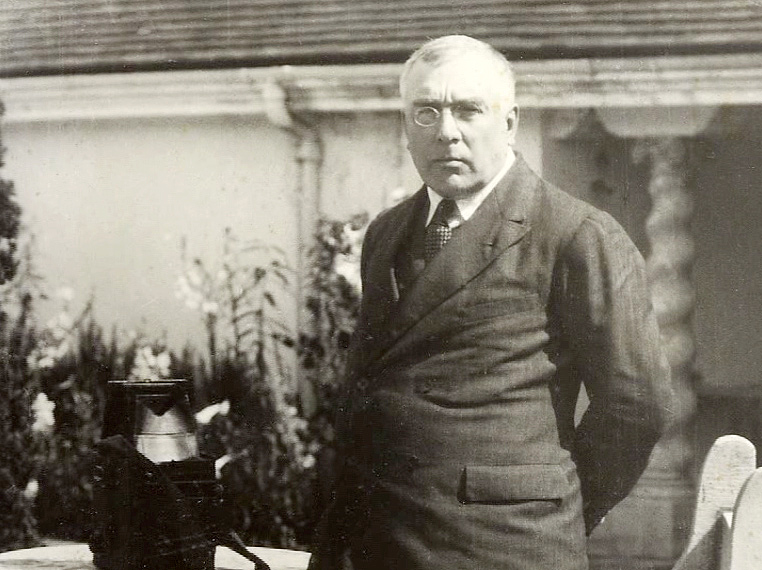
There is a particular kind of conversation that only reveals its nature after it ends. You walk away feeling enlarged, clarified, perhaps even transformed, and it takes hours, sometimes days, before you notice that everything you said was somehow redirected back toward confirming what the other person already knew. You contributed nothing. You were a mirror held up to demonstrate someone else’s depth.
Ouspensky walked into that kind of conversation in Moscow in 1915, and he would not fully walk out of it for nearly three decades.
George Gurdjieff was not a system. He was something more unsettling — a man who had metabolized a system so completely that he and it had become indistinguishable. When Ouspensky first encountered him, sitting in a noisy café on the Tverskaya, what struck him was not doctrine but presence. Here was someone who seemed to live at a different speed from ordinary people, as though he had access to a register of reality that others merely theorized about. For a man like Ouspensky, who had spent years constructing intellectual architectures to house his intuitions about consciousness and time, the encounter was not merely interesting. It was gravitational.
Hannah Arendt, writing about the structure of charismatic authority in her 1951 masterwork on totalitarianism, identified something that reaches far beyond the political: the most effective systems of domination do not operate through coercion but through the subject’s own need. The disciple does not submit. The disciple recognizes. And that act of recognition, that sense of finally being understood by someone who sees what you have always suspected to be true, produces a consent that no external force could have manufactured. The hunger for meaning, Arendt understood, is not a weakness to be exploited from outside but a door the disciple opens from within.
Ouspensky opened it completely. For years he documented Gurdjieff’s teachings with the scrupulous attention of a scientist recording phenomena that exceeded his current theoretical framework. What would eventually become In Search of the Miraculous, published only after Ouspensky’s death in 1949, reads at times like the most lucid introduction to a body of ideas ever written by someone who had already, somewhere in his nervous system, begun to suspect those ideas were being used against him. The paradox of the book is almost unbearable: the clearer Ouspensky’s prose, the more visible the trap.
There is a scene that stays with you, from a story that could belong to anyone who has apprenticed themselves to brilliance. A student sits across from his teacher, and something in the conversation shifts almost imperceptibly. The teacher is explaining something about presence, about full attention, about the difference between mechanical reaction and genuine response. The explanation is extraordinary. And then the teacher says something contemptuous, casually, almost as an aside, and the student laughs. Not because it was funny. Because the teacher laughed first. Later, alone, the student replays the moment and realizes he cannot locate the boundary between admiring the mind and absorbing the cruelty that lived inside it. They had arrived as a package. He had accepted the whole shipment without inspection.
This is what makes Gurdjieff’s teaching so particularly elegant as a trap. The Fourth Way, as he called it, was explicitly a path for people already awake enough to distrust ordinary religion, ordinary society, ordinary sleep. It was a system designed for the skeptical, the perceptive, the intellectually rigorous. It offered them a higher skepticism, a more refined perception, a more demanding rigor. And in doing so, it addressed itself precisely to the part of the person least likely to surrender, and most likely to call surrender by another name.
Ouspensky eventually broke from Gurdjieff, though the rupture was never clean, never final in the way clean breaks are. It dragged through years, cycling through distances and renewed contacts, until separation became the dominant mode. The question that his break raises is not whether Gurdjieff was a fraud. The question is whether the most awake people — the ones most sensitized to the mechanical repetitions of ordinary life — carry within that very sensitivity a particular vulnerability to a different kind of machine, one elegant enough to feel like freedom.
Eternal Recurrence and the Horror of the Familiar
![P.D.Ouspensky | Founding Father of The Fourth Way [2]](https://blog.indiecinema.co/wp-content/plugins/wp-youtube-lyte/lyteCache.php?origThumbUrl=https%3A%2F%2Fi.ytimg.com%2Fvi%2F1DzLd5WJc3o%2F0.jpg)
She knows the argument before it begins. Not in the vague way one senses a storm gathering from the color of the sky, but precisely — she knows which word will detonate first, knows the particular silence that will follow, knows the exact moment when he will push back his chair and stand near the window as though the street below contains some answer neither of them can find. It is a Wednesday evening in November. It has been a Wednesday evening in November for five years. The words are so worn from use they no longer carry meaning, only weight. At some point during the exchange she stops hearing the content entirely and begins instead to watch the mechanics, the way one watches a machine one has studied too long to find interesting but cannot stop observing. This has happened before. Not something like this. This.
Ouspensky arrived at this horror through mathematics before he arrived at it through lived experience, which is perhaps why his formulation of it is more ruthless than Nietzsche’s. Nietzsche offered eternal recurrence in 1882, in The Gay Science, as a thought experiment — a psychological test, a weight to be placed on the will to see whether the will could bear it. The demon whispers that you must live this life again and again, innumerable times, and the question is whether you can say yes to that, whether the joy of affirmation can survive such a sentence. But Nietzsche did not mean it literally. He meant it as a purification of desire. Ouspensky, writing in A New Model of the Universe in 1931, collapsed the metaphor entirely. For him, recurrence was not a thought experiment but a structural feature of time itself — a cosmological architecture that human beings were too limited to perceive, in the same way a creature living on a flat surface cannot perceive the sphere it is moving across.
The argument for this rested on his engagement with J.W. Dunne’s An Experiment with Time, published in 1927, which attempted to demonstrate through the careful recording of dreams that time is not a single linear dimension but a nested series — time one, within which events occur, and time two, within which time one is observed, and so on toward an infinite regress of temporal observers. Dunne’s framework was scientific in ambition if not in rigor, and what Ouspensky extracted from it was the possibility that the self persists across dimensions of time in ways the waking consciousness cannot access. If time is not a line but a structure with multiple axes, then the death that feels like an ending is simply a boundary within a larger geometry. You return. Not to a new life with different choices but to this one, with these choices already made, these words already spoken, this particular November argument already scripted in every syllable.
The terror this produces is not the terror of death. It is something more suffocating — the terror of perfect familiarity. Mircea Eliade, writing in The Myth of the Eternal Return in 1949, traced this specific dread back to the deepest structures of archaic consciousness. Pre-modern peoples did not simply accept cyclical time; they developed elaborate ritual architectures to transform it, to make repetition sacred rather than merely mechanical. The eternal return of agricultural seasons, of celestial cycles, of the same hunger and the same harvest, was bearable only because myth converted repetition into participation in origin. Each new year was not merely a repetition of the last; it was a regeneration of the first year, the cosmogonic moment, the time before time became merely time. The horror was always present underneath the ritual. The ritual existed precisely because the horror was there.
What modernity did, Eliade understood, was dismantle the ritual framework while leaving the cyclical structure intact. The woman at the table on the Wednesday evening does not have a myth to metabolize her recurrence. She has only the recurrence itself, the word that detonates, the chair pushed back, the window, the street, the silence that follows in exactly the configuration it has always followed, pressing against her like a room with no new walls.
The Fourth Dimension as Self-Betrayal
There is a kind of person who knows exactly how grief should move through the body. They have studied it, mapped its phases, taught its mechanics to rooms full of students who left feeling seen and recalibrated. And then their mother dies and they stand at the graveside dry-eyed, not from strength but from a terrible absence, and they understand in that moment that the map they drew with such precision describes a country they have never actually entered.
Ouspensky spent the last years of his life drinking. Not philosophically, not as a romantic dissolution — drinking in the gray, administrative way of a man who has run out of interior weather. Those who were close to him in Surrey and later in Virginia Water after the Second World War described someone who had calcified around his own system, who ran his study groups with a rigidity that had long since crossed from discipline into control. Students were corrected sharply, publicly. Questions were fielded through a kind of intellectual customs office that decided, in advance, which inquiries were worth entertaining. The man who had written with such luminous openness about waking from mechanical sleep had become, in the governance of his own household of ideas, one of the most mechanical presences in the room.
And he knew it. That is the part that refuses to be tidied away. In 1947, not long before his death, Ouspensky told his students that he was abandoning the System — Gurdjieff’s system, which he had spent three decades transmitting with the devotion of a translator who believes more in the original text than in his own voice. He told them they must start again, from themselves, from scratch. It was an astonishing admission, the kind that should have cracked something open. But by then the drinking had thickened around him like scar tissue, and what might have been liberation arrived instead as a kind of exhausted surrender, indistinguishable from defeat.
Ernest Becker, writing in 1973 with the particular ferocity of a man who finished his manuscript while dying of cancer, argued that human civilization is most accurately understood as an elaborate structure built to manage the terror of self-awareness. The knowledge that we are mortal, embodied, limited — that knowledge is so unbearable that we construct what Becker called immortality projects: systems of meaning large enough to make the individual self feel like it participates in something that will outlast the body. Religion is one. Intellectual legacy is another. And the pursuit of higher consciousness, that luminous ambition to transcend the ordinary self, is among the most sophisticated variants — because it disguises the flight from mortality as a flight toward truth.
This is not a dismissal of Ouspensky. It is something sharper. Because Becker’s argument, when placed against the arc of that life, reveals a specific cruelty built into a certain kind of intellectual vocation. The man was not wrong about what he mapped. The fourth dimension he sought — that state in which time becomes spatial, in which past and future coexist as visible territory, in which consciousness expands beyond the cramped corridor of the present moment — is a genuine horizon of human experience. Others have touched it. He had perhaps touched it himself, briefly, in Moscow in 1916, in those experiments he recorded with the precision of a seismologist measuring tremors. But to touch something once and then spend forty years building a pedagogy around the touching of it, while the touching itself recedes — that is the specific catastrophe of the intellectual life when it substitutes system for experience.
The fourth dimension Ouspensky sought may have been, in the end, simply the freedom from the self he already was. That nervous, brilliant, rigidly logical self that needed the universe to be structured, that needed hierarchy and octaves and levels because randomness was not philosophically tolerable but emotionally catastrophic.
A vision curated by a filmmaker, not an algorithm
In this video I explain our vision
What the Worm Knows
The worm moves through soil it cannot see. It registers pressure, temperature, the faint chemical signature of what is ahead, and from these inputs constructs something that functions as a world. It does not know it is inside a garden. It does not know there is a garden. It does not know that above it, at a distance measurable in centimeters but unreachable in any conceptual sense, there is light falling on roses, and a person sitting at a table, and a cup going cold. The worm’s ignorance is not a failure. It is simply the shape of what it is. The tragedy, if there is one, is not the worm’s. It is the person at the table who has read seven books about the roses and still cannot smell them.
Ouspensky died on October 2, 1947, at Lyne Place in Surrey, a large country house that had become something between a retreat center and a monument to his own intellectual impasse. He had spent the final years of his life doing something that looked, to outside observers, like a slow dismantling. He had stopped teaching the System formally. He had told the people who had gathered around him, some of whom had organized their entire inner lives around his categories and his terminology, to abandon what they had learned. Not to refine it. Not to deepen it. To abandon it. Return to your own experience, he said, to the raw and unmediated fact of what you actually encounter. This was not humility performing itself. It was something closer to a man who had built a very precise instrument for measuring a thing, and in the final measurement realized the instrument was blocking the view.
Almost no one followed this instruction. They kept the system. They kept the vocabulary. They kept the elegant architecture of the Ray of Creation and the table of hydrogens and the enneagram as Ouspensky had transmitted it, which was already Gurdjieff’s enneagram filtered through Ouspensky’s mathematical mind, which was already something else before that, traveling backward through teachers whose names dissolve into conjecture. The students kept the map because they had forgotten, or perhaps never believed, that Ouspensky himself had finally said the territory could not be mapped.
There is something recognizable in what they did. You throw the book away. You have read it seven times, highlighted the same passages each time with a slightly different color of ink as if the color itself might unlock something new, argued with it in the margins until the margins are fuller than the text. And then one morning you throw it away, not in anger but in a kind of exhausted clarity, and you sit in the silence that follows. Nothing happens. You are not enlightened. You are not transformed. You are present to the specific and unremarkable quality of your own confusion, which turns out to have a texture, a temperature, something almost like a smell. And you sit with it because there is nothing else to do, and in that sitting there is something you cannot name, and the moment you reach for the name it is already gone.
Wittgenstein wrote, in the Tractatus Logico-Philosophicus, that whereof one cannot speak, thereof one must be silent. He meant it as a boundary, a line drawn around the sayable to protect it from contamination by the unsayable. But the sentence has always functioned as a problem rather than a solution, because the unsayable keeps pressing against the boundary from inside, and the silence it demands is not emptiness but a specific kind of fullness that silence can barely hold.
Ouspensky spent forty years building a language for the fourth dimension. He died asking people to stop using it. The question he left, which is not his question but simply the question, is whether the dimension he was seeking was always already here, threaded through the ordinary Tuesday morning and the cold cup and the garden and the worm in the soil beneath it, and whether the seeking itself, precise and relentless and magnificent as it was, was the one gesture that kept making it invisible.
🌀 Seekers Beyond the Veil of the Ordinary
Pyotr Ouspensky spent his life chasing what lies beyond the three dimensions of ordinary consciousness, convinced that reality conceals higher orders of time and being. His quest places him among a constellation of thinkers who refused the boundaries of conventional knowledge and dared to map the invisible. These articles explore the spiritual explorers who, like Ouspensky, walked the razor’s edge between science, mysticism, and self-transformation.
George Gurdjieff: the Master Who Broke His Disciples to Wake Them Up
George Gurdjieff was perhaps the single most decisive influence on Ouspensky’s spiritual life, and their complex relationship—marked by devotion, rupture, and lifelong intellectual haunting—shaped the ideas Ouspensky would later systematize in ‘In Search of the Miraculous.’ Gurdjieff’s radical methods of awakening through friction and discomfort echo the same conviction Ouspensky held: that ordinary humanity sleeps through its own existence. Understanding Gurdjieff is essential to understanding what Ouspensky was both searching for and ultimately fleeing.
GO TO THE SELECTION: George Gurdjieff: the Master Who Broke His Disciples to Wake Them Up
Universal Consciousness
The concept of Universal Consciousness stands at the very heart of Ouspensky’s philosophical obsession with higher dimensions and cosmic recurrence. His notion of the fourth dimension was not merely mathematical but profoundly spiritual, pointing toward a unified field of awareness that transcends individual selfhood. This article provides a resonant philosophical backdrop for exploring how Ouspensky’s vision connects to broader currents of mystical and speculative thought.
GO TO THE SELECTION: Universal Consciousness
Helena Blavatsky and Theosophy: the Woman Who Revolutionized Esoteric Thought
Helena Blavatsky‘s Theosophical synthesis of Eastern and Western esotericism created the intellectual atmosphere in which Ouspensky’s early thinking took root and flourished. Her insistence that hidden laws govern the cosmos and that human beings can consciously evolve toward higher planes directly anticipates the questions Ouspensky would pursue throughout his life. Tracing Blavatsky’s legacy illuminates the broader esoteric map within which Ouspensky charted his own remarkable course.
GO TO THE SELECTION: Helena Blavatsky and Theosophy: the Woman Who Revolutionized Esoteric Thought
Jiddu Krishnamurti: the Man Who Refused to Be God
Jiddu Krishnamurti, like Ouspensky, was a spiritual seeker who ultimately broke with the authority structures that had shaped him, choosing direct inquiry over received doctrine. Both men embodied the paradox of the independent mystic: drawn to a teacher or system, yet driven by an inner demand for truth that no single school could fully contain. Their parallel trajectories raise timeless questions about the nature of spiritual authority and the cost of genuine awakening.
GO TO THE SELECTION: Jiddu Krishnamurti: the Man Who Refused to Be God
Discover the Cinema of Inner Worlds on Indiecinema
If Ouspensky’s search for hidden dimensions of reality resonates with you, Indiecinema streaming is your portal to the films that dare to ask the same questions. From visionary documentaries to avant-garde meditations on consciousness, our catalog gathers the independent cinema that no algorithm will ever recommend to you. Come find the films that change the way you see.
👉 EXPLORE THE CATALOG: Watch Indie Films in Streaming
A vision curated by a filmmaker, not an algorithm
In this video I explain our vision

