
The Exile Who Stayed Inside the Canon
You are reciting Heine in a language that was never entirely his, and you do not know it yet. The words feel native, the rhythm feels inherited, the irony feels like something you picked up from the air of a culture that values its poets the way it values its cathedrals — reverently, from a safe distance, without asking who was refused entry at the door.

Heinrich Heine published the first volume of his Buch der Lieder in 1827, and the German literary world absorbed it with the kind of enthusiasm that institutions reserve for talent they have not yet decided how to neutralize. The poems were Romantic in every surface register: longing, nature, the wounded heart, the moonlit forest where feeling becomes philosophy. Critics recognized the voice as unmistakably German, which is to say they recognized the furniture and ignored the man sitting in it. What they could not easily accommodate — and what they would spend the following two centuries alternately suppressing and rehabilitating — was the fact that the man was Jewish, stateless in temperament long before he became stateless by law, and constitutionally incapable of the sincerity that Romanticism demanded of its true believers.
German Romanticism as a movement had decided, well before Heine arrived at its table, that authenticity was rooted in a particular kind of belonging. Friedrich Schlegel’s lectures on the philosophy of language and the word, delivered in Vienna between 1812 and 1813, had already begun threading the needle between aesthetic theory and ethnic mythology, suggesting that genuine poetic feeling arose from a continuous, unbroken cultural inheritance. Novalis had gone further in his essay Christianity or Europe, written in 1799, imagining the medieval Christian world as the template for a spiritually unified German culture — a unity from which Jewish experience was not merely absent but structurally excluded. This was not incidental. The metaphysics of belonging that undergirded Romantic aesthetics required an outside, a constitutive other against which the authentic interior could define itself.
Heine understood this with the precision of someone who had studied the architecture of a house he was not permitted to enter through the front door. He converted to Lutheranism in 1825, describing the baptismal certificate with his characteristic savagery as “the entry ticket to European culture” — a line that functions simultaneously as confession, accusation, and joke, which is itself the signature of a mind that cannot afford sincerity as a default mode. Irony, for Heine, was not a stylistic preference. It was a survival technology. When your position inside a cultural tradition is contingent on your willingness to perform an identity that erases another identity, you develop a relationship with language that those who belong unconditionally never need to develop. Every Romantic lyric Heine wrote contains, somewhere inside it, an awareness of the conditions under which it was produced — and that awareness is precisely what makes it not quite Romantic, not quite anything the movement could fully claim.
What the German canon did with this was remarkable in its consistency across time. It kept the poems and mislaid the problem. School anthologies through the nineteenth and into the twentieth century reproduced the Lorelei — that extraordinarily compressed poem about a siren on the Rhine who lures sailors to their death with her beauty — while the Nazi administration, after banning Heine’s work in 1933, was forced to list the poem in official songbooks as written by “author unknown” because the melody had become too embedded in the national imagination to excise. The culture had metabolized the aesthetic product so thoroughly that it could no longer return it without admitting what it had taken. That is not a paradox limited to a single historical moment. It is a description of how canons work: they consume what they need and reclassify the remainder as coincidence.
What Heine represents, then, is not simply a Jewish poet inside German Romanticism but a structural exposure of what that movement required its members not to see.
Nosferatu
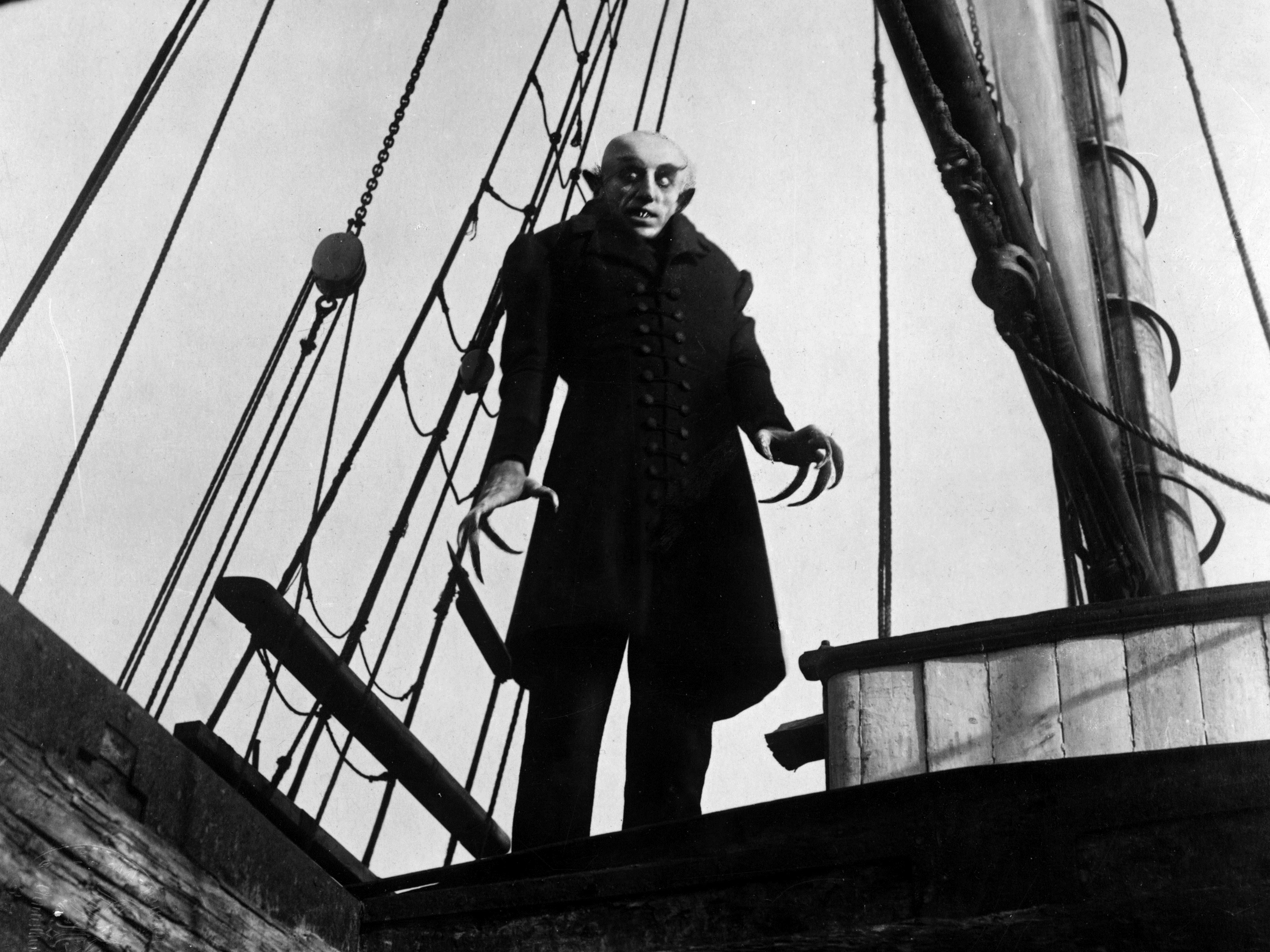
When a young real estate agent, Thomas Hutter, goes to the castle to close a deal, Orlok is attracted by his blood and decides to follow him to his hometown. The arrival of the count causes a series of mysterious deaths and spreads panic among the inhabitants.
Murnau, through evocative images and disturbing atmospheres, creates a work that goes far beyond the simple adaptation of Stoker's novel. The film explores universal themes such as the fear of death, isolation and the loss of humanity. The production of Nosferatu was characterized by some legal difficulties due to the copyright of Bram Stoker's novel. Despite this, Murnau and his crew managed to make a film of great visual impact. The choice of Max Schreck to play Count Orlok was ingenious. His cadaverous appearance and his unnatural movements have made the character of Orlok one of the iconic monsters in the history of cinema. Over the years, Nosferatu has become a cult film, influencing generations of filmmakers and becoming a reference point for the horror genre. The image of Count Orlok, with his elongated nails and sunken eyes, has become an icon of horror cinema.
Romanticism as a Political Sedative
You are sitting with a book open on your lap, the light outside going gray, and you feel it — that ache with no precise object, that pull toward something you cannot name and would not recognize if it arrived. The Germans had a word for it before you did, and that is not a coincidence.
In the winter of 1800, Friedrich Schlegel published his Athenäum Fragments, a series of compressed, almost explosive philosophical shards that collectively proposed something unprecedented: that incompleteness was not a failure of form but its highest aspiration. Fragment 116, perhaps the most cited, declared Romantic poetry a “progressive universal poetry,” forever becoming, never arriving. Scholars have read this as aesthetic theory. It was also a political instruction manual for a generation that had watched Napoleon dismantle the Holy Roman Empire in 1806 as casually as a man folding a map. When historical reality becomes unbearable, you aestheticize the wound. You transform the fact of defeat into the virtue of longing.
Novalis understood this with a precision that his dreamy prose tends to obscure. Heinrich von Ofterdingen, published posthumously in 1802, stages an entire civilization’s retreat from the present tense. The young Heinrich does not pursue an object — he pursues the memory of a dream about an object, the blue flower, which he has never held and which the novel never grants him. What Novalis engineered here was not a symbol of desire but a structural argument: that the pursuit matters more than the arrival, that the horizon is superior to any territory it might eventually become. This is a beautiful idea. It is also an idea that functions, in political terms, as sedation.
The concept of Sehnsucht — that compound longing for the distant, the lost, the impossible — did not emerge from the Romantic movement as a neutral emotional vocabulary. It emerged in a specific geopolitical crucible: a German-speaking world fragmented into thirty-nine states, economically humiliated, militarily defeated, watching a Corsican general redraw borders that had defined identity for centuries. Sehnsucht was the emotional technology that allowed educated bourgeois Germans to experience their historical impotence as spiritual depth. The man who cannot change his world discovers that yearning for a better one feels remarkably similar to having one.
What makes this cultural mechanism so durable — and so difficult to see from inside it — is that it genuinely produces beautiful things. The pain is real. The music it generated, the poetry, the philosophical longing — none of that is fabricated. But the sociologist Karl Mannheim, writing in Ideology and Utopia in 1929, drew a distinction that cuts directly through the Romantic inheritance: utopian consciousness, he argued, ruptures the existing order through its transcendence of it, while ideological consciousness uses the appearance of transcendence to stabilize what already exists. Romanticism, by this measure, trafficked almost entirely in the second category while insisting on the vocabulary of the first. It looked like rebellion. It functioned like sedation.
The bourgeois reading public of early nineteenth-century Germany did not need a revolutionary program. They needed a way to feel the full intensity of historical displacement without doing anything about it. Romanticism supplied this with extraordinary efficiency. It gave alienation a cathedral ceiling. It turned the failure to act into evidence of a soul too refined for action — the very gesture that Heine would spend his career dismantling, not because he was immune to the beauty of what Romanticism produced, but because he was constitutionally incapable of mistaking a beautiful prison for a home. He had grown up inside that beauty, had absorbed its cadences so completely that when he finally turned against it, he knew exactly which load-bearing walls to strike.

Heine's Irony as a Structural Weapon
You are reading a love poem. The language is tender, the moonlight is present, the longing is exquisite — and then, in the final line, the poet informs you that his beloved has a terrible laugh. The poem has not failed. It has executed a precise demolition of everything it built, and you are standing in the rubble wondering whether the emotion you just felt was real or whether you were being watched the whole time, the way a surgeon watches a patient before the first incision.
That structural reversal, deployed with meticulous consistency across the 1827 Buch der Lieder, was not Heine playing games with sentiment. The German Romantic lyric had developed an internal contract with its reader: you will suspend your critical faculties, enter the cathedral of feeling, and emerge transformed. Heine honored every clause of that contract until the final moment, then tore it in half and handed both pieces back. The effect was not parody. Parody operates from outside its target, pointing and laughing at a safe distance. What Heine performed was something structurally more dangerous — an inhabitation so complete that the collapse came from within.
Søren Kierkegaard, writing The Concept of Irony in 1841, identified irony not as a rhetorical flourish but as what he called infinite absolute negativity — a stance that negates without simultaneously proposing anything to replace what it destroys. The ironist, in Kierkegaard’s formulation, does not argue against a position; the ironist makes the position appear before you in full light so that you see, perhaps for the first time, that it was never standing on anything solid. This is not cynicism, which at least carries the dignity of a disappointed belief. Infinite absolute negativity is colder. It refuses even the consolation of loss.
Heine was practicing this before Kierkegaard named it, and the targets were not merely aesthetic. The Romantic lyric in Germany carried specific ideological freight: it naturalized a vision of the self as inward, essentially German, spiritually unified, and insulated from political history. The moonlit forest and the aching heart were not politically innocent images. They performed cultural work. They told a generation that the soul’s authentic drama was private, lyrical, and national — that to be moved by nature poetry was to participate in something real while the actual reorganization of German political life happened elsewhere, managed by other people. Heine’s irony struck that ideology at its load-bearing wall.
By 1843, in Atta Troll, the irony had sharpened into something that drew blood. The poem presents itself as a Romantic beast-epic, dense with the iconography the movement had canonized, then systematically makes every heroic gesture ridiculous without explaining why it is doing so. The bear Atta Troll delivers speeches about freedom and dignity that are formally indistinguishable from contemporary Romantic nationalist rhetoric, and the poem offers no corrective lens, no authorial voice stepping in to clarify the satirical distance. The reader is required to do that work — or not do it, which is equally possible, equally devastating as a diagnostic outcome.
What Heine understood, and what made him genuinely difficult to absorb into any tradition that claimed him, was that the mechanism of Romantic longing depended on the reader’s willingness to not notice. The emotion required a certain willed blindness to its own construction. A lyric that said “I am manufacturing this feeling in you through well-understood technical means” would produce nothing. The cathedral required darkness and stained glass and acoustics that made your own breathing sound reverent. Heine left the architecture intact and turned on every light simultaneously, and the congregation had to choose, in that sudden brightness, whether what they had been feeling counted as faith or as something considerably more embarrassing than faith, something closer to being surprised mid-performance in a role you had convinced yourself you were not playing.
The Mythology of the Rhine and What It Was Covering
You are standing on the western bank of the Rhine, sometime in the early nineteenth century, and the light is doing exactly what the painters needed it to do — falling in amber columns through mist, catching the surface of the water at an angle that makes the river look ancient, inevitable, sacred. The feeling that rises in you is not accidental. It has been engineered over decades by poets, landscape painters, and political theorists who needed a river to mean something larger than water flowing between two banks, and who found in the Rhine a surface onto which the entire fantasy of Germanic continuity could be projected without anyone having to defend it as argument. Nature, after all, does not argue. It simply is. And the genius of Romantic nationalism was precisely this: it borrowed the authority of landscape to make historical claims that would have collapsed under scrutiny if stated plainly.
The philosophical scaffolding for this maneuver had been assembled with considerable care. Johann Gottfried Herder, writing in his “Ideas on the Philosophy of the History of Humanity” between 1784 and 1791, proposed that each people possessed a Volksgeist, a spirit of the people organically rooted in geography, climate, and inherited custom. The river, the forest, the ancient ruin were not mere backdrop but living testimony to cultural essence. What Herder offered as a descriptive theory, the Romantics converted into a prescriptive mythology: if the German spirit was rooted in this particular soil, then those who did not share that root did not share that spirit. The syllogism was never stated this bluntly, because it did not need to be. The paintings of Caspar David Friedrich did the work more efficiently than any pamphlet, placing solitary figures before sublime Germanic landscapes in postures of absorption that implied belonging so complete it became biological.
Into this highly charged iconographic field, Heinrich Heine released his “Lorelei” in 1824, a poem about a golden-haired siren perched on a rock above the Rhine, whose singing lures a boatman to his death. The poem is melodically so natural, rhythmically so inevitable, that it was set to music almost immediately — most famously by Friedrich Silcher in 1837 — and entered the German cultural bloodstream as what every Romantic landscape poem wanted to be: anonymous, mythic, as if it had always existed. This was the irony Heine had built into the structure of the poem before history made the irony catastrophic. A Jewish writer had produced the definitive Romantic Rhine poem, the one that crystallized the entire mythology more perfectly than any poem written by those who believed the mythology applied to them.
When the Nazi regime came to power and began purging Jewish writers from German cultural life, the “Lorelei” presented an administrative embarrassment of the first order. The poem was too embedded, too loved, too thoroughly German to excise. The solution arrived at in official anthologies and school textbooks was to list the poem as “Volkslied” — folk song, author unknown — stripping Heine’s name from what his hand had made while preserving the object his hand had made. The logic was internally coherent within the terms of the ideology: if Jewishness and Germanness were mutually exclusive categories, then a Jew could not have written this poem, therefore the poem must have no identifiable author, therefore it belongs to the Volk. Evidence was not the point. Taxonomy was.
What this bureaucratic solution inadvertently revealed was the fault line running through the entire Romantic project of cultural naturalization: the mythology required constant maintenance precisely because it was not natural. A landscape does not choose who stands in front of it and feels moved. A river does not ratify ancestry. The feelings the Rhine inspired in Heine were structurally identical to the feelings it inspired in those who would later deny he had felt anything at all, and no administrative reclassification could dissolve that equivalence, which is why the reclassification was necessary in the first place.
Conversion, Citizenship, and the Price of Admission
You have already decided what you are willing to sacrifice before anyone asks you to sacrifice it. That is the most precise description of what Heinrich Heine did on June 28, 1825, when he was baptized Lutheran in Heiligenstadt, taking the Christian name Johann Christian Heinrich and acquiring, in his own bitter formulation, the ticket of admission to European civilization. He was twenty-seven years old, freshly holding a doctorate in law from Göttingen, and fully aware that without baptism no Jew in the German states could hold public office, practice law in any meaningful capacity, or occupy the institutional positions from which cultural authority flowed. The conversion was not a spiritual event. It was a transaction, and Heine knew it, which is precisely what made it unbearable rather than merely pragmatic.
What the transaction revealed was that the Enlightenment promise of universal citizenship had a hidden asterisk. The emancipation edicts that had flickered across the German states since the late eighteenth century, Napoleon’s abolition of the ghetto walls, the rhetoric of rational universalism inherited from Kant’s insistence that moral law recognized no tribal origin — all of it contained an unspoken precondition. You may enter, but you must arrive as someone else. The door was open, but it was open to a self you had not yet become and would never fully be. Heine walked through it and found that the room on the other side did not recognize him either. He wrote to his friend Moses Moser shortly after the baptism that he was now hated by Christians and Jews alike, which was not self-pity but empirical accuracy.
Theodor Adorno and Max Horkheimer, writing from American exile in 1944 in the Dialectic of Enlightenment, built an entire philosophical architecture around this structure. Their argument was that the Enlightenment’s claim to liberate the individual from myth was itself a new mythology, one that demanded the systematic liquidation of everything particular, everything that could not be universalized into the abstract citizen-subject. Assimilation, in this framework, was not integration but a specific form of self-destruction administered willingly because the alternative was persecution administered by others. The Jew who converted, who changed his name, who learned to modulate his accent and his references and his mannerisms, was not becoming European — he was performing the proof that Europeanness required his disappearance as a precondition of its own coherence.
What makes Heine’s case so surgically revealing is that the conversion did not work. The ticket of admission purchased no actual admission. He never obtained the professorship he had hoped for, never held the legal position the doctorate was meant to unlock. The anti-Jewish hostility that had surrounded him before 1825 simply mutated into a new form, targeting the convert, the Jew who had tried to pass, the figure who exposed by his very attempt the fraudulence of the offer. German Romanticism, with its deepening obsession with Volk, blood, and organic cultural continuity — a current running from Herder’s Ideen zur Philosophie der Geschichte der Menschheit through the nationalist mysticism that would harden into political programs by mid-century — had no mechanism for absorbing the converted Jew, because the category it actually opposed to the Jew was not the Christian but the German, and those were not the same thing.
The baptismal certificate solved a legal problem while leaving the underlying structure entirely intact, which is to say it solved nothing. What it did instead was make the structure visible, because Heine now occupied the space where the promise was supposed to be redeemed, and the space was empty. Every ironic line he wrote afterward carries the residue of that discovery — the voice of a man who paid the price and received the receipt but never the goods, writing from inside a belonging that had already, quietly, revoked his invitation before he arrived.
A vision curated by a filmmaker, not an algorithm
In this video I explain our vision
Paris, Exile, and the View from Outside the Myth

You pack one bag in 1831 because the gendarmes are already asking questions about your pamphlets, and you tell yourself Paris is temporary — a season, maybe two — and then you spend the next twenty-five years watching Germany from the wrong side of the Rhine, which turns out to be the only side from which it can be seen clearly.
Heine arrived in Paris the year the July Revolution had just rearranged the furniture of European power without touching the walls, and he found himself immediately absorbed into circles where the rearrangement of everything was under active theoretical construction. The Saint-Simonians — followers of Henri de Saint-Simon’s posthumous Nouveau Christianisme, published in 1825 — were building an industrial theology, a creed that worshipped productive capacity and collective organization as spiritual virtues. Heine was drawn to them not because he became a convert but because their framework gave him a vocabulary for what he had always suspected: that the German Romantic cult of the medieval, the folk, the organic nation was not an innocent aesthetic preference but a political technology, one that aestheticized hierarchy and called it destiny. Saint-Simon’s disciples taught him to ask who benefits when a people are encouraged to dream backward rather than forward.
The distance from German literary culture that exile imposed was not merely geographical. When you are no longer inside the mythology, you stop experiencing it as atmosphere and start experiencing it as architecture — you can see the load-bearing walls, the deliberate exclusions, the rooms that were sealed before you arrived. Heine’s Die Romantische Schule, published in 1836, written explicitly for a French audience and therefore free of the self-censorship that German publication would have demanded, performs exactly this kind of structural reading. He dissects the Schlegel brothers, Novalis, Tieck, and the whole constellation of early Romanticism not as a literary historian paying respects but as a diagnostician noting symptoms. He identifies the movement’s turn toward Catholicism and medievalism as a flight from Enlightenment accountability, a deliberate regression dressed in the language of spiritual depth. The book was not popular in Germany. Books that describe the architecture of a house to the people still living in it rarely are.
What sharpened this diagnosis into something prophetic rather than merely critical was Heine’s proximity, from the early 1840s onward, to Karl Marx, who arrived in Paris in 1843 and found in Heine one of the few intellectuals willing to treat the connection between cultural production and material power as something other than a category error. Their correspondence and conversation during those Paris years produced no single collaborative document, but they produced something more durable: a shared intuition that Romantic nationalism was not a soft phenomenon, not merely a literary mood that would dissolve when the economic facts became undeniable. In Zur Geschichte der Religion und Philosophie in Deutschland, written in 1834, Heine had already argued that German philosophy contained a destructive energy that had no equivalent in French political thought, that the German capacity for abstract idealism could, when transferred from the seminar to the street, produce a violence more total than anything the Jacobins had managed, because it would carry with it the absolute conviction of metaphysical righteousness. He wrote this when the men he was describing were still writing poetry.
The precision of that forecast is what makes contemporary readers uncomfortable in a way that goes beyond ordinary historical irony. It is not simply that he was right. It is that being right required him to read Romanticism against the grain of everything his own early formation had loved in it — the lyricism, the longing, the exquisite sensitivity to beauty as a moral category. To see the violence latent in a movement you once inhabited is a different kind of knowledge than detached scholarly analysis, and it leaves marks that consoling retrospective frameworks about the complexity of the period cannot quite cover over.
The Body in Ruins and the Mattress Grave
You are fifty-seven years old and you cannot move. The ceiling is what the world has become — a fixed white plane above a body that no longer obeys, a spine dissolving slowly into its own architecture while outside Paris goes on negotiating its revolutions and its fashions. Heinrich Heine lay in this condition from 1848 until his death in 1856, and he named the space with the precision of a man who had never stopped being a poet: Matratzengruft, the mattress grave. Not a sickbed. A grave you inhabit while still breathing, which is a different kind of sentence entirely.
What emerged from that enclosure was the Romanzero, published in 1851, a collection so tonally strange that its first readers could not decide whether it represented a final flowering or a kind of dissolution. The answer is that it was both, and that the distinction matters less than what the book actually performs. The Romanzero does not describe suffering from a position of wisdom above it — it is written from inside the physical fact of collapse, and the collapse is the argument. When Heine moves through figures of exile, of dispossession, of bodies broken on the wheels of history, he is not reaching for metaphor as a stylistic choice. He is reporting what the body already knows and what ideology has spent centuries pretending it does not need to know.
German Idealism — the philosophical tradition that produced, among its effects, an entire aesthetic culture built on the transcendence of the material — carried within it a structural contempt for the flesh. G.W.F. Hegel’s Phenomenology of Spirit, published in 1807, performs a relentless sublimation: whatever is particular, embodied, and contingent must be overcome in the movement toward Absolute Spirit. The beautiful in Hegel is always already on its way to something higher than the beautiful. Heine had been trained inside this current, had absorbed its energies and written some of his early work in its shadow, and what the Matratzengruft gave him was not a refutation he could argue but one he was forced to live. The body that cannot be sublimated, that refuses to dissolve into idea, that persists in its pain and its limitation — this body became the text.
The poems of the Romanzero are full of kings dethroned and relics stripped of sanctity, of Hebrew melodies played on instruments that are cracked, of romanticized suffering punctured by a line that turns suddenly cold and precise. This is not bitterness as a personality trait but bitterness as epistemological position — the earned knowledge of someone who watched a culture construct gorgeous cathedrals of feeling around a void that the culture itself placed there. The Romantic movement had made suffering beautiful; Heine had helped make it beautiful; and the Matratzengruft was the invoice. You cannot aestheticize crisis indefinitely without eventually becoming the crisis.
Michel Foucault, writing in 1963 in The Birth of the Clinic, traced how the modern understanding of disease was reorganized around the idea of the pathological body as a site of truth — a place where what was hidden in health becomes legible. Heine arrived at something structurally similar through lyric poetry rather than clinical epistemology: illness as revelation, the disintegrating body as the place where cultural self-deception finally runs out of room to perform. A civilization that had invested itself so completely in spiritual elevation, in the romance of the nation, in the purity of aesthetic feeling, had no philosophical framework for what happened when the spine gave way and the ceiling became permanent.
The cruelty of that position was not incidental to the poems — it was their engine. Heine wrote the Romanzero without the ability to sit upright, dictating parts of it, revising in conditions that would have silenced most writers, and what the collection refuses, finally, is any consolation that cannot survive contact with what the body actually reports when no transcendence is coming to collect it.
What Romanticism Could Not Metabolize
You have spent your whole life inside a story someone else wrote before you were born, and the most dangerous part is that the story feels like air — invisible, necessary, entirely yours.
German Romanticism did not fail to understand Heinrich Heine. That would be a forgiving explanation, and it would be wrong. The movement understood him precisely, which is exactly why it could not keep him. His irony was not a stylistic preference but a structural attack on the foundational premise that Romantic nationalism required to function: the idea that a people, a Volk, constituted a natural and coherent spiritual unity that literature existed to express rather than interrogate. Heine did not merely question this premise — he laughed at it, in verse elegant enough to be memorized by the same people it mocked. That combination was intolerable. You can dismiss a critic. You cannot so easily dismiss a poet whose lines you already know by heart.
Benedict Anderson argued in Imagined Communities, published in 1983, that nations are not discovered but manufactured, and that print capitalism — newspapers, novels, anthologies — provided the technical infrastructure through which millions of strangers came to feel they shared a single, continuous, collective self. The literary canon was never a neutral archive. It was a selection mechanism, a technology for deciding which voices confirmed the imagined community and which ones, however brilliant, introduced a frequency that the collective nervous system could not absorb without destabilizing. Heine introduced exactly that frequency. Born in 1797 in Düsseldorf, converting to Lutheranism in 1825 as what he himself called a “ticket of admission to European civilization,” spending the last twenty-five years of his life in Parisian exile, he was a figure the canon could quote but never fully claim — too Jewish to be purely German, too German to be comfortably foreign, too funny to be safely tragic.
What fills that gap between quotation and claim is not aesthetic judgment but something closer to what Hannah Arendt mapped in The Origins of Totalitarianism, published in 1951. Arendt did not write about Romanticism directly, but she diagnosed the longer civilizational logic that Romanticism was one early chapter of: the conversion of cultural belonging into racial essence, the slow hardening of “we feel the same things” into “we are made of the same substance,” until difference stops being an irritant and becomes a contamination. The exclusion of Heine from the German nationalist canon was not a bureaucratic oversight corrected by later anthologists. It was a rehearsal. Each generation that celebrated his imagery while quietly marginalizing his person was practicing a gesture it would eventually perform with far less subtlety and far more violence.
There is a particular cruelty in being consumed by what rejects you. Heine’s “Lorelei,” written in 1824, became so embedded in German cultural memory that when the Nazi regime could not erase the poem from popular consciousness, they printed it in anthologies attributed to “Author Unknown.” The poem remained. The man was made to disappear inside his own work. This is not an irony history stumbled into by accident — it is the logical endpoint of a culture that had learned to separate an artwork from the conditions of its making, to treat aesthetic beauty as a substance that could be extracted from its human source and purified for collective use.
Romanticism built its cathedrals out of longing — for origin, for wholeness, for a home that existed before history had a chance to complicate it. Heine knew that the home had never existed, that the longing itself was the architecture, and that architecture could house almost anything depending on who held the keys. He said so, clearly, in prose and in verse, across four decades of work. The culture heard him, sang his songs, and built the cathedral anyway, with his bones somewhere inside the wall.
🌿 The Romantic Soul: Poetry, Nature, and the Infinite
Heinrich Heine stands at the crossroads of German Romanticism and modern critical consciousness, blending lyrical beauty with sharp political wit. His work draws from a vast intellectual landscape that includes Goethe’s pantheistic naturalism, the aesthetics of the sublime, and the cursed poet tradition. These related articles illuminate the world that shaped Heine and the currents that flowed from him.
Johann Wolfgang von Goethe: Life and Works
Johann Wolfgang von Goethe is the towering figure against whom all German Romantic writers measured themselves, and Heine was no exception. Goethe’s synthesis of classical form and Romantic feeling, visible in works from Faust to the Elective Affinities, created the very cultural atmosphere in which Heine’s poetry germinated. Understanding Goethe is essential to understanding the tradition Heine both inherited and provocatively subverted.
GO TO THE SELECTION: Johann Wolfgang von Goethe: Life and Works
The Aesthetics of the Sublime: When Beauty Is Frightening
The aesthetics of the sublime — the encounter with a beauty so vast it overwhelms rational thought — is one of the central engines of German Romanticism. From Kant and Burke onward, this philosophical category gave Romantic poets like Heine a vocabulary for expressing the infinite longing known as Sehnsucht. This article traces the concept from its Enlightenment roots to its full flowering in Romantic art and literature.
GO TO THE SELECTION: The Aesthetics of the Sublime: When Beauty Is Frightening
Caspar David Friedrich: The Painter Who Painted the Infinite
Caspar David Friedrich‘s paintings are perhaps the most perfect visual counterpart to Heine’s lyric poetry, both suffused with a melancholy yearning before the vastness of nature and history. Friedrich’s solitary figures gazing into mist-covered landscapes embody the Romantic Weltschmerz that Heine expressed in verse. Exploring Friedrich’s work deepens our understanding of the shared emotional and philosophical grammar of German Romanticism.
GO TO THE SELECTION: Caspar David Friedrich: The Painter Who Painted the Infinite
Shelley and the Defence of Poetry: Poets as Legislators
Percy Bysshe Shelley‘s Defence of Poetry, which crowns poets as the ‘unacknowledged legislators of the world,’ resonates profoundly with Heine’s own belief in the political and spiritual power of verse. Both poets blended lyrical intensity with a fierce critique of oppressive social structures, making poetry an instrument of liberation. This article explores the Romantic tradition of poetry as a form of moral and political resistance that Heine embodied in his own distinctive way.
GO TO THE SELECTION: Shelley and the Defence of Poetry: Poets as Legislators
Discover the Cinema of Ideas on Indiecinema
If the world of Heine, Goethe, and Romantic thought stirs something deep in you, Indiecinema is the streaming platform where that spirit lives on screen. Our curated selection of independent and arthouse films explores literature, philosophy, and the restless search for meaning that defined the Romantic era and still drives us today. Join us and let cinema become your next journey into the infinite.
👉 EXPLORE THE CATALOG: Watch Indie Films in Streaming
A vision curated by a filmmaker, not an algorithm
In this video I explain our vision

