
The Room No One Entered
You open the door and the smell hits you first. Not rot, not neglect exactly, but the specific density of a life that has been breathing in a closed space for decades — paper and glue and something older, something that has been accumulating since before you were born. The room is small. A single man’s room in a Chicago rooming house on Webster Avenue, the kind of room that costs almost nothing and asks almost nothing in return, just that you disappear into it quietly and cause no trouble. He had lived here for forty years. He had caused no trouble.

What you find inside is not what a room is supposed to contain.
Rolled and stacked against every surface, pinned across walls, layered in columns on the floor: thousands of pages of handwritten manuscript, a novel running to more than fifteen thousand pages, the longest work of fiction ever produced by a single human hand. Watercolors, enormous and luminous, some stretching three meters across, depicting children in landscapes so lush they seem to pulse, armies of girls with strange anatomy fighting wars in countries whose geography does not correspond to any map. Photographs cut from newspapers and magazines, traced and enlarged with a technique no one had taught him, assembled into scenes of violence and tenderness so extreme they exist at the edge of what the eye can process. Journals. Weather records kept obsessively for years. A bound autobiography. And above it all, pinned to the walls like evidence of something that has no name yet, the images of the Vivian Girls — seven princesses who lead a rebellion across hundreds of thousands of words that no living person had read.
He had died just months earlier, in April 1973, in a Catholic mission home where he had finally gone when he could no longer care for himself. His landlord, Nathan Lerner, a photographer who had never thought to ask what his tenant was doing in that room for four decades, cleared it out and found an entire universe. Not a hobby. Not a pastime. A civilization built in secret, with the seriousness and the grief of someone who believed absolutely in what they were making and expected nothing from the world in return.
This is not a comfortable fact. It destabilizes something in the way we think about art, about witness, about the relationship between creation and recognition. We are accustomed to imagining that great work seeks the light, that talent is a pressure that finds its outlet, that genius is fundamentally social — it needs an audience the way a fire needs oxygen. Henry Darger spent sixty years proving that assumption wrong, and the wrongness of it sits in the chest like something swallowed too fast.
The philosopher Charles Taylor argued, in Sources of the Self, that modern identity is constituted through narratives of recognition — we become who we are through being seen by others. What happens, then, to a self that is never seen? Does it collapse into incoherence, or does it construct its own laws of gravity, its own internal witness, so thorough and so demanding that the absence of external eyes becomes irrelevant? Darger’s room suggests the second possibility, and that suggestion is almost impossible to sit with, because it means that recognition — the thing we spend our lives managing, performing, bargaining for — may be less essential to human creation than we have ever allowed ourselves to believe.
But there is another question underneath that one, quieter and more unsettling. Not what it means that he made all of this unseen, but what it means that you haven’t entered your own room yet. The one where the real work is. The one whose door you pass every day and keep walking.
Don Barry: A Quixotic Exploration

Docufiction, Experimental, by Paul Smart, Mexico, 2026.
Don Barry: A Quixotic Exploration is a debut feature that places the biography of an eighty-year-old experimental filmmaker and artist, Barry Gerson, within the metanarrative of Miguel de Cervantes’ Don Quixote. Don Barry was filmed in the city of Guanajuato during the 51st edition of the Cervantino Festival, as well as during the vibrant Day of the Dead celebrations held in the city’s UNESCO-listed tunnels. The film honors the director’s long friendship with artist Barry Gerson, drawing inspiration from Cervantes’ Don Quixote. Paul Smart’s directorial choices create something new that celebrates life and goes beyond conventional storytelling. A search for magic in our real lives. A moving film about the meaning of life, art, and death. Not to be missed.
Paul Smart is a proud outsider filmmaker with a long history of film screenings. In the 1980s, he emerged in New York’s vibrant youth art scene, working in theater production and later filmmaking, before retreating to rural upstate New York, in the Catskill Mountains, where he made a living writing and screening independent films in old parish halls for rural audiences, many of whom had never seen a film.
LANGUAGE: English
SUBTITLES: Spanish, French, German, Portuguese
Invisibility as a Social Contract
You pass him every morning. He carries a mop bucket down the corridor at the same time you arrive, and you have developed a small, automatic protocol: you angle your body slightly to the left, he angles his slightly to the right, and neither of you speaks. You have done this for six years. You do not know his name. You are not cruel. You are not indifferent in any way you would recognize as indifference. You are simply participating, faithfully and unconsciously, in one of the most durable social contracts ever devised: the agreement to render certain people structurally invisible.
Erving Goffman, writing in Stigma in 1963, described how societies do not merely exclude certain individuals but actively construct categories of spoiled identity, classifications so thorough and so internalized that the stigmatized person eventually collaborates in their own erasure. The stigma is not a mark on the skin. It is a set of social expectations that precede every interaction, that determine in advance what kind of attention, what quality of curiosity, what degree of human recognition a person is permitted to receive. A janitor, an orphan, a man who speaks to no one and is spoken to by no one, a man whose religious fervor tips visibly past the edge of what polite secular society finds comfortable — each of these attributes, in Goffman’s framework, operates as a discrediting attribute, a signal that tells the social environment: do not invest here. There is nothing here worth knowing.
Georg Simmel, decades earlier, had mapped the territory from a different angle. His figure of the stranger — developed in his 1908 essay within Soziologie — is not someone who arrives from outside and remains foreign. The stranger is the one who is already inside the community but never absorbed by it. He is near and far simultaneously. He participates in the shared space without being granted participation in the shared meaning. He is useful — his labor is required, his presence fills a necessary function — but he exists at a permanent remove from the reciprocity that transforms proximity into belonging. Simmel was describing a structural position, not a personality. The stranger is not strange because of something he does or fails to do. He is strange because the social architecture demands someone occupy that role.
Henry Darger occupied it for over forty years in Chicago. His neighbors on North Webster Avenue saw him daily. He shared walls with them, stairwells, the particular acoustics of a building where you can hear someone coughing through the plaster. He attended Mass every single day, sometimes twice, at the same church, for decades. The priests knew his face the way you know the face of furniture. When he was taken to a nursing home in 1972, dying and finally unable to live alone, his landlord Nathan Lerner entered his room to assess what needed to be cleared out, and found instead a universe. Hundreds of watercolor paintings. Thousands of pages of handwritten narrative. A life’s work of staggering, bewildering scale, produced in total silence, total anonymity, total structural invisibility.
This is not a story about neglect. Neglect implies that someone looked and then looked away. What surrounded Darger was something more precise and more brutal: a system of social perception that never directed its gaze toward him in the first place. He was a product of the Illinois Asylum for Feeble-Minded Children, which absorbed him at age eight after his father was institutionalized and his infant sister given up for adoption. He was a product of a Catholic charity ecosystem that processed poor children through labor and doctrine. He was a product of the American urban working class of the early twentieth century, which had no language and no infrastructure for the inner life of a man who mopped floors and went home to paint.
The invisibility was not incidental. It was load-bearing.

What the Realms Contain
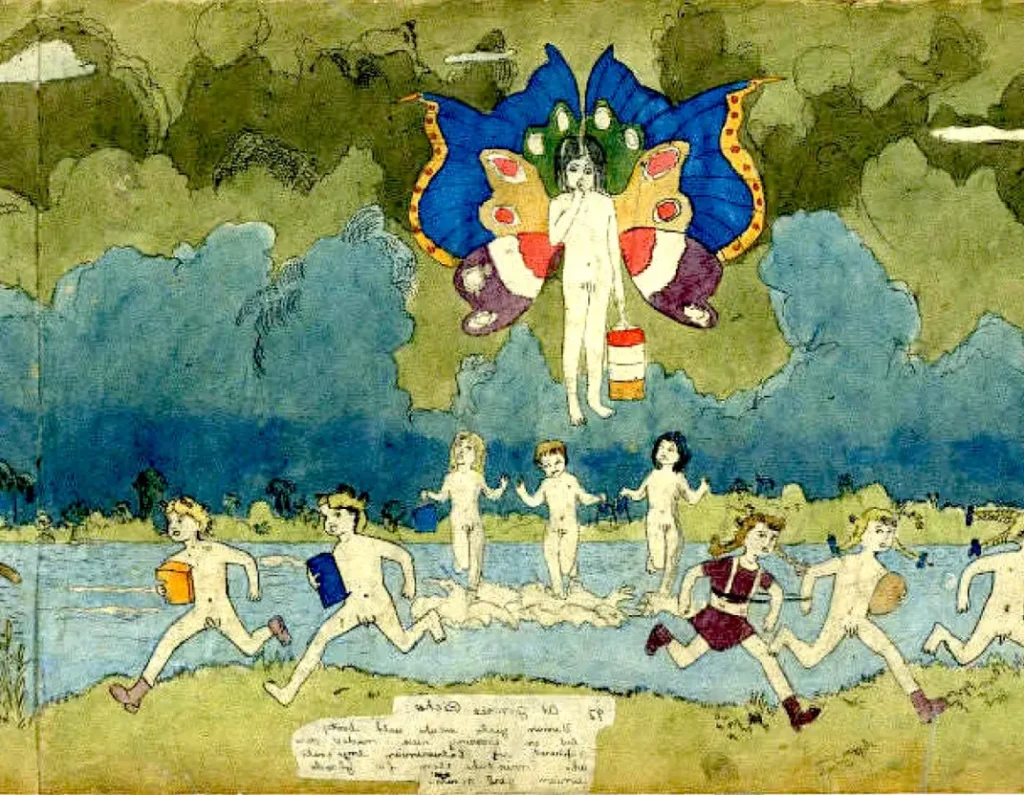
Fifteen thousand one hundred and forty-five handwritten pages. You hold that number for a moment and it refuses to mean anything, because no number really does when the thing it measures is this. Decades of nights in a single rented room, a typewriter, bottles of glue, traced figures from newspapers and coloring books, watercolors applied in long horizontal bands across pages that sometimes stretch to twelve feet wide. The work is called, in full, “The Story of the Vivian Girls, in What is Known as the Realms of the Unreal, of the Glandelinian War Storm, or the Glandico-Abbienian Wars, as Told by Himself.” Darger wrote it from somewhere in the early 1910s until his death in 1973. He was found only when it was too late to ask him anything.
The Vivian Girls are seven sisters, Christian child soldiers fighting against the Glandelinians, a slave empire that captures, tortures, and murders children, specifically girls, with a systematic cruelty that Darger renders in visual and written detail that does not flinch. The violence is not decorative. It is not cartoonish in the way that word is used to dismiss. Children are strangled, disemboweled, crucified against trees. And yet the same hand that rendered those scenes also painted enormous fields of flowers in colors that do not exist in any sky you have ever stood under, children running through landscapes of impossible tenderness, the Vivian Girls triumphant in panels that glow with something almost liturgical. The tonal range is not contradiction. It is the full emotional register of someone who understood, perhaps more directly than most, that beauty and atrocity share the same atmosphere.
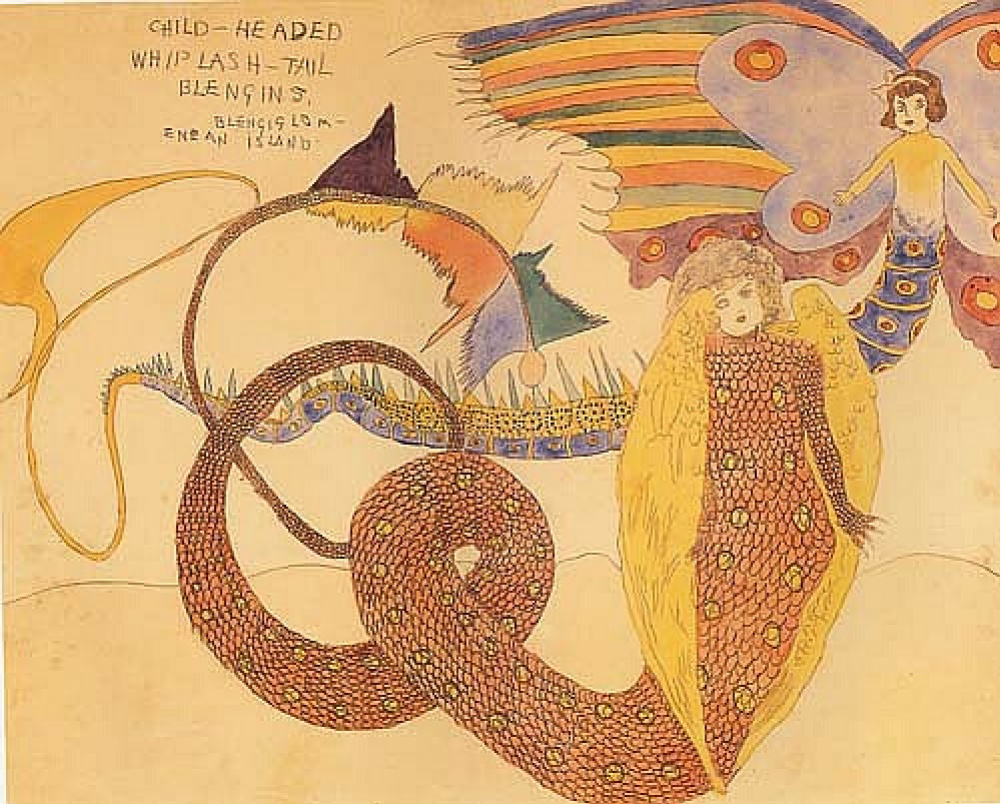
The ambiguity of gender in the work has generated sustained critical attention. The Vivian Girls and many of the children Darger painted are depicted with what appear to be male genitalia, though they are otherwise rendered as girls. Art historian John MacGregor, whose exhaustive monograph on Darger published in 1994 remains the foundational scholarly text, argued that this reflects Darger’s almost total ignorance of female anatomy, since he was raised without women in his life and had no access to unclothed female imagery. Others have read it as something stranger and more deliberate, a refusal of the binary at the level of the body itself, which may be importing contemporary frameworks onto a man whose interior life we can only approach through the evidence he left, and that evidence is not a confession. It is a world.
MacGregor’s work brought Darger into the frame of what was by then an established critical category: outsider art, or art brut, the term coined by Jean Dubuffet in the 1940s to describe work created outside the cultural mainstream by people with no formal training, often psychiatric patients, prisoners, or social isolates. Dubuffet meant it as a challenge to official culture, a provocation against the academy. By the time Darger became a celebrated figure in the 1970s and 1980s, the category had become something else: a market, a curatorial gesture, a way of consuming radical difference while keeping it at a safe theoretical distance.
When we call something outsider art, the implicit center is never examined. The insider is understood to be educated, credentialed, professionally embedded, socially legible. The outsider is authentic precisely because they lack all of that, which means their authenticity is defined by deprivation, and their work’s value is inseparable from the conditions of suffering that produced it. There is something deeply uncomfortable in this, in the fact that Darger’s isolation, his poverty, his probable mental illness, his decades of invisibility, are not incidental to how his work is received but are structurally essential to its reception. Remove the biography of deprivation and the category dissolves. Which raises the question of what the category was ever actually protecting.
The Mythology of the Solitary Genius
There is a man who spends every evening at the same table, under the same lamp, moving pieces of something enormous only he can see. The neighbors hear nothing. The landlord notices nothing. The city outside does not know this room exists as anything other than a rented space. When the man dies, they find thousands of pages, hundreds of images, a universe assembled in secret over six decades. And the first thing the art world does — before it has even finished cataloguing the work — is construct a story about him.
The story is always the same. The solitary genius. The untouched mind. The pure creator who never encountered the contaminating influence of institutions, theories, careers. The narrative has a seductive internal logic: here is someone who made without wanting recognition, who built without asking permission, whose work therefore carries a kind of moral authenticity that the credentialed artist, by definition, can never claim. Walter Benjamin, in his 1935 essay on the work of art in the age of mechanical reproduction, described the aura as something that withers under the conditions of mass culture — that singular quality of presence, of the unrepeatable. Darger, dead and unknown, becomes the perfect aura-object. He cannot be interviewed. He cannot revise his meaning. He cannot disappoint.
Jean Dubuffet understood this mechanism even as he was constructing it. When he founded Art Brut in 1945 and began collecting the work of psychiatric patients, prisoners, autodidacts, and social outcasts, he was doing something genuinely radical and something profoundly self-serving simultaneously. He wanted to locate creativity outside the academy, outside the gallery, outside the entire apparatus of cultural legitimation. But in doing so, he created a new category — and categories are cages, even when they are built with admiration. The outsider label does not liberate the artist it names. It quarantines them. It says: your value consists precisely in your distance from us. Come no closer.
Think of what it means to call someone an outsider artist after they are dead. They cannot accept the designation or refuse it. They cannot say whether the isolation was chosen or imposed, whether the solitude was a condition of creation or its wound. A man obsessed with a single enormous project — a project so large it required a room of its own, a project that swallowed every evening and every year — is not necessarily a man at peace with his solitude. He may be a man for whom the work was the only available form of company. That is not transcendence. That is survival with aesthetic consequences.
The room itself becomes mythologized. The stacks of found imagery, the traced figures, the improvised tools. These are read as signs of purity, of untrained instinct. But tracing is also a form of longing — the desire to possess an image you cannot produce otherwise, to make it yours through repetition and transformation. The obsessive archive, the careful preservation, the scale of the endeavor: none of these speak of a man indifferent to his own creation. They speak of someone who cared enormously, who wanted his work to matter, who simply had no mechanism for placing it in the world while he was alive to see it.
Dubuffet’s collection eventually became a museum in Lausanne. The work he gathered to escape the institution ended up in one. Benjamin’s aura, which supposedly cannot survive reproduction, has been reproduced on posters, in catalogues, across exhibition walls on three continents. The narrative of the untouched creator requires constant institutional maintenance to survive. The purity is a product. The isolation is a frame. And Darger, who could not choose what happened to his work after death, has been made to mean something he never had the chance to refuse or endorse.
Childhood as a Wound That Legislates
He was born in 1892 on the near north side of Chicago, and by the time he was old enough to understand what a mother was, she was already gone. Not gone in the way that leaves a traceable absence, a chair pulled back from the table, a voice that stops mid-sentence. Gone before memory could organize itself around her presence, which means gone in the way that forecloses even grief, because grief requires a before. What remained was a father who was kind enough but failing, and then a city that processed him the way cities process inconvenient children: through institutions.
He was sent to the Illinois Asylum for Feeble-Minded Children in Lincoln at twelve years old. The word feeble-minded should stop you for a moment, not because it is cruel — though it is — but because it is diagnostic in the truest sense: it tells you nothing about the child and everything about the society doing the naming. Darger was not feeble-minded. He was poor, motherless, difficult to manage, and living in an era when the distance between those conditions and institutionalization was administrative rather than ethical. He remained there for years, doing farm labor, existing inside a structure that had been built not to protect him but to remove him from view. Sometime around 1908, he left — escaped, was discharged, walked out into a world that had spent his entire formation telling him it had no particular use for him.
What Alice Miller understood, writing in 1979 in The Drama of the Gifted Child, is that the child who receives no reliable protection does not simply suffer. The child legislates. In the absence of external law that works, an internal law constructs itself, often with extraordinary precision and ferocity, to compensate for the void. The psyche does not collapse into chaos. It drafts its own constitution. Miller’s argument was about emotional deprivation in bourgeois homes, but the logic scales brutally to Darger’s situation: when the world around you operates without justice, you do not abandon the concept of justice. You become its sole custodian.
Judith Herman, in Trauma and Recovery published in 1992, identifies one of the core responses to prolonged, inescapable harm as the construction of an alternative system of meaning — not delusion, but restructuring. The traumatized mind does not stop making sense of the world. It makes a different sense, one that accounts for the violence it has witnessed and absorbs it into a framework where agency, however displaced or symbolic, remains possible. Herman is careful to distinguish this from pathology. It is adaptation. It is, under the circumstances, intelligence.
Darger spent the rest of his life in Chicago doing janitorial work, washing dishes, cleaning hospital floors. He lived alone in a single rented room on Webster Avenue for decades. He attended Mass sometimes multiple times a day. And he wrote, over fifteen thousand pages of it, and painted, hundreds of images, all organized around a single narrative premise: children are in danger, the danger is real, and someone must fight back. The Vivian Girls — seven sisters, warriors, the protagonists of his vast manuscript — are not symbols of his wounds. They are the judicial response to them. They constitute a moral order that the world he actually lived in had refused to provide.
This is the distinction that matters. To read Darger’s work as symptom is to repeat the gesture of the institution: to look at what he made and see only what was wrong with him. To read it as jurisprudence is to take seriously the possibility that a mind shaped by abandonment and confinement might produce not a record of damage but a system of redress. That the fifteen thousand pages are not the overflow of a broken psychology but its most coherent product.
The children in his images suffer. They also resist. That is not incidental. That is the entire point of the law he was writing.
A vision curated by a filmmaker, not an algorithm
In this video I explain our vision
The Archive as Survival
There is a drawer somewhere in the world that you have never opened in front of anyone. It contains things that would look like nothing to a stranger — a ticket stub from a journey you almost did not take, a photograph of someone whose name you are afraid to say aloud, a folded newspaper page with a headline that felt, on the morning you cut it out, like it was written specifically for you. You did not keep these things because they were valuable. You kept them because throwing them away would have meant agreeing that they had never mattered. That distinction is everything.
Darger kept weather journals for decades. Not meteorological records in any scientific sense, but daily notations of temperature, cloud cover, the quality of morning light. He kept newspaper clippings of crimes against children, of disasters, of wars. He re-traced images from advertisements and children’s books with a precision that bordered on devotion — Copperplate copy after Copperplate copy, the same girls with their wide eyes and their ribbon-tied hair, transferred and retransferred as though repetition could make them permanent. He saved what the world discarded. He built, over the course of roughly sixty years in a single rented room, what can only be called an archive — though no one was ever supposed to see it, and he never once referred to it as such.
Jacques Derrida, writing in Archive Fever in 1995, made a claim that sounds almost too simple until it strikes you somewhere specific: the archive is never about the past. It is about the future. What drives the archival impulse, what Derrida calls archive fever in its most elemental form, is not nostalgia but desire — the desire to have a future, to leave a trace that survives the body that made it. The archive is a wager placed against disappearance. And Darger, who had no family, no friends who visited, no audience, no institutional recognition, was placing that wager every single day, stacking it in piles that reached the ceiling of his room on Webster Avenue.
This is not hoarding. The distinction matters and it is not subtle. Hoarding is the inability to let go, a compulsive response to anxiety about loss. What Darger was doing was closer to testimony — the meticulous construction of evidence that he had been present on this earth and had noticed things. A man who noticed the weather, who tracked the suffering of children in the newspapers, who copied and recopied the same small faces as though their preservation depended on his hand, is a man who understood that the world forgets without being asked to. He was not accumulating. He was bearing witness to his own existence against the continuous verdict of invisibility.
Think of someone carefully removing the date stamp from a letter and pressing it flat between the pages of a book. Not because the date matters in itself, but because the act of pressing it preserves a moment in which something happened — in which they were the person to whom something was addressed, to whom something was sent. The archive is the insistence that subjectivity has mass, that consciousness leaves a residue. Derrida understood that the archive is constitutively tied to death precisely because it is constitutively tied to the fear of it. You do not archive what you believe will be remembered. You archive what you know will be forgotten.
Darger’s weather journals record temperatures in Chicago through winters that no one else thought to connect to him. His newspaper clippings map a sustained moral attention to violence that he could not stop and could not ignore. His traced images are the record of a looking that never stopped. None of it was addressed to anyone. All of it was addressed to whoever would eventually open that room and be forced, despite themselves, to conclude that someone had lived there.
Violence, Innocence, and the Images We Cannot Look Away From
There is a particular image — watercolor and collage, nearly four feet wide — in which a group of young girls run across a field while behind them something terrible is already happening to others who look exactly like them. The running ones have not yet turned around. You cannot tell if they are fleeing or simply moving, if they know what is happening at their backs or are entirely innocent of it. That structural ambiguity is not an accident of an untrained hand. It is the central argument of everything Darger ever made.
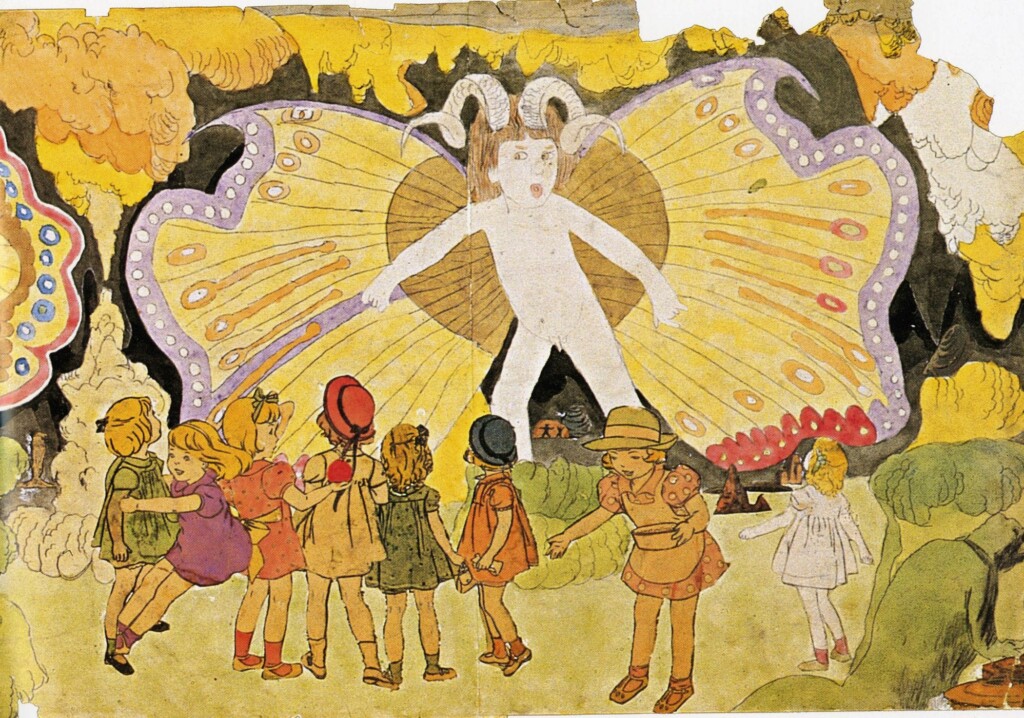
The violence in his work is real and it is extreme. Children are strangled, disemboweled, crucified on trees, their small bodies rendered with the same careful attention he gave to flowers and clouds and the patterns on their dresses. The Vivian Girls themselves occupy a body that refuses clear anatomy — prepubescent girls who, in many images, possess male genitalia, their femininity asserted through costume and name and narrative role while something else persists beneath. Critics have spent decades deciding whether to call this confusion, projection, or something more deliberately unsettling. What it resists, stubbornly, is resolution.
Susan Sontag wrote in 2003 that photographs of atrocity produce a specific kind of paralysis in the viewer: we look, we register suffering, and then we are released back into our ordinary lives having performed the act of witnessing without actually being changed by it. The image becomes a substitute for response. What Darger’s images do is structurally different and in some ways more destabilizing, because they refuse the grammar that normally allows us to organize our discomfort. There is no clear perpetrator positioned for condemnation, no rescued victim positioned for relief. The Glandelinians are monstrous but the narrative never resolves into their defeat. The Vivian Girls survive and are martyred and survive again. The same child appears tortured on one page and triumphant on the next, and the continuity of her face across both states is precisely what you cannot look away from.
Georges Bataille argued that transgression does not abolish the sacred limit it crosses — it requires that limit in order to mean anything at all. The horror of the violated thing is inseparable from its prior sanctity. In secular modernity we have displaced the sacred almost entirely onto childhood: children carry the cultural weight of innocence, of the world before experience, of everything we believe was once uncorrupted. Darger takes that displacement completely seriously. His children are not symbols deployed to make a point about the loss of innocence. They inhabit innocence structurally, which means they inhabit it alongside catastrophe, because Bataille’s logic holds: the two are not opposites. They require each other. The sacredness of the child and the violence done to the child are generated by the same cultural operation, and Darger’s images force that equation into visibility.
This is what sanitized art refuses to do. It will show you suffering in order to generate sympathy and then resolve that sympathy into action, meaning, catharsis, something that closes the wound and returns you to equilibrium. Darger’s work has no such mechanism. You cannot donate to a charity at the end of it. You cannot update your understanding of history and feel better informed. The images simply remain, asking you to hold simultaneously the extreme tenderness with which he painted those small faces and the extreme violation being enacted on the bodies below those faces, asking you to understand that both came from the same hand, the same solitary man in the same cold room, and that the tenderness did not mitigate the violence and the violence did not negate the tenderness.
What you are left holding is not a moral position. It is something closer to a fact about human interiority that most cultural production works very hard to prevent you from seeing directly.
Who Gets to Be Called an Artist
The question was never really about Henry Darger. It was always about who was standing next to the door when it opened.
Pierre Bourdieu spent much of his intellectual life mapping the invisible architecture of cultural legitimacy, and in his 1992 study of the artistic field he made something uncomfortably clear: value in art is not discovered, it is assigned, and the assignment follows the contours of social power with a precision that no aesthetic theory has ever managed to explain away. The artistic field, as Bourdieu analyzed it, operates as a space of consecration, where what gets elevated is determined not by the intrinsic quality of the work but by the position of whoever is doing the looking. The gaze that legitimizes is never neutral. It arrives from somewhere specific, carrying the weight of education, class, institutional affiliation, and the accumulated cultural capital that allows certain people to recognize, name, and therefore create what we subsequently call art.
Nathan Lerner was a photographer, a designer, a man trained at the School of the American Institute of Art in Chicago, someone for whom looking carefully at unusual visual material was a practiced habit rather than an accident. When he entered that room in 1973, after Darger had been taken to a care home and the lease had expired, he did not see garbage. He saw something. And that act of seeing, which feels to us now like justice or fate or the beautiful randomness of history, was in fact the most contingent and class-saturated event imaginable. Had Lerner been a different kind of landlord, someone without that specific formation of the eye, the scrolls would have gone to the street. The hundreds of watercolors, the thousands of manuscript pages, the fifteen-year weather journals, the elaborate collage landscapes populated by children in states of grace and terror — all of it would have entered the anonymous mass of things that disappear.
There is a man in a small room, somewhere in an American city, who spent forty years painting the interior of a world no one asked him to make. When he died, the room was cleared the same week. His name does not appear anywhere.
That sentence is not a hypothesis. It is a statistical near-certainty.
The rooms that burned, the attics cleared without inspection, the basements flooded and never excavated, the decades of work rolled into black garbage bags by relatives who had no reason to know what they were looking at — these are not exceptions to the history of art. They are the history of art, the vast submerged portion of it, the part that never reached the surface because no one with the right kind of eyes happened to be present at the right moment. Darger survived by an accident of adjacency. His landlord was educated. This is the entire explanation, and it is a devastating one if you follow it where it leads.
Bourdieu understood that the field of cultural production does not simply reflect existing social hierarchies, it reproduces them, actively, through the mechanisms of recognition and exclusion that masquerade as taste. What we call culture is largely what happened to be seen by someone with the social authority to call it that. Everything else is silence. And silence, as any honest historian knows, is not the absence of something — it is evidence of a system doing exactly what it was designed to do.
Darger is in the museums now, framed and lit and explained. But the question his existence presses against the glass is not about him. It is about every name we will never speak because no Lerner appeared, because the room was cleared on a Tuesday, because nobody thought to look, because the entire architecture of consecration was built to ensure that most of the world’s singular interior lives remain exactly where power always intended them to stay — invisible, unwitnessed, and permanently unrecovered.
🌀 Visionary Outsiders and the Inner Labyrinth
Henry Darger spent decades in secret solitude, weaving a mythological universe of staggering complexity that was discovered only after his death. His work invites us to explore other figures who dared to inhabit the margins of knowledge, art, and consciousness — each building their own infinite inner world.
The Unconscious and its Relationship With Cinema
Henry Darger’s obsessive visual and narrative creation finds a deep parallel in the study of the unconscious and its relationship with cinema. Just as filmmakers externalize buried psychic material onto the screen, Darger projected an entire inner mythology onto thousands of pages and paintings. Exploring the unconscious as creative engine reveals why outsider art like his feels so disturbingly alive and universal.
GO TO THE SELECTION: The Unconscious and its Relationship With Cinema
Jiddu Krishnamurti: the Man Who Refused to Be God
Jiddu Krishnamurti, like Darger, lived in profound tension with the roles the world tried to impose upon him — one refused godhood, the other refused visibility altogether. Both figures illuminate what it means to construct an entirely self-governed inner reality, outside institutions and social validation. Their parallel solitudes raise essential questions about freedom, obsession, and the nature of creative or spiritual autonomy.
GO TO THE SELECTION: Jiddu Krishnamurti: the Man Who Refused to Be God
The Avant-Garde Cinema: Movies to Watch
The tradition of avant-garde cinema shares with Darger’s work a radical refusal of conventional narrative and aesthetic norms. Both spaces celebrate obsessive personal vision over commercial legibility, turning private mythology into universal experience. This curated selection of avant-garde films offers a moving-image counterpart to the kind of total artistic world Darger built in silence.
GO TO THE SELECTION: The Avant-Garde Cinema: Movies to Watch
Deep Movies that Make You Think
Darger’s labyrinthine universe of child warriors and apocalyptic battles is, at its core, a deeply philosophical inquiry into innocence, suffering, and transcendence. These are the same vertiginous questions explored by films that make you think beyond the frame of ordinary life. Discovering these cinematic meditations alongside Darger’s work creates a richer, more unsettling understanding of what art does when it confronts the abyss.
GO TO THE SELECTION: Deep Movies that Make You Think
Lose Yourself in Independent Cinema on Indiecinema
If Henry Darger’s world has stirred something unnamed in you, independent cinema is the natural next step into that labyrinth. On Indiecinema streaming you will find films that share his spirit — visionary, uncompromising, and fiercely human. Step inside and let the maze take you further.
👉 EXPLORE THE CATALOG: Watch Indie Films in Streaming
A vision curated by a filmmaker, not an algorithm
In this video I explain our vision

