
The Alarm Goes Off
You are already awake before the alarm sounds. The body learned this trick somewhere along the way — anticipating the intrusion, bracing for it, so that when the noise finally cuts through the dark it finds you not sleeping but hovering in that suspended state where exhaustion and obligation have been quietly negotiating for the past hour. You silence it before it wakes anyone else. This small, automatic courtesy — the muffled tap, the held breath — is the first labor of the day, and it is unpaid, and you perform it without thinking, because the economy of your life has trained you to absorb its costs invisibly.

The shower runs cold for thirty seconds while you stand outside it. You have calculated, over years, the exact moment to step in. The coffee begins before you are dressed. Somewhere between the second button and the search for your keys, you eat something standing at the counter, or you don’t, and you make a mental note about the appointment you nearly forgot, and you check a message that arrived at eleven the previous night from someone who expected a response by morning. You have not yet spoken a word. You have already been working for forty minutes.
This is not a description of misery. That is the important thing to understand before going further. This is a description of the ordinary. The person moving through that kitchen is not suffering in any way that their world recognizes as suffering. They are functional, fed, employed. They have, by the metrics their civilization uses to measure a life, succeeded. And that success is legible in the fact that they must leave their home before the light is full, return after it is gone, and experience the intervening hours as something that happens to them rather than something they choose.
Bertrand Russell, writing in 1932, looked at this condition and called it by an unusual name. He called it a moral failure — not of the individual performing it, but of the society that had organized the performance and then declared it a virtue. In “In Praise of Idleness,” an essay that arrived in the middle of the Great Depression with the nonchalance of a man dropping a lit match into dry paper, Russell argued that the cult of work was not an economic necessity but an ideological inheritance, one that served the interests of a ruling class so thoroughly and for so long that both rulers and ruled had forgotten it was inherited at all. It had become, in the language that Pierre Bourdieu would later develop into a precise sociology, a doxa — a belief so thoroughly naturalized it had ceased to appear as a belief and presented itself instead as reality, as common sense, as the simple description of how things are.
But Russell was writing from inside a body too, and he understood what Bourdieu would later systematize: that ideology is not primarily a set of ideas held in the mind. It is a set of habits carried in the flesh. The alarm, the early dark, the standing breakfast, the preemptive apology of the silenced phone — these are not symptoms of false consciousness. They are false consciousness, materialized and repeated until they feel like the natural rhythm of a human life.
What makes this worth examining now — nearly a century after Russell wrote it, in an era of productivity applications and hustle culture and the gleaming moral vocabulary of grinding — is precisely that nothing essential has shifted. The argument Russell made has not been answered. It has been drowned. The noise of it has been replaced by a louder noise, one that reframes exhaustion as ambition and scarcity of rest as evidence of seriousness, of purpose, of worth. You step into the cold shower. The day has already begun to cost you something.
Slow Life
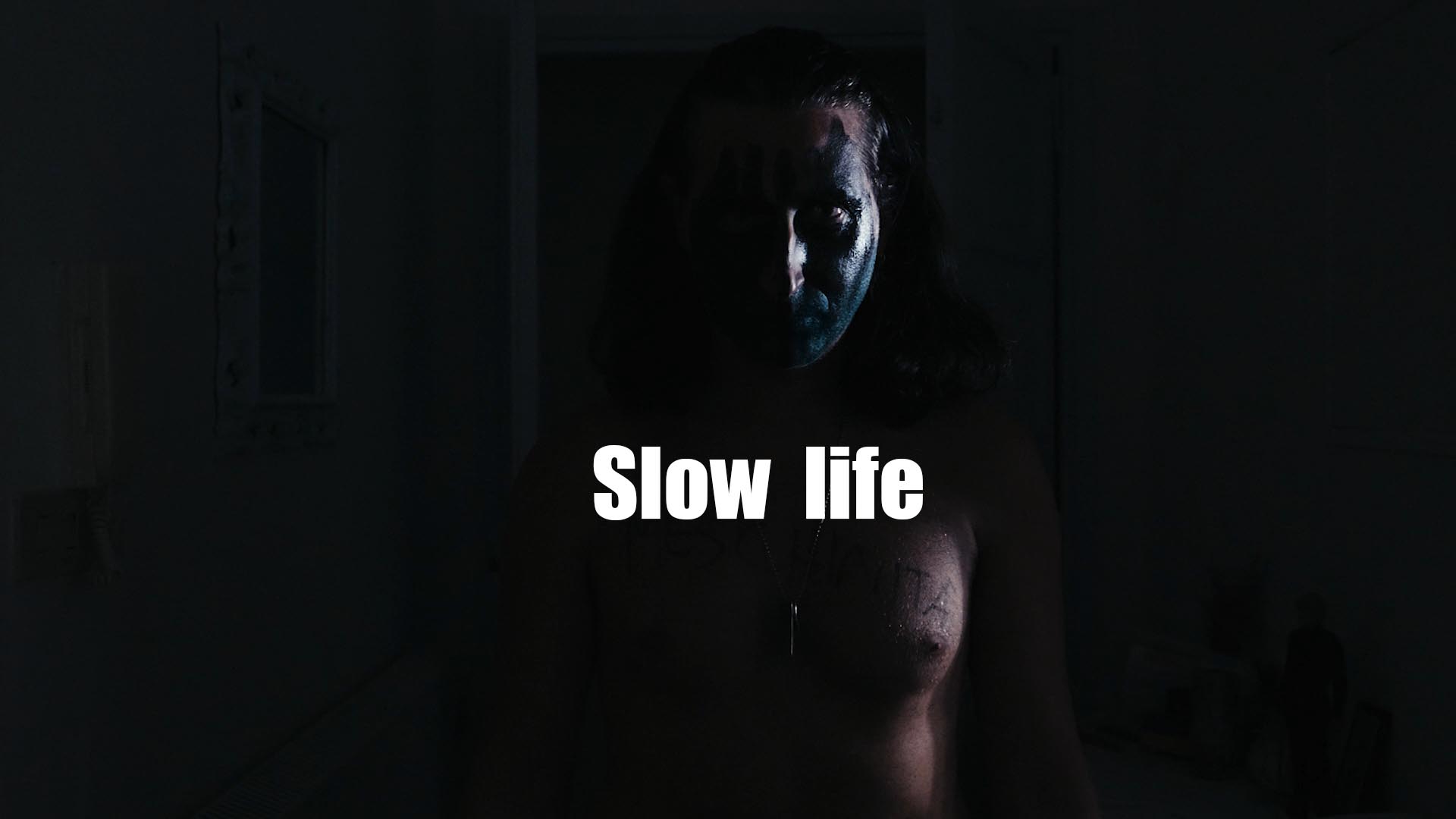
Drama, comedy, thriller, by Fabio Del Greco, Italy, 2021.
Lino Stella takes a period of vacation from his alienating job to devote himself to relaxation and his passion: drawing comics. But he did not foresee certain disturbing elements: the intrusive administrator of the building where he lives, the postman who delivers crazy fines and tax bills, an overbearing security guard, a very enterprising real estate agent, the old lady downstairs who raises the feline colony of the condominium. These characters will make his vacation hell.
Food for thought
The larger a social group is, the more rules and bureaucracy are needed, which often do not respect the individual. You have to learn to live with annoying people, but sometimes the social pressure and arrogance can become intolerable. The only laws that always come to our aid are the laws of Nature.
LANGUAGE: Italian
SUBTITLES: English, Spanish, French, German, Portuguese
Russell’s Provocation and What It Cost Him
The year is 1932. Breadlines stretch around city blocks in Detroit. A quarter of the American workforce has no job at all, and in Britain the unemployment rolls carry nearly three million names. Into this atmosphere of collective desperation and shame, Bertrand Russell publishes an essay arguing that human beings work far too much.
The audacity of that timing is not incidental. Russell knew precisely what he was doing. To praise idleness in 1932 was not eccentric philosophizing from a comfortable armchair — though he had one, and used it — it was a deliberate provocation aimed at the deepest assumption holding industrial civilization together: that labor is virtue, that effort is proof of worth, that a person who is not producing is somehow failing to justify their existence. Russell wanted to expose that assumption as a theological residue dressed in economic language, a piece of Protestant guilt that had been so thoroughly absorbed into social structure that no one could see it anymore as a choice.
His proposal was specific and structural. In the essay, Russell argued that if the available work in a society were distributed evenly across the population, four hours of daily labor would be sufficient to maintain everything a civilized society actually needs. The rest — the additional hours, the overtime, the compulsive busyness — served not material necessity but ideology. It served the psychological need of those in power to keep the laboring classes too exhausted to think, too tired to want more, too depleted to imagine alternatives. He had developed this diagnosis more fully in his 1938 work “Power: A New Social Analysis,” but the 1932 essay is where the argument finds its sharpest edge, unguarded by academic hedging.
What made Russell’s position genuinely costly was that it arrived from someone who had no material need to say it. He was a peer of the realm, a Cambridge philosopher with an aristocratic surname that stretched back centuries. He could have spent his career writing safely inside the boundaries of mathematical logic — his “Principia Mathematica,” co-written with Alfred North Whitehead and published between 1910 and 1913, had already guaranteed his reputation across several generations. Instead he chose to write about work, leisure, desire, and the management of populations with a directness that made him enemies in exactly the institutions that might otherwise have protected him. He was dismissed from a professorship at City College of New York in 1940, the appointment revoked after a legal challenge that described his views as morally unfit. The judge’s opinion specifically cited Russell’s writings on ethics and sexuality. The four-hour workday had nothing to do with the stated charges, but everything to do with the pattern: a man who questioned one foundational assumption was understood, correctly, to be questioning the whole architecture.
His argument about leisure was inseparable from his broader philosophy of happiness, most explicitly developed in “The Conquest of Happiness,” published just a year before the idleness essay in 1930. There he diagnosed what he called the pursuit of excitement as a symptom of inner emptiness, the frenetic activity of people who have never been allowed to learn what genuine rest produces in the mind. Leisure, for Russell, was not the absence of work. It was the presence of unstructured time in which genuine curiosity, creativity, and democratic participation could actually develop. A population ground down to exhaustion by eight, ten, twelve hours of labor daily was not a population capable of self-governance. It was a population capable only of obedience and distraction.
That is what made the essay scandalous in 1932, and what keeps it from being merely historical. He was not describing what workers deserved. He was describing what power requires them never to have.

The Moral Machinery of Exhaustion
You know the feeling. It is Sunday afternoon, the light is doing something generous across the floor, and there is nothing that needs doing — and yet something in you will not settle. A faint unease rises, sourceless and insistent, as though the stillness itself were an accusation. You have not earned this quiet. You should be doing something. The guilt arrives before any thought does, automatic as a reflex, older than your own choices.
This is not weakness. It is engineering.
The moral weight attached to labor is not a natural fact about human beings. It was constructed, deliberately and over time, with identifiable architects and a traceable blueprint. Max Weber, in his 1905 study of the relationship between Protestant theology and the spirit of capitalism, traced the genealogy of this guilt with a precision that still unsettles. The Calvinist doctrine of predestination, he argued, created a psychological emergency: if salvation was already determined and unknowable, the only available signal of one’s elect status was worldly success achieved through disciplined, unrelenting toil. Leisure became theologically suspect. Rest was not restoration — it was temptation, evidence of insufficient seriousness about one’s soul. What began as metaphysical anxiety hardened, over generations, into secular habit. God receded. The guilt remained, stripped of its original justification and therefore far more difficult to argue with.
E.P. Thompson, writing in 1967 in his essay on time, work-discipline, and industrial capitalism, showed the other half of the mechanism — the institutional side that Weber’s theological account did not fully reach. Pre-industrial workers, Thompson documented, organized their labor around tasks, not clocks. A fisherman worked when the tide required it. A weaver set his own rhythm. The introduction of factory time imposed an entirely different relationship to the hours of the day: time became a commodity owned by someone else, something that could be wasted, stolen, or spent. Employers distributed clocks. Churches preached punctuality. Schools trained children to sit still and wait for a bell. Tiredness, in this new dispensation, was no longer simply a bodily state — it was a moral report. The worker who flagged was not merely tired; he was failing. The worker who rested without permission was not merely resting; he was stealing.
Russell saw the combined effect of both forces clearly, even if he named them differently. The genius of the arrangement, in his view, was that the oppression had been internalized so thoroughly that external enforcement became almost superfluous. A man who has been taught since childhood that his worth is identical to his productivity does not need a foreman standing over him on Sunday afternoon. He carries the foreman inside. The guilt you feel in that generous Sunday light is not yours — it was installed in you, and it serves someone else’s interests, and it has been doing so for several centuries.
What makes this particularly difficult to dislodge is that the manufactured guilt presents itself as virtue. It masquerades as conscientiousness, as seriousness, as adult responsibility. The person who cannot rest is not seen as damaged — they are admired. The person who insists on rest is seen as lacking something, some necessary moral fiber. This inversion is the mechanism’s most elegant feature: it makes the victim of the conditioning look like its beneficiary.
A man sits at a desk long after the work is finished, rearranging papers, refreshing screens, manufacturing the appearance of effort for an audience that has already gone home. He is not lazy. He has never been lazy. He is performing the ritual that was taught to him as the shape of a worthy life, and the performance has become indistinguishable from belief. The guilt that would follow him home if he left early is not a side effect of the system. It is the system. It is the load-bearing wall.
A Man Who Stopped
He hands in his resignation on a Tuesday, which matters only because Tuesday is the most unremarkable day of the week, the day furthest from the drama of Mondays and the relief of Fridays. His desk is clean before he leaves. He has not been fired. The quarterly numbers were strong. There is no affair, no illness anyone can identify, no obvious wreckage to point at. He simply decided, with a clarity that came on slowly and then all at once, that he was finished. The colleagues who see him in the elevator on his last day will spend the next several months explaining this event to themselves and to each other, and not one of their explanations will include the possibility that he was right.
This is the social illegibility that Russell circles but never quite names with this kind of precision: a man broken by work is a tragedy the culture can absorb, file, and move on from. A man who walks away from work by choice, at the height of his functioning, having lost nothing and simply decided differently — that man is a problem. Burnout has a grammar everyone recognizes. It produces sympathy, LinkedIn posts about mental health, performative restructuring. It confirms the system’s fundamental benevolence, because the system, in this reading, demands too much of its best people, which is a form of flattery. The man who burns out was simply too devoted, too giving. The narrative holds.
But the man who stops without burning, who leaves not because the work destroyed him but because he looked clearly at what the work was and decided it was not worth the hours of living it consumed — he has no legible story. His clarity reads as symptom. His calm reads as denial. If he were suffering, his departure would make sense. Because he is not, it must mean something is wrong that he cannot yet see.
What makes the resigned man threatening is not his laziness. He works, after he leaves. He reads, walks, thinks, builds things, cooks, sleeps without an alarm. He is not inert. What he has refused is the particular form of activity that generates legible social value, the kind that produces a title, a salary, a narrative arc pointing always upward. Thorstein Veblen, writing in “The Theory of the Leisure Class” in 1899, understood leisure as a display of status, something the powerful performed to signal their distance from necessity. What Russell proposed, and what the resigned man enacts, is something entirely different: leisure as a private act of revaluation, undertaken not to signal anything to anyone, but because the hours of a life are finite and the question of how to spend them is the only serious question there is.
His colleagues will eventually settle on the word “burnout” anyway, retroactively, because it is the only container they have. The story requires a cause proportionate to the effect. That he simply saw clearly, and acted on what he saw, is a possibility the available vocabulary cannot hold.
What Leisure Was Never Meant to Be
You check your phone before you are fully awake. Not because anything urgent has happened, but because the silence of a Saturday morning has already started to feel like something that needs filling. By ten o’clock you have watched forty minutes of content you will not remember by noon, scrolled past twelve opinions you did not ask for, and consumed two products through the act of wanting them. You have not yet done anything. And yet exhaustion is already present, faint but recognizable, the way a room can feel stuffy before you notice you have been breathing shallowly for an hour.
This is what Russell did not foresee, and what makes his argument both more urgent and more complicated than it first appears. He imagined that freed time would become inhabited time — that people released from the compulsion of overwork would discover thought, craft, contemplation, the slow satisfactions of making something or understanding something without any productive justification. He was wrong about the mechanism, though not about the diagnosis. The freed time arrived, in a distorted form, and was immediately colonized by a different kind of compulsion dressed in the language of pleasure.
Guy Debord, writing in 1967, gave this colonization its most precise name. In his account, modern society had not simply produced goods — it had produced the representation of life as a substitute for life itself. Leisure, in this framework, is not the opposite of work but its continuation by other means. The spectator consuming entertainment, tourism, or lifestyle is not resting from the logic of the commodity; they are enacting it in a different register. The weekend does not interrupt the economic subject — it restores them, refuels them, prepares the body and attention for Monday. Debord’s insight was that even the hours designated as free had been engineered into a form of compliance.
Josef Pieper arrived at the same territory from the opposite direction. Writing just after the Second World War, he argued that genuine leisure was not idleness in any passive sense, but a kind of inner stillness that required a particular relationship to existence — one not organized around utility. What he called leisure was closer to what the ancient Greeks meant by schole: time that belonged to no purpose outside itself, and therefore opened the only conditions in which genuine thought, genuine festivity, genuine worship could occur. Pieper’s alarm was that industrial civilization had not merely reduced this time but had corrupted the very concept, replacing the capacity for non-instrumental being with what he called “total work” — the inability to conceive of any human activity that was not, at some level, a form of production.
What neither man could have fully anticipated was how thoroughly this total work would learn to disguise itself as its own opposite. The weekend was not an accident of generosity. The two-day rest structure, consolidated across Western economies through the early twentieth century, was adopted in part because Henry Ford discovered in 1926 that workers with Saturdays free bought more cars. Rest was rationalized as a condition of consumption, and consumption was rationalized as a form of rest. The circle closed so neatly that the seam became invisible.
Russell’s “creative idleness” — the phrase he never quite used but clearly intended — required something that cannot be manufactured and cannot be scheduled. It required a self that was not already exhausted by the performance of leisure, not already shaped by a culture that had pre-filled every silence with stimulation, not already convinced that an unoccupied afternoon was a problem to be solved rather than a space to be inhabited. What the twentieth century built in place of that was a very efficient system for feeling busy while doing nothing that matters, and feeling guilty about the nothing while consuming the busy.
The tragedy is not that people chose distraction over depth. The tragedy is that the choice was largely made for them before they arrived at the weekend.
A vision curated by a filmmaker, not an algorithm
In this video I explain our vision
The Productivity Trap Has a History

There is a particular kind of exhaustion that people announce rather than hide. You hear it at dinner tables, in office corridors, in the breathless tone of someone explaining they have not had a weekend to themselves in three months — and the voice carries something unmistakable, something adjacent to pride. This is not a private feeling that escaped accidentally into speech. It is a performance, and the audience is expected to recognize its currency.
Thorstein Veblen saw the template for this long before the performance reached its current pitch. In The Theory of the Leisure Class, published in 1899, he described how high social standing had always required the visible display of not working — leisure as proof of elevation, idleness as the badge of those who had transcended necessity. The aristocrat hunted. The gentleman scholar dawdled through libraries. The woman of good family did not carry her own parcels. What Veblen identified was that status had always been performed through conspicuous abstention from labor. But he also noticed, with the sociologist’s eye for irony, that systems of signaling are inherently unstable — they invert when the signal becomes too available to those below.
By the late twentieth century, the inversion was complete. Leisure had become cheap enough to simulate: mass tourism, weekend recreation, the appearance of ease available to almost anyone with a credit card. What became scarce — and therefore newly prestigious — was the opposite. Busyness. Overwork. The calendar with no white space. The senior consultant who lands at midnight and presents at eight. Sociologists Silvia Bellezza, Neeru Paharia, and Anat Keinan documented this shift in a 2017 study in the Journal of Consumer Research, demonstrating experimentally that Americans now associate busyness with high status, competence, and importance — a direct reversal of the Veblenian original. The rich now perform exhaustion. The aspirational class signals its value through suffering.
The numbers underneath this performance are not symbolic. They are structural. Average working hours across OECD countries in 1970 hovered near 1,900 per year in most industrialized nations. By 2022, the OECD average had fallen to approximately 1,750 hours — a reduction that sounds like progress until you notice how unevenly it distributed. In Germany and the Netherlands, the figure dropped below 1,400 hours, driven by strong union agreements, legally protected part-time work, and a cultural willingness to treat time as a legitimate negotiating object. In the United States, the figure barely moved, remaining above 1,800 hours, placing it consistently among the highest in the developed world. Mexico and Colombia, carrying different structural pressures entirely, regularly exceed 2,200 hours annually — figures that make Russell’s 1932 proposal of a four-hour working day sound not like philosophy but like emergency medicine.
What those aggregate numbers conceal is the class architecture of exhaustion. The compression of working hours in Western Europe largely benefited middle-income workers with institutional protection. At the bottom, hours expanded through the proliferation of multiple part-time jobs stitched together into an irregular, unpredictable schedule that offers neither the income of full employment nor the genuine freedom of free time. This is the other face of the contemporary leisure economy: the gig worker with four income streams and no afternoon that belongs to them, who cannot afford to perform busyness because they are simply inside it without exit.
Russell understood, writing from within the specific anxieties of interwar Britain, that the equation of labor with virtue had been installed deliberately and maintained strategically. What he could not fully anticipate was how thoroughly the equation would migrate from moral prescription into identity formation — so deep that dismantling it would feel not like liberation but like self-erasure. The trap’s sophistication lies precisely there: it does not need enforcers anymore. The prisoner has internalized the architecture of the cage and calls the walls a personality.
What Gets Thought in the Silence
There is a kind of thinking that cannot be scheduled. You have probably noticed it yourself — the idea that arrived not during the meeting where the problem was formally posed, but three days later, in the middle of something completely unrelated, when your attention had finally let go of its grip. That loosening is not incidental to the thought. It is structurally required by it.
Russell understood this, and it is one of the places where his argument in “In Praise of Idleness” reaches beyond the economic and touches something about the nature of mind itself. The leisure he defends is not recuperation from labor so that labor can resume. It is not the weekend as a biological maintenance interval. He is pointing at something more radical: that certain forms of human activity — the genuinely creative, the politically imaginative, the philosophically serious — cannot occur inside time that is organized around productive output. They require what he calls, without embarrassment, purposelessness. Not rest with a purpose. Purposelessness itself.
Hannah Arendt made a distinction in 1958 that gives Russell’s intuition a structural anatomy. In “The Human Condition,” she separated three modes of human activity: labor, which reproduces biological life and is cyclical and consumed; work, which produces durable objects and institutions that outlast the individual; and action, which is the sphere of genuine plurality, of speech and politics and the unpredictable, the realm where something genuinely new enters the world. Labor is what you do to survive. Work is what you do to build. Action is what you do to be, in the full political sense — to appear before others as a subject with a view, to initiate something whose consequences you cannot fully control.
What Arendt feared, and documented with precision, was the reduction of all three into the first. A society organized entirely around the metabolism of labor — consuming, reproducing, consuming again — colonizes the time and the inner architecture that action requires. Action needs a certain kind of attention: open-ended, not result-oriented, tolerant of ambiguity, willing to begin without knowing where arrival is. That attention cannot be maintained in a mind that has spent fourteen hours responding to urgency. The exhaustion is not only physical. It is the exhaustion of a particular cognitive posture, the one that keeps scanning for threats and deliverables. When that posture becomes habitual, the muscles required for action — for genuine political imagination, for the kind of thought that produces not an answer but a new question — atrophy quietly, without announcing themselves.
This is what gets structurally prevented. Not leisure in the abstract, but the specific mental condition in which a person can entertain an idea without immediately asking what it is for. A thought pursued for its own momentum, a political position arrived at through genuine reflection rather than identity-tribe signal, an aesthetic experience that reorganizes one’s sense of what matters — these are not luxuries that idle hands produce out of boredom. They are the substance of what Arendt meant by action. And they require time that is not accounted for, time that does not report back to productivity.
Russell wrote in 1932 that the laboring classes had been kept too busy to form political opinions of their own. He was not being cynical. He was being observational. A person who works six days a week and returns home depleted does not lack the intelligence to think politically. They lack the unstructured time in which political thought — real political thought, not the consumption of pre-formed positions — can actually form. The thought that changes something is never the thought produced on deadline. It is the one that arrived when no one was waiting for it, when the mind had been allowed, for long enough, to wander without a destination that justified the wandering.
The Question That Doesn’t Close
There is a moment that arrives, usually somewhere around the third consecutive weekend you have worked through, when you stop noticing that you are tired. Not because the tiredness has gone, but because it has become the baseline. You recalibrate without deciding to. The exhaustion stops feeling like a symptom and starts feeling like evidence — evidence that you are serious, that you matter, that your absence would be felt. And somewhere in that recalibration, a question gets buried so deep it stops seeming like a question at all.
This is where the argument becomes personal in a way that is hard to dismiss. Because you can accept the historical analysis, nod at the structural critique, acknowledge the Veblen-adjacent insight about conspicuous productivity as a class signal, and still find yourself, on a Tuesday evening, opening your laptop after dinner with something that feels disturbingly like relief. Not obligation. Relief. As if the work is the thing that keeps a more uncomfortable silence from settling in.
Simone Weil, writing about factory labor in the 1930s, described how the rhythm of mechanical work colonizes attention until the worker cannot easily tolerate its absence. The body learns to fill itself with noise. This is not a metaphor about factories. It describes something that has simply migrated upward through the class structure, traded the assembly line for the notification, the foreman for the metric dashboard, the piece-rate for the performance review. The mechanism is identical. The colonization is the same.
What Russell could not have fully anticipated was the degree to which the ideology of busyness would eventually be internalized not as submission but as identity. By the time Jonathan Gershuny at the University of Oxford was documenting in the early 2000s that higher-income workers in developed economies had actually increased their working hours as their wages rose — inverting every classical economic prediction about leisure as a superior good — the inversion was already legible as a cultural value system, not an anomaly. People were not working more because they had to. They were working more because they had come to understand themselves through working, which is a different and more durable trap entirely.
The trap is durable because it is not experienced as a trap. It is experienced as commitment, as ambition, as the responsible version of yourself that you present to others and, more importantly, to the mirror. Russell’s provocation, stripped to its sharpest edge, is not really about hours or economics or even leisure. It is about the question of who benefits from your belief that your value is inseparable from your productivity — and whether you have ever, in a moment of genuine stillness, allowed yourself to sit with the unsettling possibility that the answer to that question is not you.
⏳ Work, Leisure, and the Art of Living Freely
Bertrand Russell‘s ‘In Praise of Idleness’ invites us to question the moral cult of work and imagine a society organized around meaningful rest and creative freedom. The articles below explore the deepest philosophical and sociological roots of this vision, from the economics of leisure to the politics of time, tracing a map of ideas that speak directly to Russell’s central argument.
Veblen’s The Theory of the Leisure Class: Analysis
Thorstein Veblen‘s landmark analysis of the leisure class reveals how idleness, far from being innocent rest, became a powerful marker of social status in industrial society. Veblen’s concept of ‘conspicuous leisure’ offers a provocative counterpoint to Russell’s idealism, showing how free time is never simply free but always entangled with class and power. Reading the two thinkers together illuminates the hidden politics embedded in every hour we choose not to work.
GO TO THE SELECTION: Veblen’s The Theory of the Leisure Class: Analysis
Karl Marx and Alienation: Economic and Philosophical Manuscripts
Karl Marx’s early manuscripts on alienation provide the philosophical foundation from which Russell’s argument most powerfully departs. For Marx, forced labor under capitalism estranges workers from their own humanity, a diagnosis that Russell would later answer by calling for a radical reduction of working hours for all. Together, these two visions form a compelling dialogue about what human life could look like if labor were no longer its organizing principle.
GO TO THE SELECTION: Karl Marx and Alienation: Economic and Philosophical Manuscripts
Thoreau’s Walden: Meaning and Analysis
Henry David Thoreau‘s ‘Walden’ stands as one of the most radical experiments in voluntary simplicity and deliberate idleness ever undertaken. Like Russell, Thoreau argued that the compulsion to work beyond necessity enslaves the spirit and narrows the horizons of genuine experience. His retreat to Walden Pond was not an escape from life but an insistence on living it more fully, a gesture Russell would have deeply recognized and admired.
GO TO THE SELECTION: Thoreau’s Walden: Meaning and Analysis
Mass Social Homologation Today
Mass social homologation—the pressure to conform to dominant values, rhythms, and productive ideals—lies at the heart of what Russell diagnosed as the modern world’s excessive veneration of labor. When rest is stigmatized and busyness becomes a virtue, society loses the inner diversity that philosophy and culture require to flourish. This article examines how conformity operates today, making Russell’s century-old plea for idleness feel more urgent than ever.
GO TO THE SELECTION: Mass Social Homologation Today
Discover Films That Celebrate Freedom from the Ordinary
If Russell’s vision of a life freed from compulsory work resonates with you, independent cinema offers some of the most daring explorations of time, freedom, and human potential. On Indiecinema streaming you will find films that dare to slow down, to question, and to imagine differently—a curated space for those who believe that watching thoughtfully is itself a form of meaningful idleness.
👉 EXPLORE THE CATALOG: Watch Indie Films in Streaming
A vision curated by a filmmaker, not an algorithm
In this video I explain our vision

