
The Woman at the Threshold
You are sitting close enough to see the lamp-oil sweat on her collarbone, close enough to catch the moment before the performance begins — that fractional pause when she is neither woman nor art, neither servant nor sovereign, but something the Sanskrit grammarians never quite found a word for. The musicians haven’t struck a note. The courtiers arranged along the durbar walls are pretending not to watch, which is the only honest thing they will do all evening. And she stands there, in that lit space between the curtain and the floor, holding an entire room inside her stillness.

The courtesan in classical Indian literature is almost never introduced as a person. She arrives as a condition — of the city, of the court, of the civilized world’s claim on beauty. In Vatsyayana’s Kama Sutra, composed somewhere between the third and fifth centuries of the common era, the ganika occupies an entire book of her own, the sixth, and the detail is extraordinary: she is instructed in sixty-four arts, expected to master rhetoric and music and the preparation of garlands and the mixing of pigments, to be literate where most men were not, to hold conversation with scholars, to manage accounts. This is not description; it is architecture. The text is building a category of woman who is more accomplished than any wife the reader will ever take, and it is doing so without apology or irony, because the culture that produced it had not yet learned to be embarrassed by this.
What makes that architecture so strange to modern eyes is the simultaneity it demands. The ganika is free in every register that matters — intellectually, economically, physically — inside a structure designed entirely to contain her freedom for the pleasure of others. She owns property in a world where most women are property. She chooses her patrons in a world where most women are chosen. And yet the freedom pivots on her continued desirability, which means it pivots on her continued performance, which means it is a freedom with a trapdoor built into every room.
The Arthashastra of Kautilya, that ruthlessly practical manual of statecraft assembled in something close to its final form around the fourth century BCE, assigns the supervision of courtesans directly to the state. The superintendent of prostitutes, the Ganikaadhyaksha, is a royal officer. He records the women’s earnings, collects their tax, arranges their performances at public ceremonies, and determines the fee schedules for their time. This is not exploitation dressed as administration, or rather it is both simultaneously, which is the only honest way to describe any system that monetizes intimacy under official seal. Kautilya is not embarrassed either. His text simply notes that a kingdom requires the ganika the way it requires an army or a treasury — as infrastructure.
Literature, however, is where the infrastructure begins to breathe and sometimes to bleed. The Mricchakatika, the Little Clay Cart attributed to Shudraka and dated roughly to the second century CE, gives its central courtesan Vasantasena a series of scenes that still feel like violations of the genre’s conventions, because Vasantasena falls in love in a way that costs her something real. She gives away her jewelry. She endangers herself. She enters the poor man’s house in the rain because she wants to, not because she is paid. The play was popular for centuries precisely because it showed the trapdoor opening under the freest woman in the room, which meant every audience member could privately calculate how much more easily it opened under them.
There is a particular quality to the power wielded by a woman who understands that she is the room’s real subject while everyone pretends she is merely its decoration, and Indian literature returned to this quality obsessively, not to celebrate it, not to condemn it, but because it illuminated something about power itself that no king’s biography could reach.
Thirsty
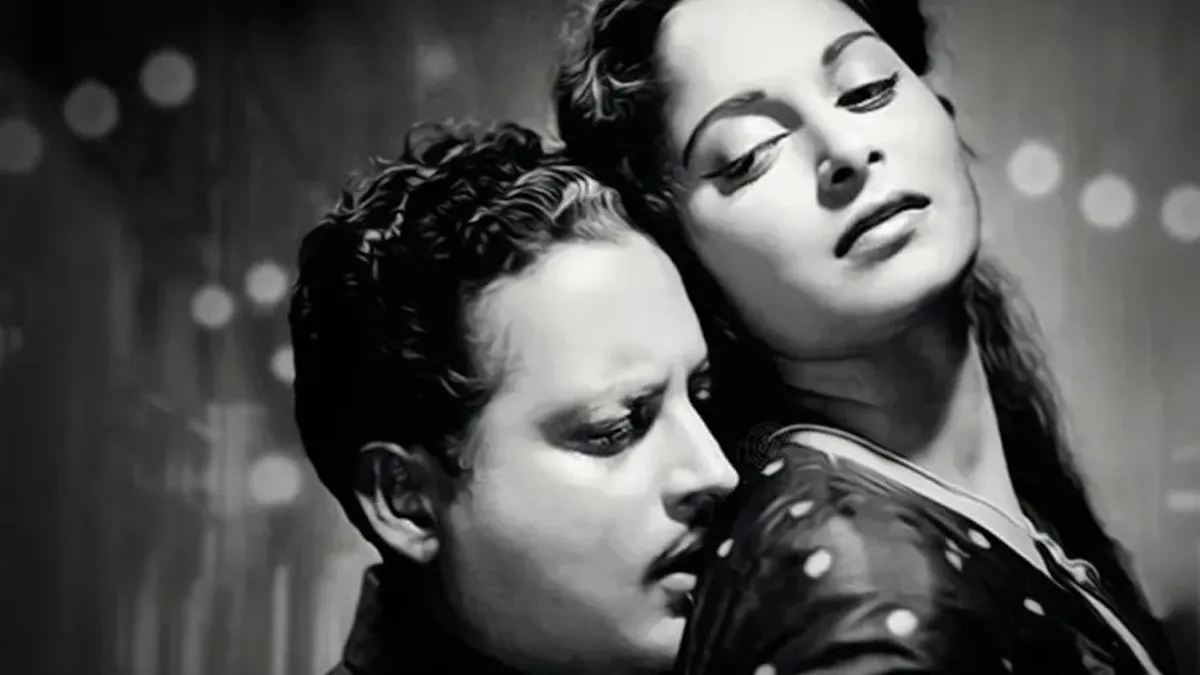
Drama, musical, by Guru Dutt, India, 1957
Thirsty is the heartbreaking story of Vijay, a young poet living in Calcutta who dreams of giving voice to the suffering and injustice of the world through his verses. Idealistic and sensitive, Vijay clashes with a society that despises his art because it is not profitable and does not cater to the tastes of the public. His brothers consider him a failure, the woman he loves leaves him for a marriage of convenience, and his poems are ignored by publishers. Only Gulabo, a prostitute with a pure heart, recognizes the beauty and truth of his words. When a misunderstanding leads everyone to believe Vijay is dead, his name and poetry suddenly become famous, exposing the hypocrisy of those who had previously rejected him.
Watching Thirsty means immersing oneself in a work that goes beyond melodrama, blending poetry, music, and imagery into a profound reflection on the human soul and the value of art. Guru Dutt, director and protagonist, creates one of the most intense and poetic films in world cinema, where black-and-white cinematography, expressive framing, and evocative lyrics produce an atmosphere of poignant melancholy. It is a film about the misunderstanding of the artist, pure love, and society’s hypocrisy, but also a universal critique of materialism and opportunism. Even today, Thirsty moves and provokes thought because it sincerely tells the story of the need to remain true to oneself in a world that measures people’s worth solely by their success.
LANGUAGE: Hindi
SUBTITLES: English, Spanish, French, German, Portuguese
Desire Codified, Desire Controlled
You have memorized the wrong thing about the Kamasutra. Almost everyone has. The text that Vatsyayana composed somewhere in the third or fourth century CE — a work of seventy-four chapters organized into seven books — is not a manual of positions. It is a manual of personhood, and more specifically, it is a manual of the kind of personhood that only a particular class of woman was expected to master completely. The ganika, the cultivated courtesan, appears in the Kamasutra not as a footnote or a cautionary figure but as the most fully realized practitioner of its entire system. The man of leisure, the nagaraka, is its nominal subject. The ganika is its secret standard.
Vatsyayana’s taxonomy of the sixty-four arts that a woman of refinement must command includes music, dance, flower arrangement, the preparation of perfumes, knowledge of poetic meters, skill in games, mastery of disguise, and fluency in at least the rudiments of several languages. What this list describes is not seduction. It is civilization compressed into a single professional body. The courtesan was the site where the aesthetic aspirations of an entire urban culture were stored and made available, much as a library stores what a city thinks it knows about itself. She did not merely participate in the cultural life of the city — she was required to embody its highest articulation, which meant that her desire, or what appeared as her desire, had to be trained into a form of eloquence legible to anyone capable of reading it.
Bharatamuni’s Natyashastra, composed roughly contemporaneously and in some scholarly estimates even earlier, makes the logic beneath this arrangement structurally explicit. The treatise’s exhaustive codification of rasa — the eight or nine aesthetic essences that govern all performance — places erotic feeling, shringara, at the apex of the entire system, the rasa from which all others draw color and intensity. The actress-dancer who performs shringara on stage is not expressing personal emotion. She is channeling a shared affective structure that belongs to the audience as much as to her, a technician of collective feeling. When the Natyashastra specifies the precise angles of glances, the calibrated trembling of the lower lip, the exact duration of a pause before speech, it is not describing spontaneity. It is describing the manufacturing conditions of what will be received as spontaneity.
This is the social technology buried inside the aesthetic one. A desire that has been trained to its finest expression has also, necessarily, been made predictable, bounded, and safe for the world that consumes it. The courtesan who mastered Vatsyayana’s arts and embodied Bharatamuni’s rasas was a figure of enormous cultural prestige and equally enormous social containment. She could not own property in the same registers as wives. She could not transmit caste status to her children in the same ways. Her very excellence was the mechanism of her enclosure, because excellence in this register required her to remain exactly what she was — available, accomplished, permanent in her function, impermanent in any specific attachment.
What neither text says aloud, but what both require in order to function, is that the woman who performs desire so perfectly must never be permitted to possess it on her own terms. The Kamasutra does include a section advising the ganika on how to calculate a lover’s worth, how to manage multiple patrons, how to protect her earnings. Generations of scholars have cited these passages as evidence of her agency. But agency dispensed by a text is always also agency shaped by one, and what the Kamasutra licenses in those chapters is a very specific form of strategic rationality — the capacity to optimize within a system whose fundamental architecture she did not design and cannot alter.

The Ganika and the Grammar of Worth

You are sitting across from a woman who has memorized sixty-four arts. She can tune a vina, debate the merits of rival philosophical schools, identify a man’s social rank by the cadence of his laughter, and compose a verse that will outlast the dynasty funding the room she inhabits. She is not a wife. She is not a slave. She is, in the precise administrative vocabulary of Kautilya’s Arthashastra, a ganika — and the state has a very specific file on her.
What Kautilya constructed in the third century BCE was not merely a theory of governance but a taxonomy of human value expressed through institutional categories. The Arthashastra dedicates substantial attention to the ganika within its broader architecture of state revenue and social regulation, and the attention is neither romantic nor condemning — it is bureaucratic, which is far more revealing. A rajaganika, a courtesan attached to the royal court, was assessed a monthly salary of one thousand panas. She was required to perform at public ceremonies. She was taxed at a fixed rate. She could be fined for refusing a summons. Her daughter could inherit her profession and her training, which was itself a form of state-managed cultural transmission. The state did not simply tolerate her existence; it scheduled it.
This is where the comfortable narrative of the liberated courtesan collides with something harder. The legal standing granted to the ganika in ancient Indian jurisprudence was real — she could own property, enter contracts, seek legal redress — but this standing was never separable from the surveillance apparatus surrounding it. Kautilya’s text specifies that a superintendent of courtesans, the ganikaadhyaksha, was responsible for overseeing their training, their earnings, and their movements. The same chapter that grants her economic personhood instructs the state to monitor her relationships and extract intelligence from her encounters with foreign dignitaries. Autonomy and instrumentalization were not opposites in this system. They were the same administrative gesture, made from two directions simultaneously.
Classical Sanskrit poetics built an entirely different scaffolding over the same social reality. The nayika typologies found in texts like Bharata’s Natyashastra, codified further by later theorists like Dhananjaya in the Dasharupaka of the tenth century, organized female figures according to their emotional and erotic posture — the svakiya, the parakiya, the samanya. That last category, the samanya nayika, the woman available to all, was not degraded in aesthetic theory. She was, in fact, considered the most technically accomplished emotional performer, precisely because she could not afford the luxury of authentic feeling. Her craft was the simulation of feeling so precise that it became indistinguishable from the real. What the aestheticians were describing, without quite saying it, was that mastery over emotion was a professional skill, and that the most economically precarious woman in the text was also the most technically sophisticated artist in it.
The sixty-four kalas catalogued in the Vatsyayana Kamasutra — which dates to roughly the third century CE — were not a curriculum of seduction. They were a curriculum of cultural completeness: music, dance, mathematics, archery, cookery, carpentry, knowledge of languages, skill in disguise. A woman trained in all sixty-four was not merely desirable; she was educated to a standard that most men of her era would not meet. The cruel irony embedded in this system is that the more accomplished she became, the more precisely she fulfilled the function the state had designed her for. Excellence was not a path out of the category. Excellence was the category’s deepest requirement.
What these texts collectively reveal is a civilization that had no difficulty granting a woman intellectual and legal personhood while simultaneously ensuring that personhood remained entangled with economic dependency and state extraction. The grammar of worth in these documents is not a grammar of freedom.
Literature's Necessary Impurity
You are standing in the middle of a courtyard at dusk, watching a woman arrange flowers she has paid for herself, in a house she owns, in a city where no respectable man will acknowledge her by daylight — and you notice, only slowly, that she is the freest person in the scene.
Vasantasena in Shudraka’s Mricchakatika, composed somewhere in the first centuries of the common era, is not a tragic figure waiting to be rescued. She is the structural center of gravity around which every other character in the play bends and breaks. A wealthy courtesan in Ujjain, she falls into something indistinguishable from love with Charudatta, a Brahmin who has lost his fortune through generosity — a man, crucially, whose social position is defined by lineage rather than wealth. The play sets these two coordinates against each other and then refuses to resolve the tension cleanly. What Shudraka understood, with a precision that most moralists of the period lacked, is that Vasantasena’s desire is not contaminated by her profession — it is clarified by it. She has spent her life reading men who want something from her, and she chooses one who does not perform that wanting. The irony is structurally devastating: the woman defined by transaction is the only one in the play capable of disinterested feeling.
The caste logic underlying this irony is not incidental. The Arthashastra, compiled in approximately 300 BCE and attributed to Kautilya, dedicates an entire chapter to the regulation of courtesans, treating them as state assets whose mobility, earnings, and client relationships required administrative oversight. This is not the register of literature but of political economy, and that distinction matters enormously — because what the Arthashastra attempts to contain, Mricchakatika tears open. The play allows Vasantasena to gift her jewels freely, to move across the city without male escort, to speak her own interiority in verse, and finally to testify on behalf of a man the state has already condemned. She enters the legal and civic space from which she is structurally excluded and forces it to reckon with her. The caste system’s deepest logic depends on the immobility of categories, and she refuses immobility at every level simultaneously.
Amrapali operates in a different register but performs an equally corrosive function within the Pali canon. According to the Therigatha and associated Jataka narratives, she was the ganika — the state courtesan — of Vaishali, a city-republic whose civic architecture depended on her controlled visibility. Her conversion and renunciation in the presence of the Buddha is recorded not as a scandal but as a demonstration, and this is where the Buddhist literary tradition does something quietly radical: it preserves her voice. The verses attributed to her in the Therigatha are an inventory of bodily decay — her hair, her teeth, her skin described in their current ruin against what they were at the height of her desirability. This is not self-erasure. It is a philosophical argument conducted through the first person by a woman whose entire social existence had been organized around others’ appraisal of her body. She wrests the right to assess it herself.
What connects these two figures across their different traditions is not virtue and not suffering but the stress they place on the systems that produced them. Both texts use the courtesan to locate exactly where social logic collapses under its own pressure — where caste purity requires economic impurity to fund it, where renunciation needs the body it claims to transcend, where the state that regulates desire depends on the desiring woman to remain legible and manageable. The moment she becomes a subject rather than a function, the entire architecture develops visible fractures. That this happened repeatedly in Indian literary tradition, across centuries and doctrinal commitments as different as Sanskrit drama and Buddhist canonical verse, suggests that the fractures were not accidental.
The Colonial Reinvention of Shame
You are standing in a courtroom in Madras in 1892, and the woman before the magistrate has spent twenty years learning the precise angle at which the wrist must rotate during a particular sequence of abhinaya. She cannot name what she is being charged with because the law has already named her, and the name it has chosen erases every other name she has ever carried.
The legal architecture that accomplished this had been imported from a specific anxiety. Britain’s Contagious Diseases Acts of 1864, 1866, and 1869 had been designed to manage venereal disease among soldiers garrisoned at home, granting police the authority to detain and medically examine any woman suspected of prostitution near military zones. When the Acts were extended to Indian cantonments through the Indian Contagious Diseases Act of 1868, the colonial administration applied a category developed in the slums of Portsmouth to women whose professional identity was inseparable from temple ritual, hereditary musicianship, and a literary tradition that had been producing major Sanskrit and Telugu verse for over a thousand years. The category did not ask what these women did. It asked only where they were and who they served, and from those coordinates alone it constructed an ontology.
What made the juridical move so destructive was precisely its indifference to interiority. Michel Foucault, writing in Discipline and Punish in 1975, described how modern institutions produce the delinquent not as someone who has committed an act but as someone whose entire life, background, and character are rendered legible as a confirmation of deviance. The devadasi system, which by conservative scholarly estimate had functioned in some form since at least the 10th century, suddenly found its entire accumulated social logic reprocessed as evidence. The fact that these women received land grants from temples, that they held legally recognized rights of inheritance in several regions, that their musical and gestural vocabularies required decades of transmission — none of this survived the reprocessing, because the juridical category was not interested in function. It was interested in sorting.
The anti-nautch movement of the 1890s finished what the law had begun, but it did so with the particular brutality of emerging from within. Indian social reformers, many of them educated in the exact epistemological framework the British had introduced, joined colonial administrators in demanding the abolition of the devadasi system. The movement culminated in the Madras Devadasis Prevention of Dedication Act of 1947, but its moral infrastructure had been laid fifty years earlier, when reformers like Veerasalingam Pantulu began arguing that temple dedication was indistinguishable from institutionalized exploitation. The argument was not entirely wrong, and that is precisely what makes it historically tragic. It contained a real critique of power relations inside a category it had not built and could not dismantle without destroying everything the category also contained. The women being protected were simultaneously being made permanently unnameable as artists.
What disappeared in this period was not simply a profession. The Sangita Ratnakara, the 13th-century treatise by Sarngadeva, had codified the aesthetic and technical knowledge that these performers embodied across seven extensive chapters on melody, rhythm, and gesture. The devadasi tradition had been one of the primary living conduits through which that knowledge moved across centuries. When the colonial administration reclassified these women as prostitutes, it did not merely criminalize their bodies. It severed a chain of transmission that no archive could replace, because the knowledge it carried was knowledge that only existed inside trained human movement, inside a body that had learned from another body across an unbroken line of instruction. The texts remained. The living grammar they described began to dissolve.
What Bharatanatyam was subsequently reconstructed into, beginning with the famous 1932 performance by Rukmini Devi Arundale at the Theosophical Society in Adyar, was something that required the devadasi tradition to be simultaneously rescued and disavowed — honored as source material while its original human carriers were held at a sanitary distance that the new respectability of the form depended upon maintaining.
A vision curated by a filmmaker, not an algorithm
In this video I explain our vision
When the Novel Inherited the Wound

You are reading her confession, but she is not confessing. Umrao Jan sits across from Mirza Ruswa in 1899 and speaks her life into the record, and the entire formal apparatus of the novel — the frame narrator, the transcribed voice, the editorial sympathy — pretends to be rescuing her from silence. What it is actually doing is something far more uncomfortable: it is giving her a microphone she was never supposed to be handed, and then discovering, too late, that she has nothing apologetic to say.
Mirza Hadi Ruswa published Umrao Jan Ada in Lucknow at a moment when colonial modernity had already begun its deep surgery on North Indian cultural life. The Uprising of 1857 had destroyed the Nawabi world that made Lucknow’s courtesan culture not merely tolerable but architecturally central — the mujra was not an embarrassment of that civilization, it was one of its load-bearing walls. By the time Ruswa wrote, that world was rubble, and the English-educated middle class had inherited both the ruins and the British missionary vocabulary for describing what had caused them. The tawaif had been reclassified. She was no longer a keeper of adab, of Urdu’s most refined register, of the only institution in which women could own property independently. She was now evidence of Oriental degeneracy, a figure requiring rescue, documentation, or removal.
What Ruswa does — and this is where the novel becomes genuinely dangerous to read — is adopt the rescue framework so completely that it collapses under Umrao’s actual voice. She speaks in a Lucknawi Urdu of devastating precision. She quotes poetry with authority. She assesses men with an irony so dry it takes a moment to register as contempt. When she describes the men who loved her, she does not spare them the surgical observation that their love was mostly a performance for themselves. She is unreliable only in the sense that all self-narrators are unreliable — she edits, she withholds, she occasionally contradicts herself — but her unreliability is never the moral failure the frame narrator implies it might be. It is simply the unreliability of a woman who learned very early that full disclosure is a luxury available only to people who cannot be punished for it.
The bourgeois readership of early Hindi and Urdu fiction in this period had already absorbed a particular lesson from Victorian novels circulating in translation and adaptation: that a woman’s redemption is proven by her suffering, and her suffering is proven by her repentance. Umrao Jan offers neither. She does not repent. She survives, she grieves, she ages, she reflects — but the reflection does not arrive at shame. This is what makes her structurally unforgivable to a reader who has been trained to receive female narration as a slow approach toward confession. She refuses the destination and keeps the vehicle running.
Premchand, writing in Hindi in the early twentieth century, attacked the problem from the opposite angle. In stories like Sewa Sadan published in 1919, he gave the prostitute figure a redemptive arc that satisfied the nationalist reform agenda — women could be rescued into respectable wifehood if the social conditions were corrected. The prostitute became, in his hands, proof of a social wound rather than its source, which was itself a radical move in 1919. But the cost was that the woman had to become legible as a victim to earn the novel’s protection. She had to surrender the irony, the property, the self-possession that Umrao Jan had kept.
These two strategies — Ruswa’s subversive memoir-form and Premchand’s redemptive realism — would press against each other inside Indian fiction for decades, because they were not aesthetic choices. They were arguments about whether a woman’s interiority is permitted to exist without a moral verdict attached to it from the outside.
The Reader Who Wants Her Punished
You are reading Vasavadatta late at night, the house quiet, and somewhere between the third and fourth chapter you realize you have been waiting — not hoping, not dreading, but waiting, with the calm certainty of someone who knows how the furniture in a room is arranged — for her to suffer. Not because you dislike her. Because the text has been building her too precisely, too completely, and something in you has registered that completeness as a debt that must eventually be called in.
This reflex is not yours alone, and it did not originate in you. When Bhasa wrote in the second or third century CE, he was already working inside a tradition that had developed what scholars of Sanskrit poetics call the rasa of karuna — the aesthetic of compassion — as a specifically calibrated emotional technology. The point of karuna was not simply to make the audience feel sad. It was to produce, through suffering depicted on stage or on the page, a kind of cathartic ratification: the world, however cruel, is proportionate. The beautiful woman who loved unwisely has wept, and therefore the universe is still legible. What this means, structurally, is that the courtesan’s punishment was never incidental to the narrative. It was the architecture. Her downfall did not interrupt the story — it completed the contract between text and reader.
Meenakshi Mukherjee, in her foundational work on the Indian novel’s emergence in the nineteenth century, traced how colonial modernity did not replace this structure but rather bureaucratized it. The new vernacular novel needed to demonstrate its seriousness, its civic responsibility, its distance from what the colonial gaze had already coded as Eastern sensuality and moral looseness. The result was a courtesan figure who arrived in fiction already pre-sentenced. Authors like Bankimchandra Chattopadhyay built plots in which the woman of ambiguous virtue was permitted intelligence, even sympathy, but the machinery of consequence was set running from the first paragraph. Readers learned to read her decline not as tragedy but as resolution.
What makes this durable across centuries is that the punitive expectation has been detached from explicit moral language and reattached to aesthetic vocabulary. A contemporary reader no longer says: she deserves to suffer because she sinned. They say instead: the ending felt earned, or the arc felt true, or the character needed consequence to feel real. These are not moral judgments in the old register. They are aesthetic preferences that carry the moral judgment inside them, the way a word carries its etymology without the speaker knowing the dead language it came from.
The psychoanalytic literature on this is, in one sense, straightforward. Anna Freud’s work on the mechanisms of moral defense, particularly her analysis of how ethical disapproval functions as a displacement for more uncomfortable responses like desire or identification, maps precisely onto what happens in the reading encounter with a courtesan narrative. The reader who wants her punished is not processing justice. They are processing the anxiety of having, for several chapters, inhabited her perspective too closely, recognized in her a freedom that the reader’s own domestic arrangement does not permit, and needed the text to retroactively make that recognition safe. Punishment makes identification retrospectively permissible: I could follow her because the story always knew she would fall.
This is why the texts that refuse the fall are so much harder to finish. Amrapali in the Buddhist Pali tradition becomes a nun and achieves liberation — she is not punished, she transcends. And yet the popular imagination has consistently retrofitted her story with loss, with longing, with the shadow of something relinquished. The actual textual record of her contentment in renunciation sits uncomfortable against the version people remember telling each other, which always includes a man she gave up, a grief she carried, a wound that justified the conversion. The reader reconstructs the punishment the text declined to deliver, because without it the story feels, to an inherited nervous system trained on rasa contracts and colonial virtue novels, structurally incomplete.
Sovereignty Without Inheritance
You are reading an account book, and the woman who kept it is dead, and her name appears nowhere in the colonial record except as a tax category.
Veena Talwar Oldenburg’s archival work on nineteenth-century Lucknow, gathered in her 1990 study of the city’s built culture and its gendered economies, did something quietly devastating to the standard narrative of decline: it showed that tawaifs owned property, managed inheritance disputes, ran households with contractual precision, and paid, in the 1858 revenue records following British annexation of Awadh, a disproportionate share of municipal taxation. Not metaphorically disproportionate — calculably, documentably so. The colonial administration that classified them as a moral problem extracted from them a fiscal contribution larger per capita than almost any other urban category. The ledger does not redeem anyone. It simply refuses the portrait of passive victimhood that both Victorian reformers and nationalist revivalists required for their separate projects.
What Oldenburg recovered was not interiority — the account books do not record desire or grief — but rather the structural conditions under which a woman could hold legal title to a house in a city where most women held nothing. The kotha was not a prison with better curtains. It was, within the extremely narrow aperture that patriarchal society permitted, a space organized by women, governed by women, and economically legible in women’s names. That aperture closed with colonial modernity, not because modernity liberated anyone, but because the regulation of sexuality that accompanied British administrative order specifically targeted female economic autonomy as a sanitary and moral problem requiring elimination.
Kunal Singh’s more recent archival recoveries push this further into the uncomfortable, because they surface oral testimony alongside property records, and the two sources do not always agree. Women who described their own training recalled rigorous aesthetic education — the memorization of classical Urdu poetry, the grammar of gesture in kathak, the social protocols of mehfil — not as coercion dressed in refinement but as genuine transmission of a craft they considered serious. This creates an epistemological problem that no framework fully resolves: how do you read claimed agency inside a structure that was, by any external measure, organized around the sexual availability of women to men with money? The answer is that you cannot flatten either side of that tension without falsifying the record.
Postcolonial feminist scholarship has sometimes been accused of romanticizing the kotha precisely because it insists on this tension. But the accusation misunderstands the stakes. To say that tawaifs exercised forms of sovereignty — over earnings, over training their daughters or younger women, over the aesthetic standards of their performances, over whom they admitted to their households — is not to say the structure was just. It is to say that sovereignty and injustice can coexist, and that a historiography which erases the first in order to condemn the second is doing its own kind of violence to the people it claims to mourn.
The body that was never fully archived — that appears in revenue rolls and property disputes but not in the literary histories that canonized the texts she helped transmit — poses a question that cannot be answered with better methodology alone. The ghazals that circulated through nineteenth-century Urdu literary culture were refined in kothas. The formal conventions of Hindustani classical music as it exists today passed through women who are named in no curriculum. The inheritance was received; the inheritors are not always acknowledged. What accumulates in that gap is not simply historical injustice, which can at least be named and dated, but something more corrosive: a cultural structure that consumed the labor and the knowledge and the voice of a particular kind of woman, then constructed its own legitimacy on the erasure of where that inheritance came from.
What we owe the unarchived body is a question the archive itself is not equipped to answer.
🪷 Desire, Power, and Sacred Feminine in Eastern Literature
Courtesans in Indian literature occupy a liminal space between the sacred and the profane, embodying beauty, erudition, and social transgression. To fully understand their role, it helps to explore the broader cultural and philosophical traditions from which they emerged — including aesthetics, spirituality, and the literary imagination of South and East Asia.
Japanese Aesthetics: Wabi-Sabi Mono no Aware and Yugen
Japanese aesthetics offers a profound counterpoint to Indian aesthetic philosophy, where concepts like wabi-sabi and mono no aware reveal how beauty is inseparable from impermanence and melancholy. In Indian literature, the courtesan embodies a similar tension — her allure is always shadowed by transience, desire, and the inexorable passage of time. Exploring these parallel aesthetic traditions illuminates how different cultures have used the feminine figure to meditate on beauty’s most fleeting dimensions.
GO TO THE SELECTION: Japanese Aesthetics: Wabi-Sabi Mono no Aware and Yugen
Rabindranath Tagore: Life and Works
Rabindranath Tagore drew deeply from Indian classical traditions, including the rich literary universe in which the courtesan — as dancer, poet, and spiritual mediator — played a central role. His work frequently engages with feminine subjectivity, devotion, and the interplay between earthly love and transcendent longing. Reading Tagore alongside classical Sanskrit texts reveals the continuity of the courtesan archetype across centuries of Indian literary imagination.
GO TO THE SELECTION: Rabindranath Tagore: Life and Works
Karma in Indian and Buddhist Philosophy
The concept of karma in Indian and Buddhist philosophy provides essential context for understanding how courtesans were perceived both morally and spiritually in classical literature. Far from being simple outcasts, figures like Ambapali were seen as embodiments of past-life consequences and vehicles for spiritual transformation. The karmic framework allowed Indian literature to portray the courtesan with a complexity that neither condemned nor idealized her entirely.
GO TO THE SELECTION: Karma in Indian and Buddhist Philosophy
Tagore’s Gitanjali: Analysis
Tagore’s Gitanjali, a collection suffused with devotional longing and the surrender of the self to the divine, resonates unexpectedly with the devadasi tradition in which temple courtesans expressed sacred eroticism through song and verse. The boundary between erotic and devotional poetry in Indian culture was always porous, and the courtesan’s art was often inseparable from spiritual offering. Gitanjali thus stands as a later echo of a much older tradition in which feminine desire and divine praise were one and the same.
GO TO THE SELECTION: Tagore’s Gitanjali: Analysis
Discover the Soul of World Cinema on Indiecinema
If these cultural and literary journeys have stirred your curiosity, Indiecinema streaming offers a carefully curated selection of independent films that explore desire, identity, spirituality, and transgression across world cultures. From intimate Asian cinema to bold postcolonial narratives, you’ll find stories that resonate with the same depth and complexity as the great literary traditions. Step beyond the mainstream — your next cinematic revelation is waiting on Indiecinema.
👉 EXPLORE THE CATALOG: Watch Indie Films in Streaming
A vision curated by a filmmaker, not an algorithm
In this video I explain our vision

