
The Voice You Cannot Silence
You are lying in the dark at three in the morning, and the voice has not stopped. It is not a voice in the pathological sense, not something you would report to a doctor, but it is undeniably there — a current running beneath the surface of your consciousness that never fully powers down. It is rehearsing the conversation you should have had this afternoon. It is revising a sentence you said six years ago to someone who probably does not remember it. It is drafting a reply to an email you have not yet received, building the architecture of an argument against a case that exists only in anticipation. You are not thinking about these things in any organized way. You are not deciding to think about them. They are simply happening, the way blood moves, the way the chest rises and falls, continuous and largely involuntary, the interior weather of a mind that cannot locate its own off switch.

This is not a symptom. This is the condition. This is what it actually means to be a conscious human being moving through time, and the reason literature spent centuries trying to find a form adequate to it is precisely because no prior form could hold it without distortion. The diary was too deliberate. The confession was too shaped by its audience. The soliloquy on stage was too rhetorical, too aware of the gallery, too structured around the pause and the emphasis. What the voice at three in the morning actually sounds like is nothing like Hamlet wondering whether to be or not to be. It is more fragmentary than that, more associative, more embarrassingly petty, more honest in its pettiness than any performance of grief or philosophy could afford to be. It skips registers without warning, moving from the cosmic to the trivial in a single breath, from a fear of death to a sudden memory of a meal, from moral reckoning to the specific quality of the light in a room you stood in twenty years ago.
The critical tradition has spent considerable energy categorizing and naming this phenomenon when it appears on the page. The term interior monologue is generally attributed in its theoretical formulation to the French critic Édouard Dujardin, who described it in 1931 in his retrospective essay Les Lauriers sont coupés, though his own novel of that name had appeared as early as 1887, predating by decades the modernist explosion the technique is most associated with. But Dujardin was naming something that writers had been circling for far longer, something that was never really a technique at all before it became one — it was first a problem. The problem of how to get the inside of a mind onto a page without flattening it into the logic of reported speech, without making it more coherent than it actually is, without betraying its fundamental resistance to sequence and conclusion.
What makes this problem so persistent is that the inside of a mind does not behave like language, even though it is made of language. It doubles back. It interrupts itself. It holds contradictions simultaneously without resolving them, the way you can be genuinely glad for someone and genuinely envious of them in the same moment, the two feelings not canceling each other out but existing in an uncomfortable parallel. Conventional prose narration had always handled this by summarizing, by saying he felt conflicted or she could not decide, collapsing the texture of inner experience into a diagnosis of it. What the interior monologue insisted on, as a literary ambition if not always as a literary achievement, was the texture itself — the grain of consciousness rather than its conclusion.
And the reason that ambition still feels urgent, still feels like it is reaching toward something not quite caught, is that the voice at three in the morning is still running. You know this better than any theory can tell you.
The Smartphone Woman
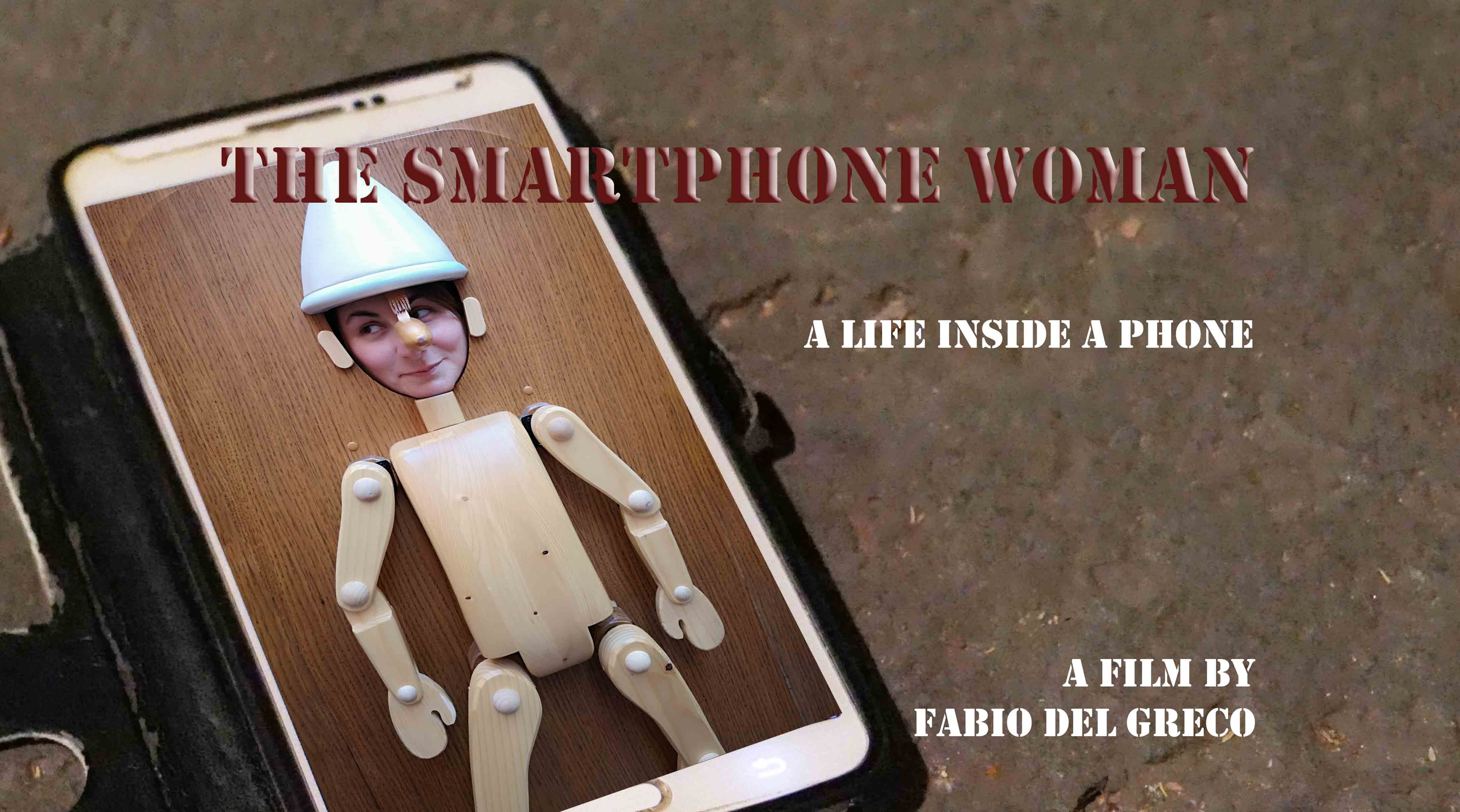
Drama, thriller, dark comedy, by Fabio Del Greco, Italy 2020.
On a bridge over the Tiber River, an elderly and severely ill man has decided to end his life, but an unusual discovery changes his mind: he comes across a lost smartphone. Intrigued, he decides to return home and watch the videos contained within it. On the screen, a series of videos unfold, telling the story of a woman who has emigrated from southern Italy to Rome to work as a teacher in schools and her struggles with integration in a social reality she cannot fully grasp.
"The Smartphone Woman" is a realistic tale of a woman's life and her complex relationship with an "infernal" city. It portrays the challenges she faces, her connection to her origins, the social discomfort she discovers in the outskirts, and the eerie presence of the ghosts of ancient Roman empire. Fabio Del Greco employs a fragmented style, using pieces of "real life" shot with the smartphone, to construct a narrative that ambiguously oscillates between fiction and truth. This creates a captivating exploration of the discomfort and alienation within the bustling city, contrasting with the peaceful village life from which the protagonist hails. The film is constructed with a variety of heterogeneous characters and situations, an emotional kaleidoscope, weaving between evenings of exploration in the Eternal City and daily struggles. Realistic smartphone-shot videos are alternated with a narrative thread reminiscent of film noir and, ultimately, surrealism in the finale. On screen, a succession of grotesque characters unfolds, representing the director's vision of a tumultuous humanity. The film's potency lies in the emotion it manages to convey and in the protagonist's naive perspective. "The Smartphone Woman" is a must-see for enthusiasts of independent and experimental cinema.
LANGUAGE: italian
SUBTITLES: English, French, German, Portuguese, Spanish
Before It Had a Name: The Ancient Precursors
You have almost certainly talked to yourself in a way you would never allow anyone to hear. Not the rehearsed argument you replay before a difficult conversation, but the other kind — the voice that surfaces at three in the morning when the body is tired enough to stop performing, the one that says things without softening them first. That voice has a much longer history than literature gave it credit for, and its earliest recorded instances were not written for readers at all.
Marcus Aurelius wrote what we now call the Meditations somewhere between 161 and 180 AD, almost certainly during military campaigns on the Danube frontier, in a language — Greek — that was not even his native tongue. The choice was not accidental. Writing in a language at slight remove from his daily speech was a way of creating distance from the self being examined, a kind of internal foreignness that sharpened the blade. The text has no audience, no dedication, no preface. It opens in the middle of a thought and never explains itself to anyone. The emperor of Rome, commanding the largest military apparatus in the Western world, was privately reminding himself not to be an idiot, not to be vain, not to waste the morning. “You have power over your mind, not outside events,” he writes, and the sentence has the flat, repetitive quality of a man who has already written this to himself before and is writing it again because it did not take. This is not philosophy performed for posterity. This is a man using language as a leash on his own behavior, in real time, under genuine pressure. What Aurelius discovered — without naming it, without theorizing it — was that the self could be addressed in the second person, could be held at arm’s length and spoken to directly, and that doing so produced a different quality of thought than either speech or conventional writing. The interiority was not a style. It was a tool.
Augustine’s Confessions, completed around 397 AD, works differently but arrives at the same structural discovery from the opposite direction. Where Aurelius addresses himself, Augustine addresses God — but the rhetorical and psychological effect is nearly identical, because the God he addresses is not external. He is invoked as the deepest listener, the one from whom nothing can be hidden, which means that confessing to God in Augustine’s framework is indistinguishable from confessing to the most honest version of oneself. The famous opening — “our heart is restless, until it repose in Thee” — is not a declaration of faith so much as a description of a psychological condition, a man diagnosing his own chronic unease and refusing to flinch from what he finds. Augustine was thirty-two when he converted to Christianity in 386, and he wrote the Confessions more than a decade later, looking back at a younger self with a candor that disturbed his contemporaries and has never entirely stopped disturbing readers. He records sexual desire, intellectual arrogance, the theft of pears in adolescence as though it were a moral catastrophe, and grief over the death of a friend so consuming that he writes he had become “a great riddle” to himself. That phrase — a great riddle to himself — is arguably the first clean articulation in Western prose of what interior monologue would spend the next fifteen centuries trying to do: render legible the experience of being opaque to oneself.
What neither man was doing was experimenting with form. Aurelius had no literary ambitions for his notebooks. Augustine was writing in a genre — the confession, the prayer — whose conventions he bent almost to breaking without ever abandoning. The interiority in both texts emerged from necessity, from the specific pressure of men who needed to think more honestly than their public roles permitted. The writing to the self, or to the deepest possible listener, was not an aesthetic choice. It was what happened when the cost of self-deception became too high to pay.

Édouard Dujardin and the Invention of a Technique

You pick up a novel and within three sentences you realize there is no narrator standing between you and the mind on the page. No mediating voice, no elegant summary of what the character is thinking, no past tense organizing sensation into digestible retrospect. Just the unfiltered current of a consciousness moving through an evening in Paris, registering the cost of a dinner, the shape of a woman’s face, the small treacheries of desire — and you feel, almost physically, that something has been removed from fiction that you never noticed was there until it was gone.
Édouard Dujardin published Les Lauriers sont coupés in 1887, when he was twenty-four years old and editing the Revue Wagnérienne alongside Téodor de Wyzewa and the poet Stéphane Mallarmé‘s extended circle. The book ran first as a serial, was ignored almost completely upon its appearance in volume form, and spent nearly three decades in total obscurity before James Joyce, by his own account, discovered a copy on a Parisian bookstall around 1903 and recognized in it the technical solution he had been moving toward without quite knowing its name. Dujardin himself would not be rescued from anonymity until 1924, when Joyce’s acknowledgment in the wake of Ulysses forced the literary world to reread a text it had never actually read the first time. What Dujardin had done — quietly, without manifesto, in a slim novel that tracks a single young man named Daniel Prince through a few hours of an April evening — was dismantle the epistemological contract that had governed European fiction since the eighteenth century.
That contract rested on a specific and largely unexamined assumption: that consciousness, to be legible in prose, required an organizing authority outside itself. The omniscient narrator of Balzac, Flaubert, George Eliot — even when restrained, even when ironized — functioned as a cognitive guarantor, shaping interiority into something syntactically complete and morally coherent. What the Symbolist generation had begun to suspect, under pressure from Schopenhauer’s philosophy of blind will and Eduard von Hartmann’s 1869 Philosophy of the Unconscious, was that this organizing authority was a fiction layered over fiction. The mind did not experience itself that way. It did not produce clean subordinate clauses. It moved associatively, elliptically, doubling back on its own heat, interrupted by sensation before a thought had finished forming.
Dujardin’s formal answer was a prose built on the present indicative and the direct address of consciousness to itself — short syntactic units, parataxis, the dissolution of the boundary between thought and perception. Daniel Prince does not remember his desire for Léa; he desires her now, in a sentence that barely ends before the next one begins. The technique does not explain itself and offers no external frame of validation. What the reader receives is not a representation of a mind but something that performs as a mind, and the distinction is not decorative. It means that reading becomes a form of inhabitation rather than observation, which is a fundamentally different ethical and cognitive position.
This mattered because the Symbolist crisis of representation — the conviction, shared by Mallarmé, by Verlaine, by the early Maeterlinck, that language referring directly to the world was a kind of vulgar lie — demanded not just new imagery but new syntax, new structure, a new relationship between the sentence and the body of experience it was supposed to carry. Dujardin understood this not as a poet but as a prose writer, and that made his move more consequential and more dangerous. Poetry had always been permitted formal strangeness. Prose was supposed to be the vehicle of the real, of the social, of the knowable. To fracture prose narration from the inside, using the instrument of interiority itself, was to suggest that the knowable was nowhere near as solid as the novel had been pretending, sometimes for two centuries, to believe.
The book failed, and its failure is part of what it means. A technique that genuinely breaks the form it inhabits will not be recognized by the form’s existing readers until someone else arrives and shows them what they were already holding.
William James, the Stream, and What Literature Stole from Psychology
You are sitting at a desk, reading something you no longer care about, and somewhere between the third and fourth line your mind has already left the room — it has gone to a conversation from six years ago, to the particular quality of light on a Tuesday afternoon in a city you no longer live in, to a low-grade anxiety about something you cannot name, and then, with a small muscular effort, back to the page. That entire arc took perhaps four seconds. No narrative structure governed it. No theme organized it. It simply happened, the way thought always happens, in a rush of superimposed time and unearned association, and the extraordinary thing is not that it happened but that you have spent your whole life assuming this was some private disorder of your own mind rather than the universal architecture of cognition itself.
William James named that architecture in 1890. In the ninth chapter of The Principles of Psychology, he called it the stream of consciousness — not as a metaphor borrowed from nature for aesthetic effect, but as a precise technical description of how mental life actually moves. James was insisting, against the atomistic psychology of his day that built the mind from discrete sensory units the way one stacks bricks, that thought is not a chain but a river: continuous, never repeating, carrying along its surface fully formed perceptions alongside half-dissolved memories, the fringe of feelings that never reach articulation, the sense of a word hovering just before it arrives. He wrote that consciousness does not appear to itself as chopped up in bits, and that every definite image in the mind is steeped in the free water that flows around it. The metaphor was deliberate and radical. It meant that the gap between one thought and the next is not empty but densely populated with what he called the transitive parts of the stream — the relations, the tendencies, the almost-said — which conventional language, built for external communication, had no grammar to express.
What James had done, essentially, was map a territory that prose fiction had been circling without adequate instruments. When James Joyce gave Leopold Bloom an interior life that moved in 1904 Dublin through the smell of grilled kidneys into death into theology into the mechanics of advertising, he was not inventing a formal experiment. He was transcribing the actual texture of the mind James had described seventeen years earlier. When Virginia Woolf in 1925 let Clarissa Dalloway move through a single day in London while the present moment dissolved constantly into the past and the future pressed forward as feeling rather than event, she was obeying the logic of the stream with a fidelity that James himself might have recognized as documentary. And when William Faulkner in 1929 gave Benjy Compson a consciousness that moved through time not chronologically but associatively — a gate, a smell, a cold, triggering decades without warning — he was demonstrating what James had argued explicitly: that the stream does not experience time as a sequence but as a field, with multiple temporal layers present simultaneously in any given moment of awareness.
This is what makes the label literary innovation slightly misleading when applied to these writers. They were not decorating fiction with a stylistic device. They were correcting a centuries-old lie that prose had been telling about the mind: that thought is orderly, that interiority moves from premise to conclusion, that the self narrates itself with the same coherence it offers to others. The interior monologue, in its most radical form, is not a technique — it is an epistemological correction. James gave writers the theoretical permission to represent what every conscious person already knew from the inside but had never seen honored on the page, which is that the mind is an embarrassment of simultaneity, that attention is perpetually ambushed, and that the apparently simple act of being present in a room while reading something you no longer care about is already, at every second, a staggering act of barely managed chaos.
Joyce’s Ulysses and the Democratization of the Inner Life

When the final episode of Ulysses arrived in print in 1922, most readers encountered it the way one encounters a wall — suddenly, without preparation, and with the distinct sensation of having run into something that was not supposed to be there. Forty-five pages. No punctuation. A woman lying in bed in the early hours of the morning, her mind moving the way minds actually move: sideways, doubled back, erotic, grieving, practical, magnificent. James Joyce had spent seven years building toward this moment, and what he delivered was not, as it has sometimes been domesticated into, a formal experiment. It was an argument. A philosophical claim about whose inner life deserved to be rendered in full.
The tradition Joyce was working inside — and against — had a very specific relationship to women’s consciousness. From the eighteenth-century novel onward, female interiority had been granted literary space largely in proportion to its usefulness to male narrative: the woman’s mind as the site of romantic longing, of moral susceptibility, of hysteria requiring management. When Jean-Martin Charcot was staging hysterical women at the Salpêtrière in the 1880s for audiences of Parisian physicians and artists, he was not doing something categorically different from what the realist novel had been doing for a century. Both enterprises displayed women’s inner states as spectacle — fascinating, excessive, ultimately illegible except through the interpretive framework of a watching male authority. Freud, who attended Charcot’s lectures in 1885, would absorb this dynamic and reconstruct it as clinical method. The woman’s inner life was a symptom to be decoded, not a world to be inhabited.
What Molly Bloom’s soliloquy does — and the violence of what it does has been softened by a century of academic appreciation — is refuse that position entirely. Joyce does not give Molly a narrator who observes her thinking. He does not give her a sympathetic male interpreter. He removes the mediating structure altogether and places the reader inside a consciousness that has no obligation to be coherent, palatable, or explicable on anyone else’s terms. When Molly thinks about her body, her desire, her contempt, her tenderness, she does so with the same ontological density that Stephen Dedalus is granted when he thinks about God and aesthetics in the novel’s opening chapters. This equivalence is the political act. Not the stream of consciousness as technique — Édouard Dujardin had used it in Les Lauriers sont coupés in 1887, and Dorothy Richardson had been developing it in her Pilgrimage sequence since 1915 — but the extension of that technique’s full philosophical seriousness to a consciousness that the literary tradition had treated as a minor key.
The answer, when you sit with it, implicates not just literary history but the entire epistemological architecture by which Western culture decided whose inner experience constituted knowledge, whose constituted noise, and whose — particularly when female, working-class, or colonized — constituted something that required translation before it could be taken seriously. Joyce did not resolve this. He detonated it. And the rubble is still
A vision curated by a filmmaker, not an algorithm
In this video I explain our vision
Virginia Woolf‘s Counter-Argument: Silence as Structure
There is a moment in the novel where Clarissa Septimus never meets — where two lives orbit the same London morning, the same post-war air, without ever touching — and Woolf makes that gap do more structural work than any collision could. The absence is load-bearing. This is the principle that separates her from Joyce not merely stylistically but philosophically, because what Woolf understood, and what her 1925 novel enacts with almost surgical precision, is that the interior monologue is not a method of total disclosure. It is a method of strategic withholding, and the withheld material is exactly where the meaning lives.
Her 1919 essay “Modern Fiction” makes the argument explicitly before the novel makes it formally. She writes there that life is not a series of gig lamps symmetrically arranged, but a luminous halo, a semi-transparent envelope surrounding us from the beginning of consciousness to the end. The word “semi-transparent” is doing enormous work. Not opaque — consciousness does transmit — but not fully transparent either. Something is always held back, not by authorial manipulation but by the very nature of how a mind moves through time. Joyce, she suggests, by recording everything, risks confusing the texture of thought with its architecture. To put every word the mind generates onto the page is to mistake noise for structure. Woolf’s counter-argument is that the structure is precisely what the mind chooses, however unconsciously, not to say.
Clarissa preparing flowers, remembering Sally Seton’s kiss, circling and retreating from that memory without ever naming what it meant — this is not evasion in the psychological sense. It is accuracy. The mind does not process its most charged material directly; it approaches and withdraws in patterns that are themselves revelatory. When Woolf renders this in prose, the indirection is not a stylistic decoration applied over the content. The indirection is the content. What Clarissa withholds from herself about her marriage to Richard, about the life she chose over Peter Walsh, about her own desire — that zone of non-articulation is precisely where the reader recognizes something true about the way they, too, have lived inside a self they cannot fully speak.
The novel’s double structure — Clarissa’s day in Westminster, Septimus’s breakdown across the city — presses this further. Septimus says what Clarissa cannot. He speaks the war, the death, the unbearable weight of Rezia’s love pressing on him, the shell-shocked mind unable to perform the social compression that Clarissa has perfected. His madness is, formally, the thing that Clarissa’s interior monologue excludes. Woolf does not connect them through plot. She connects them through the logic of omission: Septimus is what surfaces when the strategic silence breaks. The news of his suicide arrives at Clarissa’s party, and she feels, alone in a back room, something she cannot name to anyone in the house — a recognition so complete it cannot enter speech.
What Woolf is arguing, then, through both her essay and her novel working in tandem, is that the interior monologue reaches its highest expressive power not when it records everything the mind contains, but when it renders the precise shape of what a consciousness is not able, or not willing, to bring into words — because that shape is the self, the one that exists before any sentence forms to claim it.
Freud’s Shadow and the Uncomfortable Mirror

There is a particular discomfort that arrives when you read a passage of interior monologue and think, yes, that is exactly how I think, and then, a moment later, feel something cold move through you, because you cannot actually verify that. You have no recording of your own mind. You have only the sense that this literary approximation matches something you believe to be true about yourself, and that belief is precisely the problem that Sigmund Freud spent the final years of the nineteenth century trying to dismantle.
When Freud published The Interpretation of Dreams in 1899, he was not merely proposing a new theory of sleep. He was arguing something structurally devastating about waking life: that the conscious mind is not the author of experience but its editor, its press secretary, the figure who stands at the door of what actually happened and decides, with enormous efficiency and almost no awareness of doing so, what version gets released to the public. The self that narrates its own interior, for Freud, is not the self that acts. There is a gap between the two that language cannot fully cross, because language itself is one of the mechanisms of the cover-up. By the time a thought becomes a sentence, even an interior one, it has already been processed, softened, redirected, made acceptable to the censor that the ego maintains not against the outside world but against its own depths.
This is the historical coincidence that nobody inside the modernist literary project wanted to examine too directly. Stream-of-consciousness fiction arrived in the same decades as psychoanalysis, and both claimed to be moving toward a truer account of the human interior. But they arrived at that claim from opposite directions. Freud was exposing the unreliability of self-narration. Joyce, Woolf, and Faulkner were perfecting it as a form. The literary interior monologue made the inner voice feel more authentic, more raw, more unfiltered than anything that had come before, precisely because it mimicked the textures of actual thought — the interruptions, the half-finished associations, the sudden drops into memory. What it could not do, and what Freud would have immediately recognized, was reach below the threshold where the actual work of the psyche is conducted. What it gave readers was an extraordinarily convincing performance of unmediated consciousness. Which is not the same thing.
Jacques Lacan, working through and against Freud from the 1950s onward, sharpened this into something almost unbearable. For Lacan, the subject does not pre-exist language and then enter it. The subject is constituted by language, which means the subject is always already structured like the unconscious — full of gaps, misrecognitions, and a fundamental alienation from its own desire. When you say I, you are not pointing to something that was already there. You are producing a placeholder for something that cannot fully represent itself. The interior monologue, read through this lens, is not a window into the self. It is the performance of a self that the character, and by extension the reader, needs to believe exists. The almost physical recognition you feel when you read Molly Bloom’s final chapter, or Quentin Compson’s deteriorating syntax, is not recognition of your authentic interior. It is recognition of the performance you also give, every day, to yourself, the edited broadcast you transmit inward so that you can believe in your own coherence.
What makes this genuinely uncomfortable is that the discomfort does not resolve into a lesson. Knowing that the interior monologue is a constructed form, knowing that the self it represents is itself a construction, does not give you access to anything more real underneath. Lacan was unsparing on this point. There is no bedrock authentic self waiting below the performance, no raw version of you that psychoanalysis or literature could finally excavate and hand back to you intact. There is only the structure of the gap itself, and the extraordinary human compulsion to keep narrating across it, to keep writing the monologue as though the next sentence might finally close the distance between the voice and the thing it is trying to
The Trap of Interiority: When the Inner Voice Becomes a Cage
There is a moment, probably familiar, when you close a door behind you — the noise of the day still settling in the hallway outside — and you think: now I am finally alone, now I can hear myself think. This is the moment contemporary culture has trained you to treat as sacred. The retreat inward is supposed to be the antidote, the correction, the small revolution against the noise. And yet the thought that greets you in that silence, the very first sentence that rises without invitation, is almost always about productivity, self-assessment, or the quiet dread of falling behind. You close the door and step not into freedom but into a monitoring station, fully staffed.
The romantic tradition that elevated the inner voice — and the literary tradition of interior monologue that gave it form — was built on a premise that now deserves serious pressure: that interiority is a protected zone, that what happens beneath the surface of social performance belongs irreducibly to the self. Rousseau felt it when he wandered the shores of Lake Bienne and described in his Reveries of a Solitary Walker, composed between 1776 and 1778, a consciousness that exists prior to judgment. Woolf felt it when she dissolved the boundaries between sensation and syntax. Even Freud’s entire architecture of the unconscious rested on the assumption that there was something in there worth excavating, something that preceded the cultural imprint. But what happens when the excavation tools themselves are cultural products? What happens when the inner voice has been furnished?
Mark Fisher understood, with a clarity that was also a kind of grief, that the deepest achievement of contemporary capitalist culture is not the control of behavior but the colonization of desire and, by extension, of imagination itself. In Capitalist Realism, published in 2009, he argued that we have reached a historical moment in which it is easier to imagine the end of the world than the end of capitalism — not because the system is omnipotent, but because it has embedded itself so thoroughly into the structure of our inner life that critique feels like a malfunction rather than a response. The interior monologue, in this context, is not a refuge from the system; it is the system’s most efficient outpost. The self-help industry, the therapy-speak that has migrated from consulting rooms into everyday language, the meditation apps that promise access to a deeper self while tracking your engagement data — all of it functions as a grammar for thinking about yourself that arrives pre-installed. You did not choose the vocabulary of your inner voice any more than you chose the language your parents spoke.
This is not a paranoid claim. It is a structural one. The interior monologue as a literary form emerged at a specific historical juncture — the late nineteenth and early twentieth century — precisely when the boundaries between public and private were being renegotiated under industrial modernity. It was a formal response to a social pressure: the need to locate, inside the individual, a space that the outside world could not fully administer. What the form revealed, in writers from Dujardin to Woolf to Beckett, is that the inner voice is never purely spontaneous — it is always already shaped by time, by language, by the sediment of everything the self has absorbed. Beckett’s unnameable narrator, circling endlessly without arriving at a stable selfhood, was not a literary experiment in nihilism. It was an honest account of what you find when you go far enough in: not a bedrock self, but more language, more borrowed sentences, more voices that were never entirely yours.
And so the question that the entire tradition of interior monologue quietly refuses to answer — the question it keeps deferring through one more sentence, one more subordinate clause, one more free-associative turn — is whether the voice you hear in the silence after you close the door is the most intimate thing you possess, or the most sophisticated form of ventriloquism you have ever failed to notice.
🌀 The Inner Voice: Consciousness, Stream, and Self
The interior monologue is one of literature’s most daring formal inventions, placing the reader directly inside the flowing, unfiltered current of a character’s mind. To fully understand its history and theory, it helps to explore the philosophical and literary currents that made such a technique conceivable — from the psychology of consciousness to the radical experiments of modernist writing.
William James and Consciousness: The Stream of Thought
William James coined the famous phrase ‘stream of consciousness’ to describe the continuous, shifting flow of thoughts and sensations that constitute inner mental life. His radical rethinking of consciousness as a river rather than a chain of discrete ideas laid the indispensable psychological groundwork for what writers like Joyce and Woolf would later attempt in prose. No study of the interior monologue can bypass James’s foundational contribution to our understanding of the mind.
GO TO THE SELECTION: William James and Consciousness: The Stream of Thought
Stream of Consciousness in Literature and Cinema
Stream of consciousness as a literary and cinematic technique transformed the twentieth century’s approach to narrating subjectivity, dissolving conventional plot structures in favor of inner time and associative thought. From Woolf’s Mrs Dalloway to Bergman’s wild strawberries, this article traces how the technique migrated from the page to the screen, mutating and expanding along the way. It is an essential companion piece to any theoretical account of the interior monologue.
GO TO THE SELECTION: Stream of Consciousness in Literature and Cinema
Virginia Woolf: Life and Works
Virginia Woolf stands as one of the supreme masters of the interior monologue in English literature, pushing language to the very edges of conscious and pre-conscious experience. Her novels explore the texture of inner life with extraordinary sensitivity, dissolving the boundaries between self and world, memory and present sensation. Understanding her life and artistic development is crucial for grasping how the interior monologue became a vehicle for both aesthetic innovation and feminist inquiry.
GO TO THE SELECTION: Virginia Woolf: Life and Works
Henri Bergson: Life and Works
Henri Bergson‘s philosophy of time and memory, particularly his concept of durée — pure inner duration irreducible to clock time — profoundly shaped the theoretical climate in which the interior monologue flourished. His insistence that consciousness is not a series of snapshots but a continuous, qualitative flow gave writers and thinkers a new vocabulary for capturing mental experience. Bergson’s ideas echo throughout the modernist tradition and remain a vital philosophical reference for anyone studying the interiority of literature.
GO TO THE SELECTION: Henri Bergson: Life and Works
Discover the Cinema of the Inner World on Indiecinema
If these explorations of consciousness and inner voice have captivated you, Indiecinema streaming is where the literary journey meets the moving image. Our curated selection of independent and auteur films brings the interior monologue to life on screen, offering cinematic experiences that go as deep as any novel. Join us and let the stream carry you further.
👉 EXPLORE THE CATALOG: Watch Indie Films in Streaming
A vision curated by a filmmaker, not an algorithm
In this video I explain our vision

