
The Face That Predates the Role
You are looking at a face and something in your nervous system decides, before your thoughts can catch up, that what you are seeing is not quite a person. The jaw is too long. The ears sit wrong on the skull. The eyes do not catch light the way eyes are supposed to catch light — they absorb it, or deflect it, or simply refuse the transaction that human eyes normally complete when they meet yours. Your brain, which has spent its entire existence pattern-matching faces with the speed and confidence of a machine built for exactly this task, stumbles. It produces a reading and immediately doubts it. The face in front of you is a face, clearly, anatomically — two eyes, a nose, a mouth arranged in the expected coordinates — and yet the ancient circuitry responsible for distinguishing the familiar from the threatening fires an alert you cannot immediately rationalize away.

This is not a reaction you chose. It arrives before interpretation, before cultural knowledge, before you even know whose face you are looking at. Cognitive scientists would locate the mechanism in the fusiform face area, a region of the temporal lobe that activates within milliseconds of encountering a human face, calibrated through millions of years of evolutionary pressure to read social signals from the slightest muscular variation. What derails the process when you look at this particular face is not ugliness in any conventional sense. It is something more structurally unsettling — a geometry that passes every individual checkpoint and fails the composite. Each feature, examined alone, is simply a feature. Together they produce something the brain classifies, almost apologetically, as wrong.
Max Schreck was born in Berlin on September 6, 1879, and spent the first four decades of his life as a perfectly unremarkable figure in the German theatrical world — trained in the classical stage tradition, employed by Max Reinhardt‘s company, performing in the kind of serious repertory work that earns respect and leaves no particular trace in the historical record. He was, by all accounts, a disciplined and technically accomplished actor. He was not famous. He was not considered physically remarkable in any direction. Then Friedrich Wilhelm Murnau cast him as Count Orlok in 1921, and the footage that emerged from that collaboration entered visual culture like something deposited there by a process other than filmmaking — less like a performance captured on celluloid and more like evidence of something that had always existed and had only just been found.
What Murnau understood, and what the camera confirmed with a mercilessness that stage lighting never could, was that Schreck’s face under specific conditions did not read as human performance. It read as document. The silent film medium, which demands that the face carry the entire communicative weight normally distributed across voice, gesture, and language, stripped every actor to their essential physical grammar. Most faces, under that pressure, became expressive in legible and expected ways. Schreck’s face became something else — more still where other faces moved, more active where they stilled, operating on a frequency just beside the one the audience had calibrated themselves to receive.
The German Expressionist cinema of the early 1920s was not, in theory, interested in naturalism. Robert Wiene‘s 1920 production Das Cabinet des Dr. Caligari had established that distortion was the language of the interior — that warped architecture and exaggerated shadow externalized psychological states that realist staging could not touch. The movement drew from Ernst Ludwig Kirchner’s angular streetscapes, from the philosophical tradition of Schopenhauer’s will as a force beneath rational surface, from a postwar Germany whose relationship with stable appearances had been catastrophically rearranged. Into this context came a face that did not need the angles painted on the sets or the theatrical exaggeration trained into other performers.
It brought its own distortion. It required no assistance.
Nosferatu
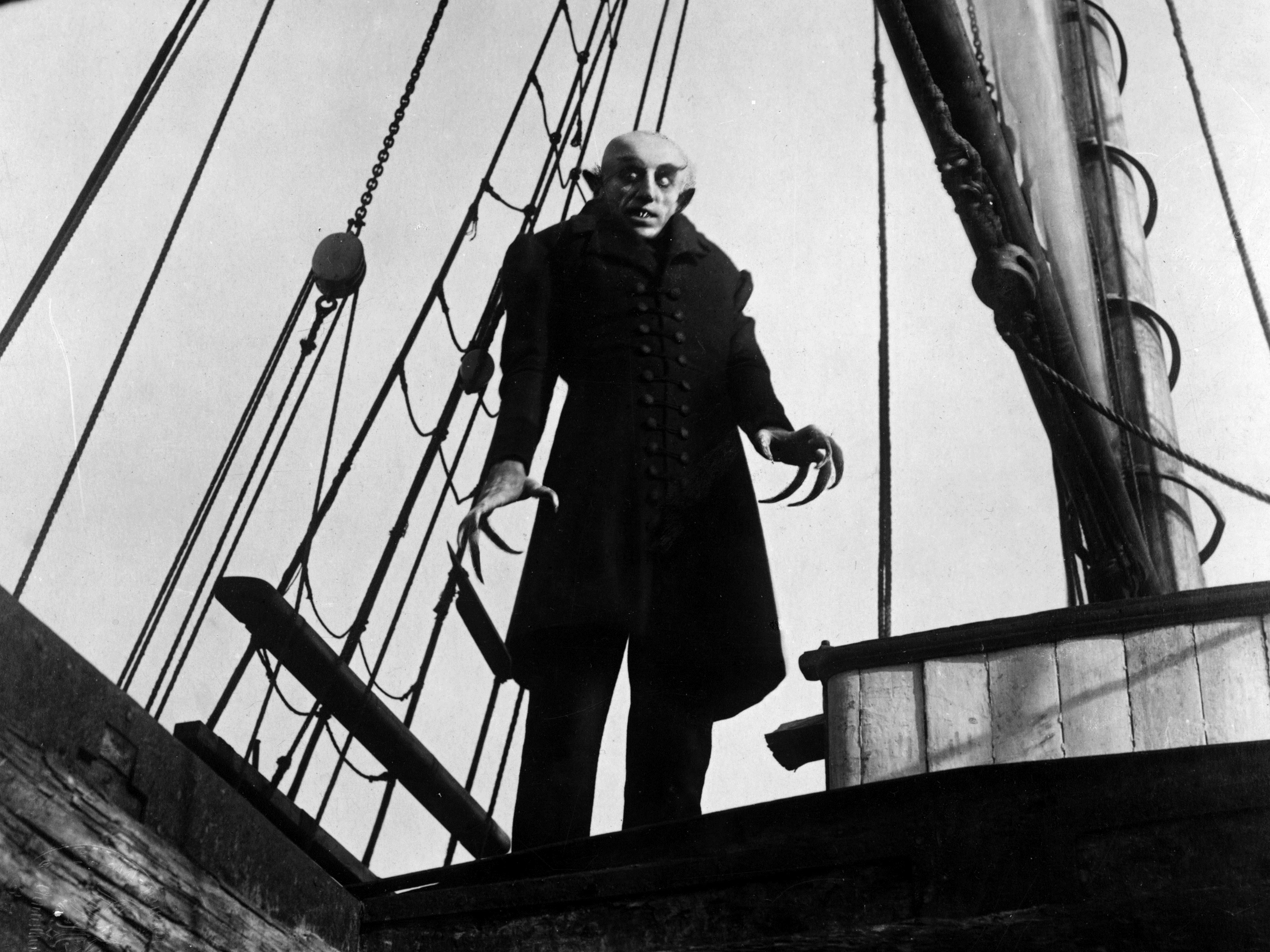
When a young real estate agent, Thomas Hutter, goes to the castle to close a deal, Orlok is attracted by his blood and decides to follow him to his hometown. The arrival of the count causes a series of mysterious deaths and spreads panic among the inhabitants.
Murnau, through evocative images and disturbing atmospheres, creates a work that goes far beyond the simple adaptation of Stoker's novel. The film explores universal themes such as the fear of death, isolation and the loss of humanity. The production of Nosferatu was characterized by some legal difficulties due to the copyright of Bram Stoker's novel. Despite this, Murnau and his crew managed to make a film of great visual impact. The choice of Max Schreck to play Count Orlok was ingenious. His cadaverous appearance and his unnatural movements have made the character of Orlok one of the iconic monsters in the history of cinema. Over the years, Nosferatu has become a cult film, influencing generations of filmmakers and becoming a reference point for the horror genre. The image of Count Orlok, with his elongated nails and sunken eyes, has become an icon of horror cinema.
When Biography Disappears Into Legend
You have seen a photograph of him exactly once, probably without knowing you were looking at it. A gaunt man, seated, entirely unremarkable in the way that working actors of the early twentieth century were unremarkable — the posture slightly formal, the eyes clear and direct, the face carrying nothing more sinister than the fatigue of a professional who has spent decades in underfunded repertory theatres. Born in Berlin on September 6, 1879, Max Schreck grew up in a theatrical culture that took craft seriously precisely because it had no money to take anything else seriously. He trained in the dense physical grammar of German Expressionist performance, where the body was not an instrument of naturalism but a site of rupture — where emotion was supposed to exceed the human frame, not fit neatly inside it. He worked under Max Reinhardt, which in the context of early twentieth-century European theatre is roughly equivalent to saying he apprenticed under the century itself. Reinhardt’s productions at the Deutsches Theater were laboratories for a new vocabulary of stage presence, and Schreck absorbed that vocabulary with the disciplined anonymity of someone who understood that mastery rarely announces itself.
What collective memory does to a figure like this is not erasure exactly — it is more precise than that. It is a selective amputation. The parts of a life that resist mythologization are not forgotten so much as rendered invisible by proximity to the one image that survives with enough force to organize everything around it. The philosopher Paul Connerton argued in his 1989 work “How Societies Remember” that social memory is not stored in archives but performed in bodies and rituals, and that what gets performed is always already a reduction — a story compressed to the dimensions required for transmission. The compression is not malicious. It is structural. A community cannot carry the full weight of a life across time, so it carries the fragment most useful to its own ongoing self-narration. In Schreck’s case, that fragment was a single performance, a single silhouette, a single shadow climbing a staircase in a film released in 1922, and from that point forward everything that preceded it became, in cultural terms, prehistory.
The cruelty of this particular amputation lies in what it conceals about the mechanism itself. Schreck was not a man who stumbled accidentally into monstrousness and was then consumed by it. He was a trained stage actor with a reputation in Berlin’s theatrical community, a man who had built a career across multiple decades in roles that demanded range, precision, and the kind of sustained psychological intelligence that anonymous character work requires. He played in comedies. He understood timing. The craft that made the vampire performance possible was the craft of someone who had spent years learning how not to be seen while being watched — how to make the instrument disappear into the effect. This is the foundational skill of character acting, and it is, with bitter irony, exactly the skill that allowed his biography to disappear into his own legend.
What makes this historically verifiable rather than merely poignant is the pattern it follows. Niccolò Paganini died in 1840 and within a generation had been so thoroughly mythologized as diabolically gifted — literally rumored to have sold his soul — that the actual technical discipline of his practice, documented in letters and in the accounts of contemporaries who watched him work for years, became a footnote to the supernatural story the culture preferred. The culture does not prefer accuracy. It prefers a story that relieves it of the discomfort of ordinary labor producing extraordinary results. If the monster was simply a craftsman, then monstrousness is available to anyone willing to work hard enough in the right direction, and that possibility is considerably more disturbing than a man who was born strange.

Expressionism as Cultural Symptom
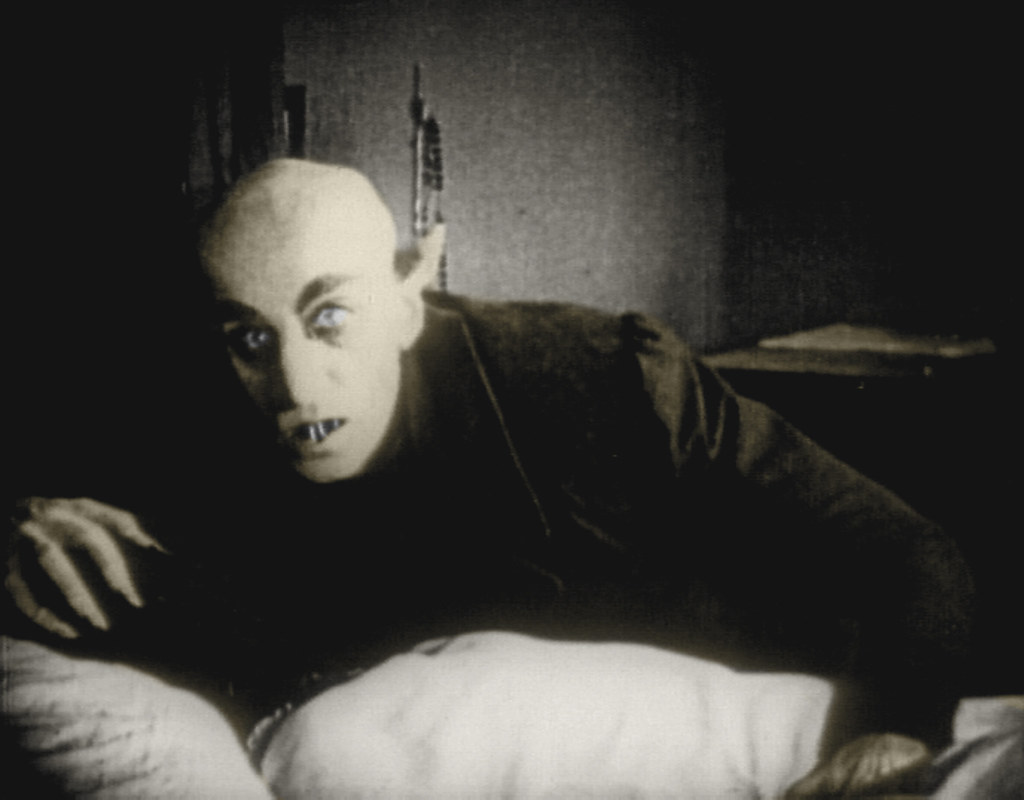
You are sitting in a cinema in Berlin in 1922, and the face on the screen does not frighten you because it is ugly. It frightens you because it is familiar — the elongated shadows, the walls that seem to breathe inward, the figure that moves through space as though space itself has already surrendered to him. You have seen this quality of light before. You have felt this particular texture of dread not in nightmares but in the street outside, in the price of bread that doubled between Monday and Thursday, in the newspapers that announced governments the way other newspapers announced weather.
Weimar Germany between 1919 and 1923 was not a political situation. It was a phenomenological collapse. The exchange rate against the dollar reached four trillion marks by November 1923, a number so structurally unreal that it ceased to function as quantity and became instead a kind of public hallucination. Georg Simmel had already theorized in his 1900 Philosophy of Money how monetary abstraction corrodes the individual’s sense of anchored identity — that when value becomes purely relational and endlessly unstable, the self begins to dissolve at its edges. What Simmel theorized philosophically, ordinary Germans were living metabolically, in their bodies, in the daily arithmetic of survival that kept changing its rules.
Expressionism did not emerge from this climate as a style. It emerged as a diagnostic instrument, the only visual language capable of rendering an experience that conventional realism could not hold. Realism assumes a stable world that the image can faithfully reproduce. Expressionism assumes that the world itself has been distorted at the source, that what you see when you look at a wall or a staircase or a human face is already the product of psychological deformation, collective and irreversible. When the sets of a film tilt at impossible angles and the shadows fall in directions that no light source could produce, the camera is not lying. It is telling a more precise truth than any photograph of an actual street could manage.
Siegfried Kracauer argued in his 1947 study From Caligari to Hitler that the entire canon of German Expressionist cinema constituted a form of collective dreaming, a visual unconscious that, when read sequentially, revealed a society rehearsing its own authoritarian surrender long before it consciously chose it. His thesis has been contested on methodological grounds — the retrospective coherence he imposes on a body of work made by dozens of different artists over fifteen years carries obvious risks of teleological projection. But the underlying intuition survives the methodological challenge: that a culture produces the images it needs, that aesthetic movements are never merely aesthetic, that they are instead the pressure of historical forces finding the only outlet available to them when rational language has been exhausted.
What rational language cannot say in 1922 is this: that the nation is haunted. Not metaphorically haunted but haunted in the precise technical sense that the past has not been processed, that the dead of the First World War — approximately two million Germans — have not been properly mourned, that the defeat has been officially denied through the myth of the stab in the back, a conspiracy narrative already circulating aggressively through right-wing political culture by the time the cameras rolled in the Jofa studio in Berlin. Freud had described in his 1917 essay Mourning and Melancholia how grief that finds no legitimate outlet does not disappear but instead colonizes the interior of the subject, producing a self that is perpetually hollowed, perpetually stalked by a loss it cannot name. Scale that dynamic from the individual to thirty million people and you have something very close to the spiritual atmosphere that Nosferatu was not depicting but was itself a symptom of.
The monster arrives from the East, from plague-soaked lands, from territory that is both geographically real and symbolically overdetermined. He carries his own soil with him because he cannot survive without it.
The Body as Ideological Object
You have seen a body like his before, though perhaps not on a screen — on a street corner in a city you were passing through, or in the peripheral vision of a crowded train, a figure too tall, too thin, moving with a wrongness that made you look away before you could identify what disturbed you. That involuntary flinch is not aesthetic. It is ideological. It is the trained response of a culture that has spent centuries encoding deviance into flesh, teaching its members to read the body as a moral document.
Sander Gilman, in his 1985 study Difference and Pathology, traces precisely this mechanism: the way Western culture projects its internal anxieties outward onto bodies marked as other, converting social fear into biological stigma. The diseased body, the foreign body, the sexually uncontrolled body — these are not natural categories but manufactured ones, assembled from centuries of medical illustration, legal taxonomy, and popular iconography. What Nosferatu did in 1922 was not invent this grammar but deploy it with extraordinary efficiency, using Max Schreck’s actual physical dimensions as raw material for a condensed symbolic text.
Schreck stood over six feet tall at a time when the average German male measured closer to five foot seven. His frame carried almost no visible fat, the bones of his face pressing against the skin with a clarity that contemporary medical photography associated with tuberculosis, with malnutrition, with the body consuming itself. These were not makeup decisions so much as directorial readings: Murnau and his cinematographer Fritz Arno Wagner understood that the camera would amplify what was already strange, that shadow would hollow the cheekbones further, that low angles would extend the already unsettling verticality into something architectural and inhuman. The production did not transform Schreck. It diagnosed him.
The hands received particular attention, both in the film’s composition and in contemporary reviews. Elongated, with fingers that tapered into prosthetic claws for the role, they carried a freight of semiotic association that Weimar audiences would have absorbed without needing it explained. The hand that grasps without invitation, that reaches into domestic space, that hovers over sleeping bodies — this was the hand that appeared in decades of antisemitic caricature, in pamphlets distributed across Central Europe throughout the nineteenth and early twentieth centuries, in the visual vocabulary of a paranoia that had been institutionalized long before National Socialism gave it state machinery. Film historians including Lotte Eisner, writing in The Haunted Screen in 1952, noted the uncomfortable convergence between Expressionist monster iconography and this older archive of ethnic caricature, without always pressing hard enough on what that convergence meant for the films being celebrated.
What it meant was that the anxiety being externalized was not simply about death or the supernatural. The figure of Orlok the vampire arrived on a ship from the East, carrying plague in his coffins, infiltrating a northern city through commerce and legal transaction — through the very real estate deal that the film’s protagonist has been sent to complete. The monster enters through capitalism’s own channels, which is itself a significant inversion, but the body that carries the infection is coded through the accumulated visual semiotics of the foreign threat: the silhouette that does not belong to the landscape, the proportions that violate the normative, the appetite that cannot be domesticated or educated into acceptability.
Gilman’s framework insists that we ask not what the monstrous body represents but what work it performs — what it allows the audience to not examine in themselves by placing it so emphatically out there, in that other frame, moving through that other darkness. Schreck’s body performed that labor invisibly, because it was so thoroughly naturalized as symbol that the audience never had to acknowledge they were reading a cultural text rather than witnessing a creature.
Performance Erased by Persona
You sit across from someone at dinner and you cannot stop thinking about what they are hiding. Not because they have given you a reason — but because the face they are wearing fits too well, and a face that fits too well always looks like a mask.
Max Schreck wore his role so completely that the seam between performance and performer became invisible, and once something becomes invisible, we stop asking whether it was ever there. What vanished behind the myth of Nosferatu was not mystique but labor — a deliberate, architecturally precise physical construction that required the kind of mastery audiences typically reward with retrospective admiration rather than erasure. His gait was not natural elongation but controlled distortion: the weight shifted perpetually forward, the arms held at angles that violated the body’s habitual geometry, every movement slowed to the threshold where stillness and motion become indistinguishable. This was not a creature shuffling instinctively through fog. It was a trained stage actor from Munich’s experimental theatre circuit making hundreds of micro-decisions per frame.
Erving Goffman, in his 1974 Frame Analysis, argued that every social encounter is organized by interpretive structures — frames — that tell us what kind of event we are witnessing and therefore what rules apply. When a frame collapses or gets replaced, all the information inside the old frame gets re-sorted accordingly. The problem is that what gets re-sorted rarely survives the transition intact. Audiences encountered Schreck inside the frame of supernatural horror, and that frame issued a retroactive instruction: what you are seeing is not acting, it is being. The moment that instruction took hold, the craft ceased to exist as craft and became instead evidence of something pathological, something ontological, something that made the performance paradoxically more powerful and the performer paradoxically less real as a human subject.
This is where the mechanism turns cruel. In most theatrical traditions, the more convincing the illusion, the greater the credit extended to the illusionist. Houdini was celebrated for his escapes precisely because audiences understood they were watching a man defeat the impossible through expertise, not because they believed he was genuinely supernatural. But horror operates under different rules of attribution. When the performance is too persuasive, the genre flips the credit: not this actor is extraordinary, but this actor is something other than an actor. The applause gets absorbed by the abyss the performer has temporarily inhabited, and the performer is left standing on the wrong side of the frame they built themselves.
Schreck’s stage work before 1922 shows a man interested in reduction — in stripping gesture down until only the essential remains. He had worked with Reinhardt’s ensemble at a moment when European theatre was interrogating the excesses of expressionist externalizing, pushing instead toward an interior pressure that manifested in economy rather than explosion. The stillness of Count Orlok was not absence of technique; it was technique refined to the point where technique disappears, which is precisely the moment audiences mistake the professional for the possessed. Minimalism, paradoxically, reads as authenticity. And authenticity in a monster context reads as monstrousness rather than artistry.
What the Goffman frame did to Schreck’s biography was restructure every available fact to confirm the persona. His relative social isolation became proof of misanthropy. His sparse filmography became evidence of reclusion. The physical details of his appearance, which on any other actor would have been noted and moved past, became the text itself — his long fingers, his deep-set eyes, catalogued not as attributes of a working performer but as symptoms of whatever the audience had already decided he was. By the time the camera had finished with him, the man who made the choices had been entirely consumed by the choices themselves, and the monster walked away wearing a human face it had learned to keep.
A vision curated by a filmmaker, not an algorithm
In this video I explain our vision
The Social Function of the Monster

You are sitting in a dark room watching something you cannot name approach you from the end of a long corridor, and what disturbs you most is not the creature itself but the recognition you feel — some cellular, pre-verbal acknowledgment that this thing moving toward you has been summoned by you, that you needed it to exist before it ever appeared on screen.
René Girard spent much of his career demonstrating that human communities do not simply happen upon their monsters — they manufacture them with extraordinary precision. In his 1972 work “La Violence et le Sacré,” Girard argued that collective violence requires a surrogate victim, a figure who can absorb the internal tensions of a group and be expelled so that social order can be restored and perceived as natural. The scapegoat is never chosen arbitrarily. It must be someone who is both inside and outside the community simultaneously — recognizable enough to carry the group’s projections, yet different enough to be sacrificed without triggering retaliation. Schreck’s Orlok satisfies this requirement with almost clinical perfection. He is Germanic, European, bourgeois in his castle and his property deeds, yet his body refuses every convention of belonging. He does not seduce like a human predator. He does not charm or negotiate. He simply arrives, and his arrival unmasks something the community of 1922 Weimar Germany could not afford to see directly: that property, law, and the orderly transfer of real estate are underwritten by a violence that never fully disappears.
What makes this more than coincidence is the mechanism Julia Kristeva named in her 1980 study “Pouvoirs de l’horreur” — abjection, the process by which the subject constitutes itself by violently expelling what threatens to dissolve its boundaries. The abject is not the Other in the comfortable sense, the foreigner safely across a border. It is the thing that was once inside, the bodily, the maternal, the animal dimension that civilization required you to deny in order to become a legible social subject. Horror as a genre operates precisely at this threshold. The monster does not represent what we have never known; it represents what we have worked very hard to forget. Orlok’s body — its elongated fingers, its refusal of normal proportion, its association with rats and plague — is a catalogue of everything the post-Enlightenment European subject had spent three centuries classifying, quarantining, and declaring beneath consideration.
Weimar cinema was not naïve about this function. The same year “Nosferatu” appeared, inflation in Germany was beginning its catastrophic acceleration toward the 1923 hypercrisis, and the political landscape was fracturing along lines that would harden into something irreversible within a decade. A culture does not project its anxieties onto accidental screens. It builds the screens it requires. The vampiric landlord arriving from the East with legal documents and a plague of rats was not a neutral fantasy — it was a specific historical grammar, one that would be picked up and weaponized with devastating literalness by political movements that understood exactly how productive the figure of the contaminating outsider could be when a population was sufficiently frightened.
And yet the abject cannot be fully expelled — Kristeva is precise about this. The ritual of expulsion must be repeated because the threat is never external. Every community that burns its scapegoat will need another one, because what it is actually trying to destroy lives inside the structures of its own desire, its own hunger for what it simultaneously forbids. Schreck’s Orlok dies at dawn in every version of the story, consumed by the one force that cannot be bargained with, and the community is restored to daylight and order. But the ship has already docked. The rats have already come ashore, and they are indistinguishable now from the ones that were always there, moving through the walls of every house in town, invisible precisely because they belong to the place entirely.
Posthumous Identity and the Violence of Iconography
You are standing in a costume shop in October, somewhere between the inflatable skeletons and the latex werewolf masks, and there it is: a cardboard box with a cellophane window showing a bald prosthetic skull, elongated ears, fingers tapered into claws. The label reads “Nosferatu Classic.” The word “classic” is doing extraordinary work here, converting a human being’s face into a product category, placing it beside the pirate hat and the vampire cape with the red satin lining. Nobody in that shop is thinking about a man named Maximilian Schreck who was born in Munich in 1879, who trained in theater, who had a wife named Fanny Normann, who suffered through the collapse of Weimar culture and died in 1936 before he could witness what his most famous role would eventually become. The box contains a face. The man has been evacuated from it entirely.
This is what iconography does at its most efficient: it creates a symbol so total that the biographical substrate beneath it becomes not just irrelevant but actively inconvenient. Roland Barthes described this operation with clinical precision in Mythologies, published in 1957, identifying how myth transforms history into nature — how a contingent, specific, dated event becomes something that feels timeless and inevitable. The image of Count Orlok crawling toward a sleeping woman, his shadow preceding him up the staircase, has achieved exactly this mythic status. It no longer refers to a film made in 1922 under difficult financial and legal circumstances. It refers to itself. It has become self-certifying, a sign that generates its own authority by sheer repetition.
The mechanism accelerates with each decade of reuse. By the time horror cinema had established its visual grammar through the 1930s and 1940s, Orlok’s silhouette was already functioning as shorthand — the ur-vampire, the shape against which every subsequent bloodsucker was measured and found either more or less human. When the image migrated into merchandise, into Halloween decorations and postage stamps and tattoo flash sheets, it shed another layer of context. The 1922 film became optional knowledge. You could consume the icon without ever having sat in darkness watching F.W. Murnau‘s cinematography transform the coastline of Wismar into something genuinely threatening. The image had achieved what theorists of spectacle call autonomous circulation: it reproduced itself without requiring the conditions of its original production.
What makes this violent rather than merely ironic is the specific nature of what was overwritten. Schreck was not an abstraction. He had a career built on physical transformation and theatrical discipline, a craft tradition rooted in the expressionist stage that treated the body as a site of psychic excavation. When he walked onto a set and allowed his frame to be reorganized into something inhuman, he was deploying technical knowledge accumulated over years. The performance in Nosferatu is not an accident of casting or a lucky accident of makeup — it is the result of a performer who understood how to make biomechanical wrongness legible to an audience. That understanding has been completely occluded by the outcome it produced. The craftsman was consumed by his artifact.
Susan Sontag, writing in On Photography in 1977, argued that photographs convert people into objects that can be symbolically possessed. Film stills operate under the same logic with additional ferocity, because the still arrests movement and evacuates duration — it removes the evidence of labor and decision-making that a moving image, however briefly, preserves. The stilled Schreck, reproduced on a thousand surfaces, becomes a shape rather than a performance. And a shape can be owned, licensed, mass-produced, and sold in a cardboard box with a cellophane window without anyone involved in that transaction pausing to wonder what it cost the original to become so perfectly, so completely, legible.
The Actor Who Never Returned
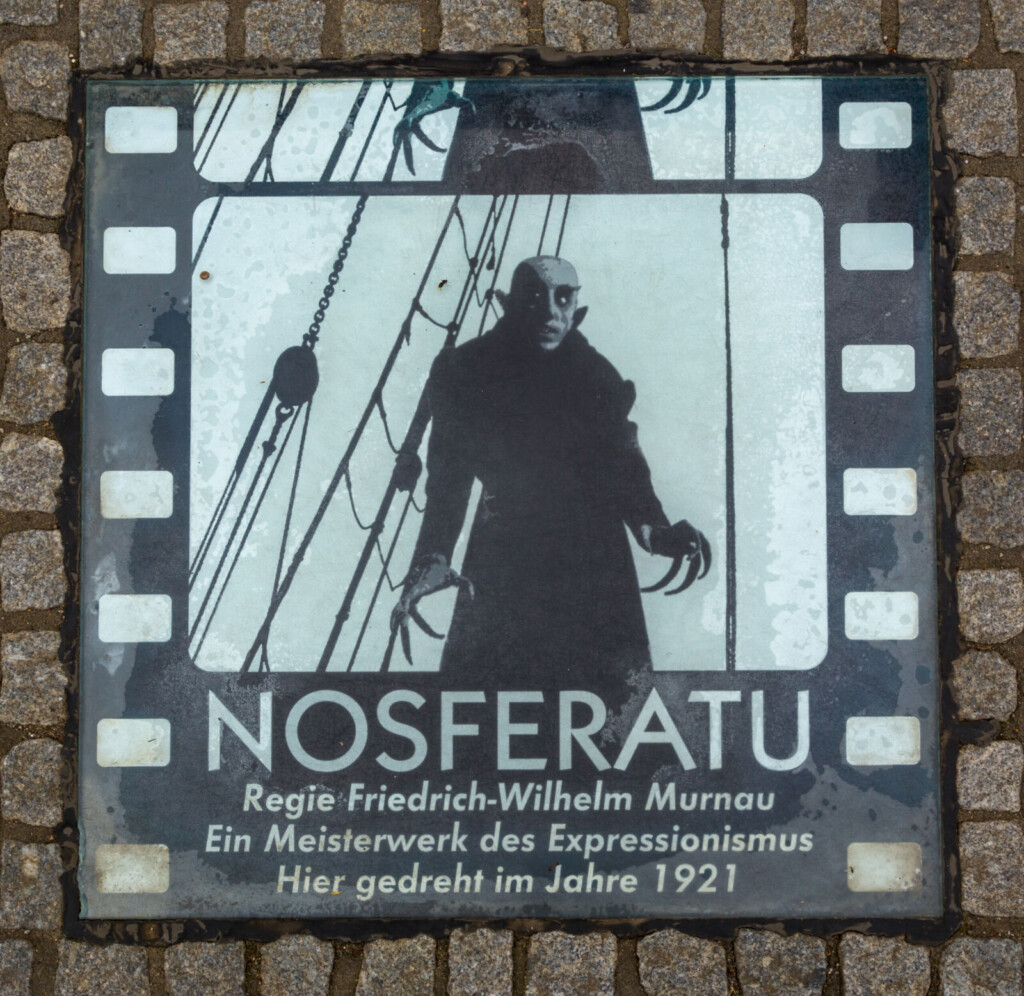
You are sitting in an archive somewhere, or you could be — the kind of place with fluorescent lighting and catalogued silence — and you ask for Max Schreck. What returns to you is a single image, repeated across every folder, every microfilm spool, every digitized collection: the elongated fingers, the hollow sockets, the posture of something that has forgotten how to be warm. The man who trained at the Deutsches Theater under Max Reinhardt, who spent decades performing across Munich and Berlin in comedies, tragedies, and the minor theatrical productions that constitute most of a working actor’s life, exists in the cultural record as precisely one thing. The archive did not lose him. It selected him, and the selection tells you more about the archive than about the man.
He died on February 20, 1936, in Munich, having worked continuously as a stage performer for over thirty years. Thirty years of embodied labor — memorized lines, physical discipline, the relentless minor negotiations of ensemble performance — reduced to approximately ninety minutes of silent film shot in 1921. This arithmetic is not an accident of history. It is a verdict, rendered quietly and without appeal, about which performances a culture decides deserve permanence. The sociologist Diana Crane, writing in The Production of Culture in 1992, demonstrated that what survives artistic production is never determined by the work itself but by the institutional structures that surround it: publishers, archives, critics, distributors. What Crane could not have anticipated is the particular cruelty with which this principle operates when the surviving artifact is a monster, because then the selection does not merely erase — it replaces.
There is a specific violence in replacement that ordinary erasure does not achieve. Erasure leaves a gap, and gaps can theoretically be filled. Replacement colonizes the space where the person stood and installs something else so completely that the question of what was there before stops occurring to anyone. Nosferatu did not erase Max Schreck the working actor — it occupied him, wore his name, and rendered the original question unanswerable in practice. Roland Barthes observed in Image-Music-Text that the photograph does not restore what is abolished but rather certifies that what we see has been. But certification assumes the image and the subject share a continuous identity. When the image is a costume, a transformation, a performance of the inhuman, certification becomes something closer to mistaken identity at the level of history.
What culture chooses to remember is almost never the sustained, the incremental, the professionally unglamorous. Memory, both collective and institutional, operates through what the psychologist Daniel Kahneman identified as the peak-end rule: experiences are evaluated not by their duration or their full texture but by their most intense moment and their final impression. Applied not to individual memory but to cultural memory, this rule becomes structural and merciless. Schreck’s career had texture, duration, the slow accumulation of craft — and it lost, completely and permanently, to its single peak, which happened to be the least human thing he ever did on a stage or in front of a camera.
The deeper question this forces is not about Schreck specifically but about what conditions must exist for a person to be preserved in their full professional complexity rather than collapsed into their most spectacular deviation from the ordinary. The answer, examined honestly, is uncomfortable: those conditions are almost never met, and the culture that congratulates itself on preserving its artists is largely preserving their most legible extremes, the moments when a human being crossed into territory recognizable enough to be reproduced, quoted, and sold. Schreck crossed into the territory of the monstrous, and the monstrous proved infinitely more reproducible than the man who spent thirty years learning how to inhabit a stage with the quiet, unarchivable authority of someone who simply knew what he was doing.
🧛 Shadows, Monsters and the Darkness of the Screen
Max Schreck’s transformation into Count Orlok in Nosferatu remains one of cinema’s most haunting mysteries, blurring the line between actor and creature. The article below explores the cultural, literary, and psychological worlds that gave birth to figures like his — from the vampire myth to the Gothic imagination and the psychology of evil.
The Vampire Myth: History and Symbolism
The vampire myth is far older than cinema, rooted in folklore traditions that stretched from Eastern Europe to the ancient world. Understanding its symbolic weight — blood, immortality, the predatory Other — helps us grasp why Max Schreck’s Orlok struck such a primal nerve in audiences of 1922 and continues to unsettle viewers today.
GO TO THE SELECTION: The Vampire Myth: History and Symbolism
Bram Stoker and Dracula: Terror as a Mirror of Victorian Society
Bram Stoker‘s Dracula, published in 1897, codified the vampire for the modern imagination and provided the blueprint that F.W. Murnau would shadow and distort in Nosferatu. Stoker’s Count is a mirror of Victorian anxieties about sexuality, foreign contamination, and the collapse of rational order — themes that Schreck’s rat-like, pestilential Orlok rendered even more viscerally disturbing.
GO TO THE SELECTION: Bram Stoker and Dracula: Terror as a Mirror of Victorian Society
The Vampire in Literature: From Polidori to Stoker
From John Polidori’s aristocratic Lord Ruthven to Stoker’s Transylvanian Count, the vampire in literature evolved as a figure of transgression, desire, and existential dread. Tracing this literary lineage illuminates how deeply Max Schreck’s physical performance drew from a tradition in which the monster is always a distorted reflection of human fear.
GO TO THE SELECTION: The Vampire in Literature: From Polidori to Stoker
The Psychology of Evil: Why People Commit Violent Acts
The psychology of evil asks why certain human beings — or the cultural archetypes we project onto them — seem to embody destruction and predation as a fundamental nature. Max Schreck’s Orlok poses this question in its most extreme cinematic form: is the monster born, constructed, or conjured by the collective imagination of a society in crisis?
GO TO THE SELECTION: The Psychology of Evil: Why People Commit Violent Acts
Discover Independent Cinema on Indiecinema
If the darkness behind Max Schreck’s eyes has drawn you in, Indiecinema is the streaming platform where the shadows run deepest. Explore our curated catalog of independent and auteur films that dare to confront the monsters — within and without — that mainstream cinema too often leaves in the dark.
👉 EXPLORE THE CATALOG: Watch Indie Films in Streaming
A vision curated by a filmmaker, not an algorithm
In this video I explain our vision

