The Room You Never Leave
You wake up and the first thing you touch is not your own face, not the body beside you, not the cold floor under your feet. You touch the screen. Before language, before the specific weight of the day settles onto your chest, your thumb is already moving — scrolling upward in that particular gesture that has no analogue in the history of human motion, that small repeated flick which is simultaneously the most practiced and the most meaningless thing your body now does. You are not looking for anything. You have already forgotten that looking for something was once the precondition of searching.

Twenty minutes pass. Maybe forty. You could not reconstruct them if asked. You saw a sunset in Patagonia posted by someone you met once at a conference in 2019. You saw an argument about something that felt urgent while you read it and has already dissolved. You saw a face you used to love, older now, standing in front of a house you don’t recognize. Was that today? Was it last week? Is the conference-person still alive? You genuinely cannot say. The timeline is not a record of time. It is a substitution for it.
This is not a lament about technology. That conversation is exhausted and has never been honest anyway. What deserves attention is something more fundamental: the specific texture of a consciousness that has begun to lose the boundary between the space it inhabits physically and the space it inhabits informationally. Not as a metaphor. As a neurological and phenomenological fact that most people navigate every waking hour without a framework adequate to describe it.
Maurice Merleau-Ponty argued in his Phenomenology of Perception, published in 1945, that consciousness is never abstract — it is always embodied, always anchored in a body that orients itself within a field of possible actions. The body does not merely occupy space; it inhabits it. It knows where the door is without looking. It reaches for the glass before the decision to reach has been formulated. What happens to that inhabited body when a significant portion of its most emotionally charged experiences — desire, recognition, grief, social belonging, professional identity — occur in a space that has no walls, no temperature, no smell, no resistance? Merleau-Ponty had no occasion to ask this question. We do not have the luxury of avoiding it.
The word metaverse arrives in our cultural vocabulary like a corporate announcement, like a press release from the future. But the condition it names is not future at all. It is already the structure of your morning. The room you lie in has a ceiling and four walls and a specific quality of light at seven a.m., and none of that is where you have been for the last forty minutes. Where you have been has no coordinates your body can verify. And yet the emotional residue of it — the low-grade anxiety, the brief spike of comparison, the phantom intimacy of a stranger’s curated life — is as real as hunger, as real as the sound of traffic outside the window.
This is the entry point that matters: not the headset, not the blockchain, not the corporate architecture of immersive commerce that awaits patient capital. The entry point is the ordinary morning, the unremarkable Tuesday, the body that has already learned to be in two places at once without being fully present in either. The philosophical implications of the metaverse are not hypothetical. They are already metabolized into the rhythm of your breathing, the drift of your attention, the strange grief you sometimes feel for experiences you are not entirely certain you actually had.
The Lost Poet
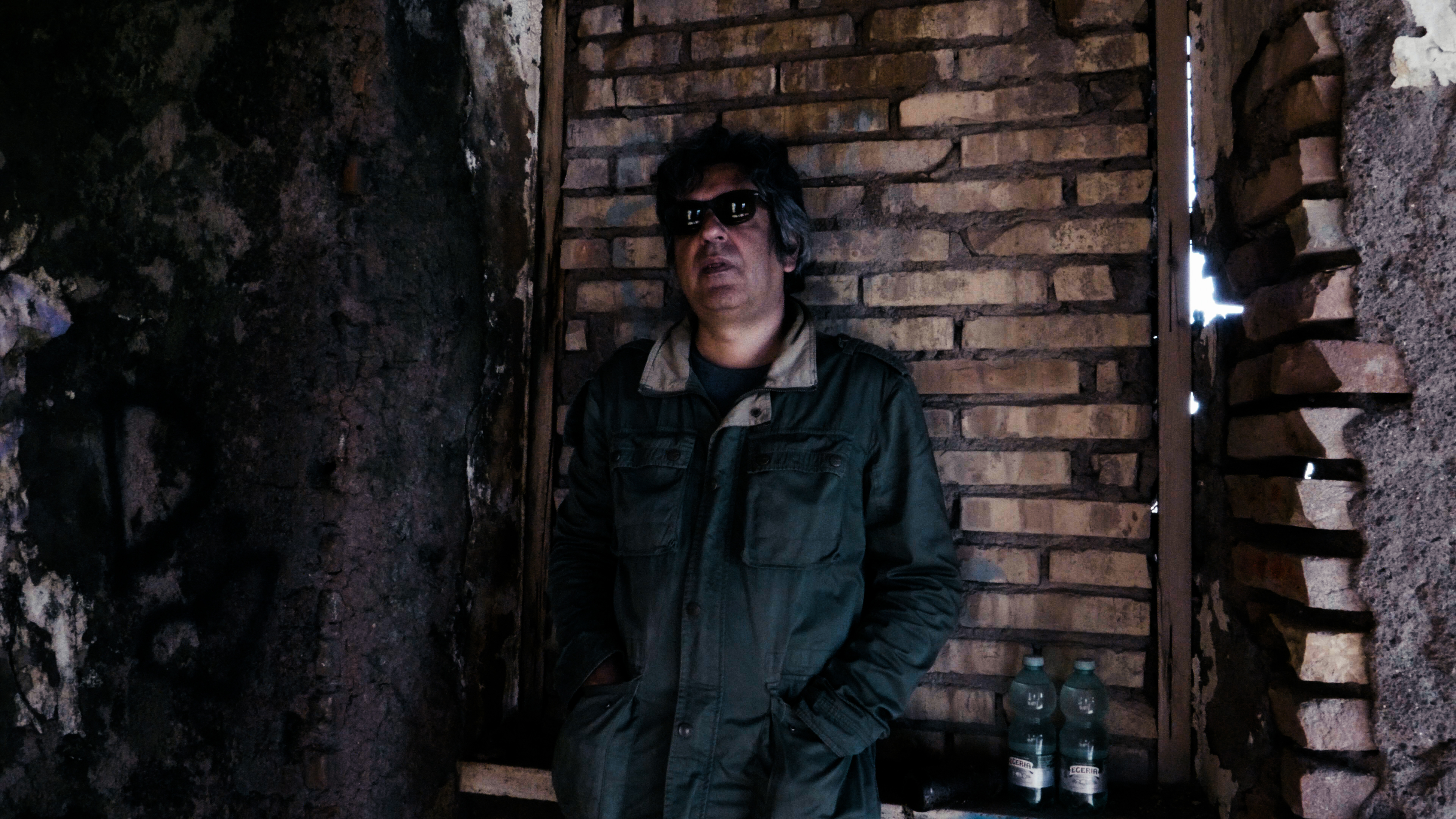
Drama, by Fabio Del Greco, Italy, 2024.
Dante Mezzadri wants to see an old friend, nicknamed the Iguana, whom he has lost sight of for many years, and who has managed to turn their shared youthful passion for poetry into a job, becoming a famous writer and poet. The man escapes from his bourgeois life and his wife to live homeless on the Roman coast, printing and trying to sell his poetry collections. At night he sleeps in a park of old carnival floats, inside a papier-mâché tank, and waits for the opportunity to meet his old friend, who however never shows up for appointments in the places they frequented when they were young, now in ruins. Dante's poetry books do not interest anyone and to support himself he is forced to "change product": he starts selling the infamous "cannibal pill" on behalf of young drug dealers, a new drug that sells like hot cakes and causes sensory and consumerist ecstasy. However, he realizes that this powerful drug is very dangerous for those who take it, he comes into conflict with his ethical conscience and throws all the pills into the sea. However, the dealers want to collect their money.
Shot over a period of 2 years, the film is a reflection on the cultural and artistic rubble of the society in which the protagonist lives, in an increasingly mechanized, consumerist and arid world. Dante Mezzadri is yet another human being who has renounced his inspiration and his creativity, but unlike many he is not willing to give his life to a system that distances him from his true identity. The physical world around him, however, seems constructed in such a way that it seems impossible to escape from this "invisible cage". The enthusiasm of the people he meets is ignited only by sensory gratification, by unreal visions of personal affirmation and success, by "metaverses" that offer an escape into an illusory and destructive reality. The poet's house on the coast, where he met with his friends as a young man, is just a pile of abandoned rubble. What happened to all those who wanted to become poets and ended up becoming something else? Are there internal forces with which that house can be "rebuilt"?
LANGUAGE: Italian
SUBTITLES: English, Spanish, French, German, Portuguese
Before the Word, the Dream
You have been here before. Not in this room, not with this headset, not with these particular pixels arranged into a sky that looks almost like a real sky — but here, in this specific act of wanting the copy more than the original. The desire precedes the technology by millennia. What changes is only the machinery we use to feed it.
Sometime around the middle of the last century, a man was strapped into a chair that resembled something between a dentist’s apparatus and a carnival ride. It vibrated. It blew scented air at him. Speakers positioned precisely at ear level gave him the sound of a city he could not actually see. His eyes were sealed behind a visor that filled his entire field of vision with moving images. He was not there, and yet every sense he possessed was being systematically convinced that he was. He sat motionless and traveled completely. That moment was not science fiction. It was engineering, it was obsession, it was a man named Morton Heilig building the Sensorama in 1962 because he believed, with the fervor of someone who has understood something essential, that cinema had failed by only capturing two of the human senses. He patented it. Almost no one paid attention.
But Heilig was not the beginning either. He was only one repetition in a very long series.
Go back thirty years further, or three hundred, or two thousand, and you find the same architecture of desire. Plato described prisoners in a cave watching shadows on a wall and mistaking them for reality — and what is striking is not that they were wrong, but that they were content. The shadows were enough. The simulation was preferred. This is the detail that tends to get lost when philosophers cite the allegory for epistemological purposes: the prisoners were not suffering. They had adapted. The cave had become home. Leibniz, writing at the turn of the eighteenth century, proposed a universe of monads — windowless, sealed units of experience, each one containing within itself a complete representation of the entire world, none of them actually touching. Every consciousness a private simulation. The metaphysics of isolation dressed as cosmology.
The nineteenth century made it architectural. The panoramas that proliferated across European capitals from the 1790s onward were enormous cylindrical paintings, sometimes thirty meters in diameter, depicting battles, cities, landscapes. Viewers stood on a central platform surrounded entirely by the image, the horizon curved around them, the painted sky above, the painted ground below. Entrance fees were charged. Crowds came daily. The experience was described by contemporaries with a vocabulary that would be entirely legible to someone reviewing a VR headset today — immersive, overwhelming, more real than reality. Robert Barker patented the panorama in 1787. By the 1820s they had spread to every major European city. By the 1850s they were already considered old technology, replaced by dioramas, then by stereoscopes, then by cinema, each medium promising a deeper enclosure, a more complete capture of the senses.
Neal Stephenson gave the idea its current name in 1992, in a novel where people plug into a shared virtual world to escape an America that has collapsed into corporate fiefdoms and trailer parks. The word metaverse enters the language there, built from the Greek prefix for beyond and the Latin for universe, a compound that manages to sound both grandiose and slightly desperate. But Stephenson himself understood he was not inventing anything. He was describing a hunger that had already organized itself into panoramas, into Sensoramas, into philosophical systems, into myths about caves.
The question that keeps surfacing, if you follow this thread long enough, is not whether the technology is new. It is why the desire is so persistent, so structurally similar across centuries, so immune to the failures of every previous attempt to satisfy it.

The Architecture of Elsewhere
You have been in that mall. You know the one. Not a specific mall — all of them, the same one reproduced across every latitude with the same marble floors that gleam under the same artificial light calibrated to suppress the awareness of time. You walk through it and something in your body registers an absence before your mind can name it. There are no windows. There is no weather. The corridor ahead looks like a street, complete with facades designed to suggest individuality, storefronts with handwritten signs that were manufactured in bulk, a fountain at the center that produces the acoustic suggestion of nature without any nature in it. You are moving through a space that has been architected specifically to eliminate all resistance — no unexpected encounters, no friction of the real, no surface that remembers you passed through it.
Foucault called certain spaces heterotopias — real places that are simultaneously outside all places, that reflect and contest and invert the social order they seem merely to contain. But the mall is something subtler and more insidious than a heterotopia. It does not contest the order. It perfects it. It creates an environment where the body circulates without ever arriving, where desire is continuously stimulated and continuously deferred, where the architecture itself functions as ideology made concrete. Marc Augé, writing in 1992 in Non-Places: Introduction to an Anthropology of Supermodernity, described the specific condition of late modernity as the proliferation of spaces that generate no identity, no relation, no history. Airports, highways, supermarkets. He was precise about what makes a non-place: it is not empty, it is actively evacuated. The meaning has been removed by design.
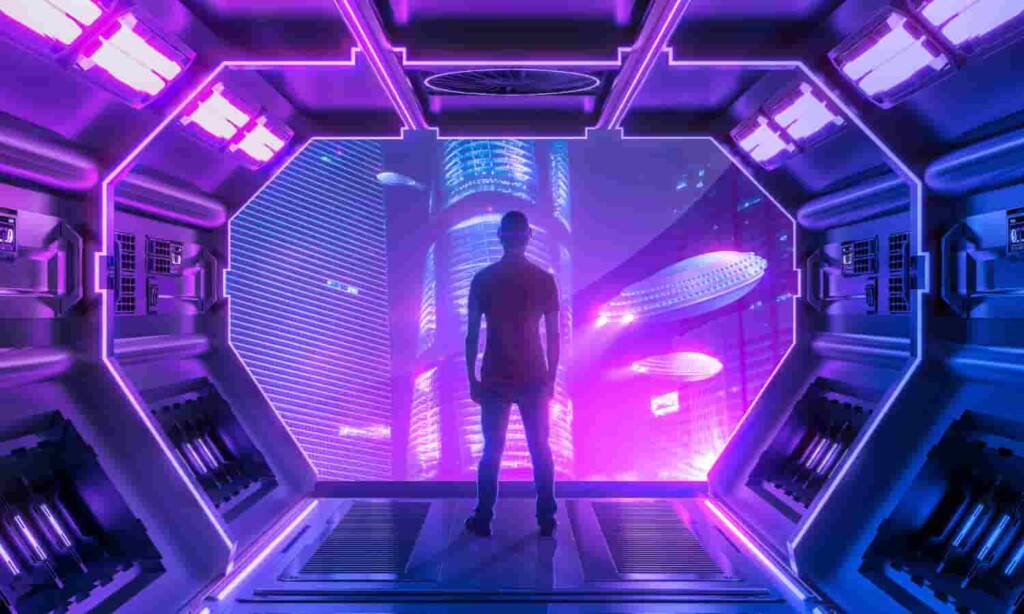
Now extend that logic inward. Not outward into larger and larger corridors, but inward, into a rendered space that you wear over your eyes. A man puts on a headset in a room in Menlo Park, California, and steps into a digital plaza where his avatar can attend a concert, sign a lease on virtual land, shake hands with someone’s digital representation in Tokyo. The plaza looks like a city. It functions like a mall. There is no friction, no memory, no resistance. There is nothing that does not want you there, nothing that refuses you, nothing that has its own existence independent of your navigation through it. The philosophical weight of this is not in the technology. It is in the desire that precedes the technology and makes it inevitable.
In 2022, Meta’s Reality Labs division lost approximately ten billion dollars. The following year it lost more. The number is enormous, but the number is not the point. Civilizations do not spend at that scale by accident. They spend toward something they need, or away from something they cannot face. Henri Lefebvre argued in The Production of Space, published in 1974, that space is never neutral, never simply a container for social life — it is produced by social relations and in turn produces them. What is being produced here, at the cost of billions, is a space explicitly designed to have no outside, no weather, no body odor, no neighbor who plays music too loud at two in the morning. No friction. No resistance. No accident.
The accident is what makes a city a city. Situationist theorists in the 1950s called it the derive — the practice of drifting through urban space without destination, allowing the city to act on you, to surprise you, to generate encounters that no algorithm would have recommended. Guy Debord understood that the society of the spectacle does not merely show you images instead of reality. It reorganizes space itself so that you move through representations rather than things. The mall was the first draft.
Who Owns the Ground You Stand On
You built it over three years. Not quickly, not carelessly — you placed every beam, chose every texture, arranged the light so it fell through the eastern window at what felt like morning even when it was midnight where your body sat. You knew the layout the way you know a childhood home: by feel, by memory, without needing to look. Then one Tuesday the door wasn’t there. The platform had updated its terms of service — section 14, subsection C, something about “non-compliant user-generated assets” — and the structure was simply gone. Not moved. Not archived. Erased. The coordinates still existed. The land remained. But everything you had made on it had been returned to the void as casually as a server clearing its cache.
This is not a metaphor for something else. This is the literal experience of millions of people who built inside spaces they were told, implicitly and sometimes explicitly, they could call their own.
John Locke argued in his Second Treatise of Government, published in 1689, that property emerges from labor — that when you mix your effort with the raw material of the world, something of you enters it, and that fusion generates a legitimate claim. The argument was always philosophically convenient for those who already had tools and time to labor, but it contained a kernel of lived intuition that most people recognize: you made this, therefore it is yours in some meaningful sense. The virtual world adopted this intuition wholesale. You spent hours, weeks, years building. The labor was real. The attachment was real. The loss, when it came, was real in exactly the way Locke‘s framework would predict — and yet the framework offered no protection, because the ground beneath your labor was never yours to begin with.
Karl Marx called this primitive accumulation: the original act of separating people from the means of their own sustenance and creation, forcing them into dependency on those who control the underlying resources. He traced it historically through the enclosure of common lands in England — fields that communities had farmed collectively for centuries, fenced off by parliamentary acts between roughly 1750 and 1860, converting shared ground into private property and converting free people into wage laborers with no alternative. The virtual enclosure follows the same logic with startling precision. In 2003, Linden Lab began selling parcels of land inside Second Life, and what had been a shared experimental space began its transformation into a real estate market. By 2021, a single parcel of virtual land in Decentraland sold for approximately 2.4 million dollars. The numbers are not absurd. They are the entirely rational consequence of scarcity being manufactured inside a space where scarcity need not exist at all — where the cost of duplicating land is functionally zero, but the decision was made to impose limits anyway, because limit is what makes ownership legible, and ownership is what makes extraction possible.
Shoshana Zuboff, in her 2019 work The Age of Surveillance Capitalism, identifies the deeper mechanism: behavioral data extracted from human experience becomes the raw material of a new economic logic, one in which the platform is not selling you a product but harvesting your activity, your attention, your construction, your emotional investment. You are not the customer. You are the mine. Every hour you spent arranging light in that room was an hour of engagement data feeding back into systems designed to keep you there longer, to model you more precisely, to sell that model to parties whose interests you will never fully know.
The philosophical violence here is not dramatic. It arrives in the language of terms of service, in the passive voice of automated notifications. Platform sovereignty does not announce itself as conquest. It presents as administration — neutral, technical, beyond appeal — and that neutrality is precisely the sophistication of the trap.
The Self That Loads
You sit in front of the customization screen longer than you expected. You told yourself it would take five minutes. It has been forty. The sliders for height, shoulder width, jaw definition, skin tone sit in front of you with the patient indifference of a mirror that asks nothing back. And something strange begins to happen: the longer you stare, the more you realize you are not decorating yourself. You are confessing.
Derek Parfit spent much of his philosophical life dismantling the intuition that there is a stable, continuous self persisting through time. In Reasons and Persons, published in 1984, he argued that personal identity is not a deep fact about the world but a matter of degree, a question of psychological continuity and connectedness rather than some metaphysical essence lodged behind the eyes. What you call “yourself” is less a fixed entity than a narrative convenience, a story told retroactively to impose coherence on a series of states that have no inherent unity. Parfit found this liberating. Most people find it terrifying. The avatar screen finds it obvious.
Because what you are doing at that customization interface is not choosing a costume. You are surfacing something the physical body has been suppressing for decades through social contract, through the exhausting performance that Erving Goffman mapped with surgical precision in The Presentation of Self in Everyday Life in 1959. Goffman understood that social life is theater, that every interaction involves front-stage management, impression control, the careful editing of self-presentation to meet what a given audience expects. Your physical body has been your most persistent prop in that performance. Height, weight, race, age, gender expression — these have been casting decisions made without your consent, handed to you before you could speak, and you have been playing the role ever since. The avatar screen is the first audition you have ever been allowed to conduct yourself.
William James wrote in 1890, in The Principles of Psychology, that a man has as many social selves as there are individuals who recognize him. He did not mean this as a lament. He meant it as a description of something already true, something social life performs continuously without acknowledging. You are not the same person at a job interview as you are at three in the morning with someone you love. The question the metaverse forces into the open is not whether multiple selves exist — they always have — but which of them has been closest to something you might call honest.
There is a moment that happens to people who thought they were choosing neutrally, who picked a taller avatar without thinking too hard about it, who softened a feature or altered a silhouette and then entered a social space and felt, for the first time in years, unremarkable. Not spectacular. Not transformed. Just unremarkable, moving through a crowd without the low-frequency friction that their physical body generates in physical rooms. That feeling is not escapism. It is a data point about what social life had been costing them all along, a cost so normalized it had become invisible.
The philosophical danger is not that people will lose themselves in virtual identities. The danger is more precise and more interesting: that they will find something in the avatar selection that makes the daily performance of the physical self feel newly, unbearably legible as a performance. Parfit’s dissolution of the persistent self was theoretical. The customization screen makes it practical, immediate, and impossible to unsee. Because once you have sat there for forty minutes deciding who you are when no one is handing you the role, the question of who you have been all this time in the rooms that did not offer you a slider becomes harder to answer with the old comfortable vagueness.
The self that loads is not a fiction replacing a truth. It may be the first time the fiction became visible enough to examine.
A vision curated by a filmmaker, not an algorithm
In this video I explain our vision
Presence Without a Body

There is a moment when you put on the headset and your hands disappear. Not metaphorically — they simply cease to exist in the field you can perceive. And then, seconds later, new hands appear. Rendered ones. And your nervous system, without consulting your philosophy, accepts them.
Maurice Merleau-Ponty spent much of his intellectual life insisting that the body is not a vehicle the mind pilots from somewhere above. In the Phenomenology of Perception, published in 1945, he argued that spatial experience is not constructed abstractly by a reasoning subject — it is lived from within a flesh that already knows where it is before thought arrives. The body is the zero-point of orientation, the origin from which all distance, all depth, all presence is measured. You do not calculate where your hand is. You are your hand, already reaching. This is what he called the “body schema” — the pre-reflective map of self in space that makes action possible before intention fully forms. Presence, in this framework, is not a cognitive judgment. It is a somatic given.
Which is precisely why what happens in virtual space is so philosophically violent. A woman sits in a simulated room, surrounded by rendered walls and the ghost of a chair that isn’t there. She is watching a version of her late mother — reconstructed from photographs, animated by artificial intelligence, voiced by the same intonation patterns archived from old video calls. And she weeps. Not performance weeping. The cortisol spikes, the throat tightens, the chest does the specific collapsing it does only when grief arrives without warning. The body does not file a disclaimer. It does not append a footnote noting that the mother is dead, the room is not real, the chair has no mass. It responds as if the event is happening, because for the nervous system, the event is happening.
The neuroscientist Mel Slater, whose work across three decades has produced some of the most rigorous empirical frameworks for understanding immersion, defines presence not as a feeling but as a behavioral and physiological response — the degree to which the organism responds to a simulated environment as it would to a real one. In his experiments, subjects exposed to virtual threats show measurable stress responses: elevated heart rate, galvanic skin response, postural adjustments. The nervous system is not deceived in the way a con artist deceives a mark. It simply operates on protocols that predate the concept of simulation by several hundred million years.
The rubber hand illusion makes this even more uncomfortable. When a subject watches a rubber hand being stroked while their own hidden hand receives the same tactile stimulus, the brain begins to incorporate the rubber hand into the body schema. After only minutes, the subject flinches when the rubber hand is threatened. The proprioceptive system — that ancient, unconscious architecture that maintains the boundary between self and world — can be rewritten with modest experimental pressure. The boundary was never as firm as you believed. The self was always somewhat negotiable.
Merleau-Ponty’s framework does not collapse under this evidence. It deepens into something more unsettling. If the body is the origin of all presence, and the body is this malleable, this susceptible to revision through sensory manipulation, then presence was never guaranteed by physical reality. It was always a construction the nervous system performed — reliably enough, in stable environments, that we mistook the performance for bedrock. The metaverse does not introduce unreliability into the system. It reveals the unreliability that was always structurally embedded there.
The tears on the woman’s face are not a category error. They are data. They are the nervous system reporting accurately on what it is experiencing, which is grief, which is presence, which is a mother in a room — regardless of what the philosopher standing outside the headset believes about ontology.
Consensus Hallucination as Social Contract
There is a moment, mid-sentence, when something shifts. You are talking to someone — a voice through a screen, a presence rendered in data packets and latency compensation — and the thought arrives uninvited: this person exists for me entirely as information. A pattern of signals that my nervous system has learned to interpret as a face, a tone, an intention. You keep talking. You nod at the appropriate moments. But the thought does not leave, and it begins to metastasize, reaching backward through time toward every conversation you have ever had, every face you believed you knew, every hand you thought you touched. The infrastructure was always this. You just never had sufficient reason to notice it.
William Gibson coined the phrase in 1984, in Neuromancer, but the formulation that matters is the earlier one, from the short story Burning Chrome: cyberspace as a consensual hallucination experienced daily by billions. The word consensual is doing almost all the philosophical work, and it is the word that gets forgotten in favor of the more dramatic hallucination. But Gibson understood something that most technologists since have missed entirely — that the agreement is the reality. That what makes something real, operationally and socially and psychologically, is not its material substrate but the collective decision to treat it as real.
Yuval Noah Harari, in Sapiens, published in Hebrew in 2011 and translated into English in 2014, names this structure with the clinical precision of a taxonomist. He distinguishes between objective realities, subjective realities, and what he calls intersubjective realities — things that exist not in the physical world and not merely in one person’s mind, but in the shared imaginative space between minds. Money is the clearest example. A hundred-dollar bill is cotton and linen fiber pressed into a specific shape. It can buy food that keeps a child alive or, withheld, let that child starve. The cotton and linen do neither. The intersubjective agreement does both. Nations are the same construction at larger scale — lines drawn on maps that people have died defending by the tens of millions, lines that did not exist before someone imagined them and convinced enough others to imagine them simultaneously. Corporations have legal personhood not because anyone discovered it embedded in nature but because enough jurisdictions agreed to pretend it was there, and the pretending accumulated legal force, and the legal force accumulated economic power, and the economic power began reshaping the physical world. The fiction became causal.
This is not a metaphor. This is the operating system of human civilization. When Harari writes that the Agricultural Revolution was history’s greatest fraud — convincing humans to organize their entire lives around the storage and protection of grain surpluses that made most of them measurably less healthy and free than their hunter-gatherer predecessors — he is describing what happens when a consensual hallucination scales fast enough to become coercive. You are born inside it. The terms of the agreement were signed before your arrival. Dissent is possible only from within frameworks that are themselves further agreements.
The metaverse, then, does not introduce unreality into human experience. It makes the unreality legible. It renders visible the mechanism that has always been running in the background, the social contract that was always a shared dream mistaken for bedrock. When the avatar moves through the rendered space, when the digital asset changes hands, when a community forms around a set of coordinates that have no physical location — none of this is more fictional than a sovereign border, a credit rating, a corporate brand worth forty billion dollars. The difference is only exposure. The scaffolding is showing. And the question that surfaces, quiet and persistent beneath all the noise about headsets and bandwidth, is not whether we can trust what the metaverse is building, but whether we ever honestly understood what we were already living inside.
The Frontier That Eats Its Own Children
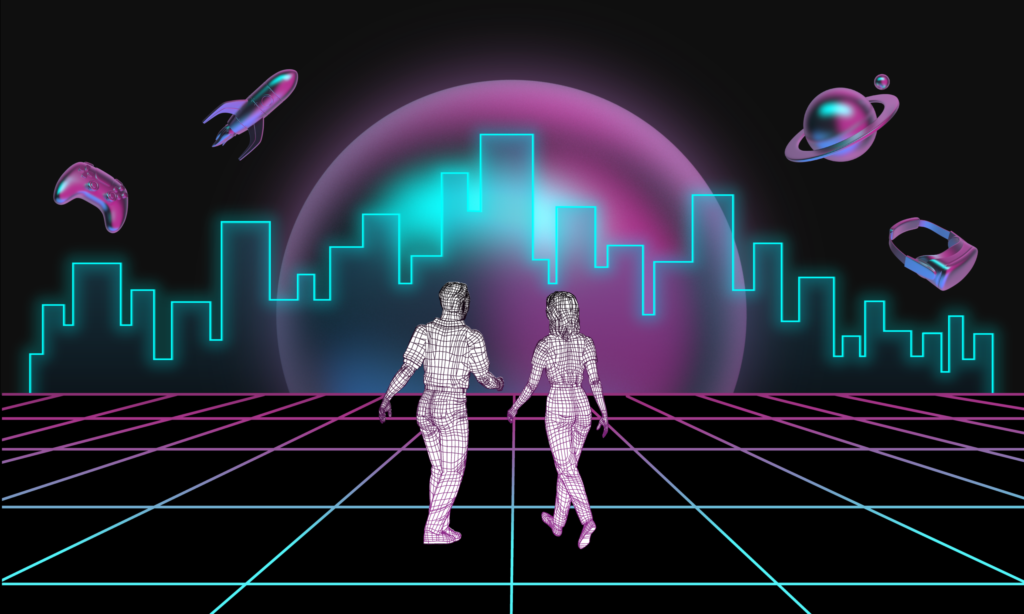
There is a moment — and you have probably felt it, even if you cannot name exactly when — where you stand at the edge of something genuinely vast and feel the particular vertigo of possibility. Not hope exactly, but something rawer. The sense that the coordinates you have been given your whole life might not be the only ones that exist. Someone experienced precisely this standing at the threshold of a rendered world so large it had its own weather systems, its own economic cycles, its own social hierarchies already crystallizing in real time. The awe was genuine. The tears, if there were tears, were real. What that person had not yet understood, could not yet see because the view ahead was too luminous, was that every square meter of what they were looking at had already been parceled, priced, and allocated before they ever arrived.
Frederick Jackson Turner delivered his frontier thesis in 1893, at the World’s Columbian Exposition in Chicago, arguing that the American character — its democracy, its individualism, its restless reinvention — had been forged specifically by the existence of free land to the west, by the perpetual possibility of beginning again. The argument was intoxicating and almost entirely wrong in the ways that mattered. The land was never free. It was taken. The freedom was never universal. It was distributed along lines of race, gender, and capital with extraordinary precision. But the mythology proved more durable than the facts, because mythologies do not compete with facts — they simply operate at a different register of human need. Silicon Valley absorbed Turner’s thesis not as history but as liturgy. Every platform, every protocol, every new digital territory has been announced in the same theological register: open land, no gatekeepers, radical democratization, the chance to begin again. And each time, within a cycle short enough to watch in a single career, the enclosures follow the promise like a shadow follows a body.
The sociologist Shoshana Zuboff, in her 2019 analysis of surveillance capitalism, traced exactly this rhythm — the way digital territories are opened with the language of liberation and closed with the architecture of extraction. The pattern is not accidental and not the result of individual bad faith. It is structural. Capital requires enclosure. The frontier, in every iteration, is the story capital tells about itself before the fences go up.
What makes the metaverse different from previous iterations is only the scale of the ambition and the completeness of the proposed substitution. Earlier frontiers claimed unused land. This one claims interiority itself — attention, sociality, presence, the felt texture of being somewhere. When presence becomes a product, the enclosure is no longer of space but of experience. And experience, unlike land, cannot even in principle be abandoned and sought elsewhere, because you carry it with you. There is nowhere else to go.
The genuine question — the one that does not resolve cleanly and perhaps should not — is whether every dream of elsewhere is finally a mechanism for avoiding the transformation of here, a way of redirecting the energy of dissatisfaction into a new geography rather than a new arrangement of power. The utopians have always believed that elsewhere is the only place transformation has ever actually begun, that you cannot rebuild the house while living inside the old architecture, that sometimes the leap is the only honest act. And they have sometimes been right. But the leap, in this particular historical moment, lands inside a territory whose deed was signed before the dreaming started, and the question of whether awe can coexist with clear-eyed reckoning — whether you can feel the vertigo of the vast and simultaneously read the fine print on the horizon — is not a philosophical puzzle but a practical and urgent demand that this specific century is placing on anyone willing to actually look.
🌐 Digital Worlds, Identity, and the Philosophy of Existence
The Metaverse raises ancient philosophical questions in radically new technological forms: What is reality? What does it mean to inhabit a space? Where does the self end and simulation begin? These articles trace the intellectual roots and conceptual neighbors of the metaverse debate, from phenomenology to virtual art to the deepest questions of consciousness.
Universal Consciousness
The concept of Universal Consciousness sits at the very heart of metaverse philosophy: if digital environments can host shared experience, the question of a collective or transpersonal mind becomes urgently relevant. Thinkers from Teilhard de Chardin to contemporary cognitive scientists have wondered whether consciousness might be substrate-independent. The metaverse pushes this speculation from abstract theory into lived, engineered reality.
GO TO THE SELECTION: Universal Consciousness
Nam June Paik: Life and Video Art
Nam June Paik was among the first artists to understand that electronic media would fundamentally reshape human perception and social space, anticipating the immersive networked environments the metaverse promises. His video installations blurred the boundary between viewer and image, turning screens into portals rather than windows. Exploring his work reveals the aesthetic genealogy of today’s virtual worlds.
GO TO THE SELECTION: Nam June Paik: Life and Video Art
Donna Haraway: Life and Thought
Donna Haraway‘s cyborg theory dismantled the clean boundary between human, machine, and animal, offering a philosophical framework strikingly applicable to metaverse identity. Her Cyborg Manifesto argued that hybrid, technologically mediated bodies are not aberrations but natural extensions of what it means to be human. In the age of digital avatars and VR embodiment, Haraway reads less like a provocateur and more like a prophet.
GO TO THE SELECTION: Donna Haraway: Life and Thought
William James and Consciousness: The Stream of Thought
William James‘s radical notion of consciousness as a continuous, flowing stream rather than a fixed substance prefigures many of the cognitive puzzles the metaverse surfaces. If experience is processual and relational, then a richly simulated environment could, in principle, generate genuine experiential states indistinguishable from physical ones. James’s pragmatist philosophy invites us to judge the metaverse not by its ontological status but by the quality of experience it actually produces.
GO TO THE SELECTION: William James and Consciousness: The Stream of Thought
Explore the Cinema of Ideas on Indiecinema
If these philosophical horizons have sparked your curiosity, Indiecinema is the streaming platform where thought meets image. Discover independent and avant-garde films that wrestle with technology, identity, consciousness, and the nature of reality — stories that the mainstream rarely dares to tell. Join Indiecinema and let independent cinema expand the boundaries of your world.
👉 EXPLORE THE CATALOG: Watch Indie Films in Streaming
A vision curated by a filmmaker, not an algorithm
In this video I explain our vision