
The Book That Says Nothing and Means Everything
There is a particular kind of frustration that has no clean name in English. You are standing in front of something — a diagram, an image, a sequence of symbols arranged with obvious intentionality — and you can feel the meaning pressing against the glass from the other side. It is not absence you are experiencing. It is presence withheld. The image is not empty. It is full, overfull, and it is looking back at you with something close to patience, waiting for a capacity you are not sure you possess. Your eyes move across it again and again, finding handholds and losing them, recognizing fragments that dissolve before they cohere. You are not lost. You are being refused.

This is the experience of opening the Mutus Liber.
Published in La Rochelle in 1677, attributed to a figure identified only as Altus — an anagram that some scholars have decoded as Jacob Saulat, though the biographical identity behind the name remains unresolved — the Mutus Liber is fifteen engraved copper plates and almost no words. Its title translates from the Latin as the Silent Book. The few words it contains are mostly invocations: an instruction to read with open eyes, a handful of biblical phrases, a Latin summons to the reader to wake and labor. And then the images begin, and language retreats, and what remains is a visual argument so dense and so deliberately opaque that scholars have spent three and a half centuries attempting to crack it without arriving at consensus.
The book claimed, in the way alchemical texts claim things — obliquely, arrogantly, with the calm of someone who has nothing to prove — to contain the complete practical method for the creation of the Philosopher’s Stone. Not metaphorically. Materially. The plates show figures working with dew collected at dawn, with celestial forces drawn down through cloth spread on grass, with the sun and moon as presences that participate in chemical transformation alongside fire and flask and human hand. The process is there, the argument insists. You simply have to be the right kind of reader to see it.
What does it mean to communicate through images alone, and what does it mean to choose that method for knowledge you claim is real and consequential? These are not the same question, though they are often treated as one. The first is a problem of cognition, of how meaning transfers across the gap between mind and symbol without the scaffolding of sequential language. The second is something harder and more charged: it is a political question about who knowledge belongs to, and a psychological one about what it does to the person who holds it.
Carl Gustav Jung, writing in Psychology and Alchemy in 1944, argued that alchemical imagery was not failed chemistry but successful psychology — that the operations the alchemists described were projections of inner transformational processes onto matter, the unconscious thinking through lead and mercury and sulphur because it had no other vocabulary yet. It is a compelling and beautiful argument, and it explains the emotional register of texts like the Mutus Liber — the sense that something deeply personal is being communicated in a language you cannot quite access. But it sidesteps the more uncomfortable possibility: that the silence was a weapon, not a symptom.
To encode knowledge so that only the already-initiated can retrieve it is not mysticism. It is gatekeeping dressed in the vocabulary of the sacred. It is the preservation of power through the performance of generosity. Here is the secret, says the silent book. It is available to anyone. Read it. The trap is perfect because it is technically true and functionally exclusive simultaneously. The knowledge is there. The conditions for accessing it have simply been made invisible, naturalized as a question of spiritual readiness or intellectual depth rather than acknowledged as a system of selection.
A man stares at a plate in which a winged figure pours something from one vessel into the sky while below him two human bodies lie in postures that might be sleep or might be death. He has been staring for an hour. He is not certain he is getting closer.
Silence as a Weapon, Not a Gift
There is a man at a dinner table who knows something the others at that table would find intolerable. He eats. He nods at the right moments. He laughs when laughter is expected. The knowledge sits behind his sternum like a stone, and the entire performance of the meal — the passing of bread, the refilling of glasses, the polite questions about family — is a kind of continuous negotiation with that stone, a way of keeping it from rising into his throat and becoming words. He has learned, through long practice, that what he knows is not something the world will receive as knowledge. It will receive it as provocation. As heresy. As a reason.
This is the grammar in which the Mutus Liber was written.
La Rochelle, 1677. France under Louis XIV is not yet the petrified monument it will become, but the architecture of control is already fully operational. The Edict of Fontainebleau is eight years away, and the Huguenots still technically exist as a community, but they exist the way anything exists under a king who considers religious uniformity a branch of statecraft — contingently, provisionally, always with one eye on the door. The book’s supposed author, a figure known only by the anagram Altus, chose silence not as a spiritual posture but as the most precise available language for a culture where the wrong sentence, spoken in the wrong room, did not end a career but ended a life.
Frances Yates, in her foundational 1972 work on the Rosicrucian Enlightenment, demonstrated with uncomfortable clarity that the wave of hermetic, alchemical, and Rosicrucian thought that swept across early seventeenth-century Europe was not primarily a spiritual phenomenon. It was a political one. The Rosicrucian manifestos — the Fama Fraternitatis of 1614, the Confessio of 1615 — arrived in a Europe freshly traumatized by the Thirty Years’ War, a continent where Protestant intellectual networks needed forms of communication that could cross confessional borders without being intercepted and decoded by the wrong authorities. Yates argued that the hermetic tradition functioned as a kind of encrypted commons, a space where reform — religious, philosophical, scientific — could be discussed in a vocabulary that provided just enough deniability to survive scrutiny. The silence of alchemy was never innocent. It was engineered.
Consider what was happening in parallel. Galileo’s recantation in 1633 was not a failure of courage — it was a man doing the mathematics of survival. He said the words they required. He bent his knee. And the knowledge persisted, moved, traveled in letters and in whispered conversations and in the margins of books that circulated under false names or no names at all. Spinoza published the Tractatus Theologico-Politicus in 1670 anonymously, with a false publisher’s name on the title page, because he understood that his real name attached to those arguments was a sentence. Giordano Bruno did not have Spinoza’s caution, and in 1600 the Campo de’ Fiori answered for it with fire.
Truth, in this period, developed a morphology. It became indirect. It became symbolic. It learned to speak in the voice of something else — allegory, image, the apparently innocent vocabulary of natural philosophy — because the direct voice had become too dangerous to use. In a room where a man needs to pass information to another man and cannot say it plainly because there are other ears present, the eyes do the work. A gesture. A pause in exactly the right place. A sentence that stops just before it arrives. The woman who knows her husband has been informed upon, and who must warn him across a crowded table without warning him, compresses everything — the danger, the route of escape, the love — into a single look that lasts less than a second and contains a novel. This is not mysticism. This is the human nervous system under pressure inventing a new syntax.
The Mutus Liber is that syntax made permanent. Pressed into copper, fixed into seventeen plates, handed to the future in a form that the present could not prosecute.

The Plates Themselves: A Grammar of Transformation
There is a man asleep in a field. Two angels bend over him, one at his head, one at his feet, their mouths open as if shouting something the sleeper cannot hear. This is not a vision, not a symbol. This is what waking looks like when the body refuses it — when the summons comes not from within but from forces the conscious mind has no vocabulary to receive. The first plate of the book begins here, with unconsciousness as a condition, not a temporary inconvenience but the starting state of the entire work.
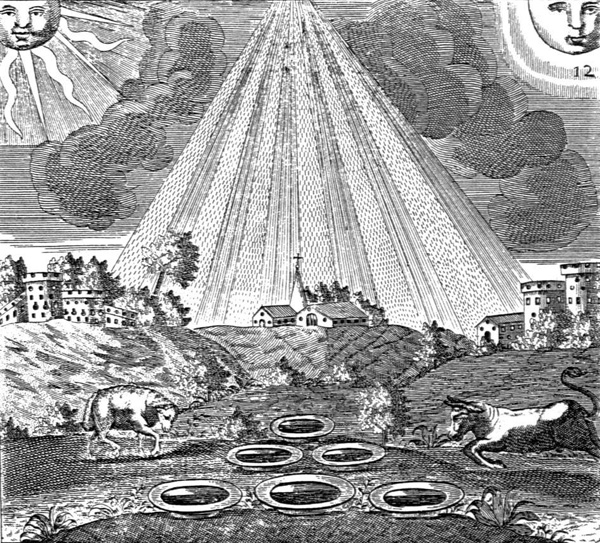
What follows across the remaining fourteen plates is not a story in any narrative sense the Western mind would recognize. It is a grammar — a set of operations performed on matter, on bodies, on relationships between substances that have no names yet because they are still becoming. A man and a woman stand at dawn in an open field, linen sheets stretched wide between them and staked to the damp ground. They are collecting dew. Not metaphorically. They wring the cloth into vessels, they bend at the waist, they work in silence while the light is still gray and indeterminate. The labor is tedious, bodily, seasonal. It requires returning to the same field on the same mornings across weeks, until enough liquid accumulates to begin. There is nothing mystical in the posture of these two figures. They look like farmers who have been told to do a strange thing and have done it.
Jung read images like these in 1944 as a cartography of what he called individuation — the long psychological process by which the fragmented self moves toward integration, toward wholeness. His Psychology and Alchemy traced the structural parallels between the alchemical stages, the nigredo, albedo, citrinitas, rubedo, and the inner life of patients whose dreams he had been collecting for decades. The argument was brilliant and genuinely opened a door that had been sealed. But it was also, in a way that matters precisely here, too reassuring. Jung wrapped the violence of these images in the language of healing. The dissolution of the self became therapeutic. The mortification of matter became growth. What had been an instruction for catastrophe became a map toward integration.
James Hillman, who spent much of his career in productive argument with the Jungian inheritance, pushed back against exactly this domestication. The soul, Hillman insisted, is not oriented toward wholeness. It is oriented toward depth, toward the intensification of experience even when that intensification means fragmentation, even when it means the permanent loss of what one had been. The alchemical images he returned to throughout his work — and the plates of this silent book belong precisely to that visual tradition — are not promises. They are reports from a process that does not guarantee survival in any recognizable form.
Look at the plate where the sun and moon face each other across a shared vessel. This is what the tradition called the chemical marriage, the coniunctio, the joining of opposites. Jung interpreted it as the reconciliation of masculine and feminine principles within the psyche. But the image does not look like reconciliation. It looks like collision. Two bodies of light aimed at each other over something they must both pour themselves into. The vessel between them is not a cradle. It is a crucible. What enters it does not emerge unchanged and enriched. What enters it burns.
The sleeping figure from the first plate reappears in later images, but transformed in ways that do not read as improvement. The face carries a different quality of attention, something less comfortable, less legible. The angels are gone. No one is watching over the work anymore. The man and woman with their linen sheets have wrung every last drop from the cloth and stand now in front of fires, tending something they did not fully understand when they began. The grammar of these plates does not build toward resolution. It builds toward a condition where the question of resolution no longer makes the kind of sense it once did.
The Alchemist’s Marriage: Gender, Labor, and the Hidden Partner

There is a photograph that does not exist. It should exist — the hands are there, in the background, holding the flask steady while the man at the front of the frame gestures toward the camera. The hands belong to a woman. They are not in the caption. They will not be in the archive. In twenty years, when someone traces the history of this laboratory, this discovery, this moment, those hands will have dissolved into the general atmosphere of the room, the way furniture dissolves, the way assistants dissolve, the way wives dissolve into the biographies of men who could not have done what they did without them.
The Mutus Liber refuses this erasure with a stubbornness that feels almost defiant given its historical moment. Plate after plate, the woman is there. Not as symbol, not as allegory, not as the passive feminine principle waiting to be acted upon — she is working. Her hands are in the dew-soaked sheets. Her arms wring the cloth. She tends the furnace alongside the man, reads the same pages, measures the same quantities. The book was published in 1677, at a moment when European natural philosophy was consolidating itself into institutions — the Royal Society had been founded in 1660, the Académie des Sciences in 1666 — and both were, with extraordinary consistency, places where women did not exist in any official capacity. The Mutus Liber’s paired figures operate, then, as a kind of counter-archive, preserving a record of collaborative labor that the surrounding culture was actively learning to suppress.
Barbara Obrist’s work on women’s participation in early modern scientific and alchemical practice documents precisely this suppression — not as sudden exclusion but as gradual administrative erasure, the slow reclassification of certain kinds of knowledge as domestic, intuitive, unverifiable, and therefore not knowledge at all. Lynne Hieatt’s research into medieval women’s engagement with natural philosophy reveals a similar pattern: women present at the work, women whose observations and practices fed directly into the written record, women who then vanished from that record as it hardened into canon. The erasure was not always malicious. Sometimes it was simply the default grammar of attribution — the same grammar that makes us say Newton discovered gravity rather than that Newton and the network of correspondents, instrument-makers, and household members who sustained his decades of work together produced an account of gravitational force that Newton then signed.
Think of a woman who has spent fifteen years compiling, translating, and cross-referencing the research notes of a man whose reputation she has helped construct from almost nothing. When the book appears, her name is in the acknowledgments — graciously, warmly — alongside the typist and the indexer. She does not contest this. She has internalized the grammar so completely that she experiences her own invisibility as a kind of modesty, even a virtue. This is what Silvia Federici, writing in Caliban and the Witch in 2004, identifies as one of capitalism’s foundational moves: the transformation of reproductive and collaborative labor into non-labor, into the background condition that makes productive labor possible, invisible precisely because it is everywhere.
The alchemical tradition’s attitude toward the feminine was never simple erasure — it was something stranger and more revealing. The soror mystica, the mystical sister, was a figure who appeared across alchemical literature as essential to the work and simultaneously impossible to fully acknowledge. She had to be present because the work required her presence; the union of opposites, the coniunctio, could not occur without the feminine principle actively engaged. And yet her presence had to be managed, contained, made symbolic rather than literal, because a literal woman doing literal labor in a literal laboratory was a social problem that the tradition did not know how to accommodate without destabilizing everything else it assumed.
The Mutus Liber does not resolve this ambivalence. It simply, without commentary, without apology, shows the woman working. Her face is as composed as his. Her gestures are as deliberate. The book says nothing because there is, apparently, nothing that needs to be said — and in that silence lives the most radical claim the book makes.
What the Dew Collectors Knew
They rise before the sky has decided what color it wants to be. The fields are still dark at the edges, the air carrying that particular cold that exists only in the hour before dawn, the kind that makes you feel the planet is a physical object moving through space. They spread the linen cloths across the grass with a care that looks, to any reasonable observer, like madness — smoothing the edges, adjusting the angle, reading something in the moisture already forming on the blades beneath their feet. They will return in a few hours and wring the cloths into vessels, collecting what the night has deposited. They will do this again tomorrow. And the day after that.
This is not ceremony. This is chemistry. Morning dew, gathered repeatedly and concentrated, yields a substance the alchemists called celestial water — rich in dissolved atmospheric compounds, micronutrients, trace minerals that fall with condensation in ways that differ fundamentally from rainwater. The Mutus Liber’s most haunting plates show this practice in precise, unhurried detail: a man and a woman, working together in near-darkness, performing a labor so specific and so patient that it cannot be dismissed as superstition. These people knew something. The question worth sitting with is exactly what kind of knowing that was, and how thoroughly we have dismantled our capacity for it.
Maurice Merleau-Ponty spent a significant portion of his philosophical life arguing against the Cartesian inheritance that treats the body as a machine piloted by a mind. In the Phenomenology of Perception, published in 1945, he proposed instead that perception is never a passive reception of data — it is an active, intelligent engagement between a living body and its world. The body learns. Not the brain through the body, but the body itself, as a unified perceiving subject. A craftsman’s hands know the grain of wood before he consciously registers it. A farmer’s feet read the consistency of soil. This is not metaphor. This is epistemology — a theory of how knowledge actually forms in beings who have not yet been convinced to distrust their own flesh.
David Abram extended this line of thinking into something more urgent and more ecological. In The Spell of the Sensuous from 1996, he argued that alphabetic literacy and abstract rationality have progressively severed Western humans from the kind of perceptual reciprocity with the natural world that Indigenous and pre-industrial peoples maintained as a matter of survival. We learned to read symbols on pages and forgot how to read the texture of morning air. We developed instruments to measure atmospheric humidity and lost the ability to feel it arriving. The dew collectors of the Mutus Liber were operating within a knowledge system that had not yet made that trade, and what looks to us like mystical patience was in fact something far more grounded — attention sustained long enough to become understanding.
There is a man who appears in a certain story about time and repetition, compelled to perform an action so specific, so seemingly irrational, that the people around him cannot determine whether he is broken or enlightened. He sharpens tools that will not be used that day. He arranges things in an order that has no obvious logic. But when the moment comes that requires exactly that preparation, he is the only one who is ready — not because he was lucky, but because his body had been rehearsing for something his mind had not yet named. The obsession was the intelligence. The ritual was the research.
We have been taught to call this kind of knowing primitive. We have a long historical tradition of dismissing pre-scientific practice as confusion waiting to be corrected. But the dew collectors were not confused about dew. They had simply refused — or never been given reason — to outsource their perception to instruments they could not feel. Their knowledge lived in the timing of their rising, in the weight of the cloth when they wrung it, in the smell of the air at four in the morning that told them whether the yield would be sufficient.
That knowledge did not disappear when modernity arrived. It went somewhere.
A vision curated by a filmmaker, not an algorithm
In this video I explain our vision
The Unfinished Calcination
There is a particular kind of exhaustion that comes not from failure but from arrival. A man sits at the edge of what he has spent decades searching for, and something in him goes quiet — not with peace, but with the sudden terrible recognition that the destination was never the point, and that he knew this all along, and that knowing it now costs him everything the journey was worth. He does not turn back. He does not go forward. He sits at the threshold and lets the question breathe.
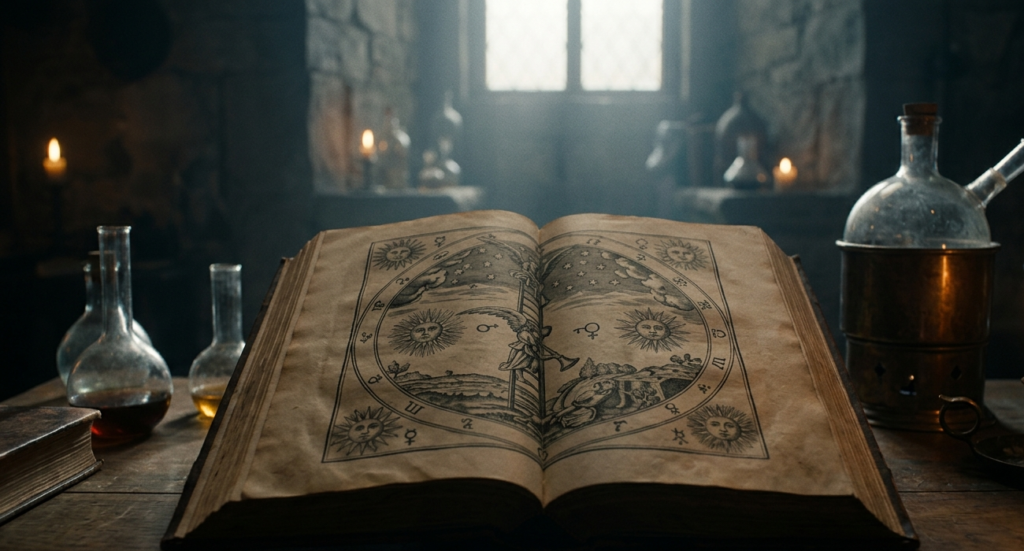
The fifteenth plate of the Mutus Liber does not conclude. Anyone who has spent time with it expecting resolution will recognize this as a kind of wound. The alchemist and his soror mystica are there, the work is gathered around them, the sequence has moved through every stage of dissolution and reconstitution — and then the image simply opens outward, like a door left ajar into a room you cannot see. The rubedo, that final reddening which alchemical tradition promised as completion, as the perfected stone, as the moment matter becomes what it was always meant to be — it is absent. Not omitted by accident. Structurally, deliberately, philosophically absent.
Walter Benjamin spent the last decade of his life assembling what would become the Passagenwerk, the Arcades Project, a vast and never-finished architecture of thought about modernity, commodity, desire, and historical time. He died in 1940 at the Spanish border, the manuscript incomplete. But scholars who have worked inside it — Susan Buck-Morss built an entire critical edifice from it in her 1989 study, and Rolf Tiedemann spent years editing what Benjamin left scattered across hundreds of fragments — understand that its incompleteness is not a deficiency. Benjamin had a concept he called the dialectical image: a moment of thought where past and present collide and hold each other in suspension, where meaning does not resolve but crystallizes precisely because it refuses to. For Benjamin, a thought that closed was a thought that had died. Genuine knowledge had to remain in tension with itself to remain alive.
The Mutus Liber understood this four centuries before Benjamin named it. Its silence was never the silence of something unfinished. It was the silence of something that knew exactly where to stop.
There is a scene that recurs across certain films — or perhaps it recurs across certain lives, and cinema merely noticed it — where a figure reaches the exact point of understanding they have been moving toward, and stops. Not collapses, not retreats. Stops. A woman who has traced a disappearance to its origin stands before the last door and does not open it, not because she is afraid, but because she has understood that opening it would replace the living question with a dead answer, and the living question has kept something essential in her alive. A man who has dismantled every illusion about his own history reaches the final document, the one that would explain everything, and folds it closed before reading the last page. These are not failures of nerve. They are recognitions — that the threshold is not an obstacle between the seeker and the truth, but is itself the truth, and that crossing it would destroy the very quality of attention that made the search meaningful.
This is what calcination means in its deepest alchemical register. Not the burning away of matter, but the burning away of the need for conclusions. What the Mutus Liber strips from its reader, plate by plate, is not ignorance. It is the consolation of closure.
And so the question that the book has been asking across all fifteen of its wordless images remains exactly where it was placed: whether the transformation it promises is of matter, of the self, or of the very idea that transformation is something that can be completed — and whether the person who reaches the end of that question without answering it has failed the work, or finally, irreversibly, become it.
🜂 The Secret Language of Alchemical Symbols
The Mutus Liber stands as one of the most enigmatic texts in the history of alchemy, communicating the Great Work entirely through images, without a single word. Its visual silence invites exploration of the broader alchemical tradition — a world where symbols, archetypes, and hidden meanings converge into a sacred science of transformation.
Magnus Opus: nigredo albedo rubedo
The Magnum Opus — the Great Work — lies at the very heart of the alchemical journey, and the Mutus Liber maps its stages in purely visual terms. The three phases of nigredo, albedo, and rubedo trace a path of dissolution and reintegration that mirrors the silent plates of the wordless book. Understanding these stages is essential to reading the symbolic grammar that the Mutus Liber so eloquently depicts.
GO TO THE SELECTION: Magnus Opus: nigredo albedo rubedo
Spiritual Alchemy: Inner Transformation and Symbolism
Spiritual alchemy transforms the language of metals and furnaces into a profound inner journey toward wholeness and illumination. The Mutus Liber, with its sequence of silent images, operates precisely on this symbolic register, inviting the reader to undergo a personal transmutation alongside the depicted operations. This article explores the deeper spiritual dimensions that make alchemical symbolism one of the most enduring systems of esoteric thought.
GO TO THE SELECTION: Spiritual Alchemy: Inner Transformation and Symbolism
Tabula Smaragdina: Text Meaning and Interpretation
The Tabula Smaragdina, or Emerald Tablet, is the foundational axiom upon which the entire alchemical edifice rests, and its influence permeates every image in the Mutus Liber. Its cryptic declaration that what is above mirrors what is below encodes the same hermetic logic that the silent book expresses through dew, sun, and moon imagery. Decoding the Emerald Tablet is therefore an indispensable key to unlocking the wordless pages of the Mutus Liber.
GO TO THE SELECTION: Tabula Smaragdina: Text Meaning and Interpretation
Jungian Alchemy: Jung and Alchemical Psychology
Carl Gustav Jung recognized in alchemy a vast projection screen for the unconscious, where the operations of the laboratory mirrored the deepest processes of psychic individuation. The Mutus Liber, communicating entirely through images rather than words, is perhaps the alchemical text most naturally suited to a Jungian reading, as it speaks directly to the archetypal imagination. This article illuminates how Jung’s psychological alchemy transforms an ancient pictorial tradition into a modern map of the soul.
GO TO THE SELECTION: Jungian Alchemy: Jung and Alchemical Psychology
Discover the Cinema of Inner Transformation on Indiecinema
If the silent images of the Mutus Liber have stirred something within you, Indiecinema’s streaming platform offers a curated selection of independent and esoteric films that continue this journey into symbol, myth, and transformation. Explore cinema that dares to speak the unspeakable — just as the great alchemists once did without a single word.
👉 EXPLORE THE CATALOG: Watch Indie Films in Streaming
A vision curated by a filmmaker, not an algorithm
In this video I explain our vision

