
The Dead Do Not Stay Silent
You are standing in a room that smells of antiseptic and something older, something beneath the chemical, and the person in the bed has just stopped moving in the way that people move when they are still alive. You know this. Your body knows this before your mind ratifies it. And yet — and this is the thing no one talks about afterward, the thing that gets edited out of the grief narrative before it reaches polite conversation — you want to ask them something. Not say goodbye. Ask. Where did you put the letters? Did you ever forgive me? Was any of it real? The question rises in you with a pressure that has nothing to do with sentiment and everything to do with the sudden, vertiginous realization that a person was a library, and the library has just burned, and you were still in the middle of reading.

This is where necromancy actually begins. Not in grimoires, not in the sulfurous theater of medieval demonology, not in the elaborate ritual instructions of the Greek Magical Papyri — though it is there too, in all of those places. It begins in the gap between what the dead knew and what the living still need. The word itself carries this tension in its etymology: nekros, corpse, combined with manteia, divination. To divine through the dead. The ancient Greeks were precise about it. Divination is not communication for its own sake — it is the extraction of knowledge that the living cannot obtain through living means. The dead were consulted not because grief demanded it, but because the dead were presumed to have access to something the living did not. They had crossed a threshold. They could see differently.
Homer understood this with a clinical clarity that later centuries would sentimentalize almost beyond recognition. When Odysseus descends to the underworld in Book XI of the Odyssey — the Nekyia, named for the ritual itself — he does not go to mourn. He goes to interrogate. He needs navigational intelligence. He needs to know how to get home. The shade of the prophet Tiresias delivers what amounts to a strategic briefing. Other shades cluster, hungry for the blood Odysseus has poured into the pit as a kind of epistemological bribe, because blood in archaic Greek thought was not merely biological fluid but the temporary medium through which the dead could regain something like cognition, something like voice. The ritual is transactional, not tender. Knowledge has a price, and the currency is life itself poured out at the border.
What is striking, historically, is how consistent this underlying architecture remains across cultures that had no documented contact with one another. The Mesopotamian text known as the Descent of Inanna, dating to roughly 1900 BCE in its written Sumerian form but almost certainly older in oral transmission, depicts the underworld as a place of rigid bureaucratic logic, where the dead are warehoused according to rules the living cannot fully access. Shamanic traditions across Siberia, documented extensively by ethnographer Mircea Eliade in his 1951 work Shamanism: Archaic Techniques of Ecstasy, describe the descent to the realm of the dead not as a supernatural rupture but as a professional competence — a skill developed and practiced, terrifying precisely because it was real work with real risks. The shaman who traveled to retrieve a soul or extract information was not performing metaphor. The community understood the journey as literal. The stakes were literal. Failure meant the practitioner’s own death or madness.
What persists across all of these instances — Greek, Mesopotamian, Siberian, and far beyond — is the refusal to accept that death constitutes a permanent information blackout. The living keep insisting that the dead are still, in some functional sense, available. Not as comfort. As resource.
Cathnafola - A Paranormal Investigation
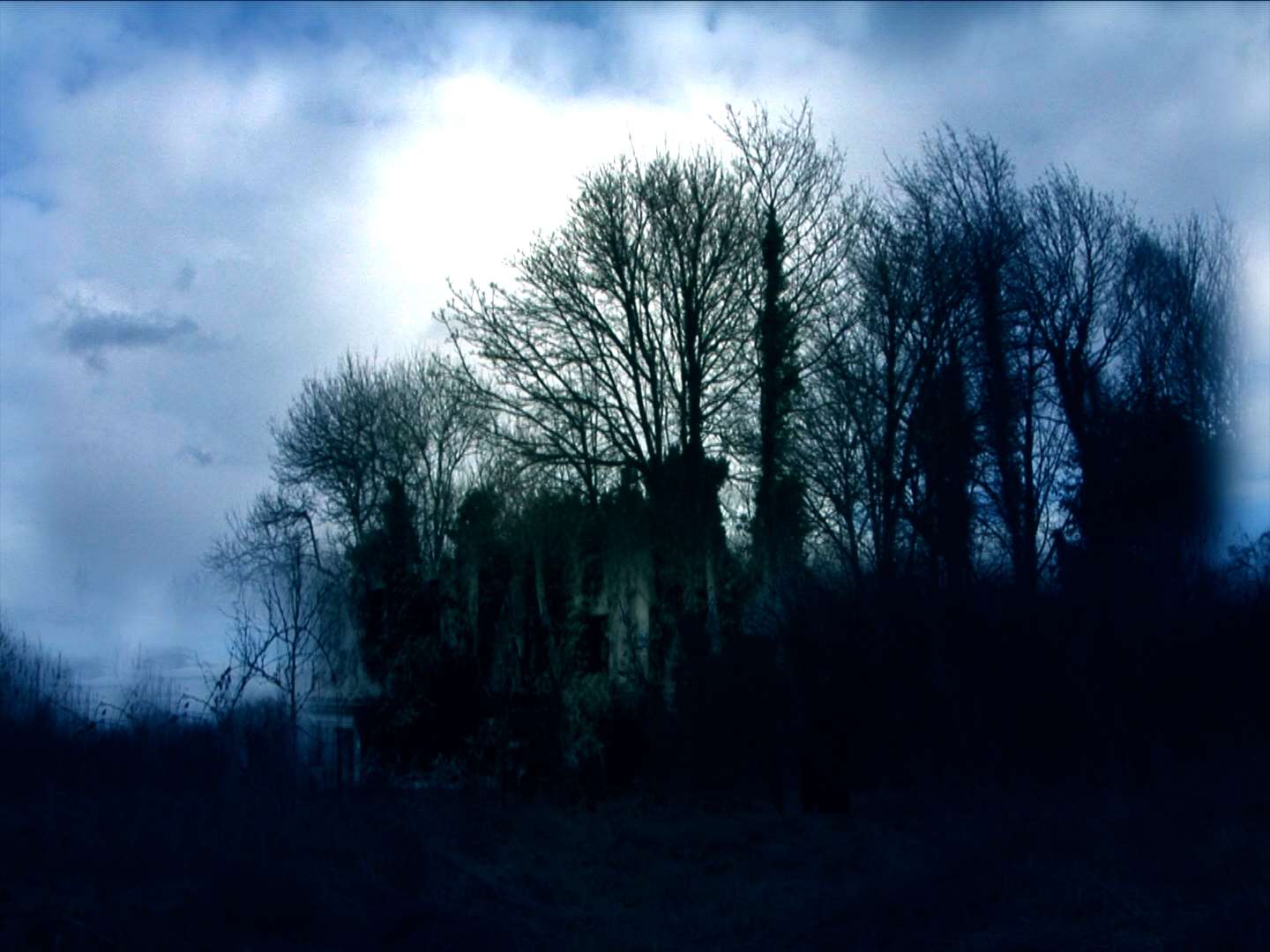
Documentary, horror, by Jason Figgis, USA, 2014.
In "Cathnafola", everything begins when renowned paranormal investigator Chris Halton of Haunted Earth UK receives footage filmed by three teenagers at the ruins of Cathnafola House in Ireland. Determined to unearth the truth behind the location’s bloody past, Halton embarks on a nighttime exploration of the infamous ruins—and soon uncovers terrifying and disturbing revelations.
LANGUAGE: English
SUBTITLES: Spanish, French, German, Portuguese
Etymology as Archaeology
You are standing at the edge of a word the way you might stand at the edge of a pit, not yet looking down, aware only that the ground beneath your feet has changed texture. The word is necromancy, and before you understand what it names, you must understand what it assumes — because the architecture of the word is itself an argument, one made long before anyone thought to question it.
Greek is a language that builds meaning the way engineers build bridges: load-bearing joints, precise tolerances, nothing decorative that is not also structural. Nekros names a corpse, a body from which life has evacuated. Manteia names divination, but not in the weak modern sense of fortunetelling or guesswork dressed in ceremony. Manteia in the Greek world designated a specific epistemological channel — a means of accessing knowledge that ordinary waking consciousness, bound by time and embodiment, simply could not reach. The compound word does not merely describe a practice. It encodes a conviction: that the dead know something you do not, and that this asymmetry can be exploited.
This is where the modern reader stumbles, because the contemporary imagination tends to read necromancy as a fantasy of power — raising armies of the obedient dead, commanding what should not move. But the original Greek conception had almost nothing to do with compulsion and everything to do with inquiry. The necromancer was not a general. He was a questioner. The dead were not soldiers. They were sources. The entire edifice rests on an epistemological premise so strange it deserves to be held still for a moment: that crossing the threshold of death grants access to a dimension of truth that life, by its very nature, occludes.
The Greeks had a separate term for the oracular practice conducted at specific geographic sites where the underworld was believed to be thin: psychomanteia, from psyche, the soul or animating breath, and again manteia. Pausanias, writing in the second century CE, describes the sanctuary at Ephyra in northwestern Greece — long identified as the Homeric Nekyomanteion, the oracle of the dead — where suppliants descended through underground corridors after days of ritual preparation, fasting, and the consumption of substances whose composition remains debated by classical scholars. The site itself, excavated in the 1950s by Sotirios Dakaris, revealed a labyrinthine structure of thick stone walls, iron wheels, and pulleys that likely produced sensory effects capable of overwhelming an already-altered nervous system. What the suppliants sought was not spectacle. They came with specific questions about specific problems: inheritances, illnesses, decisions that hung suspended between possible futures.
The critical thing Dakaris’s excavation forces into view is the institutional nature of the enterprise. Ephyra was not the improvised ritual of a lone eccentric. It was a managed infrastructure, maintained across generations, embedded in the social fabric of Greek life in a way that made consulting the dead a recognized — if extreme — form of information-gathering. Herodotus, in Book Five of his Histories, records that the tyrant Periander of Corinth sent messengers to the oracle of the dead at the Acheron River to consult the shade of his deceased wife Melissa about the location of a hidden deposit. The story is told without embarrassment, without the framing of superstition. It reads the way a modern account might describe consulting a lawyer or a specialist — as the appropriate recourse when ordinary means have failed.
What this reveals is not primitive credulity but a different map of reality, one in which death is not an annihilation of consciousness but a transformation of epistemic position. The living are partial; they see forward but not around corners. The dead, freed from the pressures of contingency and desire, are imagined to see the shape of things more completely. The word necromancy does not name a practice so much as it names a theory of knowledge, and that theory carries inside it a verdict on the living: that you are, by virtue of being alive, operating under a structural disadvantage when it comes to knowing what is real.

When Consulting the Dead Was Statecraft
You are standing in a tent at the edge of a battlefield, disguised, trying to pass for a common soldier, and the man you are talking to — the king — has already outlawed what he is about to ask you to do. Saul of Israel, on the night before the catastrophe at Mount Gilboa, crossed into Philistine territory to find a woman at Endor who could raise the dead. He had expelled all mediums and spiritists from the land by royal decree, then traveled in secret to consult one. The contradiction is not hypocrisy — it is the logic of power under duress. When the official channels fail, when priests return no answer and dreams deliver nothing, a king does not abandon the need for intelligence. He simply changes his source.
The episode recorded in 1 Samuel 28 is not a folktale at the margins of Israelite religion. It is embedded in a political crisis of the highest order: two armies positioned for a decisive engagement, a king who has lost divine favor, and a dead prophet — Samuel — who must be disturbed from his rest to deliver a verdict. What the text describes is not a private act of grief or spiritual longing. It is a reconnaissance operation. Saul needs to know the outcome before he commits his forces. The fact that the information he receives — you will lose, your sons will die, by tomorrow you will be here with me — constitutes a military briefing should not be softened by the religious frame that surrounds it. Ancient political authority required access to knowledge that living advisors could not supply. The dead, who stood outside time as the living experienced it, were understood to possess that access.
This logic traveled across cultures with remarkable consistency. In the Assyrian royal court of the seventh century BCE, under Esarhaddon and his successor Ashurbanipal, ritual specialists maintained what modern scholars of Mesopotamian religion, including Simo Parpola in his analysis of Assyrian royal correspondence, have identified as a formalized system of contact with ancestral spirits. The kispu ritual, performed monthly, involved offerings to the royal dead and formal invocations structured to elicit guidance. These were not private devotional acts — they were state ceremonies, conducted with the same institutional weight as military reviews or treaty signings. The dead king’s counsel was not metaphorical. It was treated as actionable intelligence, integrated into the deliberative culture of the court alongside astronomical omens and liver divination. Power in the ancient Near East was not legitimized only by conquest or lineage; it was legitimized by demonstrated access to the dead.
Julian, who ruled the Roman Empire from 361 to 363 CE and whose attempt to reverse the Christianization of the imperial apparatus has made him a figure of enduring controversy, did not simply restore pagan temples and fund animal sacrifices out of nostalgic piety. He was a trained theurgist, deeply influenced by the Neoplatonist Iamblichus, whose fourth-century treatise De Mysteriis argued that ritual contact with divine and semi-divine beings — including the heroized dead — was not superstition but a technical discipline, a form of applied metaphysics. Julian’s military campaigns, particularly his disastrous Persian expedition of 363 CE, were shaped in part by oracular consultations that critics even within his own circle considered reckless. When he burned his supply fleet on the Euphrates, reportedly acting on omens and inner conviction, he was not acting irrationally within his own framework. He was executing what he understood to be divinely communicated strategy — strategy filtered through the same Neoplatonic channels that connected the living emperor to the wisdom of the dead.
What these cases share is something that the category of “superstition” actively conceals: the idea that consulting the dead was ever purely personal. In each instance, the ritual is inseparable from the decision it informs, and the decision carries consequences measured in armies, dynasties, and borders.
The Church's Strategic Criminalization
You are burying your father, and somewhere between the lowering of the casket and the priest’s rote recitation, you feel the almost physical need to ask him something — not to mourn him, but to know something only he knew. Where the deed to the land is. Whether he forgave you. What he was afraid of. The Church, standing at the graveside with you, has a precise answer to that need: it is demonic. Not metaphorically. Canonically, legally, with institutional weight behind it.
This was not always the position. For most of the early medieval period, the boundary between legitimate spiritual consultation and condemned divination was genuinely porous. Learned clerics in monasteries across Europe copied and studied texts that described operations involving the dead and the demonic in clinical, almost bureaucratic language — what historians have called “learned magic,” a category that Richard Kieckhefer documented exhaustively in his 1989 study Magic in the Middle Ages. These manuscripts circulated in the same institutional spaces that housed theology and medicine. The men who read them had taken holy orders. The Church did not yet need to draw the line so sharply, because it had not yet fully consolidated the kind of centralized doctrinal authority that required a clear outside.
By the thirteenth century, that consolidation was underway. Thomas Aquinas, in his Summa Theologica, had already begun to articulate a framework in which any supernatural effect not produced through God, the sacraments, or officially sanctioned prayer must necessarily involve an implicit or explicit pact with demonic forces. This was not a theological curiosity. It was a load-bearing argument that would restructure the entire landscape of spiritual crime for the next three centuries, because it made the question of who spoke to the dead inseparable from the question of who had authority to speak at all.
Heinrich Kramer published the Malleus Maleficarum in 1487 with the co-authorship of Jakob Sprenger — though scholars including Christopher Mackay have questioned the degree of Sprenger’s actual contribution — and what that text accomplished was not primarily the cataloguing of witchcraft practices. Its deeper function was epistemological. By insisting that all anomalous spiritual power derived from diabolical contract, Kramer collapsed the older distinction between the necromancer as scholar and the witch as peasant superstition. The learned practitioner who consulted the dead through elaborate ritual became legally and spiritually identical to the village woman who was said to curse livestock. The manuscript tradition, the Latin, the geometric diagrams, the philosophical framing — none of it granted protection. If anything, the sophistication made it worse, because it implied deliberate choice.
What this reclassification actually controlled was literacy. The ability to read the old texts, to understand the ritual grammar of the dead, had been a form of power distributed unevenly but not yet criminally across the clerical class. Once that entire body of knowledge was reframed as inherently demonic rather than merely dangerous or irregular, its possession became evidence of guilt rather than proof of education. Libraries could be searched. Manuscripts could be confiscated. The man who knew too much about how the dead were supposed to speak became a suspect in an inquiry that had already decided its answer.
Grief, too, was brought under administration. The desire to communicate with the dead — which is not an abstraction but the specific, bodily anguish of bereavement — was not simply condemned as impossible. It was declared corrupt at the root, as though the wanting itself were the crime. Canon law increasingly positioned the Church as the sole legitimate mediator between the living and the dead: through prayer for souls in purgatory, through masses offered on behalf of the departed, through indulgences that could be purchased to ease a loved one’s passage. Necromancy was not merely an error. It was competition.
The Grimoire as Forbidden Archive
You are holding a manuscript that was never meant to be found. Not hidden in the conventional sense — no locked chest, no buried vault — but written in a hand so deliberately trained, so unmistakably clerical, that its existence alone collapses the story we have been told about who practiced the dark arts and why. The Munich Manual of Demonic Magic, catalogued in the Bavarian State Library as Clm 849 and composed sometime in the fifteenth century, is not the product of a village cunning-man or a half-mad hermit scratching symbols in a cave. It is a learned document, structured like a university text, written in Latin by someone who had spent years inside the very institutional Church that condemned everything on its pages.
Richard Kieckhefer, a historian of medieval religion at Northwestern University, examined this manuscript and dozens like it for his 1997 study Forbidden Rites, and what he found dismantled one of the most persistent myths in the history of magic: that necromancy was a folk practice, a superstition of the uneducated, something that rose from the soil rather than descended from the library. The practitioners Kieckhefer identifies are overwhelmingly clergy — priests, monks, cathedral canons, men who had read their Aristotle and their Augustine, who knew the liturgical calendar by heart and could cite scripture in three languages. The grimoire was not the alternative to clerical culture. It was its shadow, written in the same hand, using the same tools, structured by the same logic.
What makes Clm 849 so epistemically violent is its form as much as its content. The manual organizes its rituals with scholastic precision: categories of demons, classifications of purpose, step-by-step procedural instructions that mirror the rational architecture of a theological summa. There are experiments for binding spirits, for compelling the dead to speak, for generating illusions that manipulate the senses of observers — all written in a register that assumes the reader already understands the sacramental mechanics they are inverting. You cannot fully grasp the exorcism-in-reverse without having first internalized the exorcism. The transgression is legible only from inside the tradition being transgressed.
This is the knife’s edge that organized religion has always tried not to acknowledge. The more elaborate and codified a ritual system becomes, the more it generates the technical vocabulary for its own subversion. A religion that teaches its clergy to manipulate sacred names, consecrated objects, and prescribed gestures to produce real effects in the world has already handed those clergy the conceptual raw material for asking what happens when those same mechanisms are redirected. The medieval Church did not accidentally produce necromancers. It trained them, in the sense that it created the precise conditions — the literacy, the ritual fluency, the cosmological framework — under which necromantic experimentation became thinkable.
Kieckhefer uses the term “clerical underworld” to describe this milieu, and the phrase does something important: it refuses the clean separation between the official and the forbidden. These manuscripts circulated in spaces where educated men gathered — cathedral schools, university towns, monastic scriptoria — passed from hand to hand not as contraband exactly, but as material too dangerous to acknowledge publicly and too interesting to destroy. The prohibition was real. So was the transmission. Both existed simultaneously, sustained by the same community, which means the community itself was always more internally fractured than its external pronouncements suggested.
What the grimoire as a genre ultimately reveals is that prohibition and fascination are not opposites but collaborators. The Church’s systematic denunciation of necromancy, beginning in earnest with the canon Episcopi around 900 and intensifying through the thirteenth-century consolidation of demonological theology, did not suppress the practice — it gave it a precise shape, a set of boundaries to push against, a forbidden status that paradoxically guaranteed its transmission through exactly the literate networks capable of understanding what was at stake in crossing that line.
A vision curated by a filmmaker, not an algorithm
In this video I explain our vision
Romantic Resurrection and the Scientific Uncanny

You are sitting in a lecture hall in Bologna in 1780, watching a dead frog’s leg kick. The man at the table is not performing a ritual. He has no candles, no circle drawn in chalk, no names of angels sewn into his coat. He has copper wire, zinc, and a freshly severed limb, and when he connects them in the right sequence, the muscle contracts as though the animal simply decided, from somewhere beyond its own death, to move. Luigi Galvani called what he observed animal electricity, a vital fluid he believed resided in the tissue itself, a force that was not metaphor but mechanism. The leg kicked. The room watched. Nobody in that room used the word necromancy, but every person present understood, on some register below language, that they had just watched a dead thing respond to the living world.
What Galvani had stumbled into was not merely a scientific discovery but a conceptual rupture that the eighteenth century was entirely unprepared to absorb cleanly. The Enlightenment had spent a century insisting that the universe operated according to rational, measurable laws — that the gap between the animate and inanimate was a matter of chemistry, not cosmic permission. But the frog’s leg complicated this. If electricity could produce the signature behavior of life in dead tissue, then the boundary between death and life was not a wall but a threshold, and thresholds, unlike walls, can be crossed in both directions. Alessandro Volta would eventually demonstrate that the source of the current was the metals and not the frog, publishing his findings in 1800 and effectively dismantling Galvani’s specific theory of animal electricity. But dismantling the theory did not dissolve the cultural image it had already released into the European imagination. The frog kept kicking, in pamphlets, in dinner conversation, in the notebooks of people who had never set foot in a laboratory.
Mary Shelley was nineteen years old in 1816 when she began writing what would become, two years later, a novel about a man who assembles a body from corpses and runs electricity through it until something ancient and terrible opens its eyes. She had read Erasmus Darwin’s accounts of experiments on organic matter. She had listened to Percy Shelley and Lord Byron discuss galvanism at the Villa Diodati on a night when lightning was crossing the Swiss sky in long white fractures. What she produced was not a fantasy about magic. It was a fantasy about science — specifically about what happens when science reaches the same destination that sorcery always claimed to be approaching. The creature her novel imagined was not conjured from a grimoire. It was assembled from the same material naturalists worked with every day, reanimated by a force that legitimate researchers were actively trying to harness. The horror of the book was not that its premise was impossible. The horror was that it wasn’t.
The serious question galvanism posed — and that no one in the nineteenth century could fully answer — was whether life itself was a property of matter under certain conditions, or whether it was something granted from outside matter entirely. Giovanni Aldini, Galvani’s nephew, took the experiments further and in 1803 applied galvanic current to the body of an executed murderer named George Forster at Newgate Prison in London. Witnesses reported that the dead man’s jaw quivered, his eye opened, his fist clenched. The Times covered it. The crowd outside was not a crowd at a scientific demonstration in any way that distinguished itself meaningfully from a crowd that had once gathered to watch a cunning man call a spirit into a mirror. The apparatus had changed. The hunger behind the watching had not. What people wanted to see, and what they were afraid of seeing, was exactly what every account of necromancy from Saul at Endor to the grimoires of the medieval monasteries had always promised: the dead, briefly, answering.
Grief, Control, and the Psychology of Speaking to the Dead
You are sitting with your phone in your hand, scrolling through the old messages, reading what they wrote to you six months before they died, and you are not doing it to mourn — you are doing it because for a moment, in the blue light of the screen, they are still answering you.
This is not pathology. It is not denial in the clinical sense, not a refusal to accept reality, not the mind snagging on a wound it cannot process. It is something far more structurally human than any of those diagnoses allow, and the fact that we have treated it as dysfunction for most of the twentieth century tells us more about the cultural anxiety surrounding death than it does about any individual psychology. Sigmund Freud‘s 1917 essay “Mourning and Melancholia” established the governing model: healthy grief was grief that moved toward detachment, toward the severing of libidinal ties to the lost object, toward the eventual reinvestment of emotional energy in the living world. To remain attached was to fail. To keep speaking to the dead, internally or externally, was to have gotten stuck somewhere the psyche was supposed to pass through. The entire mid-century clinical apparatus of grief therapy was built on this architecture of letting go.
What Dennis Klass, Phyllis Silverman, and Steven Nickman documented in their 1996 edited volume “Continuing Bonds: New Understandings of Grief” was that virtually no one actually grieves the way Freud said they should, and those who do it most completely do not emerge healthier on the other side — they emerge hollowed. The book compiled decades of fieldwork with bereaved parents, widows, children who had lost parents, and what emerged from all of it was consistent and almost embarrassing in its simplicity: the bereaved do not sever bonds. They transform them. They carry the dead forward as interior presences that continue to shape decisions, values, moral sensibilities, and even daily behaviors. A woman who lost her mother at forty still hears her mother’s voice when she is making a difficult choice. A man whose closest friend died in his thirties finds himself, fifteen years later, responding to ethical questions by asking what that friend would have thought. These are not symptoms. They are, Klass and his colleagues argued, the normal structure of ongoing selfhood.
Human identity is relational in its architecture. The self is not a sealed unit that forms in isolation and then enters relationships — it is constituted through relationships, sculpted by specific others whose way of seeing, whose particular demands and tolerances and expressions of care, become literally structural in how the person understands themselves and acts in the world. When one of those constitutive others dies, the relationship does not end because the architecture does not dissolve. The dead remain active in the living precisely because the living were partly built by them. The internal presence that Klass and Silverman documented is not a projection, not a fantasy, not a symptom of incomplete mourning — it is the residual structural weight of a relationship that was real.
Necromancy, read through this lens, looks like something other than superstition dressed in theatrical costume. It looks like the ritual formalization of a psychological necessity that has no other legitimate public form. In cultures where the continuing bond is acknowledged, where the dead are fed, consulted, propitiated, spoken to at seasonal thresholds or at the family table, the individual’s internal relationship with the lost person has a social container. It is recognized as real. It has a grammar. The impulse does not need to become obsessive or destabilizing because the culture has already made space for it.
What happens when that space collapses — when the dominant framework insists that grief is a process with an endpoint, that health means completion, that the rational adult does not speak to those who cannot answer — is that the impulse does not disappear.
What the Living Are Actually Asking
You are standing at the grave of someone who died knowing something you still do not know. Not a secret they kept from you — something structural, something about the shape of a life seen from its end, a vantage point you cannot occupy without ceasing to exist. This is the pressure no grief counselor names and no funeral rite quite dissolves: not the loss of the person, but the loss of what they could see from where they ended up.
The necromancer, across every tradition that has carried the practice — Mesopotamian kispum rituals, the Homeric nekyia, the grimoire traditions of early modern Europe — has never been adequately described as someone who wants the dead back. The desire is more precise and more desperate than that. What the practitioner wants is testimony from a position that the living structurally cannot occupy. The dead are not consulted for comfort. They are consulted because they have passed through the threshold that renders all living knowledge provisional. Samuel’s ghost summoned at Endor does not reassure Saul — he confirms what Saul already feared, and the confirmation is the point. The dead know the verdict. They have already received it.
Giorgio Agamben, in his 1998 work Quel che resta di Auschwitz, builds a theory of the remnant that cuts across testimony and incompletion in a way that illuminates something far older than the Holocaust it addresses. The remnant, for Agamben, is not the survivor — it is what survives in the survivor, the part that speaks from a position that cannot fully be inhabited by the speaker. The witness always speaks on behalf of something that cannot itself speak: the drowned, the fully consumed. What the living carry forward is always this incomplete testimony, fractured by the impossibility of fully crossing the threshold and returning. Applied outward from his immediate historical subject, the logic exposes why necromancy persists not as superstition but as a philosophical compulsion. Every act of consulting the dead is an attempt to close a gap in testimony that living knowledge structurally produces. You cannot see the shape of your own life while you are still inside it, the way you cannot read the title on the spine of a book you are trapped within.
This is what medieval theologians sensed when they condemned the practice with a ferocity disproportionate to its social threat. The danger was not demonic contamination. The danger was epistemological insubordination — the suggestion that living authority, including the authority of the Church, did not possess final knowledge, and that final knowledge resided somewhere the living could not legitimately go. The Malleus Maleficarum, published in 1486 by Heinrich Kramer, treats necromancy as a theft of divine prerogative precisely because it attempts to access what is not meant to be accessed from inside a living body. The prohibition is a territorial defense of the known.
What makes this permanent rather than historical is that the epistemological gap has not closed. Neuroscience, depth psychology, and philosophy of mind have mapped the interior of lived experience with extraordinary precision, but they have done so from inside the very constraint they are trying to describe. Consciousness studying consciousness produces the same structural blindspot that a hand produces when it tries to draw itself drawing. The necromantic impulse names this problem before it could be formalized — it names the suspicion that the most consequential knowledge is always on the other side of a boundary that life itself enforces.
What the living are actually asking when they call across that boundary is not for the dead to return, but for the living to be briefly released from the condition of being only partially inside the truth of their own existence, held in a suspension that ends only once, and only when the asking does too.
🕯️ Between Worlds: Death, Magic, and the Occult
The figure of the necromancer stands at the threshold between the living and the dead, weaving together ancient ritual, forbidden knowledge, and the eternal human hunger to speak with what has passed. These related articles explore the mythologies, symbols, and cultural roots that give necromancy its enduring power across history and imagination.
The Vampire Myth: History and Symbolism
The vampire myth shares deep roots with necromantic traditions, both emerging from cultures haunted by the boundary between life and death. This article traces the historical and symbolic evolution of the vampire from ancient folklore to modern literature, revealing how fear of the undead shaped entire civilizations. Like necromancy, the vampire story is ultimately a meditation on what it means to refuse the finality of death.
GO TO THE SELECTION: The Vampire Myth: History and Symbolism
Lovecraft’s Necronomicon and the Cthulhu Mythos
Lovecraft’s Necronomicon is perhaps the most famous fictional grimoire ever conceived, a book whose very name echoes the Greek roots of necromancy — the law of the dead. This article examines how Lovecraft constructed an entire cosmology around forbidden knowledge and the terror of invoking forces beyond human understanding. The Cthulhu Mythos stands as a modern literary descendant of the oldest necromantic fears.
GO TO THE SELECTION: Lovecraft’s Necronomicon and the Cthulhu Mythos
The Philosopher’s Stone: Esoteric Meaning
The Philosopher’s Stone and the necromancer’s art both belong to the same hermetic tradition, driven by the dream of mastering the forces of transformation and transcendence. This article explores the esoteric meaning of alchemy’s supreme goal, tracing its connections to death, resurrection, and the transmutation of the soul. Understanding the Stone illuminates why necromancy and alchemy so often appear intertwined in Western occult history.
GO TO THE SELECTION: The Philosopher’s Stone: Esoteric Meaning
The Pact with the Devil in Literature: History and Symbolism
The pact with the devil in literature is a story about the same forbidden border that necromancy seeks to cross — the line between human limits and supernatural power. This article surveys the long literary tradition from Faust to modern fiction, showing how the diabolical contract became a metaphor for transgression and the fatal cost of forbidden knowledge. The necromancer and the man who sells his soul are, at their core, the same archetypal figure.
GO TO THE SELECTION: The Pact with the Devil in Literature: History and Symbolism
Discover the Darkness on Indiecinema
If these themes of death, ritual, and hidden knowledge speak to you, Indiecinema’s streaming platform is home to a carefully curated selection of independent and art-house films that dare to explore the same shadowed territories. From esoteric cinema to psychological horror and visionary fantasy, there is a world of dark wonder waiting for you to discover — stream it now on Indiecinema.
👉 EXPLORE THE CATALOG: Watch Indie Films in Streaming
A vision curated by a filmmaker, not an algorithm
In this video I explain our vision

