
The Ghost at the Paper Screen
You are reading alone, late, and the house has gone quiet in that particular way that feels less like absence of sound and more like the sound of something waiting. The story in your hands involves a man who returns home after years of wandering, and his wife is there, and she is warm, and she speaks to him, and the reunion is everything absence promised it would be — until morning comes and she is gone and has been gone, the neighbors tell him, for a very long time. You did not expect to feel your own spine in this. You did not expect a Japanese text from 1776 to reach through two and a half centuries and touch something you recognize not intellectually but physically, the way a cold room is recognized before the mind names it cold.

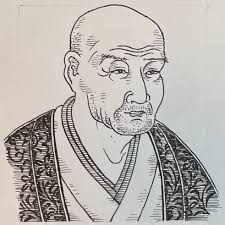
Ueda Akinari published Ugetsu Monogatari — rendered in English roughly as Tales of Moonlight and Rain — in the late Edo period, a moment when Japan’s merchant class had accumulated enough cultural capital to develop its own literary appetite, distinct from the aristocratic refinements of Heian precedent and the martial codes that had organized public life for centuries. Akinari was not a court poet. He was a man who had survived smallpox as a child, losing the use of several fingers, who ran an oil and paper shop in Osaka before abandoning commerce for scholarship and fiction, who translated and argued and annotated with the restless intensity of someone who had never quite belonged to any single world. The nine tales he assembled are supernatural in their architecture — ghosts, demons, obsession, transformation — but the supernatural in his hands is not decoration. It is the most precise instrument available for describing what ordinary language cannot hold without breaking.
What makes Akinari genuinely unsettling, in a way that separates him from both the Gothic traditions developing simultaneously in Europe and the earlier Japanese traditions of setsuwa and kaidan he was consciously revising, is his absolute refusal to let the uncanny serve as moral punctuation. Ann Harrington and other scholars of kokugaku influence have noted how Akinari absorbed the nativist philological movement of his era — particularly the work of Motoori Norinaga, with whom he engaged in famous and bitter intellectual dispute — while resisting its drive toward cultural purity and didactic clarity. Norinaga wanted mono no aware, the pathos of things, to anchor a specifically Japanese aesthetic identity. Akinari wanted something rawer: the pathos of things that will not resolve, of longing that outlasts the body that housed it, of love that becomes indistinguishable from haunting because the distinction was never as stable as the living require it to be.
The paper screen — shoji — appears repeatedly across the collection as both literal object and structural metaphor. It is a boundary that diffuses rather than blocks: light passes through it, silhouettes move behind it, you can hear what you cannot see. It is a membrane, not a wall. The ghosts in Akinari’s world do not smash through barriers. They seep. They appear where there should be only a domestic interior, and the horror — if horror is even the right category, which it probably is not — comes from the recognition that the membrane was always thinner than the household wanted to believe. The woman who returns is not a monster. She is what love leaves behind when the body fails to keep pace with the intensity of what it felt.
Roland Barthes, writing about the pleasure of the text nearly two centuries after Akinari, described the difference between a text that produces comfort and a text that produces jouissance — a rupture, a disorientation, something closer to crisis than to satisfaction. Akinari’s tales do not want your admiration. They want to find the place in you that already knows what it means to hold something too tightly and feel it become something else entirely in your hands.
Ugetsu
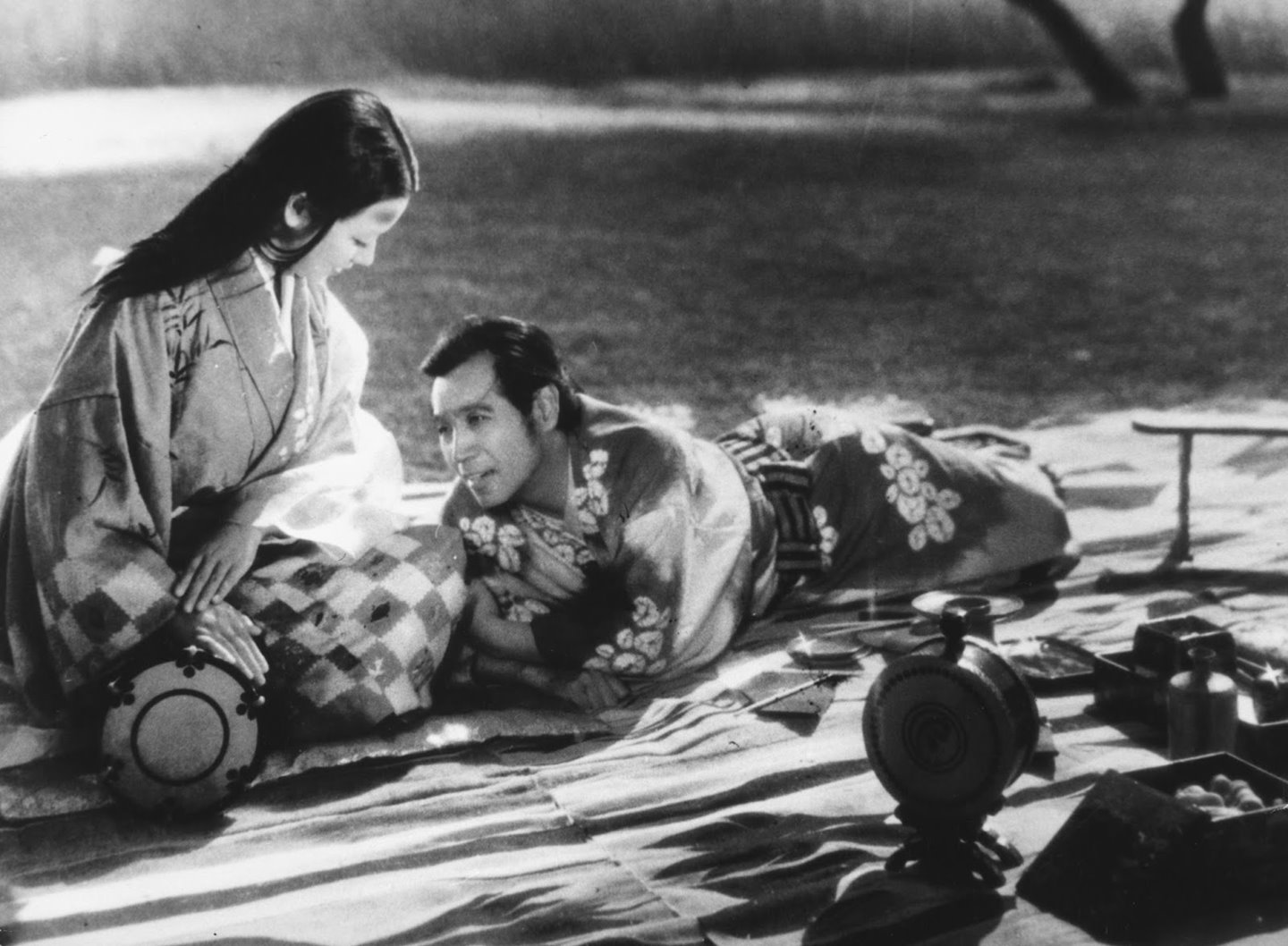
Drama, fantasy, by Kenji Mizoguchi, Japan, 1953.
Japan, late 16th century: the potter Genjurō and his brother Tobei live with their wives Miyagi and Ohama in a village in the Omi region; Genjurō, convinced that he can earn a lot of money by selling his goods in the nearby city, goes to the county of Omizo with Tobei, who joins him with the sole purpose of being able to become a samurai. Back home with a good income, the two work hard to make even more money; Tobei, increasingly obsessed with the ambition of becoming a samurai, needs the money to buy an armor and a spear while Genjurō, overcome by greed, tries to cook a batch of crockery with his brother in just one night. Legend and innovation of cinematic language, a wonderful world next to a brutal and cruel world. Mystery film that opens a discourse with the invisible planes of existence, ghosts and forays into the fantastic, made by Kenji Mizoguchi in a Japan still frozen by the two atomic bombs dropped on Hiroshima and Nagasaki. Fundamental work by Mizoguchi, recognized as one of the greatest expressions of the Seventh Art. A lofty lesson in directing that creates wonder with a dramatic tale of greed and lust for possession. A woman who is a tempting demon and a wife abandoned to a fate of war and misery, Mizoguchi uses the camera to enter "another world".
Food for thought
According to ancient Eastern traditions there are other non-physical planes beyond the physical plane. The etheric plane envelops the physical body, gives it vital energy and acts as an intermediary with the higher levels. Beyond the etheric plane there is the astral plane where entities may exist that have not been able to resign themselves to the loss of their body and wander in search of sensations. They are what are commonly referred to as "ghosts". These entities are looking for bodies that have unbalanced etheric planes to "hook up" to in order to experience sense satisfaction through them.
LANGUAGE: Japanese
SUBTITLES: English, Spanish, French, German, Portuguese
The Feudal Unconscious Wearing a Supernatural Mask
You are reading a ghost story, and you believe you are being frightened. That is the first trap.
Ueda Akinari published Ugetsu Monogatari in 1776, during the mature consolidation of Tokugawa rule — a system of governance so architecturally rigid that it classified human beings by birth into categories that could not be legally crossed, monitored movement through a national checkpoint system, and criminalized the expression of political dissent with a precision that made silence not a choice but the only viable metabolism of consciousness. Into this climate Akinari released nine tales of bleeding women, vengeful spirits, fishermen possessed, and scholars devoured by their own scholarship. The question is not whether these stories are frightening. The question is what, exactly, they are frightening about.
The Tokugawa order did not merely prohibit certain behaviors. It prohibited certain feelings — specifically, the feeling that one’s assigned social position was unjust, arbitrary, or survivable only through spiritual mutilation. The samurai caste was expected to perform a kind of permanent readiness for death that had long since hollowed itself of any authentic martial content and become pure theater. The merchant class accumulated wealth under laws that officially classified them as the lowest productive stratum, below farmers, because they produced nothing tangible — and yet by the eighteenth century they controlled the economic pulse of Osaka and Edo while being legally barred from displaying that power openly. The result was a civilization living in radical contradiction with its own self-description, and that contradiction needed somewhere to go.
What Akinari understood, whether consciously or through the pressure of what his historical moment made sayable, is that the supernatural is structurally perfect for this displacement. A ghost carries grievance across the boundary that official reality insists is final. A vengeful spirit does what the oppressed person cannot: it refuses to accept that the social verdict pronounced upon it during life was legitimate or permanent. In “The Cauldron of Kibitsu,” the dead wife Isora does not simply haunt — she makes the man who discarded her for a younger, socially more convenient woman understand, through suffering, that his act of abandonment was not a private domestic matter but a form of violence the world had agreed to call ordinary. The ghost story provides what the legal and philosophical architecture of the era explicitly withheld: a tribunal in which that kind of violence can be named as such.
Roland Barthes argued in Mythologies, published in 1957, that myth functions primarily to naturalize history — to make contingent social arrangements appear inevitable, eternal, and beyond dispute. The Tokugawa ideological apparatus was engaged in exactly this project, drawing on neo-Confucian hierarchical ethics to present the stratification of human beings as a cosmic fact rather than a political construction. Akinari’s ghosts perform the inverse operation: they denaturalize. They return precisely because the social death that was supposed to be permanent and silent has not, in fact, been accepted by the one who was supposed to disappear.
There is also something specific to the scholar figure that Akinari returns to — the man of learning who is either destroyed by his own erudition or seduced past the boundary of the human by something he found in a text. This is not an abstract philosophical motif. In a society where the right to certain kinds of knowledge was gatekept by class and institutional affiliation, the scholar who reaches too far encodes a recognizable anxiety about what happens when the unofficial person attempts to occupy intellectual space that has been reserved for official persons. The supernatural punishment that follows is less a moral verdict than a structural prediction: this is what the system does to those who exceed their sanctioned perimeter, rendered in the language of demons because the language of politics had been made unavailable.

Women Who Refuse to Dissolve
You inherit a house from a woman who never left it. That is the trap embedded in “Asaji ga Yado” — a husband departs for years, the wife remains, and when he finally returns, she is still there, waiting in a decayed structure with the patience of something that has crossed out of time. Most readers receive this as a ghost story. It is not. It is a story about what happens when a woman’s devotion is so total, so structurally enforced by the logic of her world, that it outlasts biology itself. Ueda Akinari, writing in 1776 in Ugetsu Monogatari, understood something that would not be named academically for another two centuries: the ghost is not a supernatural event. The ghost is the residue of a life that was never permitted to move.
Simone de Beauvoir argued in The Second Sex, published in 1949, that cultures do not simply oppress women — they mythologize the ones they cannot contain. The woman who refuses to be absorbed into wifehood, motherhood, or silent grief becomes, in the cultural imagination, something inhuman: witch, specter, serpent. The mythology is not decorative. It performs a function. It relocates the danger of female refusal from the social to the supernatural, making it easier to fear than to examine. What Akinari did, perhaps without the theoretical scaffolding but with an artist’s precision, was reverse the mechanism. His spectral women are not aberrations. They are logical conclusions.
The white serpent of “Jasei no In” is the most vivid case. Toyoo encounters a beautiful woman, falls under what he understands as enchantment, and spends the tale oscillating between desire and terror as her true nature is revealed. The cultural reading is ready-made: monstrous feminine, dangerous sexuality, the man imperiled by what he cannot resist. But the serpent-woman wants something specific. She wants to be chosen completely, without the hedging, the social retreat, the eventual deference to family and propriety that Toyoo repeatedly performs. Her monstrousness is not her nature — it is the label applied to a desire that refuses to subordinate itself. She demands reciprocity in a world that had no architecture for it, and when that demand cannot be met, she is classified as a demon. The exorcism at the end of the tale is not a moral resolution. It is a suppression, and Akinari writes it with enough ambiguity that the reader cannot entirely cheer for the monk’s victory.
What makes these figures agents rather than victims is precisely their persistence. They do not ask for sympathy. The wife in the ruined house does not weep for herself. The serpent does not beg. There is something in both of them that has hardened beyond the need for the living world’s validation, and that hardness is what the narrative cannot domesticate. Medieval Japanese cosmology had categories for vengeful spirits — onryō, the spirits of those who died with unresolved grievance — but Akinari’s women fit imperfectly into that taxonomy. Their grievance is not an event. It is a condition. They are not angry about a single betrayal. They are the embodiment of what was structurally refused to them across entire lifetimes.
The sociologist Émile Durkheim wrote in The Elementary Forms of Religious Life in 1912 that the sacred and the dangerous occupy the same psychological space in every culture — what a society cannot integrate, it consecrates and quarantines simultaneously. Female agency in Tokugawa-era Japan was precisely this kind of quarantined sacred: honored in the abstract as loyalty and devotion, made monstrous the moment it exceeded the permitted boundary.
Loyalty as a Death Sentence
You have already given everything to the one who commands you. Not because you were forced — because you believed the giving was the right shape of a self. This is the opening condition of “Bewitched,” one of the most quietly devastating tales in Ueda Akinari‘s 1776 collection, where a retainer’s absolute fidelity to his lord does not save him, does not redeem him, does not even register as heroic. It simply kills him, with the clean indifference of a mechanism completing its cycle.
What Akinari is doing here cannot be separated from the specific historical pressure of Tokugawa Japan, a society that had spent over a century codifying Confucian ethics into administrative reality. Loyalty — chū — was not a personal virtue in that context but a structural demand, woven into the hierarchy of lord and retainer with the same inevitability as gravity. The retainer in “Bewitched” does not choose loyalty the way a modern individual might choose a commitment. He is loyalty, constitutively, in the way that his posture, his speech, his entire orientation toward the world has been shaped by a social architecture that preceded his birth and will outlast his death. He is faithful to a man who may not deserve it, to a duty that was never negotiated, to a code whose internal logic cannot accommodate the question of whether any of this is worth the cost.
Norbert Elias, writing in The Civilizing Process in 1939, traced how European court societies between the sixteenth and eighteenth centuries transformed external compulsion into internal regulation — how the violence of feudal life was not eliminated but driven inward, repackaged as self-control, propriety, and honor. What had once been enforced by the sword became enforced by shame, by the internalized gaze of a social order that no longer needed to threaten openly because its subjects had absorbed the threat as conscience. The samurai class of Tokugawa Japan underwent a parallel and arguably more extreme version of this process. The Hagakure, dictated by Yamamoto Tsunetomo around 1716, opens with the declaration that the way of the samurai is found in death — not as hyperbole, but as a literal instruction for how to calibrate the self. You resolve yourself to die, and then you act. The body becomes expendable the moment the code is fully internalized.
Akinari understood this machinery from the inside, and his genius in “Bewitched” is that he does not attack it from the outside. He does not produce a counter-argument or a rebellious character who sees through the illusion. Instead he follows the logic of loyalty to its exact conclusion and lets that conclusion speak. The retainer is bewitched — drawn toward something uncanny, something that pulls against the clean lines of duty — and this bewitchment is less a supernatural intrusion than a name for what loyalty has never had room to address: the self’s own desires, fears, and unnamed needs, which do not disappear when a code suppresses them but go underground and return wearing the face of a ghost.
There is something Elias did not fully develop, perhaps because his framework was built for court behavior rather than sacred duty: the way certain behavioral codes achieve their deepest hold precisely by making self-destruction feel like integrity. The retainer in Akinari’s tale is not coerced in any visible sense. He is, by every measure available to him and to his society, doing exactly what a good man does. This is what makes the tale unnerving in a way that simple tragedy cannot be — because the reader who recognizes themselves in him cannot easily locate the moment of error. The code was followed correctly. The death was earned through perfect compliance. The system did not malfunction.
A Scene of Contamination
He opens the door — or what functioned as a door before the wood swelled with seasons he was not present to count — and the woman standing in the dim interior is his wife, recognizably, anatomically his wife, and yet something in the geometry of her stillness tells him that whatever elapsed between his departure and this moment has not elapsed for both of them equally. She has not aged in the way he feared. She has aged in a way he could not have anticipated, which is to say she has been transformed not by time but by the specific texture of waiting, by the particular weight of years spent in anticipation of a moment that kept failing to arrive. The house is intact. She is intact. It is the interval between them that has become uninhabitable.
Ueda Akinari understood duration not as neutral passage but as a medium with chemical properties, something that acts upon the beings submerged in it differently depending on their position within it. In Ugetsu Monogatari, published in 1776, the structure of several tales depends precisely on this asymmetry — on the discovery that two people who shared a life did not share an absence. What the traveler or the soldier or the wandering scholar experiences as a gap, a suspension of ordinary time, accumulates for the one who remains as a slow and irreversible accretion. This is not sentimentality about longing. It is a formal claim about the ontology of waiting: that it is not passive, not merely the negative space around action, but a corrosive process that consumes the architecture of shared meaning from the inside.
The Western philosophical tradition has generally treated time as a universal frame within which individual lives unfold at the same pace. Henri Bergson‘s distinction in Matiere et Memoire, published in 1896, between clock time and lived duration cracked this assumption open — but even Bergson imagined duration as something interior to a consciousness, not as something that could diverge catastrophically between two people occupying the same household. Akinari’s tales enact a divergence Bergson’s framework could not fully accommodate: not the difference between subjective and objective time, but the difference between two subjectivities whose shared temporal ground has been silently dissolved by separation.
What makes this philosophically disturbing rather than merely melancholy is the implication that presence is not simply the opposite of absence. Presence is a continuous act of mutual calibration, a constant low-level negotiation in which two people keep their versions of reality synchronized. Remove one party from that negotiation for long enough and the two realities drift. What drifts is not factual information about the world — they may agree on what year it is, what has happened in the province, who has died — but the lived texture of meaning attached to shared objects, shared spaces, shared names. The woman in the doorway and the man crossing the threshold are no longer operating inside the same story, even if they are operating inside the same house.
Akinari refuses the consolation of reunion as restoration. This is what separates his treatment from the conventional narrative of return, in which absence functions as a temporary interruption after which ordinary life resumes with perhaps a deepened appreciation for what was nearly lost. In his hands, the return is the moment at which the contamination becomes visible. The years of waiting have not been held in suspension, preserved for the moment of reunion. They have been lived, transformed, metabolized into something that cannot be undone by the arrival of whoever was absent. The supernatural elements in his tales — the woman who waited past death, the lover who returns as something other than human — are not departures from psychological realism but intensifications of a truth about ordinary absence that realism tends to soften.
A vision curated by a filmmaker, not an algorithm
In this video I explain our vision
Buddhism, Desire, and the Trap of Enlightenment

You light incense before a shrine you do not believe in, and the gesture calms you anyway. The calm is the problem.
Ueda Akinari understood something about Buddhist narrative that its practitioners preferred not to articulate: that the cosmological framework surrounding death, desire, and karmic consequence could function as a container for suffering rather than its dissolution. In “Shiramine,” the vengeful spirit of Emperor Sutoku does not achieve peace through Buddhist intercession — he achieves articulation. The monk Saigyō listens, and the ghost grows more vivid, more coherent, more dangerously alive in his resentment. The apparatus designed to release attachment instead provides attachment with its most sublime vocabulary.
This is precisely the mechanism Slavoj Žižek identifies in Living in the End Times, published in 2010, when he argues that contemporary Western appropriations of Buddhism function as a spiritual analgesic that trains its practitioners to accept systemic injustice by reframing it as the inevitable turbulence of attachment. The monk who achieves equanimity before a flooded village has not transcended suffering — he has made his relationship to suffering aesthetically tolerable. Žižek’s critique bites hardest not against meditation cushions but against the structural complicity embedded in detachment as a moral ideal, the way inner peace can become indistinguishable from passivity dressed in robes.
Akinari’s ghosts, read through this pressure, become something more unsettling than supernatural cautionary figures. They are the return of everything that Buddhist resignation asked its believers to release. The woman in “The Caldron of Kibitsu” does not haunt Shōtarō because karma demands retribution in some cosmic ledger — she haunts him because desire that has been named sinful and suppressed does not dissolve, it calcifies. The religious machinery surrounding her story classifies her jealousy as spiritual failure, as an attachment she should have transcended through correct practice. What the narrative actually shows is that the classification itself becomes part of the wound, that being told your grief is cosmologically incorrect intensifies its grip rather than loosening it.
Eighteenth-century Japan was undergoing what historians of the Edo period, including Tetsuo Najita in Visions of Virtue in Tokugawa Japan, have described as a crisis of Neo-Confucian and Buddhist institutional authority simultaneously — a period when the structural guarantees of meaning provided by temple networks and scholastic hierarchies were visibly failing ordinary people while continuing to demand their ritual compliance. Akinari was writing inside this fracture. The Buddhist resolutions his tales gesture toward are almost always incomplete, always contaminated by the emotional residue they were supposed to metabolize. Enlightenment arrives late, partially, or wearing the wrong face.
What makes this formally significant rather than merely thematically interesting is that Akinari withholds the narrative comfort that Buddhist resolution would conventionally supply. In classical kana zōshi literature, the ghost story typically ends with a sutra recitation, a monk’s intervention, the spirit’s grateful release into the Pure Land. Akinari’s spirits are never quite released. They linger at the edge of the final sentence, semantically unresolved, as if the text itself has absorbed the doctrine’s failure to contain what it promised to contain. The form enacts the argument.
This is what separates Akinari’s deployment of Buddhist cosmology from mere anti-religious satire. He does not dismiss the framework — he inhabits it so completely that its internal contradictions become visible from inside. The reader is offered the aesthetic consolation of Buddhist imagery, the autumn reeds, the temple bell, the moonlit water, and then denied the cognitive consolation that the imagery was supposed to deliver. You receive the incense smoke without the calm it was supposed to produce, which forces a reckoning with why you wanted the calm in the first place, what you were trying not to feel, what structural condition you were aestheticizing into acceptance.
The Chinese Literary Inheritance as Double-Edged Blade
You are sitting with a text that feels unmistakably Japanese — the damp air of Omi province, the rustle of supernatural presences against paper screens, the whole atmospheric grammar of a culture speaking to itself — and yet the architecture beneath it belongs to someone else entirely. Akinari built Ugetsu Monogatari (1776) on foundations quarried from Chinese soil, most decisively from Qu You’s Jiandeng Xinhua, a collection of Ming dynasty tales composed around 1378, and from the broader current of baihua fiction that had flooded Japanese literary circles throughout the seventeenth century. The borrowing was not incidental. “Shiramine,” “The Carp of My Dreams,” “The Blue Hood” — these stories do not merely echo their Chinese sources; they transplant entire narrative skeletons, flesh them with Japanese spirits, and then dare the reader to locate the seam.
What makes this transaction philosophically vertiginous is not the fact of influence itself — literary cultures have always cannibalized one another — but the specific asymmetry of desire embedded in it. Japan’s Edo-period intelligentsia consumed Chinese vernacular literature with the particular hunger of a culture that had spent centuries defining its refinement partly against and partly through its continental neighbor. The kokugaku movement, gaining force precisely in the decades Akinari was writing, positioned native Japanese feeling — mono no aware, the sensibility of Motoori Norinaga’s 1771 treatise Isonokami Sasamegoto — as something that Chinese rationalism fundamentally could not access. Akinari himself corresponded with Norinaga, respected him, and disagreed with him violently. He refused the clean binary. He was a man writing ghost stories borrowed from Chinese models to prove the depth of a Japanese soul.
Homi Bhabha, working through the colonial dynamics of cultural mimicry in The Location of Culture (1994), identified something structurally precise here: that imitation is never innocent reproduction, that the copy always introduces a slippage, an almost-but-not-quite that destabilizes the authority of the original while simultaneously revealing the imitator’s own fractured interiority. Akinari’s relationship to Ming fiction operates along exactly this fault line. When he transforms Qu You’s tale of a vengeful female spirit into “The House Amid the Thickets,” he does not simply localize the supernatural — he rewrites the emotional grammar entirely, shifting from the Chinese source’s relatively external moral accounting toward something more corrosive and unresolvable. The husband who returns to find his wife’s ghost still keeping the ruined house is not punished and released in the manner of a Confucian cautionary tale. He is left with a grief that has no pedagogical function whatsoever. The story refuses to instruct.
This refusal is the place where mimicry curdles into something more dangerous than homage. By absorbing the structural conventions of Chinese vernacular fiction — the framed moral, the supernatural as ethical mechanism, the satisfying closure of transgression punished — and then quietly evacuating their ideological content, Akinari produced texts that looked culturally legible from multiple directions while being genuinely answerable to none. A Chinese reader would recognize the form and find the center missing. A Japanese nativist would find the continental skeleton protruding through the skin. The discomfort this generates is not accidental imprecision but the very point at which Ugetsu Monogatari becomes irreducible to a single cultural project.
What the Reader Cannot Put Down and Cannot Explain
You finish the last story and close the book, and for a moment you cannot locate yourself cleanly in the room you are sitting in, as though the walls have become slightly less certain than they were an hour ago.
This is not the residue of horror or suspense. Horror resolves itself: the monster is identified, the threat is named, and naming restores the architecture of the ordinary. What Ueda Akinari produces in the nine tales of Ugetsu Monogatari, published in 1776, is something more structurally destabilizing, something that refuses the consolation of resolution even after the final sentence has been read. The unease does not dissipate with distance. It metabolizes into the furniture of the mind and stays there, rearranging things quietly.
Tzvetan Todorov, writing in The Fantastic: A Structural Approach to a Literary Genre in 1970, identified with remarkable precision the mechanism that makes certain texts function this way. He argued that the fantastic as a genre depends entirely on a hesitation — not in the characters, but in the reader — between two explanations for events that the narrative refuses to adjudicate. Either what is happening obeys natural law and can be explained through psychology, dream, or delusion, or it genuinely exceeds natural law and belongs to a reality where different rules govern existence. The text never decides. The reader is held in suspension, denied the exit that either answer would provide. Todorov called this the purest zone of the fantastic, distinguishing it from the uncanny, which resolves toward the natural, and from the marvelous, which resolves toward the supernatural. Akinari operates almost exclusively in the narrow, airless corridor between them.
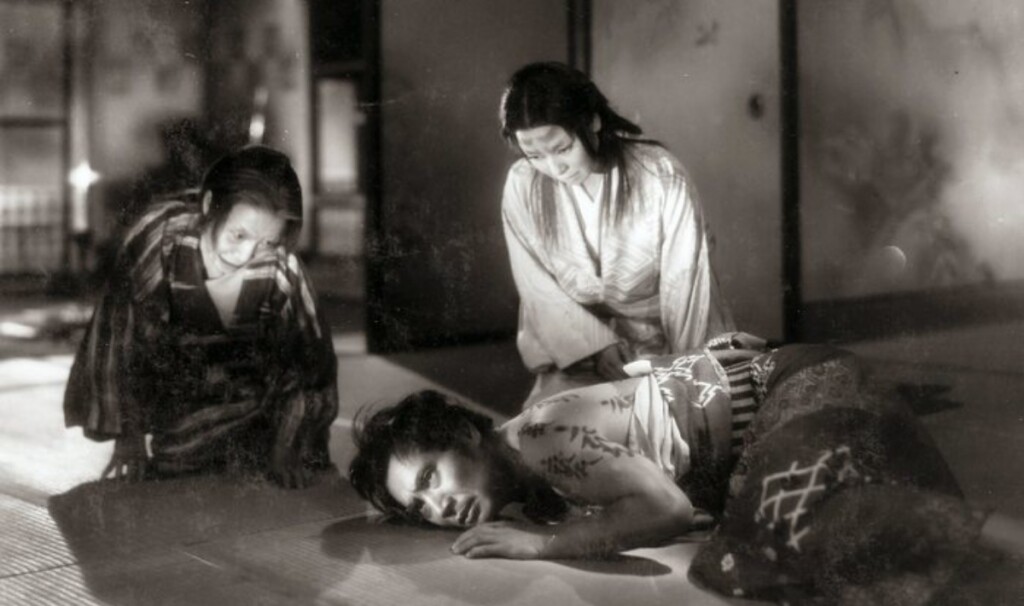
Consider what this means structurally for a reader moving through a tale like “The Carp of My Dreams” or the encounter between Katsushiro and his wife in “The Reed-Choked House.” The events are coherent within the narrative — they follow an internal logic, they produce emotional consequences, they are witnessed and felt. But their ontological status remains permanently ambiguous. Was Miyagi truly present, or did grief construct her from the cold air of an abandoned house? Akinari provides enough detail to make the supernatural reading viscerally credible and enough psychological pressure to make the natural reading emotionally devastating. To choose either interpretation is to impoverish the text. But to refuse to choose is to live inside the hesitation indefinitely, which is precisely where the discomfort lives.
What makes Akinari’s version of this suspension distinct from European Gothic contemporaries is the cultural substrate in which the ambiguity is embedded. In a tradition shaped by Buddhist impermanence and Shinto animism — where the boundary between the living and the dead is understood as porous rather than absolute, where attachment itself generates apparitions — the hesitation Todorov described is not merely a narrative device but an accurate phenomenology of the world. The reader steeped in this tradition does not bring skepticism to the encounter; they bring a different epistemology entirely, one in which the question of whether the ghost is real may be less meaningful than the question of what obligation the living carry toward those who appear. The unease Akinari produces is therefore not the unease of the inexplicable but of the all-too-coherent — a world in which the claims of the dead are as legitimate as the claims of the living, and where survival itself becomes morally complicated.
This is why the book does not release the reader. It is not because the stories are unresolved in the crude sense of being incomplete. It is because they resolve at a frequency the rational mind cannot quite receive, leaving the reader with the sensation of having understood something that cannot be paraphrased, carrying a knowledge that has no language yet and perhaps never will.
🌙 Shadows, Spirits, and the Uncanny in Literature
Ueda Akinari‘s Tales of Moonlight and Rain stands as one of Japanese literature’s most haunting achievements, weaving supernatural encounters with profound meditations on desire, obsession, and the boundary between the living and the dead. The stories resonate with a universal tradition of fantastic literature that explores what lies beyond rational understanding. These related articles illuminate the deeper currents of the supernatural, the labyrinthine, and the uncanny that flow through world literature and thought.
The Literary Fantastic: Todorov and the Theory of the Fantastic
Tzvetan Todorov‘s foundational theory of the fantastic offers essential tools for understanding how Akinari’s tales operate in the hesitant space between the natural and the supernatural. Todorov argues that the true fantastic emerges precisely when neither character nor reader can decide whether what has occurred is real or illusory, a tension that runs through every story in the Ugetsu Monogatari. This article traces the history and theory of the genre that gives Akinari’s work its uncanny, irreducible power.
GO TO THE SELECTION: The Literary Fantastic: Todorov and the Theory of the Fantastic
Jorge Luis Borges and the Labyrinth of Identity
Jorge Luis Borges spent a lifetime mapping the labyrinth as both a literary structure and a metaphor for the self, exploring how identity dissolves and multiplies in endless corridors of reflection. Like Akinari, Borges was drawn to classical Asian and medieval European texts, weaving them into a modern poetics of the uncanny and the infinite. This article examines how Borges transformed the labyrinth into the defining symbol of identity’s fragility and literature’s boundless possibility.
GO TO THE SELECTION: Jorge Luis Borges and the Labyrinth of Identity
Meyrink’s The Golem: Meaning and Analysis
Gustav Meyrink‘s The Golem shares with Akinari’s tales a fascination with spirits that return from beyond, with ancient forces that haunt living spaces and disturb the boundaries of personal identity. Set in the labyrinthine ghetto of Prague, Meyrink’s novel creates an atmosphere of dream-like dread remarkably close to the world of moonlit Japanese supernatural fiction. This article explores the meaning and symbolism of one of European fantastic literature’s most enduring masterpieces.
GO TO THE SELECTION: Meyrink’s The Golem: Meaning and Analysis
Eliade’s The Myth of the Eternal Return: Analysis
Mircea Eliade‘s analysis of the myth of the eternal return provides a powerful framework for reading Akinari’s ghost stories, in which the dead ceaselessly revisit the living, driven by passions that time cannot dissolve. For Eliade, sacred time is cyclical and repetitive, and the apparition of spirits enacts precisely this refusal of linear historical time. This article unpacks Eliade’s influential text and its implications for understanding how myth, ritual, and the supernatural intersect across cultures.
GO TO THE SELECTION: Eliade’s The Myth of the Eternal Return: Analysis
Discover the Cinema of the Uncanny on Indiecinema
If Akinari’s tales of ghosts and moonlit obsessions stir something deep within you, Indiecinema’s streaming platform gathers the world’s finest independent and art-house films that explore the supernatural, the dreamlike, and the boundaries of human experience. From Japanese cinema to European fantastic film, a curated world of visionary storytelling awaits you — venture beyond the ordinary and discover it today on Indiecinema.
👉 EXPLORE THE CATALOG: Watch Indie Films in Streaming
A vision curated by a filmmaker, not an algorithm
In this video I explain our vision

