
The Man Who Vanished Into the Desert
You pick up the book in a secondhand shop — no particular reason, just the spine, just something in the title — and within three pages you feel the ground shift slightly beneath you. Not because of any rhetorical trick or dramatic claim, but because the voice is completely calm. The man writing is describing silence the way a surgeon describes an incision: with precision, without sentiment, as though he has been inside it and returned with measurements. You put the book down. You pick it up again. You carry it home without quite knowing why.

Paul Brunton — born Raphael Hurst in London in 1898, a name he shed the way one sheds a skin that no longer fits — spent the early decades of the twentieth century doing something that almost no Western intellectual of his generation had the audacity or the recklessness to take seriously: he went looking. Not in libraries. Not in the footnotes of comparative religion or the genteel drawing rooms where Theosophy had already been domesticated into a fashionable conversation piece. He went to Egypt. He slept inside the Great Pyramid. He sat with a sage in South India who had barely spoken for decades. He traveled into territories — geographic and interior — that the respectable intellectual world of his era had agreed, by silent consensus, to classify as either superstition or scandal.
His first major book, A Search in Secret Egypt, appeared in 1936 and became, against all publishing logic, a popular sensation. It was not the Egypt of archaeologists or empire administrators. It was a country of initiatory darkness, of encounters with figures who seemed to operate outside any recognized spiritual institution, of a narrator who refused both the skeptic’s comfortable distance and the believer’s comfortable surrender. Brunton occupied a position that Western culture has never quite known how to file: the rigorous mystic, the empirically-minded seeker, the man who applies the habits of a journalist to the experience of dissolution. He had worked as a journalist. He had edited occult magazines in London. He had absorbed enough of the rational tradition to distrust easy wonder, and enough of something else — something harder to name — to distrust the rationalist’s certainty with equal force.
What made him strange, and what makes him still strangely difficult to place, is that he was not building a system. The figures who populate his early travels — the Coptic healer, the desert fakir, the Sufi who dismisses him with a look and then invites him back — are not illustrations of a pre-formed thesis. They are encounters, and they cost him something. There is in his prose a quality that the philosopher William James, writing in The Varieties of Religious Experience in 1902, identified as the noetic quality of mystical states: the sense that something has been genuinely known, not merely felt. Brunton’s writing carries that weight. The reader does not receive information. The reader receives the residue of an event.
He was thirty-two when he first arrived in Egypt with a notebook and a willingness to sleep in uncomfortable places for the sake of whatever might happen in the dark. The year was 1930, and the world he came from — interwar London, the rubble of Victorian certainty, the first tremors of a modernity that was beginning to sense its own emptiness — had furnished him with exactly the right kind of wound. Not despair. Wound. The kind that keeps a person moving, that refuses the anesthesia of settled conviction.
By the time A Search in Secret India followed in 1934, two years before the Egypt book reached print, he had already sat at the feet of Ramana Maharshi in Tiruvannamalai, and something in that encounter had rearranged him at a level below argument, below doctrine, below anything that could be adequately reported in the language available to him — though he tried, with a discipline that is itself remarkable, and the trying is visible on every page.
I Am Nothing
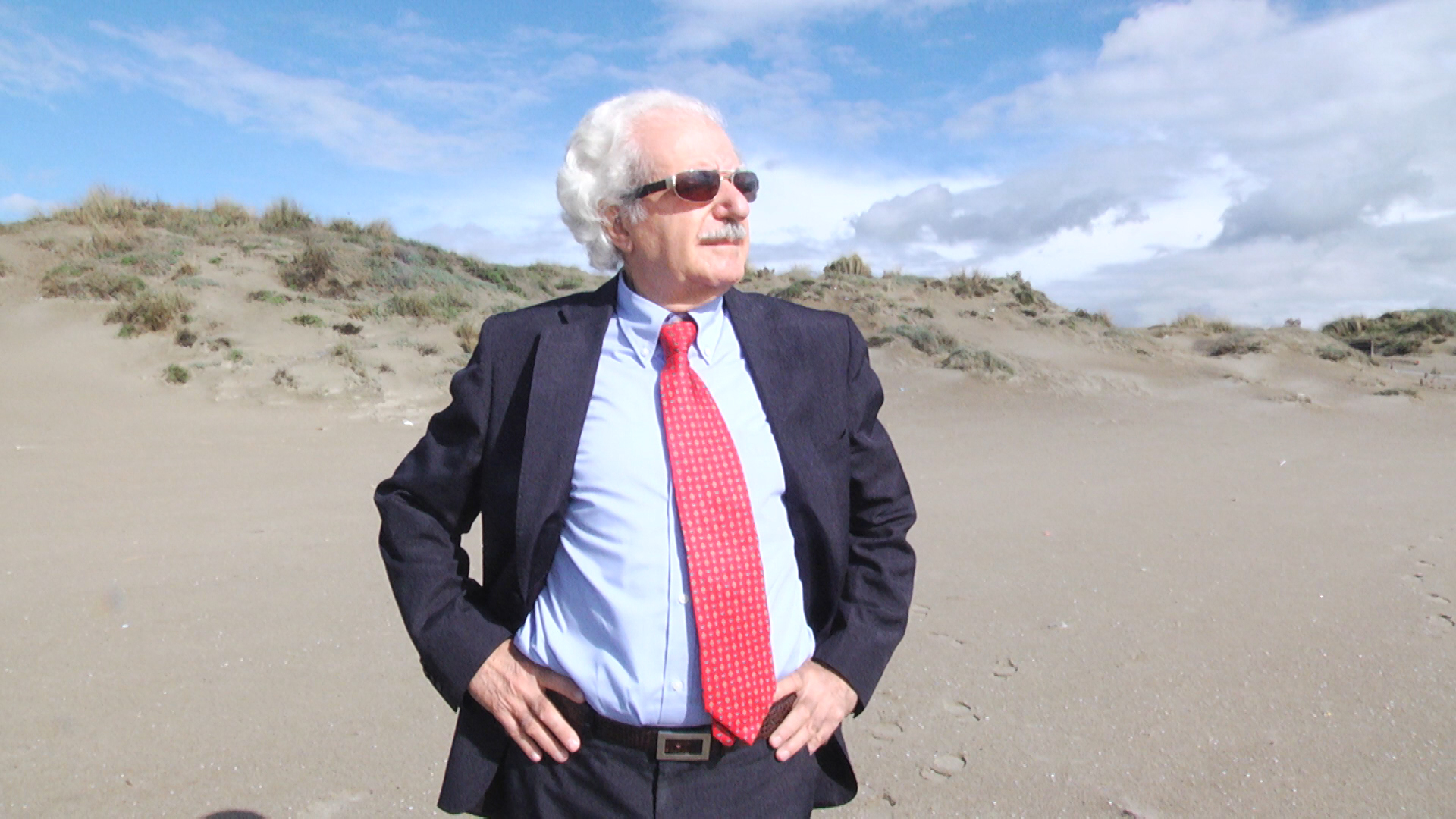
Drama, thriller, by Fabio Del Greco, Italy, 2015.
The story revolves around Vasco, a Roman builder who, at the age of 74, enjoys a life of absolute comfort. His human parable takes a dramatic turn when a mysterious encounter leads him to an ambush. Having survived, but marked by a long coma, Vasco wakes up with a new sensitivity, developing an intimate and poetic bond with nature. This new relationship with the world around him leads him to deeply explore himself, in an internal and external journey. through Italy, the United States and India, in search of a higher meaning and a cure. In parallel, the threat of a planetary cataclysm adds an epic dimension to the story.
I Am Nothing explores universal themes such as time, memory, oblivion and the connection with nature. Fabio Del Greco creates an existential drama full of food for thought. The director skillfully combines different visual materials, mixing archive images with nature photographs and dreamlike visions. This visual experimentation translates into an editing that captures the viewer's attention, guiding him through a cycle of creation and destruction. The sequences that alternate the buildings, Vasco's pride, with Indian landfills and natural landscapes create a hypnotic rhythm, underlining the beauty and fragility of life. Vasco's existential journey is a hymn to transformation and rebirth. The evolution of the protagonist, from unbridled luxury to the rediscovery of purity, represents a powerful metaphor on the meaning of life and the need to reconnect with authentic values. Io sono nulla stands out for its ability to combine introspection and visual experimentation, offering a suggestive and engaging narration. It is a film that invites us to reflect on the human condition, on our relationship with power and nature, and on the possibility of finding ourselves through change. A work that leaves its mark and lends itself to multiple readings.
LANGUAGE: Italian
SUBTITLES: English, Spanish, French, German, Portuguese
Born Into the Cracks of Empire
You are born in 1898 in Londons East End and the empire that surrounds you is not a fact of geography so much as a grammar — a set of sentences already completed before you arrived, telling you what the subject of your life is permitted to be. The streets of Whitechapel and Hackney are full of men who have accepted this grammar without ever reading it, who carry their class like a second skeleton, heavier than bone, invisible only because it has never been named. You are Raphael Hurst, son of a working-class Jewish family, and the world has already written your paragraph.
What the official histories of late Victorian and Edwardian England tend to obscure is the precise texture of that fracture running beneath the imperial confidence. By 1898, Britain had administered roughly a quarter of the earth’s landmass, and the machinery of that administration required a domestic architecture of certainty — a class structure so naturalized it appeared biological rather than constructed. Yet the Boer War was already two years away from exposing the limits of that certainty, and within the decade the suffrage movement, the rise of organized labor, and the Irish question would begin pulling at the stitching. The empire performed coherence precisely because it was losing it. And into this performance, Raphael Hurst was born: not at the center of the stage, but in the wings where the costumes are stored and the illusion is most visible.
The act of renaming oneself is rarely understood for what it actually is. Psychologists and sociologists tend to frame it as identity crisis, as compensation, as the immigrant or underclass reflex of shame. But there is another reading, closer to what the philosopher Charles Taylor described in Sources of the Self as the radical possibility of self-authorship — the idea that the modern individual can, under sufficient pressure or sufficient clarity, refuse the identity handed down by family, nation, and station. When Raphael Hurst became Paul Brunton sometime in his early twenties, he was not simply adopting a pen name for professional convenience. He was performing an epistemological severance. He was declaring, before he had the philosophical vocabulary to say it precisely, that the self is not inherited property.
What makes this act remarkable is its timing. He had not yet traveled to Egypt or India. He had not yet sat with Ramana Maharshi in Tiruvannamalai, an encounter that would come in 1930 and produce A Search in Secret India in 1934, the book that introduced millions of Western readers to a living contemplative tradition. The renaming happened before the metaphysics, which means the metaphysics did not cause the rupture — the rupture was already there, structural, prior, waiting for a language large enough to inhabit it. He did not become a seeker because he found Eastern philosophy. He found Eastern philosophy because he was already constitutionally incapable of accepting a received life.
There is something the self-help culture of the twentieth century, and certainly the twenty-first, consistently misreads in figures like Brunton: it treats their spiritual journeys as solutions to psychological problems, as healing narratives, as the successful resolution of childhood wounds. But the working-class anonymity of Hackney was not a wound to be healed. It was a pressure that produced a specific kind of clarity — the clarity that comes from having no ancestral identity worth defending, no inherited estate of meaning to protect. Georg Simmel, writing in 1903 in his essay on the metropolis, argued that the urban stranger occupies a position of peculiar intellectual freedom precisely because they belong nowhere in particular. Brunton did not theorize this freedom. He enacted it with a name, scrawled somewhere on a document no one has found, in a city that was simultaneously the capital of the world and a place where most people were invisible.

A Search in Secret Egypt and the Market for Mysticism
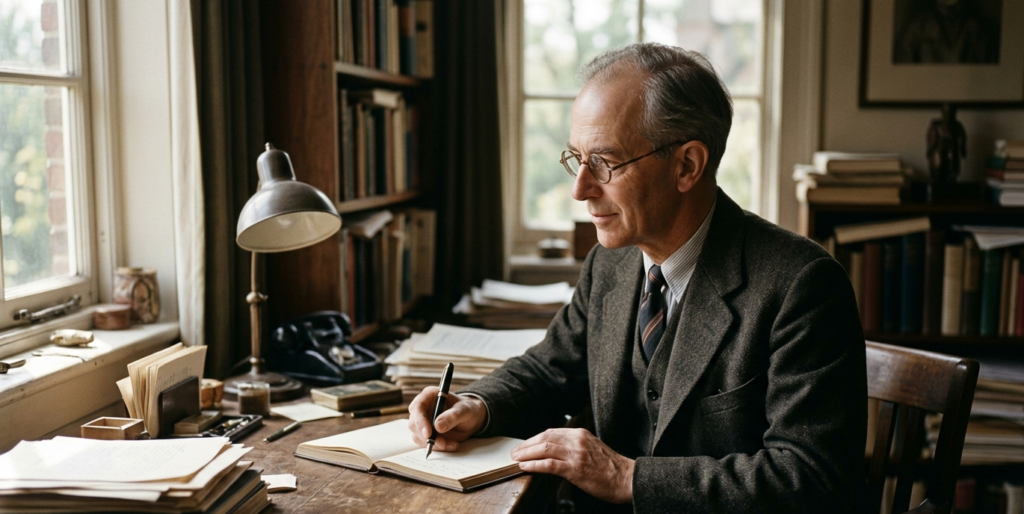
You have paid for the mystery. That is the first thing to understand about what happened in 1934, when a British journalist named Paul Brunton published A Search in Secret Egypt and became, almost overnight, the man who had slept inside the Great Pyramid and lived to describe what the darkness did to him. The book sold with the velocity of scandal. Readers who had never heard of the Hermetic tradition and would not have recognized a reference to Iamblichus if it had appeared in their morning newspaper nonetheless pressed the volume into each other’s hands, convinced they were purchasing access to something forbidden, ancient, and essentially theirs for the taking.
The machinery Brunton was working inside had been constructed long before him. Edward Said‘s Orientalism, published in 1978, maps the intellectual architecture with forensic precision: the East rendered as spectacle, as container for projected Western desire, as a space where the rules of rational Protestant civilization could be temporarily suspended without being permanently abandoned. The traveler goes, is amazed, returns improved, writes a book. By the time Brunton arrived in Egypt, this circuit was so well established that the reading public consumed accounts of Eastern esoteric encounter the way they consumed accounts of big-game hunting — as confirmation that the world still contained zones of radical otherness, and that a sufficiently brave Englishman could enter those zones and emerge with trophies. Brunton understood this completely. What is less often acknowledged is that he used it.
The scene he constructs inside the King’s Chamber of Khufu’s pyramid is not presented as metaphor or literary device. He reports lying alone in the granite sarcophagus at the center of the chamber, in total darkness, in silence that he describes as having physical weight, and experiencing what he can only call a separation — something departing from the body and observing it from above, then a visionary encounter with two figures he identifies as ancient hierophants who communicate without speech. Psychologists in the tradition of William James, who argued in The Varieties of Religious Experience in 1902 that the noetic quality of mystical states — their felt sense of delivering genuine knowledge — cannot be dismissed by pointing to their psychological mechanism, would recognize immediately what Brunton is reporting. The experience has the structural signature James documented across dozens of cases: the dissolution of the ego boundary, the certainty of contact with something not produced by the experiencer’s own mind, the permanent alteration of the experiencer’s relationship to death. Brunton’s readers received this as adventure. What they were actually receiving was initiatory literature embedded in a travel narrative, a set of instructions for encountering the self’s deeper architecture wrapped inside a genre they assumed was only entertainment.
This is the precise nature of the subversion. The market for mysticism in interwar Britain demanded exoticism and confirmation of Western superiority — the brave researcher goes where natives live in superstition and returns having sorted truth from nonsense. Brunton gives them the journey, the danger, the atmospheric color, and then, inside that familiar container, places material that does not confirm superiority at all. The pyramid chapter does not position the Western rational mind as the instrument that decodes Egyptian mystery. It positions the Western rational mind as the obstacle that must be temporarily extinguished before anything real can be perceived. The hierophants in his vision do not congratulate him on his empirical courage. They instruct him in the practice of dying consciously. A readership that thought it had purchased exotic travel writing had in fact purchased a document arguing that everything their civilization had trained them to value about themselves — the primacy of the individual reasoning ego — was precisely what stood between them and any genuine encounter with the real.
Whether Brunton himself fully inhabited what he transmitted in those pages is a question that the subsequent decades of his life would complicate in ways that neither his admirers nor his critics have found entirely comfortable to examine.
Ramana Maharshi and the Unbearable Weight of Silence
You sit across from a man who has not left a hill in decades, who answers most questions by not answering them, whose primary teaching method is to look at you — and something in you that you cannot name begins to dissolve. This was not metaphor for Paul Brunton. In 1931, traveling through India as a journalist with a notebook full of skeptical questions, he arrived at the ashram of Ramana Maharshi in Tiruvannamalai and found himself inside an experience that his entire professional formation had not equipped him to process. He published what happened in A Search in Secret India in 1934, a book that would introduce Ramana to the Western world, and yet the book’s strange power comes precisely from the fact that Brunton cannot fully explain what occurred. The testimony survives because the explanation fails.
Ramana had been on Arunachala mountain since 1896, when at sixteen he underwent a spontaneous death-experience that extinguished his ordinary sense of self and left something else in its place — something that attracted seekers for the next half-century with the same inexplicable gravity that certain silences have. He gave no systematic philosophy in lectures, wrote almost nothing of his own accord, and his most characteristic response to profound metaphysical questions was to turn them back into a single inquiry: who is asking? For a man trained in the British empiricist tradition, arriving with a journalist’s arsenal of probing interviews and fact-extraction techniques, this was not simply an unfamiliar pedagogy. It was the negation of pedagogy itself.
The Enlightenment made a specific promise about knowledge: that it travels through propositions, that it can be examined, challenged, transmitted in texts, and validated through argument. John Locke‘s 1689 Essay Concerning Human Understanding built the architecture for everything that followed — the mind as a receiving chamber for sensory data, organized by reason, refined by discourse. What Brunton encountered at Tiruvannamalai was a direct assault on this architecture, not through counter-argument but through its sheer irrelevance. Ramana did not debate the theory of knowledge. He appeared to operate from a place where the question of how knowledge is transmitted had already been made obsolete by something more immediate than any proposition.
Transmission through presence rather than argument has a precise name in the Shaiva and Advaita traditions: shaktipat, or the direct conferral of awakening from one field of awareness to another. Western psychology, when it has dared to approach this territory, has tended to reduce it to suggestion, transference, or the placebo architecture of belief. But Brunton was professionally resistant to exactly those mechanisms — he arrived suspicious, testing, alert to charlatanism, having already seen and dismissed dozens of spectacular performers elsewhere in India. The silence he encountered was not theatrical. It had no audience appeal. It simply persisted, and he found himself unable to maintain the observer’s distance that journalism requires as a survival strategy.
What this means philosophically is more corrosive than it first appears. If genuine understanding can be transmitted without language — if the medium of argument is not necessary and perhaps even obstructive — then the entire Western apparatus of education, disputation, publication, and peer review rests on an assumption that has never been examined at its root. Not that the apparatus is useless, but that it may be a very elaborate way of moving around the outside of something that can only be entered directly. Wittgenstein, in the propositions closing the Tractatus Logico-Philosophicus in 1921, had already touched this limit from the inside of logic itself: whereof one cannot speak, thereof one must be silent. He arrived there through the exhaustion of language. Ramana appears to have begun there.
The Hidden Teaching Beyond Yoga and the Architecture of Inner Work
You are sitting with a book that refuses to be what you expected. It does not promise enlightenment in thirty days. It does not offer a technique you can practice before breakfast. It builds, instead, like a legal argument assembled across decades of inner testimony, and somewhere around the third chapter you realize that what you are reading is not a spiritual manual at all but something closer to a first-person epistemology — a careful, almost painful account of how consciousness comes to know itself through the very instrument it is trying to examine.
When Paul Brunton published The Hidden Teaching Beyond Yoga in 1941, Western academic philosophy had largely completed its evacuation of interiority as a legitimate subject of rigorous inquiry. The logical positivists centered around the Vienna Circle had spent the preceding two decades systematically ruling out of court any proposition that could not be verified by empirical observation, and A. J. Ayer’s Language, Truth and Logic, published just five years earlier in 1936, had made the case with surgical cheerfulness that metaphysical statements were not merely unproven but strictly meaningless. Into this climate, Brunton introduced a book that took consciousness itself as both the instrument and the object of investigation — a move that placed him in a curious double exile, too rigorous for the theosophical drawing rooms and too interior for the analytic seminar.
The structural departure Brunton made was not simply a matter of subject matter but of method. Where popular occultism of the period trafficked in hierarchies, initiations, and invisible masters — where the Theosophical Society’s publications still spoke of astral planes with the confidence of travel guides — Brunton insisted on what he called the distinction between mentalism and mere mysticism. He was drawing, consciously or not, very close to the territory that the German Idealists had staked out a century and a half earlier, particularly the Kantian insistence that the forms of experience are conditions of possibility rather than features of an external world passively received by a neutral mind. But Brunton grounded this in something Kant had famously refused to enter: the direct phenomenology of meditative states, the first-person evidence that consciousness, when examined with sufficient patience, cannot locate a stable object that is genuinely separate from itself.
This is not a claim about the universe’s furniture. It is a claim about the structure of knowing, and its implications are quietly devastating to the ordinary psychological assumption that there is a fixed self inside you perceiving a fixed world outside you. William James had approached this border in his Principles of Psychology in 1890, noting that the stream of consciousness he described so brilliantly had a disturbing tendency to dissolve the very self that was supposed to be experiencing it. Brunton pushed through where James had paused, not because he was a more rigorous thinker but because he had spent years in conditions — silence, solitude, disciplined attention — that Western academic culture had structurally eliminated from its conception of valid inquiry.
The architecture he built in that 1941 work was therefore something the culture around him had no proper category for. It was not theology, because it made no claims about divine persons or revealed texts. It was not psychology in the clinical sense, because it refused the reductive move of explaining inner experience as the symptom of biological or social processes. It was not philosophy as the academies then practiced it, because it treated the philosopher’s own consciousness as primary data rather than as a distorting lens to be corrected. He was constructing, in effect, a first-person science at the precise historical moment when the West had decided that the first person was the one thing science must always subtract from its equations.
What that exile cost him in intellectual legitimacy, it preserved in a different and stranger form of precision — the kind that only becomes visible when you stop reading the book and notice what it has quietly done to the quality of your own attention.
A vision curated by a filmmaker, not an algorithm
In this video I explain our vision
The Notebooks and the Refusal to Consolidate
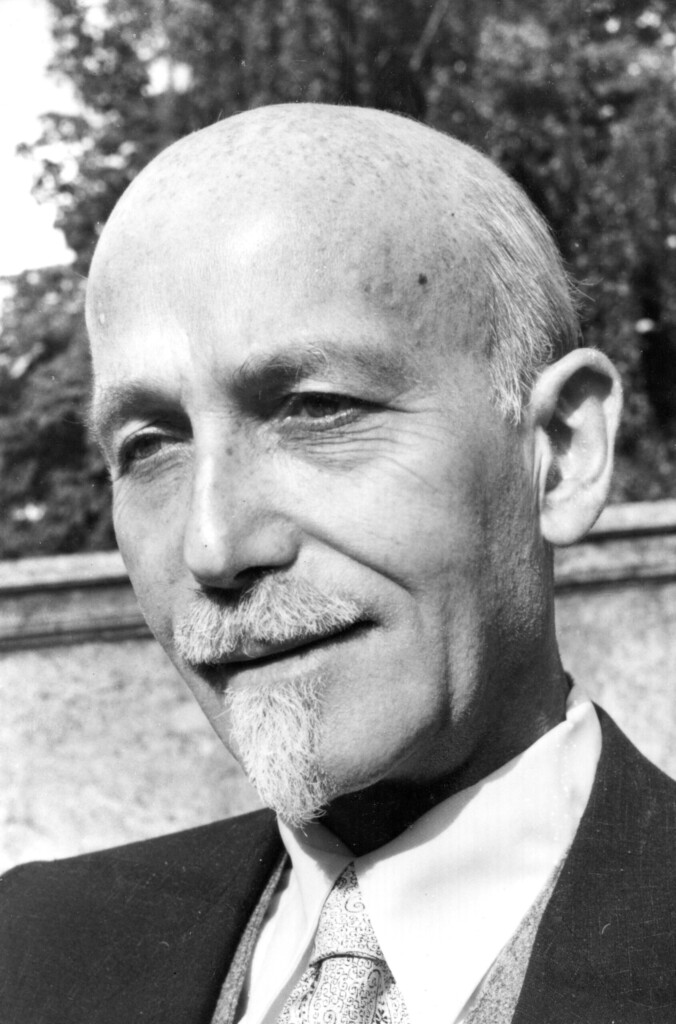
You reach for the sixteenth volume and find yourself holding something that refuses to be held in the way you expected. There is no argument to follow, no ladder of propositions that climbs toward a summit. There is instead a voice that arrives, says something precise and unsettling, and then goes silent — leaving the next entry to begin entirely fresh, as if the previous thought had never been spoken. This is not accidental. Paul Brunton spent the last decades of his life composing what would eventually be published between 1984 and 1988 as the Notebooks, a sixteen-volume archive of fragments, aphorisms, and meditations drawn from decades of private writing that he never shaped into the kind of unified treatise his earlier readers might have anticipated. The form itself is the argument.
To understand what Brunton was refusing, one has to reckon with what systematic philosophy has always promised its adherents: the comfort of completeness. Georg Wilhelm Friedrich Hegel spent thirty years constructing a philosophical architecture in which every genuine insight finds its appointed room, its necessary relation to every other insight, its ultimate reconciliation within the whole. The brilliance of that project and its danger are identical. Once a living thought is assigned its place in a system, it stops being dangerous. It becomes furniture. Brunton had watched this happen to traditions he had investigated across four decades of travel and inquiry — had seen the Vedantic transmission calcify into examination curricula, had seen the living fire of certain Zen encounters become the object of academic categorization. The fragment, by contrast, cannot be domesticated in the same way. It has no neighbors to lean on and no roof above it.
The organizational categories Brunton used across the sixteen volumes — categories devoted to the nature of mind, to the practice of meditation, to questions of ethics and spiritual development — might suggest a hidden system lurking beneath the surface, the outline of a treatise he simply chose to leave unfinished. But this reading misses something structural. Within each category, the individual entries resist synthesis. They contradict one another at the level of emphasis, circle the same territory from incompatible angles, and occasionally undermine in one paragraph what another paragraph appears to assert. Brunton was not being careless. He had absorbed enough of the tradition he called the Philosophia Perennis to know that the instrument of knowing — the human mind in its ordinary configuration — changes what it touches when it systematizes. William James identified something adjacent to this when he argued in 1902, in The Varieties of Religious Experience, that the mystical state carries a quality of authority that no subsequent intellectual formulation can fully preserve or transfer. The formulation is always a reduction. Brunton’s fragments preserve the pressure of the original contact precisely because they decline to explain it away.
There is also something biographical embedded in that formal choice. By the time the Notebooks were being assembled for publication, Brunton had spent years in voluntary obscurity in Vevey, Switzerland, writing in solitude, receiving occasional visitors, declining the kind of public role that had been offered to him repeatedly. He was not a man who had failed to build an institution around his work — he was a man who had actively stepped away from the mechanisms by which such institutions are constructed. The Notebooks extend that gesture into the domain of form itself. A system invites followers. A fragment invites thinkers.
What the sixteen volumes offer, taken seriously, is something closer to what Simone Weil called “waiting” — not passive suspension but an active refusal to close prematurely, to resolve tension before it has done its full work on the reader. Every entry performs a small act of intellectual honesty: here is what I see from where I stand at this moment, with no guarantee that standing elsewhere would produce the same vision. Whether the reader experiences this as philosophical rigor or as a provocation depends entirely on what they were hoping to be given when they opened the first page.
What the West Did With Him
You are reading him in a paperback with a lotus on the cover, purchased at a wellness fair between a crystal vendor and a booth selling adaptogenic mushroom supplements. The price sticker is still on the back. This is not an accident of commerce — it is the outcome of a process, deliberate in its effects if not always in its intentions, by which a culture absorbs what threatens it by changing the container until the contents seem harmless.
Brunton spent decades attempting to translate into Western intellectual language a body of experiential knowledge that, if taken seriously, would require dismantling several foundational assumptions of modern European selfhood — the primacy of individual identity, the reliability of discursive reason as the highest instrument of understanding, the separation between observer and observed that underwrites both Cartesian philosophy and empirical science. These are not peripheral ideas. They are load-bearing walls. And what happens to a thinker who touches load-bearing walls is consistent enough across history to constitute a pattern: they are not refuted, because refutation would require engagement, and engagement would require risk. They are instead reclassified.
Carl Jung read Brunton. The evidence is not speculative — it surfaces in correspondence and in the margins of intellectual biography, in the documented exchange between the two men and in the traceable influence on Jung’s later engagements with Eastern thought, particularly his 1944 work Psychology and Alchemy and his fraught, unresolved wrestling with what he called the Self as distinct from the ego. Jung borrowed the topology, adjusted the vocabulary to fit his clinical framework, and the result was that the destabilizing core of what Brunton had imported became legible within a system that Western psychology could metabolize without rupture. The credit did not travel with the idea. It rarely does, when the source is inconvenient to the destination’s self-image.
What makes this neutralization so effective is that it operates on two registers simultaneously. On the academic register, Brunton was simply not taken seriously — no university position, no peer-reviewed foundation, a writing career rooted in popular journalism, a life spent in ashrams and desert caves rather than seminars. The machinery of institutional credentialing, which Michel Foucault analyzed in 1969 in The Archaeology of Knowledge as a system for controlling which voices count as knowledge-producing, worked exactly as designed. The knowledge passed through. The knower was filtered out. On the popular register, the opposite problem emerged: he was taken too seriously, but in the wrong direction, absorbed into the spiritual marketplace that expanded dramatically through the 1970s and 1980s, where his careful philosophical distinctions between the personal unconscious, the World-Mind, and the Overself collapsed into a general mist of consciousness language used to sell retreats and certifications.
The Spanish sociologist José Ortega y Gasset wrote in 1930, in The Revolt of the Masses, about a civilization that had learned to consume the products of intellectual effort while remaining entirely insulated from the discipline those products demanded. He was describing something structural, not a failure of individual readers. The structure is still intact. It ensures that a thinker like Brunton can be simultaneously everywhere and nowhere — his terms circulating, his name absent, his actual demands on the reader quietly dropped in favor of the parts that feel like permission rather than confrontation.
His notebooks, the sixteen volumes published posthumously as The Notebooks of Paul Brunton between 1984 and 1988, contain passages of such compressed philosophical precision that they read less like personal reflection than like someone trying to defuse something before it detonates in the wrong hands. He knew the territory he was navigating. He understood that the transmission of genuinely radical ideas across cultural borders does not fail through opposition — it fails through welcome, through the warm embrace that reclassifies the dangerous as the decorative, and leaves the reader feeling enriched without having been disturbed at all.
The Overworld and the Question That Has No Shore
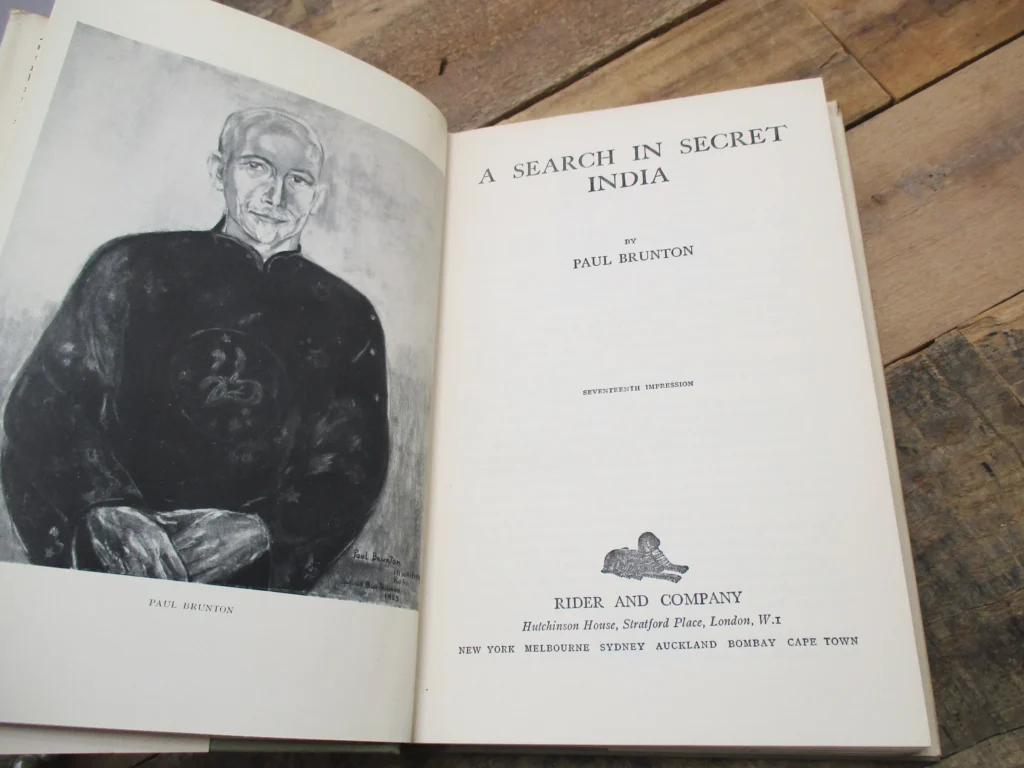
You are reading these words inside something you have never once stepped outside of. Not a room, not a culture, not a belief system — something prior to all of those, the awareness in which rooms and cultures and beliefs arise and dissolve like weather. Paul Brunton spent the final decades of his life trying to name that ground with philosophical precision rather than religious sentiment, and the name he settled on was the Overself — not a soul in the theological sense, not an individual spirit awaiting reward or punishment, but the impersonal luminous field of consciousness that underlies personal identity the way the ocean underlies a wave without being reducible to any single movement on its surface.
The distinction matters because comfort-seeking readers consistently misread him. They arrive at the Overself wanting a grander, more cosmic version of themselves — a higher self that affirms their specialness, validates their suffering, and promises continuity after death. Brunton refused that reading with a persistence bordering on severity. In the notebooks he kept across the final three decades of his life, eventually published posthumously in sixteen volumes as The Notebooks of Paul Brunton between 1984 and 1988, he returned again and again to a single insistence: the Overself is not yours. It is not an upgraded ego. The personal self does not graduate into it. The personal self is what dissolves when the Overself is actually recognized rather than merely contemplated from a comfortable intellectual distance.
This is where most readers quietly stop. They appreciate the concept, they find it interesting, they may even call it profound — and then they return to the world of appointments and grievances and self-improvement projects without anything having shifted. Brunton diagnosed this arrest with uncomfortable clarity. He borrowed the vocabulary of Kant’s distinction between knowing about something and encountering it directly, but he pushed past Kant’s limits by insisting that the Overself was not beyond experience — it was experience, stripped of every narrative the mind layers over raw awareness. The problem was not philosophical complexity. The problem was that genuine recognition of the Overself requires the suspension of the very mechanism that is doing the reading, evaluating, and filing-away-for-later. The reader cannot remain a reader and also arrive.
What this costs is not abstract. A man in his fifties, distinguished career, a library full of underlined spiritual books, sits across from someone whose eyes carry no performance — no warmth performed, no distance maintained, simply presence without agenda — and feels, for three seconds, a vertigo that has nothing to do with fear. The furniture of his identity briefly loses weight. It passes. He picks up his coffee. He never mentions it to anyone because there is no framework in his life that would hold it without making it small.
Brunton understood that philosophy built only from inherited frameworks could not touch this. He read Plotinus carefully — the third-century Neoplatonist whose Enneads described the One as the ground from which Intellect and Soul emanate, and whose entire system rotates around the claim that the highest reality cannot be an object of thought but only a kind of union — and found in him a Western predecessor who had glimpsed the same territory. But Brunton also knew that Plotinus could be read as intellectual architecture, admired from outside, and left structurally intact without a single cell of the reader’s life being disturbed.
The Overself, in Brunton’s mature formulation, is not a destination the philosophical traveler reaches after sufficient study. It is the condition that makes study possible in the first place — the silent witness that was never absent, only overlooked in the noise of seeking it. Which means the question is not whether you will ever find it, but whether you can bear to stop pretending you have not already been found.
🔮 Seekers of the Inner Light
Paul Brunton spent his life crossing the threshold between Western philosophy and Eastern mystical traditions, charting the hidden geography of consciousness. His work resonates deeply with other explorers who sought truth beyond the visible world — from the silent teachers of India to the visionary mystics of Europe. These related articles trace the same luminous thread.
Ramana Maharshi: Life and Teachings
Ramana Maharshi was the sage of Arunachala whose silent presence and radical self-inquiry became the cornerstone of Paul Brunton’s spiritual transformation after their famous meeting in the 1930s. Brunton brought Ramana’s teachings to Western audiences for the first time through his book ‘A Search in Secret India,’ making this encounter one of the most consequential in modern spiritual history. Understanding Ramana’s life and thought is essential to understanding the depth of Brunton’s own philosophical quest.
GO TO THE SELECTION: Ramana Maharshi: Life and Teachings
Rudolf Steiner and Anthroposophy: A Guide to Modern Esoteric Thought
Rudolf Steiner and Paul Brunton both belonged to that rare lineage of twentieth-century thinkers who refused to separate spiritual inquiry from rigorous intellectual discipline. Steiner’s Anthroposophy, like Brunton’s Notebooks, sought a synthesis of mystical insight and rational thought accessible to modern Western minds. Their parallel projects illuminate the broader cultural hunger for a spirituality that could survive the collapse of traditional religious certainty.
GO TO THE SELECTION: Rudolf Steiner and Anthroposophy: A Guide to Modern Esoteric Thought
Helena Blavatsky and Theosophy: the Woman Who Revolutionized Esoteric Thought
Helena Blavatsky‘s Theosophy formed part of the intellectual atmosphere in which Brunton’s early interests in esotericism and Eastern wisdom took root, even as he eventually charted a more independent and philosophically refined course. The Theosophical Society’s effort to bridge East and West created the very cultural channels through which figures like Brunton could travel, literally and intellectually, toward India and its contemplative traditions. Reading Blavatsky alongside Brunton reveals both the debts and the departures that shaped modern Western spirituality.
GO TO THE SELECTION: Helena Blavatsky and Theosophy: the Woman Who Revolutionized Esoteric Thought
American Transcendentalism: History and Thought
American Transcendentalism represents one of the closest Western counterparts to the contemplative philosophy that Paul Brunton devoted his life to articulating. Emerson, Thoreau, and their circle believed, as Brunton did, that direct spiritual experience rather than inherited doctrine was the only reliable path to truth. Tracing this transatlantic current helps situate Brunton within a longer tradition of souls who sought the infinite through the discipline of inner attention.
GO TO THE SELECTION: American Transcendentalism: History and Thought
Cinema That Searches the Depths of the Soul
If Paul Brunton’s journey into the invisible dimensions of human experience stirs something in you, Indiecinema streaming is the place to continue that exploration. Our catalog gathers films that ask the same essential questions — about consciousness, silence, and the search for meaning — with the freedom and courage that only independent cinema allows. Come discover stories that dare to look inward.
👉 EXPLORE THE CATALOG: Watch Indie Films in Streaming
A vision curated by a filmmaker, not an algorithm
In this video I explain our vision

