
The Dust on the Outskirts
You are standing on a street that has no name yet. The asphalt ends about forty meters ahead of you, not dramatically, not as a cliff or a boundary marker, but simply because someone stopped pouring it one afternoon and never came back. Beyond that edge, the ground is pale and compacted, the color of old bone, cracked in patterns that look almost deliberate, as though the earth itself is trying to organize its own abandonment. A boy, maybe eleven years old, kicks a chunk of broken cinder block along the margin between the paved and the unpaved. He is not playing. He is not going anywhere in particular. He is simply in motion because motion is the only thing that makes the afternoon feel less like a sentence.

The smell reaches you before anything else does. It is a compound smell, one that takes a moment to decompose: stagnant water sitting in a drainage ditch that was dug but never properly channeled, burnt plastic from a small fire someone made the previous evening to get rid of something, and underneath both of those, the dry mineral smell of construction dust that has been here so long it has become indistinguishable from the natural soil. This is not poverty as spectacle. There are no collapsed buildings, no visible suffering arranged for an outside gaze. The walls of the half-finished structures along the road are simply paused, their rebar jutting upward like the fingers of a hand frozen mid-gesture, waiting for resources or permissions or a political moment that keeps not arriving. People live behind those walls. You can see the laundry.
This is the borgata. Not a slum in the classic journalistic sense, not a ghetto cordoned off by legal decree, but something stranger and more difficult to name: a space produced by the city’s expansion and simultaneously excluded from its logic. Rome grew outward in the twentieth century the way all postwar European capitals grew, hungrily and without much coherence, absorbing agricultural land and medieval road traces into a sprawl that was neither urban nor rural but something suspended between the two. The borgata was the residue of that process. It was where the demolitions of the historic center displaced thousands of families during the Fascist restructuring of Rome in the 1930s, when Mussolini ordered the clearing of neighborhoods around the Campidoglio and the via dei Fori Imperiali, moving entire communities to the periphery with the bureaucratic efficiency of men who considered resettlement a form of modernization. Those families did not move to finished places. They moved to places that were intended to become places eventually, and the eventual kept receding.
What the borgata produced, over decades, was a particular kind of human formation. Not the organized poverty of the traditional working-class neighborhood, with its trades and its hierarchies and its collective memory of labor, but something more atomized and more volatile: communities without the infrastructure of community, people sharing a geography without sharing a history that the city recognized as legitimate. The children who grew up in these streets in the late 1940s and through the 1950s were not integrated into Roman culture or Italian national identity in any meaningful sense. They spoke Romanesco in its roughest registers, a dialect so far from standard Italian that it functioned almost as a private language, a wall built from vowels and consonations that the educated city could not fully scale. They inhabited a present tense so absolute and so complete that the past and future felt like things that happened to other people, people whose photographs appeared in newspapers, people who owned the buildings whose rebar still pointed at an indifferent sky.
The boy has stopped kicking the cinder block. He stands at the edge of the asphalt, looking at something in the middle distance that may be nothing at all, or may be everything he has already learned to expect from the afternoon, which amounts to the same thing.
The Smartphone Woman
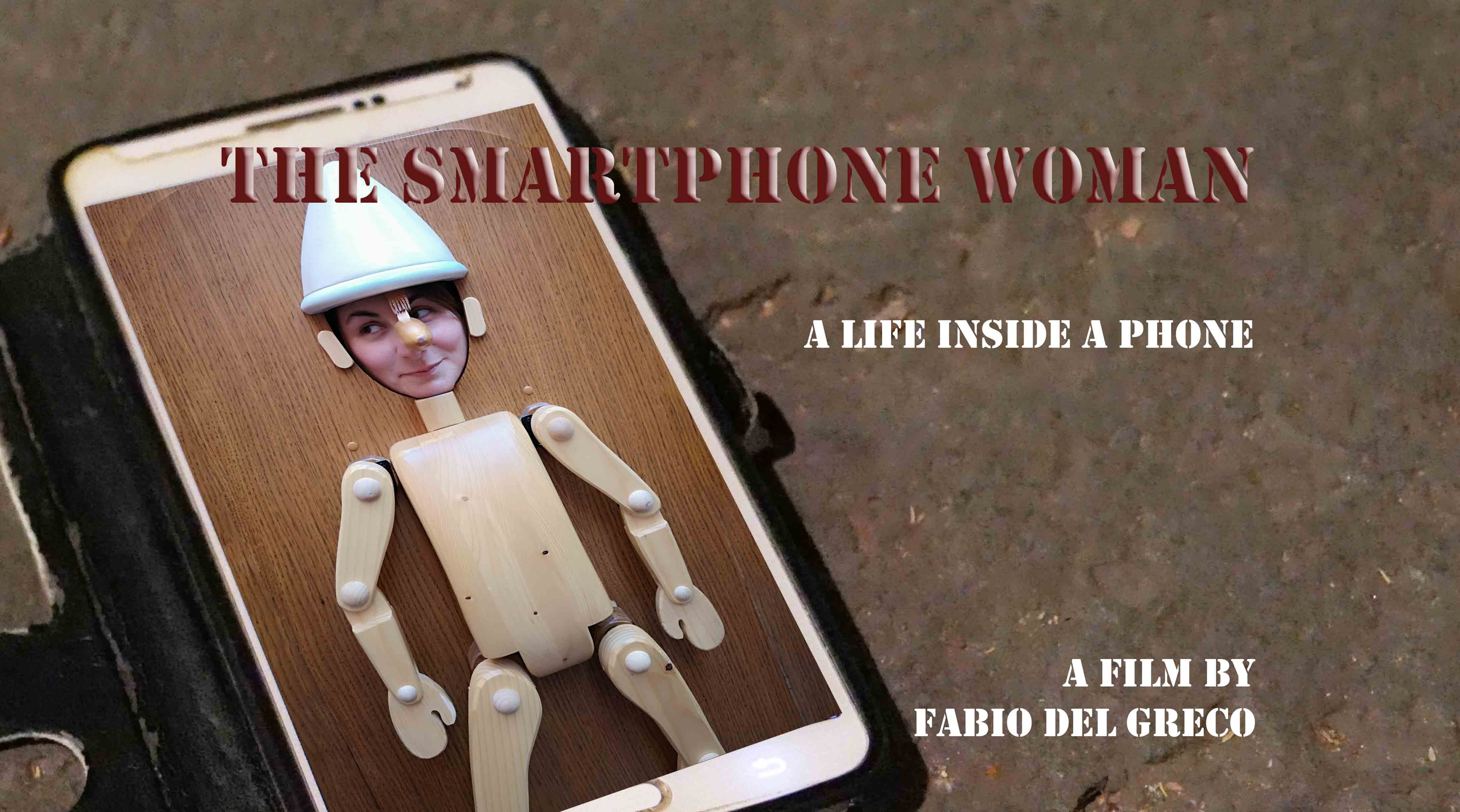
Drama, thriller, dark comedy, by Fabio Del Greco, Italy 2020.
On a bridge over the Tiber River, an elderly and severely ill man has decided to end his life, but an unusual discovery changes his mind: he comes across a lost smartphone. Intrigued, he decides to return home and watch the videos contained within it. On the screen, a series of videos unfold, telling the story of a woman who has emigrated from southern Italy to Rome to work as a teacher in schools and her struggles with integration in a social reality she cannot fully grasp.
"The Smartphone Woman" is a realistic tale of a woman's life and her complex relationship with an "infernal" city. It portrays the challenges she faces, her connection to her origins, the social discomfort she discovers in the outskirts, and the eerie presence of the ghosts of ancient Roman empire. Fabio Del Greco employs a fragmented style, using pieces of "real life" shot with the smartphone, to construct a narrative that ambiguously oscillates between fiction and truth. This creates a captivating exploration of the discomfort and alienation within the bustling city, contrasting with the peaceful village life from which the protagonist hails. The film is constructed with a variety of heterogeneous characters and situations, an emotional kaleidoscope, weaving between evenings of exploration in the Eternal City and daily struggles. Realistic smartphone-shot videos are alternated with a narrative thread reminiscent of film noir and, ultimately, surrealism in the finale. On screen, a succession of grotesque characters unfolds, representing the director's vision of a tumultuous humanity. The film's potency lies in the emotion it manages to convey and in the protagonist's naive perspective. "The Smartphone Woman" is a must-see for enthusiasts of independent and experimental cinema.
LANGUAGE: italian
SUBTITLES: English, French, German, Portuguese, Spanish
A Man Who Arrived from the Outside
He arrived in Rome in January 1950 with almost nothing — a mother, a suitcase, and a disgrace that had followed him from the Friulian countryside like a second shadow. The disgrace was official: he had been expelled from the Italian Communist Party’s local federation in Casarsa for “moral unworthiness and indignity,” a bureaucratic euphemism for the fact that he was homosexual, and that someone had decided this fact required a document. He was twenty-seven years old, already a poet in a dialect most Italians had never heard, already formed in his obsessions, and entirely without money. Rome did not receive him. It simply absorbed him, the way large cities absorb everything that arrives without resources — by pushing it outward, toward the periphery, toward the places that do not appear on the postcards.
He settled first in Rebibbia, on the northeastern edge of the city, in a neighborhood that in 1950 was barely a neighborhood at all — more an accumulation of cheap buildings at the end of a bus line, populated by people who had come from elsewhere for work that barely materialized and had stayed because leaving cost money they didn’t have. Later he moved to Guidonia, a small town in the hills outside Rome, commuting into the city to teach elementary school for a salary that left almost no margin. He spent those years in a sustained, non-metaphorical poverty: the kind measured in careful calculations at the end of the month, in the specific embarrassment of not being able to offer a drink, in the texture of rooms that are cold because heating is a luxury. This is a biographical fact that tends to get aestheticized in retrospect, turned into a romantic apprenticeship, a writer’s necessary suffering. It was not that. It was a material condition that shaped everything he saw and the precision with which he saw it.
What he observed in those years, he eventually named. Ragazzi di vita appeared in 1955 and immediately generated a minor scandal — not because it was aesthetically transgressive, though it was, but because it was sociologically precise in a way that made comfortable readers feel accused. The novel followed a cluster of young men through the borgata, the informal settlements on Rome’s outskirts, their petty crimes and idle afternoons and the particular grammar of survival that governed their days. The language was theirs, not translated into literary Italian but rendered in the actual Roman dialect of the periphery, with its truncations and its violence and its strange tenderness. Arnoldo Mondadori published it only after Pasolini agreed to cuts. The obscenity charges filed shortly after publication were eventually dropped, but the pattern had been established: the book did not describe the margins, it inhabited them, and this was understood by the cultural establishment as a kind of provocation.
Una vita violenta followed in 1959 and pressed the same territory harder. Where the first novel had moved episodically, almost ethnographically, the second constructed a full biographical arc — a young man named Tommaso Puzzilli, born in the borgata, navigating Fascist youth movements and tuberculosis and political awakening with equal bewilderment, as if ideology and disease were parallel fevers the body endured without fully understanding. The critical reception was more serious this time, less moralistic, but the fundamental discomfort remained: Pasolini was not writing about poverty as a problem to be solved or a condition to be pitied. He was writing about it as a world with its own coherence, its own beauty, its own forms of dignity that had nothing to do with bourgeois virtue.
What made this unusual — what made it, in retrospect, almost structurally impossible to replicate — was that he had actually lived in proximity to what he described. Not as a researcher. Not as a journalist on assignment. As a man who had needed cheap rent and found it where cheap rent existed, and who had then looked, very carefully, at everything around him.

The Subproletariat as Living Contradiction
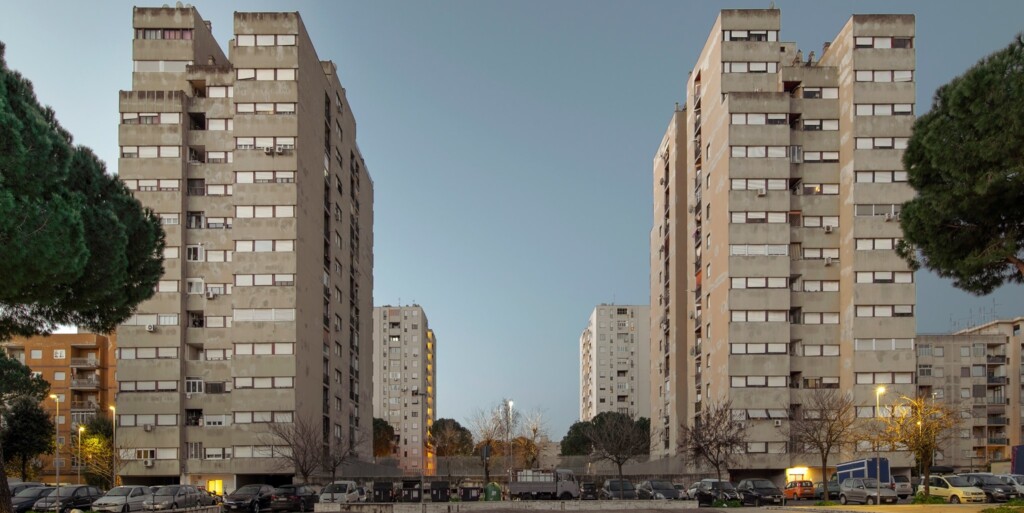
You walk past a man sitting on a crate outside a shuttered warehouse in Testaccio, and something in his stillness stops you. Not laziness, not despair, not the particular vacancy of someone waiting for a bus. Something older than all of that. A kind of presence that has not yet learned to perform itself for anyone, that has never been required to. Pasolini saw this quality everywhere in the Roman periphery during the 1950s, and it unsettled every theoretical instrument he carried with him.
The difficulty was categorical. Orthodox Marxism had a precise and confident vocabulary for the working class — the proletariat organized around industrial production, conscious of its historical role, moving toward collective emancipation. It had somewhat less patience, and considerably more suspicion, for what lay below that stratum. Marx himself, in The Eighteenth Brumaire of Louis Bonaparte published in 1852, had named this layer the Lumpenproletariat with open contempt: the ragpickers, swindlers, discharged soldiers, escaped galley slaves, thieves, charlatans, and street vendors who had no fixed relation to production and who could, in his view, be bought and sold by any political force that needed a mob. They were, for Marx, historical refuse. Pasolini read this verdict and found it not simply wrong but catastrophically incomplete, the judgment of a Northern European intellectual who had never sat in the dust of a Roman borgata at noon.
What Pasolini encountered in Torpignattara, in Pigneto, in the makeshift settlements along the Aniene river, was not refuse. It was a population that had arrived in Rome largely from the rural South and from the Castelli Romani hills, displaced by a countryside that had stopped feeding them, and they had landed in the city’s margins without being absorbed by any of the city’s organizing structures. They had no union cards, no factory shifts, no class consciousness in the Leninist sense, no party affiliation that held. What they had instead was something that Pasolini described in his 1955 novel Ragazzi di vita as an almost animal vitality, a complete and unreflective inhabitation of the present tense. Riccetto, the novel’s central figure, does not struggle against the system in any legible way. He steals, drifts, survives, occasionally laughs with a brightness that is absolutely untranslatable into political programme. He is not waiting to become anything else.
This is where Pasolini departed from every available framework, including his own Communist Party membership, which he had held since 1947 and which would produce escalating friction until the party’s contradictions became impossible to contain. He was not romanticizing poverty. He was identifying something that industrial modernity had not yet consumed, a texture of existence that preceded the logic of productivity and exchange, and he understood, with the clarity that only someone who loved the thing could manage, that this texture was already under sentence of death. The Italian economic miracle, the boom years running roughly from 1958 through the mid-1960s, would not liberate these people. It would dissolve them. It would replace their particular, untranslatable vitality with the homogeneous desires manufactured by television and the consumer market, desires that looked like freedom and functioned as the most complete colonization he could imagine.
The theoretical name he eventually gave this process drew on Antonio Gramsci‘s concept of cultural hegemony, but Pasolini bent it toward something more visceral and more pessimistic than Gramsci had intended. Where Gramsci saw hegemony as a site of contestation, a terrain where subordinate classes could build counter-hegemonic structures, Pasolini saw in the subproletariat a group whose very pre-political condition, the thing he most valued in them, made them almost perfectly defenseless against cultural absorption. They had no ideology to oppose to the new ideology because they had never needed one. Their resistance had always been bodily, immediate, encoded in gesture and dialect and appetite, and none of that offered any friction at all against a power that operated precisely through bodies, through desire, through the manufacturing of appetite itself.
What the City Wanted to Forget
You have seen this before, even if you have never been to Rome. You know the apartment block at the end of the bus line, where the pavement stops being pavement and becomes something provisional, something that was always meant to be temporary and somehow became permanent. You know the look of a neighborhood that was built to be invisible — not to you specifically, but to the part of the city that prefers not to be reminded that it is a city at all.
Rome after the Second World War was in a condition that its administrators understood very precisely and discussed very carefully. The city needed workers. It needed bodies to rebuild roads, lay sewers, manufacture the small domestic goods of the economic miracle that was already being planned before the rubble was cleared. What it did not need — what it could not politically absorb — was for those workers to live near the people who would benefit from their labor. The INA-Casa plan of 1949, formally a social housing initiative launched by the Christian Democratic government under Alcide De Gasperi, was in its stated intention a response to the catastrophic housing shortage that had left hundreds of thousands of Italians without shelter. In its actual operation, it became the administrative instrument by which entire classes of people were sorted out of the city’s visible life and deposited at its edges.
Between 1950 and 1965, Rome absorbed somewhere between 300,000 and 400,000 internal migrants, the majority arriving from Calabria, Sicily, Basilicata, the poorest provinces of the south — regions that the sociologist Banfield had described in 1958, in a formulation that would be widely misread, as trapped in what he called amoral familism, a phrase that was really a description of what poverty does to trust. These people arrived at Termini station with cardboard luggage and were funneled not into the city but into the borgate, the peripheral settlements that had been first constructed under Fascism precisely as a mechanism of removal: Mussolini had needed to make Rome presentable for imperial pageantry, and the solution had been to demolish the urban poor’s neighborhoods near the historic center and rebuild them at a distance that was meant to be experienced as exile. The postwar republic inherited this geography and largely chose to preserve it, extending it, populating it with new arrivals who did not yet know what they were arriving into.
What distinguished the borgate from poverty in general was their systematic incompleteness. These were not neighborhoods that had fallen into disrepair. They were built without the infrastructure that would have allowed them to become neighborhoods at all. Schools arrived years after children did, if they arrived. Sewers were laid on a schedule that seemed calibrated to follow rather than precede habitation. Public transit lines stopped where the property values stopped. The political scientist Robert Putnam, writing about precisely this period of Italian regional governance in his 1993 study Making Democracy Work, would document how civic institutions failed to develop in southern Italy not because of some cultural deficiency but because they were never given the conditions under which they could develop. The borgate were a northern, urban version of the same mechanism: the deliberate withdrawal of the state from spaces where the state had decided certain people could wait.
This is not a conspiracy in the dramatic sense. It does not require evil. It requires only that the people making decisions about sewers and bus routes and school construction are the same people who do not live in the borgate, and that the people who do live there have no meaningful access to the processes by which those decisions are made. Henri Lefebvre, whose work on the production of space was already circulating in French intellectual circles during this same period, argued that space is never neutral — that every spatial arrangement encodes a social relationship, a hierarchy, a set of permissions and prohibitions written in concrete and distance rather than in law. The borgate were a text. The question was whether anyone in the city center had any interest in learning to read it.
The Body as the Last Territory
There is a moment in a Roman street market where a man argues over the price of a kilo of offal with a ferocity that seems wildly disproportionate to the transaction. His hands move before his words do. The dialect that comes out of him — not Italian, not quite any single thing, but a geologic layer of Roman speech compressed over centuries — has a velocity and a music that standard broadcast language simply cannot replicate. He is not performing poverty. He is being something that has not yet been renamed. Pasolini, who spent years walking those same markets, those same streets in Testaccio and Torpignattara and Pietralata, understood that what he was watching was not backwardness. It was the last unconquered province.
What capital had not yet managed, in the Rome of the early 1950s when Pasolini arrived from Friuli after the double scandal of a paternity accusation and a Communist Party expulsion, was the full colonization of the body itself. The borgata boys he would write about in Ragazzi di vita, published in 1955, and later in Una vita violenta in 1959, moved through the city with a physical grammar entirely their own — slouches, gestures, a specific economy of touch and violence and tenderness that operated below the threshold of bourgeois legibility. This was not romanticization. It was anthropological precision. Pasolini was doing what Henri Lefebvre would later theorize in La Production de l’espace in 1974: recognizing that space is not neutral, that the body is itself a kind of space, and that how a body occupies a street corner, how it spits, laughs, fights, desires, is always already a political statement about who that space was built for and who was tolerated within it.
Lefebvre’s argument, stripped to its core, is that capitalism does not simply organize the economy — it produces space itself, restructuring how human beings inhabit the world, including their own flesh. What Pasolini saw in the subproletariat, and what he mourned with an almost violent grief in Scritti corsari in 1975, was precisely the moment when that final territory began to be absorbed. Hunger, in the borgata, had been real hunger — not metaphorical, not aesthetic, but physiological and structuring. Sexuality had been pre-ideological in a way that disturbed the left as much as the right: neither the sanitized heterosexuality of Christian democracy nor the class-conscious subjectivity that Marxist orthodoxy demanded. The body, in the condition of genuine material destitution, had simply not yet been trained into the shapes that consumer society requires. It was still feral in a way that was — and Pasolini said this clearly, at the cost of being misread endlessly — also a form of dignity.
By the time he was writing those corsair essays, weeks or months before his murder in November 1975 at Ostia, he had watched that feral quality being processed out. Television had entered the homes. The dialectal texture of Roman working-class speech was softening under the pressure of a national media culture that rewarded a single, flattened register. Sexuality was being repackaged as liberation while actually being conscripted into consumerism — what Pasolini called, with deliberate provocation, a new form of fascism more total than the historical one, because it did not need uniforms or explicit coercion. It worked through desire itself. The body that had once held out — not by resistance or ideology but simply by the brute fact of its material conditions — was being taught new wants, new postures, new hungers that were profitable rather than genuine.
A vision curated by a filmmaker, not an algorithm
In this video I explain our vision
When Development Arrived
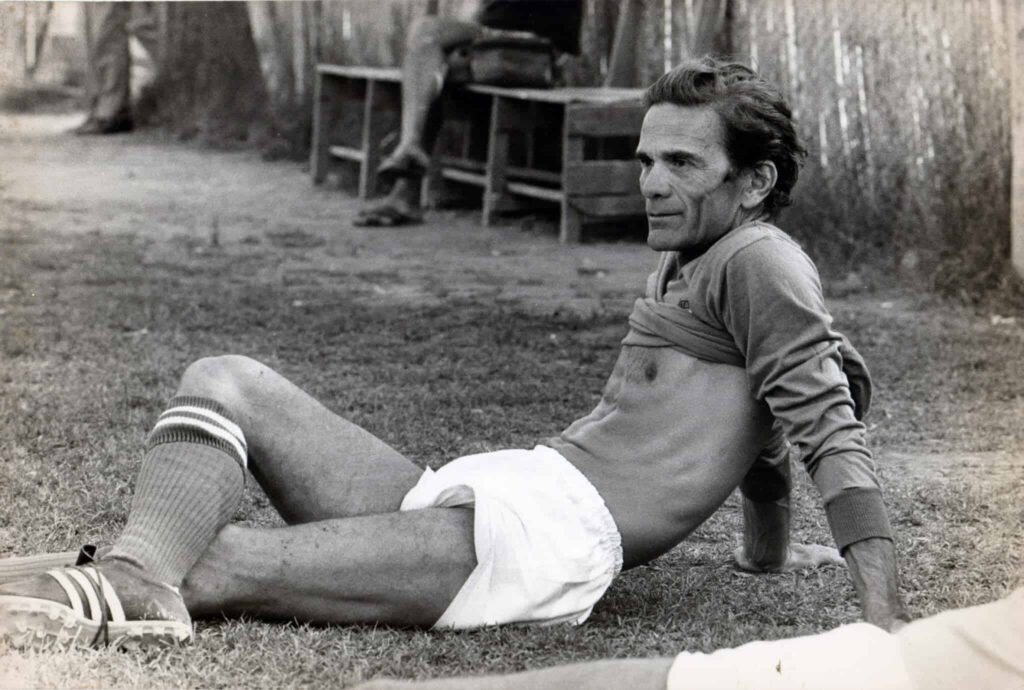
There is a moment, somewhere in the early 1970s, when you can watch a young man from Torpignattara or Pietralata change. Not slowly, the way people change through suffering or love or the accumulation of small decisions. Quickly. Almost overnight. The leather jacket is newer, the vocabulary shifts, the gestures begin to resemble something seen on television rather than something inherited from a grandfather’s particular way of standing in a doorway. It is not liberation. It is replacement.
Pasolini saw it with a clarity that bordered on grief, and he named it with a precision that his contemporaries largely refused to accept. What arrived in the borgatas in the early 1970s was not prosperity in any meaningful sense. It was the machine of consumerism, and its primary operation was not to fill empty hands but to empty full heads. The distinction matters enormously. A culture can survive poverty. It cannot survive the systematic substitution of its own values with values manufactured elsewhere and delivered through screens. Pasolini understood this as an anthropological event, not a political one, and that understanding put him at odds with almost everyone on the Italian left, who still believed that material improvement was, by definition, emancipatory.
He made the argument explicitly in his Scritti corsari, the series of polemical essays he began publishing in Corriere della Sera in 1973, and he returned to it with increasing urgency in the Lettere luterane, written in the final year of his life. The terms he used were not economic. He spoke of the destruction of dialects, the homogenization of the Italian body and face, the disappearance of what he called the culture of the people, a culture that had existed in the borgatas and the peasant south not because it was noble or pure but because it was genuinely other. It was not produced by capital. It had its own rhythms, its own shame and pride, its own relationship to death and pleasure that did not pass through the mediation of a commodity. When that otherness vanished, Pasolini argued, something irreversible happened. Not the loss of folklore. The loss of resistance.
This is where his most scandalous claim lives, the one that cost him friendships and credibility and which still makes people uncomfortable: he said that consumerism had accomplished what fascism could not. Mussolini’s regime, for all its violence and its cultural ambitions, had never managed to reach inside the Roman working class and change what it fundamentally was. The borgata boy under fascism remained, in some essential way, himself. He was oppressed, hungry, excluded from power, but his identity was his own, forged in the street and the dialect and the particular humor that comes from having nothing to lose. Consumer capitalism, without a single act of overt violence, without a single law or decree, walked into that same boy in 1972 and handed him a television set and a Vespa and a new set of desires, and the boy accepted them and was, from that moment forward, different. Not freer. Different. The distinction, again, is the whole argument.
What Pasolini was diagnosing, using the vocabulary of Antonio Gramsci‘s cultural hegemony and filtered through his own visceral knowledge of the borgatas, was the mechanism by which power no longer needs force when it has succeeded in colonizing desire itself. Gramsci had written from his prison cell in the 1930s about the way a dominant class maintains control not through coercion alone but through the shaping of common sense, the production of a worldview that the dominated class eventually adopts as its own. Pasolini looked at the borgata in 1973 and saw that process completed with a speed and thoroughness that Gramsci, dying in that cell in 1937, could not have anticipated. The local identity, the dialect, the specific face of the Roman suburb — these were not swept away by tanks. They dissolved in the solvent of a new way of wanting things, and the young men of Torpignattara wanted the same things now as the young men of Milan, which meant, for the first time, they were no longer themselves at all.
The Prophetic Rage
There is a particular kind of exhaustion that does not slow a person down but accelerates them. In the last two years of his life, Pasolini wrote as though the page itself were burning beneath his hands. The Lettere luterane, composed between 1974 and 1975 and published posthumously, are not essays in any conventional sense. They are accusations. They name names. They argue, with the precision of someone who has nothing left to lose, that the architects of Italy’s postwar economic miracle — the Christian Democratic ruling class, the industrialists, the television executives, the party secretaries — had committed a crime more total than any prosecutable offense: they had annihilated an entire civilization without declaring war, without passing a law, without a single visible act of violence. The destruction was achieved through desire, through the manufacture of consumer aspiration, through the slow replacement of regional dialect with the flat national tongue of advertising. Pasolini called it a cultural genocide, and he meant the word with clinical seriousness, not rhetorical heat.
What made this position dangerous was not its content but its method. Antonio Gramsci had written from prison in the 1930s about the hegemony of ruling culture, about how dominant classes maintain power not through force alone but through the silent colonization of common sense, the shaping of what ordinary people understand as natural, inevitable, desirable. Pasolini had absorbed that framework entirely, but he refused to keep it theoretical. He pointed at specific men. In his famous 1974 article published in the Corriere della Sera, he wrote that he knew who had ordered the 1969 Piazza Fontana bombing, even if he lacked the judicial evidence to prove it. He knew who had orchestrated the strategy of tension that seeded political violence across Italy through the late 1960s and early 1970s. He understood the difference between knowing and proving, and he published the distinction openly, as a provocation to those who held both the truth and the means to suppress it. In a country where journalists who asked the wrong questions had a tendency to encounter misfortune, this was not metaphorical courage. It was a calculated offer of his own body as a site of confrontation.
The night of November 2, 1975, he drove to Ostia. The exact sequence of what happened on that beach has never been definitively established, and the official conviction — a young hustler named Pino Pelosi, later partially recanted by Pelosi himself — has been disputed for decades by investigators, writers, and the people who knew him best. What is not disputed is where they found him: beaten beyond recognition, run over by his own car, left on the edge of the same peripheral territory he had spent thirty years transforming into literature. The irony is almost too precise to be accidental, which is exactly why it should not be treated as symbol. His death was not poetic. It was physical. It was a man’s body destroyed on ground he had consecrated with attention.
The martyrdom reading, which arrived almost immediately and has never entirely left, performs its own kind of erasure. It converts a life of material, embodied, argumentative engagement into an image — the artist destroyed by the world he criticized, the prophet killed for his prophecy. But Pasolini himself had spent decades dismantling the logic that would make his death meaningful in that way. Walter Benjamin wrote in 1936, in his essay on the storyteller, that death is the sanction of everything the storyteller can tell. Pasolini would have rejected that framing violently. He did not want his death to authorize his work. He wanted his work to survive the argument on its own terms, in the daylight, without the retrospective halo that a corpse provides so conveniently to those who could not answer him while he was still speaking. What he feared most, perhaps, was not violence but recuperation — being made safe, being made sacred, being made into exactly the kind of cultural monument that the system he attacked builds over the bodies of its most effective critics to keep them quiet forever.
The Suburbs Are Still There
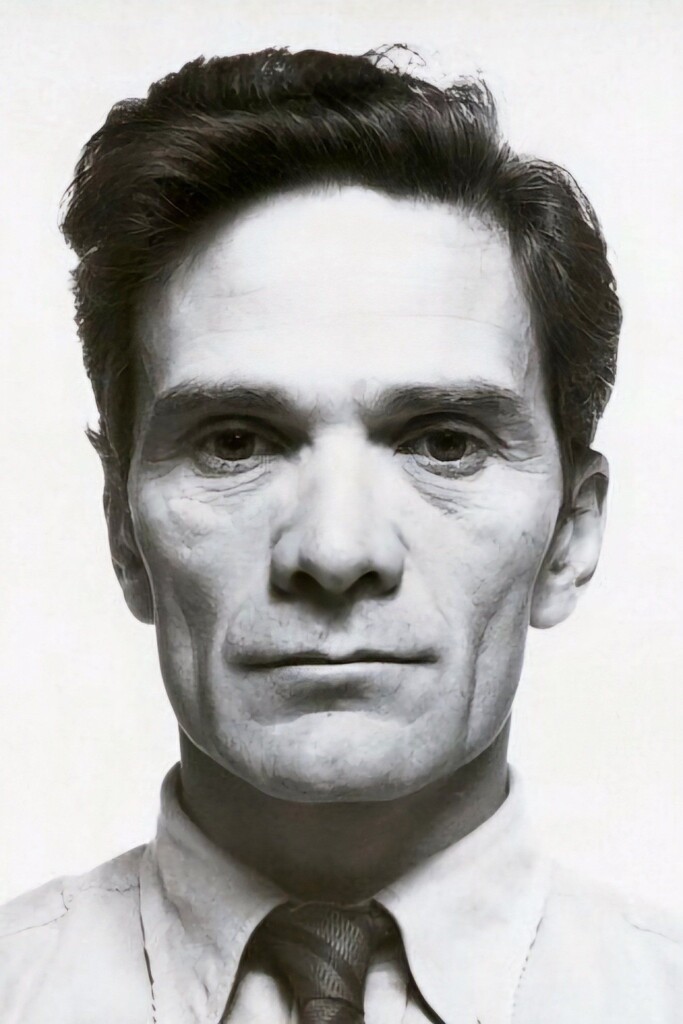
You can drive through Tor Bella Monaca on any Tuesday afternoon and see exactly what Pasolini saw in 1955. Not a resemblance. Not an echo. The thing itself, reproduced with bureaucratic precision: the long facade of residential blocks built to house people who were never quite meant to arrive, the concrete stained by decades of rain that no one repaired, the children moving through courtyards that were designed without shade or benches or any surface that invites lingering. The urban planners had names for these places. They called them satellite neighborhoods, as though proximity to orbit were a quality rather than a condition of permanent distance from the center of gravity.
Corviale stretches nearly a kilometer in a single, unbroken wall of apartments west of the city — one thousand meters of inhabited concrete completed in 1982, conceived as a self-sufficient community, meaning a place where the poor would have everything they needed except the city itself. The architects who designed it believed in a certain rationalism, the same rationalism that Walter Benjamin had already autopsied in 1936 when he described how technical reproducibility strips an object of its aura, its singularity, its presence in a specific human time and place. What Benjamin said about artworks, the postwar Italian state applied to neighborhoods. The periphery was mass-produced. Its residents were its raw material.
What makes this difficult to sit with is not the poverty, though the poverty is real and measurable — unemployment rates in Tor Bella Monaca have consistently run two to three times higher than the Roman average, drug markets have operated openly in the same courtyards for over three decades, public transit connections to the center remain structurally inadequate forty years after the neighborhood’s construction. What makes it difficult is the suspicion, which Pasolini articulated in his 1975 collection of essays Scritti corsari with a precision that bordered on cruelty, that these outcomes were never accidental. He wrote about how consumer capitalism required an underclass not to exploit in the old industrial sense but to use as a mirror, a proof of concept, a before image that justified the aspirational grammar of everything else. The suburbs existed to define what the center was not.
Pierre Bourdieu, working in France during the same decades, documented in La Distinction in 1979 how space itself becomes a form of symbolic violence — not through force but through the internalized acceptance that one’s place in a geography reflects one’s place in a hierarchy. The resident of Corviale who has never been told explicitly that they are less valuable has nonetheless been told by every material condition of their existence: the broken elevator, the absence of a decent bookshop, the bus that comes every forty minutes, the school with the ceiling that leaks. Symbolic violence is simply regular violence with better public relations.
The question that Pasolini never stopped asking, and that his death in 1975 did not resolve, is the one that the contemporary periphery forces back into view with every year it persists unchanged: whether the suburb was ever conceived as a problem to be solved or as a solution to a different problem entirely. If it were a failure of planning, it would have been corrected. Italy had the resources. Rome had the political institutions. The European Union poured structural funds into peripheral regeneration programs across four decades, and Tor Bella Monaca is still Tor Bella Monaca. The failure is too consistent, too geometrically reproduced across too many cities on too many continents, to be accidental.
What Pasolini understood, what he paid for understanding with the kind of social isolation that precedes more terminal forms of silencing, is that the periphery is not the city’s wound. It is the city’s signature — the place where the system stops performing innocence and simply shows, in concrete and distance and deliberate neglect, exactly what it believes certain lives are worth.
🏚️ Margins, Poetry, and the Urban Underworld
Pier Paolo Pasolini‘s vision of the Roman suburbs was inseparable from his poetry, his politics, and his radical way of seeing the world. These related articles explore the currents of thought and creativity that surrounded and nourished his restless, transgressive work.
Pier Paolo Pasolini and Poetry: Language and Identity
Pasolini’s poetic voice was deeply rooted in the languages of the margins, from the Friulian dialect of his youth to the raw vernacular of the Roman borgate. This article explores how his poetry became an act of cultural resistance and identity, challenging the homogenizing forces of postwar Italian society. Understanding his verse is essential to grasping the same urgency that drove his cinematic portrayal of suburban Rome.
GO TO THE SELECTION: Pier Paolo Pasolini and Poetry: Language and Identity
Situationist Psychogeography: The City as Lived Space
The Situationist concept of psychogeography offers a powerful theoretical lens through which to read Pasolini’s wanderings through Rome’s peripheral neighborhoods. Like the Situationists, Pasolini understood the city as a lived, contested space where power and desire intersect in the streets. His films and writings can be seen as passionate dérives through the forgotten zones that official culture preferred to ignore.
GO TO THE SELECTION: Situationist Psychogeography: The City as Lived Space
Antonio Gramsci: vita e pensiero politico
Antonio Gramsci‘s thought on subaltern classes, hegemony, and organic intellectuals profoundly shaped Pasolini’s political and cultural outlook. Pasolini saw in the Roman lumpenproletariat a subversive vitality that mainstream Marxism had overlooked, echoing Gramsci’s sensitivity to the cultural dimensions of class struggle. This article illuminates the ideological framework that underpinned Pasolini’s fierce defense of the marginalized and the dispossessed.
GO TO THE SELECTION: Antonio Gramsci: vita e pensiero politico
Discover the Cinema of the Margins on Indiecinema
If Pasolini’s vision of Rome’s outskirts has stirred something in you, Indiecinema is the place to continue the journey. Our streaming platform curates independent and auteur films that, like Pasolini, dare to look where mainstream cinema turns away. Explore the full catalog and let the periphery speak.
👉 EXPLORE THE CATALOG: Watch Indie Films in Streaming
A vision curated by a filmmaker, not an algorithm
In this video I explain our vision

