
Oil, Failure, and the Education of a Hard Eye
You are forty-four years old and you have just been fired. Not laid off, not downsized through some polite corporate euphemism — fired, with the particular humiliation reserved for men who were supposed to know better. The office you walked into this morning will be occupied by someone else before the week is out. The title on your business card, the deference in the secretary’s voice, the sense that your presence in a room carried some specific gravity — all of it evaporates with a speed that retrospectively reveals how thin the whole structure was. You drove to work this morning as one kind of man. You are driving home as something not yet named.

Raymond Chandler arrived at this unnamed condition in 1932, when the Dabney Oil Syndicate terminated his employment as a senior executive after years of drinking, absenteeism, and affairs with women on the company payroll. He had built a respectable career in the Los Angeles oil business across the 1920s, climbing to a position that would have satisfied most men entirely — the salary, the authority, the Californian sunshine burning down on an industry extracting impossible wealth from the earth. None of it satisfied him. He drank through the prosperity of the boom years and stumbled into the Depression already hollowed out by something the job title had never managed to fill. When Dabney finally let him go, he was broke, approaching middle age, and married to a woman, Cissy Pascal, who was eighteen years his senior and who represented, in their unconventional partnership, one of the few genuine choices he had ever made entirely on his own terms.
What gets stripped from a man in that circumstance is not merely income or status. It is the narrative he had been performing, often unconsciously, for the benefit of an audience that includes himself. The sociologist Erving Goffman spent a career documenting how identity is not possessed but staged — how the self is a performance requiring props, sets, and cooperative audiences to sustain the illusion of coherence. Lose the props suddenly, and you discover that the performance was the whole of what you thought you were. Chandler lost his in a single administrative act, and what he encountered in the wreckage was not a truer self waiting patiently beneath the surface, but rather a kind of raw perceptual alertness that had no immediate social use. He had spent years watching how power actually moved through a company, how money corroded loyalty, how men with good manners did things that men with no manners would never have dared justify to themselves. He had accumulated, without intending to, a precise and unillusioned education in the way American institutions operated when they believed no one important was watching.
He turned to pulp fiction because there was almost nothing else available to a man of his background and his moment, and because the pulp magazines of the early 1930s — Black Mask chief among them — paid a quarter of a cent per word for stories that nobody considered literature. The condescension embedded in that market was, paradoxically, its gift. No one expected Raymond Chandler to produce art in Black Mask. He was therefore free to think about what he was actually doing. His first published story, “Blackmailers Don’t Shoot,” appeared in December 1933, and it was rough in ways he would later openly acknowledge — but it was already organized around a sensibility that the respectable literary world of the period had not developed the instruments to recognize. The hard-boiled mode was broadly considered a low genre, formulaic and disposable, which meant that Chandler could reinvent it from inside without anyone noticing until the reinvention was complete.
Failure had given him something that success almost never does: the time and the necessity to see clearly, without the social insulation that a functioning career provides against the sharpness of things.
A Better Life
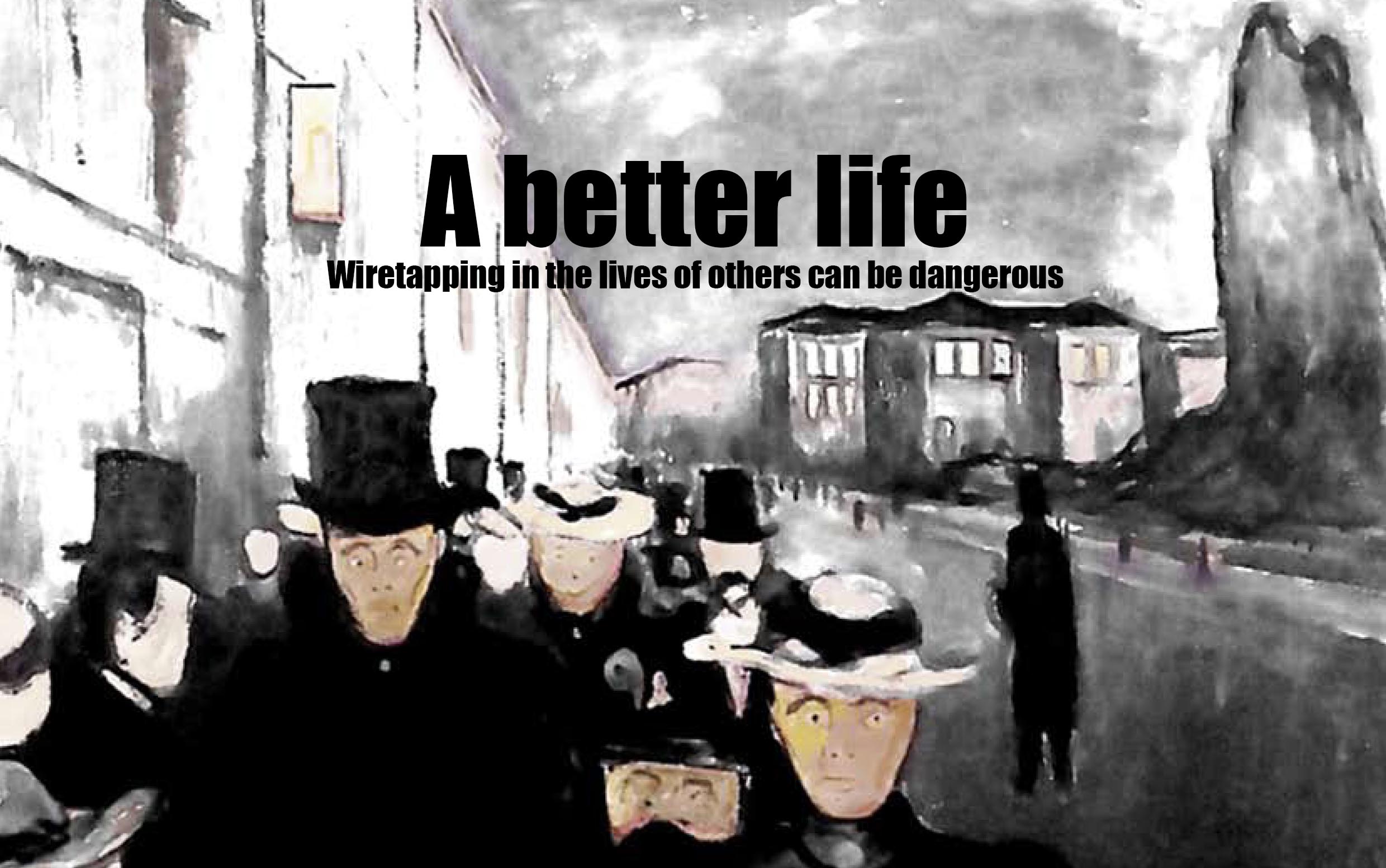
Drama, thriller, by Fabio Del Greco, Italy, 2007.
Rome: Andrea Casadei is a young investigator specializing in audio wiretapping who conducts investigations commissioned by husbands betrayed by their wives, or by parents worried about what their children are doing outside the home. But what interests him most is understanding the human soul, listening to casual conversations in the streets, knowing what people think. He often meets in Piazza Navona with his friend Gigi, a frustrated street artist obsessed with success at all costs, with whom he shares a passion for wiretapping. Shocked by the mystery of the disappearance of Ciccio Simpatia, another street artist common friend, Andrea decides to abandon the commissioned works to seek a better life and reflect on his own and others' existence. He will meet the actress Marina and with a bug he will slowly enter her life until he discovers her most unthinkable secrets. The film deals with an important theme of contemporary Western society: the lack of love. The mysterious and tormented figure of Marina is reflected in a gloomy and soulless Rome.
Director Fabio Del Greco declared about his film: "Perhaps this film is a reflection on the art of observing, of listening, in short, of what one does when one leaves the real world to tell about it. Perhaps he wants to talk about the subtle relationship between the mirages of success touted by today's society, power and the most authentic human relationships.A 'dark cloud' hangs over the city: it is engulfing everyone in a sort of indistinct, uniform mass, where everyone thinks the same things, where everyone they are more alone. Where is the truest part that makes us unique? Maybe you can try to intercept it only secretly."
LANGUAGE: Italian
SUBTITLES: English, Spanish, French, German, Portuguese, Dutch.
The Anglophile Who Never Belonged Anywhere
You are twelve years old and you have just arrived somewhere that is not quite home, and everyone around you already knows the rules of a game nobody will explain. The uniform fits, the accent is close enough, but you watch from a distance that no amount of proximity ever closes. This was Raymond Chandler’s condition not for a semester or a difficult year but for the entirety of his conscious life, and what most people experience as social embarrassment he converted into a precision instrument.
Edward Said, in Culture and Imperialism published in 1993, developed the idea of contrapuntal vision to describe a mode of perception available to those who have been forced to inhabit more than one cultural reality simultaneously. Said was writing primarily about writers produced by the experience of colonialism, but the structure of his observation travels. Contrapuntal reading, as he defined it, involves holding two frameworks in the mind at once without allowing either to dominate or cancel the other, hearing the melody and the countermelody as a single composition rather than treating one as noise to be tuned out. For someone like Chandler, who was educated into English stoicism and class-consciousness while carrying an American inheritance he had never chosen, this doubleness was not a theoretical position. It was the daily texture of perception. He saw Los Angeles through eyes that had been trained on Edwardian propriety, which meant he saw the vulgarity, the transience, and the naked economic hunger with a clarity that native observers had mostly learned to normalize.
This is what separates his detective fiction from journalism or sociology. A reporter documents what is visible. Chandler translated the visible into the felt, and what made him feel so precisely was that nothing around him had the comfortable blur of the familiar. The corruption of the LAPD in the 1930s and 1940s, the grotesque performance of wealth in the Pasadena mansions he described with such cold accuracy, the way money in California seemed always slightly unreal, slightly criminal in origin — none of this registered to him as simply the way things were. He had a reference point outside it, and that reference point was itself not innocent, which meant he could not romanticize the alternative either. England had given him the tools to see America clearly. America had given him the evidence that England’s clarity was itself a form of self-serving mythology. He was left with neither shore, which is precisely where the most useful observations tend to originate.
What grows in that kind of ground is not bitterness, exactly, though bitterness is present. It is something closer to a structural irony that cannot be switched off, a permanent awareness that every social arrangement is contingent, every hierarchy is constructed, and every man who acts as though he belongs fully to any world is performing a confidence he does not entirely possess.

Los Angeles as a Machine for Producing Illusions

You drive west on Sunset until the boulevard stops pretending to be respectable, and somewhere between the last Armenian deli and the first pink stucco wall promising ocean views, you understand that the city was never built for you to understand it. It was built to be misread. Raymond Chandler grasped this before most urban theorists had the vocabulary to say it, and he turned that spatial deception into the fundamental grammar of his fiction — not atmosphere, not backdrop, but argument.
Los Angeles in the 1930s was less a city than a confidence scheme that had incorporated. The water required to sustain it had been stolen from the Owens Valley through a campaign of fraud and political manipulation documented exhaustively by the 1913 aqueduct project and the land acquisitions that preceded it, a process in which city officials secretly purchased desert parcels that would become valuable the moment the water arrived, ensuring that the growth of the metropolitan area directly enriched the men engineering that growth. The historian Mike Davis, writing in City of Quartz in 1990, identified this founding violence as constitutive rather than incidental — Los Angeles was not a city that had experienced corruption but a city whose infrastructure was corruption, whose geography was the physical residue of class predation dressed in sunshine and Spanish tile. Chandler had arrived in this place in 1912, had worked in oil rather than real estate, and had watched the same logic repeat itself in every extractive industry that touched Southern California soil.
What Chandler understood, and what his novels demonstrate with the precision of sociology, is that a city built on illusion requires professionals of illusion to maintain it. The private detective Philip Marlowe moves through a landscape stratified by exactly the distance between what things appear to be and what they are. Bel Air looks like serenity and contains organized cruelty. The Bay City of Farewell, My Lovely, published in 1940, is a thinly disguised Santa Monica where the entire police force operates as a private enforcement arm for a gambling syndicate — not as an exceptional scandal but as the ordinary condition of civic administration. Chandler is not describing anomaly. He is describing the system functioning correctly.
The sociologist Thorstein Veblen had already theorized in The Theory of the Leisure Class, back in 1899, that conspicuous consumption was not excess layered onto a rational economy but the economy’s central organizing principle — that status display was what the system was actually producing, with goods and services as byproducts. Los Angeles in Chandler’s time was Veblen’s argument rendered in palm trees and swimming pools, a metropolitan area whose primary industry was the manufacturing of desire, the production of images designed to be consumed by people who would never inhabit them. Hollywood was not an industry located in Los Angeles by accident; it was the city’s purest expression, the factory most honestly aligned with the city’s founding logic.
Marlowe drives through this. He drives specifically, named streets, real boulevards, the actual topography of a city that would prefer its geography remain impressionistic. Chandler’s insistence on geographic precision functions as a kind of counter-cartography — mapping the city against its own mythology, anchoring the dream factory in the material conditions that sustain it. A woman with a Pasadena address and a Bel Air swimming pool does not simply have money; she has money that traces back to specific transactions, specific thefts, specific silences purchased. The geography encodes violence the way a contract encodes the threat of enforcement: politely, structurally, in language that sounds like description but is actually coercion.
There is a moment in nearly every Chandler novel where Marlowe looks at a beautiful house and sees, without sentimentality, the labor and leverage required to produce that beauty — and says nothing about it, because saying it aloud would be the one unforgivable indiscretion in a city that has survived entirely by not saying it aloud.
Pulp Fiction and the Hierarchy of Legitimate Culture
You have read a novel with a cracked spine, bought secondhand from a box outside a shop that smelled of damp paper and other people’s afternoons. You paid almost nothing for it, and that price was not an accident.
When Raymond Chandler sold his first story, “Blackmailers Don’t Shoot,” to Black Mask in December 1933, he received a cent and a quarter per word. The magazine was printed on rough wood-pulp paper — hence the name the industry had accepted as both descriptor and insult — and it sat on newsstands beside confession magazines and racing sheets, bought by men who worked with their hands and women who did not have time for Henry James. The literary establishment of the 1930s did not need to argue that this material was inferior. The argument had already been made structurally, by the paper it was printed on, by the price of its cover, by the bodies of the people who purchased it.
Pierre Bourdieu spent much of his career demonstrating that aesthetic judgment is rarely about aesthetics. In The Rules of Art, published in French in 1992, he mapped the literary field in nineteenth-century France as a space organized not around quality but around position — who occupied the consecrated center, who was assigned the peripheral margins, and how those assignments reproduced existing distributions of social power. The field rewarded those who already possessed what Bourdieu called cultural capital, the inherited familiarity with legitimate forms, legitimate references, legitimate institutions. It punished those who arrived without it, regardless of what they actually produced. What looks like a verdict on artistic merit is almost always a verdict on the social location of the artist and the audience.
Chandler arrived at Black Mask already marked. He was fifty-five years old when he published that first story, a failed oil executive from a broken Anglo-Irish background, educated at Dulwich College on a scholarship that placed him alongside boys whose families could afford to be there by birthright. He had absorbed enough classical formation to write sentences of genuine structural elegance, yet he was publishing in a format that the educated class treated as beneath acknowledgment. This combination — refined sensibility stranded inside a disreputable container — is not an irony of biography. It is the mechanism by which cultural hierarchies sustain themselves. The form is condemned so that the question of the content never has to be seriously addressed.
Between 1933 and 1939, Chandler published roughly two dozen stories in Black Mask and Dime Detective, developing across those pages the entire grammar of what would become his novelistic voice: the first-person narrator whose intelligence exceeds his circumstances, the city as a moral weather system, the crime that is never really solved because the rot it exposes runs too deep to be arrested. This was genuinely new work being done in those pages. The editor of Black Mask during much of this period, Joseph “Cap” Shaw, ran what amounted to a laboratory for American prose, corresponding with his writers about rhythm, compression, and precision with the seriousness of someone who understood that something real was being built. None of this penetrated the literary conversation of the decade, because the conversation was not equipped to see across the class boundary the paper stock had already drawn.
When Chandler’s first novel, The Big Sleep, appeared in 1939 through Alfred A. Knopf, something changed — not in the writing, which was largely assembled from the pulp stories, but in the container. Knopf was a legitimate publisher with a consecrated position in the field. The object was now a hardback book, and the social permission to take it seriously arrived with the binding. The prose had not improved. The institution had simply reclassified it, the way a painting moves from junk shop to gallery without the paint drying differently.
The question this raises about every shelf you consider respectable is one the shelf itself will never answer.
Philip Marlowe and the Myth of the Incorruptible Man
You are sitting across from a man who has just been offered more money than he will earn in a year, and he is sliding the envelope back across the desk without looking at it. The gesture is unhurried, almost bored, as if the money itself is slightly embarrassing — a social faux pas committed by someone who does not understand the rules of the room. That man is Philip Marlowe, and the room is not a room at all. It is a cultural need dressed up as fiction.
Chandler constructed Marlowe with a precision that was neither accidental nor purely aesthetic. In his 1944 essay The Simple Art of Murder, he wrote that the detective must be a man who is not himself mean, who is neither tarnished nor afraid, a man who walks the mean streets without becoming them. The sentence is so beautifully calibrated that generations of readers have accepted it as a description of a character when it is, in fact, a statement of longing. Chandler was not describing someone he had observed. He was describing someone he needed to believe could exist, which is an entirely different act, and a far more revealing one.
What makes Marlowe structurally impossible is precisely what makes him irresistible. Postwar American capitalism had produced an economy in which every transaction implied compromise, in which loyalty was a leverage point, in which the institutions ostensibly designed to protect people — police, law firms, city government, old money — were the primary engines of corruption. This was not paranoia. The investigations into municipal corruption in Los Angeles between the 1930s and 1950s, particularly those documented around the tenure of Police Chief James Davis, confirmed what Chandler’s fiction had already diagnosed: the machinery of civic life was available for purchase. Against this documented rot, Marlowe functions not as a plausible human being but as a theological proposition — the one incorruptible substance in a world that has converted everything else into currency.
The anxiety this exposes is not political but profoundly personal, and it runs directly through the marrow of what it meant to be a man in that particular historical moment. The masculine ideal of the mid-twentieth century demanded self-sufficiency, emotional impermeability, and a kind of sovereign independence from social obligation. Yet the actual economic conditions of postwar America required precisely the opposite — conformity, institutional loyalty, the slow surrender of individual will to corporate structure. William H. Whyte documented this contradiction in The Organization Man in 1956, watching the American male disappear into a collective identity while still performing the mythology of rugged independence. Marlowe is the fantasy that resolves this contradiction without resolving it: he is the organization man’s secret self, the version of him that never had to choose between dignity and survival.
What Chandler could not fully acknowledge, and what the essay’s famous manifesto obscures, is that Marlowe’s incorruptibility is purchased at a specific price. He is alone. Serially, structurally, almost constitutionally alone. He has no family, no lasting attachments, no stake in any future that extends beyond the case in front of him. The women he encounters are dangerous or damaged or both. The men who might be friends either die or reveal themselves as compromised. His freedom from corruption is indistinguishable from his freedom from connection, which raises a question the novels never quite ask aloud: whether a man who belongs to nothing has actually refused the world’s corruption or simply found a way to be unavailable to it.
There is a difference between resisting a system and being architecturally exempt from what the system requires. Marlowe can refuse the envelope because he has no mortgage, no sick child, no aging parent, no one whose welfare depends on his willingness to slide the envelope back. His virtue is real, but it is also, quietly, a function of his absolute dispensability to everyone who might otherwise compromise him.
A vision curated by a filmmaker, not an algorithm
In this video I explain our vision
The Long Goodbye and What Cannot Be Recovered

You have a drink with a man you barely know, and something passes between you that has no name — not friendship exactly, not obligation, but something closer to recognition, the sense that this other person has looked at the same darkness you have and chosen, inexplicably, not to look away. That is where the novel begins, and it is also where it ends, except that by the final page the recognition has curdled into something far more corrosive than betrayal.
Published in 1953, The Long Goodbye is the work in which Chandler finally stopped pretending that the detective story was merely a delivery mechanism for wit and atmosphere. Philip Marlowe’s attachment to Terry Lennox — drifter, war-wounded, quietly ruined — is the emotional axis around which the entire novel rotates, and what is remarkable is how ruthlessly Chandler refuses to sentimentalize it. The attachment is real. The grief that follows Lennox’s apparent death is real. And then the novel dismantles both, not through melodrama but through the patient, almost clinical revelation that the object of mourning was itself a fiction, a man who had constructed a persona rather than a self.
Sigmund Freud, in his 1917 essay Mourning and Melancholia, drew a distinction that cuts directly into this territory. Trauerarbeit — the labor of mourning — is the slow, effortful process by which the psyche withdraws its investment from a lost object and gradually reorients itself toward the living world. What distinguishes healthy mourning from melancholia, Freud argued, is that mourning eventually ends: the ego survives, reconstitutes, moves forward. Melancholia, by contrast, is mourning that cannot complete itself because the loss cannot be fully named or acknowledged — often because the mourner’s own ambivalence toward the lost object is too threatening to consciously confront. Chandler’s novel performs exactly this structure, except it refuses the consolation of resolution. Marlowe grieves, withdraws his investment, and then discovers that what he was grieving for was never what he thought it was. The labor of mourning loops back on itself and finds no stable ground.
What makes this structurally radical within the genre is that the mystery — the actual plot mechanics involving a writer named Roger Wade and a murder and the usual architecture of crime fiction — feels almost deliberately secondary, as if Chandler is demonstrating that the puzzle can be solved and nothing meaningful recovered by solving it. Roger Wade is destroyed not by any villain but by his own inability to sustain the performance of being a person. His wife is not a murderer so much as a survivor of a world that gave her no honorable options. The novel’s violence is systemic before it is individual, and Chandler is too honest by 1953 to pretend otherwise.
The social order that Marlowe moves through in The Long Goodbye is not merely corrupt in the conventional hard-boiled sense — not just cops on the take and rich men above the law. It is a world in which the very categories of loyalty, decency, and meaning have been quietly evacuated of content while their forms remain in circulation. People still use the words. The words no longer do any work. Terry Lennox, when finally revealed alive and restructured, does not offer an explanation so much as a demonstration: he has simply done openly what the culture does covertly, which is to abandon one self when it becomes inconvenient and manufacture another. Marlowe’s famous last line to him — “You had nice instincts but you’re not a man” — is not an accusation delivered from moral high ground. It is a diagnosis of something the novel has already shown to be pandemic.
The grief the novel enacts is not Marlowe’s alone, and it was never really about Lennox. It is grief for the possibility that the social contract ever existed in a form worth honoring — which is a form of mourning for an object that, as Freud would recognize immediately, was always partly imaginary to begin with.
Hollywood, Collaboration, and the Authorship Trap
You are handed a script that is not entirely yours, and the credit will read two names, and somewhere in that small typographical fact a whole belief system begins to crack. Chandler arrived in Hollywood already carrying a wound — the sense that serious literature and commercial work occupied different moral planes, that one elevated the soul while the other merely fed the body. What he found instead was something more disorienting: a form of writing that was genuinely collaborative, structurally so, in which the single authorial voice he had spent decades cultivating was not merely diluted but architecturally impossible.
The partnership with Billy Wilder on Double Indemnity in 1944 has become legendary precisely because of how badly the two men hated working together. Wilder found Chandler prickly, slow, and theatrical in his grievances. Chandler found Wilder vulgar, overbearing, and constitutionally unable to leave a sentence alone. Their correspondence from that period reads like a long argument about who owns language once it has been spoken into a room with another person present. What they produced together — a film widely regarded as one of the defining achievements of American noir — neither man would have made alone. The screenplay is better than either of them, which is precisely the scandal neither could fully absorb.
Roland Barthes published his essay The Death of the Author in 1967, two decades after these Hollywood battles, but it reads like a postmortem on Chandler’s specific anguish. Barthes’s argument was not merely that readers matter more than writers, but that the figure of the Author — capital A, originary, sovereign, the single explanatory source of a text’s meaning — is a historical construction, a product of the prestige accorded to individual creative consciousness by the European Enlightenment and Romantic movements. To believe that a text belongs to its author, that it issues from and returns to a singular intentional mind, is not a natural perception but a cultural habit, and a relatively recent one. Chandler lived entirely inside that habit, never questioning it, and Hollywood forced the question on him with the bluntness of a contract clause.
Alcoholism, Late Style, and Writing Against Disintegration

Cissy Pascal Chandler died on December 12, 1954, after years of a pulmonary illness her husband had watched advance the way a man watches a tide come in knowing there is nowhere higher to stand. She was eighty-four, though she had told Raymond for decades she was younger, and he had chosen to believe her with the particular willingness of a man who needed illusions to be true. When she was gone, he wrote to a friend that he had no reason to walk into the next room.
The suicide attempt came in February 1955, in the bathroom of their La Jolla house, two shots fired and none landing. There is a clinical reading of that failure and a crueler one — that even dissolution would not cooperate. What followed was not recovery in any useful sense but a kind of ambulatory ruin: the drinking that had shadowed his entire career now moved to the center, the correspondence that had always been brilliant became erratic and then brilliant again in the same paragraph, and the work, what remained of it, took on a quality that resisted the word decline because decline implies a direction and what Chandler was doing had no clear vector.
Edward Said, writing in On Late Style published posthumously in 2006, argued that the late works of certain artists are not valedictory or serene but intransigent — marked by what he called a “nonharmonious, nonserene tension” that refuses the closure culture expects of the aged. Said was thinking of Beethoven’s final quartets, of Shakespeare’s romances, of a Rembrandt self-portrait staring out from under the weight of accumulated knowledge with something that is not peace. The argument is that lateness, when it is genuinely late, does not soften the world but refuses to pretend the world has ever been soft. It is the opposite of wisdom-as-consolation.
Chandler’s unfinished Poodle Springs manuscript, the four chapters he produced in 1958 and 1959 in which Philip Marlowe has married a wealthy woman named Linda Loring and moved into her Palm Springs world, is one of the stranger objects in American literature. The prose is functional but the emotional atmosphere is wrong in a way that feels deliberate — Marlowe is uncomfortable in his own marriage, in his own name, in the genre that made him. He keeps looking for a case the way a man in a dream keeps reaching for a door that moves. Chandler never finished the novel. He died in March 1959, four chapters in, leaving Marlowe suspended in a domesticity neither man believed in.
The late letters, collected and published in 1981, are in some ways the truest late work — not because they are more honest than the novels but because the formal pressure is gone and what remains is a man thinking at high speed about loneliness, craft, failure, women he wanted to love, a country he had returned to and could not locate. He wrote to his agent, to strangers who had written to him, to women whose company he sought with a desperation he documented with unflinching precision. There is something in those letters that resembles what Keats called negative capability — the capacity to remain in uncertainty without an irritable reaching after resolution — except that for Chandler the uncertainty was not aesthetic but existential, and it burned rather than illuminated.
What his late work refuses is the comfort of an ending, which is not a failure of craft but a fidelity to experience. The hard-boiled novel as Chandler had always practiced it was never really about crime. It was about a world in which the institutions that promised order — marriage, money, the law, the city itself — were revealed under pressure to be theater. In his final years, stripped of the one relationship that had given his life its private architecture, he kept writing toward that revelation with the persistence of a man who had nothing left to protect.
🔍 Navigating the Labyrinth of Literary Worlds
Raymond Chandler’s hardboiled fiction, with its morally ambiguous detective navigating a corrupt urban maze, resonates deeply with a broader literary tradition of characters lost in complex, shifting realities. From existential wanderers to architects of impossible labyrinths, these works share Chandler’s obsession with identity, illusion, and the search for truth in a deceptive world. Explore these thematically kindred works to deepen your understanding of Chandler’s singular literary universe.
Jorge Luis Borges: Life and Works
Jorge Luis Borges and Raymond Chandler share a profound fascination with labyrinths — one literal and metaphysical, the other urban and moral. Both authors construct worlds where the protagonist must navigate layers of deception and hidden meaning, ultimately confronting the elusive nature of truth. Reading Borges alongside Chandler reveals how the detective genre and metafiction draw from the same existential well.
GO TO THE SELECTION: Jorge Luis Borges: Life and Works
Jorge Luis Borges and the Labyrinth of Identity
Borges’s exploration of identity within labyrinthine structures finds a striking parallel in Chandler’s Philip Marlowe, a man who must define himself against a world designed to obscure and mislead. Both writers treat identity not as a fixed point but as something perpetually negotiated through narrative and perception. This article illuminates how the labyrinth becomes a universal metaphor for the self in literature.
GO TO THE SELECTION: Jorge Luis Borges and the Labyrinth of Identity
Samuel Beckett: Life and Works
Samuel Beckett and Raymond Chandler, though stylistically worlds apart, both immerse their protagonists in environments of waiting, uncertainty, and moral ambiguity. Beckett’s fragmented, minimalist prose mirrors the dead ends and false leads that define Chandler’s detective narratives. Together, they reveal how modern literature uses stalled momentum and existential fog as powerful literary devices.
GO TO THE SELECTION: Samuel Beckett: Life and Works
The Journey as Metaphor in Literature
The journey as metaphor connects Chandler’s Marlowe — drifting through the corrupt streets of Los Angeles — to the broader literary tradition of travel as a quest for meaning. This article examines how movement through physical and symbolic space becomes a way of confronting the self and society. It provides essential context for understanding why Chandler’s novels feel like odysseys as much as mysteries.
GO TO THE SELECTION: The Journey as Metaphor in Literature
Discover More at Indiecinema
The literary worlds explored here — labyrinthine, morally complex, endlessly searching — have inspired some of the most daring independent films ever made. On Indiecinema, you’ll find a curated streaming catalog of independent cinema that shares this same spirit of artistic ambition and narrative depth. Dive in and discover the films that carry these great literary traditions into the moving image.
👉 EXPLORE THE CATALOG: Watch Indie Films in Streaming
A vision curated by a filmmaker, not an algorithm
In this video I explain our vision

