
The Workshop as Social Architecture
You are fourteen years old, and the man you call maestro has just handed you a broom. Not as an insult — as an initiation. The floor of the workshop is layered with the residue of work: chalk dust, dried pigment, curls of wood shaving, the particular grime that accumulates when human effort is applied to raw material over years without pause. You sweep it. You will sweep it for months before anyone lets you near a brush, and in sweeping it you are learning something that no one will ever explain to you in words — that the space itself is a hierarchy, that proximity to the master’s table is earned in increments so small they are almost invisible, and that your identity for the next decade will be constituted entirely by your position within this room.

The Florentine bottega of the fifteenth century was not a studio in any sense the contemporary world would recognize. It was closer to what the anthropologist Mary Douglas, writing in Purity and Danger in 1966, called a “bounded system” — a social organism that produced meaning through the precise regulation of who stood where, who touched what, and who bore responsibility for the finished object. The master, the journeymen, the apprentices: these were not simply job titles but ontological categories, positions in a moral cosmology that mapped the sacred geography of creation. Cennino Cennini, writing his Libro dell’Arte around 1400, described apprenticeship as requiring no fewer than thirteen years of formation before a craftsman could claim independent authority, and his language throughout is not that of vocational training but of spiritual ordination — the workshop as a kind of secular priesthood with its own rites of passage and its own theology of the hand.
What this system produced, with extraordinary efficiency, was a fiction of singular authorship that served the interests of the master without ever being stated as a policy. When Ghiberti’s name appeared on the Gates of Paradise — those bronze doors completed for the Florence Baptistery in 1452 after more than two decades of labor — the historical record conveniently absorbed the contributions of the twenty or more assistants who cast, chased, and polished the panels under his direction. The system was not corrupt in any simple sense; it was architecturally designed so that credit flowed upward as naturally as heat, because the master’s reputation was the workshop’s market value, and the workshop’s market value was the only thing standing between all of those apprentices and destitution. The obscuring of collaborative labor was not hypocrisy — it was the load-bearing wall of the entire structure.
What gets lost in the romantic reconstruction of Renaissance genius is that the bottega was also a site of radical economic vulnerability disguised as tradition. Apprentices were frequently the sons of families who had paid premium fees for their placement, a transaction that Giorgio Vasari‘s Lives of the Artists, published in its expanded form in 1568, consistently erases in favor of narratives about innate talent recognized by a generous master. The money paid to secure a position in Verrocchio’s workshop, where Leonardo was placed around 1466, transformed a commercial transaction into a story of destiny. That transformation was not accidental — it was the ideological work that Renaissance society performed on itself constantly, laundering economic coercion through the language of vocation and gift.
The bodies of the apprentices were, in the most direct sense, productive instruments owned temporarily by the institution. They slept in the workshop, ate in the workshop, and were legally bound by contracts that prohibited them from taking outside commissions or leaving without forfeiture of everything they had learned.
Studio 2091
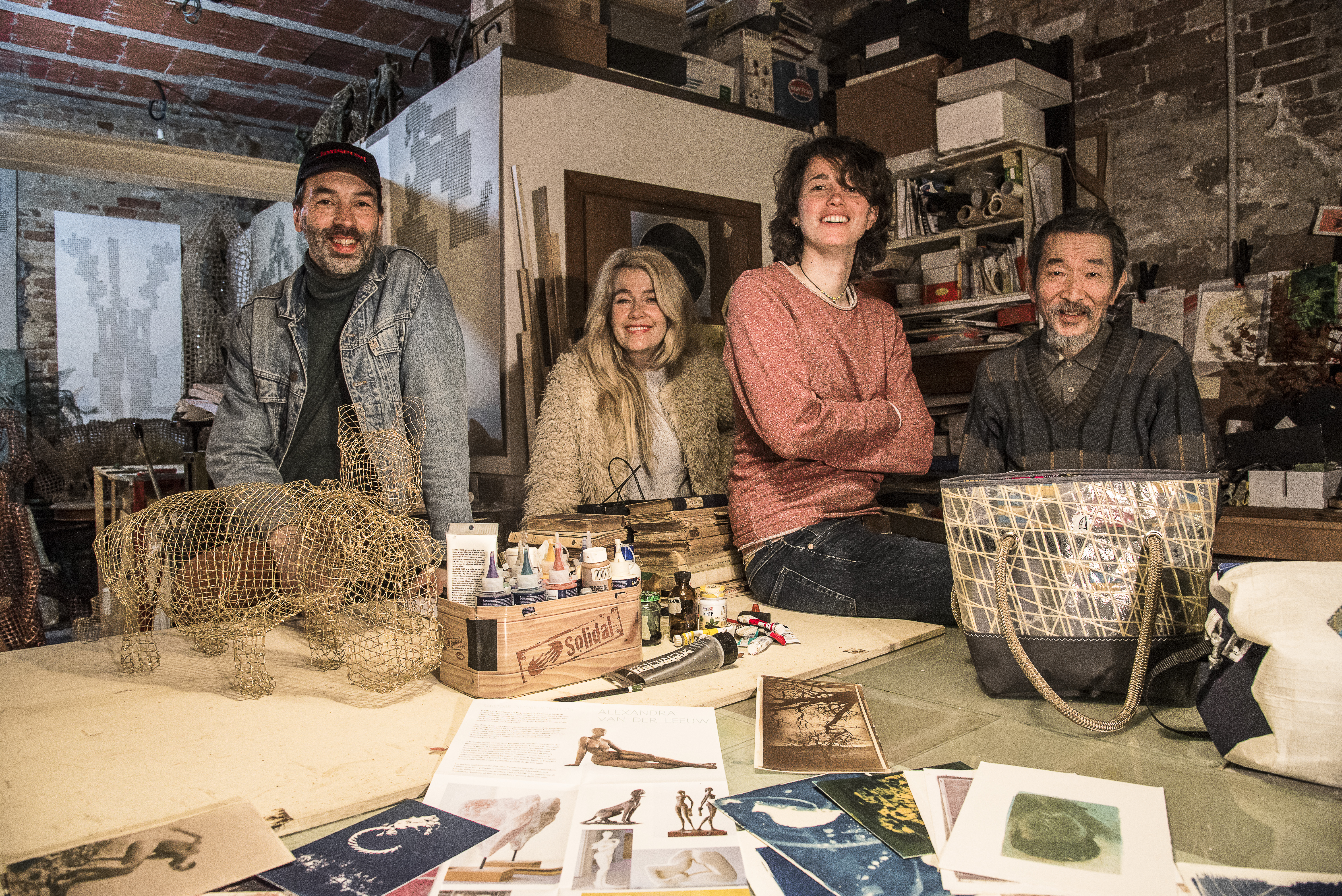
Documentary, by Naù Germoglio, Italy, 2020
In a former warehouse on the ground floor of the civic number "2091", in the district of “Santa Croce” in Venice, two sculptors, a craftswoman and an alchemist-photographer work together. It is a 65 square meters space with two windows overlooking a small canal. It is called "STUDIO2091" and it is a unique example of creative co-working space where there is no wifi connection, the cellphones work very bad, there are no tables for meetings, nor computers.
His "tenants" carry out only manual activities related to art and crafts. Each of them has a different reason to live in Venice, a beautiful and unique city, yet expensive, problematic, overrun by mass tourism and high tide. The photographer-alchemist Andrea Buffolo, who was born in Switzerland,is the only one who has spent almost all his life in the historical center of Venice. Japanese sculptor Masaru Kashiwagi chose to live in Venice 35 years ago, because he considers it the only city in the world perfect for an artist; the craftswoman Camilla Morelli was born and raised in Valtellina ( a valley in the Lombardy region of northern Italy), and although she grew up in the mountains, she chose to live in Venice to enjoy the proximity to the sea; the Dutch painter and sculptor Alexandra Van der Leeuw lives on the island half of the year carrying on a family tradition. The four protagonists of the documentary film chose to live in Venice because here,and only here, they succeed in being themselves, realizing themselves and feeling free.
SUBTITLES: English, Spanish, French, German, Portuguese
Authorship, Anonymity, and the Myth of the Solitary Genius
You stand in front of the Annunciation in the Uffizi, and the label says Leonardo. One name, one mind, one miracle. The painting seems to breathe with singular intention, as though a single pair of hands reached into the divine and pulled light out of pigment. What the label does not say — what no label in that building says — is that Leonardo was approximately twenty years old when he worked on it, that he was one of several hands in Verrocchio’s bottega at the time, and that the division between master and apprentice in that context was not a division of authorship but a division of task. You are not looking at a man. You are looking at a system that has been taught to wear a man’s face.
Giorgio Vasari published the first edition of his Lives of the Most Excellent Painters, Sculptors, and Architects in 1550, and with it performed one of the most consequential acts of historical ventriloquism in Western culture. He did not invent the workshop; he simply refused to see it. His biographical method, modeled on Plutarch’s parallel lives of great men, required a subject — a singular soul around whom events could orbit. The bottega, with its fluid hierarchies, its journeymen, its apprentices grinding pigment and transferring cartoons, its anonymous specialists painting drapery or gilding halos, simply could not be made to fit that grammar. So Vasari grammatically eliminated it. He kept the names of the masters and dissolved the rest into the word “workshop,” which in his usage means something close to “background.”
What this erasure accomplished was more than historiographical convenience. It produced the very category of the artist as we still carry it — a category so naturalized that it now feels like a biological fact rather than a cultural invention. Michael Baxandall demonstrated in Painting and Experience in Fifteenth-Century Italy, published in 1972, that Renaissance contracts between patrons and painters specified not inspiration but material: how much ultramarine, what grade of gold, how many figures, how many days. The economic and social logic of the period constructed painting as skilled manufacture. Vasari’s genius-biography was not a description of that world. It was a retrospective rebranding of it, written for a Medici court that had political reasons to celebrate Florentine cultural supremacy through heroic individual figures.
The concept of authorship itself was not stable in the fifteenth century in any way that resembles our current assumptions. Workshop practice meant that a painting signed or attributed to a master might contain passages executed entirely by assistants whose names survive only in account books, if they survive at all. Fra Angelico’s vast output at San Marco in Florence, the frescoes that fill cell after cell with visionary quietness, was produced with documented participation from Benozzo Gozzoli and other collaborators. The devotional power attributed to Fra Angelico’s singular saintly hand was, in material fact, distributed across multiple bodies working in coordinated silence. The aura was collective. The attribution became singular only later, when the market for Renaissance art — both commercial and intellectual — demanded that singular aura to justify singular price.
This demand did not diminish. The twentieth-century art market hardened what Vasari had softened into suggestion. Attribution battles over contested works generated and destroyed fortunes, academic careers, institutional reputations. Bernard Berenson, whose connoisseurship shaped American collections in the early decades of the 1900s, built an entire methodology around the detection of individual hands — and was later shown to have shaped his attributions partly around financial arrangements with dealers. The genius, it turned out, was also a commodity.
What the workshop actually was — a living organism of shared skill, transferred knowledge, and distributed creativity — had become economically inconvenient long before it became historically invisible.

The Economy of Skill and the Market for Devotion
You sign the contract on a Tuesday in February, the notary’s ink still wet, and the terms are precise enough to embarrass any theology: the Virgin’s robe must be rendered in ultramarine sourced from lapis lazuli of the first quality, not the second, and the panel must be delivered before the feast of the Assumption or the advance payment returns to the donor with penalties attached. The sacred and the mercantile were never opposites in the Florentine fifteenth century. They were the same sentence written in two different hands.
Guild membership structured everything before a single brushstroke touched gesso. In Florence, painters belonged to the Arte dei Medici e Speziali — the guild of physicians and apothecaries — because pigments were classified as medicines and spices, substances requiring regulated expertise. This was not bureaucratic accident. It meant that the man painting the wounds of Saint Sebastian operated inside the same civic framework as the man selling theriac against plague. Both trafficked in materials that could harm or heal depending on dosage and knowledge. The guild set minimum standards for apprenticeship, controlled who could open a shop, and adjudicated disputes over quality — which meant it was quietly adjudicating disputes over faith made visible, since a poorly ground azurite blue in the Madonna’s mantle was simultaneously a commercial defect and a theological failure.
Cennino Cennini understood this without irony when he wrote Il Libro dell’Arte around 1400, a technical manual that reads like a devotional text in disguise. He specifies that ultramarine blue is “illustrious, beautiful, and most perfect beyond all other colors,” and then immediately explains how to test its purity by rubbing it against your palm. Beauty and verification are the same gesture. The spiritual hierarchy of pigments — gold and ultramarine reserved for sacred figures, cheaper earth tones acceptable for landscape backgrounds — was enforced not by bishops but by contract clauses and the competitive pressure of patrons who knew enough chemistry to catch substitution.
Those patrons were running a sophisticated market. When Domenico Ghirlandaio negotiated with Giovanni Tornabuoni in 1485 for the frescoes of Santa Maria Novella, the contract specified that Ghirlandaio would paint “with his own hand” the principal figures, reserving assistants for secondary architectural elements. This clause existed because the workshop system created a genuine problem of attribution and value: a composition designed by the master but largely executed by journeymen cost less and was worth less, and everyone in the room knew it. The contract was a device for pricing the invisible — the specific nervous system of a particular craftsman translating light into devotion.
Material costs consumed between thirty and fifty percent of the total contract value in documented commissions from the period, a proportion that demolishes the romantic fantasy of the artist indifferent to economy. Lead white, vermilion, verdigris, and the preparation of wooden panels with rabbit-skin glue and multiple chalk layers — these were calculated line items. Giorgio Vasari, writing his Lives of the Artists in 1550, consistently noted when painters were ruined by expensive materials or saved by economical technique, treating this financial intelligence as inseparable from artistic genius. For Vasari, knowing how to manage a workshop budget was part of what greatness meant.
What this produces, in retrospect, is a strange kind of honesty that later centuries would lose. The Renaissance workshop did not pretend that the hunger for God and the hunger for florins occupied separate rooms. The altarpiece was an object with a price, a delivery date, a pigment specification, and a spiritual function, and none of these dimensions cancelled the others. The contract formalized something that contemporary culture prefers to deny: that the things we hold sacred are always also embedded in systems of production, exchange, and enforcement that shape what the sacred is allowed to look like.
Knowledge Transmission as Power Consolidation

You are handed a set of drawings to copy. Not to study — to copy. The distinction matters more than it seems. In the Florentine bottega of the fifteenth century, the apprentice’s hand was trained before his eye was trusted, and this sequencing was not pedagogical accident but institutional design. Cennino Cennini’s Il Libro dell’Arte, written around 1400, instructs the young painter to spend years tracing the master’s lines before attempting anything from observation, let alone imagination. The hand learns obedience first. What gets called tradition is often this: the encoded preference of whoever controlled the room.
Perspective is the clearest example of how technical knowledge functions as threshold rather than tool. When Brunelleschi demonstrated single-point perspective around 1413, and Alberti codified it in De Pictura in 1435, the system was presented as the discovery of how vision actually works — a neutral revelation of geometric truth. What it was, in practice, was a convention elevated to law, a specific and historically bounded way of organizing space that presupposed a stationary, solitary, male viewer standing at a fixed point before a window-like picture plane. To learn perspective was not to learn to see. It was to learn to inhabit a particular body in a particular posture with a particular claim to rational mastery over the visible world. Access to that training meant access to that claim. The workshop held the keys.
Fresco technique made the gatekeeping physical. Painting in buon fresco required knowing exactly how much plaster to lay — the giornata, the day’s section — because the pigment had to bond with the lime while it was still wet. This knowledge was not written down systematically; it was transmitted through proximity, through watching, through the slow accumulation of failed mornings. Giorgio Vasari understood this when he structured his Vite not as a technical manual but as a sequence of master-apprentice lineages, because the lineage was the knowledge. To sever the lineage was to destroy the skill. Guilds enforced this deliberately. The Arte dei Medici e Speziali, under whose jurisdiction Florentine painters fell, regulated who could be admitted, who could open a shop, who could sign a contract. Women who possessed the skills — and some did, working inside family workshops — could not hold guild membership, which meant they could not legally sell their labor independently, which meant the knowledge they carried had no institutional body to attach itself to. It dissolved at the edge of the system that refused to name it.
This shaped European visual culture at the level of content, not just personnel. When the bodies permitted to train are selected by gender, class, geography, and religious affiliation, the resulting images encode those selections invisibly. The suffering body in Renaissance altarpieces is almost always feminized or Christological — passive, offered, received. The body that acts, measures, commands, and names is almost always male and civic. These are not aesthetic preferences. They are the residue of who was allowed to stand in the room long enough to develop a visual language, and whose experience was therefore treated as universal. Francastel argued in Peinture et Société in 1951 that pictorial space is a social fact before it is a perceptual one — that what a culture decides to make visible is always a decision about power, dressed as a decision about form.
The apprentice who copied the master’s drawings was not simply learning a craft. He was being inducted into a system of authorization that would determine, for centuries, whose way of seeing counted as seeing at all — and whose
The Persistence of the Workshop Model in Contemporary Creative Labor
You sign the painting, but three other hands mixed the pigment, stretched the canvas, and blocked in the composition before you ever touched the surface. This is not a metaphor for anything. It is a description of what happens inside most contemporary design studios, advertising agencies, architectural firms, and art production companies operating right now, today, in cities that pride themselves on creative economies and individual merit.
The guild system that structured Florentine botteghe in the fifteenth century did not disappear when Vasari romanticized the solitary genius in his 1550 Lives of the Artists. It migrated. It shed its guild registries and its formal apprenticeship contracts and its wax seals, and it reappeared wearing different vocabulary: intern, junior associate, studio assistant, creative collaborator. Jeff Koons has stated openly that he does not fabricate his own sculptures, that teams of highly skilled technicians execute the physical objects from his concepts, yet the market prices his signature, not their labor. This arrangement is not an anomaly or a modern scandal. It is the Renaissance workshop model running without interruption, having simply absorbed the language of authorship that Romanticism invented to disguise it.
What makes this continuity so difficult to confront is that the people most damaged by it are also its most vigorous defenders. Junior architects spend years producing technical drawings that carry a partner’s name. Junior copywriters generate the conceptual core of campaigns attributed to creative directors. Young studio assistants in contemporary art production handle the material decisions that determine the actual visual character of a work, while the named artist appears at the opening. The apprentices in Verrocchio’s workshop in 1470s Florence would have recognized this arrangement instantly, but they would have been confused by one element: the contemporary worker often believes, with genuine conviction, that credit will eventually flow to them if they are talented enough, patient enough, sufficiently loyal to the brand above them. The Renaissance apprentice labored under no such illusion. He understood the hierarchical logic of the bottega as economic fact, not temporary injustice.
Pierre Bourdieu‘s analysis in The Rules of Art, published in 1992, exposed how cultural fields generate their own economies of symbolic capital, where the artist’s name functions as a brand that extracts surplus value from collective production while distributing prestige only upward. The studio master in 1480 and the senior creative director in 2024 both occupy a position in which the institutional structure itself converts collective labor into individual reputation without requiring any deliberate bad faith from the person at the top. The system is not driven by villains. It is driven by a logic so deeply embedded in how creative industries define authorship that questioning it feels equivalent to questioning whether art should exist at all.
What survives most intact from the Renaissance workshop is not the physical arrangement of the atelier or the hierarchy of tasks. It is the underlying epistemology: the belief that an idea belongs to whoever names it first, signs it most visibly, and possesses the market position to make the name stick. Intellectual property law, which did not exist in any coherent form until the Statute of Anne in 1710 and which only fully colonized visual art and design in the twentieth century, retroactively legitimized a practice that Renaissance masters exercised through social power alone. The law caught up to the custom and gave it a juridical skeleton, but the custom was already centuries old and perfectly functional without it.
The contemporary creative worker navigating this system is not making a choice about whether to participate in a historical structure. They are embedded inside one that precedes them by five hundred years and that has survived every economic transformation, every technological revolution, and every discourse about creative equity precisely because it offers the people inside it just enough hope of eventual recognition to prevent them from looking too carefully at the architecture of the room.
A vision curated by a filmmaker, not an algorithm
In this video I explain our vision
🎨 Art, History & the Workshop of Civilization
The Renaissance workshop was not merely a place of craft — it was a crucible where history, aesthetics, and cultural meaning were forged together. These related articles trace the intellectual and artistic genealogies that shaped Western culture, from the theorists who codified beauty to the artists who redefined it.
Giorgio Vasari: Life and Works
Giorgio Vasari stands as the first great historian of art, whose Lives of the Artists gave the Renaissance a narrative identity it still carries today. His vision of artistic progress — from Cimabue through Leonardo to Michelangelo — invented the very idea of the workshop tradition as a chain of mastery and inheritance. Understanding Vasari is essential to understanding how Renaissance culture constructed its own legend.
GO TO THE SELECTION: Giorgio Vasari: Life and Works
Ernst Gombrich: Life and Works
Ernst Gombrich transformed the way we read images, arguing that art history is inseparable from the psychology of perception and cultural convention. His work bridges the Renaissance workshop and the modern viewer, showing how visual language is learned, transmitted, and reinvented across generations. To read Gombrich is to understand why the Renaissance still speaks to us with such urgency.
GO TO THE SELECTION: Ernst Gombrich: Life and Works
Alchemy in the Italian Renaissance
The Italian Renaissance was not only a rebirth of classical art but also a secret laboratory of alchemical thought, where Neoplatonism and Hermeticism infused the imagery of painters and sculptors alike. Alchemy in the Italian Renaissance explores how figures like Ficino and Pico della Mirandola shaped a culture in which the workshop was also a site of spiritual transformation. The gold leaf on a Renaissance altarpiece carried meanings far deeper than ornament.
GO TO THE SELECTION: Alchemy in the Italian Renaissance
Erwin Panofsky: Life and Iconology
Erwin Panofsky developed iconology as a method for reading the hidden symbolic layers beneath the surface of Renaissance artworks, revealing how every figure, gesture, and object in a painting participates in a web of cultural and theological meaning. His approach shows that the Renaissance workshop was not just a place of technical production but a space where complex ideas were encoded in visual form. Panofsky remains indispensable for anyone who wants to truly see what Renaissance masters painted.
GO TO THE SELECTION: Erwin Panofsky: Life and Iconology
Discover Cinema That Thinks and Creates
If these explorations of art, history, and cultural meaning resonate with you, Indiecinema is your streaming destination for independent films that carry the same depth and intellectual passion. From documentaries on artistic heritage to fictional journeys through history, our catalog celebrates the kind of cinema that, like the Renaissance workshop, transforms the act of looking into an act of understanding.
👉 EXPLORE THE CATALOG: Watch Indie Films in Streaming
A vision curated by a filmmaker, not an algorithm
In this video I explain our vision

