
The Book That Should Not Have Survived
There is a particular unease that comes from holding a book you feel certain was not meant for you. Not forbidden in any legal sense, not locked behind glass or guarded by institutional silence, but wrong in the way a room feels wrong when you enter it and realize the conversation stopped the moment you opened the door. The images are what do it first. Before the Latin, before the dense allegorical prose that seems to fold back on itself like a snake eating its own argument, there are the woodcuts. A naked king and queen standing in a bath together, their hands joined, a dove descending between them. A figure submerged in black water, decomposing. A hermaphroditic body emerging from what appears to be both a grave and a womb, crowned, holding the sun in one hand and the moon in the other. You turn the page and the image looks back. This is not metaphor. Something in the compositional logic of those cuts, in the symmetry that feels less like art and more like instruction, produces a somatic response before the intellect can organize a defense. You feel watched. You feel, more precisely, implicated.

The Rosarium Philosophorum — the Rose Garden of the Philosophers — first appeared in print in Frankfurt in 1550, published by Cyriacus Jacob, bound together with other alchemical texts in a collection assembled for an audience that was already, by then, practicing a form of careful reading. Careful meaning: aware that what they were doing sat uncomfortably close to heresy, to delusion, to the kind of knowledge that ecclesiastical and later civic authority preferred to keep unspoken. But the text itself was not new in 1550. Its roots reach back into the manuscript tradition of the fourteenth century, circulating in copies that varied, accreted, lost passages and gained them, the way oral traditions mutate through transmission except that here the mutations are preserved in vellum and ink, each copy slightly more elaborate or slightly more stripped than the last. By the time it reached the Frankfurt press, the Rosarium had already survived two centuries of circulation through the hands of people who were not supposed to be asking the questions it was asking.
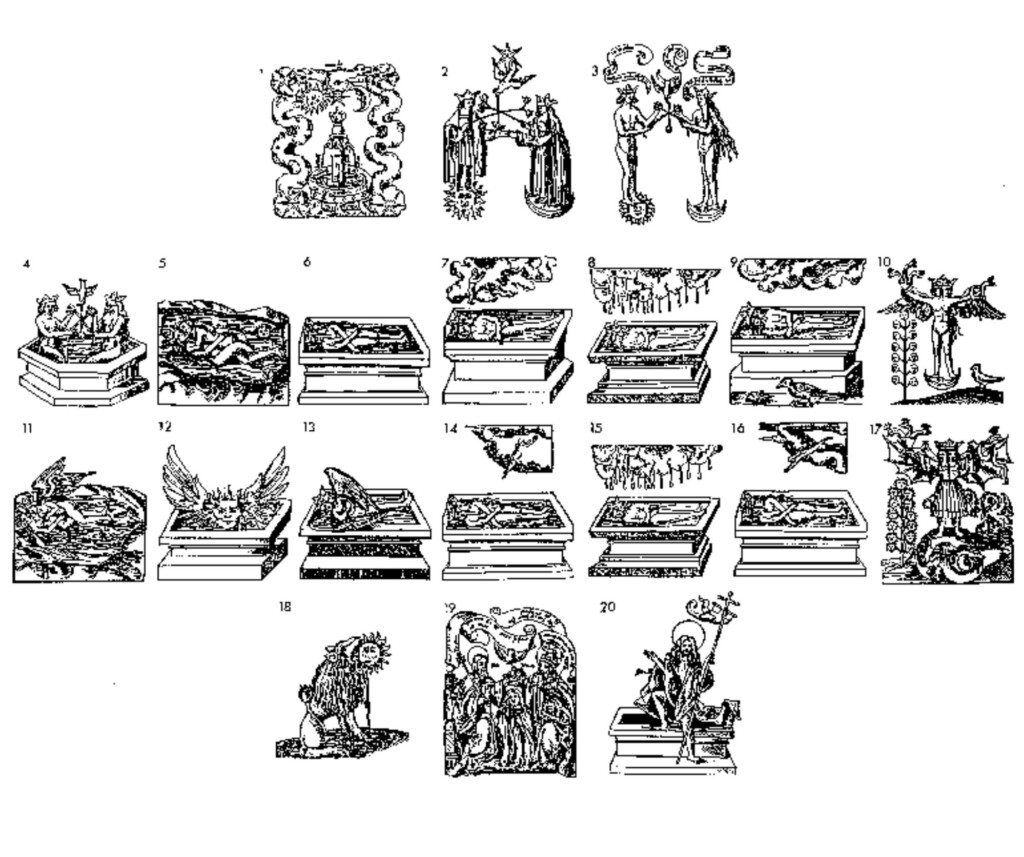
What those questions were is harder to state than it might seem. On the surface, the Rosarium is a technical manual for the production of the philosopher’s stone, the legendary substance capable of transmuting base metals into gold and, in many interpretations, conferring immortality or at least a radical extension of life. It draws on Arabic sources — the Turba Philosophorum, the works attributed to Jabir ibn Hayyan — and on a Latin tradition that includes pseudo-Arnaldus de Villanova and the Tractatus Aureus attributed in some versions to Hermes Trismegistus himself. But to read it as a chemistry text, even a failed or fantastical one, is to miss almost entirely what it does to the person reading it. The historian Barbara Obrist, in her careful work on medieval scientific illustration, has argued that alchemical imagery of this period operated not primarily as diagram but as mnemonic and initiatory device — the image was meant to restructure the reader’s understanding of their own interior before it communicated anything about exterior process. The woodcuts in the 1550 edition, twenty of them, are not illustrations of a procedure. They are stages of an experience.
That the book survived at all feels significant in a way that resists easy articulation. Texts were lost. Libraries burned, dissolved, were deliberately suppressed. The alchemical tradition navigated a sixteenth century that was simultaneously more curious about natural philosophy and more dangerous for those who pursued it outside sanctioned frameworks. Something about the Rosarium moved through that environment not by hiding but by being too strange to cleanly prosecute, too embedded in the language of natural philosophy to dismiss outright as sorcery, too soaked in Christian imagery to condemn as pagan, and too genuinely cryptic to prove as anything at all.
You hold it and feel the weight of that survival. Not as history. As something more immediate. As if the book remembers the hands that carried it through the centuries it was not supposed to reach you, and knows, somehow, that you are one more reader it was never intended for.
Twenty Woodcuts and the Grammar of Dissolution
There is a moment when you stand before an image and your chest tightens before your mind catches up. Not because the image is beautiful. Because it knows something. The twenty woodcuts printed in Frankfurt in 1550 operate precisely on this register — they do not wait for you to understand them. They act on you first, and the understanding, if it comes, arrives later, the way shock arrives before pain.
The sequence opens with something almost domestic. A king and a queen, formally dressed, approaching one another across an ornamental fountain. There is a courtesy to the scene, almost a stiffness, the kind of formal acknowledgment two people perform when they have agreed to meet but are not yet ready to admit why. Between them a bird descends carrying a branch. The fountain has five spouts. Everything is numbered, everything is placed with an architect’s precision, and yet the image unsettles rather than reassures, the way a dream unsettles even when nothing terrible is happening in it. They are about to descend together into the bath. They do not know yet what the bath will cost them.
What follows across the remaining nineteen images is not a story in the conventional sense. It is a grammar. Jung, working through these prints in his 1944 Psychology and Alchemy, understood this distinction with unusual clarity. He had spent decades watching people produce, in dreams and active imagination, the same symbolic constellations that medieval alchemists had encoded in their woodcuts, and the convergence did not suggest to him that the unconscious was well-read. It suggested that certain configurations of psychic life keep generating the same images because the images are load-bearing. They are not decorations on top of experience. They are the architecture of a particular kind of experience: the experience of being taken apart.
The dissolution begins after the bath. The two figures, king and queen, are no longer separate. They are no longer clothed. Then they are no longer upright. The woodcuts move through stages the alchemical tradition named with its own technical vocabulary — nigredo, albedo, citrinitas, rubedo — but the images cut beneath the terminology to something more visceral. A figure lies dead on a bed of earth. Above it, a soul represented as a small winged child rises into a black field. In another frame, dew descends from clouds onto the decomposing body. The sequence has the logic not of a manual but of a fever, the way consciousness behaves during genuine dissolution, when what you believed was solid about yourself becomes available for revision.
The peacock’s tail, when it appears, arrives as a violent chromatic eruption after all that monochrome dying. The alchemists called this stage the cauda pavonis and treated it as a signal that transformation was underway rather than complete — a dangerous, iridescent instability, beautiful precisely because it was transitional and therefore not yet safe. Jung noted that this phase in the analytic process corresponds to a moment of inflation, when the loosening of old structures produces not relief but a dazzling disorientation. The person believes they have arrived. They have only been released into the most unstable middle ground of the whole process.
The hermaphrodite that emerges later in the sequence, standing on a moon, winged, holding a chalice and a serpent, is not a resolution so much as a holding of irresolvable tension. The visual language here refuses to let you land. You keep searching the image for a stable orientation and the image keeps refusing to provide one. This is what certain images do when they are working correctly: they arrest the eye not by answering a question but by making the question undeniable.
The final image shows a crowned figure rising from a tomb. Resurrection is the familiar word for it. But there is something about the expression on the face — neither relief nor triumph, something more careful than either — that suggests what has returned is not what went under, and knows this, and is still deciding what to do with the knowledge.

Sex, Death, and the Alchemical Couple
There is a moment after a certain kind of intimacy when neither person knows quite where they end. Not the pleasant dissolution of early passion, but something harder and stranger — the silence that descends when two people have let something irreversible happen between them, when the usual borders of self have been breached and the air in the room feels altered, as though the furniture itself has witnessed a small catastrophe. Both of them are still there, technically, but the version of each that walked in no longer quite exists. They sit in that silence the way survivors sit after something structural has collapsed.
The woodcut sequence from the Rosarium Philosophorum depicts this with a directness that centuries of romantic idealization have never managed. The Rex and Regina — the solar king and lunar queen — meet clothed, exchange tokens, disrobe, descend into the same bath, and then die together in a merged hermaphroditic body before any resurrection is possible. This is not allegory decorating a chemical process. This is a theory of relationship, and a brutally accurate one. The sequence does not show union as arrival. It shows union as annihilation that precedes, perhaps, something unnameable.
Jung built his entire framework of the coniunctio around this imagery, particularly in his 1946 work on the transference, where he described the alchemical bath as the moment when two psychic systems contaminate each other so thoroughly that neither can claim clean sovereignty. The Royal Marriage, for Jung, was the integration of unconscious opposites within a single psyche, the anima meeting the animus in the interior theater of individuation. This reading has proven enormously generative and also, in a specific way, too convenient. It interiorizes what is fundamentally an interpersonal terror. It makes the terrifying thing private, manageable, a task of individual psychological hygiene. But the woodcuts show two separate bodies. Two distinct persons. And they die.
Mircea Eliade, writing in The Forge and the Crucible in 1956, observed something that cuts through the Jungian interiority: the alchemist’s body was never merely the observer of transformation. It was the primary instrument. The furnace worked through him, not independently of him. The heat that transmuted the metals passed through the practitioner’s own nervous tissue, his sleeplessness, his fasting, his sexual abstinence or its deliberate opposite. Eliade traced this logic across metallurgical cultures from sub-Saharan Africa to medieval Europe — the smith who must abstain from his wife before smelting iron, the adept who must align his own biological rhythms with the rhythms of maturation inside the vessel. The body is not metaphor. It is the medium.
What cultures have consistently encoded in rituals surrounding genuine union is not celebration but controlled terror. The wedding ceremony across virtually every documented tradition involves a symbolic death — the separate identities ritually ended, names sometimes changed, old social positions dissolved. Sociologists of religion from Arnold van Gennep onward have mapped this as liminality, the threshold state where what one was has ceased and what one will become does not yet exist. But the ritual scaffolding around that threshold also functions as containment, a cultural technology for managing the raw danger of two people genuinely merging. Strip the ceremony away and you approach what the woodcuts show: uncontained, unwitnessed, nakedness followed by the loss of the bounded self.
Two people in a room after something irreversible. The silence is not comfortable. It is diagnostic. Each of them is internally running a check, the way a system checks itself after a crash, testing to see which familiar structures are still standing. Some of them are not. This is precisely what the merged hermaphroditic figure at the center of the sequence represents — not a solution but a catastrophe that is also a question, a body that cannot be described by the old categories because it is no longer two things and not yet one. The self-help industry’s entire economic architecture depends on never showing the reader this image, on substituting communication techniques and attachment styles for the one unbearable fact the woodcuts state plainly: you cannot genuinely enter another person’s world without ceasing, at least temporarily, to fully occupy your own.
What the Philosophers Were Actually Hiding
There is a moment most people recognize, even if they have never named it: you are in a meeting, or at a family dinner, or in a conversation with someone who holds power over some portion of your life, and you know something true that cannot be said in the available language. Not because the language does not exist somewhere, but because using it here, now, in this room, would cost you more than you are prepared to pay. So you speak in the language that is permitted, and you carry the other thing home inside you, untranslated.
The alchemists of the sixteenth century were doing something structurally identical, but the stakes were measured in fire.
The Rosarium Philosophorum appeared in 1550, at the precise historical moment when the machinery of doctrinal enforcement was reaching its most methodical efficiency. The Inquisition was not a medieval relic by then — it was a functioning bureaucratic apparatus, and it was paying attention to anyone who suggested that matter itself might be sacred, that transformation might be a property of the physical world rather than an exclusive miracle of the divine institution. Fifty years after the Rosarium’s publication, Giordano Bruno would be burned alive in the Campo de’ Fiori for holding positions that overlapped significantly with what the alchemical tradition had been encoding in symbolic imagery for generations. Bruno was not burned for being obscure. He was burned for being clear.
Frances Yates spent much of her scholarly life mapping this terrain. Her work on Hermeticism and the Renaissance, particularly in Giordano Bruno and the Hermetic Tradition published in 1964, demonstrated with meticulous historical evidence that the recovery of Hermetic texts in the fifteenth century — Ficino’s translation of the Corpus Hermeticum in 1463 being the catalytic moment — had introduced into European intellectual life a set of ideas so dangerous that they required an entire protective architecture of indirection. The Hermetic worldview placed divinity inside matter, inside process, inside the human capacity for transformation. This was not a minor theological quibble. It was a direct challenge to the institutional monopoly on access to the sacred. Yates showed how the obscurity of Renaissance magical and alchemical writing was not a symptom of confused thinking. It was a technology of survival deployed by people who were thinking with exceptional clarity about their situation.
The image sequences of the Rosarium encode precisely this forbidden knowledge. When the text speaks of the union of Sol and Luna, of the white woman and the red man descending together into the bath, of death and putrefaction as necessary stages before any gold can emerge, it is speaking about a model of reality in which transformation is inherent to matter, in which the divine does not descend from outside to redeem a passive and corrupt physical world, but is already latent within the physical world, waiting to be activated by a particular quality of attention and labor. This is panpsychism, or something close to it, dressed in the only costume that might allow it to walk through the century without being arrested.
The encryption was not mysticism for its own sake. It was intellectual courage wearing a disguise. And the courage was not merely individual — it was a collective, intergenerational project. Each commentator who added to the alchemical corpus, each artist who drew the paired figures in the bath, was extending a chain of transmission for ideas that the dominant discourse had declared inadmissible. They were building, through accumulated symbolic labor, a vocabulary capable of holding what the official vocabulary refused to hold.
This is a human pattern that does not belong only to the sixteenth century. People who have spent time inside institutions that control speech — certain families, certain professions, certain political cultures — know exactly how this works. You develop a private language. You learn which words are safe and which words cost something. You carry the accurate description of reality in a coded form, sharing it only with those who have earned the key, and you wait, sometimes for longer than a lifetime, for the moment when the official language might finally be able to bear what you have always known.
The Putrefaction Stage, or What Growth Actually Looks Like

There is a specific quality to the light in a room where someone has stopped pretending. Not dramatically stopped — no confession, no breakdown, no cathartic scene. Just the quiet cessation of the maintenance work. The dishes stay where they are. The phone goes unanswered. The person sits in the particular stillness of someone who has run out of reasons to perform continuity with a version of themselves that no longer exists. They are not depressed in the clinical sense, though any intake form would probably categorize them that way. They are doing something more specific and more terrible: they are rotting.
The Rosarium places this stage at the literal center of its image sequence, and it does not flinch from what it looks like. The royal figures who merged in the vessel now lie as a single decomposing body, blackened, motionless, attended by a soul depicted rising like smoke from the corruption below. The Latin gloss around the image does not apologize for the spectacle. It calls this the nigredo, the blackening, and identifies it not as a failure of the process but as the process — the indispensable phase without which nothing that follows is chemically possible. The sulfur and mercury must lose their previous forms entirely before the new compound can coalesce. There is no shortcut past the rot. There is only the rot, and its duration, which the text refuses to specify.
James Hillman spent much of Re-Visioning Psychology, published in 1975, arguing against the therapeutic impulse to treat the soul’s darker movements as malfunctions requiring correction. His term for what he was defending was pathologizing — the psyche’s own tendency to move toward images of suffering, fragmentation, and dissolution — and he insisted that this movement was not a symptom to be removed but a form of soul-making in its own right. The gods who appear in human suffering, he wrote, are not obstacles to psychological health but its actual substance. To rush someone out of their darkness is not to heal them. It is to deprive them of the only education that particular darkness was ever going to provide. Hillman was drawing on Keats, on Jung, on the Neoplatonists, but he was also describing something anyone recognizes who has tried to be consoled at the wrong moment — the specific violence of a hand extended too quickly through the door of a room where you are not yet finished with what you are losing.
The person in the still room is not waiting to feel better. They are waiting for something they cannot name, and the waiting has a texture that is almost geological — slow, pressured, involving layers. The old structure — the marriage, the career, the self-understanding, the set of beliefs about what life was going to be — has dissolved not suddenly but gradually, the way a wooden structure rots: first the soft parts, then the load-bearing elements, until one morning the floor gives way and the collapse is merely the acknowledgment of something that was already long complete. What remains is not rubble, exactly. It is substrate. Material in a condition that has no name in ordinary language but that the alchemists named with precision: the prima materia after the first calcination, stripped of all its previous form, ready for nothing yet, incapable of being rushed.
What makes the Rosarium’s images almost unbearable to sit with at this stage is their refusal of drama. The decomposing figure is not anguished. It is simply inert. The blackening is not violent; it is patient, systemic, thorough. The soul rising above it is depicted without urgency, as though the separation itself is happening on a timescale that has nothing to do with human impatience. The image asks you to look at what you most want to look away from and recognize it not as catastrophe but as chemistry — as the one condition under which something genuinely other than what existed before might eventually, without guarantee, begin.
A vision curated by a filmmaker, not an algorithm
In this video I explain our vision
The Stone That Is Not a Stone
There is a moment, familiar to almost anyone who has spent years inside a difficult undertaking, when the object you were pursuing reveals itself to have been, all along, the act of pursuing it. A woman clears out her mother’s house after the funeral and finds, in a shoebox beneath winter coats, letters she wrote to her mother and never sent — drafts of conversations she had been rehearsing for decades, waiting for the right occasion that never arrived. She reads them and understands that the relationship she had been grieving as absent was in fact present in every withheld word, in every revision, in the very grammar of postponement she had mistaken for failure. The thing she wanted had been constituted by the wanting. It was never elsewhere.
This is the structure the Rosarium Philosophorum enacts in its final movement, and it is not a consolation. The lapis philosophorum, the philosopher’s stone that stands at the terminus of the entire sequence of operations, is described in the tradition with a deliberate, almost violent paradox: it is something common, something trampled underfoot, something cast aside by those who do not know how to see. The thirteenth-century compilation attributed to Arnold of Villanova already carries this insistence, and it runs like a seam through every subsequent alchemical text — that the prima materia, the starting substance from which the stone is eventually extracted, is not rare or precious or hidden in remote mountains. It is the most overlooked thing in the world. It is what everyone steps over on their way to look for it.
Walter Benjamin, writing in the Arcades Project across the 1930s until his death in 1940, developed what he called the dialectical image — a moment in which the past and the present crash together in a flash of recognition, where something that has been accumulating meaning in the dark suddenly becomes legible. The dialectical image is not a symbol. It does not stand for something else. It is the point at which what was always structurally present becomes visible as such, and Benjamin was explicit that this visibility is not comfortable. It does not offer resolution. It opens a wound in time. The alchemical stone works exactly this way: it does not appear after the work is finished; it is what the work was always disclosing, layer by layer, through every calcination and dissolution and recombination, and its appearance at the end is not an arrival but a recognition that recognition itself was the operation.
A man returns to a city he left twenty years ago and walks to the apartment building where he used to live. He stands in front of it for a long time. He had carried the memory of that place as a kind of debt, a proof of something he had abandoned, and now, standing there, he realizes the building is not what he came back to find. What he came back for was the act of standing here, this particular quality of attention that he has been practicing, without knowing it, in every city he moved through afterward. The gold was never in the ground. The gold was in the digging, and not metaphorically — literally, structurally, in the precise way that the digging had shaped the person who now stands holding a shovel he no longer needs.
The Rosarium sequence closes its twenty woodcuts on a figure of wholeness that the images do not make triumphant. The resurrected form at the end is not radiating victory. It is simply present, in the same visual register as the figures that opened the sequence, as though the elaborate machinery of transformation has returned everything to where it began, but with a difference that cannot be pointed to directly, only felt in the changed weight of looking. Whether this is completion or whether the sequence simply found a temporary resting place before the work recommences — whether any such work is ever truly meant to end — is the question the Rosarium places in your hands and quietly declines to answer for you.
⚗️ The Alchemical Labyrinth: Images, Symbols & Transformation
The Rosarium Philosophorum stands as one of the most visually and philosophically dense alchemical manuscripts of the Renaissance, weaving together sacred imagery, symbolic allegory, and the mystery of the Great Work. To fully grasp its layered meaning, one must venture into the broader landscape of alchemical thought — from the philosophical foundations of the Emerald Tablet to the psychological depths explored by Jung. These companion articles illuminate the hidden corridors that the Rosarium’s images only begin to open.
Magnus Opus: nigredo albedo rubedo
The Magnum Opus — the Great Work — is the backbone of every alchemical text, and the Rosarium Philosophorum maps its stages with haunting visual precision. Nigredo, albedo, and rubedo are not merely chemical phases but mythic thresholds of dissolution and rebirth. Understanding this triadic structure is essential to reading the Rosarium’s paired figures and coniunctio imagery.
GO TO THE SELECTION: Magnus Opus: nigredo albedo rubedo
Jungian Alchemy: Jung and Alchemical Psychology
Carl Gustav Jung devoted years to studying the Rosarium Philosophorum, recognizing in its images a profound mirror of the individuation process. His interpretation transformed alchemical symbolism into a living psychological language, revealing how the union of opposites depicted in the manuscript corresponds to inner psychic integration. Jungian alchemy remains one of the most illuminating lenses through which to approach this enigmatic text.
GO TO THE SELECTION: Jungian Alchemy: Jung and Alchemical Psychology
Tabula Smaragdina: Text Meaning and Interpretation
The Tabula Smaragdina, or Emerald Tablet, encodes the foundational axiom of all Hermetic alchemy: ‘As above, so below.’ Its terse, oracular language echoes throughout the Rosarium Philosophorum, grounding the manuscript’s elaborate imagery in a cosmological framework of correspondence and transformation. Reading the two texts together reveals how the Rosarium expands and dramatizes what the Emerald Tablet condenses into a single mythic formula.
GO TO THE SELECTION: Tabula Smaragdina: Text Meaning and Interpretation
Spiritual Alchemy: Inner Transformation and Symbolism
Spiritual alchemy reframes the laboratory operations of the Rosarium as allegories for inner transformation, turning lead into gold as a metaphor for the refinement of the soul. The manuscript’s series of conjunction images — death, putrefaction, resurrection — speak directly to this tradition of interior work. This article provides essential context for understanding why alchemical texts like the Rosarium were always as much devotional as they were philosophical.
GO TO THE SELECTION: Spiritual Alchemy: Inner Transformation and Symbolism
Discover the Cinema of the Inner World on Indiecinema
If these alchemical labyrinths of image and symbol resonate with you, Indiecinema streaming is your next threshold. Our curated collection of independent, esoteric, and visionary films mirrors the same quest for hidden meaning that drives every page of the Rosarium — step inside and let the Great Work continue on screen.
👉 EXPLORE THE CATALOG: Watch Indie Films in Streaming
A vision curated by a filmmaker, not an algorithm
In this video I explain our vision

