
The Erosion of Self in Real Time
You are sitting across from her at the kitchen table where you have sat a thousand times, and she is looking at you with an expression you have spent months learning to name — not confusion exactly, not fear, something older than both, something that lives underneath language. She asks you what your name is. Not because she has forgotten you entirely. Because the thread connecting the face in front of her to the word she once said ten thousand times has been quietly severed, somewhere in the tissue, somewhere in the dark interior work of a disease that does not announce itself but instead retreats, corridor by corridor, until the house is mostly empty.

This is not a metaphor. This is a Tuesday afternoon in 2023, and it is happening in approximately 55 million households across the world simultaneously, according to the World Health Organization’s most recent global dementia figures. The number is projected to reach 139 million by 2050, a trajectory so steep it functions less as a medical statistic than as a civilizational pressure building in slow motion behind the walls of private homes, care facilities, and hospital wards where nobody prominent is paying attention unless there is an election coming.
What medicine calls Alzheimer’s disease — first formally described by Alois Alzheimer in 1906 after the autopsy of a 55-year-old woman named Auguste Deter, whose brain showed the plaques and tangles now synonymous with the condition — is not simply a disease of memory in any ordinary sense. Memory, as the philosopher Henri Bergson argued in Matter and Memory in 1896, is not a storage system. It is the very medium through which the self remains continuous across time. To lose memory in the Bergsonian sense is not to lose files from a cabinet. It is to lose the connective tissue of personhood itself, the invisible infrastructure that allows you to be the same person who was loved, who loved in return, who carried the weight of experience forward into each new moment.
What dementia strips away, then, is not merely recollection. It dismantles the architecture of identity from the inside while the body remains entirely present, visible, still requiring feeding and warmth and touch. The cruelty specific to this condition — and it is a specific cruelty, not interchangeable with other forms of cognitive decline — is precisely this gap between the physical persistence of a person and the gradual disappearance of the person who inhabited that body. Families are asked to mourn someone who is still in the room. Grief without permission. Loss without the cultural infrastructure that normally organizes loss.
The neurologist Oliver Sacks, writing in The Man Who Mistook His Wife for a Hat in 1985, understood something that clinical literature often deflects from: that the self is not simply housed in the brain the way a document is stored on a hard drive. The self is a performance, continuous and collaborative, enacted through relationship, language, and narrative. When Alzheimer’s disease begins eroding the hippocampus — the brain region central to forming new memories, which shows measurable shrinkage years before any symptom surfaces — it is not merely damaging a biological organ. It is interrupting a performance that took an entire human life to rehearse.
The person sitting across from you at that kitchen table is not gone. But the version of her that recognized you as the specific weight she carried in her body for nine months, the version that called your name in a particular register no one else ever used — that version is navigating a dissolution that has no map, no ritual, no word in most languages adequate to what it actually is.
Days Blows by in a Moment
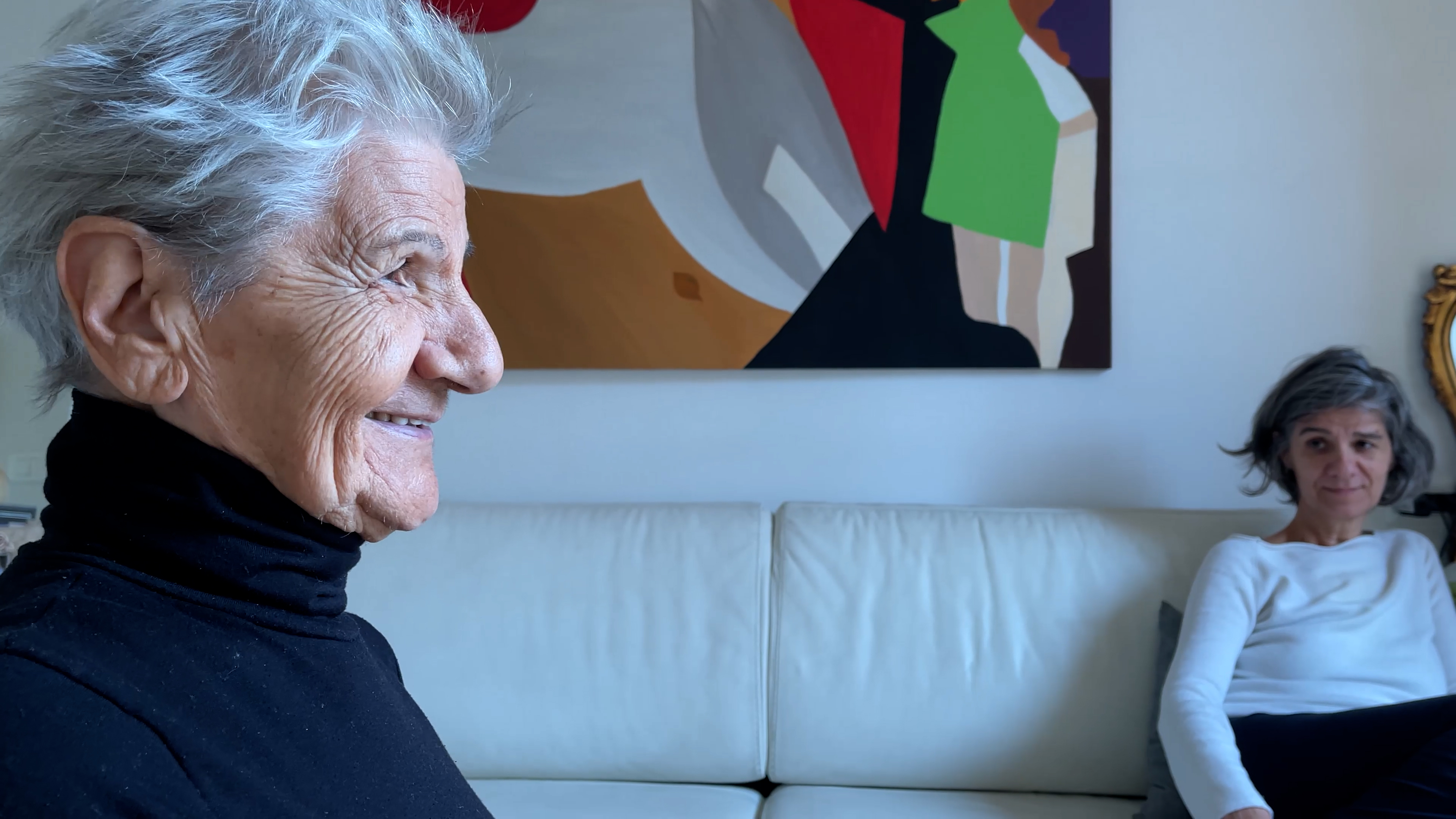
Documentary, by Cristiana Donghi, Italy, 2022.
Ancilla is 86 years old. Two years ago, she moved in with her daughter Emanuela at the pandemic's beginning. Ancilla is slowly losing her memory. He does not remember what she had for lunch, she only remembers events from the past, perhaps only because she has been repeating them for years. Emanuela takes care of her, day after day she wakes her up, prepares her food, washes her, dresses her, and accompanies her a couple of days a week to the hospice and does physiotherapy. This is one of the few contacts with the rest of the world she has left. Ancilla has another child, Mauro, who has been living in London since he left looking for a job. She hasn’t seen him for two years. Daily routines always repeat themselves and change only with the changing seasons. The mother's memories slowly introduce us to Ancilla, her past, the life she lived and that transported her here. Melancholy moments alternate with funny ones and those where patience reaches its limits. Ancilla's sympathy brings a light, fresh breeze into the lives of those around her and allows them to see everything in a way where even the most ominous clouds are blown away momentarily by a breath of wind.
LANGUAGE: Italian
SUBTITLES: English, Spanish, French, German, Portuguese
Memory as Social Contract, Not Private Archive
You are at a family dinner, and your grandmother calls you by your father’s name. The room goes quiet in that particular way — not the silence of grief, not yet, but the silence of a system registering an error. What no one says aloud, but everyone feels, is that something has broken that does not belong to her alone.
Maurice Halbwachs, writing in the 1920s well before neuroscience had the vocabulary to catch up with him, argued in “Les cadres sociaux de la mémoire” that individual memory is structurally impossible without a social framework to hold it. We do not remember alone. We remember through families, through communities, through shared rituals and repeated conversations that confirm the past into existence. The self, in this account, is not a sovereign archive but a node in a network — and when the network frays, so does the node. Dementia, read through this lens, is not merely a neurological event happening inside one skull. It is a rupture in the collective scaffolding that a person and everyone around them have spent decades constructing together.
The numbers make this rupture enormous in scale. The World Health Organization counted more than 55 million people living with dementia globally as of 2023, with nearly 10 million new cases appearing every year. These are not just individuals losing access to their own histories — they are 55 million relational webs being slowly dismantled, 55 million sets of family members being quietly written out of someone’s internal narrative without warning or ceremony. The caregiver who is no longer recognized by the person they have spent thirty years loving does not experience an administrative inconvenience. They experience something closer to a haunting: the body is present, the history is gone, and no existing social language fully addresses what category of loss this is.
What makes this particularly destabilizing is the cultural insistence on treating memory as private property. Western legal and psychological traditions have spent centuries constructing the individual as the ultimate owner of their own inner life — their recollections, their intentions, their sense of continuous selfhood. John Locke‘s theory of personal identity, elaborated in the 1689 “Essay Concerning Human Understanding,” explicitly tied the self to memory: you are the sum of what you can remember yourself having done. This was a philosophically convenient fiction for a society building itself around individual rights and personal accountability. It becomes considerably less convenient when the memory dissolves, because it implies that the person dissolves with it — which is exactly the dehumanizing conclusion that dementia care systems have often, quietly, acted upon.
Neurologically, the situation is more nuanced and in some ways more disturbing. Research on Alzheimer’s disease, which accounts for roughly 60 to 70 percent of dementia cases, shows that procedural memory — the kind embedded in muscle and habit — tends to survive far longer than declarative memory. A woman who no longer knows her daughter’s name may still fold laundry with the same precise movements she used fifty years ago, still reach for a coffee cup with the confidence of someone who has done it ten thousand times. The person is not gone; they are present in a different register, one that the people around them have largely lost the ability to read. The failure of recognition, in other words, belongs to both sides of the encounter.
This is the social trap that Halbwachs could not have anticipated but that his framework predicts almost perfectly: a society that stores identity in language and narrative will always struggle to find a person who has moved outside of both. The forgetting becomes a kind of exile — not chosen, not deserved, and administered not by the disease alone but by every institution and relationship that cannot hold a self that no longer speaks its expected lines.

The Medicalization of Disappearance
You are handed a diagnosis the way you are handed a death certificate — with clinical neutrality, a sheet of paper that converts a person you have loved into a category.
The moment Alois Alzheimer stood before the Society of Southwest German Psychiatrists in Tübingen on November 3, 1906, and described the case of Auguste Deter, he was not merely presenting a neuropathological curiosity. He was performing a cultural act. Auguste had been admitted to the Frankfurt asylum in 1901, a fifty-one-year-old woman who could no longer locate herself in time, who hid objects, who accused her husband of infidelities she could not articulate. Alzheimer’s slides showed amyloid plaques and neurofibrillary tangles in her cortical tissue, and that visibility — the fact that something could be seen under a lens — accomplished something far larger than science intended. It relocated the crisis from the relational world, where a woman was disappearing in front of people who loved her, into the biological interior, where the disappearance became a lesion. The person became a substrate.
What is rarely examined is how slowly this reframing actually conquered medicine, and what it displaced in the process. For most of the nineteenth century, cognitive decline in old age was understood as senility — a word that carried moral and social weight, not merely medical description. Families were expected to absorb it. Communities organized around it. The parish, the household, the extended kin network bore the interpretive burden: what did it mean that the old man no longer recognized his grandchildren? That question lived inside relationships, inside grief, inside theology. Emil Kraepelin’s inclusion of Alzheimer’s findings in the 1910 eighth edition of his Psychiatrie textbook — where he named the condition after his colleague, cementing it as a discrete disease entity — began transferring that burden systematically from the social body to the medical institution. The community was quietly relieved of a responsibility it had held for millennia.
The consequences of this transfer were not immediately visible, which is precisely how structural shifts in moral imagination tend to operate. By the time the National Institute on Aging in the United States formally designated Alzheimer’s disease as the primary cause of senile dementia in the late 1970s — a reclassification that unlocked federal research funding and pharmaceutical investment measured eventually in billions of dollars annually — an entire architecture of meaning had been quietly demolished. Suffering had been professionalized. The question of how to remain present to someone who can no longer recognize you had been reclassified as a clinical management problem. The neurologist replaced the neighbor.
Michel Foucault had already traced the machinery by which medicine absorbs what societies cannot hold, converting deviance and decay into objects of knowledge and governance, transforming the suffering body into a site of institutional competence. His work in The Birth of the Clinic published in 1963 described how the clinical gaze produces the diseases it claims only to observe — not through conspiracy, but through the structural authority granted to those who name. When dementia was named as a disease of the brain rather than a crisis of recognition between persons, it did not solve the problem of disappearance. It solved the problem of who was responsible for witnessing it.
There is something deeply telling in the fact that the most prominent global research frameworks — the amyloid hypothesis that dominated Alzheimer’s funding for four decades, attracting over forty billion dollars in pharmaceutical research before producing no successful treatments — remained so stubbornly focused on the lesion, on the biological signature, long after clinical results demanded a different question. The brain became the site of intervention precisely because the alternative — asking what kind of world we have built that cannot hold the slowly vanishing — was a question that implicated everyone.
What Remains When the Story Is Gone

You are standing in a corridor that smells of floor wax and reheated food, watching a woman who was once a secondary school headmistress attempt to eat soup with a fork. No one corrects her. The aide beside her speaks in that particular register — soft, slightly slowed, phonemes rounded at the edges — that adults reserve for infants and animals. The woman does not look up. She has not asked anyone’s name in four months.
Paul Ricoeur spent decades arguing that the self is not a substance but a performance — specifically, the performance of telling one’s own life as a coherent story. In “Oneself as Another,” published in 1990, he distinguished between “idem” identity, the brute fact of numerical sameness over time, and “ipse” identity, the promised continuity of selfhood through narrative. What I am is what I can account for. The self, on this view, is not a noun but a verb conjugated in the first person across time. When the conjugation breaks down — when the verb loses its tenses — Ricoeur’s framework encounters a silence it was never designed to address.
The discomfort this produces is not merely philosophical. Western legal and ethical traditions have quietly built an entire architecture of personhood on exactly this narrative foundation. Consent law, advance directives, the whole scaffolding of autonomy-based bioethics — all of it presupposes a self capable of projecting itself forward, signing documents that bind a future version of the same person. But the woman with the fork does not recognize herself in the documents she signed eleven years ago. She is not refusing her former wishes; she simply inhabits a present so total that the past no longer functions as evidence about who she is. The legal system calls this incapacity. What it actually names is a different relationship to time, one that the system cannot metabolize.
What is strange is that caregivers with long experience will tell you something that no clinical instrument is designed to measure: the woman reacts. Not to names, not to dates, not to the story of her career or her children — but to texture, to rhythm, to the tone beneath the words. Neuroscience has a partial account here. Studies published in the last decade, including work drawing on Antonio Damasio’s somatic marker hypothesis, suggest that affective memory — the body’s record of emotional valence — is encoded in structures that dementia often reaches last. The hippocampus degrades; the amygdala persists longer. The headmistress may not know your name, but she knows, in some pre-linguistic register, whether you are afraid of her.
This is where the narrative theory of identity becomes not merely incomplete but actively distorting. If personhood is tied to self-narration, then its absence becomes an invitation — almost a justification — to narrate the person from the outside, to fill the silence with your own story about who they now are. Families do this constantly, oscillating between “she’s gone” and “she’s still in there,” both statements being less about the patient than about the speaker’s need to locate grief at a fixed coordinate. The institution does it more systematically, replacing the individual’s collapsed story with a chart, a care plan, a diagnostic category that administers where a person used to be.
Erving Goffman, writing about total institutions in “Asylums” in 1961, identified the process by which the self is stripped of its props — clothes, schedules, personal objects, the right to refuse — and replaced by an institutional identity that is easier to manage. Dementia wards did not exist in their current form when Goffman was writing, but the logic he described preceded the diagnosis. The stripping was already underway before the disease arrived; the disease simply makes it legible.
The Cultural Panic Beneath the Clinical Language
You are sitting across from someone who was once your sharpest critic, your most exacting reader, the person whose judgment you feared more than anyone else’s, and now they are asking you for the third time in twenty minutes what day it is. The discomfort you feel is not grief, or not only grief. It is something closer to vertigo, because the self that once held you accountable has become unreliable, and you do not know what to do with a person who can no longer confirm your existence through their recognition of it.
Western modernity has never had a coherent answer for this. The Enlightenment built its entire architecture of moral life around the rational, self-governing subject — Kant’s autonomous agent who legislates for himself through reason — and dementia is the condition that most completely dissolves that architecture from within. A person who cannot form new memories, who cannot narrate a continuous self, who cannot consent or refuse in ways the legal system recognizes, falls outside the conceptual borders of what liberal philosophy considers a full moral participant. This is not a peripheral problem. It is a structural one, and the institutions built around dementia care expose it without meaning to.
The global pharmaceutical industry has spent hundreds of billions of dollars across four decades searching for a disease-modifying treatment for Alzheimer’s, with a failure rate in clinical trials exceeding ninety-nine percent by most assessments. That expenditure is not primarily driven by compassion. It is driven by the same logic that built the modern hospital: the body as a malfunctioning system that must be returned to productive operation. A drug that restored cognitive function would have an addressable market worth trillions. A drug that simply made the forgetting more peaceful, more dignified, more acceptable to the person experiencing it, would be nearly worthless to investors. The research agenda reveals, in its priorities, exactly which outcomes society considers worth funding.
The care home, as an institution, deserves the same cold scrutiny. Michel Foucault traced in his work on madness and confinement how societies manage the figures they cannot integrate — not by understanding them but by removing them from view, creating enclosed spaces where the problem becomes invisible to the rest of social life. The contemporary memory care facility operates on a parallel logic. It is designed, in its better versions, with genuine skill and even tenderness. But its existence as a mass institution is a symptom of a culture that has no daily language for cognitive dissolution, no ritual, no communal practice through which the demented elder remains woven into the fabric of living. The building at the edge of town is not a solution. It is an admission.
Dementia forces every question that productivity-centered societies refuse to ask: what is a person worth when they can no longer contribute, remember, or decide? What do we owe someone who will never recover and who may not, in any moment, know what they are owed? The anthropologist Margaret Mead observed that the first sign of civilization in any ancient site was a healed femur — evidence that someone had survived long enough after a serious injury to be carried, fed, and protected by others. The question dementia poses is whether the civilization that built the MRI machine and the amyloid-targeting antibody has actually advanced beyond that first measure, or whether it has simply become more sophisticated in deciding which forms of helplessness deserve to be carried.
Every society produces the deaths it believes in, and the care it offers its dying reveals, with a precision no policy document ever could, the precise boundaries of its moral imagination.
A vision curated by a filmmaker, not an algorithm
In this video I explain our vision
🧩 When Memory Fades: Identity, Loss, and the Mind
Senile dementia raises profound questions about who we are when memory dissolves. These related articles explore the psychology of loss, the fragility of identity, and the philosophical dimensions of a mind adrift in time.
Forgotten Memory: When the Past Resurfaces
Memory is not simply a record of the past — it is the architecture of the self. This article explores how repressed or lost memories resurface, reshaping identity in ways both liberating and terrifying. For anyone touched by dementia, understanding memory’s hidden dynamics offers a crucial lens.
GO TO THE SELECTION: Forgotten Memory: When the Past Resurfaces
Grief and the Processing of Loss
The loss of a loved one to dementia is a grief unlike any other — a mourning that begins before death, watching a person disappear piece by piece. This article examines how human beings process loss across its many forms, drawing on psychology, philosophy, and lived experience. It offers an essential companion for those navigating the slow farewell that cognitive decline demands.
GO TO THE SELECTION: Grief and the Processing of Loss
Bergson’s Matter and Memory: Time and Consciousness
Henri Bergson‘s philosophy of memory distinguishes between habit-memory and pure recollection, arguing that the past is never truly gone but lives within us in layered, invisible ways. This analysis of his landmark work illuminates why dementia is not merely a medical condition but an ontological wound. Bergson’s thought helps us understand what it means to lose access to the very substance of one’s own life.
GO TO THE SELECTION: Bergson’s Matter and Memory: Time and Consciousness
Dissociation in Psychology: When the Mind Divides
Dissociation — the mind’s tendency to fragment under unbearable pressure — shares unsettling terrain with the experience of advanced dementia, where selfhood splinters and continuity breaks down. This article traces the psychological history of dissociative states, from trauma theory to contemporary clinical practice. Understanding dissociation deepens our empathy for those whose inner world has become a maze without exits.
GO TO THE SELECTION: Dissociation in Psychology: When the Mind Divides
Discover Cinema That Dares to Remember
If these themes move you, Indiecinema is your destination for independent films that explore memory, identity, and the human condition with uncommon courage and depth. Stream bold, thought-provoking cinema that mainstream platforms overlook — because some stories can only be told outside the system.
👉 EXPLORE THE CATALOG: Watch Indie Films in Streaming
A vision curated by a filmmaker, not an algorithm
In this video I explain our vision

