
The Threshold Beyond the Village Gate
You step past the last fence post at the edge of the cleared field, the one that marks where your neighbor’s turnip rows give way to bramble, and the light changes before your eyes adjust to it. It is not darker, not yet, but it is different, filtered through a ceiling of leaves that has been growing toward that exact density for three hundred years. The village behind you still hums with its ordinary business, someone hammering a cart wheel, a dog barking at nothing, smoke rising in a straight line because there is no wind here to bend it. Ahead, the sounds do not carry the same way. They get swallowed. Your own footsteps on the packed dirt path sound suddenly conspicuous, as if the trees are listening to see whether you belong. You do not, not really, and some old part of your brain knows it before your conscious mind has finished forming the thought.

This is the sensation that folklore across continents has spent millennia trying to name, and it begins with a word. The English forest descends from the Latin foris, meaning outside, the same root that gives us foreign and forensic, that latter word originally referring to what happens in the forum, the public space, as opposed to what happens beyond it. A forest, in its oldest linguistic bones, was never simply a collection of trees. It was a legal and psychological category before it was a botanical one, a zone outside the jurisdiction of the hearth, outside the reach of the king’s law in medieval usage, outside the moral geometry that governs a plowed field or a marketplace. When William the Conqueror designated tracts of English land as royal forest in the eleventh century, he was not necessarily describing wooded terrain at all. Some of that land had no trees on it whatsoever. What made it forest was its exemption from ordinary law, its status as a separate order of space governed by different rules, forest law, with its own courts and its own punishments. The trees came later, semantically speaking, riding along on a word that had already been built to mean elsewhere.
That etymological fact is not a curiosity. It is a key to why nearly every folkloric tradition that has left a written or oral record treats the wood as a threshold rather than a place. The Brothers Grimm, compiling their tales in the German states between 1812 and 1857, sent children into forests again and again, not because German forests were more populated with wolves than German farmyards, but because the forest functioned as the narrative machinery for testing what happens to a person once the rules of the village no longer apply. Hansel and Gretel do not get lost in a field. Little Red Riding Hood does not meet her wolf on the road between two houses in town. The danger requires the boundary to have already been crossed. Anthropologist Arnold van Gennep, writing in 1909 about what he termed rites of passage, identified this same structure operating beneath the surface of initiation ceremonies worldwide, a spatial separation from the known community as the necessary first stage of any transformation, followed by a liminal period of ambiguity, followed by reincorporation into the group changed. The forest, in an enormous number of these traditions, is where that middle stage physically occurs. It is not incidental scenery. It is the machine itself.
What gets lost in the modern experience of the word forest, softened now into something scenic, a place for weekend hiking and marked trails, is the sheer psychological weight it carried for someone whose entire conception of safety ended at a visible tree line. The villager did not enter the wood as a tourist entering a national park with a map in hand and a parking lot behind them. They entered a space that their culture had spent generations encoding as the residence of what does not answer to human names, human laws, or human gods, and every story told around the fire afterward was, in some sense, an attempt to draw a chalk outline around that fear.
The Anthropology of the Sacred Grove
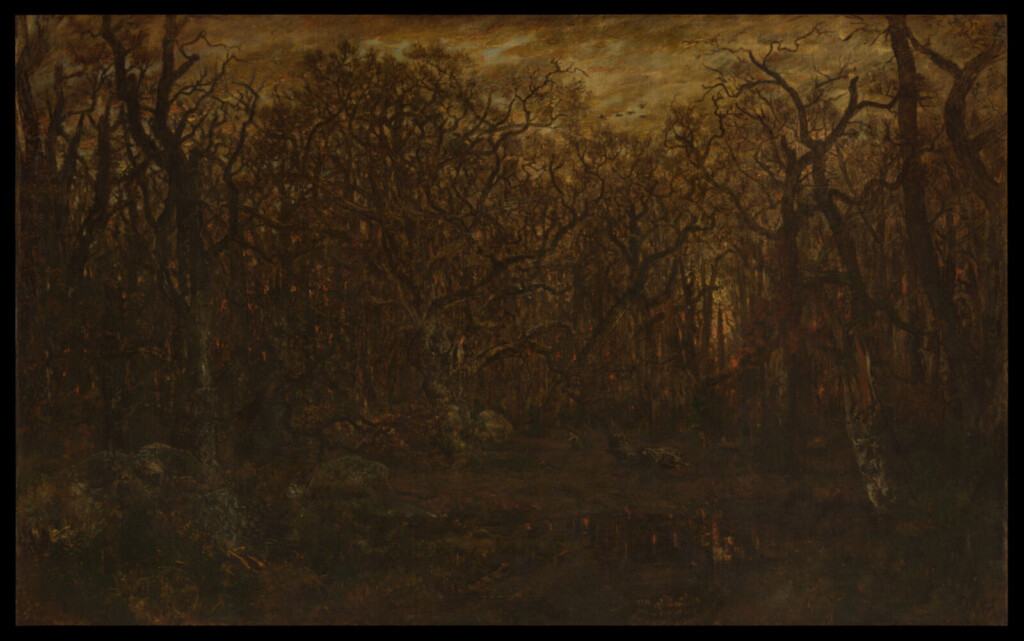
You walk into a clearing at Nemi, a shallow crater lake south of Rome, and even now, with tour buses grinding along the rim road and gelato wrappers caught in the reeds, something about the enclosed geometry of the place makes you lower your voice. That instinct, unearned by any personal belief, is the entire subject. James Frazer opened The Golden Bough in 1890 with exactly this spot: the sanctuary of Diana Nemorensis, where a priest called the King of the Wood patrolled a single sacred tree with a drawn sword, waiting to be killed by whoever could break off one of its boughs and take his place. Frazer spent twelve volumes and most of his working life trying to explain why a man would guard a tree to the death, and his answer, however later anthropologists picked it apart, established something that has never been successfully un-established: the grove was not decoration for the ritual. The grove was the ritual’s entire architecture, its physical law.
What Frazer’s critics got right, particularly the fieldworkers who came after him and actually sat in villages instead of reading missionary reports in Cambridge libraries, is that he was too quick to universalize, too eager to find one dying-god pattern under every regional variant. But the ethnographic record he was drawing on, however unevenly digested, keeps confirming the underlying premise even where his synthesis fails. Among the Kalasha of the Hindu Kush, groves remain off-limits to menstruating women and to anyone who has recently touched a corpse, not as a metaphor for purity but because impurity is understood to physically damage the deities residing there. The Igbo concept of the evil forest, the ajo ofia documented extensively in colonial and postcolonial ethnography of southeastern Nigeria, functioned as a real zone of exile where twins, suicides, and those who died of certain diseases were left, not symbolically abandoned but genuinely returned to a domain where different physical rules applied. These are not metaphors doing cultural work. They are load-bearing cosmological facts.
Mircea Eliade gave this phenomenon its sharpest name in The Sacred and the Profane, published in 1957: hierophany, the irruption of the sacred into ordinary space, an event that does not represent the divine but that is the divine showing itself through a particular stone, a particular tree, a particular clearing. Eliade’s point, easy to flatten into New Age paraphrase but genuinely radical in its original formulation, is that the sacred tree is never a symbol of some cosmic axis existing elsewhere. It is the axis. The Yggdrasil of Norse cosmology, threaded through the Poetic Edda and Snorri Sturluson’s thirteenth-century Prose Edda, is not a poetic figure for the structure of the universe. Within the cosmology that produced it, the universe is structured because that tree exists, holding the nine worlds in its actual branches and roots. Removing the tree does not leave you with an inaccurate metaphor. It leaves you with no cosmos.
This distinction matters because modern readers, trained by centuries of Protestant literalism followed by secular literary criticism, instinctively decode myth as coded meaning, as if every sacred tree were a rebus waiting to be translated into a moral lesson. The Dodona oracle in Epirus, where priestesses called peleiades interpreted the rustling of a sacred oak’s leaves as the direct speech of Zeus, described at length by Herodotus in his Histories, was not staging a poetic performance about divine communication. Pilgrims traveled for weeks believing the oak spoke, full stop, because the boundary between vegetal matter and divine voice had not yet been installed in their conceptual furniture. That boundary, the one insisting a tree is only ever a tree, is not an anthropological universal. It is a historically recent, culturally specific achievement, and its arrival changed what a forest could mean to the people standing inside one.

Spirits, Guardians, and the Logic of Trespass
You are gathering mushrooms in a forest outside Minsk when your grandmother’s voice returns to you, unbidden, telling you never to whistle among the trees, never to boast of what you have found, never to walk past the same pine three times without acknowledging it. You do not believe in the leshy. You have never believed in the leshy. And yet your hands stop whistling anyway, and the silence you impose on yourself feels less like superstition than like a debt being paid to something you cannot name.
That debt has a structure, and the structure is older than any single belief system, which is precisely why it survived the collapse of the beliefs that first articulated it. The leshy of Slavic folklore was never simply a monster to frighten children away from wandering; he was an accountant. He counted the trees you felled, the game you killed beyond your need, the paths you widened without asking. He could lead a greedy hunter in circles for days, disorient him until he emerged starving and humbled, sometimes not at all. The punishment was never random. It was proportional, almost bureaucratic, to the offense. Take only what you need, announce your intentions, leave something behind as tribute, and the forest lets you pass. Take more, take silently, take with contempt, and the forest closes around you like a hand.
The Greek dryad operates on a narrower but harsher logic, because her body and the tree’s body are the same body. To fell an oak inhabited by a hamadryad was not resource extraction; it was homicide, and the myths recorded as much. Apollonius Rhodius and later Ovid preserved stories in which the dying nymph curses the axeman, and the curse always lands, always generationally, as though the crime could not be absorbed by a single lifetime and had to be metabolized across a lineage. Erysichthon, in Ovid’s Metamorphoses, cuts down a sacred grove of Demeter and is sentenced to a hunger that can never be satisfied, devouring his own estate, his daughter’s freedom, finally his own flesh. The punishment is not injury for injury. It is a metaphor made literal: he who consumes nature without limit becomes a consuming machine that cannot stop, and the moral architecture of the myth turns ecological transgression into a kind of digestive apocalypse.
The Japanese kodama refuses even the drama of punishment, offering instead a quieter, more chilling premise: the tree simply is a spirit, and to cut it without ritual is to commit an act whose consequences are less about vengeance than about metaphysical injury to a fabric that includes you. Shinto animism, formalized loosely across the centuries but never systematized into a single doctrine, treats certain ancient trees, marked with the shimenawa rope, as shrines in themselves, kami requiring no separate temple. The felling of an unmarked tree might mean nothing. The felling of a marked one is a violation of a covenant so basic it barely needed to be stated, which is exactly why it needed the rope.
Claude Lévi-Strauss, writing in the 1960s, particularly in La Pensée Sauvage and the four volumes of Mythologiques, argued that myth’s core function is mediation between oppositions that cannot otherwise be resolved, nature against culture chief among them. The forest spirit is not decoration on top of an economic relationship; it is the very mechanism by which a society converts an amoral extraction of resources into a moral transaction with rules, penalties, and permissible exceptions. Lévi-Strauss noticed that mythic structures recur across unrelated cultures not because of shared origin but because the oppositions they mediate, raw and cooked, wild and tame, taken and given, are structurally universal to any group that must eat the world it lives in. The leshy, the dryad, the kodama are not separate inventions. They are the same cognitive machinery, wearing different regional clothing, solving the identical problem of how a species that must destroy in order to survive can still consider itself something other than a plague.
The Forest as Psychological Territory

You are seven years old and it is dark and the trees have stopped being trees. They are shapes now, and the shapes are breathing, and somewhere behind you the path you were following has folded itself away like something ashamed of you. This is not a memory you have, or not exactly, because you were probably never actually lost in an actual forest, and yet the panic is fluent in your body anyway, filed somewhere below language, ready to surface the moment an unfamiliar hallway loses its lights. Fairy tales installed that panic in you before you had any forests of your own to be lost in.
Carl Jung spent decades insisting that certain images arrive in the human mind already loaded, inherited rather than learned, and the forest was one of the images he returned to obsessively across his writings, particularly in the material collected in Symbols of Transformation and in his seminars on dream analysis conducted through the 1930s. For Jung the forest was not scenery. It was a rendering of the unconscious itself, that portion of the psyche unlit by the ego’s narrow flashlight, dense with contents the conscious mind has not yet metabolized, has perhaps actively refused to metabolize. To enter the forest, in dream or in story, was to cross a threshold the daylight self does not usually cross, and to get lost there was simply an accurate description of what happens to consciousness when it loses its bearings inside its own depths. The trees were never really trees. They were everything the mind carries and does not look at.
Bruno Bettelheim, writing in 1976 in The Uses of Enchantment, took this same intuition and grounded it in the specific mechanics of childhood. Bettelheim, a psychologist who had survived Dachau and Buchenwald before building a career treating severely disturbed children at the University of Chicago’s Orthogenic School, argued that fairy tales succeed precisely because they refuse to sanitize the terror of growing up. The forest, in his reading, is where the child protagonist is compelled to separate from parental protection and confront, alone, the chaotic material of its own emerging selfhood. Hansel and Gretel do not simply wander into danger. They wander into an externalized version of abandonment anxiety, oral greed, sibling rivalry, all the ugly undigested feelings a child cannot yet name and therefore cannot yet integrate. The witch’s house made of candy is what desire looks like when it has not yet been disciplined by a self capable of restraint. Bettelheim’s clinical claim, controversial then and still argued over now, was that children need this externalization, that a story willing to depict abandonment and hunger and predation does more genuine psychological work than one that keeps the forest tidy and well lit.
What both men are describing, from different disciplinary directions, is displacement as a form of mercy. It is unbearable to sit with a child and say plainly that part of you wants to devour and part of you is afraid of being devoured. It is bearable to say there is a house made of gingerbread, and a woman inside it, and she wants to eat you. The forest performs the psychic labor of taking an internal, formless dread and giving it geography, giving it a path that can be lost and a clearing that can be found. Losing the path stops being an abstract failure of self-knowledge and becomes an event with weather in it, with sound in it, something a child can survive inside a story before ever having to survive it inside themselves.
This is why the forests of folklore are so rarely neutral background, why the Brothers Grimm collection assembled between 1812 and 1857 keeps returning its characters to the same tangled setting rather than inventing new locations for new dangers. The setting is not incidental to the danger. The setting is the danger, translated into bark and shadow, because the human mind has always found it easier to survive a monster it can locate on a map than a monster it can only locate in itself.
Deforestation and the Death of Enchantment
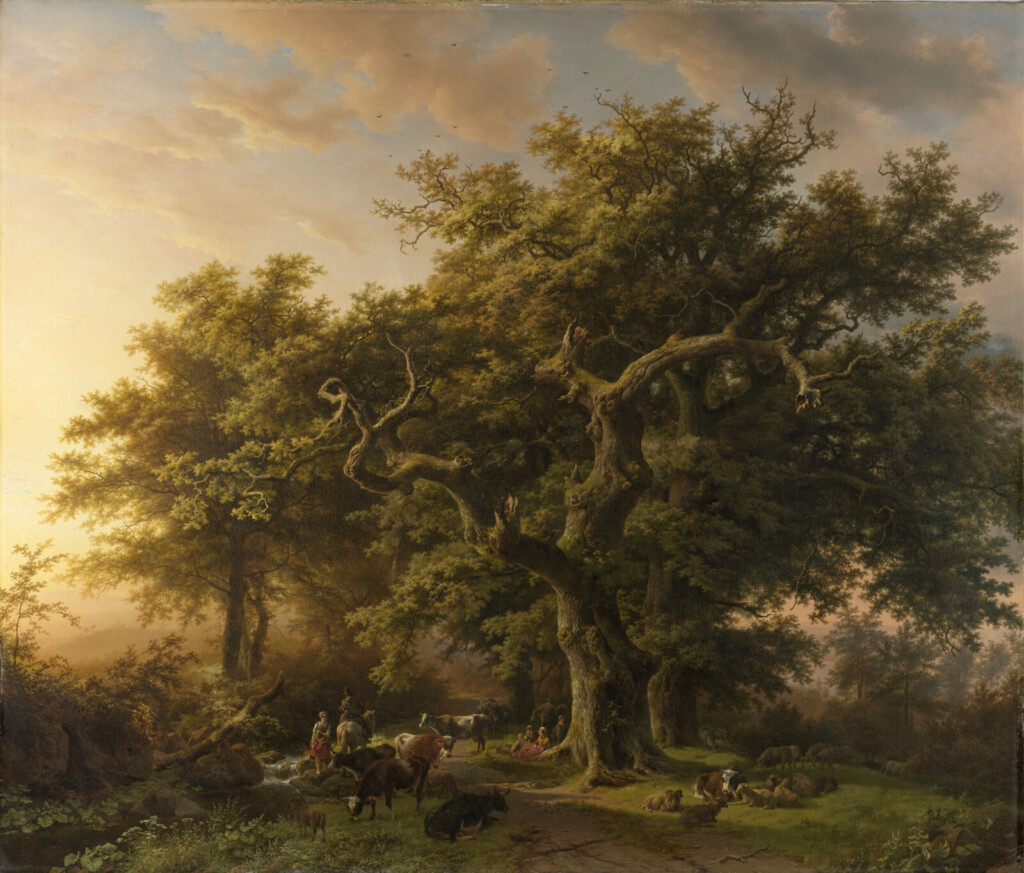
You stand at the edge of a clear-cut in what used to be called, on old parish maps, the Hollow Wood, and there is nothing uncanny about it anymore. No sensation of being watched, no reluctance to step past the tree line, only stumps arranged like a cemetery for something that was never given a name in the first place. This is what an ending looks like when it has already happened so long ago that no one alive remembers the beginning.
Max Weber, in a lecture delivered in Munich in 1917 and later published as Science as a Vocation, gave this ending a term that has outlived every one of his other formulations: Entzauberung, disenchantment, the historical process by which the world stops being a garden of magical forces one must negotiate with and becomes instead a set of causes and effects one can calculate. Weber was not writing about trees. He was writing about the rationalization of Western life as such, the replacement of ritual by technique, but he chose the vocabulary of magic deliberately, because what rationalization kills first and most completely is precisely the population of intermediate beings, the spirits, the nymphs, the guardians, who used to live in the gaps between human intention and natural event. A forest full of Weber’s Zauber, his enchantment, is a forest you cannot simply enter with an axe and a plan. A forest after Entzauberung is a standing crop.
The chronology is not metaphorical. Between roughly 800 and 1300, Europe cleared woodland at a pace that has no precedent before the twentieth century, driven by population growth, monastic land management, and the expansion of arable farming under feudal lords who needed rents in grain rather than reverence. The historian Oliver Rackham calculated that England went from perhaps 15 percent woodland cover at the time of the Domesday survey in 1086 to something closer to 10 percent by 1350, and France lost comparable ground under the assarting campaigns of Cistercian and Benedictine houses, the same monasteries that, centuries earlier, had positioned themselves deliberately atop or beside groves the local population still regarded as holy, absorbing the site’s authority even as they began dismantling its cover. The sacred grove did not survive its consecration as a Christian shrine. It survived a little while, then it was timber.
What is lost in this transaction is not simply acreage. It is a mode of address. A landscape inhabited by a genius loci, in the Roman sense the classicist Georg Luck and later scholars of ancient religion have described, a spirit proper to a specific place and no other, demands negotiation, propitiation, a relationship structured by reciprocity and risk. A landscape reclassified as timber resource, arable margin, or later, board feet and cubic meters of pulpwood, demands only extraction, and extraction has no grammar of respect built into it because none is required for the transaction to succeed. The shift from grove to resource is a shift in the kind of sentence you can make about a tree. You go from it will not forgive us to it will regenerate in forty years under proper silvicultural management.
By the time industrial forestry codifies itself in the German states in the late eighteenth century, with the systematic, quota-driven Normalbaum plantations that the political scientist James Scott anatomizes in Seeing Like a State, the disenchantment is not an event anyone experiences. It is simply the baseline. Scott’s account of how German foresters in the 1765 to 1800 period redesigned entire forests as monocultures of Norway spruce planted in rows, legible from a bureaucrat’s desk, optimized for a single calculable yield, describes an ecology stripped not only of its spirits but of its own biological complexity, since the underbrush, the deadwood, the mixed-age canopy that had once sheltered the imagined and the literal alike were now simply inefficiencies to be planted out of existence. The forest that returns, decades later, sick with the fungal and insect blights that monoculture invites, is not haunted. It is malfunctioning. And the peculiar grief that visits some people walking through a healthy, ancient, mixed wood today, a grief with no object, no ritual to discharge it, no name in any therapeutic vocabulary, may simply be what disenchantment feels like from the inside, generations after the spirits stopped being asked for permission and started, instead, being logged.
A vision curated by a filmmaker, not an algorithm
In this video I explain our vision
🌲 Into the Enchanted Woods
The forest has always been a threshold between worlds, home to spirits, guardians and hidden dangers that folklore transforms into unforgettable tales. These related articles explore the mythic and psychological dimensions of sacred woodlands across cultures.
Japanese Folklore: History and Traditions
Japanese folklore is steeped in forest lore, where ancient trees shelter yokai, kami and vengeful spirits waiting in the shadows. This article traces the traditions that shaped centuries of storytelling about nature’s uncanny inhabitants, offering a perfect companion to any exploration of sacred woods in world mythology.
GO TO THE SELECTION: Japanese Folklore: History and Traditions
Yuki-onna: The Female Ghost in Japanese Folklore
Yuki-onna, the ghostly woman of snow and forest, embodies the seductive and deadly power nature holds in Japanese folklore. Her legend reveals how forests become liminal spaces where beauty and death intertwine, a theme central to mythological woodland spirits everywhere.
GO TO THE SELECTION: Yuki-onna: The Female Ghost in Japanese Folklore
Genius Loci: When Places Have a Soul
The concept of genius loci, the spirit of a place, is essential to understanding why forests have always felt inhabited by something beyond the visible. This piece examines how landscapes carry memory and presence, illuminating the deep roots of sacred forest belief.
GO TO THE SELECTION: Genius Loci: When Places Have a Soul
Algernon Blackwood: The Supernatural in Hostile Nature
Algernon Blackwood‘s fiction turned hostile, sentient nature into a literary archetype, with forests functioning as living, malevolent forces. His work bridges folklore and modern horror, showing how the mythic sacred grove evolved into the uncanny wilderness of Gothic literature.
GO TO THE SELECTION: Algernon Blackwood: The Supernatural in Hostile Nature
🎬 Explore More on Indiecinema
If these ancient tales of forest spirits and folklore have sparked your curiosity, Indiecinema offers a curated selection of independent films that delve into myth, mystery and the supernatural. Dive into our streaming library and discover stories where nature still whispers its secrets.
👉 EXPLORE THE CATALOG: Watch Indie Films in Streaming
A vision curated by a filmmaker, not an algorithm
In this video I explain our vision

