
The Silence Before the Word
You know the moment. The page is white and the pen is in your hand and there is no shortage of things you want to say — in fact there are too many, pressing against each other like bodies in a corridor, and somehow that pressure, instead of forcing words out, seals everything shut. You sit there. The silence is not empty. It hums. It vibrates with all the language that refuses to become the right language, and you begin to understand, without being able to articulate it, that the problem is not what you want to say but the instrument itself. Words are already contaminated. Every word you reach for has been touched by a thousand other hands before yours, worn smooth by common use, loaded with meanings you did not choose. To write “night” is to inherit every night that has ever been written. To write “flower” is to enter a room you did not build and cannot rearrange. Most people solve this problem by ignoring it. They pick up the compromised instrument and use it anyway, and the world generally accepts the result and calls it communication, or literature, or thought. Stéphane Mallarmé looked at that same problem and decided not to solve it. He decided to live inside it.

This is not a metaphor for his biography. It is his biography. Born in Paris in 1842 into a family of civil servants, orphaned of his mother before he turned six, Mallarmé grew up with the particular gravity of someone who has learned early that the things you love disappear without warning and without explanation. He became an English teacher by necessity, spending decades in provincial towns — Tournon, Besançon, Avignon — teaching a foreign language to indifferent students while attempting, in the hours the state did not own, to do something that increasingly seemed to him either the most essential or the most impossible thing a human being could attempt: to write a poem that was actually true to the nature of language rather than merely obedient to it.
By his late twenties he had already touched something that most writers spend entire careers avoiding. He called it, in letters to his friend Henri Cazalis in 1866 and 1867, “the Void” — le Néant — and he described it not as a spiritual crisis in the conventional sense but as an intellectual discovery that had nearly destroyed him. He had looked directly at language, at what language actually is and what it actually does, and he had seen that it refers to nothing stable, that every word points away from the thing it names, that meaning is not contained in signs but generated between them, in the gaps, in the silences, in the relationships of absence and presence that no single word can control. Ferdinand de Saussure would not formalize this insight until his Cours de linguistique générale, published posthumously in 1916, but Mallarmé had already lived it from the inside, not as a theory but as a wound.
What he built from that wound is what we are here to examine. Not the comfortable narrative of the symbolist poet who wrote difficult verse and hosted famous literary salons in his apartment on the rue de Rome — though all of that is true — but something stranger and more urgent. He built an entire poetics out of the conviction that the crisis of writing, the paralysis before the blank page, the unbearable weight of inherited language, was not a problem to be overcome on the way to the poem. It was the poem. The silence was not what preceded the word. The silence was where the word had to learn to live.
The Lost Poet
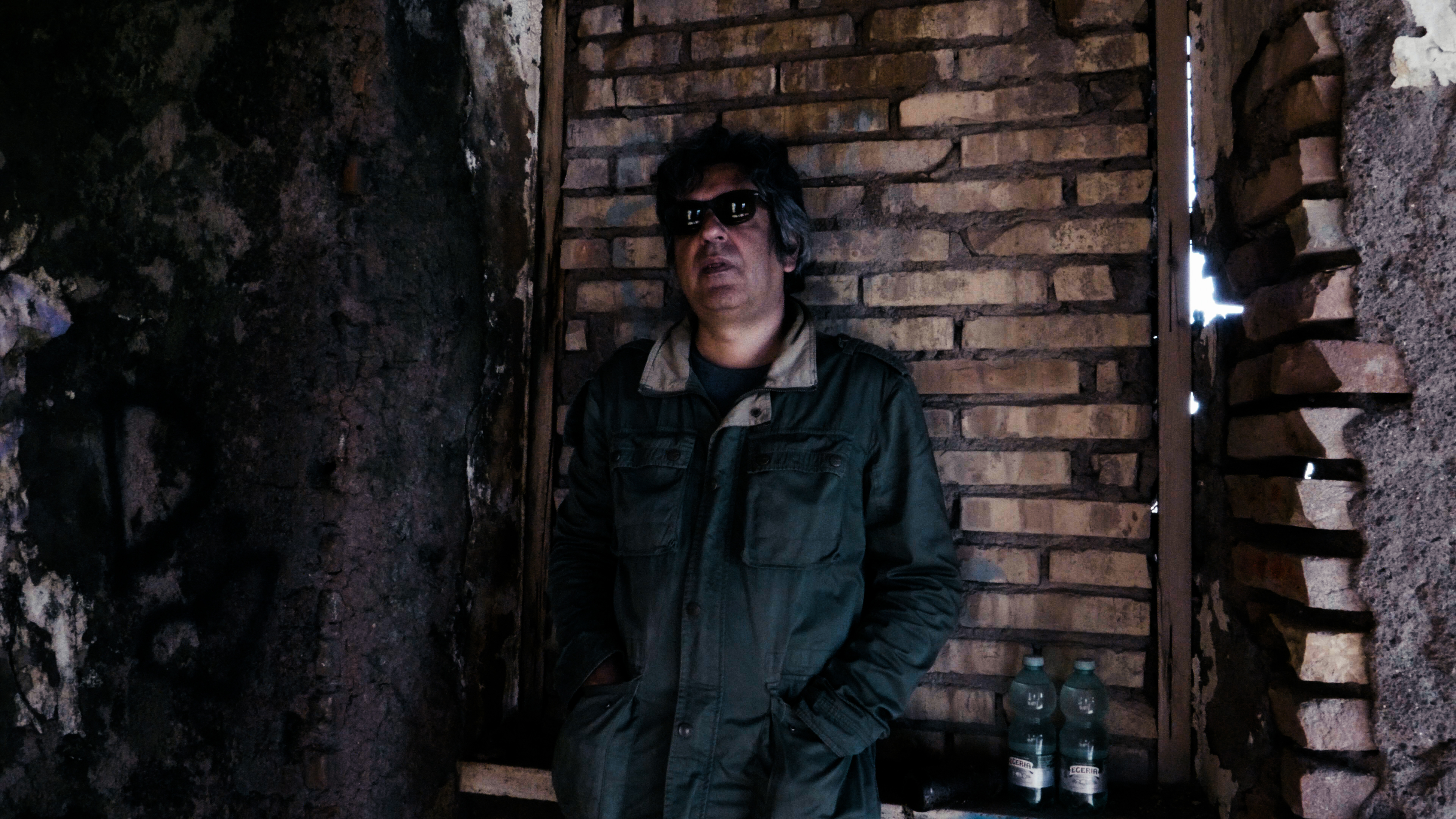
Drama, by Fabio Del Greco, Italy, 2024.
Dante Mezzadri wants to see an old friend, nicknamed the Iguana, whom he has lost sight of for many years, and who has managed to turn their shared youthful passion for poetry into a job, becoming a famous writer and poet. The man escapes from his bourgeois life and his wife to live homeless on the Roman coast, printing and trying to sell his poetry collections. At night he sleeps in a park of old carnival floats, inside a papier-mâché tank, and waits for the opportunity to meet his old friend, who however never shows up for appointments in the places they frequented when they were young, now in ruins. Dante's poetry books do not interest anyone and to support himself he is forced to "change product": he starts selling the infamous "cannibal pill" on behalf of young drug dealers, a new drug that sells like hot cakes and causes sensory and consumerist ecstasy. However, he realizes that this powerful drug is very dangerous for those who take it, he comes into conflict with his ethical conscience and throws all the pills into the sea. However, the dealers want to collect their money.
Shot over a period of 2 years, the film is a reflection on the cultural and artistic rubble of the society in which the protagonist lives, in an increasingly mechanized, consumerist and arid world. Dante Mezzadri is yet another human being who has renounced his inspiration and his creativity, but unlike many he is not willing to give his life to a system that distances him from his true identity. The physical world around him, however, seems constructed in such a way that it seems impossible to escape from this "invisible cage". The enthusiasm of the people he meets is ignited only by sensory gratification, by unreal visions of personal affirmation and success, by "metaverses" that offer an escape into an illusory and destructive reality. The poet's house on the coast, where he met with his friends as a young man, is just a pile of abandoned rubble. What happened to all those who wanted to become poets and ended up becoming something else? Are there internal forces with which that house can be "rebuilt"?
LANGUAGE: Italian
SUBTITLES: English, Spanish, French, German, Portuguese
A Schoolteacher Who Dreamed of the Absolute
He was born in Paris in 1842, and Paris would spend the rest of his life refusing to fully receive him. His mother died when he was five. His grandmother died when he was seven. Loss arrived early and with a kind of clinical regularity that might have made another man practical, resigned, anchored to survival. Instead, something in Mallarmé moved in precisely the opposite direction — toward the immaterial, toward a realm where nothing could be taken away because nothing had ever been fully present.
The young man who would become the most radical theorist of poetic language in the nineteenth century trained himself as an English teacher. Not out of passion. Out of necessity. He crossed the Channel in 1862 partly to improve his English, partly to escape a France that had nothing particular to offer a dreamer with no inheritance and no connections. He married Maria Gerhard in London. He returned to teach. And then began the long provincial exile that would define, in its grinding ordinariness, the entire outer perimeter of his life.
Tournon first, from 1863. Then Besançon. Then Avignon, where he would spend a decade correcting the spelling mistakes and grammatical confusions of adolescents who could not have conceived that the man holding their exercises had been awake until three in the morning trying to dissolve language into silence. The classes were too large. The pay was insufficient. The administration was indifferent. He applied repeatedly for transfers to Paris, to positions that might give him proximity to the literary world he was slowly, almost secretly, reshaping from a distance. The applications were mostly denied, delayed, or lost in bureaucratic indifference. He was, by every institutional measure, a mediocre employee in a system that had no mechanism for recognizing what it was dealing with.
This is where the paradox lodges itself like a splinter you cannot see but constantly feel. The man who wrote, in his theoretical prose of the 1890s, that the poet must efface himself entirely so that language can speak through him — that the personal “I” is a distraction, an impurity, an obstacle to the poem’s absolute existence — this same man spent thirty years filling out attendance registers, arguing with school inspectors about classroom hours, writing letters begging for better placement. The self he wanted to dissolve in theory was the same self that had to show up every morning and perform the most mundane administration of social existence.
Michel Foucault, writing in 1969 in “What Is an Author?”, observed that the author function in Western culture serves partly to personalize, to locate responsibility, to domesticate the radical impersonality of writing by anchoring it to a human face and a verifiable biography. Mallarmé understood this intuitively before Foucault formalized it, and his response was not merely aesthetic but almost ethical: strip the poem of the poet, make the page itself speak, let language enact its own necessity without the ego’s intervention. Yet the institution that employed him did the exact opposite — it reduced him to a function, a number, a line in a budget, a body that occupied a classroom for a set number of hours per week. In this sense, the school system and Mallarmé’s poetic project were mirror images of each other’s violence. Both erased the individual. But where the school erased him into bureaucratic anonymity, the poem was meant to erase him into something transcendent.
The years in Avignon were particularly heavy. By 1871, when he finally obtained a position in Paris, he had been writing in near-isolation for almost a decade, circulating manuscripts among a tiny circle, watched by almost nobody. The absolute he was pursuing had cost him something measurable and real — time, proximity, recognition, the ordinary warmth of being understood by the people around him while the work was still forming.

The Crisis of 1866 and the Void at the Center
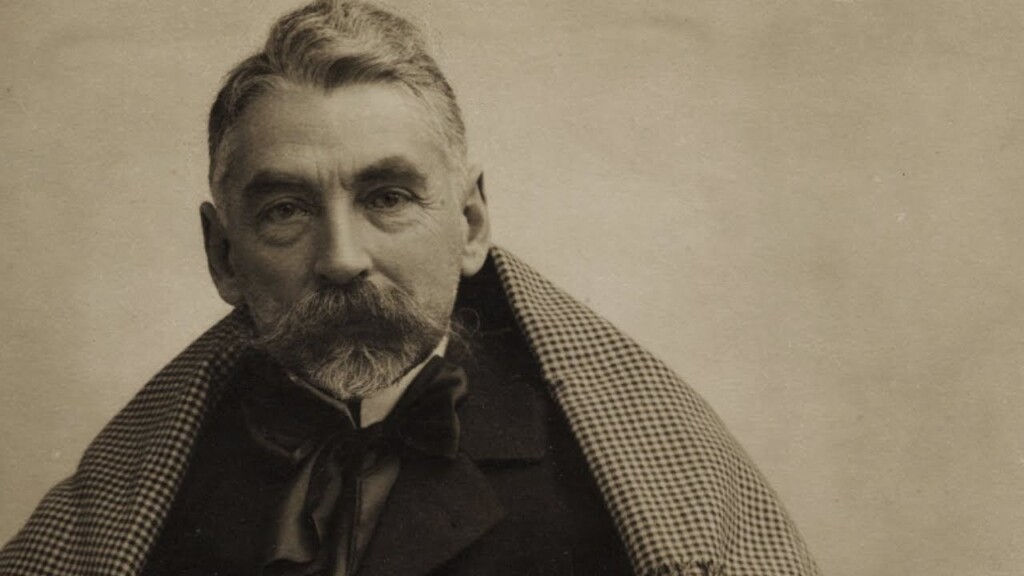
There is a particular kind of exhaustion that has nothing to do with sleep deprivation. You know it when it arrives — not as fatigue but as clarity, a sudden inability to pretend that the words you use correspond to anything solid. Mallarmé hit this wall in 1866 with the force of a man who had been running toward it his entire life without knowing it.
He was twenty-four years old, living in Besançon, teaching English in a school that bored him to a kind of spiritual asphyxia, and something in him simply gave way. Not dramatically. Not with the theatrical collapse of a Romantic hero. It happened in the way the ground disappears under ice that has been thinning for months — you take one step and suddenly there is nothing beneath you. He wrote to his friend Henri Cazalis that he had encountered the Void. Not as a metaphor. Not as a philosophical concept borrowed from a book. As something he had looked at directly and that had looked back.
Think of a man sitting alone in a room, staring at a manuscript that will never be finished, and understanding for the first time with the full weight of his body that there is no God waiting at the end of the sentence. No transcendence that language reaches toward and finally grasps. Only the reaching, perpetually, and the absence where the destination should be. He described losing his faith not in religion — he had discarded that earlier — but in something more fundamental: the idea that consciousness itself might be anchored to something real. What remained was pure negation, and he reported to Cazalis that he had spent days unable to move, the ceiling above him somehow the most honest thing in the room.
Heidegger, writing decades later in “Being and Time” and in his lectures on Hölderlin, described this confrontation as the moment authentic existence becomes possible — the encounter with the abyss not as destruction but as disclosure. What the abyss reveals is that everything we have built our certainties upon was always already suspended over nothing. This is not pessimism. It is, for Heidegger, the only honest starting point. Mallarmé reached it intuitively, in a rented room in provincial France, without the vocabulary to name what he had found, which may be why the finding nearly killed him.
Cioran, whose entire philosophical project could be described as the slow documentation of this same recognition, wrote in “The Trouble with Being Born” that lucidity is a form of violence the mind commits against itself. The person who sees clearly enough sees through everything, including the constructs that make continued living feel purposeful. What Mallarmé experienced in 1866 was precisely this — not madness, but vision so unfiltered it became indistinguishable from madness to everyone around him. His letters to Eugène Lefébure from this period read like dispatches from a border crossing between two entirely different relationships to reality.
And yet he came back from it changed in the only way that mattered. He came back understanding that language is not a vehicle for meaning — it is the performance of its own impossibility. The poem does not deliver truth. The poem enacts the motion toward truth so precisely that the absence of arrival becomes visible, becomes, in fact, the point. This is what “Igitur,” his strange, unfinished prose poem begun around this time, is doing on every page — a character who descends through the corridors of his own mind toward a midnight that never resolves, carrying a candle whose light only deepens the surrounding dark.
The crisis did not end. It transformed into a method. The void Mallarmé found at the center did not get filled. He learned instead to build architecture around it, to write poems whose beauty derives entirely from what they refuse to say.
The Poem as Disappearing Act
There is a particular kind of conversation you have probably had, where the most important thing never gets said. Not because of cowardice or evasion, but because the moment it is named, it disappears. You and the other person circle it, approach it from oblique angles, let it live in the silences between sentences, and you both understand perfectly. The instant either of you speaks it plainly, it collapses into something smaller than it was.
Mallarmé built an entire poetics out of this phenomenon. Not as a rhetorical strategy, not as ornament, but as a metaphysical conviction: the thing itself, the pure idea, exists only in the space vacated by its name. To say “a flower” is to kill the flower and replace it with a sign. What he wanted — what he spent decades attempting — was the flower before the word arrived, the presence that trembles in the absence of its designation. In 1891, speaking to Jules Huret, he articulated it with the precision of a surgeon: “To name an object is to suppress three-quarters of the pleasure of the poem, which consists in the happiness of guessing little by little; to suggest it, that is the dream.”
L’Après-midi d’un faune, published in 1876 after years of revision that would themselves constitute a minor literary history, enacts this principle at the level of syntax itself. The faun’s memory of the nymphs is structurally undecidable — dream, desire, hallucination, event — and Mallarmé refuses to resolve the ambiguity not because he cannot, but because resolution would be a form of poverty. The poem’s famous opening, “Ces nymphes, je les veux perpétuer,” announces a desire for perpetuation that the poem then systematically frustrates, circling back, dissolving certainties, leaving the reader in a state of suspended apprehension that is more alive than any definitive statement could produce. The syntax fractures and rejoins. Relative clauses nest inside each other until the antecedent has drifted out of reach. You lose your grammatical footing, and in that loss something opens.
Hérodiade operates on the same principle but colder, more architectural. The princess refuses touch, refuses visibility, refuses even her own reflection except as pure surface. She is a figure of absolute self-withholding, and in that withholding she becomes overwhelming. What Mallarmé understood, and what Roland Barthes would formalize almost a century later in his 1967 essay “The Death of the Author,” is that meaning is not transmitted from a sovereign consciousness to a passive receiver. It erupts in the space between, in the reader’s encounter with a text that does not explain itself. When the author’s intention ceases to be the ultimate authority — when, as Barthes writes, “the birth of the reader must be at the cost of the death of the Author” — language stops being a vehicle and starts being an event.
Think of a man who has just learned something devastating, sitting across from someone he loves, saying nothing about it for an entire evening. His hands move differently. He laughs a half-second late. The other person feels the weight without being able to name its source. This is not evasion — it is the most precise possible communication, because naming it would produce a different and lesser reality. The devastation lives, fully and correctly, in everything except the sentence that would describe it.
Mallarmé’s dismantling of conventional syntax was not difficulty for difficulty’s sake. Every fractured sentence, every noun floating free of its verb, every pronoun whose referent has been quietly withdrawn — these were precise instruments for producing the sensation of meaning that cannot be domesticated by statement. He was after what persists when language stops performing its social function of pointing and naming. He was after the remainder.
Tuesday Evenings on the Rue de Rome
There is a particular kind of room that history keeps returning to, always slightly too small for the number of people who claim to have been inside it. The apartment at 89 rue de Rome was one of those rooms. Every Tuesday evening, beginning in the early 1870s and continuing for nearly three decades until Mallarmé’s death in 1898, writers and painters and musicians climbed the stairs to sit in the presence of a man who, by every account, talked the way others breathe — continuously, sinuously, without apparent effort and without ever quite landing on a statement you could quote back to him the following morning.
Paul Verlaine came. André Gide came, as a young man barely formed, and left each time with the sensation of having understood everything and nothing simultaneously. James McNeill Whistler came, the painter who understood better than most that the space around a mark matters as much as the mark itself. Paul Valéry came so regularly and with such devotion that he would later describe those evenings as the decisive education of his intellectual life, more formative than any school, any book, any theory encountered on a page. What they all came for was not a lecture. Mallarmé did not lecture. He spoke in the same oblique spirals as he wrote, sentences that opened onto other sentences the way one corridor in a dream opens onto another, the destination perpetually deferred, the meaning always hovering just ahead of the last syllable.
The contradiction here is worth sitting with rather than resolving too quickly. This is the man who wrote that the pure work requires the poet to disappear from it, to efface himself, to let language speak through him rather than him through it. This is the man who theorized silence as the highest ambition of the poem, who built entire architectural structures out of what was not said, who described the blank space of the page as something charged, present, necessary. And yet here he was, every Tuesday, filling a room with his voice, being listened to, being venerated, becoming — and this word is unavoidable — a presence. Walter Benjamin, thinking about the figure of the storyteller in his 1936 essay, observed that the authority of the storyteller depends not on what he says but on his having been there, on the weight of accumulated experience his body carries into the room. Mallarmé reversed this: he had not been anywhere extraordinary. He had taught English to provincial schoolboys for most of his working life. What he carried was not experience but a particular quality of attention, the same attention he brought to the page brought now to the act of speech itself.
And this is where intellectual culture begins manufacturing its myths. The mardis became legendary in the way that intimate gatherings always become legendary after the fact, which is to say they became something slightly different from what they actually were. The participants’ memoirs diverge, contradict, inflate. Valéry’s Mallarmé is a saint of pure intellect. Gide’s is more equivocal, more human, occasionally exhausting. What all the accounts share is the grammar of initiation, the sense of having been admitted to something, of proximity to a secret. Pierre Bourdieu, mapping the social logics of the literary field in his 1992 study, noted that cultural consecration requires not just work but ritual, not just production but a visible community of reception. The mardis were that ritual. They were the social form that confirmed the work’s seriousness at the same moment they threatened its most fundamental premise.
Because if the poem aspires to silence, to the erasure of the author’s personality, to a pure impersonal music, what are we to make of the fact that the poem’s author spent thirty years being eloquently, magnetically, unmistakably himself in a small room every Tuesday night, and that this too was considered part of the work?
A vision curated by a filmmaker, not an algorithm
In this video I explain our vision
Un Coup de Dés and the Architecture of Chance

You have seen someone stare at a blank page long enough that the blankness becomes the message. Not paralysis — something more deliberate than that. The refusal to begin because beginning means choosing, and choosing means surrendering every other possible world the words might have made. Mallarmé lived inside that hesitation for decades, and in 1897, one year before his death, he finally published it.
Un coup de dés jamais n’abolira le hasard is not a poem that sits still on the page. The words are scattered across double-page spreads in typefaces of different sizes, some phrases drifting upward, others plunging toward the margin as if falling off the edge of thought itself. There is a central proposition — a throw of the dice will never abolish chance — and around it, like debris from an explosion caught mid-air, swirl subordinate clauses, phantom images, syntactic fragments that refuse to resolve. You cannot read it left to right, top to bottom, in the way you were trained. The page forces you to make choices about where your eye goes next, which means every reading is different, which means the poem enacts the very thesis it states. Chance is not cancelled. Chance is reinstated at the level of perception itself.
This was not a formal experiment for its own sake. Mallarmé wrote to Verlaine in 1885 — one of those rare moments of autobiographical honesty that he usually avoided — and described his entire life’s ambition as the creation of something he simply called Le Livre. Not a book. The Book. A total work that would contain the universe within its structure, that would function as a kind of secular scripture capable of replacing all other texts, all other explanations. He told Verlaine this project had consumed him for years and would continue to consume him, that everything else he published was merely a study toward it, a fragment broken off from the impossible whole. He never finished it. He left only notes — chaotic, numbered, rearranged, impossible to reconstruct into any stable order — and those notes, published posthumously, show a mind trying to design a machine that would generate all possible meaning simultaneously.
The cultural compulsion he was surrendering to is not difficult to recognize. Ernest Becker argued in 1973, in The Denial of Death, that human civilization is fundamentally a system of immortality projects — symbolic structures built to outlast the body that constructed them. The pyramid, the cathedral, the collected works in twelve volumes, the monument in the town square. We build things that endure because we cannot. Mallarmé understood this with a lucidity that was almost cruel to himself. He knew Le Livre was impossible. He knew that any completed work is a kind of death — fixed, finished, no longer alive to chance — and that an uncompleted work is a different kind of death, the death of the man who never managed to build the monument before the monument builder collapsed. Un coup de dés is his attempt to thread between these two deaths, to make a work whose incompletion is structural rather than accidental, whose openness is not failure but argument.
What the poem actually says, beneath its formal dispersal, is something close to this: even the grandest human gesture, even the most total act of will — a throw of the dice, the writing of a Book, the founding of a civilization — cannot master the fundamental contingency of existence. The throw still happens inside chance. The poem still happens inside silence. The monument still stands inside time, which will eventually dissolve it. Mallarmé does not lament this. He places his words in the white space of the page the way a navigator might read stars — not to conquer the sea, but to acknowledge how vast it is before moving anyway.
The Symbolist Trap and What Gets Lost in Translation
There is a moment in every literature classroom where a teacher writes “Symbolism” on the board and draws a clean arrow from Baudelaire to Mallarmé to Valéry, and the students copy it down, and something dies quietly in the room. Not dramatically. Not with any sound. The arrow looks like knowledge. It functions like a coffin.
Pierre Bourdieu spent years anatomizing exactly this mechanism. In The Rules of Art, published in 1992, he demonstrated how the literary field — that constellation of publishers, critics, academics, prizes and syllabi — does not simply celebrate its most radical figures. It absorbs them. It metabolizes the threat they pose by converting their singularity into a movement, their rupture into a school, their assault into a teachable style. The more genuinely dangerous a writer is to the existing order of meaning, the more urgently the field needs to classify them, to draw that arrow, to make them the father of something manageable. Fatherhood domesticates. It gives the radical figure children, disciples, inheritable techniques — and in doing so, it transfers attention from what the figure destroyed to what they supposedly built.
Mallarmé built very little, in the sense that the Symbolist label implies. He did not establish a set of identifiable features — the symbol as vehicle for ineffable emotion, the musicality of verse, the correspondence between sensory realms — that subsequent poets could simply adopt and deploy. What he actually did was far more corrosive. He interrogated whether language could represent reality at all, and he concluded, across decades of increasingly radical work, that it could not. Not because reality was too vast or too subtle for words, but because the assumption that words point toward things outside themselves is precisely the illusion that keeps both language and thought servile. A word does not name a flower. It erases the flower and replaces it with an absence that vibrates.
This is not Symbolism. This is the destruction of the premise on which Symbolism — and most of Western literary aesthetics — rests. The symbol, in the conventional sense that the movement took from him and institutionalized, still assumes a relationship between sign and referent, even if that relationship is mysterious, private, musical. The symbol gestures toward something. Mallarmé’s mature practice gestures toward nothing outside the text because he no longer believed the outside was accessible through language. Un Coup de Dés, completed in 1897, does not symbolize the chaos of thought. It enacts the impossibility of thought arriving at a conclusion, using the white space of the page as meaning-bearing silence, destroying the line, the sentence, the very contract between writer and reader that says: follow me, I am going somewhere.
You cannot teach that as a technique. You can describe it, admire it, place it historically — and in doing so you perform precisely the neutralization Bourdieu diagnosed. Once Mallarmé becomes the father of Symbolism, his radicalism is retroactively converted into a founding gesture, a beginning, an origin point for something that came after. The violence of his thinking is reframed as fertility. And the students copy down the arrow.
What gets lost in translation — and translation here means not just between languages but between a living thought and its institutional afterlife — is the refusal. Mallarmé refused the consolation that poetry communicates. He refused the idea that difficulty is a problem to be solved by deeper reading. He refused, most profoundly, the social contract of literature itself: that the writer and reader share a common ground called meaning. Every movement built in his name reinstates that contract. Every school that claims his inheritance signs, on his behalf, a document he spent his entire adult life trying to leave unsigned.
What Remains When the Word Refuses to Arrive
You have written a message and deleted it. Not because it was wrong, not because it was too long or too short, but because something in it was not the thing itself — because the words arrived but the meaning did not travel inside them. You stared at the blank field afterward and felt, for a moment, the full weight of what Mallarmé spent his entire life trying to articulate: that language is not a vessel. It is a membrane that vibrates without ever quite touching what it surrounds.
This is not a historical problem. It is not a problem that belonged to one melancholy French poet working in the second half of the nineteenth century, revising the same poem for thirty years, leaving behind a book he called the Book — Le Livre — that was never written, only imagined, only circled. The problem is alive in every conversation that moves around its real subject like water around a stone, every exchange where two people talk for an hour and both walk away knowing the central thing was never said. You have been in that conversation. You have been both people simultaneously.
Walter Benjamin, writing in the 1930s in the fragmentary constellation of his Arcades Project, developed the idea of the dialectical image — the moment when past and present crash into each other not chronologically but spatially, not as history but as recognition. The dialectical image does not explain; it illuminates by collision. Mallarmé’s work operates exactly this way. Reading “Un coup de dés” — published in 1897, the year before his death, spread across the page in a typographical explosion that scandalized and bewildered its first readers — is not an experience of understanding. It is an experience of impact. Something in you knows it before your intellect has processed a single line.
Julia Kristeva, in her 1974 work “La Révolution du langage poétique,” named what Mallarmé was doing with the precision of someone who had looked directly at it. Poetic language, she argued, is the eruption of the semiotic into the symbolic — the pre-linguistic pulse, the bodily rhythm that precedes grammar and meaning, breaking through the ordered surface of communicative speech. The infant before syntax, the cry before the word. Mallarmé did not decorate language; he pushed it back toward its own origin, toward the place before it became serviceable, before it agreed to carry messages efficiently from one functional mind to another. This is why reading him produces a physical sensation rather than an intellectual conclusion. The meaning does not sit still long enough to be grasped.
There is a moment — not in any film, but in experience itself, the kind of experience that cinema sometimes accidentally documents — when a character opens their mouth to say the one true thing and the scene cuts away. Not because the filmmaker is being coy. Because the one true thing, if spoken, would expose the entire architecture of the scene as a construction built to avoid it. The cut is honest. The cut is, in its way, Mallarmé.
What it costs to live inside language after you have understood its fundamental inadequacy is not a small thing. You do not get to return to innocence. You cannot unsee the gap between the word and the world the word pretends to name. Mallarmé saw it young and never looked away — not in the grief letters written after the death of his son Anatole in 1879, not in the late prose poems where syntax seems to be dissolving under pressure from something it cannot contain. He kept writing not because writing solved the problem but because the problem was the only honest place to stand, the only location where a human being who has truly paid attention can remain without lying to themselves about what language is and what it costs to love it anyway.
🌀 The Labyrinth of the Word: Poetry, Thought, and the Absolute
Stéphane Mallarmé’s work stands at the crossroads of language, silence, and the infinite pursuit of pure form. To understand his poetic universe, one must trace the deeper currents of symbolism, memory, and literary rebellion that animated nineteenth-century thought and beyond. These related articles open pathways into the intellectual maze from which Mallarmé never sought to escape.
Montaigne: Life and Essays
Montaigne's Essays represent one of the earliest and most radical experiments in self-reflective writing, where language becomes both the subject and the instrument of inquiry. Like Mallarmé, Montaigne understood that the page is never innocent, that every word carries the weight of being itself. Exploring his essays illuminates the long tradition of writers who made style and thought inseparable.
GO TO THE SELECTION: Montaigne: Life and Essays
Virginia Woolf: Life and Works
Virginia Woolf pushed the boundaries of literary form in ways that echo Mallarmé’s obsession with the dissolution of conventional narrative and the musicality of prose. Her experiments with stream of consciousness and interior time share a deep kinship with the Symbolist ambition to transcend ordinary language. Reading Woolf alongside Mallarmé reveals how poetry and the novel sometimes breathe the same impossible air.
GO TO THE SELECTION: Virginia Woolf: Life and Works
Johann Wolfgang von Goethe: Life and Works
Johann Wolfgang von Goethe cast a long shadow over European culture, and Mallarmé’s generation was deeply shaped by the German poet’s vision of art as a total, almost sacred act of creation. Goethe’s alchemical and symbolic imagination prefigured the Symbolist movement’s hunger for transcendence through aesthetic form. Understanding Goethe is essential to tracing the philosophical roots of Mallarmé’s poetic ambition.
GO TO THE SELECTION: Johann Wolfgang von Goethe: Life and Works
Albert Camus: Life and Philosophical Thought
Albert Camus confronted the silence at the heart of existence with the same unflinching gaze that Mallarmé turned upon the blank page, that terrifying white space he called the poet’s ultimate enemy and aspiration. Both figures wrestled with absurdity and the impossibility of perfect expression in a world indifferent to meaning. Camus’s philosophical thought provides a twentieth-century mirror in which to reread Mallarmé’s radical poetics.
GO TO THE SELECTION: Albert Camus: Life and Philosophical Thought
Discover Independent Cinema on Indiecinema
If these ideas about language, beauty, and the infinite have stirred something in you, Indiecinema streaming is the place to follow that impulse further. Our curated selection of independent and auteur films brings to life the same questions that haunted Mallarmé: the limits of expression, the silence beneath every image, and the art that dares to reach beyond itself. Step into the stream and let cinema become your next labyrinth.
👉 EXPLORE THE CATALOG: Watch Indie Films in Streaming
A vision curated by a filmmaker, not an algorithm
In this video I explain our vision

