
The Body That Betrays You
You wake up one morning and something is wrong with your hands. Not broken, not injured — just wrong, as if overnight they have been replaced by a slightly larger, slightly stranger version that you have not yet learned to operate. You catch your reflection in the bathroom mirror and the face looking back is yours and not yours simultaneously, stretched at unfamiliar angles, erupting in new textures, broadcasting signals you never authorized. You did not ask for this. Nobody asked you. The transformation simply arrived, indifferent to your consent, and now you are expected to live inside it as though it were still home.

The horror tradition has always known something that developmental psychology spent decades trying to codify: the monster is not outside the adolescent. It is the adolescent. When a vampire rises for the first time — disoriented, ravenous, suddenly aware of a body that operates on entirely different terms than the one they inhabited yesterday — the emotional architecture of that moment is not metaphorically adjacent to early puberty. It is structurally identical to it. The creature does not choose its transformation. It does not understand its new appetites. It experiences its altered form as something imposed from without, even as that form is now irreversibly its own.
Bruno Bettelheim argued in The Uses of Enchantment, published in 1976, that fairy tales and monster narratives persist across cultures precisely because they encode developmental crises in symbolic form, giving children and adolescents a language for experiences that resist direct articulation. The body horror of the vampire’s awakening performs exactly this function — it externalizes the interior catastrophe of puberty, makes visible the violence of a transformation that is happening to you rather than being chosen by you. The teenager cannot explain to an adult why their own skin feels like a costume. The vampire, at least, has fangs as evidence.
What makes the parallel viscerally accurate rather than merely poetic is the specific quality of the alienation involved. Adolescent bodily estrangement is not the clean disruption of an injury or illness, where the body departs from a stable norm and is expected to return to it. It is the permanent installation of a new set of operating conditions, a revised biology that arrives without a manual and begins immediately generating social consequences the self is not equipped to manage. The vampire wakes into exactly this situation: a transformed physiology producing desires and capabilities that mark them as irrevocably other, that make ordinary social participation suddenly treacherous, that require concealment and performance simply to function in proximity to the people they were closest to before.
Erving Goffman, in Stigma from 1963, described the management of a discreditable identity as the central social labor of those whose inner reality differs dangerously from what their surface projects. The adolescent body is a stigma engine — it makes previously private biological information suddenly, embarrassingly public, broadcasting developmental status through acne, voice breaks, altered proportions, and emergent sexuality to anyone in the room. The vampire’s entire social existence is organized around the same problem: concealing what the body now is in order to remain legible to a world that will destroy what it correctly identifies. Both learn, in parallel, that survival requires performance, and that the performance is exhausting, and that the exhaustion itself must also be hidden.
The deepest cruelty of the vampire’s condition — the one that makes the figure so enduringly resonant rather than simply frightening — is not the bloodthirst or the immortality. It is the fact that the transformation is irreversible and the old self is genuinely gone, not suppressed or dormant but ended, while something continuous with it must still navigate the same relationships, the same social world, the same face in the mirror that now means something entirely different than it did before.
The Ecstasy of Isabel Mann

Horror, thriller, by Jason Figgis, United States, 2016.
Set in Ireland, the film tells the story of Isabel Mann, an introverted and lonely teenager who is drawn into a dark and seductive world of blood, violence, and vampirism. As the story unfolds, Isabel undergoes a disturbing transformation—from a vulnerable young girl to a ruthless creature—guided by a group of vampires who pull her into a spiral of murder and ritual. At the same time, a team of detectives attempts to shed light on a series of brutal killings that seem to be connected. However, their investigation leads them toward a truth far more unsettling than they could have anticipated.
The film stands out for its cold, disturbing atmosphere and a slow, reflective narrative that favors psychological depth over action. Vampirism here is not just a genre element, but takes on a symbolic meaning tied to adolescent alienation, the search for identity, and the longing to belong. *The Ecstasy of Isabel Mann* embraces an auteur style and carries the emotional intensity of Ellen Mullen’s lead performance. It’s a different kind of horror film—intimate and melancholic—capable of blending teenage tragedy with the vampire myth in a modern, introspective way.
LANGUAGE: English
SUBTITLES: Spanish, French, German, Portuguese
Hunger Without a Name
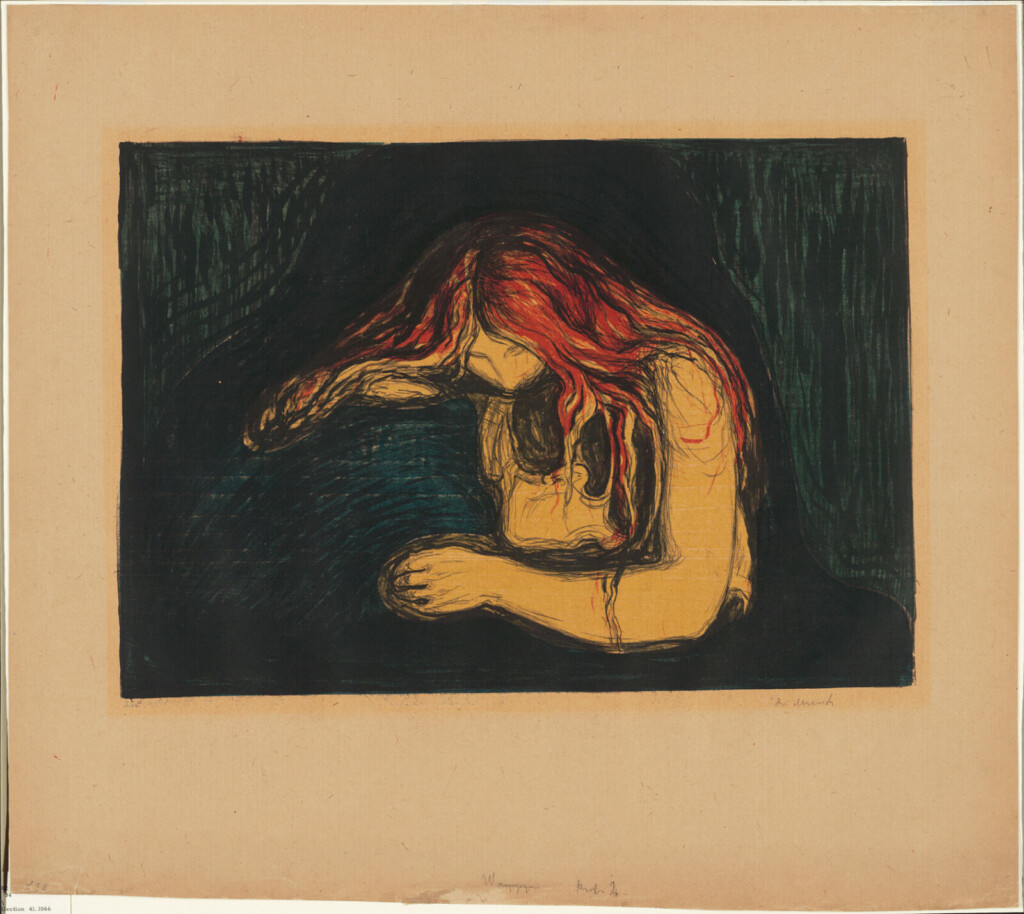
You are sitting across from someone who makes you feel like your skin is too small, and you have no language for it — not because the feeling is new to the species, but because every adult in your proximity has spent considerable energy ensuring you will not find the words.
Erik Erikson published Identity: Youth and Crisis in 1968, and what he mapped there was not a phase but a structural condition: the adolescent self as something genuinely unfinished, caught between the identity assigned by childhood and the one that has not yet cohered. He called the central danger of this period identity diffusion — not confusion exactly, but a kind of interior dissolution, a state in which the self cannot locate its own edges. What made Erikson’s observation quietly devastating was the implication embedded in it: that culture does not wait for the self to cohere before it begins demanding legibility. Society requires that you name yourself before you have the materials to do so, and the gap between that demand and that incapacity is not a personal failure. It is the architecture of the thing.
The vampire lives permanently inside that gap. Its hunger is the defining fact of its existence, and it is a hunger that cannot be metabolized into any socially acceptable category. It does not eat. It does not love, exactly. It does not reproduce in the way institutions recognize. What it does is want — with an intensity that overwhelms the container of the body, that spills past politeness, past daylight, past the negotiations that make civil life possible. The specific horror the vampire produces in its victims is not merely physical. It is the horror of being wanted that completely, which is indistinguishable, at a certain threshold, from being consumed. Adolescents understand this from both directions.
The late nineteenth century produced something instructive here. Between roughly 1880 and 1910, European and American medicine constructed an entirely new category of pathology organized around the developing body. Richard von Krafft-Ebing’s Psychopathia Sexualis, published in 1886, enumerated desires with clinical precision, transforming what had previously been sin or eccentricity into diagnosis. G. Stanley Hall, in his 1904 two-volume Adolescence — the first systematic psychological treatment of the period as a distinct developmental stage — described puberty as a recapitulation of a primitive evolutionary phase, chaotic and dangerous, requiring careful management. The language was scientific but the agenda was containment. What these frameworks accomplished, with enormous institutional momentum behind them, was the conversion of intensity itself into symptom. To want too much, to feel without modulation, to be driven by forces that outpaced your own comprehension — these became signs of disorder rather than signs of being alive inside a transformation you had not consented to.
The vampire was born into the same cultural moment. Bram Stoker published Dracula in 1897, eleven years after Krafft-Ebing, seven years before Hall. The novel is saturated with medical authority — Van Helsing is a doctor, the threat is catalogued and studied, the monster’s nature is subjected to rational analysis even as it escapes rational resolution. What Stoker could not name clinically, he displaced into the supernatural. But the displacement is thin. The vampire’s specific danger is that it reawakens in its victims a hunger they did not know they carried, a hunger that preceded and survives their social formation. Lucy Westenra does not become monstrous because she is infected with evil. She becomes monstrous because she stops managing her wanting.
That is the adolescent terror in precise form: not that you will become something alien, but that the thing you are becoming will make visible everything you were supposed to have learned to suppress.

The Monster Made by the Village
You did not choose to be sixteen. Nobody does. The age arrived on you like a verdict handed down by a court you never petitioned, carrying with it a set of prohibitions, expectations, and social meanings that felt ancient and absolute — as though they had always existed, as though they could not have been otherwise.
Philippe Ariès demonstrated in 1960, in his landmark work L’Enfant et la vie familiale sous l’Ancien Régime, that childhood as a distinct psychological and social category is an invention of modernity. Before the seventeenth century, children in Western Europe were treated as small adults the moment they could work and walk without assistance. There was no developmental corridor, no protected threshold, no institutional holding pen between infancy and full participation in adult life. What we now call adolescence — that turbulent, legally codified, biologically dramatized interval between childhood and adulthood — did not exist as a social reality until the twentieth century formalized it through compulsory secondary education, juvenile justice systems, and eventually, in the United States, the invention of the teenager as a distinct consumer demographic around the 1940s. The word itself barely predates the Second World War in common usage. This is not a minor historical footnote. It means that the storm of identity crisis, the sense of not-yet-belonging, the feeling of being suspended between two worlds — all of it was manufactured. The institution created the wound.
The vampire operates by precisely the same logic. No vampire in canonical Western mythology generates itself. From the earliest Serbian folklore collected by Vuk Stefanović Karadžić in the early nineteenth century through Bram Stoker‘s 1897 novel, the creature is always downstream from a prior violence. Something older, more powerful, and largely invisible reached down and marked the body before the victim had any say. The bite precedes consciousness. The transformation is not chosen — it is inherited, imposed, transmitted through contact with a force the victim did not invite and cannot fully understand. What makes the vampire monstrous is not its hunger but its origin: it is a made thing that must now live as though it were a natural thing.
Sociology has a term for this phenomenon. Pierre Bourdieu, writing in Reproduction in Education, Society and Culture in 1970, described how institutions produce in individuals the very dispositions that institutions then treat as innate. The school does not identify the awkward, the ambitious, the rebellious, the compliant — it generates them, then grades them accordingly, then uses those grades as evidence of pre-existing qualities. The adolescent who feels alienated from the social body did not arrive that way. Alienation was installed through the precise machinery of categories: the grade level, the examination, the dress code, the curfew, the conditional freedom. The bite was institutional. The monster that emerged was then blamed for its own monstrousness.
What gives this particular mythology its staying power is that the made creature cannot simply be unmade. The vampire cannot un-bite itself. The adolescent cannot exit the developmental category by refusing it — the law will not permit it, the school will not release them, the family will not reclassify them. They must pass through. And passing through requires something almost unbearable: living inside a definition of yourself that was written by others, while simultaneously being told that authenticity — the discovery of who you really are — is your primary task and greatest obligation during these exact years. The cruelty of that instruction has never been adequately named.
What the myth keeps returning to, in every culture that reinvents the undead in its own image, is the question of what a body owes the force that made it.
Nosferatu
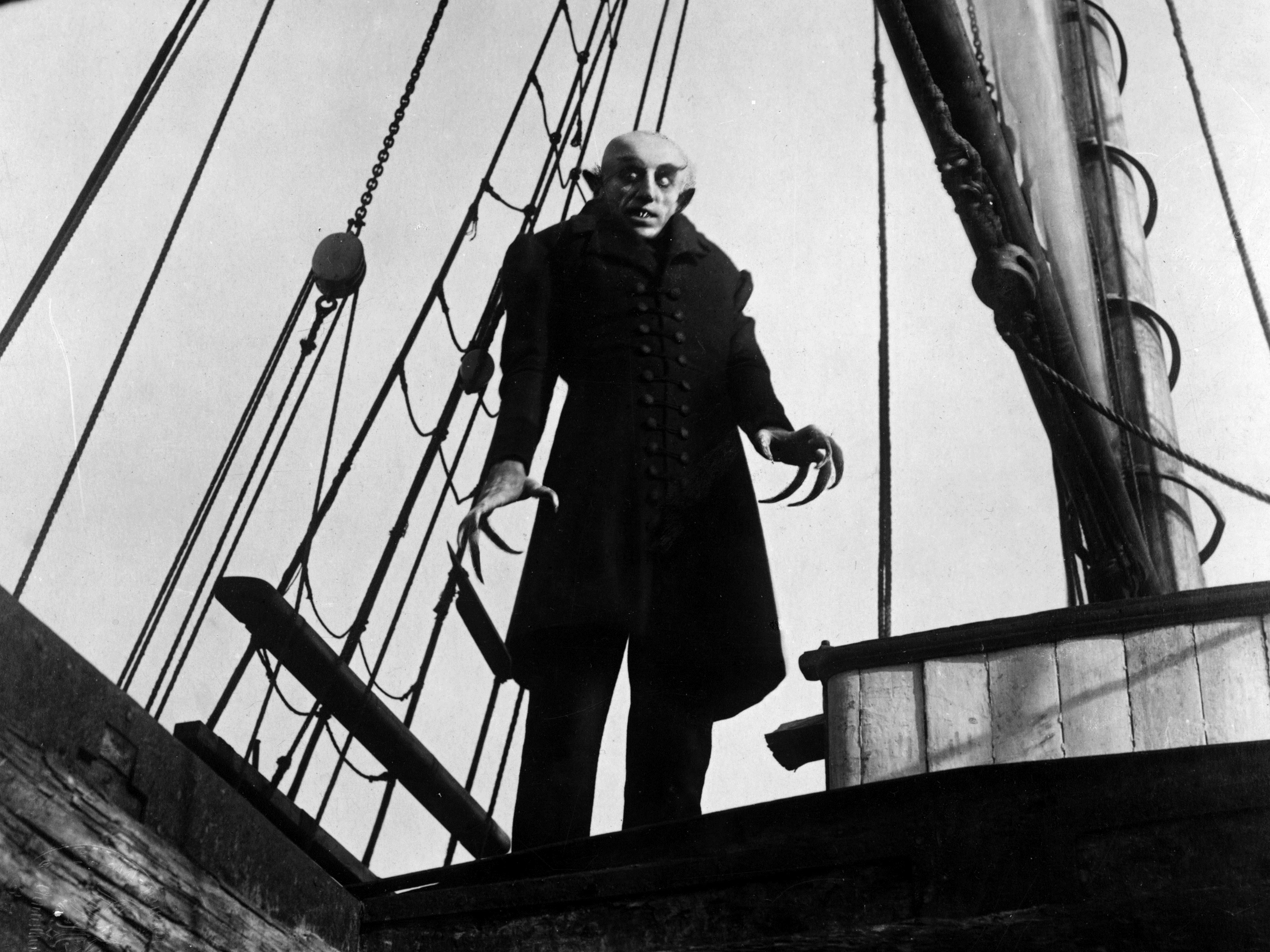
When a young real estate agent, Thomas Hutter, goes to the castle to close a deal, Orlok is attracted by his blood and decides to follow him to his hometown. The arrival of the count causes a series of mysterious deaths and spreads panic among the inhabitants.
Murnau, through evocative images and disturbing atmospheres, creates a work that goes far beyond the simple adaptation of Stoker's novel. The film explores universal themes such as the fear of death, isolation and the loss of humanity. The production of Nosferatu was characterized by some legal difficulties due to the copyright of Bram Stoker's novel. Despite this, Murnau and his crew managed to make a film of great visual impact. The choice of Max Schreck to play Count Orlok was ingenious. His cadaverous appearance and his unnatural movements have made the character of Orlok one of the iconic monsters in the history of cinema. Over the years, Nosferatu has become a cult film, influencing generations of filmmakers and becoming a reference point for the horror genre. The image of Count Orlok, with his elongated nails and sunken eyes, has become an icon of horror cinema.
Seduction as the Only Language Left

You have rehearsed this scene a thousand times without knowing it: the way you adjusted your posture before entering a room, recalibrated your voice a half-register lower, chose which version of yourself to wear depending on who was watching. Not vanity. Survival arithmetic.
The vampire does not seduce because it enjoys the ritual. It seduces because seduction is the only instrument it has not been stripped of. Banned from daylight, from civic life, from the ordinary mechanisms of social leverage that everyone else operates through without thinking, it is left with one grammar: the ability to make you want something before you understand what is happening. Erving Goffman, writing in “The Presentation of Self in Everyday Life” in 1959, described social interaction as a continuous theatrical performance in which actors manage impressions to control how they are perceived, because direct assertion of power is almost always foreclosed. What Goffman mapped as a general condition of social life is, for the vampire and the adolescent alike, not a strategic choice but a structural necessity. When the institutional doors are closed, you learn to work the threshold.
The adolescent body is itself a kind of ambush. It signals maturity before maturity has been granted institutionally, which creates a permanent discrepancy between what the body communicates and what the world is willing to recognize. This gap does not produce freedom. It produces a specific kind of performance anxiety that has nothing to do with wanting attention and everything to do with needing to manage the meaning of your own presence before someone else manages it for you. Charisma, in this context, is not a gift. It is a defensive technology, a way of occupying interpretive space before hostile readings can settle in. The adolescent who becomes magnetic is not necessarily more confident than their peers. They are simply faster at deploying the only currency available in a system that has not yet issued them legitimate tender.
What makes this particularly brutal is the trap embedded inside the success. If seduction works, if the performance lands, if people lean in and the room reorganizes itself around you, the skill gets reinforced precisely at the moment it is most dangerous to trust. You learn that charisma produces outcomes, which trains you to invest further in the performance rather than in the person performing it. Psychologist James Marcia, developing Erik Erikson‘s framework in the 1960s through his identity status research, identified foreclosure as one of the primary failure modes of adolescent identity formation: the state in which a person adopts a coherent self-presentation without ever passing through genuine exploration, locking into a role because the role works before they have discovered whether they want it. The vampire’s curse is not immortality. It is foreclosure stretched across centuries.
There is also something worth sitting with in the directionality of seduction itself. The vampire does not merely attract. It redirects desire, bends the other person’s attention toward a destination they did not choose, and this is structurally identical to what any person does when they perform identity in a social field they cannot dominate by other means. You make the world want to look at you before it can decide to look away. The verb here is not passive. It requires constant, exhausting work, the management of eye contact, timing, silence, the precise calibration of availability and withdrawal. What looks like confidence from the outside is, from the inside, a continuous labor of preemptive self-defense.
And the deeper cruelty is that this labor leaves almost no residue of authentic preference, because every choice about how to present yourself has been made in response to a room rather than in response to an interior.
Immortality as the Punishment for Not Yet Being
You are sitting with the acceptance letter, or the rejection letter, or the absence of any letter at all, and what you feel is not the beginning of something but a prolonged hovering that nobody prepared you to name. The room around you has not changed. You have not changed. The ceremony keeps being postponed by the ceremony itself.
The vampire does not suffer from death. It suffers from the permanent deferral of whatever was supposed to come after the bite. The transformation has already happened — the threshold has already been crossed — and yet full arrival never follows. Bram Stoker‘s creature in Dracula, published in 1897, is not terrifying because it kills. It is terrifying because it persists without accumulating anything that counts as a life. It moves through time without being changed by it, which means it is not really moving through time at all. It is frozen at the exact moment the crossing should have produced a new self.
Erik Erikson, writing in Identity: Youth and Crisis in 1968, called this condition identity diffusion — not the absence of development but its indefinite suspension, the state in which the self keeps rehearsing transformation without completing it. What Erikson observed in clinical settings was already becoming a structural feature of the broader economy. Between 1950 and 1975, the average age at which Western men and women achieved what sociologists then called full adult status — stable employment, independent housing, partnership, first child — shifted by nearly four years. By the early 2000s, the developmental psychologist Jeffrey Arnett was arguing that a wholly new life stage had emerged, which he named emerging adulthood, covering roughly ages eighteen to twenty-five. The argument sounded like a description. It was also a ratification. The threshold had not been discovered; it had been manufactured and then named as though it had always existed.
What the culture refuses to say plainly is that the extension of adolescence has never been primarily about psychological readiness. It has been about labor markets, housing costs, and the progressive withdrawal of public investment from anything that would allow early independence. The British sociologist Frank Furedi, in Therapy Culture published in 2004, traced how the vocabulary of vulnerability and incompleteness had expanded precisely as the material conditions for early autonomy contracted. The result is that young people are handed a psychological explanation for a structural condition — told they are not yet formed when what is actually true is that the architecture meant to receive them has been quietly demolished.
The vampire’s immortality is not a gift gone wrong. It is the logical terminus of a system that needs people to remain in permanent preparation. An adolescent who is always preparing is an adolescent who can be sold preparation. The industry around readiness — the test-prep courses, the gap years, the unpaid internships framed as investment, the graduate degrees that used to be unnecessary for jobs that now require them — depends entirely on the threshold continuing to recede. Move the finish line and you do not need to ban running; the runners will exhaust themselves voluntarily, convinced the problem is their stride.
The cruelest part of the vampire’s condition is not the hunger. It is the memory of having believed, at the moment of the bite, that something real was about to begin. That belief does not die. It calcifies. And the creature carries it across centuries not as hope but as a wound that refuses to close, which is perhaps the most accurate image available for what it means to grow up inside a culture that has decided, for reasons it will never fully disclose, that growing up should take just a little longer than any single lifetime can afford.
A vision curated by a filmmaker, not an algorithm
In this video I explain our vision
🦇 Blood, Darkness, and the Rites of Growing Up
The vampire has always been more than a creature of the night — it is a mirror held up to the turbulent, hungry, and transformative experience of adolescence. From the first taste of forbidden desire to the terror of a body that no longer feels one’s own, the undead archetype maps the emotional landscape of youth with uncanny precision. These articles explore the deeper psychological and cultural currents that flow beneath the surface of the vampire myth.
Problematic Adolescence is Not a Developmental Disorder
Adolescence is not a pathology, yet its storms of identity, desire, and social alienation are so intense they have always demanded mythological expression. The vampire — eternally caught between life and death, belonging nowhere — functions as a perfect emblem for the teenager suspended between childhood and adulthood. This article examines how what looks like disorder is often a necessary, if painful, rite of passage.
GO TO THE SELECTION: Problematic Adolescence is Not a Developmental Disorder
The Masks We Wear: Identity and Fiction in Everyday Life
The vampire traditionally conceals its true nature behind a human facade, seducing and deceiving those around it — a dynamic that resonates deeply with adolescent performance of identity. This article on masks and everyday fiction explores how individuals construct and wear social personas to survive environments that would reject their authentic selves. The parallels with the bloodsucker who hides in plain sight are both illuminating and unsettling.
GO TO THE SELECTION: The Masks We Wear: Identity and Fiction in Everyday Life
Regression in Psychology: When the Mind Returns to Childhood
Psychological regression — the retreat to earlier, more primitive modes of feeling and behavior — is a hallmark of adolescent crisis, and it haunts the vampire narrative as well. The undead creature is forever arrested, unable to fully develop or leave behind its hungers, mirroring the teenager’s fear of being trapped in an immature, uncontrollable self. This article traces how regression functions in the psyche and why horror so often makes it visible.
GO TO THE SELECTION: Regression in Psychology: When the Mind Returns to Childhood
The Secret and the Rite: Initiation, Transformation and Jungian Psychology
Initiation, transformation, and the shedding of an old identity lie at the heart of both Jungian psychology and the vampire’s symbolic bite. To be turned is to undergo a violent, irreversible rite of passage — a dark inversion of the initiatory ceremonies that mark the crossing into adulthood across all cultures. This article unpacks the secret architecture of transformation that links ancient ritual to modern horror mythology.
GO TO THE SELECTION: The Secret and the Rite: Initiation, Transformation and Jungian Psychology
Discover the Cinema That Dares to Show What Youth Really Feels
If these themes stir something in you, Indiecinema is the streaming platform where independent cinema gives voice to the stories that mainstream screens are too afraid to tell — films about identity, transformation, desire, and the darkness inside growing up. Explore our catalog and find the movies that see you.
👉 EXPLORE THE CATALOG: Watch Indie Films in Streaming
A vision curated by a filmmaker, not an algorithm
In this video I explain our vision

