The Morning Ritual Nobody Questions
You reach for it before you are fully conscious. Before language, before thought, before the first coherent decision of the day — your hand moves. The cup is already there, the machine already gurgling, the smell already doing something to your nervous system that you stopped noticing years ago because familiarity is how dependency makes itself invisible. You are not awake yet. And yet your body knows exactly what it needs.

This is not a metaphor. The caffeine molecule, 1,3,7-trimethylxanthine, binds to adenosine receptors in your brain within minutes of ingestion, blocking the chemical signal that tells your body it is tired, triggering the release of dopamine and adrenaline, accelerating your heart rate, sharpening your attention. You did not decide to be a pharmacological subject this morning. You simply woke up and became one, as you do every morning, as your parents did, as their parents did before the word addiction had been invented to describe other people’s problems with other substances.
There is a particular kind of comfort in not being seen. Not by others — by yourself. You drink your coffee and read the news about the opioid crisis, about fentanyl deaths, about teenagers vaping synthetic compounds in school bathrooms, and somewhere in the architecture of your moral attention, a line has already been drawn. Over there: the problem. Over here: the ritual. Over there: the addict. Over here: you, simply needing a moment before the day begins.
The philosopher Michel Foucault spent much of his career examining exactly this operation — the way modern societies produce categories of normality and deviance not through honest moral reasoning but through institutional repetition and historical forgetting. In Discipline and Punish, published in 1975, he showed how the definition of what constitutes a threat to social order is never innocent. It is always a political act wearing the costume of common sense. The drug you consume legally before nine in the morning and the drug that sends someone to prison are not separated by chemistry. They are separated by history, by commerce, by race, and by the particular anxieties of whoever held power at the moment the laws were written.
You might also take something else. A pill for anxiety, for sleep, for the blood pressure that has been slightly elevated since the pandemic reshaped your relationship with time. Or you smoke, still, despite everything, stepping outside at intervals that structure your day like a private liturgy. Or you drink in the evening the way others pray — consistently, quietly, with genuine gratitude for the chemical distance it places between you and the rawness of being conscious. None of this feels like drug use because drug use is something that happens to people who have lost control, and you have not lost control. You have a system.
The sociologist Howard Becker, in his 1963 work Outsiders, argued that deviance is not a quality inherent in an act but a label applied by those with the social power to make it stick. The same substance, the same gesture, the same relief sought from the same unbearable pressure of existing — these become criminal or recreational, pathological or civilized, depending entirely on who is doing them and in which century. The coffee houses of seventeenth-century London were sites of genuine moral panic. Charles II attempted to suppress them in 1675, convinced they were breeding grounds for sedition and idleness. The substance being consumed in those rooms was no different from what you are drinking now.
Your cup is almost empty. The day has begun. Nothing unusual has happened. And yet here you are, already chemically altered, already dependent, already inside a story about drugs that started long before you were born and that you have never, until this precise moment, thought to question.
Return to Planet Underground
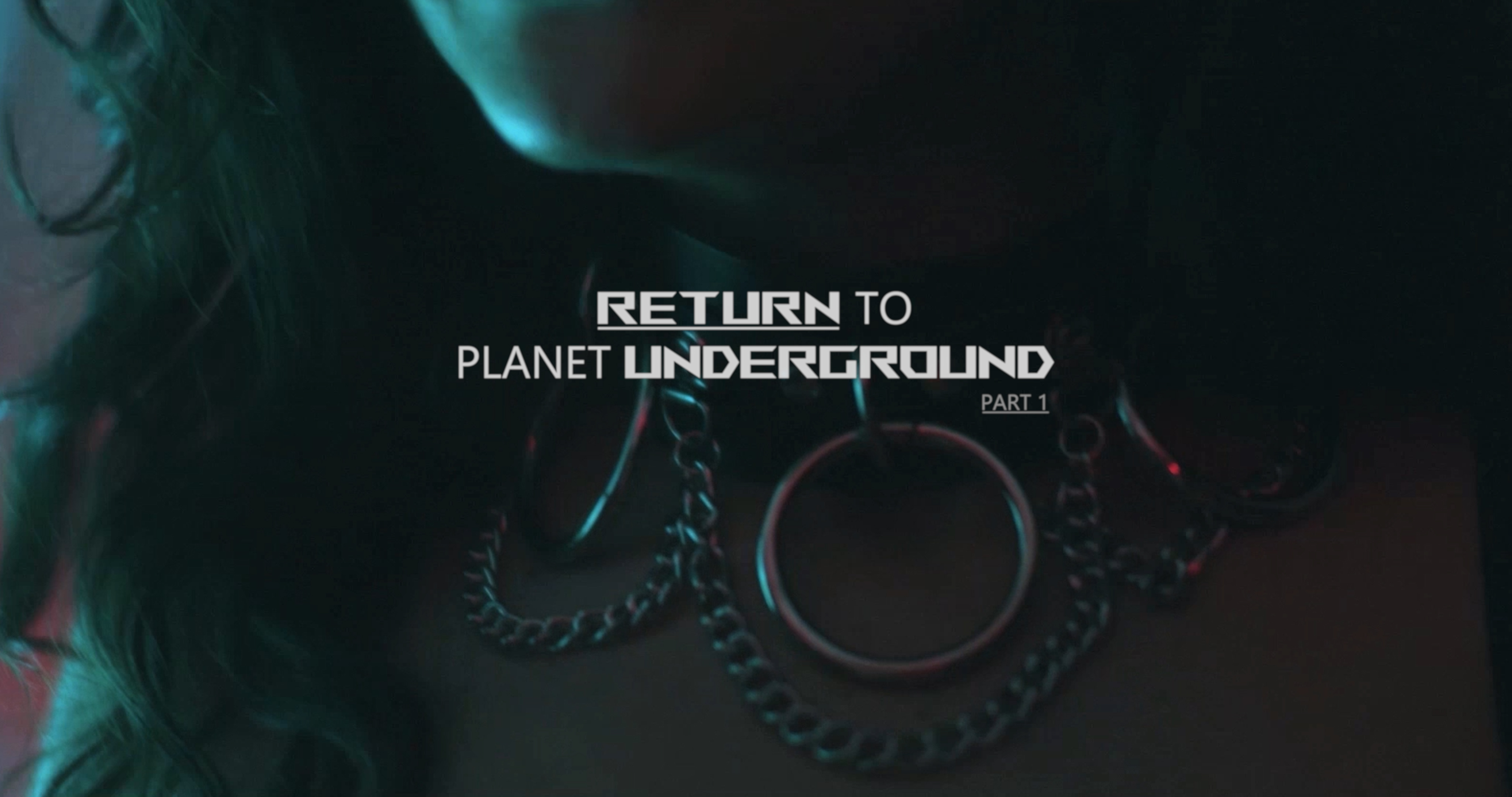
Drama, Thriller, by Gideon Homes, Netherlands, 2025.
A former underground techno DJ working in a large and famous law firm delves into the dark side of society. With one eye on the past and one on the future, he stirs up the ashes of the true underground. The demand of society to function superficially and deliver top performance increasingly clashes with the protagonist's questioning of his own life reality and the values of his past. After being employed for almost six years and being a respected employee, Tyrel falls ill. On top of that, he witnesses a fraud within the company and asks to leave. But the illness creates a complex situation in which his employer starts playing a game of chess with Tyrel.
In "Return To Planet Underground", director Gideon Homes gives the audience a gripping insight into the Dutch underground techno scene, offering a gripping drama set in a dark world, full of intense moments and touching human tragedies. This film is not just a visual feast; it is a gripping exploration that immerses viewers in the lives of its protagonists. Set to a backdrop of thumping techno beats, "Return To Planet Underground" takes audiences on a rollercoaster ride through the highs and lows of human desires, drug-fueled escapades, societal pressures and the pursuit of perfectionism. Drawing inspiration from iconic films such as Trainspotting, Berlin Calling and Human Traffic, Gideon Homes' work stands out for its unique stylistic devices and unconventional storylines. Based on real events and personal experiences, "Return To Planet Underground" faced numerous lawsuits before finally conquering audiences around the world. Prepare yourself for an immersive dive into a world where music, morality and the human spirit collide.
LANGUAGE: English, Dutch
SUBTITLES: Spanish, French, German, Portuguese
When Plants Were Gods and Gods Were Plants
You have performed a ritual without knowing it. Every morning, before your mind fully surfaces from sleep, you reach for something that will chemically alter your consciousness — something that will make the world slightly more bearable, slightly more navigable, slightly more yours. The cup of coffee in your hand carries within it ten thousand years of human beings reaching toward the same thing: not oblivion, not escape, but contact. Contact with something larger than the ordinary texture of waking life.
The distinction we draw today between sacred use and recreational use — between the shaman swallowing peyote buttons before dawn and the college student doing the same at a music festival — is not a distinction that existed for most of human history. It is, in fact, a distinction so recent that its invention can almost be dated precisely, and what it reveals about us is less flattering than we would prefer.
Walter Burkert, in his foundational work on ancient Greek religion, spent decades reconstructing the ritual logic of a world in which the boundaries between the human, the divine, and the chemical were not merely porous but nonexistent. The Eleusinian Mysteries, celebrated without interruption for nearly two thousand years until their suppression in 392 CE, centered on a drink called kykeon — barley, water, and pennyroyal, though the specifics have invited speculation that the barley itself may have been infected with ergot, a fungus containing compounds chemically related to what we would later synthesize as LSD. Cicero, who was initiated, wrote that the Mysteries had given him not only a reason to live with joy but a reason to die without fear. What he drank in that underground chamber at Eleusis was not a recreational substance. It was a technology of transformation, administered once in a lifetime, embedded in an elaborate ritual architecture of fasting, procession, and symbolic death.
The Rigveda, composed somewhere between 1500 and 1200 BCE, devotes more hymns to Soma than to almost any other subject. Soma is simultaneously a plant, a drink prepared from that plant, and a god — the deity and the substance are not analogous but identical. You do not drink something that helps you reach the divine. You drink the divine itself. The archaeological record from the Indus Valley suggests fermentation and psychoactive plant use going back well before these texts were composed, and the continuity between material culture and religious practice is not incidental. It is the entire point.
At Palenque, in the limestone reliefs that line the tomb of K’inich Janaab’ Pakal, the iconography of the mushroom and the maize plant intertwines with images of resurrection and celestial descent in ways that contemporary scholars have spent decades decoding. The psilocybin mushroom in Mesoamerican cosmology — called teonanácatl, flesh of the gods — was not a substance that produced interesting visions. It was a doorway through which the practitioner stepped out of ordinary time and into mythic time, where the dead spoke and the future was legible. The Spanish friars who arrived in the sixteenth century understood immediately that these substances were the structural center of indigenous religion, which is precisely why they burned so many of the codices and why the prohibition of teonanácatl was framed explicitly as a theological emergency.
What all of these traditions share — the Greek, the Vedic, the Mesoamerican — is a fundamental premise that consciousness is not simply a given. It is a threshold, and that threshold can be crossed. The crossing requires preparation, intention, community, and cosmological framing. Strip away those elements, reduce the molecule to a molecule and the experience to a transaction, and you have not liberated the substance from superstition. You have amputated the very structure that made the experience legible to those who lived inside it. What you are left with is something that looks like freedom but functions like severance.

The Pharmacy of Empire
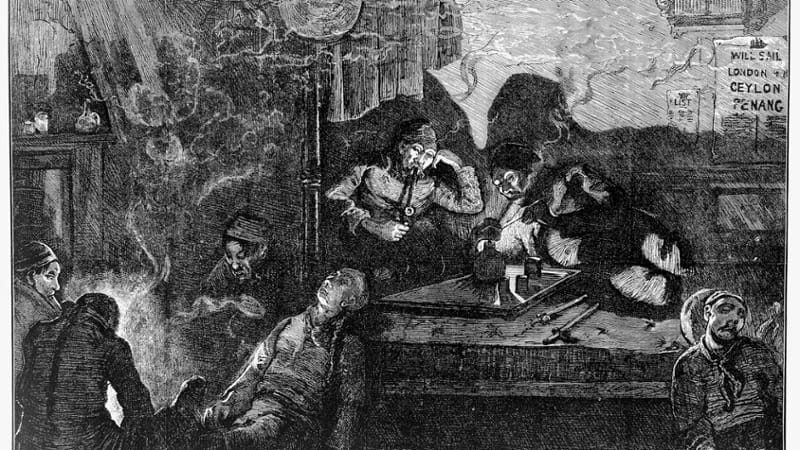
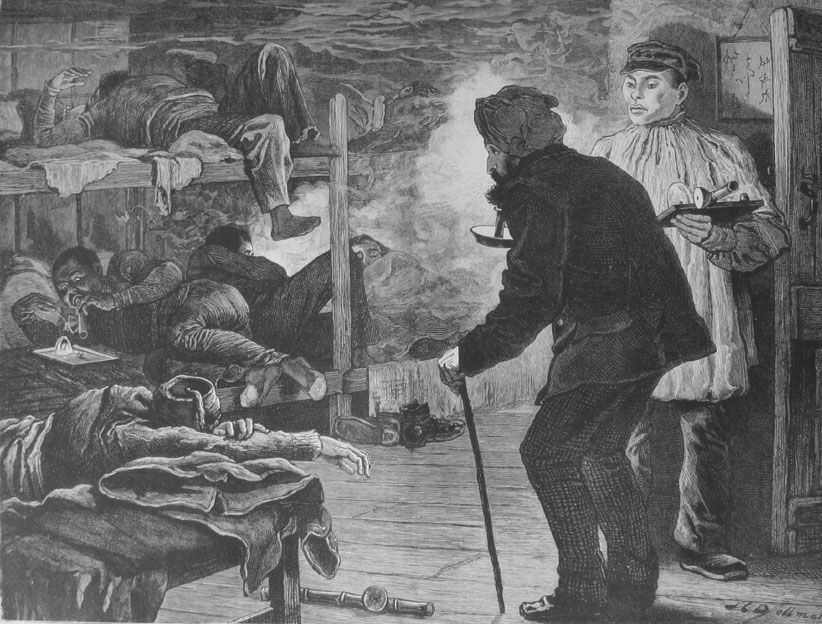
You have seen the painting. Not a painting — a ledger. Columns of numbers in careful ink, quantities of chest upon chest of a grey-brown substance loaded at Patna and Benares, shipped to Canton, exchanged for silver that flowed back to London to pay the salaries of clerks, the dividends of shareholders, the operating costs of an empire that called itself civilized while running the largest narcotics operation in recorded history. This was not a criminal enterprise operating in the shadows. It had a board of directors. It had parliamentary approval. It had, for a time, its own army.
David Courtwright, in Forces of Habit published in 2001, makes the point with a precision that should be more unsettling than it typically is: the global drug trade was not something that happened despite modernity, but something that built modernity. The British East India Company did not stumble accidentally into opium. It cultivated the poppy fields of Bengal with the same administrative thoroughness it applied to cotton and indigo, and when the Chinese government attempted to suppress the trade in the 1830s — when Commissioner Lin Zexu destroyed over twenty thousand chests of opium at Humen in 1839, a quantity worth millions — Britain declared war. Not metaphorically. Gunboats. The Treaty of Nanking in 1842 forced open five Chinese ports and ceded Hong Kong, and the opium kept flowing. By the late nineteenth century, the trade accounted for roughly fifteen to twenty percent of British India’s total revenue. The empire was, in the most literal fiscal sense, sustained by addiction.
The pattern is not unique. In the Andes, the Spanish colonial system had discovered early that coca leaves enabled indigenous workers to endure the brutal extraction labor of silver mines at altitude — at Potosí, where a mountain of silver was eating through human bodies at a rate that killed an estimated eight million people over three centuries. The Church initially condemned coca as a demonic substance, then pivoted entirely when it realized the tax revenue from coca tithes was too valuable to sacrifice to theology. The forced cultivation and controlled distribution of coca was not a side effect of colonialism. It was a management strategy.
Tobacco built Virginia before Virginia built anything else. The first successful export crop of the English colonies, it transformed what had been a desperate and failing settlement into an economic proposition compelling enough to attract investment, indentured servants, and eventually enslaved Africans in numbers that would reshape a continent. By 1700, the Chesapeake colonies were exporting tens of millions of pounds of tobacco annually. The financial architecture of early American colonialism — the plantation system, the transatlantic slave trade’s American dimension, the fortunes that would fund the revolutionary generation — ran on a leaf that physicians were already beginning to suspect caused disease.
What Courtwright identifies, and what remains stubbornly difficult to absorb, is that none of this required hypocrisy in the usual sense. The men who designed and administered these systems did not think of themselves as drug dealers. They thought of themselves as merchants, administrators, servants of crown and company and progress. The categories that would later make such activities legible as crimes — or as anything requiring moral accounting at all — did not yet exist in the form we assume. Psychoactive substances were trade goods. Addiction was a condition of the market’s customers, not a responsibility of its architects.
A man watches a ship being loaded in a port he will never leave, watches the chests move down the gangway, notes the figures in his ledger with satisfaction. He is doing his job. The job is the problem, but no one has given that problem a name yet, and naming things, as any empire knows, is itself a form of power.
The Lost Poet
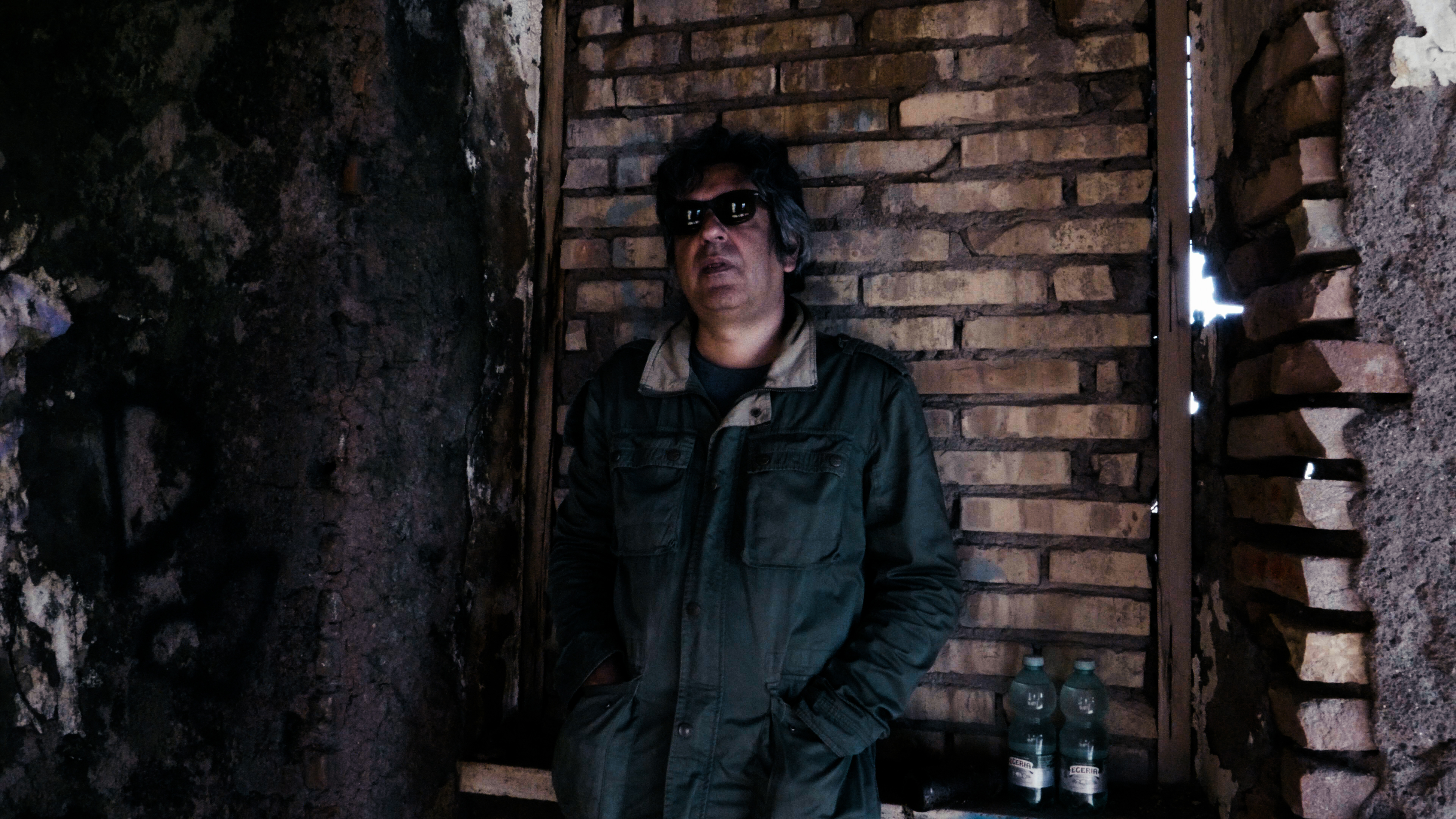
Drama, by Fabio Del Greco, Italy, 2024.
Dante Mezzadri wants to see an old friend, nicknamed the Iguana, whom he has lost sight of for many years, and who has managed to turn their shared youthful passion for poetry into a job, becoming a famous writer and poet. The man escapes from his bourgeois life and his wife to live homeless on the Roman coast, printing and trying to sell his poetry collections. At night he sleeps in a park of old carnival floats, inside a papier-mâché tank, and waits for the opportunity to meet his old friend, who however never shows up for appointments in the places they frequented when they were young, now in ruins. Dante's poetry books do not interest anyone and to support himself he is forced to "change product": he starts selling the infamous "cannibal pill" on behalf of young drug dealers, a new drug that sells like hot cakes and causes sensory and consumerist ecstasy. However, he realizes that this powerful drug is very dangerous for those who take it, he comes into conflict with his ethical conscience and throws all the pills into the sea. However, the dealers want to collect their money.
Shot over a period of 2 years, the film is a reflection on the cultural and artistic rubble of the society in which the protagonist lives, in an increasingly mechanized, consumerist and arid world. Dante Mezzadri is yet another human being who has renounced his inspiration and his creativity, but unlike many he is not willing to give his life to a system that distances him from his true identity. The physical world around him, however, seems constructed in such a way that it seems impossible to escape from this "invisible cage". The enthusiasm of the people he meets is ignited only by sensory gratification, by unreal visions of personal affirmation and success, by "metaverses" that offer an escape into an illusory and destructive reality. The poet's house on the coast, where he met with his friends as a young man, is just a pile of abandoned rubble. What happened to all those who wanted to become poets and ended up becoming something else? Are there internal forces with which that house can be "rebuilt"?
LANGUAGE: Italian
SUBTITLES: English, Spanish, French, German, Portuguese
The Invention of the Addict
Before there was an addict, there was simply a person who used something. That distinction, so obvious once stated, has been systematically buried under two centuries of moral architecture designed to make you forget it was ever a choice of classification rather than a discovery of nature.
In 1821, Thomas De Quincey published his confessions not as a confession of weakness but as a literary and philosophical exploration of altered consciousness. He was a man of letters describing an interior landscape, and his readers received him largely as such. What he did not know, could not have known, was that he was writing the first draft of a character who would later be stripped of all his complexity and reduced to a diagnosis. The figure he invented in prose would be reborn, decades later, as a medical category, and that medical category would be reborn again as a moral sentence.
The pharmaceutical transformations of the mid-nineteenth century changed everything about how that sentence was delivered. Morphine, isolated from opium in 1804 by Friedrich Sertürner, was mass-produced and distributed to soldiers during the American Civil War with a casualness that today seems almost incomprehensible. Hundreds of thousands of men returned home from that war carrying what physicians at the time called “soldier’s disease,” a dependency so widespread it was essentially an epidemic of institutional creation. Then, in 1898, Bayer — the same company that would give the world aspirin a year later — introduced heroin as a supposedly non-addictive substitute for morphine, marketing it aggressively to physicians and patients alike. The substance was named for its heroic qualities. The company was not embarrassed about this. There was, at that moment, no addict to be embarrassed about, because the category had not yet fully solidified.
What solidified it was not science but governance. Michel Foucault, in his lectures at the Collège de France and throughout Discipline and Punish, traced with forensic patience how the medical establishment of the nineteenth century did not so much discover new human conditions as manufacture new human types requiring management. The clinic, the asylum, the prison — these were not responses to pre-existing social problems. They were the instruments through which those problems were constructed as problems in the first place. The addict fits this genealogy precisely. Once dependency was medicalized, it became simultaneously a disease and a moral failure, a combination uniquely useful to systems of control because it made the subject simultaneously pitiable and culpable. You could be treated and punished at the same time, and no contradiction was visible because medicine had absorbed the vocabulary of sin without renouncing it.
Think about what that produces in practice. A person who becomes dependent on a substance that a corporation manufactured, that a physician prescribed, that a government approved, wakes up one morning and is told that the problem is him. Not the supply chain. Not the incentive structure. Not the regulatory capture. Him, specifically, his weakness, his lack of will, his defective character. The factory that produced both the substance and the dependency remains, somehow, outside the frame.
You have seen a man sit in a room where everything around him has collapsed — the work gone, the relationships fraying at the seams, the days bleeding into each other without distinction — and reach for the only thing that still produces a reliable effect. That gesture, in any honest accounting, is not a mystery. It is not a pathology. It is a logical response to an environment that has been systematically stripped of alternatives. The pathology, if we must use the word, belongs to the environment. But environments do not stand trial. People do.
The addict was not found. The addict was needed — needed by an emerging pharmaceutical economy that required consumers, and by an emerging carceral state that required categories of the manageable deviant. One industry created the dependency. Another was built to administer it.
The Chemical Twentieth Century
There is a man strapped into a chair in a room with no windows. He has been given something without his knowledge, and now the walls are breathing. He is not sick. He was not sick before they brought him here. He is a soldier, or a prisoner, or simply someone whose name appeared on a list, and what is happening to him is being recorded by men in white coats holding clipboards, men who believe they are doing science. What they are doing is finding out how much of a human being’s interior can be dismantled before the structure collapses entirely.
This is not a metaphor for anything. It happened, systematically, across multiple facilities, beginning in 1953 and running for at least two decades, funded by an intelligence apparatus that had decided the mind was a territory to be conquered like any other. The logic was military, even when the vocabulary was clinical. LSD was not being studied because anyone cared about consciousness or healing. It was being studied because if you could dissolve a man’s sense of self completely, you might be able to rebuild it along lines more useful to the state. The number of non-consenting subjects ran into the thousands. Some of them never recovered. Some of them jumped out of windows.
Nikolas Rose argued in Governing the Soul, published in 1989, that the modern management of human interiority has never been innocent of power. What appears as care, as treatment, as the compassionate administration of chemistry to suffering minds, is also always a technology of normalization, a way of producing subjects who fit the shapes that society has already decided are acceptable. The clinical and the political are not separate rooms. They share a wall, and the wall is thin.
Consider the woman standing in a kitchen that looks like an advertisement for the life she was promised. It is before noon. She opens the cabinet above the sink, takes out a small yellow pill, swallows it with water, then closes the cabinet with the particular care of someone who does not want to make noise. This is the third one today. The house is clean. The children are at school. Her husband will return at six. There is nothing wrong, by any external measure, with her life. Betty Friedan called the ambient despair of these women the problem that has no name, documenting it across hundreds of interviews for The Feminine Mystique in 1963, and what she found was a generation chemically managed into a contentment they did not feel. Valium, introduced in 1963 and becoming by 1978 the most prescribed drug in the Western world, was not a solution to the problem Friedan named. It was a method of ensuring the problem remained unnamed, dissolved before it could become language, before it could become demand.
The pattern repeats with a different population, a different chemical, a different war. While the government was telling young Black men they were fighting for freedom in Southeast Asia, heroin was moving through the neighborhoods those men had left behind with a speed and volume that did not happen by accident. Gary Webb’s investigations decades later, and the Church Committee hearings before them, pointed toward systemic negligence at minimum and active facilitation at maximum. The chemistry changed. The geography changed. The logic of chemical control as a substitute for political justice did not change at all.
A vision curated by a filmmaker, not an algorithm
In this video I explain our vision
The War on Drugs Was Never About Drugs

You have probably never thought of a law as a weapon. Laws feel neutral — cold, procedural, equally distributed across everyone who breaks them. You picture the scale of justice, the blindfold, the even hand. But there is a moment when the blindfold slips, and what you see underneath is not justice at all. It is a target list.
John Ehrlichman was Richard Nixon‘s domestic policy chief. In 1994, toward the end of his life, he said something that should have stopped the world. He told journalist Dan Baum, in plain English, that the War on Drugs — launched with such fanfare in 1971, dressed in the language of public health and moral urgency — was designed to do two things: disrupt the antiwar left and destroy Black communities. Not contain drug addiction. Not protect families. Disrupt and destroy. The quote sat unpublished for years and finally appeared in Harper’s Magazine in 2016, by which point the infrastructure Ehrlichman described had already imprisoned millions. “We knew we couldn’t make it illegal to be either against the war or Black,” he said, “but by getting the public to associate the hippies with marijuana and Blacks with heroin, and then criminalizing both heavily, we could disrupt those communities.”
There it is. Not a conspiracy theory. A confession. From inside the room where it happened.
Michelle Alexander spent years mapping what that confession built. In The New Jim Crow, published in 2010, she demonstrated with meticulous precision that mass incarceration in the United States functions as a racial caste system — not a side effect of drug enforcement, but its central purpose. By the time Alexander published her work, the United States held more than 2.3 million people in prisons and jails, a figure that had increased by more than 700 percent since the early 1970s. The majority of those imprisoned for drug offenses were Black or Latino, despite consistent data showing that white Americans use drugs at comparable or higher rates. The law did not see that. The law had its target list.
Think of a man released from prison after a drug conviction — not for violence, not for trafficking at scale, but for possession. He walks out and discovers that in most American states he cannot vote, cannot access federal housing assistance, cannot receive food stamps, cannot sit on a jury, cannot hold many professional licenses. He is, in Alexander’s precise formulation, relegated to a permanent second-class status — legally, structurally, invisibly. Jim Crow did not end. It learned to speak the language of criminality rather than race, and the courts found it constitutional because it never said the word.
The architecture of this lie was not built in back alleys or on street corners. It was built in the Oval Office, ratified by Congress, extended enthusiastically by administrations of both parties. The 1994 Crime Bill, signed into law by Bill Clinton, added mandatory minimums and three-strikes provisions that accelerated the carceral machine. Clinton later admitted it had gone too far. The machine did not stop.
What makes this particularly vertiginous is the simultaneity. While Black men were being imprisoned in record numbers for crack cocaine offenses, powder cocaine — chemically identical, statistically more prevalent among white users — carried sentences one hundred times lighter. The 100-to-1 sentencing disparity existed in federal law from 1986 until 2010, when it was reduced to 18-to-1. Not eliminated. Reduced.
You were told this was a war on drugs. But wars are fought against enemies, and the enemy here was never a substance. Substances do not vote. Substances do not organize. Substances do not march. The people who used them did, and that is where the crosshairs were always pointing — not at the chemical, but at the body holding it.
The Psychedelic Renaissance and Its Contradictions
There is a man lying on a couch in Baltimore, wearing an eye mask and listening to a carefully curated playlist of ambient music, while two credentialed guides sit nearby and monitor his dissolution into what researchers will later describe, in peer-reviewed language, as “mystical-type experiences.” He has been administered a precise dose of psilocybin under conditions of clinical sanctity — informed consent forms signed in triplicate, blood pressure checked, emergency protocols in place. The year is somewhere between 2016 and now, because this scene has been repeating itself at Johns Hopkins University with increasing frequency since their Center for Psychedelic and Consciousness Research began publishing results that the mainstream press received with the breathless enthusiasm usually reserved for technological breakthroughs. Depression lifted. Addiction interrupted. End-of-life anxiety dissolved. The data is real, the suffering it addresses is real, and the relief reported by participants carries the unmistakable weight of genuine human experience.
And yet. Three hundred miles south, or west, or in any direction you care to point, someone is being arrested for carrying the same molecule in a different container, under different circumstances, without the eye mask or the ambient playlist or the institutional benediction that transforms a Schedule I controlled substance into a promising therapeutic agent. The chemistry is identical. The criminality is not.
Michael Pollan spent considerable time in 2018 explaining this resurgence to a readership that had, for the most part, spent decades absorbing the official narrative of psychedelics as casualties of the 1960s — too dangerous, too destabilizing, too associated with the kinds of social movements that made governments nervous. His book performed a genuine service in making these conversations legible to audiences who would otherwise never encounter them. But there is something worth pressing on in the way that rehabilitation tends to work, which is to say: it works by laundering. The same substance that was systematically associated with disorder, with Black and brown communities, with political dissidence, with everything the Nixon administration found threatening enough to fabricate a crisis around — John Ehrlichman’s 2016 confession to Dan Baum remains one of the more nakedly honest admissions in American political history — that substance is now acceptable precisely because it has been reintroduced through the bodies and institutions of the professional class. Pollan himself is a Harvard-educated journalist. His guides were licensed therapists. His experiences cost money that most people do not have.
Roland Griffiths and his colleagues at Johns Hopkins have produced work of serious scientific value. The 2020 paper in JAMA Psychiatry on psilocybin for major depressive disorder, the ongoing MDMA trials through MAPS that have shown response rates approaching 67 percent for treatment-resistant PTSD — these are not minor findings. Ketamine clinics have proliferated across Manhattan, Los Angeles, and every other city where disposable income meets existential distress, offering infusions that run between four hundred and eight hundred dollars per session and are covered by insurance only selectively, capriciously, in ways that track economic class with the precision of a diagnostic instrument. The transcendence is available. It has simply been priced and credentialed into a demographic.
There is a deeper contradiction embedded in the very vocabulary of renaissance. A renaissance implies that something died and is being reborn, which erases the fact that these substances never stopped being used — they simply stopped being used by people whose use the state was willing to tolerate. The Mazatec curandera María Sabina, whose ceremonies introduced psilocybin mushrooms to Western consciousness through R. Gordon Wasson’s 1957 Life magazine expedition, watched her community be overrun by seekers, her practice commodified, her sacred framework stripped away so that what remained could be repackaged for export. She died in poverty in 1985. The molecule that is now generating clinical papers and venture capital was already doing its work long before Johns Hopkins built a room for it.
The Self That Needs Altering
You wake up and for a few seconds you are no one. Before the name, before the obligations, before the face you have agreed to wear — there is a gap, a small clean nothing. Then consciousness reassembles itself like a familiar prison, and you get up and begin again.
This is not a metaphor for suffering. It is just the structure of being human. And somewhere inside that daily reassembly, before the coffee and the calendar and the careful management of who you are supposed to be, there is a flicker of something that wants out. Not out of life. Out of this particular version of it.
William James understood this with a precision that still feels almost reckless for a Harvard professor writing in 1902. In “The Varieties of Religious Experience,” he argued that sober waking consciousness is not the whole of mind but merely one type of consciousness, separated from other entirely valid modes by the flimsiest of membranes. Nitrous oxide, he admitted from direct experience, had shown him states of insight that felt more real than ordinary perception, even when they dissolved on contact with air and language. He was not endorsing addiction or chaos. He was saying something more disturbing: that the consensus reality we treat as the only reality is a convention, not a truth, and that humans have always known this, even when they have not had the vocabulary to say it.
Aldous Huxley pushed the same thought further and stranger in “The Doors of Perception,” taking mescaline in 1953 and returning with a report that was less about euphoria than about saturation — the unbearable, luminous weight of things seen without the brain’s usual filtering. Huxley borrowed from Henri Bergson the idea that the nervous system’s primary function is not to produce consciousness but to reduce it, to narrow the infinite input of reality down to the thin slice that is useful for survival. What psychoactive substances often do, in this reading, is not add something foreign to the mind but remove a constraint, briefly opening the aperture that evolution has spent millions of years learning to keep mostly shut.
This reframing changes everything about how the long history of human intoxication reads. The Vedic priests drinking soma, the Greek initiates descending into Eleusis, the medieval penitent in his wine-dark chapel, the jazz musician bent over a needle in a Harlem tenement, the teenager in a suburban bedroom swallowing something that promises to make Saturday night feel like it was always supposed to feel — they are not, in this light, deviants from a norm. They are participants in the oldest and most consistent behavior of the species. More consistent, arguably, than agriculture. More universal than writing. The anthropologist Andrew Weil observed in “The Natural Mind” in 1972 that no human culture in recorded history has been found without its intoxicant, its ritual alteration, its chosen door. The desire is not a malfunction. It appears to be the baseline.
Which brings you back to that gap between sleep and waking. That half-second of unassembled self. Because if the self that needs altering is also the self doing the altering, then what exactly is being sought? Not oblivion — or not only. Not pleasure — or not only. Something closer to contact. Contact with a version of experience that the ordinary, managed, socially legible self cannot reach by itself.
The question that the entire history of human intoxication has been circling, the one that sits beneath every prohibition and every ecstasy, every war on drugs and every sacrament, is not whether this impulse is dangerous. It obviously can be. The question is what it says about consciousness itself that it perpetually seeks to exceed its own boundaries — and what it means that we have spent centuries building elaborate systems to prevent it from doing the one thing it seems to have always wanted to do.
🌿 Altered States: Substances, Mind, and Human History
Throughout history, human beings have sought to expand, alter, or transcend ordinary consciousness through substances drawn from nature and culture alike. From shamanic rituals to Romantic poetry, from bohemian subcultures to modern psychedelia, the use of drugs weaves through art, medicine, philosophy, and social rebellion. These articles trace the deepest threads of that labyrinth.
Psychedelic Movies for One-Way Trips
Psychedelic cinema has long served as the visual counterpart to chemically altered states of consciousness, translating inner dissolution into film language. From the lysergic visions of the 1960s counterculture to contemporary arthouse explorations, these films mirror humanity’s relentless fascination with the edges of perception. This curated list is an essential companion to any serious inquiry into drugs as a cultural and experiential phenomenon.
GO TO THE SELECTION: Psychedelic Movies for One-Way Trips
The Cursed Poet: History and Figures
The figure of the cursed poet — Baudelaire, Verlaine, Rimbaud — is inseparable from the history of substance use as a pathway to creative and spiritual extremes. These writers did not merely consume; they theorized intoxication as a method, a philosophy, and a form of revolt against bourgeois sobriety. Understanding the cursed poet is indispensable for any historical reading of drugs within artistic modernity.
GO TO THE SELECTION: The Cursed Poet: History and Figures
Antonin Artaud: Life and Thought
Antonin Artaud‘s life and thought are deeply entangled with the use of peyote, opium, and other substances he encountered both in Mexico and in the ravaged landscape of his own mind. His Teatro della Crudeltà sought a visceral, chemically raw experience of presence that challenged the sanitized conventions of Western theater. Artaud remains one of the most radical testimonies to the intersection of drugs, body, and artistic vision.
GO TO THE SELECTION: Antonin Artaud: Life and Thought
La Bohème: History and Myth of the Poor Artist
The myth of the poor artist in Bohemian Paris was sustained not only by poverty and passion but by a widespread culture of absinthe, opium, and hashish that permeated the cafés and garrets of the Latin Quarter. La Bohème as a cultural ideal romanticized altered states as inseparable from creative freedom and social marginality. Examining this myth sheds critical light on how drug use became aestheticized and normalized within the modern artistic imagination.
GO TO THE SELECTION: La Bohème: History and Myth of the Poor Artist
Explore the Cinema of the Mind on Indiecinema
If these articles have opened a door into the complex, visionary, and sometimes dangerous relationship between humans and substances, then independent cinema offers the most honest and unfiltered way to go deeper. On Indiecinema, you will find films that dare to explore altered consciousness, cultural transgression, and the hidden histories that mainstream cinema refuses to tell. Join the streaming platform that treats cinema as a form of knowledge.
👉 EXPLORE THE CATALOG: Watch Indie Films in Streaming
A vision curated by a filmmaker, not an algorithm
In this video I explain our vision