
The Man Who Refused to Let You Off the Hook
You are standing in a crowd and you know, with the clean certainty of someone who has never had to examine it, that the person at the center of the square deserves what is coming. Everyone around you believes the same thing. The agreement is total, which is precisely why no one has said it aloud. The punishment proceeds. You watch. And the watching, you will discover only much later, if ever, was not passive — it was a vote, cast with your body, your silence, your willingness to remain. You were not a bystander. You were a constituent.

Friedrich Dürrenmatt spent his entire career building the architecture of that moment and locking you inside it. Born on January 5, 1921, in Konolfingen, a small village in the Emmental region of Switzerland, he came into the world inside a Protestant parsonage, raised by a father, Reinhold Dürrenmatt, who preached moral order as though it were load-bearing structure. The church was not a background detail of his childhood. It was the epistemological frame through which guilt, accountability, and consequence were first organized for him — a frame that would not crack but shatter, producing not apostasy but something far more dangerous: a dramatist who had internalized theology deeply enough to understand what it concealed.
Switzerland in the 1920s and 1930s presented its own particular species of moral comfort. The country’s famous neutrality was, even then, a carefully maintained fiction that required enormous cultural energy to sustain — a studied looking-away from what surrounded it, dressed in the language of principle. Dürrenmatt absorbed this atmosphere the way a child absorbs anything ambient and formative: not consciously, but into the tissue. When he moved to Bern to study philosophy and literature at the University of Bern in 1941, and later briefly at the University of Zurich, he was already carrying the paradox of a society that prided itself on standing outside history while history was consuming everything around it.
His early ambitions were not theatrical. He painted, obsessively, dark grotesque canvases that critics would later scramble to describe as visionary but which were more simply the output of a mind that processed reality through distortion rather than representation. He read Kierkegaard with the intensity of someone looking for an escape route and finding instead a more elaborately locked room. The leap to drama came through financial necessity as much as artistic vocation — he was broke, newly married to actress Lotti Geissler in 1946, and theater paid faster than novels. This is worth holding: one of the twentieth century’s most unsparing moral dramatists arrived at the stage partly because he needed the money. The conditions of production shape the form of the thought, which is something that thinkers who write only about ideas tend to forget.
His first play, Es steht geschrieben, performed in Zurich in 1947, provoked a scandal not because it was obscure but because it was exact. It placed the Anabaptist rebellion of Münster in 1534 on stage and refused to allow the audience to locate themselves safely in the bleachers of history. The Zurich audience, comfortable, neutral, morally self-satisfied, found themselves watching fanaticism and recognizing something they could not name. The booing at the premiere was the sound of people rejecting a mirror.
What distinguished Dürrenmatt from the beginning was not nihilism, which is always a form of comfort — a permission slip to disengage — but something colder and more demanding: the conviction that the world could not be excused. Not by circumstance, not by complexity, not by the sheer scale of institutional evil that makes individual responsibility feel absurd. His father’s Protestantism had taught him that each soul stands alone before judgment. He secularized that architecture and pointed it back at the congregation.
Crazy World
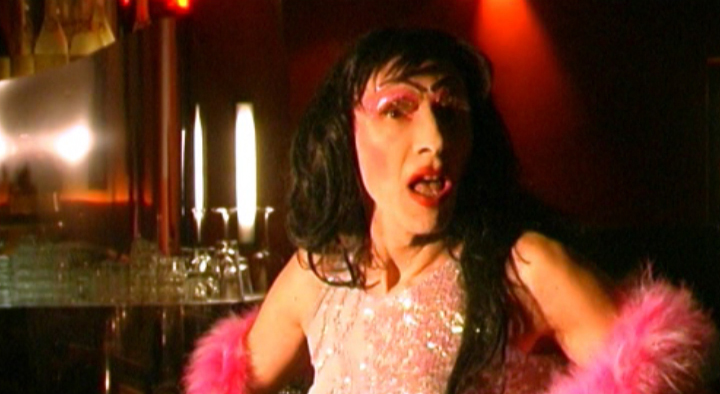
Drama, thriller, by Fabio Del Greco, Italy, 2010.
Luca is poor and works, precariously, as a waiter. He lives a problematic relationship with his girlfriend, and his life is full of doubts. One day Luca meets Chiara, a friend who had studied philosophy with him at university. She has realized her dream of opening a night and is now well-off. Luca leaves everything behind and starts a relationship with Chiara. He manages the nightclub with her and, thanks to the cocaine and call girls sold to politicians, he gets out of his hard economic situation. But Chiara does not manage to obtain the contract for an old furnace, so she blackmails Saverio, a member of the Parliament. Chiara owns a video in which Saverio has sexual intercourse with a transsexual.
LANGUAGE: Italian
SUBTITLES: English, French, Spanish, German, Dutch, Portuguese.
A Country That Stayed Clean by Staying Out
You grow up in a country that was never bombed, and something strange happens to your relationship with guilt. Not that you feel none — you feel it differently, as a kind of ambient pressure without a source, a debt that has no creditor and therefore can never be repaid. Friedrich Dürrenmatt was born in 1921 in Konolfingen, a village in the canton of Bern, and by the time he reached adolescence, the world around him was burning in ways that Switzerland’s borders officially refused to acknowledge. The country signed no armistice because it fought no war. It hosted negotiations, protected assets, processed gold. It stayed clean the way a surgeon’s gloves stay clean — by not touching anything directly.
Swiss neutrality in the Second World War has been defended as strategic wisdom and attacked as moral abdication, but what interests us here is neither the diplomatic verdict nor the historical accounting, as devastating as that accounting eventually became — particularly after the Bergier Commission published its findings in 1996, documenting with precise archival evidence how Swiss banks held looted Nazi gold and turned away Jewish refugees at the border. What matters is the specific psychological atmosphere that neutrality generated for those living inside it in real time, during the years when the rest of Europe was being reorganized by catastrophe. When destruction is the common language of a civilization and you are excused from speaking it, you do not emerge innocent. You emerge suspicious of your own innocence.
Dürrenmatt absorbed this suspicion early, and it shaped his understanding of where evil actually lives. He refused the comfortable European postwar narrative in which evil had a face, a uniform, a definable historical moment that could be ended, prosecuted, and mourned. That narrative allowed whole populations to locate monstrousness outside themselves — in a regime, in a period, in a named set of perpetrators. Switzerland’s position made that narrative unavailable. There was no regime to oppose, no occupation to resist, no rubble to photograph as evidence of what had been survived. There was only prosperity, order, and the faint administrative smell of complicity that no one was required to name. Hannah Arendt would spend years after the war trying to explain that evil operates through the suspension of judgment rather than through the presence of sadism, that the desk clerk who processes the paperwork is not innocent because he did not pull the trigger. Dürrenmatt understood this not as a philosophical proposition but as the texture of daily life in a functioning, comfortable, well-heated democracy.
His earliest plays, written in the late 1940s, are not war plays. They do not stage trauma or ruins or the aftermath of occupation. They stage institutions — courts, businesses, civic arrangements — and show them operating exactly as designed while producing outcomes that are morally catastrophic. This is not irony deployed for effect. It is a diagnosis of what systemic comfort actually does: it makes the mechanism so smooth that no single person inside it ever needs to decide to do harm. The harm emerges as a byproduct of everyone doing their job correctly.
There is a particular kind of corruption that only becomes visible in the absence of external crisis, and Switzerland was, for Dürrenmatt, its laboratory. A nation that had not been forced to choose sides had also not been forced to discover what it would have chosen. That unknowing became its own moral condition — not neutral but suspended, not clean but untested. For a writer, there is almost nothing more generative than a society that functions perfectly and means nothing. The machinery hums. The clocks run. The trains leave on time. And somewhere inside that precision, something deeply wrong has found a permanent home, because there is nothing dramatic enough to force it out into the light where it could be identified, confronted, or even properly named.

The Grotesque as the Only Honest Form
You are sitting in a theater and something is making you laugh, but the laughter curdles halfway up your throat and you are not sure, by the time it reaches your mouth, whether it is still laughter at all. That sensation — that precise physiological confusion — was not an accident for Friedrich Dürrenmatt. It was the destination.
In 1955, Dürrenmatt published Theatreprobleme, a lecture-essay that functions less as a theory of drama than as a verdict on the century. The central argument is deceptively simple and quietly devastating: tragedy, in the classical sense, requires a hero, and a hero requires a world ordered enough to be destroyed by individual guilt. Oedipus can fall because Thebes holds together long enough to witness the fall. The structure of the cosmos, however punishing, is legible. What Dürrenmatt saw around him in the mid-twentieth century was something categorically different — not a world of comprehensible catastrophe but one of diffused, bureaucratic, anonymous destruction in which no single figure could be said to carry the weight of events. The gas chambers were not the work of a tragic hero. They were paperwork.
Aristotle had built his entire architecture of dramatic effect around catharsis — that civic and psychological release achieved when audiences watched a great figure destroyed by a flaw that was also, somehow, their own. The logic required a specific geometry: elevation, recognition, fall, purgation. But catharsis depends on scale, on the audience’s ability to locate themselves in relation to a suffering that is larger than ordinary life. Dürrenmatt’s insight was that modernity had not simply made heroes rare — it had structurally abolished the conditions under which heroism could function as a meaningful moral category. When guilt is distributed across thousands of signatures, when the machinery of harm operates without a face, Aristotle’s geometry collapses. And a theater that still performs within that geometry is lying.
The grotesque, for Dürrenmatt, was not a stylistic preference or a matter of dark humor deployed for shock. It was an epistemological position — the only form honest enough to represent a world that had become, in his precise formulation, too opaque for tragedy but too violent for comedy. In Theatreprobleme he wrote that the grotesque is a sensory paradox, an image that holds mutually exclusive truths in the same frame without resolving them. A man laughs at a funeral and is not wrong to do so. A joke is told about annihilation and the joke lands. These are not failures of tone — they are accurate reports about a world in which suffering and absurdity have fused irreversibly.
This is why his plays refuse the clean exit of tragic dignity. In Die Physiker, written in 1962, the three men confined to an asylum reach a moment of apparent clarity and choice, only to have the entire architecture of their moral reasoning rendered moot by a woman they never fully considered. The punchline is also the horror. There is no catharsis because there is no release — only the recognition that the world has already moved past the point where recognition changes anything. The audience leaves not purged but implicated, slightly nauseated, holding something they were not offered a way to put down.
What Dürrenmatt understood, and what most of his contemporaries were too elegant to admit, is that a dramatist who insists on tragedy in conditions that no longer support it is not being profound — he is being sentimental. Sentimentality, in this sense, is not an excess of feeling but a refusal to let the form match the facts. The grotesque was his refusal to be sentimental about a century that had earned, at minimum, honesty. Whether the audience could tolerate that honesty without retreating into the comfortable misreading that it was all just very dark comedy — that was a problem he left entirely to them.
The Visit and the Price of Forgetting
You are living in a town that is dying. The shops have closed one by one, the factory stands hollow, and the men who once ran this place now wear the shame of poverty like a second skin they cannot shed. Then a woman returns — a woman they drove out decades ago, stripped of her name, her child, her future, her very legibility as a human being — and she brings with her an offer so obscene it should end the conversation before it begins. She will give the town more money than it has ever imagined. In exchange, she wants the life of the man who destroyed her. The town refuses. Then it accepts. The distance between those two moments is the entire history of how ordinary people become capable of anything.
Dürrenmatt finished Der Besuch der alten Dame in 1956, and what he constructed was not a morality tale but something far more structurally precise: an anatomy of how a collective transforms a private crime into a civic virtue. The people of Güllen do not decide to become killers. They decide, first, to believe they deserve better. They begin spending money they do not yet have, buying shoes and coffee and small comforts on credit, and in doing so they install the outcome before they have consciously chosen it. The murder of Alfred Ill is arranged not in a room where someone gives an order, but across dozens of individual acts of anticipation — a new coat here, a television there — until the deed itself arrives as a mere administrative conclusion to an economic logic that was already in motion. No one holds the knife. Everyone holds the knife.
Hannah Arendt, watching Adolf Eichmann in a Jerusalem courtroom in 1961 and publishing her account two years later, identified something she called the banality of evil — not a phrase about monsters, but a clinical observation about the absence of thought. Eichmann did not hate Jews with passion. He processed paperwork with efficiency. What Dürrenmatt dramatized in Güllen, Arendt diagnosed in the machinery of the Final Solution: guilt distributes itself so finely across a bureaucratic or communal structure that no single individual ever feels its full weight. The community in the play does not experience itself as murderous because each person is only doing what the situation seems to require. The teacher writes a speech. The mayor shakes a hand. The men of the town form a corridor. Ill walks through it. Justice, they call it. They use the word without irony.
What makes Dürrenmatt’s mechanism so precise is that Clara Zachanassian — the returning woman, the billionaire, the instrument — does not deceive anyone. She states her terms with absolute clarity from the very beginning. The horror is not that the town is tricked. The horror is that it understands exactly what is being offered and chooses, step by breathable step, to meet the price. This is not the corruption of innocence. This is the revelation of what was always there beneath the performance of innocence — the willingness to monetize a human being when survival feels like justification enough. They did it to her forty years before the play begins. They do it again at its end. The logic is identical. Only the economics have changed.
There is a particular cruelty in the structure of collective rehabilitation. A community that has committed a wrong does not necessarily seek to undo the wrong. It seeks, instead, a story in which the wrong becomes retroactively invisible — absorbed into a narrative of necessity, of historical complexity, of circumstances beyond anyone’s control. Güllen does not repent. It reframes. And Dürrenmatt’s most savage implication is that the reframing costs exactly as much as the original crime — which is to say, precisely nothing that the town was not already willing to pay.
Physics, Power, and the Scientist Who Chose Madness
You are sitting in a room that looks like a hospital but functions like a prison, and the men around you are pretending to be insane because sanity, they have concluded, is the more dangerous condition. This is not a metaphor offered gently. In 1962, three years after the Berlin Wall divided a continent along the seam of its own terror, Dürrenmatt placed three physicists in a Swiss psychiatric ward and let them perform madness as the last coherent ethical act available to them. One believes he is Newton. One believes he is Einstein. The third, Möbius, has received the complete unified theory of all physical forces and has chosen to destroy it by hiding inside the fiction of his own collapse. He kills his nurse. Not because he is mad, but because he is, in this moment, the most rational man alive.
The play premiered at the Schauspielhaus Zürich on February 20, 1962, and it arrived into a world that had watched Hiroshima and Nagasaki absorb the full weight of what human intelligence could manufacture. Dürrenmatt was not interested in mourning. He was interested in the structural problem that the Manhattan Project had made permanent: knowledge, once produced, cannot be unproduced. Robert Oppenheimer stood before a congressional hearing in 1954, his security clearance revoked, his life reduced to the question of whether a man who creates a weapon can afterward refuse it. The answer the twentieth century gave was no. Möbius knows this answer before anyone asks the question, which is why he burns his manuscripts and calls it medicine.
Max Weber, in his 1919 lecture “Politik als Beruf,” drew a distinction that has never been properly absorbed by the institutions that claim to teach ethics. He separated the Gesinnungsethik, the ethic of conviction that measures action by its internal moral purity, from the Verantwortungsethik, the ethic of responsibility that measures action by its foreseeable consequences in the world. Weber was not declaring one superior. He was describing a wound. Because a man operating purely from conviction can commit atrocities without guilt, having acted from principle. And a man operating purely from responsibility is eventually crushed by the infinite regress of consequences he cannot predict or contain. Möbius has run this calculation and arrived at a solution that is no solution: disappearance. He will not publish. He will not resist. He will simply cease to be legible to power.
What Dürrenmatt understood, and what makes the play something beyond political allegory, is that the asylum itself is not neutral. The institution that houses the three physicists is run by a hunchbacked woman named Mathilde von Zahnd, who is not mad at all, who has been reading Möbius’s manuscripts the entire time, and who has already handed his discoveries to a cartel that will use them to control the planet. The escape was never possible. The silence was already too late. This is the formal logic Dürrenmatt introduced as one of his “21 Points” appended to the published text: a story is only thought through to the end when it has taken its worst possible turn. Not the worst turn the author fears. The worst turn the internal logic of the situation demands.
There is a category of writer who believes that by naming a catastrophe clearly enough they are performing resistance. Dürrenmatt did not belong to that category. He belonged to the smaller, colder group who understand that the act of naming sometimes completes the catastrophe rather than interrupting it, that Möbius’s silence and Möbius’s speech both arrive at the same destination, and that the question Weber left unresolved in 1919 did not become more answerable simply because the weapons grew larger and the consequences more visible to anyone with eyes to see them.
A vision curated by a filmmaker, not an algorithm
In this video I explain our vision
Justice as Theater, Theater as Trap

You are handed a corpse and a promise. The detective novel, in its classical form, is a contract written in blood and ink: something has been broken, and by the final page it will be repaired. The world will be legible again. Friedrich Dürrenmatt accepted this contract in 1950 with The Judge and His Hangman, and then he quietly burned it from the inside.
Inspector Bärlach, aging, dying of stomach cancer, is given exactly one year to live by his doctors — a fact Dürrenmatt deploys not as sentiment but as machinery. Bärlach solves his case, identifies his murderer, maneuvers the guilty party toward destruction. Justice, apparently, is served. Except the mechanism of that justice has nothing to do with law, evidence, or institutional order. It is personal, private, constructed by a dying man who manipulates everyone around him like pieces on a board. The guilty are punished, but by a process that is itself a crime. What looks like resolution is actually a confession: that order was never restored because it was never there to restore. It was performed, by one man, against a clock, for reasons that die with him.
Umberto Eco, in his 1979 work The Role of the Reader, described the detective narrative as a machine for producing retrospective coherence — the reader moves through disorder and arrives at a moment where every fragment clicks into place. This click, Eco argued, is not merely aesthetic pleasure. It is epistemological reassurance: the world has a grammar, and someone can read it. The detective is the proof that reality is decipherable. The genre’s enormous commercial success across the twentieth century — Agatha Christie alone sold over two billion copies in English by the time of her death in 1976 — is not a cultural accident. It is the statistical measure of how badly a civilization needs to believe that chaos is temporary and solvable.
What Dürrenmatt understood, with a precision that feels almost surgical, is that this need is itself the trap. The hunger for the click — for the moment when the puzzle resolves — is a form of addiction that makes the reader complicit in a lie. In The Pledge, published in 1958 as a direct assault on genre conventions, he literalized this assault through structure. A detective named Matthäi makes a promise to a murdered girl’s mother to find the killer. He builds a trap, constructs an elaborate logic, stakes everything on a prediction about human behavior. He is right. He is completely right. And then a drunk driver kills the suspect in an unrelated accident before the trap closes, and Matthäi is left holding a solved case that cannot be proven, standing in a roadside gas station, still waiting, ten years later, for a man who is already dead. The logic was perfect. Reality was indifferent.
The genre’s promise is not just violated; it is shown to have been a category error from the beginning. Dürrenmatt forces the reader to confront something that a Christie or a Conan Doyle never allowed: that the restoration of order at the end of a detective novel is not a discovery about the world. It is a formal convention, as artificial as a curtain call, and the applause it generates is the applause of people who needed the lie more than the truth. The theatrical language here is not accidental. Dürrenmatt spent his entire career moving between stage and page precisely because both are spaces where audiences consent to being deceived, and then congratulate themselves on the deceit as though it were wisdom.
A man stands at a gas station in the Swiss countryside, waiting. He has solved everything. He has understood nothing about what understanding costs when the world refuses to cooperate with your conclusions. And the reader, who wanted the click, who turned every page of The Pledge waiting for the mechanism to close, sits with him in that paralysis — not outside the trap, but inside it all along.
Late Work, Darker Ground
You are sitting with a man who has stopped trying to explain himself, and you realize, slowly, that this is the most threatening thing he has ever done. The late Dürrenmatt — post-1980, working in the house in Neuchâtel that had become both studio and fortress — was not retreating. He was excavating. The distinction matters enormously, because his critics consistently mistook the second for the first.
The 1980s revisions of his earlier plays were not corrections. When he returned to works like The Meteor and added new layers of commentary and structural complication, he was doing what very few writers have the nerve to do: treating his own past work as raw material rather than monument. These revisions unsettled the literary establishment precisely because they refused nostalgia. There was no Author’s Note explaining what had been wrong and what was now right. The revised texts simply existed, more opaque than before, as if Dürrenmatt were personally offended by the idea that understanding should be made easier with age.
The essay collections of this period — particularly Stoffe, the sprawling sequence of prose fragments and reflections that he worked on through the 1980s and that would form the backbone of the posthumous Labyrinth, published in 1990 — reveal a mind operating under sustained pressure from within. These are not the essays of a man settling accounts. They move through autobiography, cosmology, geometry, and political diagnosis with the associative logic of someone who has given up on the pretense that thought arrives in clean categories. He wrote in Stoffe about the image of the labyrinth not as a symbol to be decoded but as a structural condition — the absence of a center that was supposed to be there. The Minotaur, in his retelling, is not the monster. The monster is the architect who believed the labyrinth had a solution.
His isolation from the literary currents of the 1970s and 1980s was real, and it was mutual. The decade that celebrated maximalist metafiction and politically committed theater had little appetite for a Swiss writer who insisted that political theater was most honest when it refused to tell audiences which side to applaud. His quarrels with Max Frisch, long simmering and never fully public, crystallized something essential about two different bets on what literature owed the world. Frisch believed in the writer as witness, the text as testimony. Dürrenmatt believed the witness was also always a suspect. Their estrangement was not personal bitterness dressed as aesthetic disagreement — it was aesthetic disagreement that happened to be personal, which is the only honest version of that conflict.
What the literary world called his failure to remain relevant was, in structural terms, his refusal to manufacture consolation. Georg Lukács had argued in The Theory of the Novel, back in 1916, that the novel form emerges from a world in which God has withdrawn and meaning must be sought rather than given — but Lukács still believed meaning could be found, that the quest was noble even when it failed. Dürrenmatt, writing seventy years later with the additional evidence of the twentieth century, had concluded that the nobility of the quest was itself a sales technique. His late work did not offer the tragic grandeur of the failed search. It offered the comedy of someone who has stopped searching and is now watching the other searchers with something that looks like pity but is probably closer to recognition.
What the Comedy Cannot Save
You are sitting in a theater, and the man on stage has just lost everything — his daughter, his dignity, his last plausible claim on the future — and you are laughing. Not nervously. Not apologetically. You are laughing because the playwright has arranged the furniture of disaster with such precise comic timing that your body responds before your conscience can intervene. This is the trap Dürrenmatt spent his entire career constructing, and the trap is the point.
He argued, with the kind of stubbornness that looks like perversity until you follow it to its end, that tragedy had become a luxury the modern world could no longer afford. Not because suffering had diminished but because the architecture of tragedy requires a protagonist large enough to be crushed meaningfully — a figure whose fall reorganizes the moral universe around the wound. Tragedy flatters. It tells the sufferer that their pain has weight, that the cosmos noticed, that something was at stake beyond the merely contingent. Oedipus does not simply have bad luck; the gods are interested in him. This interest is the gift tragedy offers, and it is, Dürrenmatt concluded, a lie that the twentieth century had made untenable.
The lie became visible somewhere around 1945, when the administrative machinery of mass death revealed that modernity’s signature catastrophes were not tragic in any classical sense — they were grotesque, bureaucratic, and structurally indifferent to the dignity of their victims. Hannah Arendt, writing in 1963 in Eichmann in Jerusalem, reached for the word “banality” and found that it cut deeper than any tragic vocabulary could. The evil was not sublime. The mechanism simply ran. Dürrenmatt had already understood this a decade earlier when he wrote The Visit in 1956, constructing a world in which an entire community negotiates its way toward murder through the familiar grammar of economic necessity and collective self-deception — no villain, no hero, only process. The play cannot be experienced as tragedy because there is no one inside it large enough to carry that weight.
Comedy, in his framework, is not relief from this condition. It is the only honest form available for depicting it. When the comic mechanism runs without purpose, when the actor keeps moving after the script has ended and the audience keeps laughing past the point where laughter makes sense, something is exposed that tragedy would have buried under dignity. Comedy refuses the consolation of meaning. It shows the gap between the gesture and its justification, between the institutional role and the human being performing it, between the verdict and the justice the verdict claims to represent. In The Physicists, written in 1962, three men pretend to be mad inside an asylum run by a woman who actually is, and the nuclear secrets one of them tried to suppress in order to save humanity have already been stolen and will now destroy it — the logic is airtight, the outcome is total, and there is nothing to be done. The play does not mourn this. It presents it as the inevitable result of rationality operating at full capacity within an irrational world.
What Dürrenmatt never offered was the further step that his readers often wanted: the implication that seeing the mechanism clearly constitutes a form of freedom from it. His comedy does not liberate. It does not transform the spectator’s laughter into critique, or critique into action, or action into change. The grotesque, as he deployed it, is not a diagnostic tool in the service of repair. It is a form adequate to a reality that has outgrown the human scale required to repair it. The world does not need a playwright to fix it. It needs, perhaps, only a witness — one precise and cold enough to describe what is happening without flinching into hope, without the final mercy of a shape that would make the catastrophe feel, even briefly, like something that was meant to occur.
🌀 Labyrinths of Justice, Guilt, and the Absurd
Friedrich Dürrenmatt built a dramatic universe haunted by moral traps, grotesque power, and the impossibility of justice in a world ruled by chance. The writers and thinkers gathered here share his obsession with guilt, bureaucratic absurdity, and the human condition cornered by forces beyond its control. Each path leads deeper into the maze.
Kafka and Bureaucracy: The Trial and The Castle
Kafka’s two great novels place the individual inside a labyrinthine system of power that prosecutes without charges and governs without transparency. Like Dürrenmatt, Kafka transforms bureaucracy into a metaphysical condition, where guilt is assumed before any act and justice remains forever deferred. Together they define the literary grammar of institutional terror.
GO TO THE SELECTION: Kafka and Bureaucracy: The Trial and The Castle
Albert Camus: Life and Philosophical Thought
Albert Camus built his entire philosophy around the confrontation between human longing for meaning and a universe that offers none, a tension Dürrenmatt dramatized with dark comedy and grotesque staging. Both thinkers refuse consolation, insisting that lucidity in the face of the absurd is the only honest response. Their works form a dialogue across languages about what it means to act ethically in a world without guarantees.
GO TO THE SELECTION: Albert Camus: Life and Philosophical Thought
Mann’s Doctor Faustus: Analysis
Thomas Mann‘s Doctor Faustus traces the pact between artistic genius and destructive power through the life of a composer who surrenders his soul for creative greatness. The novel shares with Dürrenmatt a fascination with guilt, fate, and the collapse of humanist ideals under modern barbarism. Both authors use the German cultural tradition as a mirror to expose its darkest contradictions.
GO TO THE SELECTION: Mann’s Doctor Faustus: Analysis
Eco’s The Name of the Rose: Meaning and Analysis
Umberto Eco‘s The Name of the Rose turns a medieval monastery into an epistemological labyrinth where knowledge, murder, and forbidden texts intertwine. Like Dürrenmatt’s theatrical traps, Eco’s architecture of mystery questions whether truth is ever truly reachable or simply another corridor in an infinite maze. The novel stands as one of the most dazzling literary demonstrations of the labyrinth as both structure and theme.
GO TO THE SELECTION: Eco’s The Name of the Rose: Meaning and Analysis
Discover Independent Cinema on Indiecinema
If Dürrenmatt’s moral labyrinths and theatrical daring stir something in you, independent cinema is where those same questions find their most urgent and uncompromising visual form. On Indiecinema you will find films that refuse easy exits, just as the great writers above refused easy answers. Step inside and explore.
👉 EXPLORE THE CATALOG: Watch Indie Films in Streaming
A vision curated by a filmmaker, not an algorithm
In this video I explain our vision

