
The Pact Before the Signature
You are sitting across from the thing you want most, and you already know what it will cost you. Not in the vague, deferrable way that most costs announce themselves — some future inconvenience, some theoretical toll — but with a clarity that feels almost physical, the way cold water clarifies the edges of your hand. You know. The warmth in the room, the particular quality of the silence, the fact that your pulse has changed register — all of it tells you that this moment is different in kind, not degree. And still you lean forward. Not because you have lost your reason, but because your reason is precisely what is pushing you there.

This is the structure Thomas Mann spent twelve years trying to describe, and the result, published in 1947 after a forced exile from Nazi Germany and a sustained confrontation with everything he believed about German culture, was a novel that refuses to behave like a novel. Doctor Faustus — the full title, Das Leben des deutschen Tonsetzers Adrian Leverkühn, erzählt von einem Freunde, “The Life of the German Composer Adrian Leverkühn, as Told by a Friend” — is narrated by a humanist schoolteacher named Serenus Zeitblom, a man constitutionally incapable of the very thing he is documenting, which is perhaps why Mann chose him. Zeitblom writes in 1943 and 1944, while Germany burns around him, trying to make biographical sense of a friend who died in 1940 after a decade of madness. The story is not about catastrophe. It is about the agreement that makes catastrophe structurally inevitable.
What Mann understood — and what makes the novel unbearable in the specific way that precise diagnoses are unbearable — is that the pact is never the moment of rupture. It is the formal acknowledgment of something that was already decided in the disposition, in the longing, in the particular shape of a person’s ambition. Adrian Leverkühn does not sell his soul in a moment of weakness. He sells it from a position of terrible lucidity. He knows the theology. He knows the precedent. He has studied the music theory, the folklore, the biblical architecture of damnation with the same cold intellectual rigor he brings to counterpoint. His transaction with the devil, rendered in one of the most disturbing chapters of twentieth-century European fiction, reads less like seduction and more like a contract review between two parties who have already agreed on the terms and are now simply formalizing the language.
The philosophical tradition Mann was drawing on was not primarily Goethe, though the shadow of the earlier Faust is everywhere present as a deliberate counter-argument. Mann was in direct correspondence with Theodor Adorno during the writing of the novel, and Adorno’s influence — particularly the ideas that would become Dialektik der Aufklärung, co-written with Max Horkheimer and published in 1944 — is inscribed into the novel’s bone structure. The idea that Enlightenment rationality carries within it the seed of its own regression, that the tools of liberation become instruments of domination when pushed past a certain threshold of abstraction, is not a backdrop for Adrian’s story. It is his story, transposed into the language of musical composition and erotic catastrophe.
What unsettles the reader who is paying attention is not the devil. The devil is almost too convenient, a dramaturgical device for something that needs no supernatural scaffolding. What unsettles is the recognition that Adrian’s logic is coherent. That the coldness, the refusal of ordinary human warmth, the systematic sacrifice of connection in the service of creative extremity — none of it is pathology. It is method. It is, in fact, a recognizable mode of being that the culture of genius has not only tolerated but consecrated, and continues to consecrate, in the biographies it chooses to celebrate and the suffering it chooses to aestheticize.
Altin in the City
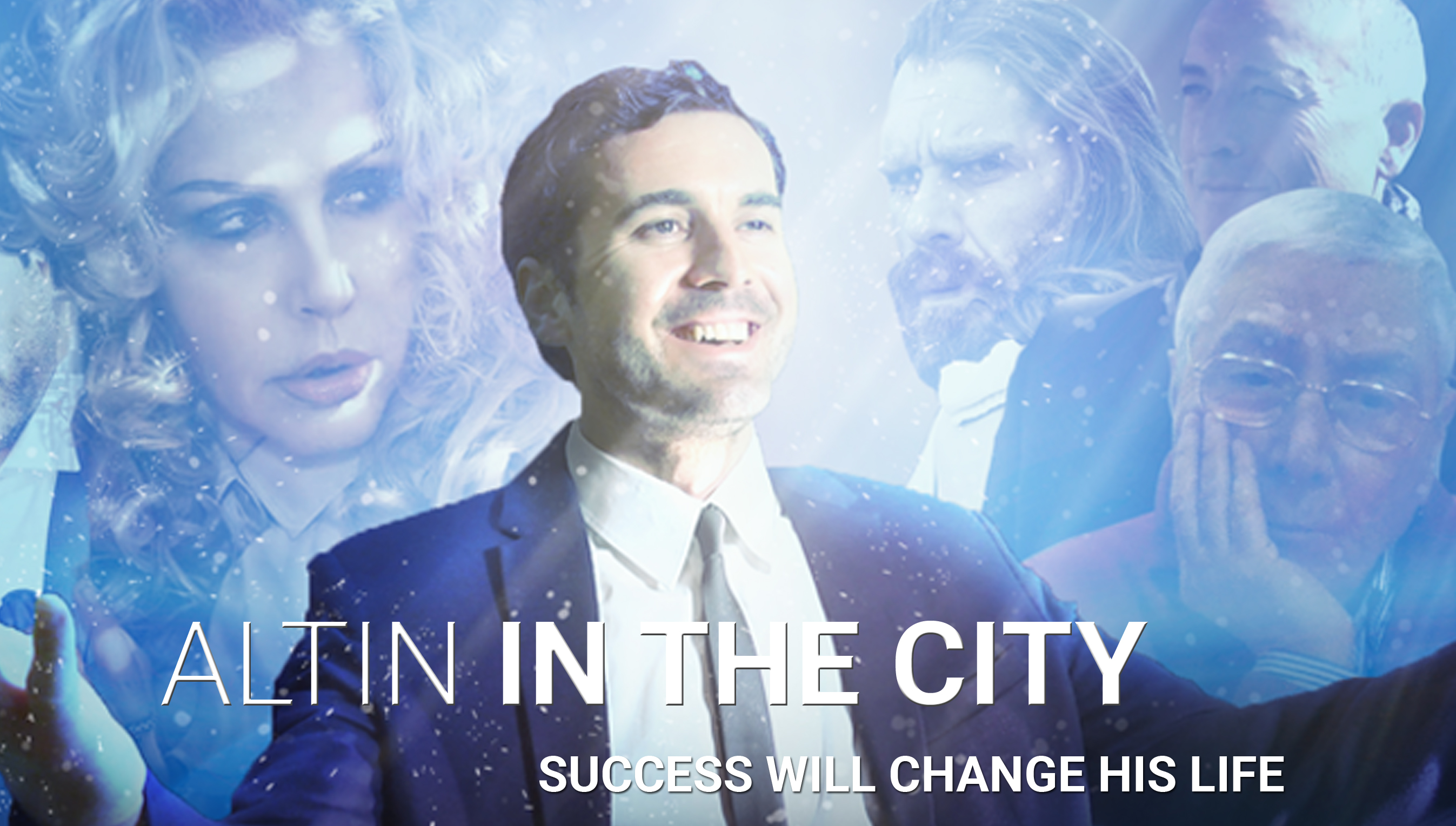
Drama, thriller, by Fabio Del Greco, Italy 2017.
Altin, aspiring Albanian writer arrived in Italy aboard a large ferry in the 90‘s, works in a butcher shop when he’s selected to audition for a reality of writers and finally sees a chance to be successful with his book “the journey of Ismail.” Unfortunately, this is the begin of the adventures which will lead him to learn about revenge, loneliness and extreme poverty, to the dark side of wealth and success.
The theme of Altin in the City should not lead to the assumption that it is merely the story of a young immigrant trying to integrate. In reality, it is a tale where greed, thirst for power and success, cynicism, and ambition intertwine, creating a sort of modern-day Faust and a new "pact with the devil" belonging to the 22nd century, which we could summarize as: show business. The reality show becomes the Mecca, the keystone, and the springboard for those who wish to achieve success without effort. Del Greco presents this world with subtle irony, characterized by kitsch nuances and parodic tones. However, success without effort comes at a price: Altin has sold his soul to the devil and, from being an easy prey of television showbiz, will soon become a victim of himself.
LANGUAGE: Italian
SUBTITLES: English, French, Spanish, German.
What Faustus Knows That Faust Did Not
You are given a diagnosis before you are given a story. That is the first unsettling thing about Thomas Mann‘s 1947 novel, and it does not relent. The narrator, Serenus Zeitblom, tells you from the opening pages that his friend Adrian Leverkühn is already dead, that the life he is about to reconstruct ended in madness, silence, and disgrace. There is no dramatic irony to enjoy, no suspense to feed. Mann has stripped away the one comfort that narrative normally provides — the illusion that you are moving toward meaning — and replaced it with something far more disturbing: the certainty that you are moving toward a conclusion you already understand but cannot yet bear to articulate.
Goethe spent nearly sixty years writing his version of the legend, and what he produced in 1832 was, beneath all its philosophical ambition, a story of exemption. Faust strives, errs, destroys, and is saved — not despite his crimes but almost because of them, because striving itself is the theological loophole. The divine wager is won not through virtue but through relentless desire. What that framework quietly smuggles in is the assumption that culture, individual genius, and historical progress are ultimately aligned, that the restless European subject who burns through everything around him is, in some cosmic accounting, on the right side. Mann, writing from California in exile while the crematoriums were still operating, had watched that assumption turn to ash with a literalness no metaphor could improve upon.
Adrian Leverkühn does not make a bet with the devil in a moment of blind desperation. He enters the pact with full analytical clarity, understanding its terms, its costs, its implications for everyone he will ever love. This is the departure that matters. The medieval Faust was damned through credulity; Goethe's Faust was saved through vitality; Mann’s Leverkühn is destroyed through knowledge — specifically, through the knowledge that the entire inheritance of Western tonal music, with its architecture of resolution and redemption built into the physics of harmony itself, has become a lie that serious art can no longer tell. The musicologist Theodor Adorno, who sat beside Mann during the novel’s composition and whose 1949 work Philosophy of New Music ran almost parallel to its themes, had already argued that late-capitalist culture had colonized even dissonance, turning rebellion into product. Leverkühn internalizes this not as theory but as creative paralysis, and the pact with the devil is, structurally, his solution to the problem of living after exhaustion.
What he purchases with his soul is not pleasure, not power, not the full range of human experience that Goethe’s hero demanded. He purchases twenty-four years of creative coldness — the ability to compose without warmth, without the irony that has become the only honest mode but that has also become too safe, too distanced, too aesthetically comfortable. The devil in Mann’s novel is not a tempter. He is a diagnostician. He appears in a chapter that reads like a fever hallucination, speaks in a shifting voice Mann renders in archaic German to make it feel both ancient and clinical, and offers Leverkühn not freedom but a very specific prison: genius purchased at the cost of human connection, love forbidden as the condition of the contract. The cruelty is precise. An artist who cannot love cannot be sentimental, cannot produce the falsely redemptive art that a sick culture craves and therefore cannot be absorbed by it.
This is what Faustus knows that Faust did not: that damnation, in the twentieth century, is not a punishment handed down from outside. It is a structural position that certain kinds of consciousness arrive at through honesty alone, by following the logic of their historical moment all the way to its terminal point, without flinching, without the mercy of self-deception, and without anyone left to blame for where they end up.

Syphilis as Epistemology
You stand at the edge of a room you were never supposed to enter. The door was left ajar, and the smell coming through it is wrong — metallic, slightly sweet — but your hand is already on the frame, and the question is no longer whether you will cross but what it will cost you.
Thomas Mann constructed this threshold with surgical precision. When Adrian Leverkühn deliberately allows a syphilitic prostitute to infect him in Leipzig — twice, the second time by tracking her down after she warned him away out of what passes for mercy — he is not surrendering to appetite. He is signing a contract whose terms he has already read. The infection is the mechanism of cognition itself, not its punishment. Mann borrowed this structure from a historical wreckage he knew intimately: on the third of January, 1889, Friedrich Nietzsche collapsed in the Piazza Carlo Alberto in Turin, threw his arms around the neck of a flogged horse, and never recovered coherent thought. The syphilitic deterioration that followed — documented in clinical detail, disputed in exact etiology but not in consequence — had been silently accumulating for years, and the philosophical output of the preceding decade, the volcanic productivity of “Thus Spoke Zarathustra,” “Beyond Good and Evil,” “The Genealogy of Morals,” arrived in that light as something produced not despite the spirochete but in a kind of terrible collaboration with it.
This is not mere biographical coincidence that Mann is trafficking in. The nineteenth century had already built an entire epistemology around the idea that access to certain registers of truth requires a body paying an inadmissible price. The Romantic tradition handed it down as consumption, as tuberculosis transfiguring Keats and Chopin into vessels too transparent for ordinary survival. By the time Cesare Lombroso published “The Man of Genius” in 1888, one year before Nietzsche’s collapse, the pathologization of exceptional cognition had become pseudo-scientific doctrine — the argument being that genius and degeneracy shared a neurological substrate, that the same deviation from the norm that produced crime could, tilted at a different angle, produce art. Lombroso’s data was grotesque and his methodology would not survive scrutiny, but the cultural logic embedded in his project outlasted the science: that ordinary minds are protected by their very ordinariness, and that whoever sees further has paid for the distance in biological coin.
Mann inverts this passively received cultural inheritance into an active choice. Leverkühn does not fall ill — he chooses the illness as one chooses a tool, understanding that the specific neurological effects of late-stage syphilis, the grandiosity, the dissolution of inhibition, the strange luminosity of perception that precedes catastrophic breakdown, are not side effects but features. The pact is not metaphysical in any safely allegorical sense; it is pharmacological. The treponema pallidum is the Devil. What the infection offers is not supernatural access to forbidden knowledge but a neurochemical dismantling of the filters that ordinary consciousness uses to remain livable. The price is that the dismantling is progressive and terminal.
What makes this unbearable to sit with is that the novel refuses to adjudicate. Leverkühn’s late works — above all the cantata that inverts and annihilates Beethoven’s Ninth, replacing its transcendent affirmation with a single high note of sorrow held until the orchestra drops away beneath it — are presented as genuine achievements. Not as symptoms. The music is real, and it is great, and it was produced by a brain being eaten. Mann had spent enough time studying Nietzsche, whose “Ecce Homo” was written in the weeks immediately preceding the Turin collapse, to understand that the question of whether the ideas were true could not be separated from the question of what was happening to the neurons generating them — and that this inseparability itself was the most terrifying thing he had encountered in any archive.
The infection does not explain the genius away. It raises the possibility that explanation itself is the wrong instrument for what Leverkühn touched.
Zeitblom’s Cowardice and the Reader’s Complicity
You are reading about a man who watched everything happen and wrote it down beautifully. Serenus Zeitblom, Doctor of Philosophy, devoted friend, lover of Cicero and the classical period, sits at his desk in Bavaria as German cities burn around him and composes sentences of lapidary precision about a composer he has known since childhood. He is horrified, he tells us. He is devastated. He keeps writing.
This is the trap Mann sets, and it is sprung not on Zeitblom but on you. The reader who settles into the novel’s elaborate humanist prose, who appreciates the irony and the classical allusions, who finds Zeitblom’s hand-wringing both charming and a little ridiculous — that reader is already inside the cage. Because the very act of reading elegantly narrated catastrophe without rage, of finding the style pleasurable while the content is monstrous, reproduces exactly the posture Zeitblom embodies. He aestheticizes what he cannot stop. So, quietly, do you.
The unreliable narrator as a device has a long critical history, but what Mann accomplishes with Zeitblom goes considerably further than the standard Jamesian irony of a limited consciousness exposing itself through its blind spots. Wayne Booth’s concept of the implied author, elaborated in The Rhetoric of Fiction in 1961, describes the gap between what a narrator says and what the text as a whole communicates. In Zeitblom, that gap is not epistemological but moral, and it indicts not just the character but the reading practice itself. Zeitblom knows. He is not deceived about Adrian Leverkühn’s pact, not confused about Germany’s crimes, not ignorant of what the death camps mean. He narrates with full lucidity and does nothing. His humanist education has given him the perfect instrument for witnessing atrocity and finding the right words for it, which is to say the perfect instrument for surviving it without intervention.
There is a particular kind of cultivated cowardice that the twentieth century produced in abundance and that the twenty-first has refined to near-invisibility. It is the cowardice of people who read Hannah Arendt‘s Eichmann in Jerusalem, published in 1963, who understand the concept of the banality of evil at a sophisticated theoretical level, and who use that understanding as a form of emotional completion — as though comprehending the mechanism exempts them from its operations. Zeitblom is this person at an earlier historical moment, and Mann understood before Arendt provided the vocabulary that ordinary decent educated men were not the bulwark against fascism but frequently its most useful bystanders, because their sense of their own decency remained intact regardless of what they failed to do.
What makes Zeitblom’s position structurally insidious is that his narration is an act of love. He genuinely adores Leverkühn. His prose when describing Adrian’s music achieves something close to rapture. This is not cynicism or detachment — it is deep, committed aesthetic feeling directed at a man whose genius is indistinguishable from his catastrophe, whose art is the product of a deal that costs him his sanity and his soul. Love, in Zeitblom’s case, becomes another way of not acting. The more completely he feels, the more completely he renders, the less he needs to do anything beyond feeling and rendering. This is the humanist trap at its most elegant: substituting depth of response for any other form of responsibility.
Mann published the novel in 1947, two years after the end of the war, and the timing is not incidental. Germany was already engaged in a complex reconstruction of its cultural self-image, and the educated bourgeoisie — precisely the class Zeitblom represents — was doing what it had always done: positioning its cultivation as evidence of its fundamental innocence. Zeitblom writes his memoir from the ruins and expects that the quality of his grief will matter.
Germany as the Artist’s Body
You are sitting across from someone you once loved, watching their face change. Not gradually — that is the lie comfort tells. It happens in a recognizable moment, and then you spend years pretending you didn’t see it, because seeing it would mean admitting something about the nature of change that undoes your faith in continuity altogether.
Adrian Leverkühn does not decline. He transforms, and the transformation has a logic that Mann spent the better part of a decade trying to make legible. The composer’s syphilitic infection, contracted in 1906 from a woman he was warned against and sought out anyway, does not destroy his genius — it reorganizes it, strips it of hesitation, gives it a ruthlessness that clean health could never have produced. The works that follow are not diseased art. They are art that has bargained away the conditions under which art normally breathes: scruple, restraint, the willingness to leave things unresolved. What emerges instead is a cold brilliance, technically overwhelming, spiritually evacuated — music that dazzles precisely because nothing human is left inside it.
Mann wrote the novel between 1943 and 1947, in Pacific Palisades, in exile, receiving letters from Germany that described a country he no longer recognized as the one he had left. His own correspondence from those years, collected and published decades later, shows a man reasoning in real time about something he found almost physically repugnant in its familiarity. In a 1938 essay, he confronted the phenomenon directly: the figure leading Germany was not, in his reading, an alien intrusion into German culture but a degraded expression of it, a failed artist whose resentments had found a political form. The essay named this without flinching, and the naming cost Mann considerably in terms of how the German emigre community received him. What he was saying was not that evil had visited Germany from outside. He was saying that the catastrophe was a family resemblance.
This is what makes the novel structurally intolerable to read comfortably. Leverkühn is not a metaphor for Hitler. The relationship is more unsettling than that. Both figures, in Mann’s construction, draw from the same reservoir of Romantic energy — the German tradition’s particular investment in the transgressive, the nocturnal, the irrational as a path to higher truth. Friedrich Schlegel had theorized irony as the artist’s necessary distance from his own creation; Schopenhauer had placed the will beneath reason and called it the real. By the time Nietzsche arrived, the demolition of Apollonian order in favor of Dionysian excess had become not just an aesthetic position but a civilizational wager. What Mann understood, with a clarity that the essay of 1938 barely contains, is that these energies do not distinguish between a genius who deploys them and a demagogue who weaponizes them. The Romantic tradition had no immune system against its own worst possibilities.
Leverkühn’s final public act — a gathering of friends to whom he announces his masterwork and then collapses into madness before their eyes — takes place in 1930. The date is not incidental. Germany’s political catastrophe and the composer’s neurological one arrive at the same threshold simultaneously, and Mann refuses to let the reader treat this as coincidence or allegory. The body that has been living on borrowed neurological fire for twenty-four years finally presents its account, and the account is total. What the infection gave, the infection takes — and what it takes is not just cognition but the last residue of the capacity for genuine connection that had distinguished even Leverkühn’s coldest work from mere technical display.
The nation’s body worked on the same schedule. The energies that had produced Beethoven, Hölderlin, and the entire architecture of German Idealism did not disappear in 1933. They were redirected, their structure intact, their warmth removed, their hunger for the absolute pointed at something that could be burned.
A vision curated by a filmmaker, not an algorithm
In this video I explain our vision
Twelve-Tone Music and the Death of Freedom

You sit down at the piano and realize, somewhere around the third hour, that every note you might play has already been determined. Not by God, not by instinct, not by the muscle memory of ten thousand practice sessions, but by a system you yourself designed and from which you cannot now escape. The system is perfect. That is what makes it a cage.
This is the philosophical core of Adrian Leverkühn’s fictional invention in Thomas Mann‘s novel, a twelve-tone method arrived at not through academic ambition but through a bargain whose terms include the prohibition of love. The serialist technique Leverkühn develops — in which all twelve chromatic tones must appear in a fixed sequence before any may repeat, governing melody, harmony, counterpoint simultaneously — mirrors almost exactly the historical method Arnold Schoenberg formalized in the early 1920s. Mann built this fictional architecture in direct, sometimes uncomfortable dialogue with Theodor Adorno, who served as his musicological conscience throughout the composition of the novel and whose own thinking appears nearly verbatim in Serenus Zeitblom’s technical explanations. When Adorno published his Philosophie der neuen Musik in 1949, the same year the novel appeared in German, the two works formed something like a single argument split across two genres: music had reached a historical moment where freedom and order had collapsed into each other, and neither exit remained available.
What Adorno diagnosed with sociological precision, Mann dramatized as damnation. The twelve-tone row eliminates the hierarchy of tonal music — there is no home key, no privileged note, no return — but in abolishing that hierarchy it installs a different tyranny, total and invisible. Every compositional decision is both absolutely free, because the composer chooses the original row, and absolutely unfree, because that choice then legislates every subsequent note in the piece. Adorno called this the dialectic of enlightenment applied to aesthetic material: reason, pushed to its limit, becomes its own opposite. The emancipation of dissonance ends in a new servitude so complete it no longer feels like servitude. It feels like logic.
Mann was alert to what this meant politically, and he was writing in the historical shadow that made the allegory almost too obvious to survive as art. The novel was composed between 1943 and 1947, in exile in Pacific Palisades, while Germany burned through its own version of a total system — one that had also promised rational order, also abolished old hierarchies, also delivered its subjects into a structure from which individual deviation had become literally lethal. The parallel is never stated directly in the novel, which is part of what keeps it from collapsing into parable. Instead Mann allows the musical logic to carry the political weight, trusting that a system which removes the possibility of the wrong note and a system which removes the possibility of the wrong thought share an identical grammar of control.
What Leverkühn discovers, though, is something neither purely political nor purely aesthetic: that the system begins to compose itself. Once the row is established, the music that follows has an inevitability that the composer can observe but not alter. This is not inspiration — it is closer to watching a machine you have built begin to operate. The creativity has migrated from the act of composition into the act of system-design, and that original act happened in darkness, in a Faustian transaction the composer barely remembers making. The work that emerges is, by every technical measure, rigorous. It is also, in some sense Zeitblom cannot name but keeps circling, cold. Not cold as in emotionally restrained, but cold as in the temperature of something that no longer requires warmth to function.
At a certain level of formal perfection, the distinction between composition and decomposition dissolves entirely. The row contains chaos and order simultaneously because it cannot be heard by the listener as a system — it sounds like the abolition of all systems, like music falling apart at the level of its foundations, like something coming undone.
The Cold Ecstasy of Forbidden Knowledge
You are sitting at a piano you cannot fully play, and you know it. The notes exist, the structure is there, the tradition has handed you every tool — and still something refuses to arrive. Not failure of technique. Something worse: the suspicion that technique itself has become the obstacle, that mastery might be the very cage from which the music cannot escape. This is where Adrian Leverkühn lives permanently, before any pact, before any syphilitic bargain, before the devil arrives to formalize what was already cosmically broken.
Kierkegaard mapped the stages of existence in Either/Or, published in 1843, and the first stage — the aesthetic — is not about beauty. It is about the person who consumes experience without ever being transformed by it, who stands at the edge of sensation perpetually, reaching toward an intensity that keeps retreating. The aesthete does not lack feeling; he lacks the capacity to let feeling destroy and reconstitute him. Leverkühn is the aesthete pushed to his terminal limit: a man of such immense intellectual sensitivity that ordinary emotional access has calcified into irony, and irony has become a prison from which only catastrophe offers exit. His music cannot move because he cannot be moved — not because he is cold, but because he is so acutely aware of every emotional gesture’s prior existence in the tradition that sincerity has become structurally impossible for him. He sees the mechanism behind every feeling before the feeling can land.
This is the specifically modern wound that Thomas Mann is diagnosing, and it is not aesthetic in the comfortable sense. It is theological. When grace withdraws — when the Protestant architecture of direct access to God collapses under Enlightenment pressure, when reason subsequently proves insufficient to fill the void reason itself created — what remains is not atheism’s clean freedom but a kind of stranded verticality. The human being still orients upward, still hungers for transcendence, but finds every legitimate ladder removed. The Romantics tried beauty. The idealists tried pure thought. The vitalists tried instinct and blood. Each attempt failed not because the hunger was wrong but because the structure that would have received it no longer existed.
Georges Bataille argued in Erotism, published in 1957, that transgression is not the opposite of the sacred but its continuation by other means. The prohibition and its violation form a single structure; neither exists without the other. What Bataille understood — and what makes his thinking devastatingly applicable here — is that the person who crosses the limit is not escaping the sacred but desperately seeking it through the only aperture modernity has left open. The transgression is a religious act performed by someone who no longer has access to religion’s official architecture. Leverkühn’s pact is not a rejection of the divine. It is a violent lunge toward it through the only door that hasn’t been bricked shut: self-destruction as illumination, annihilation as the price of contact.
The devil does not offer Leverkühn power in the simple sense. He offers him fever — twenty-four years of burning, of the inhibition lifted, of the irony dissolved by infection into something that feels, however grotesquely, like grace. The syphilitic inflammation is literalized theology: the brain heated past the point where self-consciousness can police the gates, where the terrible brightness of genuine creation becomes momentarily possible. Mann is not being metaphorical. He is being precise. The only transcendence available to the modern artist is the one purchased through the systematic destruction of the self that would otherwise intercept it.
What the Devil Actually Offers
You are sitting across from someone who tells you exactly what you already believe about yourself — not what you fear, not what you hope, but the thing you have been circling for years without ever saying aloud. And the unbearable part is not that they know it. The unbearable part is the relief.
This is the transaction that Thomas Mann buried inside his 1947 novel, beneath the theology and the musicology and the collapsing Germany. Adrian Leverkühn does not meet a devil who brings something foreign into the room. He meets a figure who arrives already fluent in every private conviction Leverkühn has nurtured in solitude — the contempt for warmth, the belief that authentic art requires the abolition of comfort, the secret understanding that his gift has always demanded a price he was prepared to pay before he knew its name. The creature in the cold room does not seduce. It ratifies.
This is a philosophical distinction with devastating consequences. The history of Western thought has largely imagined temptation as invasion — something external breaking through the membrane of the self, corrupting an otherwise stable will. Augustine built an entire architecture of sin on this premise. But what Mann understands, and what the twentieth century kept discovering, is that the most consequential agreements we make are never with strangers. Erich Fromm, writing in Escape from Freedom in 1941, six years before Mann finished his novel, identified a mechanism he called the authoritarian surrender: the individual does not lose freedom to an external force so much as flee from it into the arms of a structure that promises to decide. The devil in this reading is not the one who takes. The devil is the one who receives.
Leverkühn’s pact is most disturbing precisely because it contains no coercion. The twenty-four years of illuminated creative life, the syphilitic infection reframed as the carrier of genius, the prohibition against love — none of it is imposed. It is confirmed. The composer already understood that love would dilute him. He already believed that the great work required the sacrifice of ordinary human contact. The figure across the table simply names the price he had already set and tells him the shop is open. What collapses in this scene is not Leverkühn’s freedom but the comforting story that freedom and desire were ever pointing in different directions.
The question this raises extends far past one fictional composer in one exhausted century. Every account of radical creative rupture — from Nietzsche’s breakdown in Turin in January 1889, letter after letter signed as Dionysus or the Crucified, to Rimbaud’s systematic derangement of the senses pursued as a deliberate poetic technology — carries the same structural shadow. The artist who reaches beyond the available forms, who refuses the consolation of inherited language, who insists on making something that did not exist before: what portion of that insistence is chosen, and what portion is the working-out of a compulsion that chose the artist long before any decision was made? Georg Lukács, in The Theory of the Novel written in 1916, described the modern artist as someone for whom the world has ceased to be a home — not someone who left home, but someone for whom the condition of homelessness is constitutive, the ground on which everything else is built. The pact is already signed in the ontology.
What Mann leaves unresolved, and what no subsequent reading has honestly dissolved, is whether the mirror the devil holds up reflects a tragedy or simply a truth. If radical creation always requires this structure — the surrender of warmth, the consecration of the self to an inhuman demand, the ratification of a desire that preceded conscious choice — then the devil is not an aberration in the story of art. He is a recurring and perhaps necessary presence in it, waiting patiently in every cold room where someone is about to make something that will outlast them.
🔥 Pacts with the Devil: Art, Genius, and Damnation
Thomas Mann‘s Doctor Faustus plunges into the darkest territories of artistic ambition, moral corruption, and Germany’s cultural self-destruction. These related readings illuminate the philosophical, literary, and spiritual dimensions of a novel that reimagines the Faustian pact as the very soul of modernity in crisis.
Goethe’s Faust: Meaning and Analysis
Goethe's Faust stands as the direct and towering precursor to Mann’s revisitation of the Faustian myth, transforming the old legend of diabolical bargain into a meditation on human striving and the limits of knowledge. Where Goethe's Faust ultimately reaches redemption through ceaseless effort, Mann’s Adrian Leverkühn finds only ruin and silence, inverting the Romantic optimism of his source. Reading the two works together reveals how radically the twentieth century darkened the myth it inherited.
GO TO THE SELECTION: Goethe’s Faust: Meaning and Analysis
Hesse’s Steppenwolf: Analysis
Hesse’s Steppenwolf, like Doctor Faustus, centers on an artist-intellectual torn between the life of the spirit and the destructive forces lurking within the self. Both novels inhabit the crisis of German bourgeois culture and portray their protagonists as men constitutionally unable to belong to the world they inhabit. The parallels between Harry Haller and Adrian Leverkühn illuminate a shared diagnosis of modernity as a condition of irreparable inner fracture.
GO TO THE SELECTION: Hesse’s Steppenwolf: Analysis
Kafka and Bureaucracy: The Trial and The Castle
Kafka’s explorations of bureaucracy and guilt in The Trial and The Castle resonate powerfully with the nightmarish logic of Mann’s infernal pact, in which hidden forces govern a protagonist stripped of agency and mercy. Both writers construct narrative worlds where guilt is presupposed and judgment arrives without the possibility of appeal. Placing Mann alongside Kafka reveals a distinctly Central European literary imagination shaped by theological dread and the collapse of rational order.
GO TO THE SELECTION: Kafka and Bureaucracy: The Trial and The Castle
Alchemy in Literature: From Dante to Goethe
Alchemy in literature — from Dante to Goethe — provides the essential esoteric and symbolic backdrop for understanding the transformative and destructive ambitions at the heart of Doctor Faustus. Mann’s novel is saturated with alchemical imagery: the nigredo of Leverkühn’s syphilitic descent, the false gold of genius bought at the cost of love and sanity. Situating the novel within this long literary-alchemical tradition reveals how Mann encoded his critique of fascism in the language of hermetic fire and irreversible dissolution.
GO TO THE SELECTION: Alchemy in Literature: From Dante to Goethe
Discover the Cinema of the Soul on Indiecinema
If Mann’s Doctor Faustus has stirred in you a hunger for stories that wrestle with genius, fate, and the price of beauty, Indiecinema is where that search continues. Our streaming platform gathers independent and author-driven films that dare to ask the same questions literature’s darkest masterpieces have always posed. Join us and let cinema take you where reason alone cannot follow.
👉 EXPLORE THE CATALOG: Watch Indie Films in Streaming
A vision curated by a filmmaker, not an algorithm
In this video I explain our vision

