
The Peripheral Imagination: Abruzzo as a Mirror of Italian Self-Deception
You are standing in a village square in the interior of Abruzzo, somewhere between Sulmona and the Gran Sasso massif, in a year that could be 1880 or 1910 and the difference would be almost undetectable. The square is not picturesque in the way that postcards demand. It is functional, slightly eroded, surrounded by buildings that have the particular dignity of things that were never meant to impress anyone. Half the men who should be standing in it are gone. Not dead, precisely. Simply absent, as if the land itself had exhaled them toward Buenos Aires or Pittsburgh, leaving behind women, old men, and a silence that the new Italian state had decided, in its bureaucratic wisdom, not to hear.

The Kingdom of Italy was declared in 1861, and within a generation it had already demonstrated something that official historiography would spend the following century carefully obscuring: unification was not a project of inclusion but of annexation. The Piedmontese administrative machinery extended southward and into the central Apennines not to integrate these territories but to extract from them — conscripts, taxes, labor, and the passive legitimacy of being counted as Italian without being treated as such. Massimo d’Azeglio’s famous formulation, recorded in his posthumous memoirs, that Italy had been made and now Italians needed to be made, contained within its elegant grammar a violent asymmetry: it was always certain Italians who would do the making, and certain others who would be made, or unmade, or simply not considered in the calculation at all.
Abruzzo between 1861 and 1914 lost somewhere between 30 and 40 percent of its population to emigration — a hemorrhage so severe that entire valley communities functionally ceased to exist as productive social units. These are not approximate figures drawn from melancholy folklore; they are documented in the demographic surveys conducted by Leopoldo Franchetti and Sidney Sonnino during their 1876 inquiry into southern conditions, and subsequently reinforced by the parliamentary commission on emigration that reported in 1904. What those documents reveal, when read without the softening lens of national narrative, is that the Italian state had essentially decided certain territories were more valuable as sources of exported labor than as constituent parts of a functioning democratic polity. The railway infrastructure that would have connected the Apennine interior to the coastal economy was systematically deprioritized. Roads that might have integrated mountain communities remained unbuilt or collapsed into disrepair. This was not negligence. Negligence implies distraction.
Antonio Gramsci, writing from a prison cell in the 1930s, developed across his notebooks a framework he called the Southern Question, which identified the structural subordination of the Italian mezzogiorno as a deliberate product of the northern industrial bloc’s alliance with southern landowners — an alliance that required the peasantry to remain poor, fragmented, and politically incoherent. Abruzzo sits at the geographical border of this analysis, neither fully south nor granted the protections of the center-north, which meant it occupied a kind of double invisibility: too northern to attract the solidarity that the Southern Question occasionally generated, too peripheral and too agrarian to register in the imagination of the modernizing industrial Italy that Turin and Milan were busy constructing as the nation’s self-image.
What nations do with their inconvenient territories is not so different from what individuals do with the memories that threaten their preferred self-narratives. They do not erase them entirely — erasure leaves evidence. Instead they assign them a role: the quaint, the rustic, the authentically ancient, the repository of folk wisdom and genuine feeling that the sophisticated center has traded away for progress. Abruzzo was given the costume of authenticity precisely because that costume made its structural abandonment legible as a kind of spiritual privilege rather than as a political crime.
Bare Hands

Drama, adventure, by Andrea Malandra, Italy, 2021.
Daphne is a young woman fleeing the grayness of the city and her ghosts to find herself in contact with nature. She arrives in Abruzzo, a region that meets her expectations from a naturalistic point of view, but during an excursion she ends up getting lost in the Majella woods. From here begins the story of how she tries to survive, completely alone and lost, until the experience ends up becoming something else for her: a moment of transformation and catharsis, triggered by the mythical and spiritual inspiration of the nature that is meeting, and this will forever change the way she perceives herself and the world.
The film transports the usual elements of Malandra's visual research in a new direction, no longer urban but oriented towards the nature of the mountain woods, those of the Majella, freely inspired by a true story and by several news stories that have occurred in recent years, i.e. the disappearance of hikers in the mountain forests of Abruzzo.
LANGUAGE: Italian
SUBTITLES: English
Transhumance and the Economics of Forgetting
You have almost certainly never thought about grass as a form of currency, but for roughly three thousand years, the movement of sheep between summer highlands and winter lowlands was one of the most sophisticated economic systems the Italian peninsula ever produced. The tratturi — those ancient grassy highways cutting across the Apennines toward the Tavoliere plains of Puglia — were not rustic paths worn by accident. They were engineered corridors, legally codified, fiscally administered, and socially layered in ways that would embarrass most modern infrastructure projects. At their peak under Aragonese administration in the fifteenth century, the Royal Customs of Foggia was processing the transit of nearly five million sheep annually, generating tax revenues that financed wars and courts while sustaining a human population of transhumant shepherds, drovers, veterinarians, toll collectors, and seasonal traders whose entire cosmology was organized around altitude and season rather than city and clock.
What made transhumance genuinely radical as an economic model was its distributed intelligence. No single capital controlled it. The knowledge required to move a flock from the Gran Sasso down to the Adriatic lowlands before the first frost — reading cloud formations over Corno Grande, knowing which springs along the tratturo remained potable in drought years, negotiating pasture rights with communities whose dialects shifted every thirty kilometers — this knowledge lived entirely in bodies and in oral transmission. Carlo Levi, exiled to Basilicata in the 1930s and recording what he observed in Cristo si è fermato a Eboli, noticed that the peasant and pastoral cultures he encountered operated on epistemologies the modern Italian state found not merely alien but actively threatening. The state did not simply fail to understand these systems; it needed them to appear primitive in order to justify replacing them.
The deliberate administrative dismantling began with Italian Unification after 1861, accelerated through the land reclamation schemes of the early twentieth century, and was largely completed by the postwar economic miracle that reframed southern agricultural life as embarrassing evidence of backwardness rather than as a functioning civilization with its own internal logic. The tratturi themselves were progressively fragmented — built over by roads, enclosed by private landowners, absorbed into farmland — until by the 1970s less than a third of the original 3,000 kilometers of legally protected corridors remained accessible. What was lost was not merely a picturesque custom but an entire architecture of ecological knowledge: which plants indicated toxic soil, how to distribute grazing pressure across an ecosystem to prevent erosion, the precise social contracts that governed communal resource use across regional and linguistic boundaries.
There is something instructive in how quickly a practice sustaining millions can become, within two generations, a subject for folklore museums. The transformation requires active cultural work, not mere neglect. Benedetto Croce, writing his histories of Naples and of the Kingdom of the Two Sicilies in the early twentieth century, helped establish an interpretive framework in which the south’s history was essentially a history of failure, of missed modernization, of civilizations that did not arrive at their own rational conclusions. Within that framework, transhumance could only appear as an arrested development, never as a completed and sophisticated system that had simply been interrupted by external force.
The sheep are almost entirely gone from the tratturi now. A handful of shepherds in the Abruzzo interior still practice a residual version of the migration, documented by ethnographers with the faint urgency of people recording a dying language. But the routes themselves occasionally resurface in satellite imagery, those wide green corridors cutting through fragmented agricultural land like a memory the landscape refuses to fully surrender, visible from above in ways they no longer are from ground level, which may be the most precise spatial metaphor for what official culture has done to the knowledge they once carried.

The Saffron Paradox: Luxury Produced by the Poor
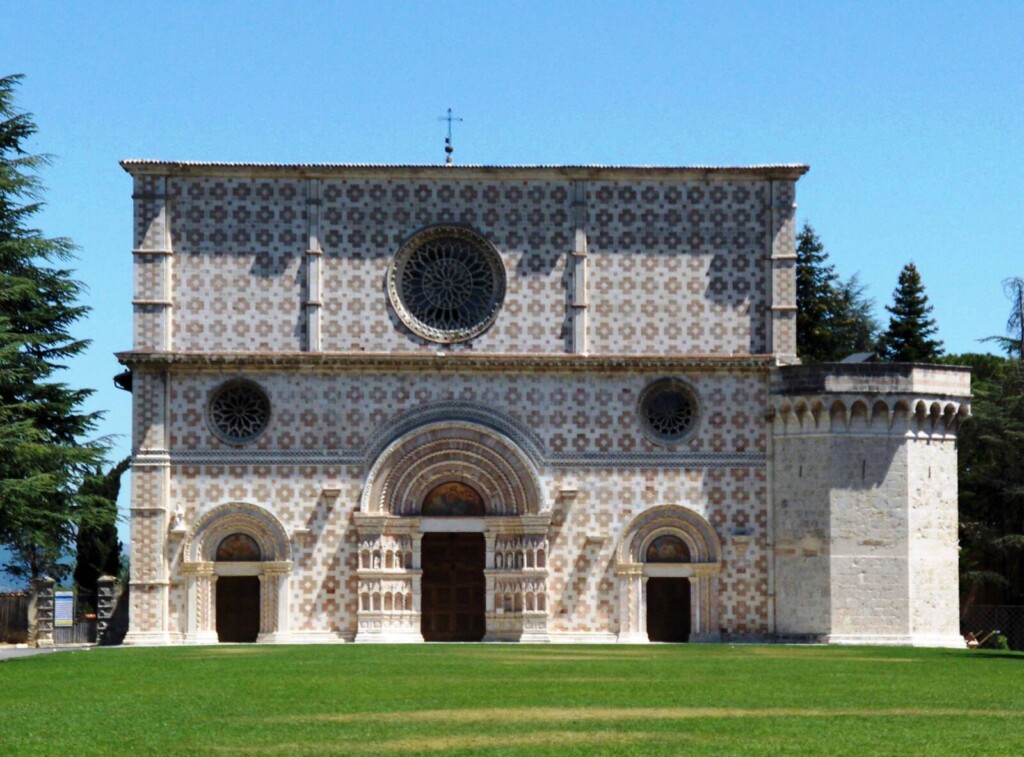
You are on your knees in a field before dawn, your fingers working in the cold dark, pulling the stigmas from crocus flowers that will close again by midmorning and render the entire day’s harvest worthless if you are too slow. The plateau of Navelli, sitting at roughly 700 meters above sea level in the province of L’Aquila, has been producing what traders historically called “red gold” since at least the thirteenth century, when a Dominican friar named Santucci allegedly smuggled the bulbs back from Spain concealed inside a hollowed walking stick. The story may be embellished, but the mathematics of what followed are not: a single kilogram of dried saffron requires between 150,000 and 200,000 hand-picked flowers, each harvested at the precise moment between dawn and the first warmth of sun, and the families who performed this labor across six centuries rarely saw the market value of what left their hands.
The contradiction embedded in Abruzzese saffron culture is not incidental — it is architectural. The spice that colored the risottos of Milanese aristocrats and dyed the vestments of papal ceremonies was classified by Renaissance merchants as a luxury commodity on the same tier as silk and certain spices arriving from the Levant. By the sixteenth century, saffron from the Navelli plateau had earned a specific geographic prestige that preceded what we now call protected designation of origin by four hundred years. Florentine merchants knew its provenance. Venetian traders priced it accordingly. Yet the agrarian contract structures governing the plateau — a feudal remnant reinforced through the Bourbon administration of the Kingdom of Naples, under which Abruzzo fell — ensured that the cultivators themselves operated under mezzadria arrangements, sharecropping systems designed to transfer the surplus upward with structural precision. The spice was valuable; the people who produced it were, economically speaking, its least benefited participants.
This is where the anthropologist Ernesto de Martino becomes quietly indispensable, not for anything he wrote specifically about saffron, but for what his 1959 work “Sud e Magia” exposed about the psychic economy of Southern Italian rural life: the way that communities under conditions of material precarity develop elaborate symbolic systems that reframe dispossession as identity. The pride that Navelli families took in the quality of their harvest — a pride that was real, transmitted across generations, embedded in gesture and knowledge — functioned simultaneously as cultural inheritance and as the most efficient mechanism for ensuring continued unpaid refinement of technique. You perfect what you love. And what you love keeps you poor in ways you do not experience as poverty.
The labor calculus grew more brutal when measured against the harvest season itself, which lasted roughly three weeks in October, during which entire family units — including children — worked before sunrise every morning. Italian agricultural census data from the early twentieth century documented child labor participation in saffron harvesting in the Aquilano zone as standard practice, unremarkable enough to appear in statistical tables without commentary. The International Saffron Market, which expanded dramatically through European colonial trade networks in the seventeenth and eighteenth centuries, created demand that enriched intermediaries in Naples, Genoa, and eventually Lyon without generating capital accumulation in the plateau communities themselves.
What accumulated instead was something harder to price: an intergenerational technical mastery so refined that Navelli saffron, designated DOP in 2005, is now analytically distinguishable from Iranian or Spanish varieties by its specific concentration of safranal and crocin compounds — qualities produced not by soil chemistry alone but by harvesting precision passed through families across hundreds of years. The market now celebrates this as artisanal heritage. It does not ask who subsidized the development of that precision with their unpaid mornings, their children’s hands, their acceptance of contracts that kept knowledge abundant and money scarce at the exact same address.
Earthquake Theology: Disaster, Power, and Collective Memory
You are sorting through what is left of your life in cardboard boxes when the government official arrives to explain that everything will be rebuilt, better than before, and that the history of this place will be honored in the reconstruction. You nod. You have nowhere else to put your grief.
On April 6, 2009, at 3:32 in the morning, the earth beneath L’Aquila moved for 42 seconds. 309 people died. Tens of thousands lost homes that had stood through centuries of smaller tremors, through wars, through the slow negotiations between stone and time that Abruzzese builders had understood as a craft and a theology simultaneously. The rubble contained not just structural failure but a specific kind of knowledge — vernacular architecture calibrated to the landscape’s violence, developed across generations who had no word for “resilience” because they had never conceptualized fragility as a temporary condition. They simply built for a world that shook.
What followed the disaster was not reconstruction. It was a political operation wearing reconstruction’s vocabulary. Silvio Berlusconi‘s government moved survivors into hastily built satellite settlements called C.A.S.E. — Complessi Antisismici Sostenibili ed Ecocompatibili — concrete modules delivered with such speed that they became the campaign image of governmental efficiency. By 2010, roughly 15,000 displaced residents had been dispersed into nineteen new neighborhoods planted in the periphery of L’Aquila’s territory, each one architecturally identical, each one severed from the street grids, piazzas, and social geographies that had organized collective life for centuries. The delivery of modern housing was framed as progress. What it dissolved was irreplaceable: the spatial memory that tells a community who it is.
Theodor Adorno, writing in Minima Moralia in 1951, observed that the administered world produces a peculiar violence — not the violence of destruction, but the violence of organization, of management so total that it leaves no space for the unmanaged to persist. Disaster creates the conditions for this administration to become total, because suffering generates consent for intervention that peace would never permit. The emergency suspends ordinary negotiation. What communities might have resisted for decades they accept in hours because the alternative is to remain in the cold. L’Aquila’s survivors were not coerced in any dramatic sense. They were managed, with sympathy, into arrangements that served the political calculus of a specific historical moment.
The criminal prosecution of six scientists and a government official for failing to adequately warn the population before the earthquake produced a grotesque inversion of accountability. The trial, which ended in 2012 with initial convictions later substantially revised on appeal, shifted public attention toward the question of seismic prediction and away from the question of building codes, enforcement failures, and the decades of deferred maintenance on public structures. It was far easier to prosecute geophysicists for incomplete communication than to prosecute the accumulated negligence of municipal and regional governments across thirty years. The juridical spectacle consumed the grief that might otherwise have demanded structural reckoning.
Collective memory, the French sociologist Maurice Halbwachs argued in Les cadres sociaux de la mémoire in 1925, is not stored in individual minds but in the physical and social frameworks that communities inhabit together. Destroy the frameworks and you do not merely displace people — you interrupt the transmission of everything those frameworks carried. The medieval center of L’Aquila, still partially inaccessible more than a decade after the earthquake, became a frozen zone, a quarantined past, while the present was being assembled in prefabricated modules that carried no memory at all. To live in a space with no history is not neutral. It is a specific condition that makes certain thoughts harder to think, certain solidarities harder to feel, certain resistances harder to organize.
Abruzzo has been called by its own people a region that forgets nothing. What earthquake theology actually reveals is how much institutional power depends on ensuring that the opposite becomes true.
The Brigand as Philosophical Figure
You are standing in a photograph taken sometime around 1865, though you will never see it. You are barefoot, your jacket torn at the shoulder, and behind you three carabinieri hold rifles as if you might still run. The caption beneath the image, written in the clean administrative Italian of the new unified state, calls you a brigand. It does not ask what you ate last winter, or who took your land, or what you understood by the word Italy, a word that arrived in your valley like a foreign tax collector and left the same way.
The phenomenon that Italian official historiography labeled brigandage in the years immediately following unification — concentrated between 1861 and 1870, most violently in the southern Apennines and across the interior of Abruzzo — was not the eruption of criminality that Piedmontese generals and liberal newspapers described in their dispatches. Eric Hobsbawm, writing in Primitive Rebels in 1959 and later in Bandits in 1969, gave historians the conceptual vocabulary to see what was actually happening: a pre-political form of class rebellion, articulated not through manifestos or unions but through armed refusal, through the body of a man who would not surrender his commons, his grazing rights, his unwritten claim on land that had been enclosed and redistributed by a state he had never consented to join. Hobsbawm called these figures social bandits — not criminals in any meaningful sociological sense, but symptoms of a structural violence that the dominant order preferred to rename as disorder.
In Abruzzo, the terrain itself made the distinction between peasant and outlaw functionally meaningless. The Gran Sasso massif, the Maiella plateau, the deep gorges of the Sangro — these were not backdrops to resistance but its architecture, spaces that the Bourbon administrative apparatus had never fully penetrated and that the new Italian state inherited as a problem it could only solve militarily. Between 1863 and 1865, the Pica Law — formally the Law for the Repression of Brigandage — authorized military tribunals, summary executions, and the deportation of anyone suspected of supporting armed bands. Tens of thousands of people were processed under its provisions. The law did not distinguish between a man who carried a rifle and a woman who left bread at the edge of a field. It criminalized an entire social ecology.
What the liberal state could not admit, because admitting it would have delegitimized the entire project of unification, was that the peasants of Abruzzo and the broader Mezzogiorno had experienced the Risorgimento not as liberation but as conquest. The abolition of feudal land rights had been promised and then deferred. The common lands that had sustained subsistence communities for generations were privatized through a process that systematically favored local notables and northern investors. The new tax regime extracted from populations that had nothing to give. Antonio Gramsci, writing from a Fascist prison cell in the 1930s in what would become the Prison Notebooks, described this structural abandonment as the Southern Question — the recognition that Italian unification had been achieved not by integrating the south but by colonizing it, installing a northern industrial bourgeoisie as the hegemonic class over an agricultural periphery kept deliberately underdeveloped.
The brigand, then, was not a failure of civilization. He was its proof — evidence that the social contract had never been extended to include him, that the state whose laws he broke had never offered him anything those laws were designed to protect. His violence was legible, if anyone chose to read it, as a demand: not for a different government, not for a different king, but for the elementary conditions of a life that modernity had promised universally and delivered selectively, and whose selective delivery required, as its administrative complement, the invention of the criminal class.
A vision curated by a filmmaker, not an algorithm
In this video I explain our vision
Dialect, Silence, and the Violence of Standard Language

You are sitting across from your grandmother at a kitchen table in Lanciano or Pescara or some village whose name the highway signs have already half-forgotten, and she is telling you something — something precise, something that carries the specific weight of a life lived in stone and cold and altitude — and the word she reaches for does not exist in Italian. She hesitates. She finds a substitute. Something is lost in that half-second, quietly, the way snow disappears when it lands on warm skin.
The Abruzzese dialect, or rather the constellation of dialects scattered across the Apennine valleys and the Adriatic coastline — since no single tongue ever governed this fractured interior — belongs to the southern Italo-Romance family, deeply archaic in its phonology, preserving Latin structures that standard Italian abandoned centuries ago. These are not corruptions of a purer language. They are independent epistemological architectures, carrying distinctions that Italian cannot make, encoding relationships between humans and land, between seasons and obligation, between shame and honor, that have no equivalent grammatical home in the national tongue. When a linguistic system dies, it does not leave a gap that another fills neatly. It leaves a shape that cannot be named by its absence.
Antonio Gramsci understood this with a clarity that was partly biographical. Born in Sardinia in 1891, writing his Prison Notebooks between 1929 and 1935 while Mussolini’s regime enacted its campaign of linguistic unification, Gramsci saw language not as a neutral medium of communication but as a battlefield where class power reproduces itself invisibly. In those notebooks, he argued that hegemony operates most efficiently not through force but through the internalization of the dominant culture’s assumptions — and that language is the primary vehicle through which this internalization occurs. To speak the language of those who rule you is to begin, almost imperceptibly, to think within the categories they have sanctioned.
Fascist linguistic policy was not subtle about its ambitions. The 1923 Gentile Reform had already positioned Italian as the singular legitimate vehicle of national identity, and by the late 1920s the regime was actively suppressing dialect use in public spaces, in schools, and eventually in theatre and radio. Regional vocabularies were framed as symptoms of backwardness, of the rural ignorance that the modern nation was supposed to overcome. In Abruzzo, where dialects were not merely spoken but were the primary means through which agricultural knowledge, legal custom, and communal memory were transmitted, this was not a pedagogical intervention. It was an amputation performed under anesthetic, while the patient was told it was surgery for their benefit.
What persisted afterward was something more insidious than outright loss. The dialect survived, as dialects do, in kitchens and fields and the conversations of old age, but it survived marked. It carried the stigma that had been deliberately attached to it — the stigma of the uneducated, the provincial, the embarrassing. Speakers learned to code-switch not freely but defensively, producing in their children a form of linguistic shame that functioned as cultural self-erasure passed down the generations. By the 1970s, sociologists like Tullio De Mauro were documenting how the spread of Italian through television had completed what fascism had begun, not through coercion now but through aspiration — through the desire of working-class and peasant families across the south and interior to sound, and therefore to be, modern.
What cannot be measured in any demographic survey of language shift is the specific knowledge that dissolves with a vernacular’s retreat. The Abruzzese dialects carried within their vocabulary a granular taxonomy of terrain, weather, and seasonal labor that had been calibrated over centuries of transhumant pastoralism — the twice-yearly movement of flocks between the mountain pastures and the Tavoliere plain, along the ancient drove roads called tratturi, some of which date to pre-Roman settlement. That knowledge was not written down. It was encoded in speech, in the particular words used between shepherds to describe wind direction or the behavior of a flock before a storm. When the language contracted, that precision contracted with it, and no Italian word arrived to replace what had been specific, functional, and irreplaceable.
Patron Saints and the Architecture of Social Control
You have attended the festa at least once in your life — maybe as a child dragged through a crowd that smelled of incense and fried dough, maybe as an adult watching a gilded statue of a saint hoisted onto the shoulders of men who wept openly while the band played and the fireworks cracked above a village square. You felt something. That feeling is the problem.
Émile Durkheim, writing in The Elementary Forms of Religious Life in 1912, identified what he called collective effervescence — the surge of emotional electricity generated when bodies gather around a shared symbol, producing a sensation so intense that participants attribute it to something supernatural. He was not being dismissive. He was being precise. The feeling is real; what it is attributed to, and more critically what it accomplishes socially, is where the architecture begins to reveal itself. In Abruzzo, where each municipality maintains its own patron saint with its own feast day, its own procession route, its own hierarchy of confraternities controlling who carries the statue and in what order, the effervescence is not incidental to the social structure — it is the method by which that structure reproduces itself annually and seals itself against examination.
The confraternities of Abruzzo, many dating to the fifteenth and sixteenth centuries, were never simply devotional associations. They were guilds of local authority operating under ecclesiastical cover, controlling burial rights, charitable distributions, and the symbolic economy of public honor. When a family’s men had carried the saint for three generations, that act of devotion became inherited capital — not metaphorically but practically, determining credit arrangements, marriage alliances, and which disputes the village elder would mediate in whose favor. The festa was the annual publication of these invisible ledgers, a ceremony in which everyone could see, without anyone needing to say, exactly who belonged where.
What makes the system durable is that it encodes hierarchy inside an experience of radical equality. The procession creates a temporary suspension of ordinary social distance — the priest and the shepherd walk the same route, breathe the same smoke, shout the same invocation. Pierre Bourdieu‘s concept of symbolic violence, developed in Outline of a Theory of Practice in 1977, names this mechanism directly: power is most stable when it presents itself as something other than power, when domination is experienced as participation and exclusion is experienced as sacred order. The person who was never invited to carry the statue does not feel excluded. They feel unworthy. This is a profoundly different emotional register, and it requires no enforcement.
The question of historical amnesia embedded in these festivals is more disturbing still. Many Abruzzese patron saint cults absorbed, renamed, or suppressed pre-Christian sacred sites and local deity figures during the Christianization campaigns of the early medieval period — a process historian Peter Brown traced across the late Roman world in The Cult of the Saints, published in 1981. The mountain sanctuary of the Madonna di Pietà near Castel del Monte, for instance, occupies a ridge that local oral tradition itself acknowledges as a site of pre-Christian gathering, though what was gathered there, what was believed, what was contested, has been layered over so completely that the question itself seems almost offensive to raise at a festa. The saint does not replace the memory — she replaces the need to have one.
Children in Abruzzo still learn, before they learn almost anything else about their town’s history, the name of their patron saint, the date of the feast, and the correct manner of reverence. They learn this the way they learn their surname — as something that precedes them, that explains them, that makes them legible to the community before they have developed any capacity to make themselves legible on their own terms. What they do not learn is that someone, at some specific historical moment, made a decision about which saint this would be, and why that decision served certain people’s interests far more than others.
Emigration as Permanent Condition, Not Historical Episode
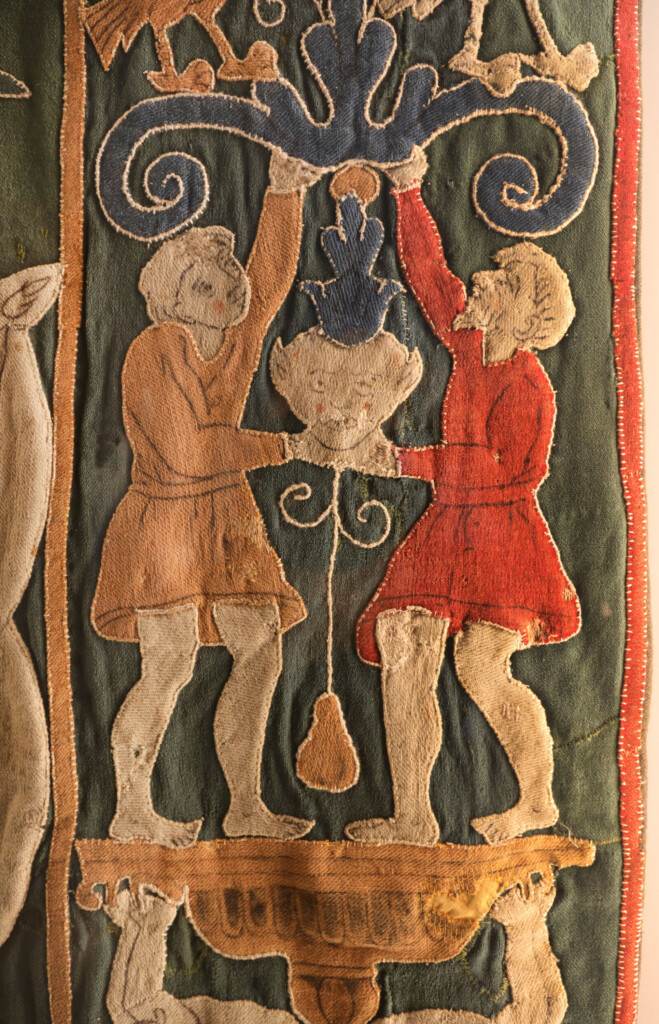
You leave your village at dawn, before the church bells, because you cannot afford to be seen crying at the station — and because the men who built the railroad that carries you away did not build it to connect you to anything, but to move you out efficiently.
Between 1880 and 1930, the Abruzzo region hemorrhaged something close to half a million people, a figure that emptied stone villages in the Apennine interior down to their foundations, leaving behind architectures of absence that tourists would later photograph as picturesque. The Italian state, newly unified and structurally incapable of integrating its southern and central mountain populations into a coherent economic project, did not respond to this exodus with alarm. It responded with policy. The Commissariato Generale dell’Emigrazione, established in 1901, was not a rescue institution but a logistics apparatus — it regularized the flow, protected shipping companies’ profits, and ensured that remittances would cycle back into an economy that had never planned to employ the people sending them. What is called emigration in the history books was, in administrative terms, a managed export of demographic surplus.
Antonio Gramsci, writing from a prison cell in the 1930s in his Notebooks, described the Southern Question not as a failure of development but as a structural relationship — the industrial north requiring a south that remained underdeveloped, a reserve of cheap labor and captive markets, its educated classes co-opted into state functions that kept them loyal to the center. Abruzzo was not exactly south, geographically, but it occupied the same structural position: a territory whose productivity was extractable only through human bodies, and whose bodies were therefore the primary commodity. The emigrant was not a person who left. He was a unit released when the local economy could no longer absorb him and recalled — through the mythology of return, through the language of roots — when the receiving country’s economy expelled him back.
The villages of the Majella and Gran Sasso did not simply shrink. They underwent a specific form of social reorganization around absence, in which the emigrant husband or father became a figure of authority exercised from overseas, through letters and remittances, more powerful in his distance than he had been in his presence. Women who remained managed land, settled disputes, raised children, and in many cases made every consequential decision for years without being recognized legally as heads of household. The anthropologist Tullio Tentori documented precisely this inversion in postwar communities in central Italy in the 1950s and 1960s, showing that the official family structure and the functional family structure had almost nothing to do with each other. The law described a patriarch. Reality had produced something far more complex and far less legible to the state that had created the conditions for it.
What makes this a permanent condition rather than a historical episode is not that emigration continued — though it did, in different waves and toward different destinations, in the 1950s toward Turin and Milan, in the 1990s toward Germany and the United Kingdom — but that the structural logic was never dismantled. The regions of the Apennine interior never received the investment, the infrastructure, the institutional density that would have made departure unnecessary. Each wave of departure was treated as a problem of the people who left rather than a symptom of the political choices that made leaving rational. When the 2009 earthquake struck L’Aquila and killed more than three hundred people, the reconstruction process that followed reproduced in miniature the same logic: funds allocated, projects announced, populations temporarily displaced, and a decade later, entire neighborhoods still uninhabited, the young still leaving for cities that had no particular reason to want them but at least pretended to offer a future.
To call this emigration is already to concede too much to the vocabulary of choice.
🏔️ Roots and Identity: Italy's Cultural Soul
Abruzzo is one of Italy’s most ancient and distinctive regions, where history, folklore, and landscape intertwine to form a rich cultural identity. To understand Abruzzo’s place within Italian civilization, it helps to explore the broader traditions and regional identities that have shaped the peninsula’s cultural mosaic.
Southern Identity in Italian Culture
Southern Italian identity is a complex weave of historical memory, oral tradition, and local pride that has long been the subject of literary and sociological inquiry. This article explores how writers and thinkers have grappled with the idea of a distinct Southern self, caught between modernity and deeply rooted cultural inheritance. Understanding this identity helps illuminate how regions like Abruzzo have preserved their own unique character within the broader Italian narrative.
GO TO THE SELECTION: Southern Identity in Italian Culture
Umbria in Italian Culture and Literature
Umbria, like Abruzzo, represents one of Italy’s most spiritually resonant and historically layered regions, deeply embedded in the literary and cultural imagination of the country. This article traces the way Umbrian landscapes, saints, and traditions have inspired writers, poets, and artists across the centuries. Comparing these central Italian regions reveals the common threads of mysticism, rural culture, and local pride that define the Italian interior.
GO TO THE SELECTION: Umbria in Italian Culture and Literature
Sardinian Culture: History Traditions and Identity
Sardinian culture offers one of the most striking examples of how a distinct regional identity can resist homogenization and maintain its own language, traditions, and worldview over millennia. This article examines the history and cultural foundations of Sardinian identity, from its ancient Nuragic civilization to its modern literary expressions. The parallels with Abruzzo’s own tenacious local culture make this a compelling companion reading.
GO TO THE SELECTION: Sardinian Culture: History Traditions and Identity
Italian Medieval Communes: History and Culture
The Italian medieval communes were crucibles of civic life, local governance, and cultural production that shaped the identity of countless Italian towns and territories, including those of Abruzzo. This article reconstructs the history and cultural significance of these urban communities, which forged the political and artistic DNA of the Italian peninsula. Their legacy is still tangible in the architecture, festivals, and traditions of regions like Abruzzo today.
GO TO THE SELECTION: Italian Medieval Communes: History and Culture
Discover Italy's Deepest Stories on Indiecinema
If the history and traditions of Abruzzo have sparked your curiosity about Italy’s cultural roots, Indiecinema streaming is the ideal place to continue your journey. Our curated catalog of independent and documentary films explores regional identities, forgotten histories, and the living traditions that make Italian culture so extraordinarily rich. Join us and let independent cinema open a new window onto the world.
👉 EXPLORE THE CATALOG: Watch Indie Films in Streaming
A vision curated by a filmmaker, not an algorithm
In this video I explain our vision

