
The Ordinary Trap
You wake up at the same hour you have woken up for eleven years. You make coffee in the same kitchen, with the same gestures — the tap, the spoon against ceramic, the brief pause before the first sip — and somewhere between the coffee and the door you realize, without drama, without crisis, that you are performing yourself. Not living. Performing. The distinction arrives quietly, like a draft from under a closed door, and then disappears just as quietly, because there are emails to answer and a train to catch and a version of you that the world expects to show up on time.

This is not depression. That would be easier to name, easier to treat, easier to carry like a visible wound that explains itself. This is something more slippery: the condition of being fully functional and almost entirely absent. You participate in the mechanics of your own existence with a professionalism that would be impressive if anyone were watching. You work, you want things, you touch people, you are occasionally moved by music or light or the smell of rain on concrete. But underneath the participation there is a kind of hollow resonance, as if the actions you perform are slightly larger than the person performing them, like clothes cut for someone taller.
Sociology has a language for the outer edges of this feeling. Émile Durkheim wrote about anomie in 1897 in his study of suicide, describing the condition of individuals untethered from the moral frameworks that once gave their actions collective meaning. Marx spoke of alienated labor as the condition in which a worker becomes estranged not merely from the product of his hands but from the very act of producing, from other human beings, and finally from himself. Georg Simmel, in his 1903 essay on the metropolis and mental life, identified the blasé attitude as the city-dweller’s only viable defense against the sensory overload of modern existence: a learned indifference that protects the nervous system at the cost of depth. Each of these thinkers was pointing at the same architectural feature of modern life: the systematic distance between a human being and the meaning of what they do.
But these frameworks remained largely structural. They described the cage with precision and measured its dimensions carefully. What they did not do, what perhaps only literature could do, was place you inside it in the first place, make you feel the bars not as theory but as the particular texture of a Tuesday afternoon, the way a conversation over dinner can feel both intimate and utterly evacuated, the way desire can arrive fully formed and depart without having touched anything real. That other register, the register of lived phenomenology rather than social diagnosis, requires a different instrument. It requires a writer who is willing to press his hand against the wound without flinching, without moralizing, without offering the reader the small consolation of a lesson.
The borghesia, the Italian bourgeoisie of the mid-twentieth century, was an especially fertile ground for this kind of excavation, precisely because it had perfected the art of surface. It was a class that had survived fascism by accommodating it, that had survived the war by rebuilding quickly, that had learned to convert any rupture in the social fabric into an occasion for renovation rather than reckoning. Its living rooms were full of objects that declared stability. Its marriages were contractual architectures. Its sexuality was either suppressed to the point of deformation or enacted with the same compulsive emptiness as any other consumption. It did not suffer, exactly. It managed. And the management of suffering, the bureaucratic administration of one’s own interiority, is perhaps the most sophisticated trap that comfort has ever built.
To read Italian literature of that era without reckoning with this terrain is to miss the entire moral weather of the century. And to understand that weather without its most unflinching chronicler is to read the room while ignoring the person who described it with the accuracy of someone who had been trapped inside it his entire life.
The Smartphone Woman
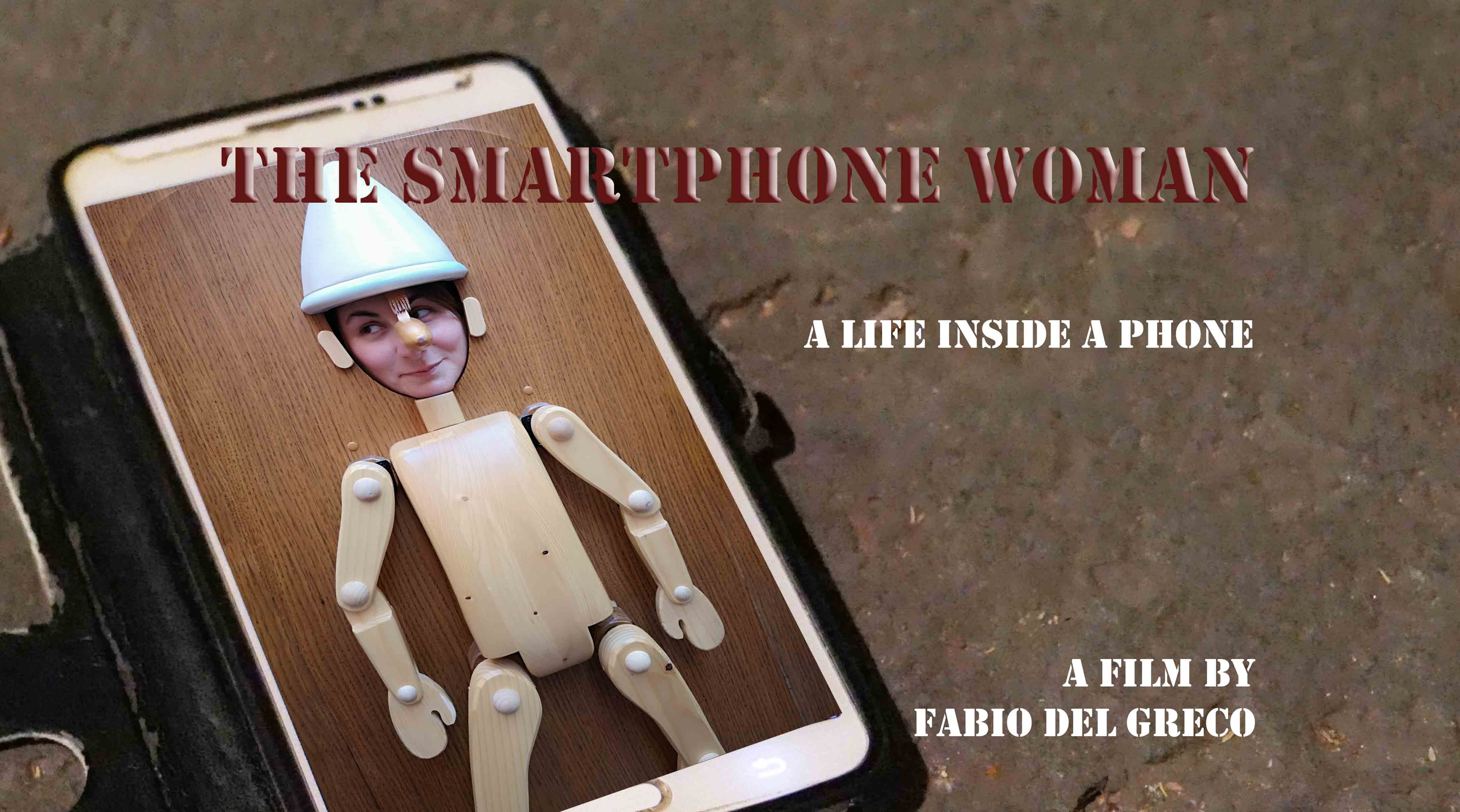
Drama, thriller, dark comedy, by Fabio Del Greco, Italy 2020.
On a bridge over the Tiber River, an elderly and severely ill man has decided to end his life, but an unusual discovery changes his mind: he comes across a lost smartphone. Intrigued, he decides to return home and watch the videos contained within it. On the screen, a series of videos unfold, telling the story of a woman who has emigrated from southern Italy to Rome to work as a teacher in schools and her struggles with integration in a social reality she cannot fully grasp.
"The Smartphone Woman" is a realistic tale of a woman's life and her complex relationship with an "infernal" city. It portrays the challenges she faces, her connection to her origins, the social discomfort she discovers in the outskirts, and the eerie presence of the ghosts of ancient Roman empire. Fabio Del Greco employs a fragmented style, using pieces of "real life" shot with the smartphone, to construct a narrative that ambiguously oscillates between fiction and truth. This creates a captivating exploration of the discomfort and alienation within the bustling city, contrasting with the peaceful village life from which the protagonist hails. The film is constructed with a variety of heterogeneous characters and situations, an emotional kaleidoscope, weaving between evenings of exploration in the Eternal City and daily struggles. Realistic smartphone-shot videos are alternated with a narrative thread reminiscent of film noir and, ultimately, surrealism in the finale. On screen, a succession of grotesque characters unfolds, representing the director's vision of a tumultuous humanity. The film's potency lies in the emotion it manages to convey and in the protagonist's naive perspective. "The Smartphone Woman" is a must-see for enthusiasts of independent and experimental cinema.
LANGUAGE: italian
SUBTITLES: English, French, German, Portuguese, Spanish
A Body That Forced Him to Think
He was nine years old when his left knee began to betray him, and the world that other children moved through freely — the streets of Rome, the noise of school, the ordinary friction of growing up — became something he could only observe from a distance, through windows and through pages. Alberto Pincherle, born in Rome on November 28, 1907, into a bourgeois Jewish family of comfortable means and considerable coldness, would spend much of his adolescence horizontal. Tuberculosis of the bone is not the romantic illness of poets coughing beautifully into white handkerchiefs. It is grinding, humiliating, and slow. It attacks the architecture of the body itself, the structural matter, the parts that hold you upright, and in doing so it teaches the person trapped inside that flesh is not neutral. Flesh has opinions. Flesh imposes conditions. And for the boy who would become Alberto Moravia — a pen name chosen later, deliberately, with the particular awareness of someone who understood that identity is partly a construction — that enforced immobility became something stranger and more generative than simple suffering.
Between 1916 and 1925, with interruptions, he spent long stretches confined to bed or to sanatoriums, including years at Cortina d’Ampezzo and at a clinic in Bressanone. He had almost no formal education to speak of. He read instead — voraciously, without curriculum, without a teacher telling him what mattered. He encountered Dostoevsky and was changed by it in the way a person is changed by something that names what they already knew but had no language for. He read Goldoni, Molière, Joyce, and the French naturalists, not as a student fulfilling requirements but as someone who had nothing else to do with time except think. And thinking, when the body forces it upon you long enough, stops being an activity and becomes a condition. It becomes the way you breathe.
What emerged from those years was not wisdom in the conventional sense — not acceptance, not serenity, not the patient philosophy of the convalescent. What emerged was a ferocious and almost clinical attention to the way people perform their inner lives rather than live them. Moravia would later describe indifference not as the absence of feeling but as a kind of moral paralysis, the state of knowing what you feel and being constitutionally unable to act on it. That is not an idea a healthy, socially integrated adolescent arrives at easily. It is the idea of someone who has spent years watching the world operate without him, noticing the gap between what people say and what they do, between the face they wear and the mechanism running underneath.
He began writing Gli indifferenti at nineteen. He finished it at twenty. It was published in 1929, at his family’s expense, and it landed on Italian literary culture like something that had no right to exist — a novel of such technical and psychological maturity that reviewers struggled to believe it was a debut, let alone the debut of someone who had never formally studied literature. The novel follows a Roman bourgeois family across two days of moral dissolution, and it does so with the kind of airless precision that belongs to someone who has observed social theater from outside the theater itself. The mother who sells herself emotionally to maintain appearances. The daughter who knows she is being betrayed and watches herself fail to resist it. The son, Michele, who stands at the center of the novel as a figure of radical inaction — a young man who sees everything clearly and finds himself unable to make a single gesture that is truly his own. Michele is not cynical. He is something far more disturbing: he is conscious.
That consciousness, born in a sickbed in the Alps, written in a rented room in Rome, would define Italian literature for the next five decades in ways that were not always immediately legible, because the truths it carried were not the kind anyone was in a hurry to recognize.

Indifference as a Philosophical Condition
There is a moment, familiar to almost anyone who has sat at a dinner table with people they have known their entire lives, when the words being spoken seem to arrive from very far away. The conversation continues. Glasses are refilled. Someone laughs. And yet something has gone slack, some interior thread connecting you to the scene in front of you, and you find yourself watching your own life the way you might watch rain move across a window — present, technically, but sealed off from it by a surface you cannot name. Moravia spent the better part of four decades trying to name that surface, and what he arrived at was not boredom in any casual sense but something far more corrosive: indifferenza and noia as conditions of being, as the precise temperature at which a self begins to dissolve from within.
His first novel, Gli indifferenti, published in 1929 when he was twenty-two, announced the diagnosis with almost clinical directness. The two young protagonists, Michele and Carla, move through the destruction of their family’s financial and moral world without genuine affect. They witness betrayal, sexual compromise, the slow erasure of any stable ground beneath them, and they do not feel it — or rather, they feel a kind of dim awareness that feeling is what they should be doing, and they perform approximations of it instead. This gap between the emotion that is socially expected and the vacancy that actually inhabits the chest is precisely what Jean-Paul Sartre, writing nearly two decades later in Being and Nothingness in 1943, would call mauvaise foi, bad faith: the human tendency to treat oneself as a fixed object, to inhabit a role so thoroughly that genuine freedom becomes not just inconvenient but literally unthinkable. Moravia reached the same diagnosis from a different direction, through narrative rather than phenomenology, through watching bourgeois Romans rather than Parisian café waiters, but the structure of the trap is identical.
What separates Moravia’s version from simple social criticism is that he refuses to locate the cause in external circumstances. His characters are not indifferent because they are oppressed or exploited or even unhappy in any measurable way. They are indifferent because comfort has severed them from necessity, and without necessity they have lost the thread back to themselves. The bourgeoisie he dissects across his major works — from the Roman family of Gli indifferenti to the protagonist of La noia in 1960, a painter who cannot work because objects have lost their density, their thereness — is not suffering in any way the world would recognize as suffering. This is the trap within the trap. The numbness presents itself as stability. The disconnection presents itself as sophistication. A man who feels nothing is very difficult to accuse of feeling the wrong things.
By the time La noia appeared, Moravia had refined noia into something approaching a formal philosophical category. His painter does not lack desire; he is saturated with it in the abstract while being incapable of attaching it to anything specific. Reality keeps slipping. Objects, people, even his own canvases fail to hold their weight. The condition is not depression, not nihilism, not laziness. It is closer to what the sociologist C. Wright Mills described in White Collar in 1951 as the alienation not of the factory worker but of the middle-class professional who has sold not just his labor but the very capacity for self-direction — the person who no longer knows what he would want if wanting were permitted. Moravia understood, with the instinct of a novelist rather than a theorist, that this variety of emptiness is the most durable because it carries no visible wound. It does not announce itself. It simply spreads, imperceptibly, until one day the dinner table feels very far away and the rain on the glass is the most honest thing in the room.
Sex, Power, and the Currency of the Body
There is a moment, somewhere in the middle of an ordinary afternoon, when a woman calculates. Not dramatically, not with visible anguish, but with the quiet precision of someone who has long understood that her body is not simply hers — it is also a form of currency, subject to exchange rates she did not set and cannot fully refuse. Adriana, the young Roman woman at the center of Moravia’s 1947 novel, knows this arithmetic before she can articulate it. She is not corrupt. She is not naive. She is simply living inside a system that has made the transaction of flesh the most reliable economy available to her, and Moravia watches her navigate it without flinching and without sentimentalizing what he sees.
Alberto Moravia had been writing about sex since Gli indifferenti in 1929, but by the time he published La romana, something had hardened in his understanding. Sexuality in his earlier work was a symptom of spiritual vacancy, a way of passing through the world without truly touching it. By 1947, having lived through fascism, having hidden in the mountains near Fondi with his wife Elsa Morante to escape Nazi-Fascist roundups after the Italian armistice of September 1943, he was writing about the body as a political surface. Adriana is not liberated by her sexuality, nor destroyed by it in any operatic sense. She is simply shaped by it, the way a coin is shaped by the mint that produces it. She circulates. She acquires value and loses it according to logics entirely external to her own desire.
This is precisely the terrain that Simone de Beauvoir had mapped in Le Deuxième Sexe, published just two years after La romana, in 1949. De Beauvoir’s argument was not that women were weak or passive but that femininity itself had been constructed as a condition of immanence — a state of being defined by one’s usefulness to others rather than one’s own transcendence. The woman’s body, in de Beauvoir’s analysis, is not a natural fact but a cultural inscription, a site where class, economic dependency, and political subordination are written into flesh so thoroughly that they begin to feel like anatomy. What Moravia shows in Adriana’s daily negotiations — with clients, with lovers, with a society that simultaneously desires and condemns her — is exactly this: not the drama of a fallen woman, but the mundane, exhausting labor of someone managing an asset she never chose to own.
La ciociara, published a decade later in 1957, pulls this logic into its most devastating form. Cesira and her daughter Rosetta, fleeing wartime Rome for the hills of Ciociaria, discover that the collapse of civil order does not create freedom — it accelerates the exposure of what was always there. The body, in a landscape stripped of legal and social mediation, becomes the most immediate site of power’s exercise. The violence Rosetta suffers near the end of the novel is not a rupture in the world’s order. It is the world’s order, briefly made visible without its usual dressings. Moravia does not aestheticize it. He reports it with the flatness of someone who believes that the truth of a thing is most fully present when you refuse to give it a redemptive frame.
What separates Moravia from simple naturalism — from the idea that he is merely documenting poverty and brutality — is that he never lets the reader believe the problem is exceptional. The woman who sells her body in La romana and the woman whose body is taken in La ciociara are not at opposite ends of a moral spectrum. They are inside the same structure, one with more agency than the other, both subject to the same foundational truth that de Beauvoir named and Moravia dramatized: that for women in a society organized around male economic and political primacy, the body has never been a private matter, and what looks like personal choice has almost always been a negotiation conducted under conditions the chooser did not design.
Fascism as the Logical Endpoint of Indifference
There is a moment, familiar to anyone who has ever watched a crowd not react, when you understand that the real catastrophe is not the event but the silence before it. Not the silence of fear, which is at least honest, but the silence of habit — the practiced, almost elegant look-away of people who have spent decades training themselves not to feel what inconveniences them. Moravia had been writing about that silence since 1929, and by 1943 it had a name, a uniform, and a list with his name on it.
His Jewish heritage, which the Italian racial laws of 1938 had transformed into a legal liability, was never something Moravia had centered in his identity the way antisemites needed him to. He was Roman, literary, restless, and the laws arrived the way bureaucratic violence always does — not as a rupture but as a formalization of what had already been building in the atmosphere. The Fascist regime had been censoring and suppressing his work for years before it moved to suppress him as a person. Gli indifferenti, published in 1929, had already made the authorities uneasy, not because it was politically subversive in any programmatic sense, but because it diagnosed something they depended on. A regime of spectacle and manufactured passion cannot tolerate a novelist who shows that the spectacle works precisely because the audience is empty inside.
When the German occupation of Rome began in September 1943 and the deportations accelerated, Moravia and his wife, the writer Elsa Morante, fled into the mountains of Ciociaria, south of Rome, where they spent nine months living among peasants in conditions of genuine poverty and physical danger. He was not in hiding in the metaphorical sense that writers sometimes use to describe retreat. He was in hiding in the literal sense: cold, hunted, dependent on the generosity of people who had nothing, watching a world collapse that he had already, in a different register, autopsied on the page. What he observed in those mountains was not a new lesson. It was the confirmation of everything he had already argued through his characters — that the same incapacity for moral seriousness which lets a middle-class family destroy itself through boredom and evasion is the same incapacity that lets a nation watch cattle cars roll through its stations without asking what they carry.
Hannah Arendt, writing about Adolf Eichmann in 1963, would give this phenomenon its most famous formulation: the banality of evil, the idea that atrocity does not require monsters but only functionaries, people who have perfected the art of not thinking. Moravia had been writing the Italian version of that argument for thirty years before Arendt named it. His indifferent characters are not Eichmanns, but they are practicing the same fundamental skill — the deliberate suspension of moral imagination, the choice to experience one’s own life as something that happens to you rather than something you are responsible for. What Arendt observed in a Jerusalem courtroom, Moravia had been watching in Roman drawing rooms and bourgeois bedrooms, and his insight was perhaps more disturbing because his subjects were not bureaucrats processing paperwork but people making love, inheriting money, resenting their mothers. The machinery of moral abdication runs on the most ordinary fuel.
After the liberation, Moravia returned to Rome and to writing with an urgency that never fully left him. The Ciociaria period would eventually become the material for La ciociara, published in 1957, a novel narrated by a woman whose experience of the war and its violence refuses every available consolation, sentimental or ideological. But the deeper consequence of those nine months in the mountains was not a single book. It was the permanent refusal of any argument that places political catastrophe in a separate category from private moral failure — as though fascism were an interruption of normal life rather than its logical destination, arrived at by the same small daily surrenders that Moravia had been mapping since before most of his readers knew what was coming.
A vision curated by a filmmaker, not an algorithm
In this video I explain our vision
The Conformist and the Architecture of Self-Betrayal

There is a moment in the life of Marcello Clerici, the protagonist of Moravia’s 1951 novel, when he is given the precise opportunity to refuse. Not to rebel, not to flee, not simply to say nothing — but to actively choose not to participate in the murder of a man who has done him no harm. He knows what is being asked of him. He understands its weight. And then, quietly and with terrifying efficiency, he complies. What makes that compliance unbearable is not the violence it enables, but the almost architectural deliberateness with which Marcello has been constructing the conditions for it for years, brick by careful brick, erasing every edge of himself that might have resisted.
Moravia published Il conformista in 1951, six years after the fall of Italian Fascism, in a country still absorbing what ordinary participation in that system had actually required of ordinary people. He was not interested in the monsters. He had already spent the previous two decades mapping the bourgeoisie’s spiritual decay, from Gli indifferenti in 1929 through the war years, and what he had learned was that catastrophic historical evil rarely needs fanatics. It runs smoothly on a much quieter fuel: the desperate need to be normal. Marcello is not an ideologue. He is a man who, as a child, experiences an episode of violence that leaves him convinced he is fundamentally aberrant, constitutionally different from others, and who then spends his entire adult life designing a self that cannot be distinguished from the median. Marriage, career, political conformity — each choice is not a preference but a disguise. He volunteers as a Fascist agent not because he believes but because belonging, at that particular historical moment, is what normal looks like.
What Moravia constructed fictionally was something Erich Fromm had begun analyzing theoretically just nine years earlier, in Escape from Freedom published in 1941. Fromm’s central argument was that freedom, once experienced, produces an unbearable anxiety in those who lack the inner structure to bear it, and that this anxiety generates a compulsive retreat toward authoritarianism, conformity, or destructive submission — not because people are weak, but because the self that would be required to live freely has never been allowed to form. Marcello’s entire biography is a case study in exactly this mechanism. The self he suppresses is not replaced by a stronger one; it is replaced by a performing vacancy, a man-shaped outline that does what the surrounding architecture demands.
Hannah Arendt arrived at a related but distinct diagnosis a decade after Moravia, watching Adolf Eichmann sit in a glass booth in Jerusalem in 1961 and finding there not a monster but a bureaucrat, a man whose defining characteristic was what she called, in Eichmann in Jerusalem in 1963, the absence of thought. Thoughtlessness as moral catastrophe. The refusal — or the trained inability — to imagine the full reality of one’s own actions. Moravia had already given that condition a nervous system, a childhood, a sexual anxiety, and a face. Marcello does not stop thinking entirely; what he does is more insidious. He thinks obsessively about himself and never once about the human consequences of what he does. His interiority is enormous and completely sealed. It loops back on its own reflection without ever touching the other.
This is what makes Il conformista something beyond a political novel about Fascism. The regime is a backdrop, almost incidental — the specific structure onto which Marcello’s need to disappear into normality happens to attach itself. Moravia understood, and it is an understanding that still costs something to sit with, that the architecture of self-betrayal does not require a dictatorship to function. It requires only a sufficiently powerful social definition of what counts as normal, and a person frightened enough to pay whatever the entry price is.
Rome as a Living Character
You have probably walked through a city and felt, without being able to name it, that the street itself was making a demand of you. Not the people on it, not the traffic, not the storefronts — the street itself. The angle at which it meets a piazza, the width that permits a certain kind of loitering but not another, the way a particular neighborhood smells of something fried and something damp and something older than either. Alberto Moravia spent his entire writing life trying to name that demand, and what he found was that Rome was not a setting for his fiction the way a theater is a setting for a play. Rome was an argument, and the bodies of his characters were the evidence.
Michel de Certeau wrote in 1980, in The Practice of Everyday Life, that a city as planned and a city as lived are two entirely different structures. The planner sees from above, imposes grids and zones, believes in the transparency of space. The walker, moving below, through, and across, produces something the planner never authorized: a text written in footsteps, a meaning generated by use rather than design. Moravia had understood this intuitively decades before de Certeau gave it a name. In his Rome, the distance between Parioli and Trastevere is not measured in kilometers. It is measured in what you can ask for and expect to receive, in the register of your voice when you speak to a shopkeeper, in whether you enter a building through the front door or the service entrance.
His working-class and lower-middle-class characters — the women of the Roman suburbs, the small-time fixers, the factory girls, the doormen — do not experience the city as geography. They experience it as a system of permissions and refusals encoded into brick and asphalt. In La romana, published in 1947, Adriana’s movements through the city are not free. Each neighborhood she passes through calibrates her body differently: what is possible in one street becomes unthinkable in another, and the transition happens not in her mind but in her posture, in the distance she keeps from walls, in whether she meets eyes or avoids them. The city is performing its social logic through her without ever announcing itself as ideology. This is precisely what de Certeau meant by practiced place — ideology that has become so thoroughly architectural that it requires no enforcement because the body has already been trained to enforce it on itself.
Moravia also understood dialect as an extension of this architecture. The Roman vernacular his characters speak — its elisions, its particular cadences of contempt and tenderness, its capacity to render social hierarchy in a single inflection — is not local color. It is a spatial marker. To speak a certain way in his novels is to occupy a certain stratum of the city, and to move between strata requires a kind of linguistic immigration most of his characters cannot afford. The educated characters who appear in his bourgeois fiction carry a different weight of language, one that moves through Roman space with an ease that passes itself off as naturalness, which is always how class presents itself when it has won.
What makes this remarkable as a literary project is that Moravia never aestheticizes the city into nostalgia. There is no Rome of golden light and ancient stones in his pages, or rather, when that Rome appears, it is immediately revealed as the story the comfortable tell themselves about where they live. For everyone else — and in Moravia’s fiction, everyone else is the majority of Rome — the city is a machine that produces desire and then structures its frustration along lines that were drawn long before any individual arrived to live inside them. The question his Rome keeps asking, in the particular grammar of its streets and transactions and silences, is not whether you are free within it, but whether you have yet noticed that you are not.
What His Silence Means for Us Now
You probably own at least one book you have never finished — not because it was bad, but because it made you feel something you were not ready to name. That is a different kind of abandonment than boredom, and cultures do it too, collectively, to entire bodies of work. Alberto Moravia died in Rome in September 1990, leaving behind more than fifty volumes of fiction, essays, travel writing, and drama, a career that spanned six decades and touched virtually every political and erotic nerve available to the twentieth century. He had been translated into dozens of languages. He had been a finalist for the Nobel Prize multiple times. And yet, if you walk into an English-language bookshop today, you are unlikely to find more than one of his novels on the shelf, probably The Conformist, and probably because a celebrated film adaptation gave it a second life that the prose alone, apparently, could not sustain in the Anglophone imagination.
This is not an accident of publishing logistics. The Anglophone literary world has a remarkably efficient mechanism for deciding which foreign discomforts it will absorb and which it will allow to quietly expire. It absorbed Camus, whose existential despair arrives wrapped in Mediterranean light and a certain romantic futility that is easy to aestheticize. It absorbed Sartre, whose philosophy is difficult enough to make the reader feel intelligent and distant enough from daily life to feel safe. It absorbed even Céline, whose nihilism is so extreme it becomes almost abstract, a performance of rage rather than a diagnosis. What it has largely refused to absorb is Moravia, and the distinction is worth examining carefully, because Moravia’s discomfort is not abstract. It is structural. It is about the way ordinary bourgeois life — the apartment, the salary, the marriage, the small social ambitions — functions as a machine for producing psychological deformation, and that diagnosis does not aestheticize well. It just sits there, recognizable and unpleasant, like a mirror in bad lighting.
The sociologist Pierre Bourdieu spent much of his career demonstrating that cultural consecration, the process by which certain works become canonical and others disappear, is never purely aesthetic. It follows the logic of class interest, of which discomforts a dominant culture can safely incorporate as art and which threaten to destabilize the very foundations from which that culture judges. Moravia’s relentless attention to money — not as symbol but as the literal daily arithmetic of dignity and shame — his insistence that desire is never innocent of power, his refusal to grant his characters the redemption of self-awareness, these are not qualities that translate easily into the kind of literary prestige that requires a reader to feel elevated by the encounter. His work makes the reader feel caught, and caught people do not write the kind of enthusiastic reviews that drive academic curricula.
There is also something specifically threatening about his women, or rather about the male gaze he dissects from the inside. Moravia wrote men who believe they are looking at women while Moravia himself is watching the men look, exposing the mechanics of that vision with a clinical patience that predates by decades the theoretical frameworks second-wave feminism would later develop to name the same thing. That is an uncomfortable position for a male canonical author to occupy — too knowing to dismiss as patriarchal, too implicated to celebrate as feminist — and so the easier institutional response is simply not to assign him, not to translate the later work, not to keep the midlist titles in print.
What gets institutionalized as literature is always a portrait of what a culture can bear to know about itself. Moravia knew too much, rendered it too plainly, and refused to make the knowing feel like an achievement. The silence around his work is not neutral. It is the shape of something a culture looked at directly and then decided, quietly and collectively, to look away from instead.
🌿 Italian Literature, Society, and the Modern Self
Alberto Moravia’s work sits at the crossroads of realism, existentialism, and social critique, mapping the anxieties of modern Italian life with unflinching precision. His novels explore alienation, sexuality, bourgeois hypocrisy, and the search for authentic identity — themes that resonate far beyond his time and place. The articles below trace the broader intellectual and literary currents that shaped and surrounded his world.
Italo Calvino: Life and Works
Italo Calvino, like Moravia, was one of the defining voices of twentieth-century Italian literature, yet his approach could not have been more different — playful, metafictional, and fantastical where Moravia was blunt and realist. Understanding Calvino illuminates the full spectrum of postwar Italian literary culture, from neorealism to combinatorial experimentation. Together, these two writers reveal the remarkable range of imagination that flourished in the same national context.
GO TO THE SELECTION: Italo Calvino: Life and Works
Cesare Pavese and Poetry: Hard Labor
Cesare Pavese was a contemporary of Moravia who shared his deep engagement with Italian working-class and rural life, as well as a preoccupation with existential solitude and erotic desire. His poetry collection Hard Labor introduced a stark, almost mythological realism that paralleled Moravia’s own narrative plainness and social sensitivity. Exploring Pavese alongside Moravia reveals the broader neorealist sensibility that defined an entire generation of Italian writers.
GO TO THE SELECTION: Cesare Pavese and Poetry: Hard Labor
Karl Marx and Alienation: Economic and Philosophical Manuscripts
Marx’s concept of alienation — the estrangement of individuals from their labor, their desires, and their authentic selves — provides one of the most powerful philosophical frameworks for reading Moravia’s fiction. Characters in novels like The Time of Indifference are paralyzed not by personal weakness alone, but by the structural contradictions of a bourgeois society that commodifies human relationships. This article on Marx’s Economic and Philosophical Manuscripts opens a direct dialogue with Moravia’s literary diagnosis of modern malaise.
GO TO THE SELECTION: Karl Marx and Alienation: Economic and Philosophical Manuscripts
Albert Camus: Life and Philosophical Thought
Albert Camus and Moravia were near-contemporaries who independently arrived at a similar literary territory: the absurd, the indifferent protagonist, and the impossibility of authentic action in a morally empty world. Reading Camus alongside Moravia makes visible the shared existentialist undercurrent running through European literature of the mid-twentieth century. Their respective works offer complementary portraits of a civilization struggling to find meaning after the collapse of traditional moral certainties.
GO TO THE SELECTION: Albert Camus: Life and Philosophical Thought
Discover the Cinema That Dares to Ask the Same Questions
If Moravia’s fiction made you feel the weight of modern alienation, desire, and social contradiction, Indiecinema is the streaming platform where those same themes come alive on screen. Explore a curated selection of independent and auteur films that share the literary courage of Italy’s greatest realist novelist. Join Indiecinema and keep following the threads that matter.
👉 EXPLORE THE CATALOG: Watch Indie Films in Streaming
A vision curated by a filmmaker, not an algorithm
In this video I explain our vision

