
The Laboratory as Mirror: When the Alchemist Stares Into the Crucible
There is a particular kind of madness that comes over a person at three in the morning when they are staring at something they have been trying to fix for years. It might be a letter they have rewritten seventeen times, each draft stripping away another layer of pretense until what remains on the page is barely language at all — just the raw, embarrassing ore of what they actually feel. It might be a relationship they have been heating and cooling, heating and cooling, convinced that the right temperature will finally produce something stable, something gold. They are not sleeping. They are not eating. They have organized their obsession into a system, convinced themselves that if they can find the precise combination of words, gestures, timing, they will transmute what is broken into something whole. The crucible is always there, even when it is made of paper or silence or the blue light of a screen at midnight.

This is where the story actually begins — not in medieval manuscripts, not in the laboratories of Alexandria or Prague, but in that recognizable and slightly shameful territory of the person who cannot stop trying to change something fundamental about themselves or their world through sheer concentrated will. The alchemist is not a historical curiosity. The alchemist is anyone who has ever believed, with their whole body, that transformation is not only possible but imminent, that the next attempt will be the one that works, that the work itself — the endless, grinding, humiliating work — is somehow the point.
Carl Gustav Jung spent the better part of two decades trying to explain why this particular fever felt so ancient, so structurally human. His Psychology and Alchemy, published in 1944, represented one of the most audacious intellectual maneuvers of the twentieth century: the argument that the alchemical tradition, far from being a failed precursor to chemistry, was an elaborate symbolic system through which pre-modern minds had projected the contents of the unconscious onto matter. The alchemists, in Jung’s reading, were not trying to make gold. They were trying to make themselves whole. They were conducting the individuation process — his term for the lifelong psychological project of integrating the shadow, the anima, the self — but they had no vocabulary for interiority, so they displaced the entire drama onto lead, mercury, sulfur, and fire. The laboratory was a mirror. The substances were themselves.
What makes this insight genuinely unsettling, rather than merely elegant, is that it does not diminish what the alchemists were doing. It elevates it into something almost unbearably serious. These were not confused proto-scientists bumbling toward the periodic table. They were sophisticated practitioners of a psycho-spiritual technology that mapped the interior of the human being centuries before psychology had even invented the concept of the interior. They understood, in their own language, that transformation is never merely physical, that any genuine change in the outer world requires a corresponding dissolution and reconstitution of the self — what they called the nigredo, the blackening, the necessary death before any new form can emerge.
And Kabbalah was doing something structurally identical, in an entirely different register. Where alchemy worked through matter, Kabbalah worked through language and number and the architecture of the divine — but both were reaching toward the same recognition, which is that the universe is layered, that the visible world is a surface over which deeper forces move, and that the human being who wants to understand reality must first be willing to undergo reality. Not study it. Not observe it from a safe distance. Undergo it.
The correspondences between these two traditions are not coincidental. They are the signature of a shared question that refuses to go away.
The Tree Beneath the Furnace: Sephiroth, Metals, and the Architecture of the Invisible
There is a moment, familiar to anyone who has spent time with old diagrams and older texts, when a symbol you assumed was ornamental suddenly reveals itself as structural. You are looking at a diagram — lines connecting spheres, numbers assigned to positions, planetary glyphs scattered across a vertical axis — and you realize, with something close to vertigo, that you have been reading a blueprint without knowing it. The decorative becomes load-bearing. The margin note becomes the main argument.
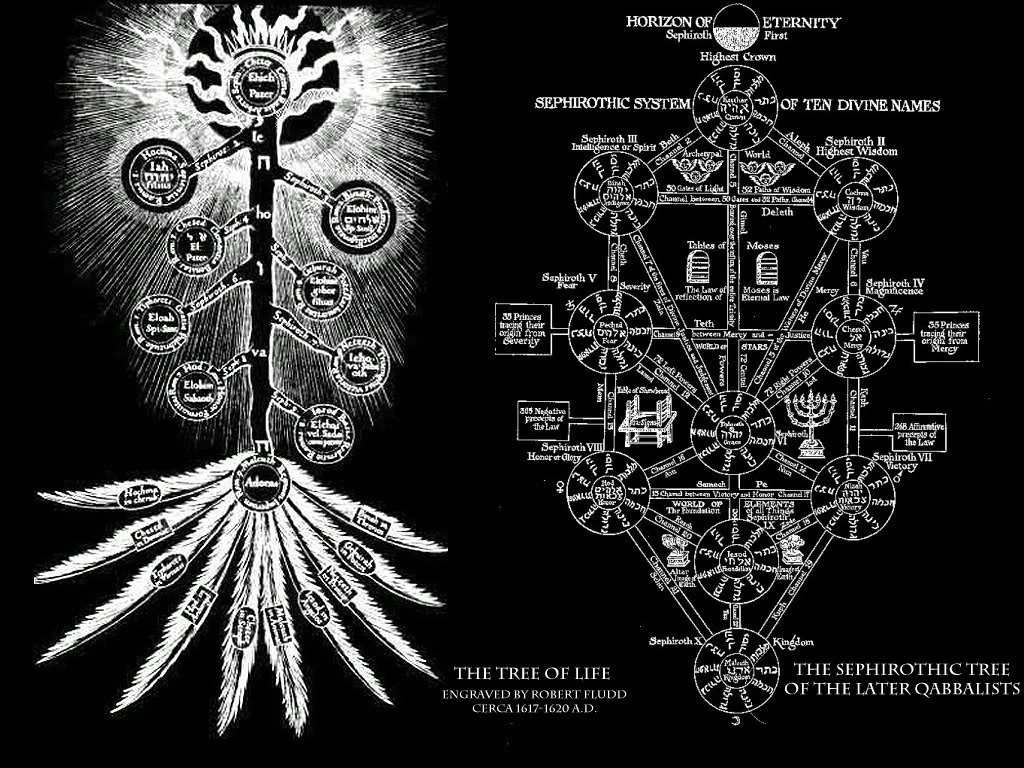
This is precisely the experience the Tree of Life produces when encountered seriously for the first time. The ten Sephiroth arranged along three pillars are not a spiritual decoration, not a meditation aid in the vague modern sense. They constitute, as Gershom Scholem documented with meticulous historical care in his 1941 lectures collected as Major Trends in Jewish Mysticism, a complete cosmological grammar — a system for understanding how the infinite contracts itself into the finite, how Ein Sof, the limitless, pours downward through successive vessels until it arrives, thickened and slowed, in the world of matter we inhabit. Scholem was insistent on something most popularizers prefer to ignore: Kabbalah did not emerge as mystical decoration layered over rabbinic tradition. It emerged in tension with it, as a living counter-tradition that refused to accept legal observance as the whole of the covenant. It wanted the architecture behind the law, the grammar beneath the commandment.
What the alchemists wanted was structurally identical, which is why the correspondences between the two systems are not arbitrary mappings but recognitions. When the alchemical tradition assigns lead to Saturn and Saturn to the Sephirah Binah, it is not playing a game of analogies. It is pointing at the same thing from a different direction. Binah — Understanding, the third Sephirah, the great mother, the principle of limitation and form — corresponds naturally to Saturn because both represent the same cosmological function: the first contraction of infinite possibility into bounded structure. Lead is heavy because it has descended furthest from the solar principle. It is the metal of gravity, of patience, of time, of everything that resists transformation precisely because it has been transformed the most by the descent into density. The alchemist who works with lead is not choosing an arbitrary starting material. He is beginning where the universe itself begins when it moves toward matter.
Gold and Tiphereth are equally precise. Tiphereth, the sixth Sephirah at the center of the Tree, is the sphere of beauty, of the solar principle, of the point where opposites achieve equilibrium. The Sun in alchemical cosmology is not merely one planet among seven. It is the heart, the organizing principle around which the other metals arrange themselves in hierarchical relation. Gold does not simply represent perfection. Gold is what matter looks like when it has achieved the equilibrium Tiphereth names. The philosopher’s stone, in this reading, is not a substance that transforms other substances from the outside. It is the restoration of the solar center within a material that has forgotten its own origin.
Yesod, the ninth Sephirah, the sphere of foundation, of the moon, of the unconscious reservoir that mediates between the higher Sephiroth and the physical world of Malkuth — corresponds to silver, to the lunar, to the reflective principle that neither generates light nor absorbs it entirely but passes it on, changed by the passage. Silver in alchemical work marks the stage before completion, the penultimate purification. The moon before the sun. Yesod before Tiphereth. Both systems know that you cannot arrive at the solar principle without passing through the lunar. You cannot abbreviate the descent.
This is the shared axiom that neither system will negotiate: the fall into matter is not a catastrophe to be reversed but a passage to be completed.

Nigredo: The Blackening That Neither System Lets You Skip
There is a particular kind of morning that arrives after everything has stopped making sense. Not the dramatic morning after catastrophe, which still carries the adrenaline of crisis, but the quieter one, perhaps three weeks later, when you sit with coffee you do not taste and realize that the story you had been telling about yourself for forty years has simply ceased to cohere. The career, the relationship, the private mythology of your own competence and direction — none of it was destroyed violently. It dissolved, the way a body dissolves in acid, leaving behind something you cannot yet name because you do not yet know whether it constitutes residue or essence.
The alchemists called this nigredo, the blackening, and they were not speaking metaphorically in the way that word is now used to dismiss inconvenient precision. They meant something that happens materially, in the vessel, to actual substance. The prima materia must be reduced to chaos before it can be rebuilt into anything that did not previously exist. Paracelsus, writing in the early sixteenth century, insisted that putrefaction is the beginning of all generation — that the living thing must first be brought to the condition of death before new life becomes chemically possible. This was not consolation. It was instruction about sequence. You cannot skip the black phase by willing yourself into the white.
Isaac Luria, working in Safed in the 1570s with the small circle of mystics whose ideas his student Chaim Vital would eventually codify in the Etz Chaim, arrived at something structurally identical from an entirely different direction. The doctrine of Shevirat HaKelim, the shattering of the vessels, describes a cosmogonic catastrophe embedded within creation itself. The divine light poured into the primordial vessels was too intense, too undifferentiated, and the vessels broke. Sparks of holiness fell downward, trapped within the husks of broken form — the Qliphoth, the shells, the realm of unprocessed and unredeemed matter. The world as it exists is already the aftermath of a rupture. Existence begins in a condition of fragmentation that no amount of comfort or efficiency can paper over, because the fragmentation is not an accident that befell creation. It is the condition from which creation must work its way forward.
What both traditions recognize, with a severity that most contemporary self-improvement literature actively refuses, is that disintegration is not a sign that the process has gone wrong. It is the sign that it has genuinely begun. Mircea Eliade, in The Forge and the Crucible published in 1956, traces the figure of the smith across shamanic and metallurgical cultures and finds consistently that the one who works transformation — who takes raw ore and makes from it something that did not exist before — must first undergo a descent into formlessness. The smith is not simply a technician applying heat. He is a figure who has learned to inhabit chaos without being destroyed by it, which is a different skill entirely, requiring an entirely different relationship to disorientation.
The man sitting with his untasted coffee is not in a metaphor. He is in a vessel. The blackening is not a symbol of his confusion but its actual chemical name. Somewhere in the dissolution of his certainties, in the collapse of the narrative architecture he had mistaken for his identity, the Lurianic notion of nitzotzot becomes unexpectedly precise — scattered sparks of something still luminous, embedded in what appears to be wreckage, waiting not for rescue but for recognition. The terrifying fertility of that void is not hope in the ordinary sense. It is something older and less kind, the kind of generative force that does not ask whether you are ready.
The Hieros Gamos and the Union of Opposites: Sulfur, Mercury, and the Divine Marriage
There is a moment that happens between two people sometimes, in an ordinary room, when the conversation stops and something else begins. Not silence exactly — more like a different frequency of attention. Both of them feel it. Neither of them names it. And what is strange, what neither will say afterward, is that they did not feel like subjects of the experience but like instruments of it. Something was moving through them that was larger than their wanting, larger than their history together. They were not having an encounter. They were conducting one.
Both alchemy and Kabbalah knew this moment intimately, and both built entire cosmological architectures around its logic.
The alchemical tradition called it the coniunctio — the sacred marriage of sulfur and mercury, the two primary principles whose opposition structured the material world. Sulfur was active, solar, masculine, the principle of combustion and desire. Mercury was receptive, lunar, feminine, the principle of fluidity and dissolution. Neither was more fundamental than the other. Neither could generate anything alone. The entire alchemical project, understood at its deepest register, was not the manufacture of gold but the orchestration of their union — and through that union, the production of something that had not existed before, something the tradition called the lapis, the philosopher’s stone, which was itself neither sulfur nor mercury but the living third thing their marriage created. The imagery in texts like the Rosarium Philosophorum from the sixteenth century is explicitly, almost shockingly erotic: the king and queen descending into the bath together, submerging, dying, and rising transformed. The body is not transcended here. It is the site of the entire operation.
Moshe Idel, in his landmark Kabbalah: New Perspectives published in 1988, executed a fundamental reorientation of how scholars understood the theurgical dimension of Jewish mysticism. Against the dominant reading that had emphasized the contemplative and the cognitive, Idel argued that a central and underappreciated strand of Kabbalistic practice was theurgical in a precise and radical sense: human ritual action literally affected the structure of the divine. The commandments were not merely obedience to God — they were interventions in God. And the intervention most charged with cosmological consequence was the reunion of the Shekhinah with the Holy One, the feminine divine presence with the masculine principle of Tiferet, the sixth sefirah, the heart of the divine tree.
In the Zohar, the foundational text of medieval Kabbalah composed in thirteenth-century Castile and attributed to Moses de León, the exile of the Shekhinah is experienced as a cosmic fracture — a separation within the divine itself that mirrors every separation experienced in the human world. The Sabbath was understood as the weekly moment of reunion, the hieros gamos enacted in time, the marriage chamber of the universe briefly restored. When a man and woman came together in sacred intention on Friday night, they were not merely expressing love. They were — in a framework Idel’s work made impossible to dismiss as metaphor — participating in the repair of divine structure. The human body was not a vessel from which the spirit escaped upward. It was the instrument through which the divine resolved its own internal tension.
This is what that moment in the room between two people has always been carrying without being told. The intensification is not incidental. It is the mechanism. Both traditions converge on this with an insistence that refuses to be spiritualized away: the sacred does not begin where the body ends. It begins precisely where the body becomes most fully itself, most fully other, most fully in contact with something it cannot contain.
The Adept Who Disappears: Transmutation, Tikkun, and the Ethics of the Unfinished

There is a moment, familiar to anyone who has spent years inside a single sustained labor, when the thing you have been building finally stands complete — and you feel, instead of arrival, something closer to severance. A man closes the last page of a manuscript he has worked on for eleven years. He does not feel triumph. He feels the particular grief of someone who has just lost the only place he knew how to live. The work, while unfinished, was a world. Completed, it becomes an object. It no longer needs him, and the horrifying corollary is that he no longer needs it — except that he does, desperately, in the way you need the rooms of a house that has been sold.
Both alchemy and Kabbalah were constructed, at their deepest structural level, to prevent exactly this moment from arriving.
The Philosopher’s Stone was never purely a personal prize. The alchemical literature is almost unanimous on this point, even when it seems most obsessed with individual transformation: the Stone, once achieved, becomes a universal medicine, the medicina catholica capable of healing metals, bodies, and — in the more audacious formulations — the wound in matter itself. Paracelsus, writing in the early sixteenth century, framed the alchemist’s task not as self-improvement but as participation in the ongoing creation. The adept who works only for himself has already misunderstood the work. The gold he seeks is not his gold. It belongs, in some sense that resists easy paraphrase, to everything.
The Kabbalistic parallel is not metaphorical — it is structural. Tikkun Olam, the repair of the world, emerges directly from the Lurianic account of cosmic catastrophe. When the vessels shattered and the divine light scattered into the density of matter, it did not scatter into one place. It dispersed into every corner of existence, imprisoned in the husks of the ordinary. The task of the human being — specifically, the task of conscious, ethical, spiritually attentive human action — is to locate those sparks and release them. Not to accumulate them. To release them back into a wholeness that no single person will ever witness. Isaac Luria taught this in Safed in the 1570s, and he died at thirty-eight, the work barely begun. That was not a tragedy. That was the condition.
Walter Benjamin understood something cognate to this when he wrote, in 1940, in what would be among his final pages before his death at the Spanish border, that redemption does not arrive as a completed project. It arrives, if it arrives at all, in fragments — in what he called the “chips of Messianic time” embedded in the now. His Theses on the Philosophy of History refuse the consolation of historical progress precisely because progress implies a destination, and destinations imply that someone gets to rest. Benjamin’s redemption is perpetually incomplete by design, not by failure. The angel of history, face turned toward the wreckage of the past, wings caught in the storm we call progress, cannot stop, cannot repair, can only be blown forward into a future that accumulates rather than heals. What makes this image unbearable is also what makes it true: the work of repair is the condition of being alive, not the prelude to something better.
This is what both the alchemist and the Kabbalist knew, and what the man closing his manuscript had forgotten to expect: that the goal was never possession of the result. The Philosopher’s Stone was medicine for the world, not a trophy for the maker. The scattered sparks were not yours to keep once found. The years spent inside the labor were not preparation for completion — they were the thing itself, and completion was always the lesser event, the husk from which the light had already moved on, leaving you standing at a threshold with empty hands and the strange, unbidden knowledge that the work continues without you, that it was never yours to finish, only yours to carry forward until someone else, or something else, takes up what you were never meant to put down.
A vision curated by a filmmaker, not an algorithm
In this video I explain our vision
🔮 Where Alchemy Meets the Hidden Letters of Creation
Alchemy and Kabbalah have long shared a secret language, weaving together symbols of transformation, divine emanation, and the hidden structure of reality. Both traditions seek to penetrate the veil of matter and touch the luminous core beneath existence. These related articles will guide you deeper into the esoteric currents that flow beneath Western mystical thought.
The Corpus Hermeticum: Guide to Esoteric Reading
The Corpus Hermeticum stands as one of the foundational texts linking Neoplatonism, alchemy, and the Kabbalistic vision of a universe structured by divine intelligence. Its layered cosmology of emanating principles mirrors the Sephirotic Tree of Life with striking precision. Reading it alongside Kabbalistic texts reveals a unified esoteric grammar underlying both traditions.
GO TO THE SELECTION: The Corpus Hermeticum: Guide to Esoteric Reading
Giordano Bruno and the Hermetic Tradition
Giordano Bruno pushed the boundaries of Hermetic thought by synthesizing magical memory systems, Neoplatonic cosmology, and Kabbalistic letter mysticism into a single visionary framework. His work demonstrates how alchemy and Kabbalah were not isolated disciplines but threads in a vast Renaissance tapestry of esoteric knowledge. Bruno’s tragic fate underscores how dangerous it was to map the correspondences between matter and the divine.
GO TO THE SELECTION: Giordano Bruno and the Hermetic Tradition
Robert Fludd: Macrocosm Microcosm and Alchemy
Robert Fludd‘s magnificent cosmological diagrams place the human being at the intersection of macrocosm and microcosm, a concept central to both alchemical practice and Kabbalistic thought. His illustrations visually encode the correspondence between the Sephirot and the stages of alchemical transformation. Fludd remains one of the most eloquent visual voices of the Hermetic-Kabbalistic synthesis.
GO TO THE SELECTION: Robert Fludd: Macrocosm Microcosm and Alchemy
John Dee: Alchemy Angel Magic and Enochian Language
John Dee‘s visionary work with angelic language and his deep engagement with Kabbalistic gematria placed him at the crossroads of alchemy, magic, and divine communication. His Enochian system was conceived as a direct interface with the same hidden structure of creation that Kabbalah seeks to decode through the Hebrew letters. Dee’s life illuminates how alchemical and Kabbalistic pursuits were inseparable in the Elizabethan esoteric imagination.
GO TO THE SELECTION: John Dee: Alchemy Angel Magic and Enochian Language
Explore the Mysteries on Indiecinema
The search for hidden correspondences between matter and spirit is also a cinematic quest. On Indiecinema streaming you will find a curated selection of independent films that dare to explore the depths of consciousness, mysticism, and transformation that no mainstream platform will offer you.
👉 EXPLORE THE CATALOG: Watch Indie Films in Streaming
A vision curated by a filmmaker, not an algorithm
In this video I explain our vision

