
The Ritual Before the First Drink
You do not pour the drink because you are thirsty. You pour it because something in the room has shifted — the hour has changed, the light has gone amber, the day’s particular weight has settled into your shoulders — and the act of reaching for the bottle is itself already the relief, before a drop has touched your lips. This is the part no one talks about honestly: the ritual preceding consumption, the small ceremony of selection and preparation, carries most of the psychological payload. The glass chosen with a kind of care. The sound of liquid moving. A pause that masquerades as pleasure but is actually something closer to permission — permission to stop performing.

Alcohol was never simply a chemical. It has always been a technology, in the oldest and most precise sense of the word: a tool that extends human capacity beyond its natural limits. The specific capacity it extends is not courage, not sociability, not creativity, though it has been mythologized for all three. What it actually extends is the ability to tolerate the self. William James, writing in 1902 in The Varieties of Religious Experience, identified alcohol’s grip with unusual clarity — he described its power as lying in the way it stimulates the mystical faculties of human nature, usually crushed to earth by the cold facts and dry criticisms of the sober hour. He was not endorsing it. He was diagnosing something that the temperance movements of his era were too moralistic to see: that people drink toward something, not merely away from something.
The distinction matters enormously, because the entire architecture of how Western societies have framed addiction for over a century depends on collapsing it. If drinking is flight — escape, weakness, failure of will — then the cure is moral fortitude, abstinence as triumph of character. This is the grammar that produced Prohibition in 1920, which achieved the extraordinary feat of simultaneously failing to stop drinking and succeeding in making drinking feel like rebellion, identity, and freedom all at once. By the time the Eighteenth Amendment was repealed in 1933, the cultural meaning of alcohol had been permanently altered: it now carried the residue of defiance. Every drink since has inherited, faintly, that charge.
But the anticipatory relief — that specific loosening that happens before the first sip — is not about defiance. It belongs to a different psychological register entirely. The neuroscientist Kent Berridge, whose research at the University of Michigan through the 1990s and 2000s reshaped the understanding of reward systems, distinguished between wanting and liking in ways that should have dismantled a great deal of folk psychology about pleasure. The brain’s dopaminergic wanting system fires in anticipation, not in consummation. What you experience in that pause before drinking is neurologically closer to hunger than to satisfaction — a forward-leaning urgency that the act of drinking will temporarily resolve without ever actually answering. The drink arrives and the wanting quiets. The liking, it turns out, is almost beside the point.
This means the ritual is doing most of the psychological work. The person standing at the kitchen counter at seven in the evening, selecting a glass, is not yet managing their anxiety — they are already managing it. The physical substance is almost secondary to the elaborate grammar of self-permission that surrounds it. Anthropologists have noted that virtually every human culture that has incorporated fermented beverages has also constructed formal ceremonies around their consumption — from the Greek symposium to the Japanese sake ceremony to the Irish wake — as though the culture itself recognized intuitively that what needed to be regulated was not the liquid but the meaning attached to its approach. Ritual is how a society externalizes and collectively holds what would otherwise be an unbearably private negotiation between a person and their own interior.
Which raises a question that rarely gets asked with sufficient seriousness: what exactly is being negotiated, in that pause, in that pour, in that moment before the first drink changes the room?
The Passenger

Documentary, by Tommaso Valente, Christian Poli, Italy, 2022.
The territory of Ravenna, suspended between its centuries-old history and recent industrial development, is a land of conflicts and rarefied landscapes. It is here that the action of "Housing First" develops, an association that focuses on social housing as a way to reintegrate people in situations of extreme hardship, whether it be psychological, economic, or due to different addictions. The Passengers tells the stories of these "wayfarers without a destination", who find in the homes in which they live a starting point for their journeys. Each house therefore lives on multiple narrative levels and multiple stories, from that of the apartment itself, in which the daily conflicts of coexistence explode and are resolved, to those of each participant in the project. Often painful stories of defeats, losses, falls into the abyss of alcohol and drugs; but also stories of redemption, in the paths that each protagonist undertakes to find their way in work and relationships.
There are people still looking for a place in the world, wayfarers marked by painful stories who are looking for a starting point: home. The Passengers tells their stories and that of "Housing first", a philosophy that puts social housing at the center of its action. In the stories of often conflicting coexistences, and in the evocation of tortuous life paths, the sense of a possible way to seize an opportunity for redemption emerges. Contrasting this "present-day narrative" of the various characters, all told with a dry documentary gaze, is the past of each of them, the traumatic starting points that have brought them here. Illustrated by evocative animations, the voices of the protagonists tell of failed marriages, corporate crises in which they lost everything, abuse suffered in the family and migrations from third world countries.
LANGUAGE: Italian
SUBTITLES: English, Spanish, French, German, Portuguese
Addiction as Cultural Construction, Not Moral Failure
You are handed a glass at your cousin’s wedding before you are old enough to understand what refusal means socially, and by the time you do understand, the gesture of acceptance has already been rehearsed so many times that it has become something close to instinct. Nobody planned this. Nobody intended harm. The glass was simply part of the architecture of belonging, and belonging, at sixteen, is not something most people are equipped to decline.
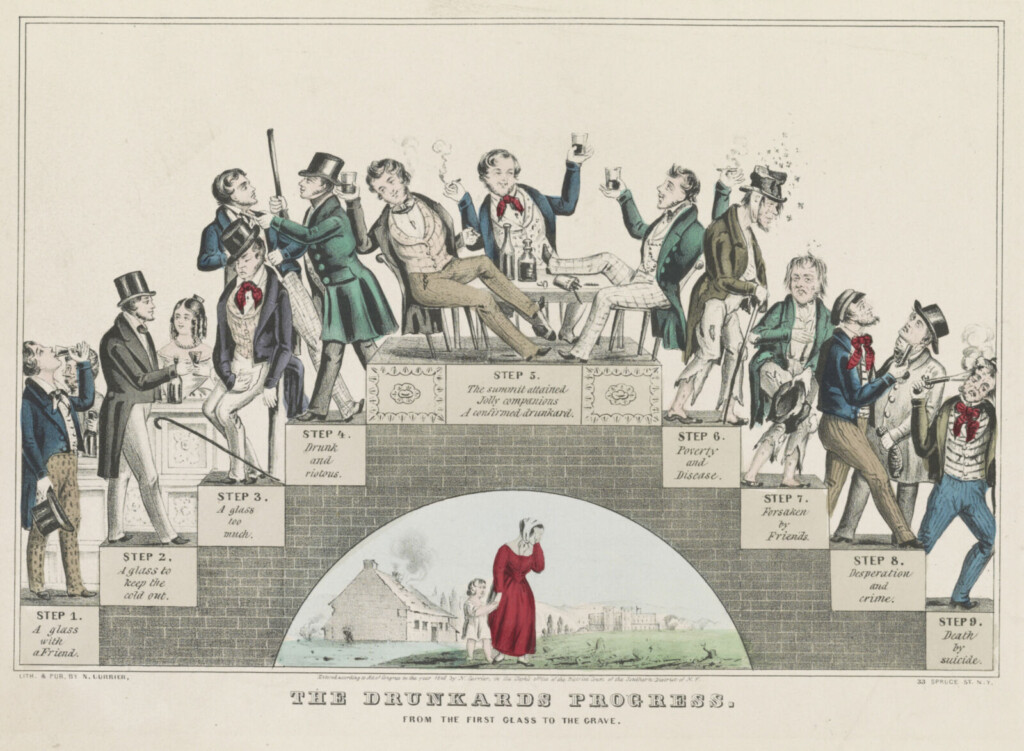
The story that Western culture tells about what happens next has changed dramatically over the past century, though the change is less radical than it appears. Before E.M. Jellinek published The Disease Concept of Alcoholism in 1960, the dominant framework for understanding a person who could not stop drinking was explicitly moral: weakness, sin, a failure of will that revealed something rotten in the character. The temperance movements of the nineteenth century, culminating in American Prohibition from 1920 to 1933, were not primarily medical campaigns. They were moral crusades, and the alcoholic was their central villain — a figure of self-destruction who threatened the family, the economy, and the social order simultaneously. The disease model that Jellinek advanced did something that felt, at the time, like compassion. It moved the alcoholic from the courtroom to the clinic. It reclassified a sin as a symptom.
What Jellinek actually argued was more cautious and more contested than its legacy suggests. He proposed that alcohol dependence followed identifiable progressive phases, that certain individuals possessed a physiological predisposition that distinguished them categorically from social drinkers, and that this biological specificity warranted medical rather than moral intervention. His sample was deeply flawed — largely self-selected members of Alcoholics Anonymous who responded to a questionnaire — and he acknowledged the limitations privately even as the model was being institutionalized publicly. By the time the American Medical Association formally recognized alcoholism as a disease in 1956, four years before Jellinek’s book appeared, the cultural machinery was already moving faster than the evidence.
What the shift from sin to sickness preserved, almost surgically intact, was the location of the problem. Whether you called it moral weakness or neurological vulnerability, the failure remained inside the individual body. The drunk was still the unit of analysis. The glass pressed into the hand at the wedding, the office culture where sobriety signals social anxiety, the housing precarity that makes oblivion rational, the grief that has no institutional container — these disappeared from the frame. Sociologist Émile Durkheim had demonstrated as early as 1897 in Suicide that behaviors coded as deeply personal and individual vary systematically with social integration, economic structure, and collective belonging. His data showed that suicide rates shifted predictably with religious affiliation, marital status, and economic crisis — not because individuals suddenly became weaker or stronger, but because the social fabric itself was bearing different loads. The same logic applies to intoxication, though it took another century for anyone to say it clearly in addiction research.
Bruce Alexander‘s experiments at Simon Fraser University in the late 1970s made the point with rats in a way that was difficult to dismiss. When animals were given the choice between plain water and morphine-laced water while isolated in standard laboratory cages, they consumed the drug compulsively. When the same choice was offered inside an enriched environment with space, social contact, and stimulation — what Alexander called Rat Park — consumption dropped dramatically. The conclusion Alexander drew was not that addiction was imaginary but that it was a response to conditions, not a property of substances or of defective individuals. His 1980 paper was largely ignored by the research establishment for a decade. The disease model was already too institutionally embedded, too legally useful, too economically convenient for the treatment industry that had grown around it to tolerate a finding that pointed outward rather than inward.
The question that neither the moral nor the medical framework ever seriously entertained is what it means to build an entire social calendar around a substance and then pathologize the people who cannot moderate their relationship with it.

The Neuroscience of Wanting Without Pleasure
You are sitting with a drink you no longer enjoy. You know this, somewhere beneath the reach of language, and yet your hand moves toward the glass with the same mechanical certainty as a compass needle swinging north. Not because it will feel good. Because something deeper than feeling good has already made the decision for you.
The neuroscientist Kent Berridge spent decades at the University of Michigan dismantling what most people assume is a settled question: that we pursue things because they give us pleasure. His work, developed across the 1990s and refined in landmark papers co-authored with Terry Robinson, most consequentially in their 1998 publication in Brain Research Reviews, demonstrated through precise lesion experiments on rats that the brain runs two fundamentally separate systems — one that generates wanting, one that generates liking — and that these systems can be decoupled entirely. The wanting system is dopaminergic, rooted in the mesolimbic pathways, and it operates as what Berridge termed incentive salience: a mechanism that tags certain stimuli as magnetized, as worth pursuing, regardless of whether pursuing them produces any felt satisfaction. The liking system, far smaller and more fragile, involves opioid and endocannabinoid circuits in the hedonic hotspots of the nucleus accumbens and the orbitofrontal cortex. Damage the wanting system, and an animal stops pursuing food entirely, even though it still displays pleasure when food is placed in its mouth. Damage the liking system, and the animal chases and chases and chases, consuming without any visible sign of enjoyment.
What alcohol does to a brain over years of heavy use is not to amplify pleasure. It sensitizes the wanting system while progressively degrading the liking system. The dopamine spike that once accompanied the first drink — the sense of arrival, of warmth that felt like a homecoming — diminishes with repetition. What does not diminish, and in fact grows louder, is the anticipatory pull, the neurological urgency that precedes the drink and has no interest in what happens after it. The craving is no longer pointing toward anything real. It is pointing toward itself.
This is why willpower framing collapses so completely when applied to severe alcohol dependence. The cultural mythology of the addict as someone who simply refuses to stop choosing pleasure over responsibility misreads the biology at every level. By the time dependence has restructured the reward circuitry, the person is not choosing pleasure. They are being driven by a signal that has become untethered from outcome entirely, a wanting that cannot be satisfied because satisfaction was never the engine. The philosopher Harry Frankfurt, writing on the structure of the will in his 1971 essay “Freedom of the Will and the Concept of a Person,” argued that what makes human agency distinctive is the capacity to have desires about desires — second-order volitions that evaluate and govern first-order impulses. Addiction, seen through Berridge’s lens, does not merely overwhelm second-order volition. It produces a first-order wanting so neurologically dominant, so insulated from feedback, that the second-order apparatus is left issuing instructions to a machine that has already stopped listening.
The cruelty of this architecture is that it remains invisible from the outside, and almost equally invisible from within. A person can know, consciously and articulately, that the next drink will produce no pleasure, will produce in fact a specific and familiar misery, and still find themselves standing at the cabinet because the wanting does not receive that information as relevant. The anticipation engine does not consult experience. It was never designed to. It was designed, across millions of years of evolutionary pressure, to keep organisms moving toward caloric sources and reproductive opportunities with relentless urgency. Alcohol simply found the wiring and rewrote the address labels.
What gets routed through that ancient urgency, once readdressed, is no longer food or warmth or connection.
Shame as Architecture, Not Emotion
You are already rehearsing the apology before anyone has asked for one. The drink is still in your hand, the evening is not yet over, and some part of your nervous system is composing a defense, calculating damage, pre-suffering the morning. This is not guilt — guilt is about what you did. What you are feeling now is about what you are, and that distinction is not semantic. It is the difference between a wound and a foundation.
Gershen Kaufman spent decades mapping the interior geography of shame, and what he identified in his 1980 work “Shame: The Power of Caring” was not an emotion in the conventional sense but something closer to an organizing principle of selfhood. Shame, in Kaufman’s framework, does not arise after behavior — it precedes it, structures it, and in the case of addiction, actively generates it. The person who drinks to quiet self-contempt is not experiencing shame as a consequence of drinking. They entered the drink already carrying shame as their most intimate architecture, and the alcohol was simply the renovation project that made the building temporarily livable.
What Western cultures have done with extraordinary efficiency is engineer environments in which this architecture becomes self-sealing. The Protestant inheritance — and here Max Weber‘s 1905 analysis of the relationship between moral worth and productive self-discipline becomes suddenly clinical rather than historical — produced a civilization that measures a person’s interior value by their visible performance of control. To lose control is not merely to fail. It is to reveal, publicly, a deficiency of character that was supposedly always there, waiting. Addiction in this cultural context is not read as a medical event or even a human crisis. It is read as a confession. The person who cannot stop is presumed to have been confessing, in slow motion, the truth of their fundamental inadequacy.
This is why concealment is not a symptom of addiction but one of its primary operating systems. The hiding is not irrational. It is the only rational response to an environment that has structured exposure as annihilation. Sociologist Erving Goffman wrote in 1963’s “Stigma” about the elaborate work people perform to manage what he called “spoiled identity” — the daily labor of controlling information about oneself, of passing as normal, of maintaining what he described as a “virtual social identity” distinct from the actual one. For the person caught in the addictive cycle, this labor becomes total. The energy required to hide is indistinguishable from the energy required to survive.
The paradox that emerges from this is structural, not ironic. Virtually every evidence-based recovery framework — from twelve-step approaches to contemporary trauma-informed therapy to the peer support models gaining clinical credibility in the 2010s — operates by demanding precisely what shame has made existentially dangerous: disclosure. Speaking the thing that cannot be spoken. Allowing the actual self to become visible in a context where visibility has functioned, for years, as the primary threat. This is not a gentle ask. This is asking someone who has organized their entire psychological architecture around self-concealment to dismantle the building while still living inside it.
Brené Brown’s research at the University of Houston, published in a series of studies beginning in 2006, established empirically what Kaufman had theorized clinically: shame loses significant structural power specifically through witnessed acknowledgment. Not through private reflection, not through willpower, not through intellectual understanding of the problem, but through the act of being seen by another person and surviving that exposure. The shame has to be brought into contact with something outside itself. Brown’s phrase — “shame cannot survive being spoken” — sounds almost too elegant, but the mechanism it describes is ruthlessly concrete. The self-concealment that addiction requires and the self-exposure that recovery requires are not merely in tension. They are structurally opposed — and yet recovery asks that one be dismantled by the other.
Sobriety's Hidden Violence and the Social Contract of Drinking
You stop drinking and discover, almost immediately, that you have also stopped speaking a language you didn’t know you were fluent in. The rounds, the toasts, the shared vulnerability of the third drink — these were never merely habits. They were syntax, and now you are mute at the table where everyone else is still talking.
Robin Dunbar, the British anthropologist and evolutionary psychologist best known for establishing that human social networks cap at roughly 150 stable relationships, spent years arguing something far more uncomfortable: that alcohol, in moderate and socially embedded consumption, functions as a bonding accelerant with no clean cultural equivalent. His research, consolidated in work published around 2017 examining pub culture and social connectivity in Britain, found that people who drank in traditional social settings reported larger friendship networks, higher levels of trust, and greater feelings of belonging than those who abstained — not because abstainers were personally deficient, but because the ritual itself was doing structural work that nothing else was replicating. The drink was never just the drink. It was the mechanism by which emotional walls came down fast enough for genuine intimacy to form before social anxiety could reassert itself.
What recovery culture almost universally refuses to name is that sobriety, for many people, doesn’t simply remove a destructive substance — it removes them from an entire architecture of human contact. The wedding where you hold a sparkling water while everyone else loosens into laughter. The after-work gathering where the confessions come out at the second round and you are sitting there, perfectly clear-headed, watching people bond over a shared altered state you are no longer permitted to enter. The loneliness isn’t imagined. It isn’t a symptom of unresolved addiction. It is real, structural, and almost never acknowledged in the language of twelve-step programs or clinical sobriety frameworks, which tend to reframe every social cost as evidence of how damaged the relationships were to begin with — a sleight of hand that protects the recovery narrative at the expense of the person living inside it.
Identity is not merely psychological. It is relational and positional — it is who you are inside specific systems of meaning. Erving Goffman’s work on social roles, developed across his 1959 study of everyday performance and his later writing on stigma, showed that human selfhood is radically dependent on the contexts in which it is performed and recognized. When you remove yourself from a context — or when a context removes you — part of the self that existed there simply loses its stage. The recovering person who is told that their new identity as someone sober is a fuller, more authentic self is receiving a story that is partly true and partly a survival mechanism dressed as philosophy. Because what is also true is that the self who laughed a certain way at a certain bar with certain people no longer has anywhere to exist.
The social contract of drinking is rarely explicit precisely because it doesn’t need to be. Cultures encode their most powerful norms in the things they never have to say aloud. In most Western social contexts, the offer of a drink is simultaneously an offer of trust, of inclusion, of willingness to be temporarily vulnerable together. Refusing it — for whatever reason, with whatever grace — carries a faint but persistent charge of refusal toward the person offering. Not consciously. Not maliciously. But structurally, the way that declining to shake a hand carries a charge even when everyone understands intellectually that it may be medically necessary. The sober person learns to manage this charge constantly, to apologize for their clarity, to perform accessibility they can no longer achieve through the same channel everyone else is using.
And the cruelest part is that this cost is rarely legible as a cost at all — it is absorbed silently into the category of personal growth, reframed as evidence of strength, when what it sometimes is, simply, is loss without a name.
A vision curated by a filmmaker, not an algorithm
In this video I explain our vision
The AA Paradox: Surrender, Power, and Narrative Control

You are sitting in a folding chair in a church basement that smells of burnt coffee and old carpet, and the man across the circle from you has just said the words “I am powerless” with the steadiness of someone who has finally, after years of white-knuckling it, found solid ground. Something in you resists this violently. You were raised to believe that power over oneself was the definitive human achievement, the axis around which dignity rotates, and here is a room full of people treating abdication as arrival.
Bill Wilson built Alcoholics Anonymous in 1935 on a paradox he borrowed, consciously and explicitly, from William James. The 1902 lectures collected in “The Varieties of Religious Experience” described what James called the “twice-born” self — a personality that cannot integrate its contradictions through will alone, that must undergo a collapse of the ego before a more stable identity can crystallize. Wilson read James during his own hospitalization, and the intellectual debt was not incidental. The Twelve Steps are essentially James’s phenomenology of conversion translated into a secular liturgy, complete with the submission to a force larger than the self, the moral inventory as confession, and the new life as testimony. What looks like folk wisdom in a church basement is in fact one of the most sophisticated applied psychologies of the twentieth century, built on the observation that certain human beings cannot outwill their own nervous systems.
The surrender dynamic does something structurally remarkable: it relocates agency without abolishing it. The person who says “I am powerless over alcohol” is not, in the grammar of the program, saying that they are helpless. They are performing a precise conceptual operation — withdrawing the self from a domain where its authority has proven catastrophically unreliable and reasserting it in a domain where it can function. The narrative control shifts from “I can manage this substance” to “I can choose, daily, not to pick up.” This is not the erasure of the self. It is the self learning to govern its own jurisdiction.
What makes this philosophically uncomfortable for secular Western observers is that it exposes the fragility at the center of Enlightenment individualism. The dominant cultural story, at least since Kant codified autonomy as the ground of morality, has been that the rational self is self-legislating and self-sufficient. Addiction is a direct empirical refutation of this story — not a moral failure but an epistemological crisis, evidence that the sovereign self was always a constructed fiction with sharper limits than the fiction admits. AA did not invent the solution to this problem so much as it institutionalized a workaround, one that happens to require borrowing the architecture of religious experience because that architecture was historically designed for precisely this kind of ego dissolution.
The peer testimony structure — standing up, naming yourself, narrating your destruction and your ongoing precarious survival — functions as what the sociologist Arthur Frank, writing in “The Wounded Storyteller” in 1995, called a “restitution narrative” that keeps converting into something stranger and more honest: a story that does not end in cure but in perpetual, conscious management. Frank argued that illness narratives in Western culture are under enormous pressure to resolve into recovery, to satisfy the cultural need for the arc of triumph. AA resists this because it insists the story never ends. The alcoholic is always in recovery, never recovered, a grammatical tense that keeps the self permanently accountable rather than declaring victory and disengaging.
The critics who dismiss the program as cult-adjacent are not entirely wrong about the mechanics — the repetition, the in-group language, the sponsor hierarchy, the narrative scripts — but they miss what the mechanics are doing. A technology is not invalidated by resembling other technologies. The question is whether it works, and the honest answer, drawn from decades of outcome research including the 2020 Cochrane Review that analyzed studies covering over ten thousand participants, is that for a significant subset of people it works better than almost anything else medicine has yet produced.
Trauma as the Unspoken Substrate
You are standing in a kitchen at two in the morning, and the bottle is already open, and you already know this is not about thirst. Something happened — maybe decades ago, maybe last week — and your nervous system never got the memo that it was over. The body logged it, encoded it in the architecture of muscle tension and shallow breath and a startle reflex that fires at nothing, and now it runs the show at hours when the rational mind has finally gone quiet. The drink is not weakness. It is precision engineering.
Bessel van der Kolk spent decades working with trauma survivors at Boston’s Veterans Center and later at the Trauma Center in Brookline, Massachusetts, and what he documented in The Body Keeps the Score — published in 2014 after more than thirty years of clinical observation — upended the standard model of addiction as moral failure or neurochemical accident. His central finding was anatomical before it was psychological: trauma reorganizes the brain’s alarm systems, particularly the amygdala and the medial prefrontal cortex, in ways that make ordinary regulation of emotion not merely difficult but physiologically compromised. When the prefrontal cortex goes offline under threat — a process van der Kolk mapped using neuroimaging — the survivor loses access to the very cognitive machinery that would allow them to talk themselves down, to contextualize, to wait out the wave. Alcohol, opioids, benzodiazepines, and stimulants each operate on exactly those disrupted systems, restoring — temporarily, chemically, brutally — a version of the calm that trauma stole.
This reframes the entire clinical question. The person asking “why can’t they just stop” is implicitly assuming that stopping is a neutral act, that the substance fills some optional gap, some recreational preference. But for a significant proportion of people with severe use disorders — research published in JAMA Psychiatry in 2016 found that between forty and sixty percent of individuals seeking treatment for alcohol use disorder reported histories of childhood abuse or neglect — the substance is not filling a gap. It is plugging a wound that would bleed out without it. Gabor Maté, working for over a decade with severely addicted individuals in Vancouver’s Downtown Eastside, reached the same conclusion from a different angle: in his 2008 book In the Realm of Hungry Ghosts, he documented case after case in which the drug was the only reliable source of relief the person had ever found, in lives shaped by abandonment, violence, and the particular cruelty of being a child in an environment that required dissociation to survive.
What makes this framework destabilizing is not that it excuses anything — it does not — but that it relocates agency. If the question was always “why can’t they stop,” the hidden assumption was that the person had the full suite of human faculties available to them and was simply choosing badly. Van der Kolk’s data suggests the opposite: that the choice architecture itself was compromised long before the first drink, that the nervous system’s capacity to self-regulate was damaged before the substance ever entered the picture. Somatic therapies — EMDR, developed by Francine Shapiro in 1987 and now recognized by the World Health Organization as a frontline trauma treatment, alongside body-based approaches like Somatic Experiencing — specifically target this physiological layer, not because conversation is useless but because the memory that drives compulsion is stored below language, in the body’s own record-keeping system.
The cultural discomfort with this reading is not incidental. A society that locates addiction in individual will protects itself from harder questions — about what it creates, what it fails to protect, how many of its most reliable citizens learned to function by metabolizing damage that was never theirs to carry. The body that keeps the score was keeping it against someone, and that someone is rarely the person reaching for the bottle at two in the morning.
Recovery as Ontological Reconstruction, Not Behavioral Change
You stop drinking on a Tuesday. By Thursday, the body has already begun its negotiation with physical reality — the tremors, the sweating, the sleep that comes in broken shards. But by the following month, when the body has quieted and the medical crisis has passed, something far more disorienting begins to surface. You are standing in your own life and you do not recognize the architecture. Every room feels like someone else’s furniture. The compulsion organized your hours, your social rituals, your emotional vocabulary, your reasons for being awake at two in the morning. Without it, there is no relief. There is a vast, echoing openness that most recovery literature has no honest language for.
Viktor Frankl, writing in 1946 from the specific wreckage of Auschwitz in “Man's Search for Meaning,” named this condition before addiction research had caught up to it: the existential vacuum, a state in which the individual has lost the organizing principle of their existence and finds themselves confronting a freedom they did not ask for and do not know how to inhabit. Frankl's logotherapy was not built around symptom reduction. It was built around the premise that human beings require meaning not as a luxury but as a structural necessity — that without it, the psyche will generate its own substitutes, often destructive ones, simply to fill the unbearable blankness of purposelessness. What is striking, and what the addiction research community has been slow to absorb fully, is that the substance was never simply a pleasure. It was a meaning-delivery system. Crude, borrowed, ultimately corrosive — but functional in the way that a rotten scaffolding is still, technically, scaffolding.
The philosopher Charles Taylor, in “Sources of the Self” published in 1989, argued that identity is not a fixed interior object but a continuous interpretive project — that to be a self is to be oriented toward what Taylor called a “horizon of significance,” a framework of values and commitments against which choices acquire weight. Addiction doesn’t destroy this framework so much as it hijacks it, redirecting every question of significance back to a single answer. When that answer is removed, the horizon doesn’t automatically reappear. The person in recovery is not returning to a pre-existing self. They are being asked to construct one, often for the first time, without the distorting intensity of a substance that made all previous choices feel either irrelevant or already decided.
This is why relapse rates remain so brutally high even after successful detoxification — around 40 to 60 percent within the first year, according to data consistently reported by the National Institute on Drug Abuse — and why that figure cannot be reduced to neurochemical vulnerability or insufficient willpower. The craving that returns is not simply the body’s memory of dopamine. It is the self’s terror at its own incompleteness, its reaching back toward the one structure that, however destructively, answered the question of what it was for. The twelve-step tradition intuited this when it insisted that recovery required not just abstinence but what it called “a spiritual awakening” — a phrase that sounds mystical until you translate it into the secular language of existential philosophy, where it means precisely this: the emergence of a new orienting framework capable of bearing the weight of a life.
What makes this reconstruction so difficult is not that it requires unusual courage or insight, but that it requires the person to remain present inside an emptiness that the entire logic of addiction was designed to escape. The willingness to sit inside that open, unorganized space — without filling it immediately, without rushing toward any new certainty — may be the only act that makes genuine reconstruction possible, because it is the first honest encounter with the self that was always there, waiting beneath the noise.
🌀 The Labyrinth of Addiction and the Self
Alcohol and addiction are rarely just about a substance — they are maps of inner pain, social fracture, and the desperate search for meaning. The articles below trace the psychological, philosophical, and cultural corridors that surround dependency and recovery, revealing how deeply intertwined addiction is with identity, trauma, and the human need to belong.
Gambling: When Risk Becomes Obsession
Gambling addiction and alcoholism share a common psychological architecture: the compulsive repetition of a behavior that promises relief but deepens the wound. This article explores how risk-taking becomes obsession, dismantling the boundary between pleasure and self-destruction. Understanding this mechanism is essential to any honest conversation about addiction and recovery.
GO TO THE SELECTION: Gambling: When Risk Becomes Obsession
Social Exclusion: Causes, Dynamics and Ways Out
Social exclusion is both a cause and a consequence of addiction, trapping individuals in cycles that are as much societal as they are personal. This article examines the structural forces that push people to the margins, where substances often become the only available comfort. Recovery, then, must address not just the individual psyche but the community that failed to hold them.
GO TO THE SELECTION: Social Exclusion: Causes, Dynamics and Ways Out
Drugs in Rave Culture: History and Psychology
Rave culture and its relationship with drugs offers a vivid case study in how substances become entangled with identity, belonging, and escape from an unbearable ordinary life. This article traces the history and psychology of drug use within underground music scenes, where altered states were both a communal ritual and a personal refuge. The line between recreation and dependency has always been thinner than the culture admitted.
GO TO THE SELECTION: Drugs in Rave Culture: History and Psychology
Overcoming trauma to live the present
Overcoming trauma is one of the central tasks of addiction recovery, since unprocessed pain is so often the hidden engine behind compulsive substance use. This article explores the psychological pathways through which individuals learn to inhabit the present again, rather than medicating against a past that refuses to stay silent. It offers an essential perspective on healing as an active, embodied process rather than mere abstinence.
GO TO THE SELECTION: Overcoming trauma to live the present
Discover the Cinema That Dares to Look Inside
If these themes move you, Indiecinema is the streaming platform where independent cinema confronts addiction, trauma, and transformation with uncompromising honesty. Explore films that the mainstream won’t show you — stories that illuminate the darkest corridors of the human condition and, sometimes, point toward the light.
👉 EXPLORE THE CATALOG: Watch Indie Films in Streaming
A vision curated by a filmmaker, not an algorithm
In this video I explain our vision

