
The Uncomfortable Mirror in the Drawing Room
You are at a dinner party. The wine is good, the lighting is forgiving, and somewhere between the second course and the third you say something you do not believe. You say it fluently, with the right pause before the punchline, and the table laughs, and you laugh too, and for a moment you cannot locate the seam between the performance and the person performing it. This is not dishonesty, exactly. It is something more troubling: it is the social self operating on autopilot, running its familiar program so efficiently that the authentic signal beneath it has gone quiet. You will drive home later and feel, without being able to name it, a faint and sourceless exhaustion.

Arthur Schnitzler spent his entire literary life inside that exhaustion. Born in Vienna in 1862, the son of a prominent laryngologist who moved in the cultivated upper-middle-class circles of the Habsburg capital, Schnitzler grew up in drawing rooms precisely like the one you just left. He trained as a physician, practiced as one, and eventually found that medicine and literature were, for him, the same instrument pointed at the same wound. The Vienna he inhabited was a city of extraordinary productive tension: a dying empire maintaining the theater of its own grandeur, a bourgeoisie constructing identities out of manners and marriages and carefully managed silences, and beneath all of it, a subterranean life of desire, anxiety, and self-deception that the surface world had agreed, by collective unspoken contract, never to acknowledge directly. Schnitzler acknowledged it directly. This made him, for much of his career, either celebrated or despised, and sometimes both at once by the same people.
What set him apart from the satirists of his age was not that he mocked the bourgeoisie — that was a fashionable sport — but that he refused to place himself outside it. His characters are not specimens observed from a clinical distance. They are narrators of their own delusions, men and women who lie to themselves with such structural elegance that the lying has become indistinguishable from thinking. Sigmund Freud, who was eleven years older than Schnitzler and working in the same city on what would become the theoretical architecture of psychoanalysis, famously wrote to Schnitzler in 1922 confessing that he had avoided meeting him for years out of something like the anxiety of a double. He called Schnitzler his Doppelganger, his uncanny counterpart. What Freud was mapping in the consulting room through the formal apparatus of drive theory and the unconscious, Schnitzler was dramatizing in plays and fiction through character and dialogue. The two projects were not parallel. They were the same diagnosis written in different languages.
The plays in particular operated like surgical instruments disguised as entertainment. His 1900 play Reigen, known in English as La Ronde, traced a chain of sexual encounters across the full vertical spectrum of Viennese society, from a street prostitute to an aristocrat, each encounter revealing not passion but transaction, not intimacy but the negotiation of social position conducted through the grammar of seduction. When it was finally staged in Vienna in 1921, it provoked riots. The Austrian parliament debated it. Schnitzler was accused of pornography, of Jewish degeneracy, of moral destruction. What he had actually done was show a room its own furniture. The riots were not about sex. They were about recognition.
This is the specific discomfort Schnitzler produces that has never entirely dated, even as the drawing rooms have changed their décor and the empires have collapsed and the bourgeoisie has renegotiated its vocabulary. The machinery he was describing, the gap between the self that is presented and the self that is lived, the lies that sustain social cohesion, the desire that cannot be spoken without destroying the very structure that enables it, did not belong only to Vienna in 1900. It belonged to any room where people perform for each other, which is to say every room.
Slow Life
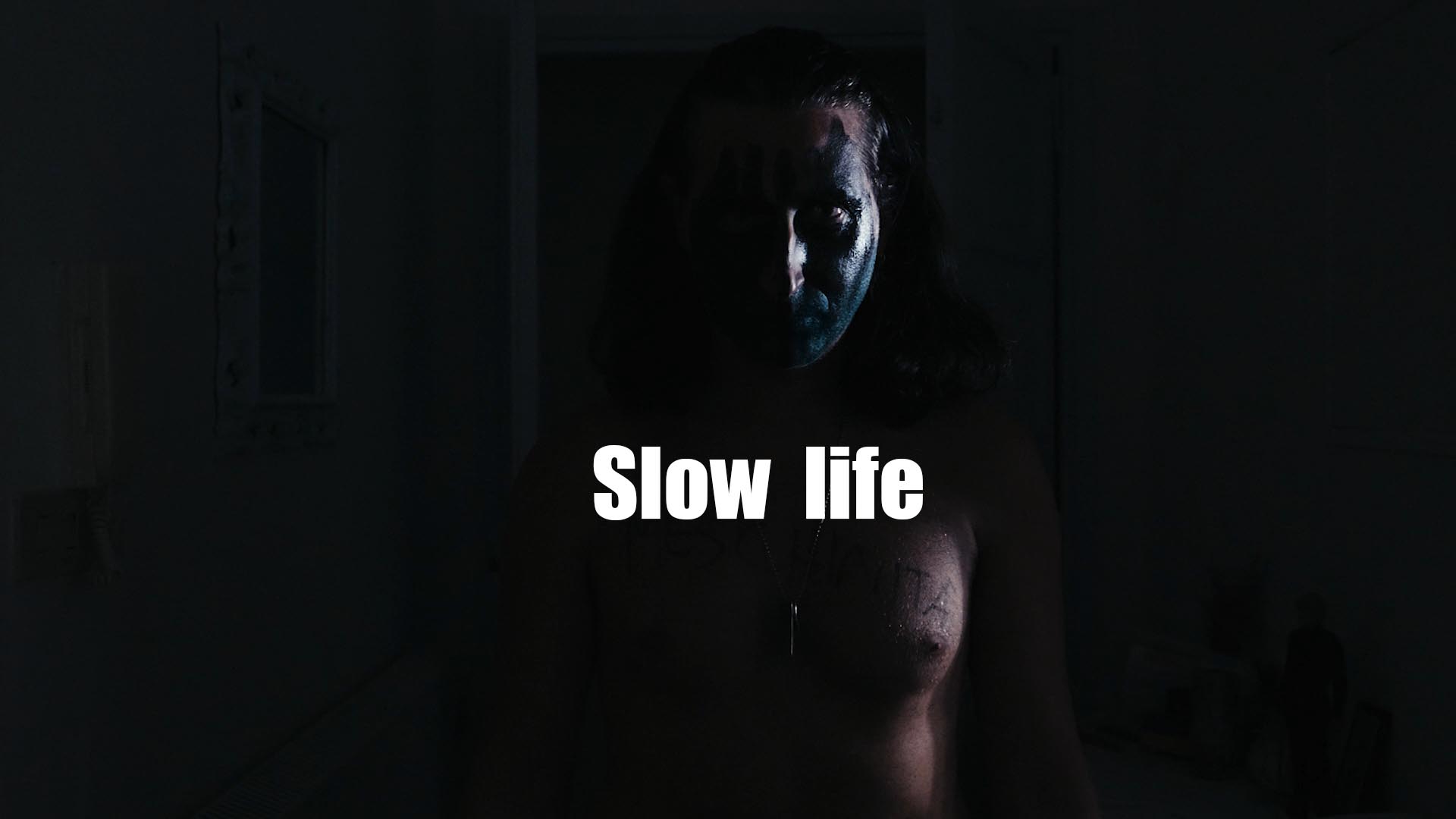
Drama, comedy, thriller, by Fabio Del Greco, Italy, 2021.
Lino Stella takes a period of vacation from his alienating job to devote himself to relaxation and his passion: drawing comics. But he did not foresee certain disturbing elements: the intrusive administrator of the building where he lives, the postman who delivers crazy fines and tax bills, an overbearing security guard, a very enterprising real estate agent, the old lady downstairs who raises the feline colony of the condominium. These characters will make his vacation hell.
Food for thought
The larger a social group is, the more rules and bureaucracy are needed, which often do not respect the individual. You have to learn to live with annoying people, but sometimes the social pressure and arrogance can become intolerable. The only laws that always come to our aid are the laws of Nature.
LANGUAGE: Italian
SUBTITLES: English, Spanish, French, German, Portuguese
A Doctor Who Diagnosed Society
You already know the type: the man at the dinner table who listens more than he speaks, who watches the way a guest adjusts their collar when the conversation turns to money, or the way a woman’s smile falters for half a second before it returns, corrected. He is not being rude. He is diagnosing. Arthur Schnitzler was that man, except that his dinner table was an entire civilization, and the symptoms he catalogued were not physical but moral, psychic, and deeply, irreversibly social.
The medical training did something specific to Schnitzler’s writing that cannot be reduced to metaphor. A physician in fin-de-siècle Vienna was trained in the discipline of the symptom: the understanding that what a patient presents is never quite what is wrong, that the body and the psyche alike speak in displacement, substitution, and concealment. When Schnitzler began writing for the stage and for the page in the late 1880s and through the 1890s, he brought that clinical epistemology directly into the drawing rooms of the Viennese middle class. His characters do not announce their desires. They perform their suppressions. They speak in the elaborate social grammar of a culture that had aestheticized repression into an art form, and Schnitzler’s narrative eye dissected each evasion with the patience of a man who had spent years reading pulse rates and pupillary responses.
The political atmosphere was not merely backdrop. By the 1890s, Karl Lueger’s Christian Social movement was rising toward the mayoralty of Vienna on a platform of virulent antisemitism, winning the position in 1897 over Franz Joseph’s repeated refusals to confirm the appointment. The empire that had promised emancipation was visibly reconsidering the offer. For a Jewish intellectual of Schnitzler’s formation, this was not an abstraction but a recalibration of all prior assumptions, a revelation that the assimilationist bargain had always been conditional. His 1908 novel Der Weg ins Freie, The Road into the Open, would eventually anatomize that renegotiation with devastating clarity, but the urgency was already present earlier, embedded in the very structure of his dramatic method: to expose what polite society required everyone to pretend they could not see.

The Unconscious Before Freud Named It
There is a moment, reading Lieutenant Gustl, when you realize that what you are inside is not a story but a trap. The year is 1900, and Schnitzler has placed you inside the skull of an Austro-Hungarian army officer for the duration of a concert he cannot bring himself to enjoy — a man whose inner voice loops and stutters and contradicts itself with the restless, self-deceiving energy of someone who has never once examined a single one of his own thoughts. Gustl is not a character you observe from the outside. He is a voice you inhabit, and the discomfort of that habitation is the entire point. By the final page, you do not pity him. You recognize him. Worse, you recognize something in yourself that you had not given permission to be named.
What Schnitzler achieved in that novella had no precise literary precedent in German-language fiction. The interior monologue — unbroken, unmediated, moving without authorial intervention between petty vanity and existential terror — was not simply a technical innovation. It was an epistemological claim: that the self, left to its own devices, is not a coherent narrator but a scrambled, defensive, wish-fulfilling machine. Gustl rehearses conversations he will never have, inflates slights into catastrophes, and maneuvers around the truth of his own cowardice with the nimbleness of someone who has spent a lifetime doing exactly that. The structure of his consciousness is not dramatic. It is bureaucratic, repetitive, and deeply ashamed of itself — which is to say, it is human.
This distinction matters more than it might first appear. Psychoanalytic vocabulary gives the reader a framework for understanding a character’s self-deception. Schnitzler’s method removes the framework entirely and leaves you stranded inside the deception itself, with no interpretive ladder to climb. There is no narrator to signal to you that Gustl is rationalizing. You have only the rationalizations, warm and immediate, and the unsettling work of noticing — slowly, uncomfortably — that they are rationalizations. It is the difference between being told that a room is dark and being placed inside it. One produces understanding. The other produces experience.
What makes this philosophically vertiginous is that Schnitzler was writing these interiors not as an anomaly but as a diagnosis. Lieutenant Gustl was published in a Vienna where the Austro-Hungarian military still governed personal honor through duel culture, where a man’s social identity was maintained through elaborate performances of dignity that everyone tacitly agreed to sustain. The interior monologue does not simply expose one officer’s psychological fragility. It exposes the entire system’s dependence on the agreement never to look too closely at what was happening inside the people maintaining it. Freud named the unconscious and built a clinic around it. Schnitzler let it speak in the first person and dared anyone reading to claim they did not recognize the voice.
Desire as a Social Weapon
There is a moment, somewhere in the middle of a dinner party you have attended more than once, when you realize that the conversation about desire happening around the table is not really about desire at all. It is about position. Who is wanted, by whom, under what conditions, and what that wanting confers or withdraws. Schnitzler understood this before the sociology of the twentieth century had the vocabulary to name it, and in 1900 he completed a work so precise in its dissection that it was banned from public performance in Vienna until 1920, prosecuted for obscenity in Berlin in 1921, and remained effectively suppressed in Austria for decades. The play consists of ten dialogues, each one a sexual encounter between two characters, arranged in a chain: the prostitute with the soldier, the soldier with the parlor maid, the parlor maid with the young gentleman, and so on, climbing through every layer of Viennese society until the last scene closes the circle by returning to the prostitute, this time with the count. What looks like a round of pleasure is, in structural terms, a transmission belt.
The genius of the architecture is that no one in the chain is fully honest with anyone else, and the dishonesty is not individual failure but social instruction. Each character performs a version of desire calibrated to the class distance between them and their partner. The young gentleman is tender and almost courtly with the parlor maid, not because he feels tenderness but because condescension requires a costume. The married woman is passionate with her young lover in a way she never permits herself to be with her husband, not because passion is absent from marriage but because marriage in that world is a property arrangement and property does not require performance. Schnitzler was trained as a physician, spent years studying neurology and psychology in Vienna during precisely the period when Josef Breuer and Sigmund Freud were developing the theoretical framework for what desire repressed can do to a body, and what he brought from medicine to the stage was a clinical patience: the willingness to watch a mechanism operate without flinching and without editorializing.
What the chain reveals, scene by scene, is that intimacy in a stratified society is never symmetrical. Someone always holds more leverage. Someone always performs and someone always receives the performance, and these positions shift as the social coordinates shift. The count who closes the circle behaves with the prostitute in a way that mimics genuine connection, perhaps even sincerely believes in it, and this is Schnitzler’s most disturbing insight: that the self-deception of the powerful is not hypocrisy in the ordinary sense. It is a structural necessity. To acknowledge the transaction would be to acknowledge the hierarchy that makes it possible, which would require acknowledging that desire itself, in this world, is not a natural force but a currency whose value is set by something outside the body entirely.
Michel Foucault, writing in The History of Sexuality in 1976, argued that sexuality in modern Western society functions not as a suppressed truth waiting to be liberated but as a produced discourse, a mechanism through which power relations are organized and maintained. Schnitzler arrived at something adjacent to this conclusion seventy-six years earlier, through a playwright’s rather than a philosopher’s instrument, which means he showed it rather than argued it. The difference matters. An argument can be refuted. A scene, when it is precise enough, sits in the body differently. You watch the parlor maid believe, for the duration of the encounter, that she has been chosen, and you understand in the same moment that the choosing is the mechanism of her containment, not the evidence against it.
The circular form was not a stylistic flourish but a statement about reproduction. The structure of power does not progress. It cycles.
The Lie We Call Virtue
There is a particular kind of exhaustion that comes not from doing too much but from maintaining a version of yourself that was never quite true. You know the feeling: the careful way you phrase something in front of certain people, the instinctive adjustment of posture when someone whose opinion matters walks into the room. You are not lying, exactly. You are performing the lie that precedes all other lies — the one that says this performance is simply who you are.
Schnitzler understood this mechanism with a precision that bordered on cruelty. Writing in Vienna at the turn of the twentieth century, he watched a bourgeois society construct its moral identity not through genuine ethical commitment but through the relentless management of appearances. His characters do not merely deceive others; they deceive themselves with such fluency that the deception has become structural, woven into the very grammar of how they speak and move and love. Anatol, the protagonist of his loosely connected cycle of one-act plays published in 1893, is perhaps the clearest embodiment of this. He is charming, introspective, perpetually in love, and constitutionally incapable of honesty — not because he is a villain but because honesty would dissolve the self he has so painstakingly assembled. He asks his friend Max to hypnotize his lover Cora so that he might finally hear the truth about her fidelity, and then, when she is under and the moment of revelation is at hand, he stops the session. He decides he does not want to know. The truth is less bearable than the performance of not needing it.
Erving Goffman would not publish The Presentation of Self in Everyday Life until 1959, but the conceptual architecture he described there — the front stage and back stage of social interaction, the costumes and scripts and carefully managed impressions that constitute what we call identity — maps onto Schnitzler’s fictional world with an almost uncomfortable exactness. Goffman argued that the self is not a private essence that occasionally appears in public, but rather a dramatic effect produced through interaction, a kind of ongoing negotiation between what we project and what others agree to accept. Schnitzler’s genius was to dramatize the psychological cost of that negotiation, to show what accumulates in the back stage when the front-stage performance becomes permanent. His characters are not hypocrites in the simple sense. They are people who have inhabited their performances so completely that the original self — if there ever was one — has become inaccessible even to them.
Dream Story, published in 1926, takes this further into a terrain that is almost unbearable in its intimacy. Fridolin and Albertine are a respectable Viennese couple, affectionate, professionally established, comfortable in the way that people call happiness when they mean the absence of disturbance. In a single night, Albertine confesses a fantasy she never acted upon, and this small honest moment — this slip of the back stage into the front — fractures everything. Fridolin spends the night wandering through a city of masked rituals and suppressed desires, not because he is extraordinary but because the mask of virtue he wears daily has no mechanism for processing the truth of what he wants. The mask is not a disguise over the real man. The mask has become the man. What Schnitzler shows is that respectability, as a social technology, does not merely regulate behavior — it colonizes interiority, until the distance between what one performs and what one genuinely experiences becomes impossible to measure, let alone cross.
This is why reading Schnitzler at the beginning of the twenty-first century produces that specific unease that has nothing to do with historical distance. His Viennese drawing rooms and their etiquette of emotional concealment are not relics. They are the grammar of every professional lunch, every managed disclosure on a first date, every carefully worded message sent to preserve the image of a person who long ago stopped believing in their own innocence but cannot yet afford to say so out loud.
A vision curated by a filmmaker, not an algorithm
In this video I explain our vision
Anti-Semitism and the Architecture of Exclusion

There is a particular kind of humiliation that does not announce itself. It arrives dressed as a procedural matter, a bureaucratic oversight, a politely worded refusal. Arthur Schnitzler knew this architecture intimately, not as a theoretical proposition but as the texture of his professional life in Vienna, where the medical establishment, the literary press, and the imperial censors all found ways to make clear that a Jewish doctor writing about the unconscious desires of the Viennese bourgeoisie was operating on borrowed tolerance. When he completed Professor Bernhardi in 1912, he did not write a polemic. He wrote something far more unsettling: a precise anatomical study of how exclusion perpetuates itself through the language of reason, institutional protocol, and wounded dignity.
The play’s architecture is deceptively simple. A Jewish physician, director of a private Viennese clinic, prevents a Catholic priest from administering last rites to a dying patient — a young woman in the final euphoric stage of septic fever who does not yet know she is dying, and whom Bernhardi refuses to shatter with that knowledge. The act is medical, compassionate, defensible. What follows is its systematic destruction by every institution surrounding it: the church, the government, his own medical colleagues, and eventually the legal system. Schnitzler, writing from inside Viennese professional culture as a trained and practicing physician, understood that the machinery did not require malice to function. It required only the ordinary cooperation of men protecting their positions, and an available target whose Jewishness could be made to explain, retroactively, every inconvenient thing he had ever done.
What made Schnitzler dangerous — why Professor Bernhardi was banned in Austria until 1918, why the censors understood what some critics did not — was his refusal to organize the material into the two available narratives. He would not write the assimilationist story, in which Jewish integration into European culture was simply a matter of patience and achievement, because he had seen too clearly that the goalposts moved with every Jewish success. He would not write the martyrology either, in which Bernhardi’s suffering becomes ennobling, because that framework required the victim to remain a victim, to accept suffering as identity. Bernhardi ends the play not defeated but also not vindicated, returned to his clinic, stripped of illusions about the institutions that destroyed him but stripped equally of any comforting counter-narrative. He is a man who has seen clearly and must now live inside that clarity.
Dream Story and the Violence of the Normal
There is a moment in a marriage — you may recognize it — when one partner confesses a fantasy to the other, not in the heat of passion but quietly, almost clinically, in the dark after sleep. The confession is offered as intimacy, perhaps as trust. And what follows is not liberation but a strange, suffocating silence, because what has been revealed is not merely a desire but the entire architecture of what the relationship has been quietly suppressing. Schnitzler placed exactly this moment at the opening of Traumnovelle, published in 1926, when he was already in his sixties and had spent four decades watching Vienna perform its domestic theater. Fridolin and Albertine, a bourgeois couple in perfect social standing, lie in bed and begin, cautiously, to admit the fantasies they had harbored separately — hers for a Danish officer she once saw, his for a young woman glimpsed at a seaside resort. The admission does not bring them closer. It fractures the floor beneath the entire marriage, and Schnitzler knew that this fracture was not a failure of their relationship but its most honest moment.
And Albertine, who has gone nowhere, who has slept and dreamed while her husband wandered, arrives at the morning in possession of something her husband cannot name or refute. Her dream, which she narrates at the novella’s close with a calm that is more devastating than any accusation, reveals that she has already lived everything he experienced, internally, without moving. The domestic space — the bed, the apartment, the marriage — was never the opposite of the erotic wilderness. It was always its container, and its warden, and the violence of that arrangement had always been hiding in plain sight, in the silence after a confession, in the dark.
What We Still Cannot Say Out Loud
You already know how the evening ends before it begins. You dress carefully, you choose words that will not offend, you perform the version of yourself that the room requires, and somewhere between the appetizers and the goodbyes you have said almost nothing true. This is not hypocrisy in the vulgar sense. It is civilization operating exactly as designed, and the unsettling thing Schnitzler spent his entire career demonstrating is that this design was never meant to protect you from your worst impulses — it was meant to give them a better address.
The structural unwelcomeness of that insight has not diminished. If anything, the mechanisms for suppressing it have grown more sophisticated. We now have entire industries built around the language of authenticity — therapeutic culture, personal branding, the confessional register of social media — and yet the masks Schnitzler described in the Vienna of the 1890s and early 1900s have not been removed. They have been relaunched. The self that declares its vulnerability online is still a performed self, still calibrated to the audience, still governed by the same economy of desire and social positioning that animated every lieutenant and every married woman in his fiction. The vocabulary has changed. The architecture has not.
That accuracy is still uncomfortable to sit with. We prefer the narrative in which civilization is the solution to human darkness, the restraint placed upon the animal, the progress story in which each century moves further from the brutality beneath. Schnitzler spent forty years of published work — from the early psychological novellas through Lieutenant Gustl in 1900, the first sustained interior monologue in German-language literature, through to Traumnovelle in 1926 — methodically dismantling that narrative from the inside. Not with ideology, not with polemic, but with the simple, devastating act of following a character’s thoughts wherever they actually went. What he found there was not a monster. That would have been easier. What he found was a perfectly ordinary person, capable of love and cruelty in the same breath, whose social performance was not a mask placed over a true face but the only mechanism through which the true face could function at all. The mask and the face had become load-bearing for each other.
This is what we still cannot say out loud in any room that requires us to be good. The implication is too corrosive: that the rituals of decency, the careful language, the performed empathy of contemporary life may not represent progress beyond what Schnitzler observed but rather its more elaborate continuation. And perhaps the most destabilizing thing he left behind is not a question about his century but about ours — about what it means that we still reach for the same masks he described, now with better lighting and a more convincing script.
🌀 Into the Labyrinth of the Modern Soul
Arthur Schnitzler’s work is a profound exploration of desire, identity, and the hidden corridors of human consciousness. His Vienna was a city of masks, where bourgeois propriety concealed erotic longing and existential dread. These articles trace the literary and philosophical threads that weave through his world.
William James and Consciousness: The Stream of Thought
William James coined the revolutionary metaphor of the ‘stream of consciousness’ to describe the continuous, fluid flow of thought that shapes human experience. This psychological concept became the literary foundation for writers like Schnitzler, who pioneered the interior monologue in German-language fiction. James’s philosophy of mind illuminates why Schnitzler’s characters feel so uncannily alive and unstable.
GO TO THE SELECTION: William James and Consciousness: The Stream of Thought
Stream of Consciousness in Literature and Cinema
The stream of consciousness technique transformed literature and cinema by turning inward, dissolving linear narrative in favor of associative, fragmented perception. Schnitzler was among the first European writers to deploy the interior monologue as a sustained literary form, most famously in ‘Lieutenant Gustl.’ This article traces that revolutionary tradition across the arts, showing how inner life became the true stage of modernity.
GO TO THE SELECTION: Stream of Consciousness in Literature and Cinema
Kafka and Bureaucracy: The Trial and The Castle
Like Schnitzler, Kafka mapped the psyche through spatial and institutional labyrinths, turning the external world into a projection of inner terror and helplessness. Both writers inhabited the twilight of the Austro-Hungarian empire and shared an acute sensitivity to the absurdity of social structures. Reading Kafka alongside Schnitzler reveals a shared Central European vision of modernity as an inescapable maze.
GO TO THE SELECTION: Kafka and Bureaucracy: The Trial and The Castle
Henri Bergson: Life and Works
Henri Bergson‘s philosophy of duration and memory profoundly influenced the literary generation to which Schnitzler belonged, reshaping how time and consciousness were understood in the early twentieth century. Bergson argued that lived experience cannot be reduced to measurable moments but flows as an indivisible stream, an idea that resonates deeply with Schnitzler’s narrative experiments. Together, Bergson and Schnitzler represent two parallel attempts to capture the irreducible complexity of inner life.
GO TO THE SELECTION: Henri Bergson: Life and Works
Discover the Cinema of the Inner Life on Indiecinema
If Schnitzler’s world of desire, masks, and hidden selves speaks to you, Indiecinema is the streaming home for films that dare to explore the same depths. From dreamlike European art cinema to bold independent narratives about identity and memory, our catalog is a labyrinth worth getting lost in. Join us and let independent cinema lead you further inward.
👉 EXPLORE THE CATALOG: Watch Indie Films in Streaming
A vision curated by a filmmaker, not an algorithm
In this video I explain our vision

