
The Weight You Carry Before You Name It
You are lying awake at three in the morning and the ceiling has become a kind of mirror. Nothing is wrong, technically. The job exists, the rent is covered, the people who are supposed to love you probably do. And yet there is something pressing against the inside of your sternum, something without a name, something that feels less like a problem to be solved and more like weather — permanent, sourceless, indifferent to your attempts to reason it away. You run the inventory. You check the list. You find no single item that explains the weight. And that absence of explanation is somehow the worst part, because a culture that has trained you since childhood to locate causes and apply solutions has left you completely unequipped for suffering that arrives without an invoice.

This is not depression in the clinical sense, though it can become that. It is not grief, though it borrows grief’s texture. It is something older and more structurally embedded than either, something that most people manage by staying busy enough that it never quite surfaces into consciousness. The busyness is not incidental — it is the strategy. Blaise Pascal observed in his Pensées, written in the 1650s, that all of humanity’s problems stem from the inability to sit quietly in a room alone. He meant it as a theological observation, a comment on humanity’s flight from God, but strip away the theology and what remains is a diagnosis so accurate it feels almost aggressive: we have built entire civilizations around the project of not sitting with ourselves.
What the sleepless three a.m. strips away is the infrastructure of avoidance. The phone eventually loses its pull. The body is too tired to perform its usual routines of distraction. And what surfaces in that silence is not nothing — it is something that has been there all along, something that the noise was specifically designed to drown out. Cognitive behavioral frameworks would call this intrusive ideation or ruminative thinking, and they would offer techniques for interrupting it. But the interruption is not the same as the understanding, and there is a profound difference between silencing a signal and reading what it is trying to transmit.
The signal is older than psychology. It is older than philosophy as a Western institution. Somewhere around the fifth century BCE, in what is now northern India, a man named Siddhārtha Gautama articulated something about this signal that no thinker before or since has stated with quite the same anatomical precision. His first formal teaching, delivered at Deer Park in Sarnath to five former ascetic companions, introduced what Pali texts call the Dhammacakkappavattana Sutta — the Discourse on the Setting in Motion of the Wheel of the Dhamma. At its center were four observations about human experience so structurally fundamental that they are less a religious creed than an X-ray of consciousness itself.
The first observation is the one that stops people cold when they encounter it without the protective softening of translation: life is dukkha. The Pali word is almost always rendered as “suffering” in English, and that translation is not wrong but it is not quite complete. Dukkha originally described a wheel with an axle that does not sit properly at its center — a technical, mechanical term for something that turns but grinds, moves but never smoothly, functions but with a friction built into the function itself. A life that looks fine on paper but feels like slow suffocation is not a failure of that life. It is a perfectly accurate report on the nature of experience as such.
This is the thing that makes the four a.m. ceiling so disorienting. You were not promised the grinding. Nobody mentioned the axle. And so when the pressure arrives without a cause you can name, you assume the fault is yours — a personal malfunction in an otherwise functional system, a private defect in an otherwise successful life.
Ugetsu
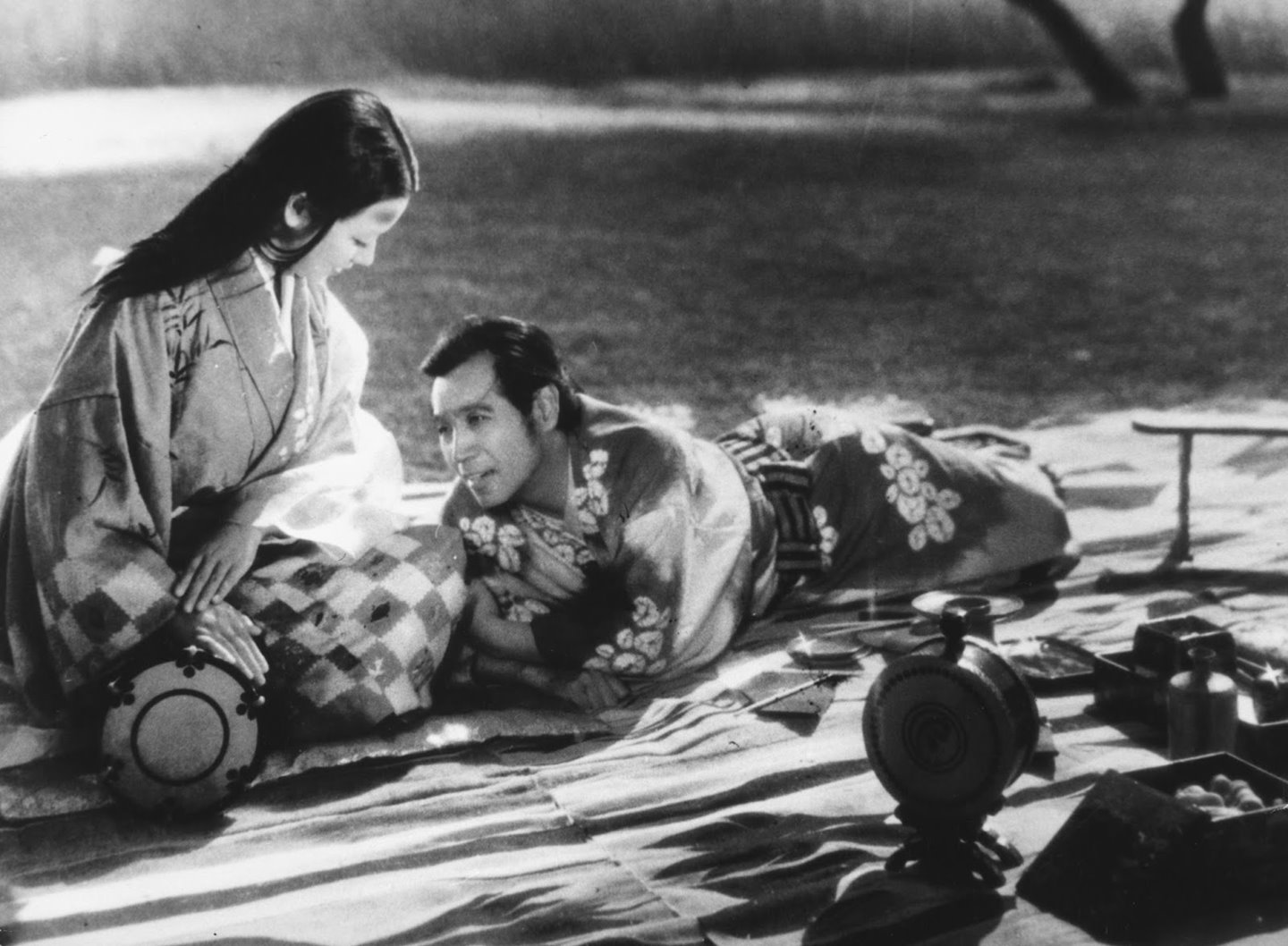
Drama, fantasy, by Kenji Mizoguchi, Japan, 1953.
Japan, late 16th century: the potter Genjurō and his brother Tobei live with their wives Miyagi and Ohama in a village in the Omi region; Genjurō, convinced that he can earn a lot of money by selling his goods in the nearby city, goes to the county of Omizo with Tobei, who joins him with the sole purpose of being able to become a samurai. Back home with a good income, the two work hard to make even more money; Tobei, increasingly obsessed with the ambition of becoming a samurai, needs the money to buy an armor and a spear while Genjurō, overcome by greed, tries to cook a batch of crockery with his brother in just one night. Legend and innovation of cinematic language, a wonderful world next to a brutal and cruel world. Mystery film that opens a discourse with the invisible planes of existence, ghosts and forays into the fantastic, made by Kenji Mizoguchi in a Japan still frozen by the two atomic bombs dropped on Hiroshima and Nagasaki. Fundamental work by Mizoguchi, recognized as one of the greatest expressions of the Seventh Art. A lofty lesson in directing that creates wonder with a dramatic tale of greed and lust for possession. A woman who is a tempting demon and a wife abandoned to a fate of war and misery, Mizoguchi uses the camera to enter "another world".
Food for thought
According to ancient Eastern traditions there are other non-physical planes beyond the physical plane. The etheric plane envelops the physical body, gives it vital energy and acts as an intermediary with the higher levels. Beyond the etheric plane there is the astral plane where entities may exist that have not been able to resign themselves to the loss of their body and wander in search of sensations. They are what are commonly referred to as "ghosts". These entities are looking for bodies that have unbalanced etheric planes to "hook up" to in order to experience sense satisfaction through them.
LANGUAGE: Japanese
SUBTITLES: English, Spanish, French, German, Portuguese
Siddhartha’s Unsentimental Diagnosis
You already know the smell of a room where everything is fine. The furniture is arranged correctly, the people are saying the right things, the light is pleasant, and somewhere beneath all of it something is slightly, persistently wrong — not painful enough to name, not subtle enough to ignore. That feeling has a word, and it is not “suffering.” It is dukkha, and the man who diagnosed it with the precision of a structural engineer was not a god, not a myth, and emphatically not the serene golden figure that airport bookshops and wellness brands have been selling you for decades.
Siddhartha Gautama was born around 563 BCE into the Shakya clan in what is now southern Nepal, into a stratum of society that gave him everything the ancient world considered a shield against misery: aristocratic lineage, physical beauty, trained warriors for protection, and a father, Suddhodana, so determined to keep the boy insulated from hardship that he reportedly constructed entire seasonal palaces to manage the young man’s exposure to weather. This is not mythology functioning as metaphor. The Pali Canon’s Anguttara Nikaya records Siddhartha’s own account of these conditions with a specificity that reads less like hagiography and more like testimony — the testimony of a man describing, without nostalgia, the elaborate architecture of a comfortable lie. What Suddhodana built was not a home but a management system, a curated reality designed to prevent a single question from forming in his son’s mind. It failed, as all such systems eventually do, not through catastrophe but through a crack in the choreography: an old man, a sick man, a corpse, and a wandering ascetic seen on four separate excursions beyond the palace walls.
Western reception of this story has consistently romanticized what was, in clinical terms, a diagnostic crisis. The young aristocrat did not have a spiritual awakening in the way that word now functions — soft-lit, gradual, affirming. He had what we might now recognize as a radical confrontation with baseline ontological reality, and his response was not to seek comfort but to pursue understanding with the rigor of someone who had decided that imprecision was itself a form of violence. He left a wife, a newborn son, and a guaranteed inheritance. He was approximately twenty-nine years old. The sentimentality that surrounds this departure in popular culture systematically obscures what it actually demonstrates: that the gilded trap is most dangerous not when it is uncomfortable, but when it is almost enough.
The First Noble Truth that eventually emerged from years of inquiry — including a period of extreme asceticism he later explicitly rejected as another dead end — is rendered in Pali as dukkha, and its standard English translation as “suffering” has done more damage to the actual philosophy than almost any other single interpretive choice. The word’s etymology involves the prefix du, meaning bad or difficult, and kha, which in the context of a wheel refers to the axle-hole. A wheel with a slightly displaced axle hole does not collapse. It rolls. It functions. It gets you most of the way there. But there is a wrongness in the motion that accumulates over distance, a friction that is not agony but is never quite absent. This is precisely what Siddhartha was pointing at: not the dramatic ruptures of human experience, not bereavement or physical torment, but the structural misalignment that runs beneath ordinary life even when ordinary life is going well.
This distinction matters because a philosophy built on “life is suffering” is a philosophy that most comfortable people in comfortable circumstances can dismiss with a shrug, pointing to their functional relationships and adequate pleasures as counterevidence. A philosophy built on dukkha cannot be so easily escaped, because it does not ask whether you are in pain — it asks whether you have noticed the axle.

The Illusion of the Pain-Free Life as a Modern Invention
You scroll through the feed at 11 p.m. and somewhere beneath the curated glow of other people’s evenings, a formless unease settles in your chest that you cannot name and will not tolerate for more than forty seconds before reaching for something — anything — to dissolve it. This is not weakness. It is the precise outcome of two centuries of philosophical engineering.
Jeremy Bentham spent the last years of the eighteenth century constructing what he believed was a moral science rigorous enough to replace theology. The calculus was elegant in its brutality: pleasure is good, pain is evil, and the entire apparatus of society should be organized to maximize the former and eliminate the latter. His 1789 “Introduction to the Principles of Morals and Legislation” did not merely propose a theory of governance — it planted a conceptual seed that would eventually make ordinary human anguish feel like a civic failure. When suffering becomes the enemy of the good society rather than a condition of conscious life, then the person who suffers becomes, by implication, a malfunction in the social machine.
John Stuart Mill softened the edges of that framework without dismantling its core architecture, and by the time industrial capitalism had metabolized utilitarian logic into production and consumption cycles, the philosophical premise had become economic infrastructure. The pain-avoidance imperative was no longer a theory — it was a market. In 1955, economist Victor Lebow published a retail analysis that American policymakers treated as a blueprint: the economy required that consumption become a way of life, that the search for spiritual satisfaction be converted into the satisfaction of purchasing. What Lebow described as strategy, advertising perfected into sensation. By 1970, the average American was exposed to roughly 500 advertisements daily; by 2007, researchers at Yankelovich estimated that figure had climbed past 5,000. Every one of those messages carried the same embedded premise — that there exists a corrected version of your current state, available for acquisition, just beyond the present moment of discomfort.
What this produced was not happiness but a specific and modern form of suffering that has no clean name: the suffering of people who have been convinced that suffering is not supposed to happen to them. Sigmund Freud observed in his 1930 “Civilization and Its Discontents” that the program of the pleasure principle — what he called the pursuit of happiness — is fundamentally incompatible with the conditions civilization requires to sustain itself, and yet civilization relentlessly advertises its own capacity to deliver what it structurally cannot. This is not irony. It is a productive contradiction. A population that expects comfort and receives ordinary human pain is a population that will purchase remedies indefinitely.
The pharmaceutical data maps this exactly. Between 1991 and 2018, antidepressant prescriptions in the United States increased by more than 400 percent, a figure the American Psychological Association documented not as evidence of a depression epidemic but as evidence of a diagnostic expansion — a reclassification of ordinary grief, transient sadness, and existential restlessness as pathology. The Diagnostic and Statistical Manual itself underwent revisions that progressively narrowed the threshold between normal emotional response and disorder. Bereavement, once a protected category exempt from the depression diagnosis for at least two years, was stripped of that exemption in the DSM-5 published in 2013. Even mourning the dead became a condition requiring clinical intervention.
What Buddhism named as dukkha — the pervasive unsatisfactoriness woven into the fabric of conditioned existence — the modern West named as malfunction, deficiency, and market opportunity simultaneously. The second noble truth locates the origin of suffering in craving, in the compulsive reaching for states that are different from the present one. A civilization built on the constant stimulation of craving and the constant promise of its resolution does not abolish the second noble truth. It industrializes it, scales it, and charges admission at every stage of the loop.
Tanha: The Thirst That Manufactures Its Own Desert
You have gotten everything you wanted, and you are already somewhere else. Not physically — you are still in the same room, holding the same object, standing next to the same person — but the self that wanted this thing so badly has quietly vacated the premises, leaving behind a stranger who now wants something slightly larger, slightly further, slightly more refined than what was just obtained.
This is not weakness of character. Mihaly Csikszentmihalyi, in his 1990 study of optimal experience, documented something that cuts far deeper than motivational advice: the human nervous system is architecturally incapable of sustaining satisfaction as a stable state. What he called the hedonic treadmill is not a poetic warning about materialism — it is a measurable recalibration of baseline expectation that follows the fulfillment of any desire. The neurological reward circuitry does not register arrival; it registers movement toward. The moment movement stops, the signal degrades. The wanting was never about the object. The object was merely the justification the mind constructed to keep the machinery running.
The Second Noble Truth names this precisely. Tanha, the Pali word rendered in English as craving or thirst, does not merely describe the desire for pleasant things. The Buddha identified three distinct streams of it in the Dhammacakkappavattana Sutta: the thirst for sensual pleasure, the thirst for continued existence, and the thirst for annihilation — the desire to escape, to dissolve, to not be what one currently is. What unites these three is not their object but their structure. Each is a posture of the self that positions the present moment as insufficient and some other configuration of reality as the cure. The self is not the one who desires. The self is desire performing itself, moment by moment, and calling that performance identity.
What makes this genuinely destabilizing is the realization that renunciation, as popularly imagined, does not dissolve the structure at all. The person who gives up wealth and retreats from pleasure can still hunger ferociously for spiritual attainment, for the experience of enlightenment, for the social recognition of having transcended social recognition. The object rotates; the mechanism does not. Tanha is not the content of desire but the grammar through which the self constructs its relationship to experience — and that grammar operates below the level of choice. You can change your diet, your address, your philosophy, your partner, and still be running the same sentence in the same tense.
Psychologist Philip Brickman’s research from the 1970s on lottery winners and accident survivors found that within approximately one year of dramatically altered life circumstances, both groups returned to their pre-event levels of subjective wellbeing. The data is brutal in what it implies: external transformation leaves the internal architecture untouched. The mind absorbs the new condition into its baseline and immediately begins generating a fresh horizon of lack. This is not pessimism — it is a description of the mechanism that Buddhist philosophy identified centuries before neuroscience had instruments to measure it, and it reframes the Second Noble Truth as something far less exotic than it initially appears. It is not a spiritual diagnosis handed down from a distant tradition. It is a structural observation about what the ordinary mind does every single waking hour.
The desert that tanha manufactures is invisible precisely because we are so thoroughly inside it. Wanting feels like aliveness. The pursuit feels like purpose. To stop wanting, even briefly, can feel like dying — and this is not metaphor; the threat of cessation triggers the same anxiety circuits as physical danger. A culture organized around stimulation, consumption, and the perpetual generation of new objects of desire is not a corruption of human nature. It is human nature running without friction, without the counterforce that any tradition of serious introspection has always tried to introduce — not to make people passive, but to make them capable of recognizing what is actually happening inside the machinery they are convinced they are driving.
The Social Contract Built on Collective Denial
You are standing in a shopping mall on a Tuesday afternoon, surrounded by people who have nowhere urgent to be, moving slowly past storefronts with the glazed determination of people completing a task they cannot name. Nobody is shopping for anything they need. They are shopping to remain in motion, because stillness, in a culture engineered down to its last detail, has become the most dangerous state a person can occupy.
Ernest Becker argued in 1973, in the book that would win him the Pulitzer Prize weeks after his death from cancer, that human civilization is not primarily a project of flourishing but a project of forgetting. The Denial of Death proposes that every cultural institution, every monument, every career ladder, every nationalist myth, every religion bent toward reward in an afterlife, functions as what Becker called an “immortality project” — a collective mechanism for suppressing the one fact that, if held in full consciousness, would paralyze the species entirely: that each body here is a body in the process of dying. The achievement is not civilization. The achievement is the not-knowing.
This is where the Third Noble Truth becomes genuinely subversive, not spiritually but economically. The cessation of suffering — nirodha, the extinguishing of craving — does not merely describe a private liberation. It describes the dismantling of the engine that runs the world as currently organized. Craving is not a bug in the consumer system. It is the operating principle. The entire architecture of late capitalism, from the thirty-second advertisement to the infinite scroll, is designed around the precise perpetuation of the gap between desire and satisfaction — keeping that gap open, warm, and productive, never allowing it to close. A person who has genuinely ceased craving is not a spiritual success story. They are an economic failure.
Anthropologist Sheldon Solomon, building directly on Becker’s framework in his 2015 work The Worm at the Core, demonstrated through decades of terror management theory research that when people are subtly reminded of their mortality, they do not become contemplative — they become more aggressive consumers, more nationalistic, more punitive toward those who hold different worldviews. The reminder of death does not open people to truth. It drives them deeper into the structures already in place to deny it. Which means that the social contract is not a neutral agreement between citizens. It is a negotiated armistice between people who have silently agreed not to mention what is actually happening.
What the Third Noble Truth names as liberation, the social contract names as dysfunction. The monk who has renounced craving is not celebrated by modern institutions — he is quietly pathologized, economically invisible, spiritually admired at a safe distance that ensures his way of being never contaminates the functioning world. Contemplative traditions have always understood this. The Buddha himself left a palace, not a slum. The renunciation was not of poverty but of comfort — specifically, of the comfort that comfort is enough. There is something in the structure of that departure that no society organized around consumption can afford to take seriously.
The philosopher Charles Taylor, in his 1991 work The Ethics of Authenticity, described what he called the “malaise of modernity” — a pervasive sense of flatness, of life narrowed to individual satisfaction, stripped of the larger moral frameworks that once gave suffering its meaning. Taylor was not a Buddhist and was not diagnosing craving in any technical sense. But the flatness he describes is recognizable: it is the texture of a life organized entirely around the management of discomfort, in which no one has ever been permitted to ask whether the discomfort itself might be pointing somewhere. The cessation of suffering requires, as a first condition, the willingness to stop running from it long enough to look at what it actually is — and that stillness is precisely what the mall, the feed, the noise, and the forward motion are there to prevent.
A vision curated by a filmmaker, not an algorithm
In this video I explain our vision
Nirodha Against the Productivity Gospel
She has the standing desk adjusted to the precise centimeter her physiotherapist recommended, the ambient light calibrated to reduce cortisol by what some study she bookmarked promised was eleven percent, the breathwork app sending gentle chimes at fifty-three-minute intervals. Her performance reviews describe her as exceptional. She has optimized sleep, nutrition, social exposure, and what her therapist calls “emotional throughput.” She feels almost nothing, and she has learned to call this balance.
What the Buddha described in the third of the Four Noble Truths — nirodha, the cessation of craving — is not this. The Pali word carries the sense of confinement, of stopping at the root, of extinguishing the very mechanism of wanting rather than redirecting it toward better objects. The Majjhima Nikaya frames it not as an achievement but as a remainder: what is left when the engine of grasping is no longer fed. It is not a state you purchase or install. It has no interface.
The distinction matters enormously because the wellness industry has constructed its entire architecture on the confusion between cessation and management. Headspace reported over seventy million downloads by 2022. Calm was valued at two billion dollars in 2020. These platforms sell, with extraordinary precision, the aesthetic of nirodha — quietness, breath, present-moment awareness — while their business model depends structurally on the perpetuation of the suffering they claim to address. A user who achieves genuine cessation of craving cancels their subscription. The product is not liberation; the product is the ongoing, renewable proximity to liberation.
This is not incidental. Herbert Marcuse argued in “One-Dimensional Man,” published in 1964, that advanced industrial societies absorb the forces that would otherwise negate them, neutralizing opposition by satisfying it at the level of image rather than substance. Mindfulness, stripped of its ethical and communal scaffolding — what Theravada tradition calls sila, the moral discipline that precedes any serious contemplative practice — becomes precisely this kind of absorbed negation. The form of the critique is retained; the critical force is dissolved.
What the Third Noble Truth actually proposes is structurally incompatible with self-improvement culture because it locates the problem not in the quality of your choices but in the compulsive act of choosing as a strategy for existing. Tanha, the craving the Buddha diagnosed at the root of dukkha, operates at three registers in the Pali texts: craving for sensory pleasure, craving for existence itself, and craving for non-existence. That last one is crucial and consistently omitted from contemporary reformulations. The desire to stop suffering, pursued as a project with measurable outcomes and trackable progress, is itself a form of tanha. The woman with the calibrated light and the breathwork timer is not doing something different from what she has always done. She has simply found a more sophisticated object for the same compulsion.
Bhikkhu Bodhi, the American scholar-monk who produced the definitive English translations of the Majjhima and Samyutta Nikayas, has noted that the secular mindfulness movement tends to extract techniques from a framework that gave them their meaning, then applies them to goals — productivity, resilience, emotional regulation — that the original framework would have recognized as further elaborations of craving. The technique without the context is like administering one compound from a medicine while removing the one that makes it bioavailable. It produces something, but not what was intended.
The cessation the Third Noble Truth points toward was never described in the canonical texts as pleasant. Nibbana — the Pali term that Pali-English dictionaries render, inadequately, as “extinguishing” — was characterized by the Buddha in the Udana as “unborn, unbecome, unmade, unconditioned.” These are not adjectives that sell. They do not resolve into a before-and-after photograph.
The Eightfold Path as Structural Critique, Not Self-Help
You are already on the path. That is the problem. You wake at a reasonable hour, you practice your breathing, you consume content about impermanence between meetings, and somewhere in the architecture of that routine you have mistaken administration for liberation. The Eightfold Path was not designed for people who wanted to optimize. It was designed to be structurally incompatible with the world as organized.
Magga, the fourth of the noble truths, is typically rendered in Western contexts as a roadmap for personal improvement — right speech, right livelihood, right effort, arranged like a wellness checklist that sits comfortably beside your subscription to a meditation app. But the original Pali framework carries no such comfort. The word “right” in each of its eight components translates more precisely as “sammā,” meaning complete, whole, or — and this is the part that gets quietly edited — non-distorted. Which immediately raises the question: distorted by what? The Buddha’s answer was not your childhood trauma or your bad habits. It was the entire social and perceptual architecture through which craving reproduces itself as normalcy.
Slavoj Žižek, in “The Sublime Object of Ideology” published in 1989, made an argument that has never quite found its audience in Buddhist circles, though it should have collapsed the self-help interpretation of the path entirely. His claim is that ideological systems do not primarily operate through false belief — people do not follow capitalism because they sincerely believe it is just. They follow it because it delivers a structured form of enjoyment, what Žižek calls “jouissance,” a surplus pleasure derived from participating in the system even while knowing it is absurd. The person who complains about consumerism while compulsively purchasing, the practitioner who meditates to become more productive — these are not failures of the system. They are its most elegant expressions.
What the Eightfold Path actually demands, read without the sedative of self-help framing, is precisely the refusal of that structured enjoyment. Right livelihood does not mean finding a job you feel good about. In the context of fifth-century BCE northern India, it meant withdrawing from economic participation in systems that generated harm — specifically, the trade in weapons, living beings, meat, alcohol, and poison. The Buddha enumerated these with sociological precision, not spiritual vagueness. He was describing a political economy and telling practitioners to get out of it. That is not meditation advice. That is structural disobedience.
Yuval Noah Harari, writing in “Sapiens” in 2011, observed that the subjective experience of modernity is characterized by a peculiar paradox: humans today report higher rates of depression and anxiety than at almost any measurable point in recorded history, despite — or perhaps because of — living in the most materially abundant civilization ever constructed. What Harari frames as a paradox of progress is, from the perspective of the untranquilized fourth noble truth, not a paradox at all. It is craving operating at industrial scale, institutionalized and accelerated beyond any individual’s capacity to simply think their way free of it.
This is why the path cannot be a self-help program. Self-help operates within the existing system of desires — it makes you better at wanting, more efficient at acquiring, more resilient in pursuit. The path, in its uncensored form, asks whether the wanting itself has been constructed for you by forces you did not choose and cannot see clearly while you remain inside them. Right view, the first component of the eight, is not an invitation to adopt a Buddhist worldview. It is an instruction to perceive the mechanisms by which any worldview — including a Buddhist one adopted as identity — becomes another vehicle for the same craving it claims to dissolve.
The practitioner who finds the path comfortable has almost certainly found a version of it that has already been domesticated, trimmed of everything that would make it genuinely dangerous to the life they have arranged around themselves.
What Buddhism Actually Asks You to Lose
You have probably spent years assuming that the point of any spiritual practice is to make you feel better — more grounded, more present, more at peace with the particular shape your life has taken. This assumption is so embedded in how Western culture has absorbed Eastern philosophy that it functions less like a belief and more like atmospheric pressure: invisible, total, structuring everything you reach for when you reach for meaning.
The Four Noble Truths do not support this assumption. They do not promise relief for the self you currently are. They diagnose that self as the condition being treated. Dukkha is not a mood that passes with better habits or a wound that heals with sufficient compassion practice. It is, in the Buddhist account, coextensive with the structure of selfhood as such — with the machinery of craving, aversion, and identification that constitutes what you call “you.” The path does not lead to a renovated version of that machinery. It leads toward its cessation.
This is where the philosophical precision of Derek Parfit becomes impossible to avoid. In Reasons and Persons, published in 1984, Parfit dismantled the intuitive notion that personal identity is a deep, determinate fact about the world. Through a series of thought experiments involving fission, gradual psychological replacement, and teleportation, he demonstrated that what we take to be a continuous, bounded self is actually a series of loosely connected psychological states with no metaphysical glue holding them together. His conclusion was not nihilistic in the colloquial sense — he found it, explicitly, liberating. Once you accept that you are not a persistent entity but a process, the terror of loss diminishes, because there was never a stable possessor to do the losing. Parfit arrived at this through analytic philosophy. The Buddha arrived at something structurally identical through meditative inquiry, approximately 2,500 years earlier.
What makes this convergence destabilizing rather than comforting is what it implies about the destination. Nirvana, in its earliest Pali formulations, is described as the extinguishing of a flame — not the flame’s relocation to a better room, not its transformation into a warmer, steadier glow, but its going out. The Theravada tradition is unambiguous on this point in ways that later, more psychologically palatable adaptations have quietly softened. The aggregates — form, sensation, perception, mental formations, consciousness — that constitute the apparent self are precisely what ceases. Not purified. Not elevated. Ceased.
From inside the ego, this is indistinguishable from annihilation. The ego cannot model its own absence without experiencing that model as a threat, which means the very instrument you would use to evaluate the Buddhist path is the instrument the path is designed to dismantle. There is no neutral vantage point from which to assess the trade. You are being asked to consider a destination you cannot represent to yourself accurately, using a faculty of representation that is part of what would be surrendered. Parfit acknowledged a version of this vertigo: even after concluding intellectually that the self is not what it seems, the emotional residue of selfhood persists, because the conclusion and the feeler of the conclusion are not the same thing.
What Buddhism actually asks you to lose is not your bad habits, your anxiety, your attachment to outcomes, or even your fear of death — though all of these may loosen along the way. It asks for the one who is anxious, the one who is attached, the one who fears. The Four Noble Truths are not a self-help framework wearing robes. They are a rigorous, unsentimental account of what suffering is made of, and the answer they return is an answer that the sufferer, by definition, does not want to hear: that the solution and the self are not compatible, and that the path forward requires you to stop mistaking the disease for the patient.
🕯️ The Path Through Suffering and Liberation
Buddhism places suffering at the heart of existence, offering a rigorous diagnosis of the human condition and a path toward freedom. The Four Noble Truths resonate deeply with philosophical and spiritual traditions across cultures, from Indian mysticism to Western existentialism. The articles below explore the most vital crossroads between suffering, meaning, consciousness, and awakening.
Buddhism and 3 Documentaries to Understand it
This documentary selection offers an accessible yet profound entry point into Buddhist thought, tracing its origins, practices, and contemporary relevance. Understanding the lived dimension of Buddhism — through film — transforms abstract doctrine into immediate human experience. These three documentaries illuminate precisely what the Four Noble Truths describe: the universal texture of suffering and the possibility of release.
GO TO THE SELECTION: Buddhism and 3 Documentaries to Understand it
Hesse’s Siddhartha: Analysis
Hermann Hesse‘s Siddhartha is one of literature’s most celebrated explorations of the Buddhist path, following a young man’s journey through desire, renunciation, and ultimate awakening. Hesse distills the essence of the Four Noble Truths into a narrative that is both intimate and archetypal. The novel remains a touchstone for anyone seeking to understand how Eastern spirituality translates into personal transformation.
GO TO THE SELECTION: Hesse’s Siddhartha: Analysis
Viktor Frankl: Life and Logotherapy
Viktor Frankl developed logotherapy from his experience of extreme suffering in Nazi concentration camps, arriving at conclusions that echo Buddhist insight: suffering itself can become a gateway to meaning. His work stands as a Western philosophical parallel to the Buddhist teaching that craving and resistance — not circumstances — are the root of inner anguish. Frankl’s thought invites a profound dialogue between psychotherapy and the Dharma.
GO TO THE SELECTION: Viktor Frankl: Life and Logotherapy
Albert Camus: Life and Philosophical Thought
Albert Camus confronted the absurdity of human existence with the same unflinching honesty that the Buddha brought to the truth of dukkha. Where Buddhism offers the Eightfold Path as liberation, Camus proposed rebellion and lucid acceptance as the only honest responses to a world without inherent meaning. Reading Camus alongside the Four Noble Truths reveals striking convergences — and illuminating differences — between Eastern and Western responses to existential suffering.
GO TO THE SELECTION: Albert Camus: Life and Philosophical Thought
Explore the Cinema of Consciousness on Indiecinema
If these reflections on suffering, meaning, and liberation have stirred something in you, Indiecinema streaming is the place to continue the journey. Our curated catalog of independent films explores the deepest questions of existence — from Buddhist-inspired storytelling to existential drama and spiritual documentary. Come discover cinema that thinks, feels, and transforms.
👉 EXPLORE THE CATALOG: Watch Indie Films in Streaming
A vision curated by a filmmaker, not an algorithm
In this video I explain our vision

