
The Frozen Instant as Philosophical Provocation
You are standing in front of a small silver plate, not much larger than your palm, and the man looking back at you has been dead for a hundred and seventy years. His collar is stiff. His expression carries the particular gravity of someone who understood, in that moment of exposure, that something unprecedented was happening to him. You do not know his name. The plate does not offer one. And yet the encounter is not abstract — it is uncomfortably intimate, the way a stranger’s diary found in a used bookshop is intimate, the way you feel seen by someone who cannot possibly see you.

What the daguerreotype accomplished in 1839 was not merely technical. Louis Daguerre’s announcement to the French Academy of Sciences on January 7th of that year — received by the assembled members with a silence that witnesses described as stunned — introduced into Western civilization something it had never possessed and had never genuinely understood it lacked: a mechanism for trapping a moment of lived time in physical matter with a fidelity that no painter’s hand could rival. The painter’s portrait is always, at some level, an argument. The daguerreotype presented itself as a fact.
Roland Barthes, writing in Camera Lucida in 1980, identified what he called the punctum — the detail in a photograph that wounds, that pricks the viewer without permission, that bypasses intellectual consideration entirely. He was circling something older and more vertiginous than aesthetics. He was trying to name the reason a photograph of a dead person produces a sensation that a painted portrait of the same person does not. The photograph, he argued, carries within it a certificate of presence — it testifies not to what something looked like but to what something was. The distinction collapses the comfortable distance between representation and reality, and with it collapses a great deal of what Western culture had constructed to make mortality bearable.
Before 1839, the dead receded. Memory softened them, painting idealized them, language transformed them into the figures that survivors needed them to be. Grief was, among its many functions, also an editorial process. The daguerreotype interrupted that process with the bluntness of evidence. When a mother in Boston or Lyon or Vienna could hold a silver plate bearing the precise face of her dead child — every eyelash in place, the specific weight of the child’s brow exactly recorded — something shifted in the architecture of human mourning that has never fully shifted back. Historians of photography, notably Geoffrey Batchen in Forget Me Not: Photography and Remembrance, have documented the immediate and widespread use of early photographic processes in memorial portraiture, including the practice of photographing the newly dead arranged as if sleeping, a custom that spread through both Europe and North America within years of the daguerreotype’s introduction. The technology did not create the desire to preserve the dead — that desire is ancient — but it transformed the terms on which such preservation was possible, from symbolic approximation to what felt, viscerally, like literal capture.
This is where the philosophical disturbance runs deepest. Every culture before photography had developed, over centuries, a shared understanding that the past was irretrievable — that time moved in one direction and took everything with it. Religious frameworks, funerary rituals, oral traditions, portrait painting: all of these were elaborate negotiations with irreversibility. Photography did not resolve that irreversibility. It did something stranger. It created objects that exist in the present tense but belong entirely to the past, artifacts that make the past visually indistinguishable from the now, and in doing so exposed the degree to which humanity’s sense of temporal order — its confidence that now and then are meaningfully separate — had always been a kind of cultural agreement rather than a fact of physics.
The man on the silver plate is still looking at you, and you still do not know what to do with that.
Studio 2091
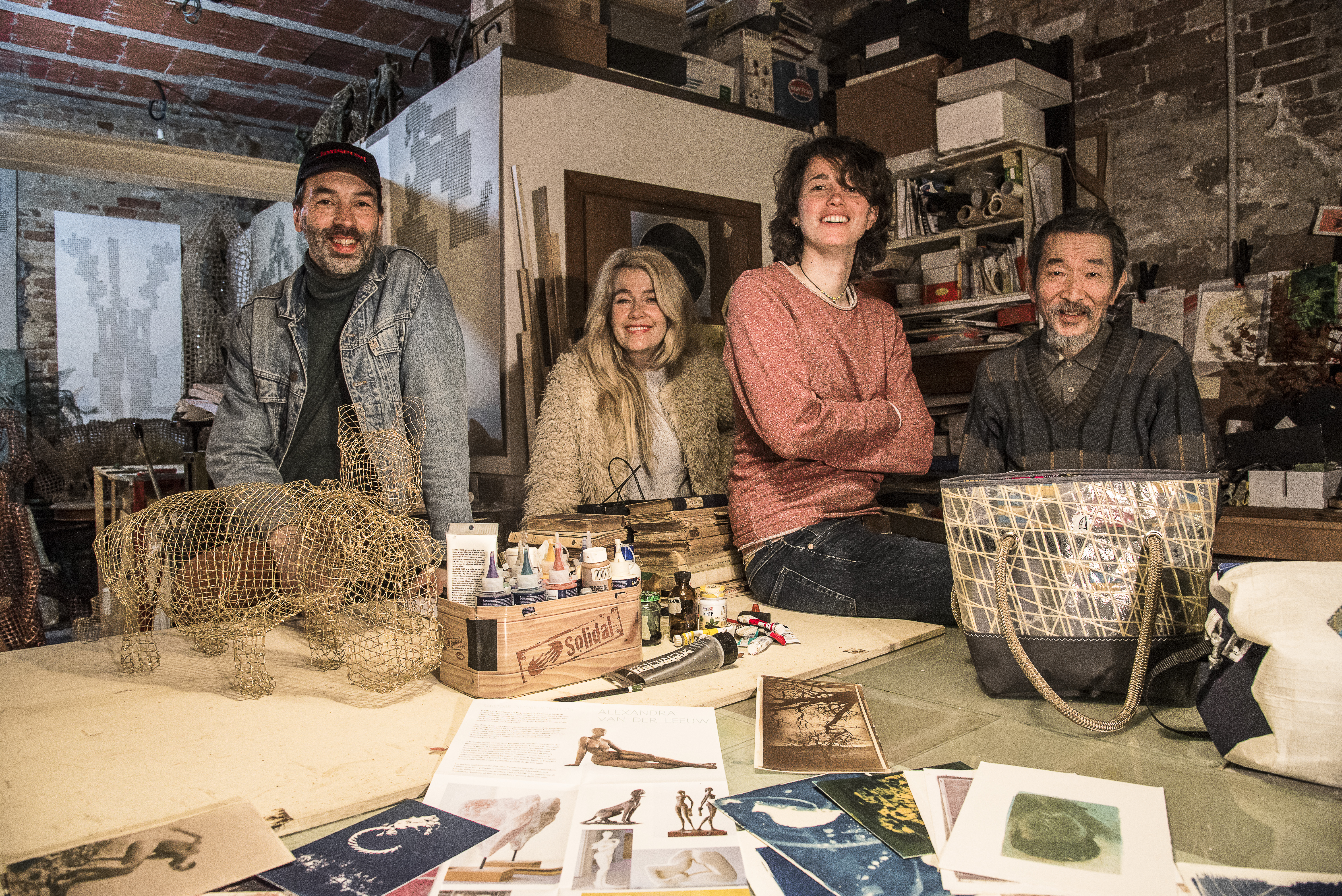
Documentary, by Naù Germoglio, Italy, 2020
In a former warehouse on the ground floor of the civic number "2091", in the district of “Santa Croce” in Venice, two sculptors, a craftswoman and an alchemist-photographer work together. It is a 65 square meters space with two windows overlooking a small canal. It is called "STUDIO2091" and it is a unique example of creative co-working space where there is no wifi connection, the cellphones work very bad, there are no tables for meetings, nor computers.
His "tenants" carry out only manual activities related to art and crafts. Each of them has a different reason to live in Venice, a beautiful and unique city, yet expensive, problematic, overrun by mass tourism and high tide. The photographer-alchemist Andrea Buffolo, who was born in Switzerland,is the only one who has spent almost all his life in the historical center of Venice. Japanese sculptor Masaru Kashiwagi chose to live in Venice 35 years ago, because he considers it the only city in the world perfect for an artist; the craftswoman Camilla Morelli was born and raised in Valtellina ( a valley in the Lombardy region of northern Italy), and although she grew up in the mountains, she chose to live in Venice to enjoy the proximity to the sea; the Dutch painter and sculptor Alexandra Van der Leeuw lives on the island half of the year carrying on a family tradition. The four protagonists of the documentary film chose to live in Venice because here,and only here, they succeed in being themselves, realizing themselves and feeling free.
SUBTITLES: English, Spanish, French, German, Portuguese
Louis Daguerre and the Alchemy of Silver Iodide
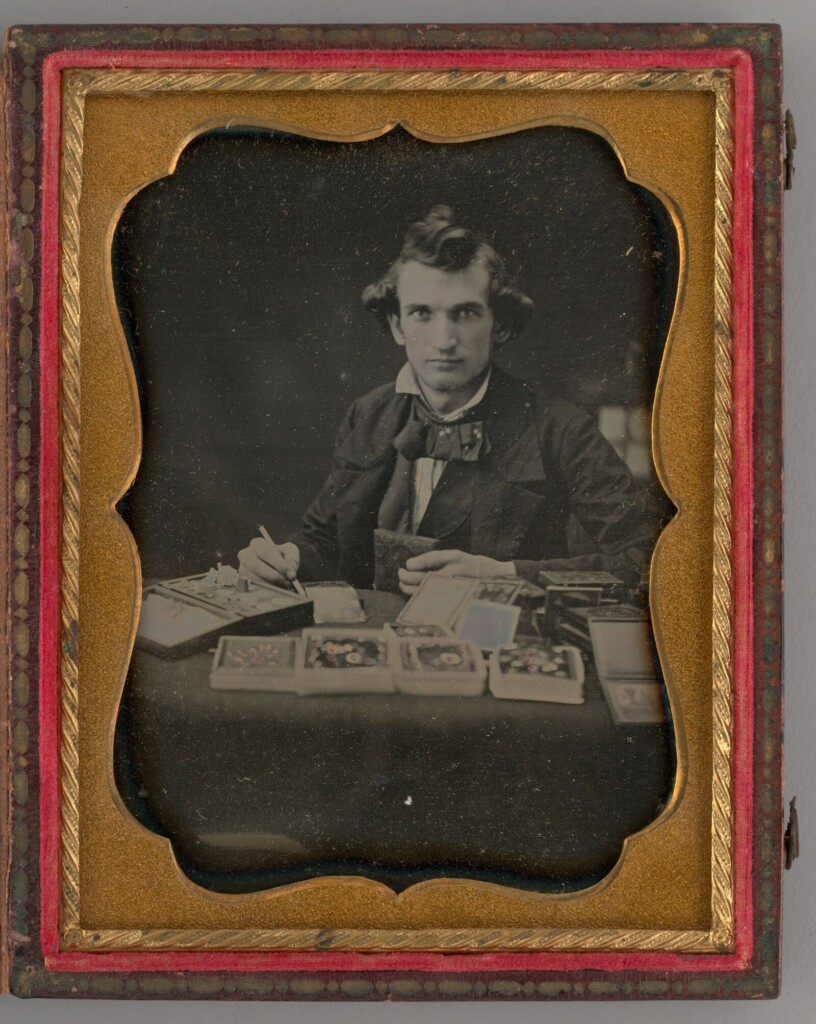
You are standing in front of a daguerreotype portrait from 1841, and something about it refuses to behave like a photograph. Tilt it one way and you see a face — a man in his forties, collar starched, expression locked into the particular gravity that long exposure times demanded. Tilt it the other way and the image inverts, turns negative, becomes a ghost of itself. The object is not quite a picture. It is a silvered surface that caught light once and will never fully surrender it.
Louis Daguerre did not invent photography out of curiosity. He was a showman, the co-creator of the Diorama, a theatrical spectacle that had drawn Parisian crowds since 1822 by flooding enormous translucent paintings with shifting, manipulated light to simulate sunrises, fires, and floods. When the Diorama burned to the ground in March 1839, nine months after he had sold his process to the French government and two weeks before the formal public demonstration, the symmetry was almost too clean to be accidental. The machine for producing illusions was consumed by the very element it had exploited, and in its place stood something that claimed to do without illusion entirely — to let nature inscribe itself.
The material process Daguerre had stabilized by 1837, after years of collaboration with Nicéphore Niépce and then alone following Niépce’s death in 1833, depended on a sequence of chemical reactions that were far better understood in practice than in theory. A copper plate coated with silver was exposed to iodine vapor, producing a thin layer of silver iodide sensitive to light. After exposure in a camera, the latent image — invisible, chemically present — was developed by suspending the plate over heated mercury, whose vapor bonded selectively to the exposed silver particles, rendering the image visible. The result was fixed with a solution of sodium thiosulfate, a compound the chemist John Herschel had identified as a solvent for silver salts in 1819 and whose photographic utility Herschel himself communicated to the community in January 1839, just days before François Arago’s announcement to the Académie des Sciences made Daguerre’s process public knowledge on January 7th of that year.
What the history of art tends to narrate as a moment of rupture was, in the material sense, a convergence of pressures that had been building for decades. Portrait miniaturists — a profession employing thousands across Europe — had already watched their market compress under the weight of cheaper printing technologies. The physiognotrace, a mechanical device for tracing facial profiles invented in 1786, had democratized portraiture enough to make the handmade object feel slow and expensive without yet displacing it entirely. Daguerre understood, with the instinct of someone who had spent twenty years selling spectacle, that the anxiety of obsolescence is itself a commercial engine. He did not offer the daguerreotype to painters as a tool. He offered it to a public that had already been trained by the Diorama to equate mechanical precision with truthfulness.
The state transaction completed by Arago was peculiar in ways that have rarely been interrogated with the directness they deserve. France purchased the process not to distribute it freely out of republican generosity, but because Arago recognized that a French state gift to the world could function as a form of soft power, an assertion of scientific and cultural primacy at a moment when British industrial dominance was generating real political anxiety. William Henry Fox Talbot, who had been developing his own paper-based process in parallel and who had rushed a partial account of his work to the Royal Institution in London on January 25, 1839, eighteen days after Arago’s announcement, found himself suddenly positioned as second — not because his process was inferior in every dimension, but because he had no Arago.
The mercury vapor that made the daguerreotype legible was also, of course, slowly poisoning everyone who worked with it.

William Henry Fox Talbot and the Negative Paradigm
You hold a sheet of paper up to the light and see, reversed and shadowed, something that is not quite an image — a negative, a world turned inside out, where brightness becomes darkness and the familiar face of a friend appears as a pale ghost against blackened sky. This is not yet the photograph. This is the matrix, the wound from which photographs will be born, potentially without limit, each one identical to the last and none of them the original. William Henry Fox Talbot understood, perhaps before he could fully articulate it, that he was not inventing a way to capture reality but a way to multiply it.
Talbot filed his calotype patent in February 1841, and the technical procedure he codified was deceptively modest: paper coated with silver nitrate, then bathed in potassium iodide to produce silver iodide on the surface, then sensitized again with a solution of gallic acid and silver nitrate just before exposure. The latent image that resulted required only minutes rather than hours, and the gallic acid development that followed drew out tones from what appeared to the naked eye as a blank sheet. The negative produced by this process could then be pressed against fresh sensitized paper and exposed to sunlight, producing a positive print — and then another, and another, as many as the paper’s grain and the light’s patience would allow. What Talbot had constructed was not a picture but a procedure, not an object but a relationship between objects, a chain of chemical translations that could in principle extend indefinitely.
The epistemological weight of this is easy to miss if you are focused on the chemistry. Walter Benjamin, writing in his 1936 essay “The Work of Art in the Age of Mechanical Reproduction,” identified the aura of an artwork as inseparable from its singularity, its existence in a particular place at a particular time, its having passed through specific hands and specific moments. The daguerreotype, for all its cold precision, preserved something of this logic: each plate was singular, unrepeatable, the exact record of one moment of silver’s encounter with light. Talbot’s calotype dissolved that logic at its root. The negative is not the work — it is the potential of the work, a standing invitation to produce instances of something that has no original instance. The photograph made from a calotype negative is not a copy of anything; it is a sibling to every other print made from the same matrix, and none of them is prior.
This reorientation has consequences that reach far beyond photography. Charles Sanders Peirce, the American philosopher who spent much of the 1860s and 1870s developing his theory of signs, would have recognized in the calotype a pure index stripped of its object — a trace that points toward something it can never fully contain, a sign whose referent is always elsewhere. The paper negative encodes light as absence, presence as shadow, the world as its own inversion. Every positive print is a double negation, a negation of a negation, and arrives at resemblance through a detour that the daguerreotype never needed to take. Meaning, in Talbot’s system, is constitutionally deferred.
Talbot himself seemed to sense that he was doing something philosophically strange. His 1844 publication “The Pencil of Nature,” the first photographically illustrated book ever commercially produced, contained a plate of shelves lined with china and glassware accompanied by a note explaining that these objects could be legally identified in court if stolen, the photograph serving as documentary witness. But the witness he was proposing was itself a reproduction, a print from a negative, already once removed from the event of exposure. He was offering evidence whose chain of custody began with an absence, a dark room, a reversed world, and moved toward truth only by passing through its own structural impossibility.
Patent Wars and the Politics of Visibility
You might have stood in a chemist’s shop in Edinburgh in 1847, holding a small piece of treated paper, knowing that the portrait it might produce would cost you not only money but legal exposure. The man who invented the process that paper depends on has already sued a photographer in London for practicing his own art without paying tribute, and the threat is not theoretical — William Henry Fox Talbot holds a patent so broad, so deliberately encompassing, that it extends to almost any photographic act performed on paper in Britain. You put the paper down.
Talbot filed his first patent in February 1841, protecting the calotype process with a specificity that bordered on territorial aggression. By 1843 he had begun licensing it, and by 1852 he had initiated legal proceedings that paralyzed a significant portion of British photographic practice. The historian Larry Schaaf, who spent decades reconstructing Talbot’s correspondence, documented how practitioners across England and Scotland simply abandoned the paper process rather than navigate the legal labyrinth Talbot constructed around it. Studios that might have developed a British vernacular of the calotype instead pivoted toward the daguerreotype, a process they could use without asking permission from anyone.
This pivot happened for a reason that had nothing to do with optics or chemistry. On August 19, 1839, the French government formally purchased the daguerreotype process from Louis Daguerre and his partner Isidore Niépce and declared it a gift to the world — or rather, as the physicist and politician François Arago phrased it in his address to the Chamber of Deputies, a gift to all of humanity except the English, who were quietly excluded through a simultaneous British patent filed just days before the announcement. France had made a political theater of generosity while protecting its own inventors commercially. The result was that a French invention spread across every continent in roughly eighteen months, adopted freely in the Americas, in Germany, in Japan, while Talbot’s English invention calcified behind legal walls within its country of origin.
What this produced was not simply a market imbalance but an epistemological one. The daguerreotype, technically precise and incapable of reproduction, became the medium of official truth in cultures where it circulated freely. The calotype, soft and reproducible and perfectly suited for books and albums, remained concentrated in the hands of a small artistic elite — David Octavius Hill, Robert Adamson, a few French practitioners like Gustave Le Gray who worked in countries beyond Talbot’s legal reach. Le Gray’s seascapes of the early 1850s, produced using a waxed-paper variant of the calotype, circulated through Parisian salons as art while virtually identical work could not legally exist as commerce across the Channel.
The sociologist of science Bruno Latour argued in “Science in Action” that a discovery becomes real only when it enrolls allies — institutions, users, networks, infrastructure. Talbot’s calotype, measured purely by chemistry, was arguably the more consequential invention: it established the negative-positive logic that would govern photography for the next hundred and fifty years. But Talbot’s refusal to enroll allies, his insistence on extracting fees rather than building a community of practice, meant that the calotype lost the contest for historical presence not because it failed technically but because it was deliberately starved of users. Dominance in the historical record followed from dominance in actual practice, and actual practice followed from who got sued.
The deeper violence of this arrangement is that it masked itself as natural selection. When historians in the late nineteenth century began writing the first accounts of photography’s origins, the daguerreotype appeared everywhere in archives, in newspapers, in studio records, simply because it had been practiced so widely and so freely. The calotype appeared as an anomaly, a footnote, an aesthetic curiosity pursued by gentlemen with time and money to spare, and that appearance was not the result of inferiority but of enforcement.
The Texture of Chemical Uncertainty
You tilt it slightly, and the face disappears. Tilt it back, and there it is again — a man in a dark coat, eyes fixed on something outside the frame, expression unreadable. The daguerreotype does not simply show you an image; it negotiates with you, demanding a particular angle, a particular quality of light, before it surrenders its subject. Move two degrees to the left and the whole surface inverts, turning from a portrait into a ghostly negative, the face replaced by its own shadow. This is not a defect in the object. It is the object’s fundamental nature, built into the chemistry of silver and mercury that Louis Daguerre fixed onto a copper plate in 1839, a process he announced to the French Academy of Sciences on January 7th of that year before selling the rights to the French government for an annual pension of six thousand francs.
What that negotiation reveals is something the history of image-making has been remarkably reluctant to face: that instability in a visual record does not diminish its truthfulness but may in fact intensify it. The daguerreotype’s surface was a layer of silver iodide exposed to light and then developed in mercury vapor, producing an image so thin and fragile that a fingerprint could erase it permanently. The image lived on the outermost edge of the metal, exposed and vulnerable, sealed under glass not merely as a protective convention but out of genuine physical necessity. Roland Barthes, writing in Camera Lucida in 1980, described the photograph as a certificate of presence — the evidence that something was there. But the daguerreotype goes further and stranger than that claim suggests, because it refuses to let you confirm presence without effort, without movement, without a small act of submission to its terms.
The calotype operates under an entirely different logic of uncertainty. William Henry Fox Talbot’s paper negative process, patented in England in 1841, did not produce images on polished metal but within the fibrous body of the paper itself. The silver salts saturated the cellulose, and when light struck them, the resulting image was inseparable from the texture of its support. Fine architectural detail softened. A leaf’s edge blurred slightly into the surrounding grain. A face became something closer to a face remembered than a face observed. This was not a resolution failure in any meaningful technical sense — it was a consequence of the material’s constitution, and it meant that every calotype carried within it evidence of the physical substance through which it had been made.
Talbot himself understood that the process was doing something philosophically unusual. In The Pencil of Nature, published in fascicles between 1844 and 1846 — the first commercially published book illustrated with photographs — he argued that the images had been made by nature’s own agency rather than by human hand. But the grain of the paper contradicted that claim quietly and persistently, because it kept insisting on the presence of a medium, a material body standing between subject and viewer. The calotype never let you forget that you were looking through something.
What both processes shared, despite their radical technical differences, was an honesty about the conditions of their own making that later photographic technologies would systematically erase. The gelatin dry plate, commercially viable by the 1870s, and then the celluloid film that followed it, produced images of increasing tonal smoothness and apparent neutrality, images that seemed to present the world without mediation. But the world has never arrived without mediation, and the surfaces that pretend otherwise do not represent reality more accurately — they simply represent the desire to believe that transparency is possible, that the instrument can disappear and leave only the thing itself, clean and unambiguous and available to anyone who looks without adjusting the angle.
A vision curated by a filmmaker, not an algorithm
In this video I explain our vision
Portraiture, Class, and the Democratic Illusion

You are already performing before the camera shutter moves. The moment you enter the portrait studio — straightening your collar, smoothing the fabric at your shoulders, arranging your hands with a deliberateness you would never apply to ordinary life — you have accepted the terms of a transaction whose real currency is not silver nitrate but social aspiration. The daguerreotype studio of 1840s Paris did not reveal who you were. It allowed you to propose who you wished to be taken for.
The mythology of democratic visibility attached itself to photography almost from the first published announcements. When François Arago presented the daguerreotype to the French Chamber of Deputies in August 1839, he deployed the language of universal gift, of science made available to all humanity. Newspapers across Europe repeated the claim with the enthusiasm of people who had no financial interest in questioning it. What none of them paused to calculate was the actual cost of a sitting at a Parisian portrait studio in the years immediately following that announcement. By 1841 and through the mid-decade, a daguerreotype portrait in a reputable studio on the Boulevard des Capucines cost between three and five francs — equivalent, in purchasing power, to a full day’s wage for a Parisian skilled laborer, and considerably more than a day’s earnings for the unskilled workers who constituted the overwhelming majority of the city’s population. In London, Beard’s studio on the Strand charged fees that placed a single portrait beyond the reach of anyone living below the emerging professional class. The instrument that Arago had described as belonging to everyone belonged, in practice, to those who could afford to purchase a version of themselves.
What the bourgeoisie was purchasing was not a likeness but a position. Walter Benjamin, writing in his 1931 essay “A Short History of Photography,” noticed that the earliest portrait photographs carried a quality of presence, an aura saturated with technical difficulty and social weight, that later mechanical reproduction would erode. But he stopped short of the more uncomfortable observation: that aura was inseparable from exclusivity. The sitting required stillness, patience, the willingness to submit to a minor ordeal of exposure time — head braces, fixed gazes, shoulders locked — and the financial capacity to absorb the cost as a discretionary expense. These conditions did not simply filter who appeared in front of the camera. They determined what posture, what expression, what sartorial grammar would become legible as worthy of being photographed at all. The middle classes were not merely represented by the daguerreotype; they colonized the visual vocabulary of what it meant to be a subject worth representing.
The sociologist Pierre Bourdieu, in his 1965 study “Un art moyen,” examined how photography functioned not as a neutral recording instrument but as a site of social legitimation, where taste, propriety, and hierarchical distinction were continuously rehearsed and encoded. His fieldwork concerned a later era of cheaper amateur photography, yet the structural logic he identified — the camera as an apparatus for performing belonging — was already fully operational in those early Parisian studios, simply performed by fewer people at far greater personal expense. The scarcity of access was not a temporary technological limitation waiting to be overcome by progress. It was constitutive of the medium’s social meaning during its founding decades. A portrait that anyone could afford would have meant something categorically different from one that required sacrifice or privilege to obtain.
The calotype process, cheaper in principle because paper negatives could yield multiple prints, never seriously dislodged the daguerreotype’s commercial dominance in portraiture precisely because William Henry Fox Talbot’s patent enforcement made it financially prohibitive for independent studios in Britain until the early 1850s. Two technical systems that might have competed on terms of access instead competed on terms of legal exclusion, and the portrait remained a luxury commodity dressed in the rhetoric of universalism — which is a condition so familiar it barely registers as a condition at all.
Scientific Authority and the Manufactured Objectivity of the Lens
You are handed a photograph of a fern taken in 1843 and told it is a scientific record. Something in you immediately defers to it. Not to the person who held the camera, not to the hand that steadied the paper negative in the fixing bath, not to the decision about what angle, what light, what distance — but to the image itself, as though it arrived from nowhere, authored by nothing, carrying only the brute fact of the plant’s existence.
Lorraine Daston and Peter Galison, in their 2007 study of the epistemological history of scientific illustration, traced a transformation they called the shift from “truth-to-nature” to “mechanical objectivity” — a shift that happened precisely during the window when the calotype found its most ambitious institutional applications. Before the camera, botanical illustration required an artist to synthesize across many specimens, to draw the ideal leaf, the representative flower. The image was openly constructed. What the calotype introduced was not accuracy in any simple sense, but the philosophical claim that the human will had been removed from the process. The machine looked. The machine recorded. The scientist merely developed what nature had already written.
Between 1843 and the late 1850s, this claim was mobilized with extraordinary ambition. William Henry Fox Talbot’s own circle contributed to botanical documentation on paper negatives. Archaeological expeditions into Egypt and the Levant carried calotype equipment specifically because drawings were increasingly treated as suspect — as carrying the unconscious biases of the hand — while photographs were classified as extractions rather than constructions. The Paris Observatory began incorporating photographic plates into lunar and stellar records during the 1850s, and the institutional language around these images was consistently the same: the camera sees what we cannot see without seeing. It witnesses without witnessing.
What Daston and Galison identified is that this was not a scientific discovery but a cultural choice about what kind of knowledge deserved authority. The suppression of the observer’s will became an ethical ideal, and the photograph became its icon — the artifact that most perfectly performed the disappearance of human subjectivity. The lens was positioned not as a tool shaped by human decisions but as a transparent aperture through which reality passed unfiltered. That this aperture was ground by craftsmen, mounted in brass by technicians, pointed by investigators with theoretical agendas, and processed in chemical solutions whose composition reflected specific institutional resources — none of this appeared in the epistemological story the nineteenth century told about its own images.
The cultural inheritance is not benign. Courts in the United States had already begun admitting photographs as evidence by the 1860s, decades before any coherent legal framework for evaluating their conditions of production existed. The evidentiary weight placed on photographic images in legal proceedings was not the result of rigorous analysis of what photographs actually captured — it was the legal system absorbing a cultural assumption that had been constructed in botany labs and astronomy observatories and archaeological digs, then released into general circulation. Verbal testimony required assessment of motive, memory, position, relationship. The photograph required none of that assessment, because it had already been granted a category of its own: mechanical witness.
What makes this inheritance so durable is that it flatters us on both sides of the image. The person producing the photograph is absolved of the rhetoric of persuasion — they did not argue, they merely captured. The person receiving the photograph is absolved of the labor of interpretation — they did not judge, they merely saw. This double absolution is not a neutral cognitive convenience. It is a structure that makes photographs extraordinarily useful for anyone who needs to present a constructed reality as an extracted one, and extraordinarily dangerous for anyone who needs to contest what the frame excluded, what the timing distorted, what the contrast ratio quietly erased from the shadows at the edge of the plate.
The Disappearance of the Calotype and What It Erased
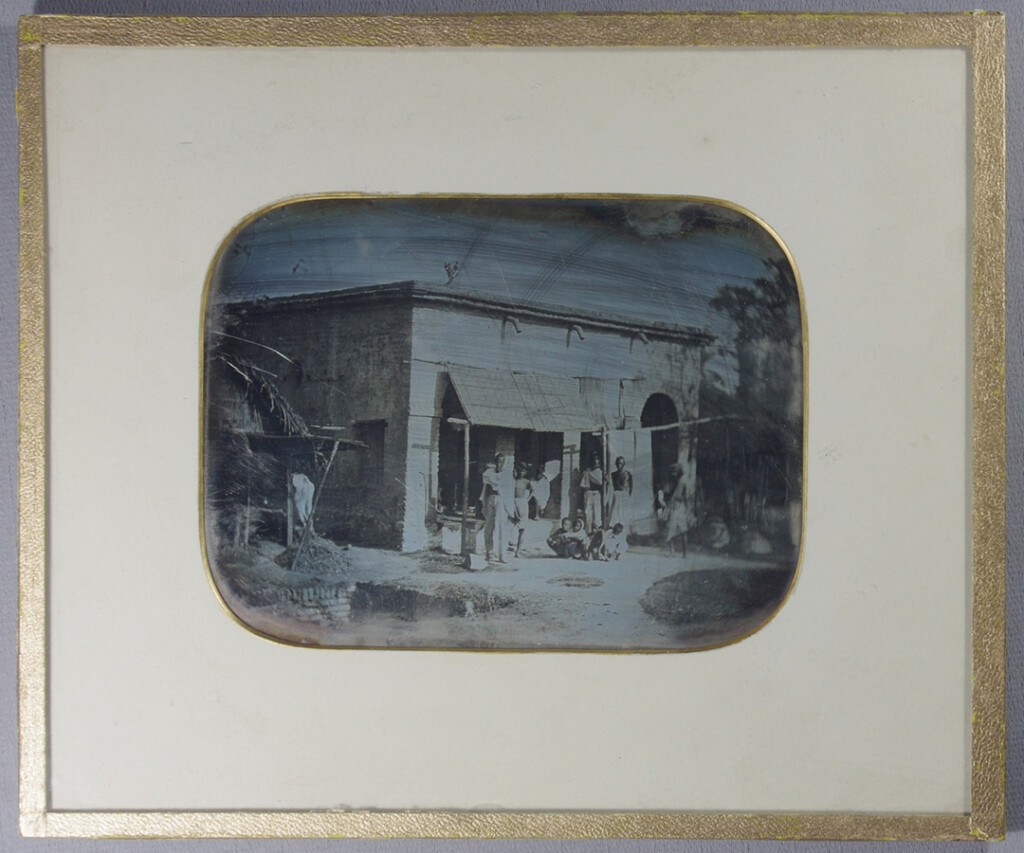
You are standing in front of a contact print made sometime around 1845, and something about it is making you uncomfortable in a way you cannot name. The image is soft. The edges of a stone wall blur into the sky with a kind of reluctance, as though the world being depicted has not fully agreed to be photographed. You assume this is a flaw. You have been trained, without knowing it, to assume this is a flaw.
The wet collodion process, perfected by Frederick Scott Archer and published in 1851 without patent, did to the calotype what industrialization does to craft: it didn’t argue against it, it simply made it irrelevant by another standard. Archer’s glass negatives offered exposure times measured in seconds, detail so fine it could record the individual hairs of an eyebrow, and negatives that could be reproduced with mechanical consistency. By 1855, most professional studios in Britain and France had already migrated. By the end of that decade, the calotype had become a relic in the hands of a few committed amateurs and aesthetes who recognized, with the particular bitterness of the prescient, that something was being surrendered rather than surpassed.
What was surrendered was a specific relationship between the photographic image and the act of seeing. Fox Talbot had called his process “the pencil of nature,” but that phrase contains a paradox he may not have fully intended: a pencil is held by a hand, and a hand belongs to a person who decides where to press and where to release. The calotype’s paper negative, with its fibrous texture and its absorption of light in ways that could not be fully predicted or controlled, forced interpretation into the technical process itself. The photographer did not merely record — they negotiated. The grain of the paper was not a defect to be eliminated but a condition of the image’s existence, the way a brushstroke is a condition of a painting’s existence rather than evidence that the painter lacked a steadier hand.
Roland Barthes, writing in Camera Lucida in 1980, distinguished between the studium — the cultural, informational content of a photograph — and the punctum, the detail that wounds, that escapes intention. What the collodion process and every subsequent refinement systematically accomplished was the engineering of images in which the studium consumed everything, in which technical perfection became the guarantee of meaning. The assumption hardened into ideology: a sharper image is a truer image, and a truer image is a more honest one. This equation is not neutral. It is a philosophical position disguised as a technical improvement, and it colonized visual culture so completely that we now call photographs taken on medium-format film “artistic” as though we are granting them a special exemption from their own nature.
The deeper consequence is epistemological. When photography declared itself a transparent record of the real — a declaration the calotype’s very materiality would have made absurd — it also declared the photographer invisible. The image appeared to produce itself, to be extracted from the world rather than made. This fiction, consolidated through the second half of the nineteenth century and calcified by the twentieth century’s press photography, documentary tradition, and legal uses of photographic evidence, transformed the camera from an interpretive instrument into a truth machine. Entire judicial systems, entire wars, entire political realities were adjudicated through images whose claim to objectivity rested on a suppression of craft that began with the elimination of a process that never pretended to be objective in the first place.
The calotype did not simply lose a market competition. It lost a philosophical argument that was never openly conducted, a debate that happened in the silence of abandoned darkrooms and the acceleration of commercial demand, leaving behind a visual culture that would spend the next century and a half mistaking resolution for reality, and sharpness for truth.
📷 Light, Shadow, and the Gaze That Changed Everything
Photography did not emerge in a vacuum: it was born from a century obsessed with light, optics, and the desire to fix the fleeting image of the world. The calotype and daguerreotype were not merely technical inventions but cultural revolutions that transformed how humans perceive reality, memory, and representation. These articles trace the philosophical, aesthetic, and historical threads that connect early photography to the broader landscape of visual culture.
Photography as Art: The History of a Visual Revolution
Photography’s rise to the status of art form was neither immediate nor uncontested, requiring decades of aesthetic debate and artistic experimentation. This article traces the long journey from the chemical darkroom to the gallery wall, exploring the pioneers who fought to have the lens recognized as a legitimate creative instrument. Understanding this history is essential for anyone wishing to grasp the cultural weight carried by every photographic image, from calotype paper prints to digital files.
GO TO THE SELECTION: Photography as Art: The History of a Visual Revolution
Barthes’s Camera Lucida: When a Photo Pierces the Soul
Roland Barthes‘s Camera Lucida remains one of the most profound meditations ever written on what a photograph truly is and what it does to the person who looks at it. Through his concepts of studium and punctum, Barthes revealed that photography is not simply a mechanical record but an intimate wound, a trace of time and loss. His reflections resonate deeply with the earliest photographic processes, where the long exposure times and fragile materials made every image feel like a recovered memory.
GO TO THE SELECTION: Barthes’s Camera Lucida: When a Photo Pierces the Soul
Susan Sontag and Photography: The Gaze as Power
Susan Sontag‘s landmark essays on photography interrogated the power dynamics hidden within the act of looking, arguing that every photograph is also an act of possession and control. Her thinking forces us to reconsider the social and political implications of the calotype and daguerreotype, technologies that were immediately deployed to document, classify, and govern populations. Sontag’s work remains an indispensable critical framework for anyone approaching the history of photographic techniques with serious intellectual intent.
GO TO THE SELECTION: Susan Sontag and Photography: The Gaze as Power
Black and White Photography: Masters of Shadow and Light
Black and white photography is not the absence of color but a complete visual language in its own right, one that descends directly from the silver-salt chemistry of the earliest photographic processes. This article explores the masters who elevated monochrome from a technical limitation to a deliberate aesthetic choice, sculpting reality through gradations of shadow and luminosity. The lineage from the daguerreotype’s mirrored silver surface to the darkroom prints of Ansel Adams or Henri Cartier-Bresson is a continuous and fascinating story of light made permanent.
GO TO THE SELECTION: Black and White Photography: Masters of Shadow and Light
Discover the Cinema That Dares to Look Differently
If the history of photography teaches us anything, it is that the most powerful images emerge when technique and vision become inseparable. On Indiecinema you will find independent films that carry this same spirit: works by filmmakers who use the camera not merely to record but to reveal. Explore our streaming catalog and let independent cinema open your eyes to the world anew.
👉 EXPLORE THE CATALOG: Watch Indie Films in Streaming
A vision curated by a filmmaker, not an algorithm
In this video I explain our vision

