
The Underground Civilization Beneath the Piedmont Hills
You are driving north from Turin on a road that narrows as the Alps announce themselves, the valley tightening around you like a question you did not know you were asking, and somewhere beneath the forested hills of Valchiusella — beneath the soil, the roots, the geological patience of the Piedmont — there are rooms. Not cellars. Not bunkers. Rooms with domed ceilings covered in stained glass, walls inlaid with mosaic, columns carved from living rock, corridors that descend through nine levels into the mountain’s interior and extend for over 8,000 square meters of hand-excavated space. You were not told about them. Neither, for fourteen years, were the Italian authorities.

The construction began in 1978, carried out in near-total secrecy by a community that had settled in the hamlet of Baldissero Canavese a year earlier, led by a man named Oberto Airaudi, who had gathered around him a group of people convinced that what civilization needed was not reform but reinvention. They worked at night, in shifts, carrying extracted rock and soil out in buckets so that nothing suspicious would accumulate on the surface. There were no industrial machines, no contractors, no permits filed with any municipal office. There was only the sustained, unreasonable commitment of ordinary people — engineers, artists, schoolteachers, former office workers — who had decided to build a cathedral inside a hill using their own hands, guided by Airaudi’s visions and by a set of architectural intentions so ambitious they would have been implausible even with state funding and professional crews. The Temples of Humankind, as the community called them, were not designed to be seen. They were designed to exist, which is a different kind of ambition entirely.
What the Italian police found when they finally entered in 1992 — following an anonymous tip that triggered a judicial investigation — was so far beyond what they expected that several officers reportedly stood in stunned silence before the painted ceilings of the Hall of the Earth. By that point the community had completed sections of astonishing intricacy: a Hall of Metals whose walls depicted the mythological history of humanity in a visual language that borrowed from Art Nouveau, Egyptian iconography, and something that had no name in any existing tradition. A Hall of Spheres. A Hall of Water. Tiffany-style glass domes filtering colored light into chambers that no sunlight had ever touched naturally. The scale was not symbolic. It was architectural fact: over 200 people had contributed to a project that, had it been submitted as a proposal to any government arts body in Europe, would almost certainly have been dismissed as the work of people who did not understand how reality functioned.
Italian law, confronted with the impossible, defaulted to procedure. The initial order was demolition. The temples were illegal structures, built without permits on privately owned but nonetheless regulated land, and the legal framework had no category adequate to what it had discovered. What followed was years of negotiation, expert assessment, and a gradually shifting public conversation — driven in part by the intervention of art historians and preservation specialists who argued, with increasing urgency, that what stood beneath those hills constituted a work of genuine cultural significance regardless of the beliefs that had produced it. By 1996, the Italian government had stepped back from demolition. The temples were allowed to remain.
The community that built them, known as Damanhur, had by then existed for nearly two decades as something the sociological literature struggles to classify cleanly: part intentional community, part esoteric school, part self-declared Federation with its own currency, its own constitution ratified in 1990, and a population that at its peak exceeded one thousand residents spread across multiple settlements in the valley. But all of that organizational architecture rests, physically and symbolically, on the fact of those rooms — on the audacity of the excavation, on the nights of hauled rock, on the specific human stubbornness required to hollow out a mountain because someone believed it needed to be done.
The Choice to Stay
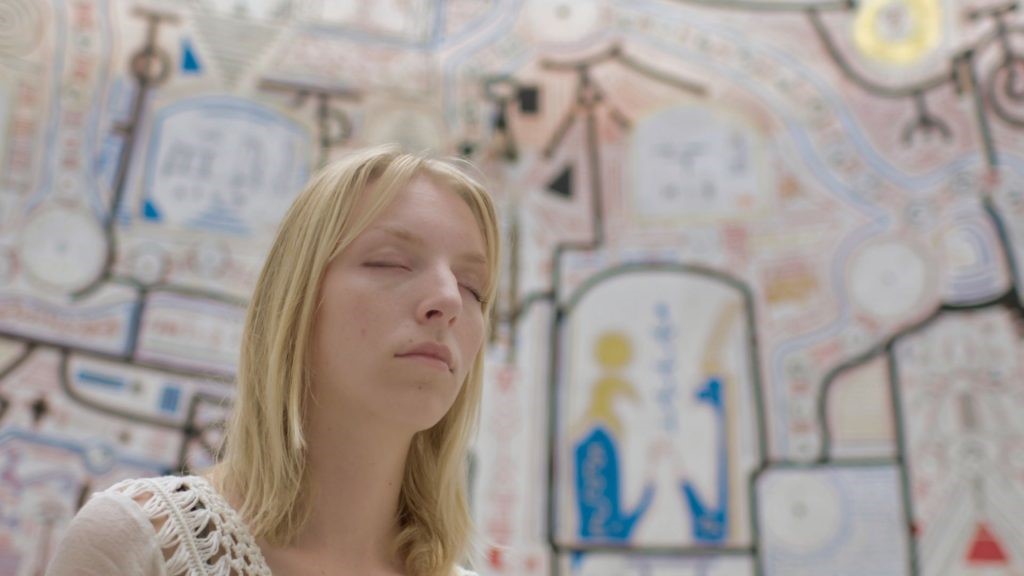
Documentary, by Mattia Mura, Italy, 2020.
Damanhur is a community of spiritual seekers located in Valchiusella, Piedmont. The people of Damanhur, who live in the largest ecovillage in Italy, consider themselves to belong to a micronation, although it is not recognized by the Italian state. The community, active since the mid-seventies, secretly built an underground temple recognized today by the Guinness Book of Records as the largest underground religious structure in the world. Through the eyes of Celastrina, a Swedish girl who arrived in the community to shoot a documentary and who instead chose to stay and live inside, the film tells the story of lights and shadows of the spiritual community, amidst the accusation of being a sect and the creation of a possible alternative society.
Damanhur constantly appears to the director in a series of coincidences, as if there were a calling, a mission. So Mattia Mura proposed the project to Fabrica who rejected it because it was "not in line with his editorial choice". But Mattia believes in his intuition and manages to carry out the project on his own, independently. It was a long journey, but the documentary was finally made.
LANGUAGE: Italian, English
SUBTITLES: English, Spanish, French, German, Portuguese
Oberto Airaudi and the Theology of Self-Construction
You sit across from a man at a cluttered desk in Turin sometime in the mid-1970s, and he is selling you insurance. He is polite, methodical, attentive to risk in the way that profession demands — and he is also, quietly, convinced that human beings contain dormant sensory capacities that modern civilization has systematically buried, that time is not linear, and that the physical world is penetrable by consciousness in ways academic science has not yet measured. Oberto Airaudi was born in Baldissero Canavese in 1950, and he held both of these realities simultaneously without apparent contradiction, which was either the mark of a visionary or of a man who had learned to occupy multiple registers of existence at once.
His early writings, particularly the collection published under the title Cronaca del mio suicidio in the 1970s, reveal a mind already moving in a direction that conventional spiritualism could not contain. He was not interested in passive mysticism or in meditation as withdrawal. What runs through his early work is an insistence that the sacred must be enacted, materialized, forced into matter by deliberate and effortful human action. This was not metaphor. Airaudi came out of a self-taught immersion in parapsychology, studying the literature on psychic phenomena that circulated in Italian esoteric circles of the postwar decades, and he drew from it a conclusion that most of his contemporaries did not: that if consciousness could affect matter, then the inverse was also true — that matter, correctly shaped, could affect consciousness. Sacred geometry was not decorative. It was operational.
This distinction collapses the entire symbolic framework that Western religion had constructed over centuries. In the Christian cathedral, the vault and the rose window point toward something beyond themselves — they are representations of a divine order that exists independently of the stone. Airaudi’s theological position, if it can be called that, was structurally incompatible with this. When he began gathering the community that would become Damanhur in the late 1970s, settling in the Valchiusella valley in Piedmont, the foundational premise was that building a sacred space was not a gesture toward the transcendent but a participation in it. The labor was the ritual. Every cubic meter of granite removed by hand was itself the spiritual practice, not preparation for one.
Rudolf Steiner had moved in an adjacent direction decades earlier, arguing in his lectures on architecture that form carries spiritual force — that the shapes of a building are not neutral containers but active participants in the consciousness of those who inhabit them. Steiner built the Goetheanum in Dornach between 1913 and 1928 precisely on this logic. But even Steiner’s anthroposophical architecture existed above ground, visible, legible as a cultural statement. What Airaudi proposed and then executed was something more radical in its concealment: a temple carved entirely beneath a mountain, invisible to the outside world, never submitted for permits, never announced. The hiddenness was not incidental. It was part of the ontology.
The community that gathered around him numbered around two hundred people by the early 1980s, organized into nuclei, small residential groups, each contributing labor and resources to a project most of them had taken years to fully comprehend. Airaudi operated under the name Falco — Hawk — within Damanhur’s internal naming system, and the hawk’s symbolic freight matters here: a creature that sees from altitude, that acts with precision, that does not circle without purpose. He died in 2013, having watched the temple discovered by Italian authorities in 1992, raided, and then — remarkably — granted protected status as a cultural heritage site, a legal inversion that transformed an act of civil disobedience into a state-recognized monument, which is perhaps the strangest institutional outcome any heterodox spiritual project has ever produced.

Esoteric Syncretism as Structural Grammar
You walk into a room and every wall speaks a different sacred language simultaneously — hieroglyphs bleed into Celtic knotwork, Pythagorean spirals orbit planetary sigils borrowed from Renaissance hermeticism, and somewhere in the geometry a figure that is neither Isis nor Sophia but contains the syntactic logic of both stares back at you without blinking. This is not decoration. This is grammar.
The spiritual architecture of Damanhur does not borrow from traditions the way a museum borrows artifacts — inert, decontextualized, safely behind glass. It operates more in the manner that Claude Lévi-Strauss described in “The Savage Mind” in 1962 when he identified bricolage as a mode of intellectual construction: using whatever symbolic material is available not randomly but according to an internal logic that produces coherent meaning precisely through unexpected combination. What Damanhur has constructed since Oberto Airaudi began formulating its principles in the early 1970s is a system in which Theosophical cosmology, Egyptian mystery traditions, Pythagorean number theory, Celtic cyclical time, and Anthroposophical ideas about spiritual evolution are not layered decoratively on top of one another but woven into a load-bearing epistemological structure. Remove any one element and the weight distribution of the entire edifice shifts.
Helena Petrovna Blavatsky’s “The Secret Doctrine,” published in 1888, posited that all world religions encode fragments of a single primordial wisdom — that the apparent contradictions between traditions are symptoms of historical fragmentation rather than genuine incompatibility. Damanhur inherits this axiom but radicalizes it operationally: instead of using comparative mythology to prove the existence of a hidden universal substrate, it deploys multiple symbolic systems as simultaneous active instruments within daily ritual and spatial practice. Rudolf Steiner‘s later Anthroposophical framework, which proposed that human consciousness evolves through identifiable spiritual epochs and that art functions as a vehicle for genuine metaphysical development, provides the developmental scaffolding inside which Egyptian cosmological roles and Pythagorean harmonic ratios become executable rather than merely commemorative. The number three does not appear in the Temples of Humankind because someone found it aesthetically pleasing across cultures. It appears because the community’s cosmological grammar treats it as a structural operator governing the relationship between individual souls, collective fields, and higher intelligences — a usage closer to mathematics than to symbolism.
This is precisely where the system becomes resistant to external categorization in ways that are not accidental. When sociologists attempt to classify Damanhur, they encounter a phenomenon that refuses the standard taxonomic binaries: it is neither a religion nor a philosophy nor an artistic commune nor a political experiment, and this refusal is not vagueness but a designed epistemological condition. Giorgio Agamben, in his work on the relationship between law and life in “The Highest Poverty” from 2013, observed that communities which construct their own rule as a form of life rather than as external juridical imposition create a zone where conventional authority loses its leverage points. Damanhur’s syncretism functions analogously: because its framework cannot be fully mapped onto any existing institutional tradition, no existing institutional authority possesses the interpretive keys to adjudicate its legitimacy from the outside. The Italian state attempted legal action against the community in 1992, raiding its properties and charging Airaudi with fraud and illegal construction — and discovered that prosecuting a community whose sacred architecture was simultaneously a temple, an artwork, and a philosophical proposition required categories the legal system did not own.
Celtic traditions contribute specifically to Damanhur’s relationship with temporal structure — the understanding that time moves in overlapping spirals rather than linear sequences, that certain moments carry qualitatively different energetic properties than others, and that community ritual must be calibrated to these rhythmic thresholds. This is not folk mysticism imported for atmosphere. It functions as the chronological operating system through which Pythagorean harmonic theory and Egyptian cosmological cycles are scheduled and synchronized, producing a calendar that is itself a philosophical argument about the nature of causality.
The Community as Experimental Social Technology
You have probably never been asked to abandon your name. Not rename yourself for convenience or affection, but formally, structurally, as a condition of belonging — to become Falcon Birch or Hawk Poplar or some other compound of animal and plant that the community assigns you upon full membership. The strangeness of that requirement is not incidental. It is the mechanism.
Damanhur drafted its constitution in 1981, decades before most intentional communities thought to codify their internal governance at all. The document established elected bodies — the School of Meditation’s council structure, the figure of the Guide of Damanhur, the Kings’ Game as a ritual-political process for collective decision-making — and it did so with the administrative seriousness of a small sovereign state. The credito, the community’s internal currency introduced to manage exchanges within the federation of communities, was not a symbolic gesture toward autonomy. It was a functional instrument that partially decoupled daily economic life from the Italian lira, and later the euro, creating a parallel valuation system in which labor, housing, and goods circulated according to logic that national tax authorities could not easily monitor, assess, or extract from.
James C. Scott, writing in Seeing Like a State in 1998, identified the core ambition of modern governance as legibility — the drive to render populations, territories, and transactions visible and measurable to central administrative power. Surnames standardized by Napoleonic decree, land surveys that flattened centuries of customary usage, the grid plans of colonial cities: each was an instrument for making human life readable to the state apparatus so that it could be taxed, conscripted, and controlled. What Scott described as a historical process, Damanhur constructed as a deliberate inversion. The plant-animal names are not whimsy — they are systematic illegibility, a refusal to appear in the registries that states require to manage populations. A person named Falcon Birch does not slot neatly into the Italian civil record system. The friction is the point.
The school system at Damanhur operates on this same logic of productive friction. Children raised within the community attend a curriculum that integrates conventional Italian state requirements — the community is not entirely separatist — with instruction in selfica, in the community’s own cosmological history, and in the arts and crafts traditions that generate a significant portion of Damanhur’s external income. The child who emerges from this education is bilingual in a deeper than a linguistic sense: capable of passing through ordinary Italian institutional life while holding an entirely different internal map of what that life means and what alternatives exist. That bilingualism is itself a form of structural resilience. Communities that refuse all contact with surrounding society tend toward brittle isolation; communities that produce members fluent in both registers can persist without dissolving.
What mainstream commentary usually misses when it encounters places like Damanhur is that the accusation of utopianism is itself a deflection. Utopia, in its Thomas More coinage from 1516, means no-place — the ideal society located safely outside history, immune to friction and failure. Damanhur has failed repeatedly: internal schisms, legal confrontations with the Italian state culminating in raids in 1992, the death of Oberto Airaudi in 2013 that forced a succession crisis the governance structure had not fully anticipated. These are not embarrassments to be minimized. They are evidence that the social technology being tested is real, operating under actual pressure, producing actual breakdowns and actual recoveries. A utopia never breaks down because it never existed. What breaks down and rebuilds is an experiment, and the distinction between those two categories is not aesthetic — it determines whether the knowledge generated is transferable to anyone outside the walls.
The credito, the renamed citizen, the elected council, the dual-track school: none of these elements is unprecedented in isolation.
Sacred Art as Epistemological Claim
You descend into the hill through a passage that smells of cold stone and mineral damp, and the first thing that registers before your eyes adjust is sound — the particular silence that large decorated spaces produce, a silence that is actually acoustic fullness, every surface giving back a slightly different frequency of the air you displace as you move. Then the light resolves into color, and you are standing inside a mountain that has been turned inside out.
The Temples of Humankind at Damanhur are not metaphorically subterranean — they occupy roughly 8,500 cubic meters of excavated rock beneath a hillside in the Valchiusella valley in Piedmont, carved by hand beginning in 1978 without authorization, without architectural permits, and therefore without the sanction of any institutional body whose approval would have framed the work as art. That absence of institutional framing is not incidental. It is the condition of production asserting its own meaning. The Hall of Mirrors deploys hundreds of glass panels etched and painted with figures drawn from traditions that do not recognize each other as kin — Egyptian funerary iconography beside Mesoamerican calendrical symbols beside alchemical diagrams from sixteenth-century European manuscripts — and arranges them so that any viewer standing at the hall’s center sees an infinite regression of themselves surrounded by every cosmology simultaneously. The visual argument is not syncretic in the casual sense. It proposes that these traditions are not parallel roads to the same destination but facets of a single epistemological object that Western modernity chose to disassemble.
Walter Benjamin, writing in 1935 in “The Work of Art in the Age of Mechanical Reproduction,” identified the aura of an artwork as its embeddedness in a singular place and time, its resistance to being anywhere other than where it is. He was describing what industrial reproduction destroyed. The Temples perform the inverse operation: they produce aura not by accident of historical survival but by deliberate architectural decision. Nothing in those rooms can be photographed adequately, not because photography is technically insufficient, but because the program of the space depends on the body moving through it, on peripheral vision catching a mosaic detail at the moment the eye is focused elsewhere, on the cold floor through the soles of your shoes calibrating your nervous system to take the images seriously. The Hall of the Earth uses curved walls covered in mosaics depicting the planet’s energetic geography — ley lines, sacred sites, geological formations — rendered in tesserae of glass and stone at a scale that requires you to step back until your shoulder blades touch the opposite wall to see the full composition, and even then you cannot see all of it, because the room curves and part of the image is always behind you.
The Labyrinth functions differently from the named halls. It is a passageway system whose turns are not decorative but timed — the sequence of images you encounter depends entirely on which route you take, meaning the cosmological narrative is not fixed but contingent on the body’s choices. This is not postmodern indeterminacy; it is closer to what the medieval builders of Chartres called the program, the deliberate theological architecture of a building that teaches through movement and not through text. The difference is that Chartres was built with the authorization of a bishop, a diocese, a monarchy, and a papacy — the full weight of institutional legitimacy pressing every stone into place. What presses the Damanhur stones into place is the conviction of people who had no such backing and who understood that conviction itself is a material force.
The stained glass in the upper halls achieves something that secular contemporary art museums have spent decades trying to recover: it makes light an active ingredient rather than a neutral medium of visibility. The glass was designed so that morning light and afternoon light produce categorically different chromatic environments in the same room, meaning the hall you see at nine in the morning is not the hall you see at four in the afternoon — and neither version is the correct one, which is itself the claim.
A vision curated by a filmmaker, not an algorithm
In this video I explain our vision
Legal Confrontation and the Politics of Spiritual Sovereignty

You are in the kitchen of a farmhouse in the Valchiusella valley, December 1992, and the men who arrive before dawn are not pilgrims. They carry warrants, not wonder. The Guardia di Finanza — Italy’s financial police, whose jurisdiction covers fiscal fraud and economic crime — descended on the Federation of Damanhur with the stated purpose of investigating irregular construction. What they found instead, carved into the granite beneath hundreds of meters of Alpine hillside, stopped them. Officers trained to detect tax evasion stood inside painted vaults of a scale and ambition that no building permit had ever authorized, and the legal machinery they had brought with them had no adequate category for what they were looking at.
The Italian state’s problem was not simply administrative. The temples had been excavated without authorization beginning in 1978, meaning that by 1992 the community had spent fourteen years constructing what amounted to one of the largest privately built underground complexes in the world — nine interconnected halls across five floors, covering roughly eight thousand five hundred cubic meters, containing original mosaics, stained glass ceilings, marble sculptures, and frescoed walls of genuine artistic density. The state’s initial response was legally straightforward: unauthorized construction in protected mountain terrain is subject to mandatory demolition. The threat was real, and the order was prepared.
What the authorities had not calculated was the speed and character of the international response. Giorgio Colli’s foundational work on the genealogy of Greek wisdom traditions would have recognized the dynamic instantly — sacred spaces throughout antiquity derived their protection not from the law but from the consensus of those who recognized them as sacred, a consensus that preceded any legal institution and frequently outlasted it. Within months of the raid, Damanhur’s situation had attracted the attention of intellectuals, artists, journalists, and religious freedom organizations across Europe and the United States. The community circulated photographs of the temples, and the images did something that legal arguments alone cannot: they created witnesses. People who had never heard of Damanhur and had no interest in its cosmology looked at those photographs and experienced something closer to aesthetic shock than ideological sympathy.
The Italian government found itself negotiating a terrain it had not entered willingly. Religious freedom in the Italian constitutional framework — articulated in Article 19 of the 1948 Constitution — guarantees the right to profess and practice any faith, but says nothing about the right to build unreported sacred infrastructure inside a mountain on private land. Property law and heritage law pulled in different directions. The Regional Authority of Piedmont, which would have been responsible for enforcing demolition, faced the paradox of being legally obligated to destroy something that a growing body of expert opinion was beginning to classify as a work of cultural significance. Sergio Donadoni, one of Italy’s most respected Egyptologists, had already contributed to Damanhur’s internal symbolic vocabulary; his presence in that intellectual orbit complicated any claim that the temples were merely the hobby of a fringe group.
The resolution, reached through negotiations that extended across several years, produced no clean legal precedent. Damanhur was required to retroactively regularize the construction — a process involving engineering assessments, safety certifications, and municipal negotiations — while the demolition order was effectively suspended and eventually withdrawn. The community paid fines. Italian authorities gained, for the first time, a fully documented record of what existed beneath that hillside. Neither side won cleanly, and that ambiguity was itself the outcome: the state had been forced to absorb an unauthorized sacred space into its administrative framework without establishing any principle that would protect the next one.
What the confrontation exposed was a structural tension that liberal democracies have never resolved: the political legitimacy of a community that builds its own sacred geography outside the state’s permission, outside established religion’s recognition, and outside the categories that heritage law was designed to protect.
The Problem of Charismatic Authority Within Intentional Communities
You are handed a role the moment you walk through the door — not a formal title, not a contract, but something more adhesive than either: a place in a cosmology. Damanhur assigns its members animal and plant names, situates them within a social game called the Game of Life, and asks them to measure their spiritual progress through a system of evaluations conducted by peers and by Oberto Airaudi himself, the founder known as Falco, who died in 2013 after four decades of constructing what he called a federation of communities in the foothills of the Piedmont. The architecture of belonging is elegant precisely because it feels chosen. No one forces you to stay. And that apparent voluntarism is exactly where the problem begins.
Eileen Barker’s 1984 study of the Unification Church demonstrated something that disrupted a comfortable liberal assumption: that people who join high-demand religious movements are not, by any measurable psychological standard, more gullible, more damaged, or more desperate than those who do not join. They are, in many cases, idealistic, highly educated, and genuinely searching. What the organization provides is not deception in the crude sense but a structured environment in which the self becomes progressively re-narrated — where your past is reinterpreted as preparation, your doubts as tests, and your loyalty as evidence of spiritual advancement. The sophistication of this re-narration makes it nearly invisible from the inside.
Former members of Damanhur, some of whom have spoken to Italian journalists and to researchers studying new religious movements in the post-1970s European context, describe a graduated system of disclosure — where deeper teachings, more intimate access to Falco, and greater communal responsibility are granted only after sustained demonstrations of commitment. This structure is not unique to Damanhur; it appears across the sociology of initiatory communities. But its consequences are specific: the person who has invested five years, surrendered a career, contributed financially, and reorganized their social world around a community faces an exit cost so high that skepticism becomes psychologically unaffordable. The community does not need coercion. The sunk cost does the work.
Luc Boltanski and Laurent Thévenot’s framework, developed across their 1991 collaboration on orders of worth, offers a precise tool here. They argue that social actors justify their actions and claim legitimacy by appealing to different registers — civic, market, domestic, inspired — and that conflict within institutions often turns on which register is treated as supreme. In a community like Damanhur, the inspired register, the logic that spiritual truth supersedes ordinary social calculation, systematically delegitimizes any appeal made in civic or critical terms. To raise a question about financial transparency is not experienced as a reasonable request for accountability; it is reframed as an expression of insufficient spiritual development. The hierarchy survives not through force but through the monopoly on the legitimate grammar of complaint.
What makes this worth examining carefully rather than dismissing is that Damanhur has produced something genuinely extraordinary — the Temples of Humankind, built in secret over sixteen years by volunteers who carried stone and mixed plaster after their working days, represent one of the most ambitious collective artistic projects of the twentieth century. The achievement is real. And yet achievement is precisely what makes authority unassailable. When a leader or a system produces beauty at that scale, the beauty becomes evidence — not of human capacity in general, but of the specific rightness of the conditions that generated it. The miracle becomes the argument. Those who carved those underground halls and painted those ceilings believed, with reason, that they had made something no ordinary life could have made. What that belief costs, in autonomy quietly surrendered, in dissent quietly swallowed, in the slow migration of one’s own judgment toward the community’s preferred conclusions, is a question the temples themselves cannot answer, because they were not built to ask it.
Damanhur in the Genealogy of Western Esoteric Modernity
You arrive at a certain kind of place expecting to find the irrational, and instead you find blueprints. Schedules. Rotating work assignments. A governance structure that would not embarrass a mid-sized cooperative in the Piedmontese wine country. The cognitive dissonance this produces is not accidental — it is, in fact, the entire argument.
Antoine Faivre, whose 1992 framework in Access to Western Esotericism remains the most rigorous cartography of the tradition, identified a cluster of recurring features that define esoteric thought across centuries: correspondences between visible and invisible orders, living nature saturated with hidden forces, imagination as a cognitive instrument of genuine epistemic power, and the experience of transmutation — not metaphorical but operative, enacted on the practitioner’s actual constitution. What Faivre recognized, and what his critics often missed, is that none of these features are inherently anti-rational. They are, more precisely, post-Cartesian refusals — not retreats from the project of understanding the world, but dissenting bids for a different understanding of what understanding means.
Wouter Hanegraaff pushed this further in Esotericism and the Academy, published in 2012, demonstrating that Western esotericism was not some primordial undercurrent finally suppressed by Enlightenment reason, but was itself produced by the Enlightenment’s internal fractures — the excess meanings that rationalism generated and then immediately needed to expel from its self-image. The rejected knowledge of modernity, as Hanegraaff called it, was not pre-modern residue. It was modernity’s own shadow, cast by the very lamp it lit. Damanhur did not emerge despite the Enlightenment; it emerged from the wound the Enlightenment left in its own body.
Falco Tamagni was a trained practitioner of homeopathy and an autodidact in physics before he articulated the founding metaphysics of Damanhur, and this biographical fact is not trivial. The community’s cosmological system, set out in the Initiation School texts and the teachings collected across decades of internal transmission, does not abandon causality — it multiplies it, positing nested planes of reality operating through laws that are lawful but irreducible to the single register that post-Newtonian physics has been willing to authorize. This is precisely the structure Giordano Bruno was burned for in 1600: not atheism, not simple heresy, but the insistence that the cosmos is populated by intelligences operating through their own causative logics, and that human beings possess faculties capable of engaging those logics directly.
The Temples of Humankind concentrate this genealogy into stone and pigment and time. The labor investment alone — begun secretly in 1978, with hundreds of thousands of hours accumulated before any outside observer was permitted entry — represents a commitment to what the anthropologist Tanya Luhrmann, studying magical practitioners in contemporary Britain for her 1989 study Persuasions of the Witch’s Craft, called the cultivation of interpretive drift: the slow rewiring of perceptual habits until the practitioner genuinely encounters the world differently, not as performance but as altered epistemology. Damanhur operationalized this drift at architectural scale, building an environment designed to make a different kind of attention feel natural.
What this exposes is the degree to which the mainstream post-Enlightenment settlement — secular, disenchanted, measurable — has always depended on strategic forgetting. Max Weber‘s diagnosis of Entzauberung, the disenchantment of the world, was never a description of something completed. It was a description of something attempted, and the persistence of communities like Damanhur across fifty years of European modernity is evidence of the attempt’s ongoing incompleteness. Not its failure, exactly — more its constitutive insufficiency, the gap it cannot close because the hunger it was meant to replace belongs to a dimension of human cognition that instrumental reason was never designed to feed.
Damanhur does not resolve this tension. It inhabits it deliberately, architecturally, generationally — as if the unresolved question were itself the most honest form of answer available to beings who build temples underground and keep working.
🔮 Hidden Knowledge: Communities, Temples and Sacred Mysteries
Damanhur is one of the most extraordinary experiments in esoteric community-building the modern world has ever produced — a federation built on spiritual initiation, sacred art, and a vision of human transformation carved literally into the earth. To understand its deeper roots, one must explore the broader landscape of esoteric traditions, utopian communities, and the spiritual movements that shaped the twentieth century.
The Theosophical Society: History, Principles and Influence on Western Culture
The Theosophical Society, founded by Helena Blavatsky in 1875, created the intellectual and spiritual scaffolding upon which many later esoteric communities — including Damanhur — would build their worldviews. Its synthesis of Eastern philosophy, Western occultism, and evolutionary spirituality opened a new cultural space in which sacred architecture, initiation, and hidden knowledge became central preoccupations. Understanding Theosophy is essential to tracing the genealogy of twentieth-century esoteric movements.
GO TO THE SELECTION: The Theosophical Society: History, Principles and Influence on Western Culture
Rudolf Steiner and Anthroposophy: A Guide to Modern Esoteric Thought
Rudolf Steiner‘s Anthroposophy represents perhaps the closest parallel to the Damanhurian experiment in its ambition to unite spiritual knowledge with artistic creation, communal life, and practical transformation of the world. Like Damanhur, Steiner envisioned a total sacred community — one in which architecture, education, medicine, and ritual all served the evolution of human consciousness. The Goetheanum itself, Steiner’s great spiritual building, echoes the impulse behind Damanhur’s underground Temples of Humankind.
GO TO THE SELECTION: Rudolf Steiner and Anthroposophy: A Guide to Modern Esoteric Thought
The Artistic Community: History and Sociology of Collective Creativity
The artistic community as a sociological and spiritual phenomenon has a long and rich history, from the medieval guild to the utopian colony, from the Bauhaus to contemporary intentional communities. Damanhur fits powerfully within this tradition, transforming collective creativity into a vehicle for inner transformation and sacred world-building. Exploring the sociology of collective creativity reveals why such communities arise, what they demand of their members, and what they leave behind as cultural legacy.
GO TO THE SELECTION: The Artistic Community: History and Sociology of Collective Creativity
The Secret and the Rite: Initiation, Transformation and Jungian Psychology
The secret rite of initiation is one of the oldest and most universal structures of spiritual life, weaving together psychology, symbolism, and communal identity into a transformative threshold experience. Damanhur’s elaborate system of initiatory paths, mystery schools, and sacred roles draws directly from this ancient reservoir of human practice. Jungian psychology offers a compelling lens through which to understand why initiation remains so psychologically necessary — and why it continues to attract seekers in the modern world.
GO TO THE SELECTION: The Secret and the Rite: Initiation, Transformation and Jungian Psychology
Discover Esoteric and Visionary Cinema on Indiecinema
If the mysteries of Damanhur, sacred communities, and esoteric transformation have sparked your curiosity, Indiecinema is the streaming platform where this inner journey continues on screen. From visionary documentaries to spiritually daring independent films, Indiecinema offers a curated universe of cinema that dares to ask the deepest questions about consciousness, beauty, and the hidden architecture of existence. Come and explore — the labyrinth has many doors.
👉 EXPLORE THE CATALOG: Watch Indie Films in Streaming
A vision curated by a filmmaker, not an algorithm
In this video I explain our vision

