
The Victorian Body and Its Forbidden Hungers
You are reading this wrong if you think it is about a monster. Sit with that for a moment — the novel you were assigned, summarized, or watched adapted into a dozen films is not, at its core, a story about the supernatural. When Bram Stoker published Dracula in 1897, he handed Victorian England a mirror so dark and so precise that the culture immediately agreed, by collective reflex, to call it fiction.

The London into which that novel arrived was a city of extraordinary productive tension. It was the same year Havelock Ellis published the second volume of his Studies in the Psychology of Sex, the same decade in which Krafft-Ebing’s Psychopathia Sexualis was being passed in translation between gentlemen who claimed they were reading it for medical interest. The repression was not merely social discomfort — it was architecturally embedded into the culture. Victorian propriety had constructed such an elaborate system of denial around the body that desire had to find other vocabularies entirely: illness, fainting, nervous collapse, the spiritualist séance, the mesmerist’s couch. The body still wanted what it wanted. It simply had no legal language for that wanting.
What Stoker gave his readers was a creature who enters bedrooms uninvited, who bends over sleeping women, who penetrates with a bite that leaves the victim not destroyed but transformed, not simply harmed but made to hunger in kind. The exchange is mutual, intimate, and explicitly pleasurable for both parties — and Stoker knew exactly what he was encoding. Jonathan Harker’s early encounters in the Transylvanian castle are among the most erotically charged passages in Victorian literature, precisely because they are never permitted to call themselves erotic. Three women approach him in the night, their movements described with a languor that no one in 1897 needed a glossary to decode. The bite, in this schema, is not death — it is initiation into a body that finally, catastrophically, feels.
The cultural machinery that surrounded the novel’s release tells you more than the novel itself. The reviews praised its atmosphere. Its Gothic architecture. Its narrative ingenuity in presenting the story through journals, letters, and phonograph recordings — a technique that itself mimics the fragmentation of traumatic memory. What reviewers did not discuss, because discussion would require naming, was the specific nature of the threat Dracula posed. He did not simply kill women. He made them want him back. Lucy Westenra, after her first infection, begins showing a vivacity, a boldness, a frank appetite that her fiancé Arthur and her physician find simultaneously irresistible and alarming. Her destruction by the men who love her — the staking, the decapitation — is performed with ritual precision that reads, to an unguarded eye, as punishment for having desired at all.
Sigmund Freud, writing his Interpretation of Dreams two years after Dracula’s publication, would argue that the symbolic logic of dreams operated through exactly this kind of displacement — that the unconscious takes what it cannot state and reroutes it through imagery just opaque enough to pass the censor. Stoker was not Freud’s patient, but Dracula is a textbook instance of cultural dreamwork: the blood is not blood, the bite is not a bite, the castle is not merely geography. The novel enacts a collective fantasy that Victorian society could consume without confessing to consumption.
What makes this more than literary analysis is what happens to you, the reader, the viewer of every subsequent adaptation, when you feel the particular pull that Dracula exerts. That pull is not nostalgia for Gothic atmosphere. It is recognition — the way a dream image recognizes you before you recognize it. The Count does not seduce his victims from outside their desire. He locates desire already present, already waiting, and he names it the only way the culture would permit: as a curse arriving from elsewhere, from the East, from before civilization, from outside the self entirely.
Nosferatu
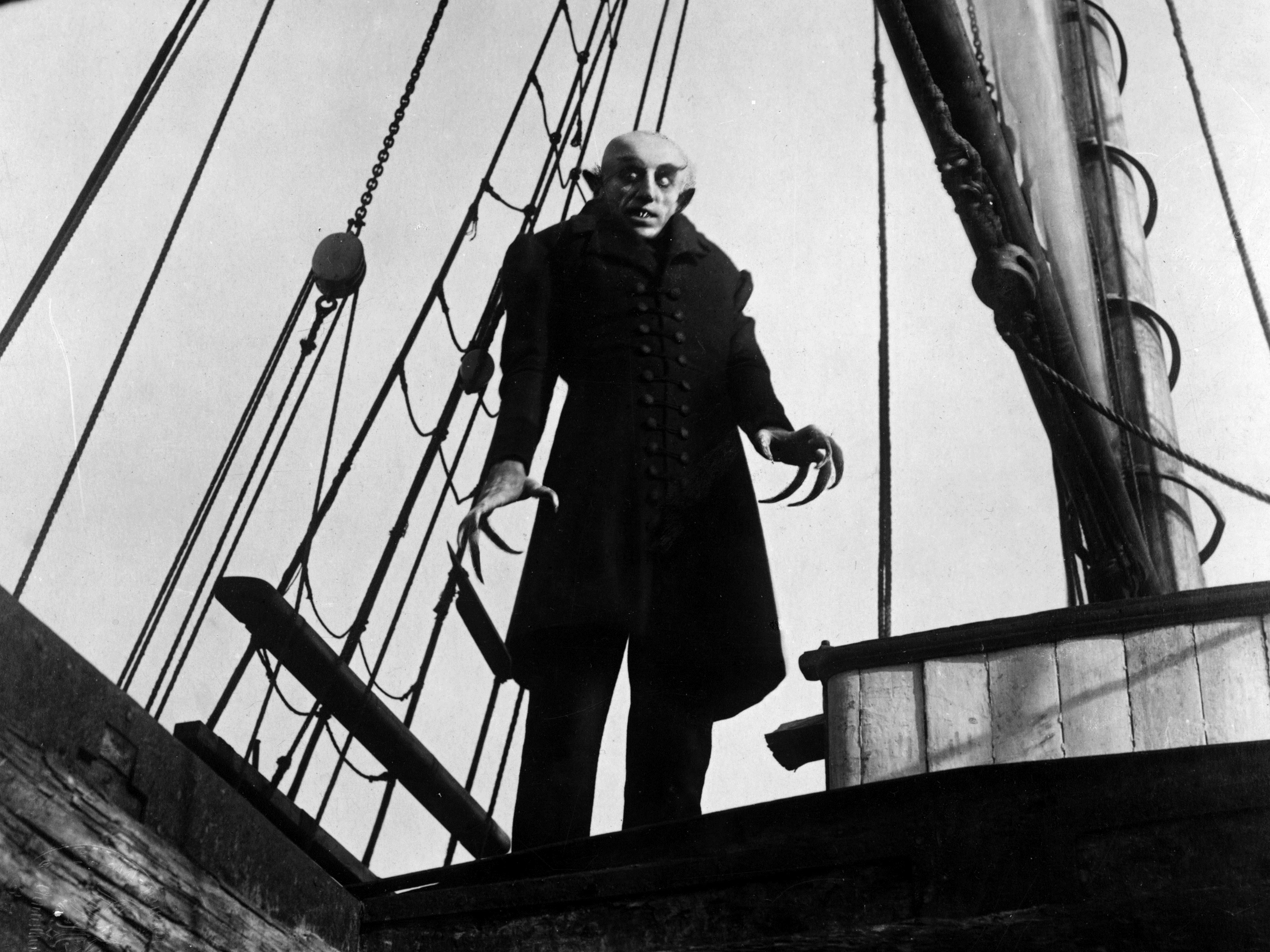
When a young real estate agent, Thomas Hutter, goes to the castle to close a deal, Orlok is attracted by his blood and decides to follow him to his hometown. The arrival of the count causes a series of mysterious deaths and spreads panic among the inhabitants.
Murnau, through evocative images and disturbing atmospheres, creates a work that goes far beyond the simple adaptation of Stoker's novel. The film explores universal themes such as the fear of death, isolation and the loss of humanity. The production of Nosferatu was characterized by some legal difficulties due to the copyright of Bram Stoker's novel. Despite this, Murnau and his crew managed to make a film of great visual impact. The choice of Max Schreck to play Count Orlok was ingenious. His cadaverous appearance and his unnatural movements have made the character of Orlok one of the iconic monsters in the history of cinema. Over the years, Nosferatu has become a cult film, influencing generations of filmmakers and becoming a reference point for the horror genre. The image of Count Orlok, with his elongated nails and sunken eyes, has become an icon of horror cinema.
Folklore Drained of Its Original Terror
You are standing in a village in eighteenth-century Serbia, and your neighbor has just died of tuberculosis. Within a week, his brother falls ill. Then his wife. The priest offers prayers that dissolve in the cold air. Someone remembers that the dead man was seen at his window three nights ago, and suddenly the village has a name for what is happening to it — not a metaphor, not a literary device, but a working explanation for invisible contagion in a world without germ theory.
The Eastern European vampire was never romantic. It was a corpse that had failed to stay dead, bloated with gases, dark with decomposed blood, smelling of the earth it had crawled through. When Habsburg imperial officials — bureaucrats dispatched to investigate the infamous cases of Arnod Paole in Serbia around 1725 and Peter Plogojowitz shortly before — exhumed bodies and wrote their clinical reports, what they documented was a peasant community’s attempt to reason through epidemic death. The vampire was a social technology, a way of externalizing communal guilt, managing grief, and imposing ritual control over biological processes that no one could otherwise understand. Scholars of folklore, including Paul Barber in his 1988 study Vampires, Burial, and Death, have shown with forensic precision how nearly every attribute of the folkloric vampire — the liquid blood at the corner of the mouth, the uncorrupted appearance, the bloating — corresponds exactly to normal stages of human decomposition misread by people who rarely opened graves. The terror was not sensual. It was visceral, democratic, and deeply communal: the vampire came for your cattle and your children, not your virtue.
What the nineteenth-century English literary imagination did with this material constitutes one of the more elegant acts of cultural laundering in Western history. By the time John Polidori published The Vampyre in 1819 — a text born from the same Geneva storm that produced Frankenstein, and almost certainly modeled on the young Polidori’s complex relationship with Lord Byron — the creature had already been removed from its epidemiological context and dressed in aristocratic clothing. Polidori’s Lord Ruthven is cold, seductive, socially superior. He does not terrorize a village; he infiltrates polite society. The mechanism of contagion has become the mechanism of seduction, which means the horror has migrated from the body of the community to the body of the individual, specifically to the female individual whose corruption is rendered in terms indistinguishable from sexual awakening.
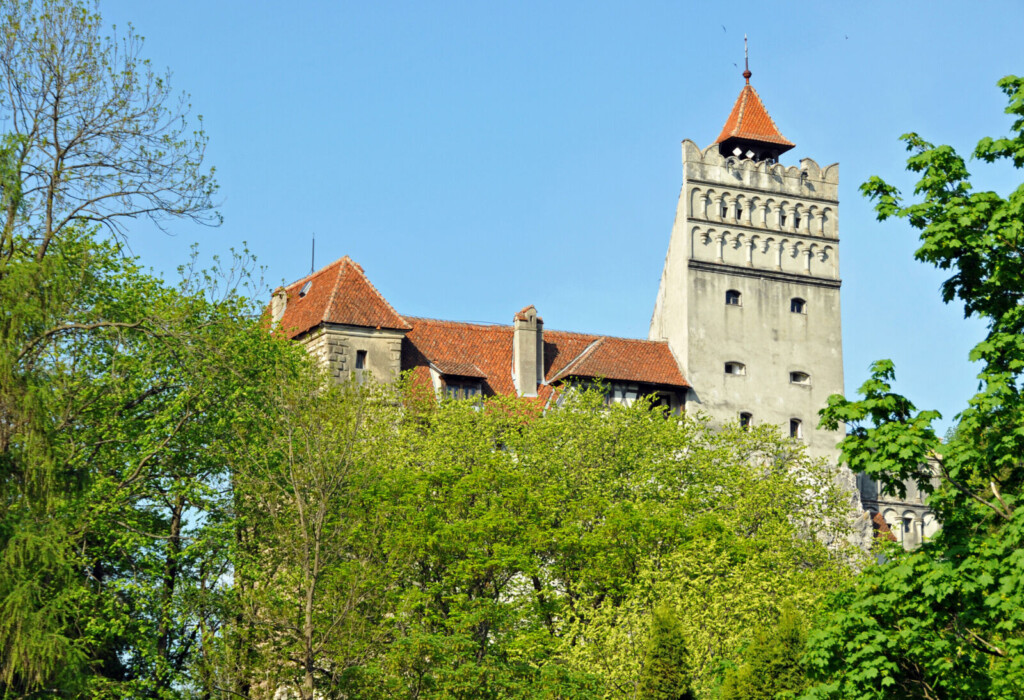
This migration was not accidental. Victorian culture was organizing itself around a series of anxieties — about class permeability, about women’s desire, about the dangerous influence of foreign bodies on the English domestic sphere — and the aestheticized vampire absorbed all of them simultaneously. When Bram Stoker spent seven years between 1890 and 1897 assembling Dracula from travel writing, Eastern European geography he had never visited, and theatrical intuitions sharpened by his decades managing the Lyceum Theatre under Henry Irving, he was not transcribing folklore. He was constructing a container for English cultural dread, and the Eastern origin of his Count functioned not as anthropological fidelity but as a marker of threatening otherness pressing at the borders of empire.
The Transylvania that Stoker built in the opening chapters of Dracula barely resembles the actual region documented by Emily Gerard in The Land Beyond the Forest in 1888, from which he lifted specific details about superstitions and local customs. Gerard’s Romania was poor, agricultural, and haunted by a very practical relationship with death. Stoker borrowed the surface textures and discarded the social substrate entirely, replacing village dread with Gothic atmosphere and replacing the community’s existential crisis with a single aristocratic predator whose primary crime, in the logic of the novel, is his desire to relocate to London — to become, in other words, an immigrant with supernatural advantages.

The Aristocrat as Predator: Class Anxiety in Disguise
You are sitting in a drawing room in 1897, reading by gaslight, and something about this Transylvanian count unsettles you in a way that has nothing to do with his fangs. He is too familiar. The accent is foreign, the castle is distant, the superstitions are conveniently Eastern, but the man himself — the title, the land, the ancient name that commands without explanation — you have met him at dinner. You have borrowed money from his cousin. Your grandfather worked his fields.
Bram Stoker gave Dracula a count’s title with extraordinary precision, and the choice was not decorative. The aristocracy Stoker’s English readers inhabited was still, in the final decade of the nineteenth century, a system in which inherited land generated wealth that no labor had produced and no merit had justified. The Corn Laws had been repealed fifty years prior, the Reform Acts had redistributed some political power, but the House of Lords still exercised veto authority over elected legislation, and the great landed estates — twelve thousand families owning half the agricultural land in England, by the calculations published in John Bateman’s The Great Landowners of Great Britain and Ireland in 1883 — continued to extract rent from millions of people who would never own the soil beneath their feet. The vampire who feeds on sleeping bodies without their knowledge or consent was not an exotic metaphor. It was a diagram.
What Victorian Gothic fiction accomplished, and what Stoker’s novel accomplished with particular ruthlessness, was to make this diagram safe to look at by displacing it onto a foreign body. Dracula is not an English aristocrat draining English peasants — he is a Transylvanian one, with wolf-servants and Romani escorts, operating in a landscape that English readers could comfortably classify as primitive. This geographic distance is the ideological machinery of the whole enterprise. Karl Marx, writing in Capital in 1867, had used the vampire figure explicitly — “Capital is dead labour, that, vampire-like, only lives by sucking living labour” — but Marx’s vampire was systemic and invisible. Stoker’s innovation was to give it a face, a name, a nationality, and a castle in the Carpathians, so that the reader could feel the outrage of parasitic power while reassuring themselves that such power was, by definition, elsewhere.
The character of Jonathan Harker makes this displacement structurally visible. He arrives in Transylvania as a solicitor — a professional man, credentialed, self-made in the bourgeois sense — to complete a real estate transaction on behalf of a count who wants to purchase property in England. The terror of the novel’s opening act is not supernatural. It is the terror of a professional-class man discovering that his contractual relationship with a noble client has made him a prisoner. The solicitor believed himself to be a free agent conducting business; he was always already the count’s guest, which is to say the count’s possession. Every reader who had ever signed a lease, accepted an employer’s terms, or navigated the social machinery of deference to a name older than their own profession recognized that room in Castle Dracula.
The genius of the monster-as-aristocrat construct is that it permitted moral condemnation without political consequence. A reader could despise Dracula’s predation completely, feel righteous fury at the ancient count feeding on the innocent, and walk away from the novel having never once interrogated the structural logic that made inherited titles and unearned rents a fact of English daily life. The foreign body absorbs the critique. Condemn the count; pay the landlord. The novel doesn’t close this trap — it is the trap, elegantly sprung, offering its readers the catharsis of outrage without the discomfort of application, which is precisely why it felt, and still feels, so satisfying to consume.
Contagion, Consent, and the Seduction Trap
You are at a dinner party, and someone across the table is talking, and you realize with quiet horror that you are nodding — that your body has already agreed to something your mind had not finished evaluating. The agreement happened in the interval between listening and thinking, in that narrow corridor where social pressure moves faster than conscious will. Stoker built an entire architecture of dread inside that corridor.
The vampiric bite is not simply violence. It is, structurally, a transaction that looks like seduction until it is too late to call it anything else. Lucy Westenra does not scream. She sleepwalks toward the cliffs at Whitby, and what the novel cannot bring itself to say plainly — what it encodes instead in the grammar of somnambulism and half-remembered dreams — is that some part of her walked willingly. Victorian fiction had no language for a woman’s desire that did not immediately criminalize her. Stoker found a workaround: make her unconscious. Make her not responsible. The horror of the vampire, for the men who surround Lucy and eventually destroy her, is not that she was taken. It is that she seemed to enjoy it.
Elaine Showalter, in Sexual Anarchy published in 1990, identified the 1890s as a decade convulsed by what she called the “crisis of gender” — a cultural moment in which the boundaries between masculine and feminine, pure and contaminated, were perceived to be dissolving with terrifying speed. The New Woman was reading, cycling, refusing marriage. Syphilis was rewriting the moral arithmetic of sex into epidemiological fact. Degeneration theory, imported from Benedict Morel and amplified by Max Nordau’s 1892 polemic Degeneration, had convinced educated Europeans that civilization could literally be undone through bad heredity, sexual excess, and the wrong kind of body fluid entering the wrong kind of body. Dracula arrives in England at the precise historical moment when contagion had become the dominant metaphor for everything a respectable society feared about desire.
What the novel stages, beneath its adventure-story surface, is an extended meditation on the contamination of women who experience pleasure. Lucy is beautiful, mildly flirtatious, loved by three men simultaneously — a fact the text notes without quite condemning, though the punishment that follows is meticulous and complete. Once bitten, she becomes sexual. She bites back. She looks at Arthur with eyes the novel describes as voluptuous, and that single word is the diagnosis: she has crossed from object to agent, and the only available response within the logic of the text is a stake through her heart administered by the man who would have been her husband. The scene is written as mercy. It functions as execution.
The deeper trap embedded in this structure is not that Stoker was unusually misogynistic — he was, in this respect, entirely ordinary. The trap is that the narrative logic he formalized has proved almost perfectly durable. The vampire’s victim is always already complicit: she was too beautiful, too curious, too willing to open the window. The architecture of consent is collapsed in advance, replaced by a framework in which female desire itself constitutes a form of invitation that cannot afterward be revoked. Bram Dijkstra, cataloguing the visual culture of the period in Idols of Perversity in 1986, documented hundreds of paintings from the 1880s and 1890s in which women are shown prostrate, passive, bitten, drained — and in almost every composition, their posture reads as ecstatic rather than agonized. The culture was not depicting assault. It was depicting surrender, which it found far more troubling, because surrender implies a will that moved in a direction it was not supposed to move.
The contamination that Victorian culture feared was not external. It was the possibility that the woman, given the right conditions, might choose.
Psychoanalysis Meets the Undead
You wake in the night certain something is in the room with you. Not a sound, not a shape — just a pressure on the chest, a breath that isn’t yours, a certainty so absolute it bypasses every rational category you possess. Ernest Jones, writing in 1931 in On the Nightmare, did not treat this experience as a superstition to be corrected. He treated it as a confession.
Jones was Freud’s closest disciple and most vigilant biographer, and his study of nightmare folklore across European cultures arrived at a conclusion that still carries an uncomfortable precision: the vampire is not a monster projected outward onto the unknown. It is desire projected outward onto the self. The creature that comes in the night, that drains and paralyzes, that is invited even when it is feared — Jones read this as the psyche’s own mechanism for externalizing what it cannot consciously own. Repressed libido, he argued, does not disappear. It acquires a body. It comes back through the window.
What made this framework so revelatory was not its clinical vocabulary but its historical timing. The year 1931 placed Jones’s work in a civilization that had just survived one world war and was already accelerating toward another, a culture that had medicalized grief, pathologized mourning, and developed an entire bureaucratic architecture for processing death without feeling it. Freud himself, in Mourning and Melancholia published in 1917, had distinguished between grief that releases its object and melancholia that cannot, an attachment so absolute it turns inward and begins to consume the self. The vampire is what melancholia looks like when it refuses to stay internal — when it insists on walking.
The Dracula of Stoker’s 1897 novel carries this logic in his very biology. He does not merely kill; he converts. His victims do not simply die; they become versions of him, undead mirrors who then seek others to drain. This is the structure of a trauma that cannot end, a wound that reproduces itself through contact. The Victorian reader who shuddered at Lucy Westenra’s transformation from virtuous invalid to predatory night-creature was not responding to a fantasy of evil. They were recognizing a model of contagion they already understood from their own emotional lives — the way certain losses, certain desires, certain shames do not resolve but recruit.
Jones identified the incubus tradition, the folkloric predecessor to the vampire, as carrying specifically sexual anxiety, the dream-visitor whose weight on the chest mapped precisely onto desires that the waking mind refused to acknowledge. But there is a dimension his Freudian architecture partially obscures: the death drive, what Freud named Todestrieb in Beyond the Pleasure Principle in 1920, the organism’s own pull toward dissolution, toward the inorganic stillness that preceded life. The vampire does not only represent eros denied — it represents thanatos aestheticized, made seductive, given a cape and a castle and an accent that makes annihilation sound like an invitation.
Secular modernity had no container for this. Churches had once provided liturgical frameworks for mourning, for sitting with the unbearable, for naming the pull toward death without pathologizing it. By the late nineteenth century those frameworks had been evacuated by rationalism, and what remained was a culture that could not mourn, could not desire openly, and could not acknowledge its own complicity in its losses. Stoker gave that culture a figure that did all three simultaneously and called it a monster — which allowed the reader to consume the content while disclaiming the recognition.
What psychoanalysis revealed, and what the vampire mythology had always encoded, is that the creatures we build to frighten ourselves are always built from material we already own — scraped from the parts of the self that civilization has decided cannot be admitted to the daylight world.
A vision curated by a filmmaker, not an algorithm
In this video I explain our vision
The Twentieth Century's Infinite Recycling Machine

You have probably bought something with fangs on it. A mug, a T-shirt, a Halloween costume sealed in plastic, manufactured somewhere in a province you will never visit, designed by an algorithm calibrated to your browsing history. The object arrived and you felt nothing in particular, which is precisely the point — transgression so thoroughly processed it no longer registers as anything other than aesthetic preference, a personality marker as neutral as a favorite color.
When F.W. Murnau‘s production company shot its unauthorized adaptation of Stoker’s novel in 1922, the resulting creature — Nosferatu, that rat-faced, plague-carrying Count Orlok — was genuinely disturbing in ways that had nothing to do with gothic theatrics. Orlok moved wrong. He rose from his coffin in a single rigid motion, like a plank of wood animated by malice. He carried disease visibly on his body, and German audiences in the immediate aftermath of the 1918 influenza pandemic, which had killed somewhere between fifty and one hundred million people worldwide, did not need to be told what that meant. The film was sued out of existence by Stoker’s widow, most prints ordered destroyed — and yet it survived, which tells you something about the cultural immune system’s failure to suppress what it most needs to process.
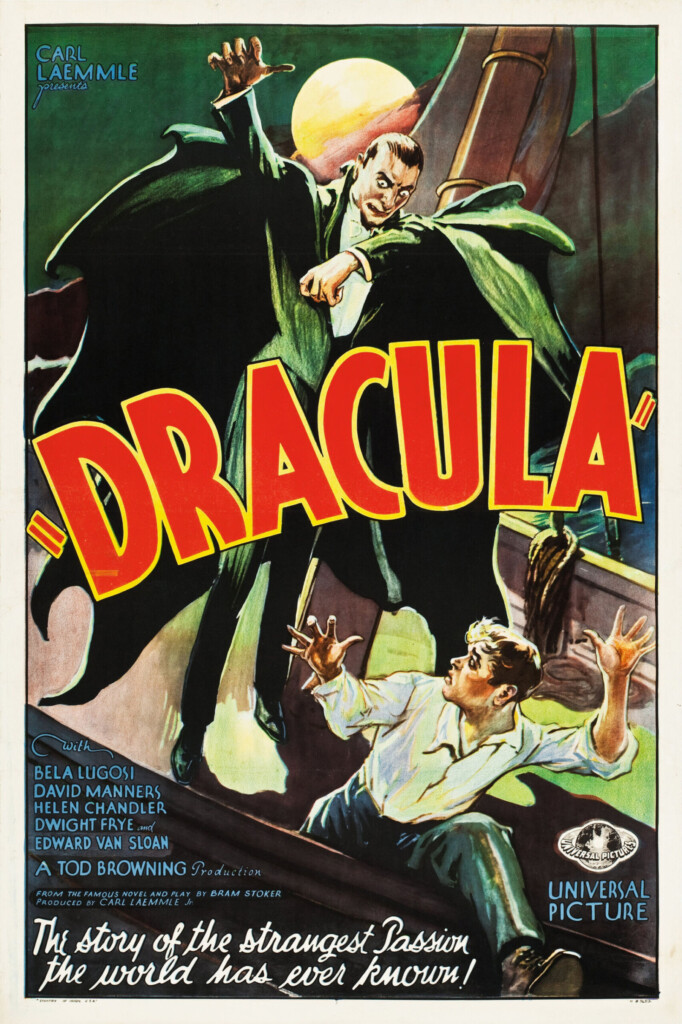
What Hollywood did over the following decades was not interpret that residual terror but manage it. Universal Pictures’ 1931 Dracula, starring Béla Lugosi, was the decisive transformation: the vampire became elegant, seductive, foreign in a specifically aristocratic register rather than a pestilential one. Lugosi’s accent was Romanian but his costume was the formal evening wear of the European upper class, and the threat he posed was framed almost entirely as sexual contamination of respectable Anglo-American womanhood. The monster had been reclassified. It was no longer death incarnate; it was improper desire, which the culture already knew how to contain because it had centuries of practice containing desire.
Once the figure was safely erotic rather than genuinely annihilatory, the industrial logic of Hollywood could proceed without friction. Each decade required a fresh reinterpretation not because the culture had new questions about mortality or evil but because the market required novelty to sustain consumption. The Hammer Film Productions cycle of the late 1950s and 1960s added color blood and cleavage, targeting a postwar youth audience that had grown up with television. Anne Rice‘s 1976 novel Interview with the Vampire inverted the power dynamic entirely — her vampires were introspective, mournful, burdened by consciousness — and sold over eight million copies by 1994, the year its film adaptation was released. Rice did not so much challenge the vampire myth as psychologize it for a therapeutic culture that had learned to read suffering as depth and depth as value.
The critical pivot, though, is not any single text but the cumulative effect of recycling on the category of transgression itself. When a symbol is reproduced often enough, it loses its capacity to point beyond itself. Georges Bataille, writing in 1957 in Eroticism, argued that genuine transgression requires the actual presence of a prohibition — that without a real limit, the crossing of a limit produces nothing, neither fear nor liberation nor meaning. The vampire’s commercial domestication is a case study in what happens when transgression is divorced from any actual prohibition: the symbol persists, the form survives, but the experience it once organized has quietly evacuated the premises.
By the time the early twenty-first century arrived, the vampire had become available as a template for almost any narrative requirement — teenage romance, family drama, political allegory, fashion campaign — because it had been emptied of specific content. A symbol that can mean anything has effectively ceased to mean. What circulates now is not the myth but its silhouette, a recognizable shape that the market can fill with whatever the current emotional demand requires, undead not by supernatural logic but by the more banal mechanism of brand equity.
Immortality as Consumer Fantasy
You have probably stood in a pharmacy aisle longer than you intended, studying the fine print on a serum that promises cellular renewal, collagen restoration, the reversal of what your body is quietly, persistently doing to itself. The product does not call itself an anti-aging cream. It calls itself a “youth activator,” a “regenerative complex,” a linguistic maneuver that transforms the simple fact of dying into a technical problem awaiting its solution. This is not vanity in the old moralistic sense. This is something more systemic, more structurally embedded — a cultural imperative to treat biological finitude as a design flaw.
Zygmunt Bauman argued in Mortality, Immortality and Other Life Strategies, published in 1992, that modern Western culture does not confront death so much as it dismembers it into a series of manageable, defeatable sub-problems. You do not die from life itself; you die from cancer, from cardiovascular failure, from a specific cellular malfunction that researchers are working to correct. Each individual cause of death becomes a campaign, a fundraiser, a ribbon color — and the aggregate logic is that if you defeat enough of them in sequence, the final horizon perpetually recedes. The vampire, in its contemporary commercial incarnation, has become the aesthetic embodiment of this logic made flesh.
The shift is not subtle and it did not happen overnight. Through most of the twentieth century, eternal life in vampire fiction carried genuine horror precisely because it was inescapable — a sentence, not a reward. The creature that cannot die is also the creature that cannot change, cannot grow, cannot move toward anything because there is no destination left. But somewhere in the final decades of that century, the cultural appetite flipped. Eternal life began appearing in fiction not as a trap but as an upgrade, a premium tier of existence available to those deemed exceptional enough to receive it. The vampire stopped being a warning about what humanity loses when it refuses to end and became instead a projection of what humanity secretly wants: beauty that does not erode, desire that does not exhaust itself, power that does not require succession.
What makes this transformation ideologically precise rather than merely aesthetic is its alignment with the logic of neoliberal selfhood, which demands that individuals optimize their biological capital the same way they manage a portfolio. The body becomes an asset subject to depreciation, and the vampire’s body — perpetually liquid, perpetually solvent — is the aspirational benchmark. Vampire narratives from the late 1990s onward began encoding eternal life as something earned through correct choices, correct bloodlines, correct affiliations, mirroring the broader cultural fantasy that mortality is something that happens to people who did not take sufficient care of themselves. The vampire no longer stalks the deserving; the vampire selects them.
This produces a particular kind of reader and viewer identification that Stoker’s original architecture could not have anticipated. In 1897, identification with the monster was a transgressive, guilty pleasure at best. In the contemporary moment, identification with the vampire has been entirely normalized because the vampire is no longer other — it is the idealized self, the version of you that has solved the problem Bauman identified as the central neurosis of modern life. The seductive pull is not toward darkness or danger but toward permanence, toward the fantasy of a self that accumulates experience without accumulating damage, that moves through history as a collector rather than as a casualty.
The market has formalized this logic with a precision that is almost clinical. The global anti-aging industry was valued at approximately 62 billion dollars in 2021 and projected to exceed 120 billion by 2030 — not because people are more afraid of death than they were in previous centuries, but because the cultural architecture now frames death as optional, as the outcome of insufficient investment in the self, and the vampire floats above that architecture as its purest and most elegant symbol, perpetually just out of reach, perpetually receding — which is, of course, the point.
The Mirror Dracula Holds That We Refuse to See
You have probably stood in a queue — at a bank, a clinic, a government office — and felt something drain out of you that had no name. Not time exactly, not money yet, but something prior to both: a willingness, a forward motion, a small portion of the future you had arrived with. The institution took it without asking and gave you a number in return. Nobody in that building was villainous. The architecture did the work.
Bram Stoker published his novel in 1897, the same decade that Thorstein Veblen was assembling the arguments that would become The Theory of the Leisure Class, his 1899 dissection of how elite consumption is always, structurally, the consumption of someone else’s produced labor repackaged as personal distinction. The Count does not work. He accumulates. He moves through borders with forged documents and purchased legitimacy. He owns property in multiple jurisdictions. He feeds on people who, notably, remember nothing clearly afterward — only a vague sense of depletion and a compulsion to return. Veblen’s rentier class and Stoker’s monster share the same metabolic logic: value flows upward, confusion flows down.
What makes the cultural persistence of Dracula so uncomfortable is that he has never, across more than a century of adaptations, been made genuinely ugly in the way that true monstrousness demands. He is costumed in authority. He speaks with the cadences of inherited education. He is received in drawing rooms. The horror writers and filmmakers who have returned to him compulsively since 1897 have not been able to strip him of his manners, because his manners are not incidental to the terror — they are the terror’s delivery mechanism. Remove the elegance and you remove the recognition.
The philosopher Giorgio Agamben, working through the concept of “bare life” in Homo Sacer published in 1995, argued that sovereign power has always operated by deciding which lives are included in the political order and which are reduced to biological raw material — bodies that can be used without the full weight of legal or moral consequence. Dracula performs this decision openly and personally. What is historically abnormal about him is not the extraction itself but the fact that it has a face, a name, a cape. The extraction that Agamben identifies moves through bureaucratic systems precisely because facelessness protects it from moral reckoning.
There is a man in a documentary filmed sometime in the early 2000s — a logistics worker in a massive warehouse who describes the moment he understood that the company tracking his movements by the second was not monitoring him for safety. The metrics were structured so that any pause, including the pause required to report an injury, would count against his performance score. He describes this not with rage but with a slow, almost clinical recognition, the kind of recognition that arrives when a system finally becomes legible. He was being consumed. The consumption was optimized. The optimization was legal.
Dracula’s endurance as a figure is the endurance of that recognition kept at a safe fictional distance. He allows a civilization to rehearse the understanding of its own extractive structures without having to hold anyone in particular accountable, because the Count is, reassuringly, not real. The danger of that distance is not that it breeds complacency — it might — but that it breeds something subtler: a habituated aesthetic pleasure in the image of domination made glamorous, a trained reflex to find the predator charismatic precisely because the culture has spent over a century teaching itself to do so.
What Stoker could not have anticipated is that the monster would become a mirror that people voluntarily carry. The Count no longer needs to enter uninvited; he has been invited so many times that the threshold no longer exists, and whatever lives on the other side of it has quietly learned to call the hunger romance.
🧛 The Dark Roots of the Vampire: Culture, Fear & Myth
Dracula did not emerge from a vacuum. Bram Stoker‘s immortal creation drew upon centuries of folklore, gothic literary tradition, and the anxieties of Victorian society to produce a figure that still haunts the Western imagination. These articles trace the deeper cultural veins from which the vampire myth draws its blood.
Bram Stoker and Dracula: Terror as a Mirror of Victorian Society
Bram Stoker‘s Dracula is inseparable from the Victorian world that produced it, embodying fears of foreign invasion, sexual transgression, and the collapse of rational order. This article explores how Stoker transformed Eastern European folklore into a gothic masterpiece that functioned as a cultural mirror for late nineteenth-century England. Understanding Stoker’s biography and historical context is essential to grasping why Dracula became so much more than a horror novel.
GO TO THE SELECTION: Bram Stoker and Dracula: Terror as a Mirror of Victorian Society
The Vampire Myth: History and Symbolism
The vampire myth predates Stoker by centuries, rooted in Slavic, Romanian, and Balkan folklore where the undead were genuine objects of communal terror and ritual. This article traces the long symbolic life of the vampire from peasant superstition through Enlightenment debates to its full literary flowering. It reveals how the myth consistently functions as a vessel for a culture’s deepest anxieties about death, desire, and the boundary between the living and the dead.
GO TO THE SELECTION: The Vampire Myth: History and Symbolism
The Vampire in Literature: From Polidori to Stoker
The literary vampire did not begin with Dracula but with John Polidori’s The Vampyre in 1819, a figure born out of the same stormy night that gave the world Frankenstein. This article charts the evolution of the vampire in literature from Polidori’s aristocratic predator through Sheridan Le Fanu‘s Carmilla to Stoker’s definitive creation. It shows how each iteration of the vampire refracted the particular cultural tensions of its historical moment.
GO TO THE SELECTION: The Vampire in Literature: From Polidori to Stoker
Sheridan Le Fanu’s Carmilla: The Female Vampire
Published in 1872, Sheridan Le Fanu‘s Carmilla gave the vampire myth a female face and charged it with an unmistakable erotic energy that would prove profoundly influential on all subsequent vampire literature including Stoker’s own. This article examines how Carmilla articulated fears around female autonomy, same-sex desire, and the seductive power of death in an era deeply uncomfortable with all three. Le Fanu’s novella stands as a crucial bridge between the early Romantic vampire and the fully realized Gothic monster of Dracula.
GO TO THE SELECTION: Sheridan Le Fanu’s Carmilla: The Female Vampire
Discover the Cinema That Dares to Go Deeper
The themes explored in these articles — darkness, transformation, cultural fear, and the mythology of the predatory Other — find their most visceral and original expressions in independent cinema. On Indiecinema you will discover films that dare to engage with the uncanny, the gothic, and the psychologically complex in ways that mainstream cinema rarely attempts. Stream the films that go beyond the myth and into the living heart of darkness.
👉 EXPLORE THE CATALOG: Watch Indie Films in Streaming
A vision curated by a filmmaker, not an algorithm
In this video I explain our vision

