
The Ritual Before Words
You are nine years old and you already know the rules, though no one has stated them. You sit beside him on the couch — close enough that your shoulders nearly touch, far enough that the distance is clearly deliberate — and you watch the screen because watching the screen is the one activity that requires nothing from either of you except presence. He leans forward when the play develops. You lean forward half a second later. Not because you care about the outcome, not yet, but because mirroring his body is the closest thing to conversation you have found that does not risk rejection. The game runs. Neither of you speaks. And in that silence, something is being said with extraordinary precision.

This is not neglect, exactly. It is something more structurally interesting and far more difficult to name — a form of intimacy that has learned to disguise itself as distraction. Sport enters the domestic space between fathers and sons not as entertainment but as a shared object of attention, a third presence in the room that absorbs all the feeling neither party knows how to direct at the other. The ball, the referee’s call, the injury replay: these become the acceptable containers for emotion. A man who cannot say “I am proud of you” can say “did you see that pass” with a quality of trembling in his voice that means exactly the same thing, and both people in the room understand this, and neither will acknowledge it.
The anthropologist David Gilmore, in his 1990 study Manhood in the Making, documented across cultures a recurring male initiation structure built not on disclosure but on shared ordeal — the idea that men bond through parallel suffering or parallel witness, never through direct emotional exchange. What he found was not a pathology but a grammar, a fully functional system of communication that operates through adjacency rather than address. You do not speak to the other man. You speak into the same space the other man is also speaking into, and meaning accumulates in the overlap. The sports broadcast is the industrialized, commodified version of this ancient structure, piped into living rooms across the twentieth century with the precision of a cultural institution that understood, before sociology did, what it was actually providing.
It provided permission. Permission to feel — the surge of collective tension before a penalty kick, the collapse of a crowd’s roar into silence — without the vulnerability of feeling being seen feeling. The sociologist Michael Messner, in his 1992 Power at Play, traced how American men across class lines described their earliest memories of bonding with fathers and grandfathers, and the statistic that emerges is almost brutal in its clarity: sport appeared as the primary site of father-son emotional memory in over seventy percent of cases, not because these men were sports fanatics, but because sport was the only available occasion for something resembling tenderness. A father’s hand on a son’s shoulder after a home run. The way a grandfather’s voice changed when he talked about a game he had watched with his own father in 1943. The memory is never really about the game.
What gets transmitted across these generations is not athletic knowledge or team loyalty, though those travel too. What gets transmitted is the emotional architecture of the ritual itself — the understanding that closeness is approached sideways, that love is spoken in the third person, that the most important things between men are said about something else entirely. A boy absorbs this grammar before he has language for it, the way he absorbs the rhythm of his mother tongue before he understands syntax. By the time he is old enough to question it, it is already the structure of his inner life, already the shape of what intimacy feels like to him, already the only frequency on which he knows how to broadcast and receive.
Along For The Ride
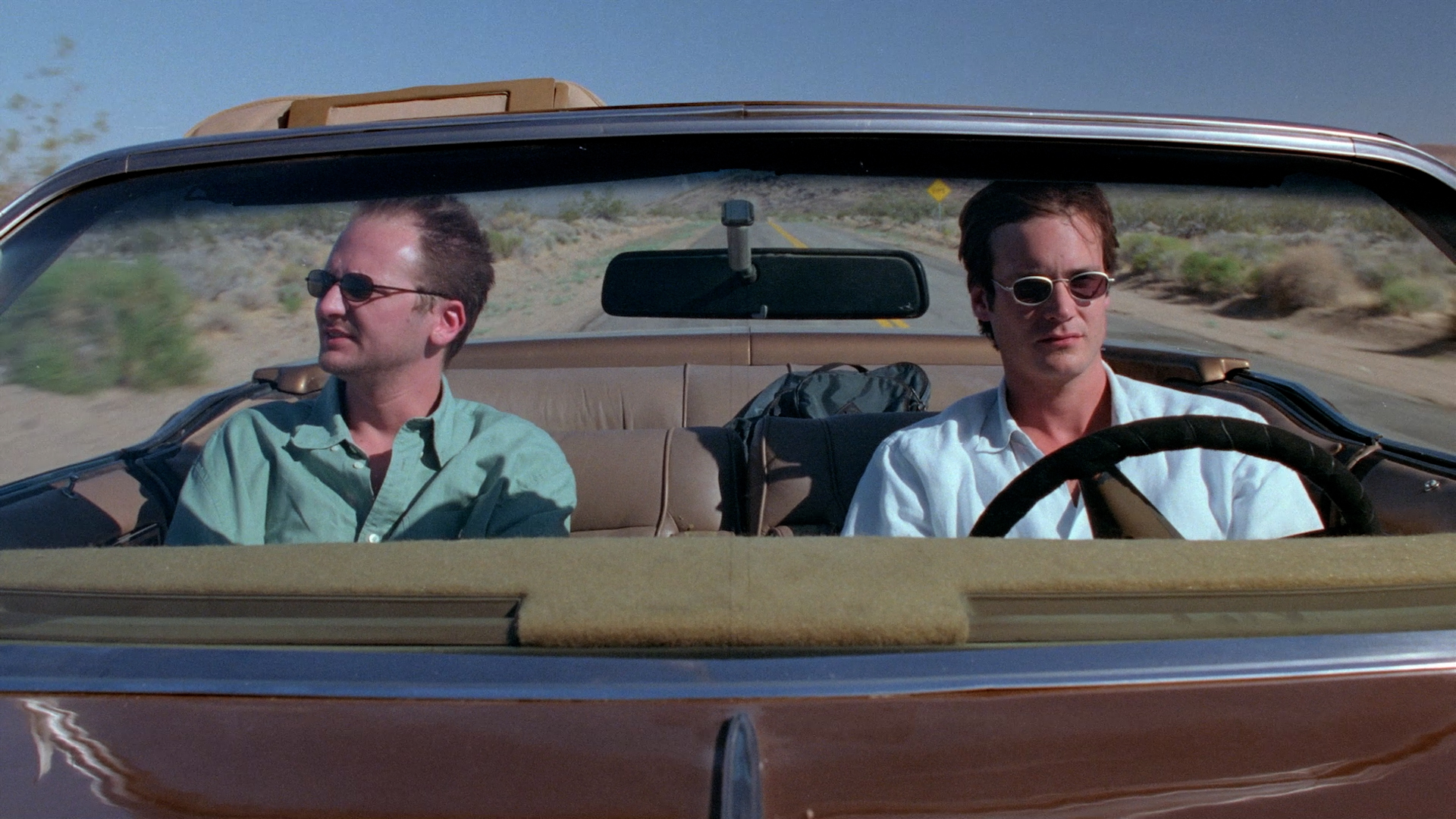
Drama, Comedy, by Bryan Simon, USA, 2001.
Two brothers, Terry (Randy Batinkoff) and Vance (Dylan Haggerty), embark on a journey into the desert with the body of their recently deceased father. Their goal is to find a burial site for him, but along the way unresolved family conflicts resurface. Terry, a successful former baseball player, has always exerted a dominant influence on the younger Vance, a humble mailman. Both carry within themselves the burden of a complicated relationship with their father, Jake (J.E. Freeman), a former professional player obsessed with sports. Even after his death, Jake appears to his children in dream sequences, but instead of offering wise advice, he continues to be distant and authoritarian. The journey thus becomes not only a physical but an emotional journey, in which the two brothers confront their mutual grudges and the emotional legacy of their father.
The film, directed by Bryan Simon with a budget of 150,000 dollars, was shot in extreme weather conditions, with a screenplay adapted by Jim Moores from a work by Randall Wheatley. The film also explores the role of sport as a vehicle for communication between father and son. For many men, expressing feelings is difficult, while talking about sport is a natural and shared language. "Along for the Ride" addresses these issues with sensitivity and realism, resulting in a touching work for those who have experienced similar family dynamics. An indie not to be missed for lovers of quality independent cinema.
LANGUAGE: English
SUBTITLES: Spanish, French, German, Portuguese
When Emotional Illiteracy Became Masculine Virtue
You learned to read your father’s love through statistics. Not through anything he said at the dinner table, not through any conversation that lasted longer than the time it took to drive to a game, but through the way he could recite batting averages from 1974 the way other men recited prayers — with precision, with reverence, with something that trembled just beneath the surface of the numbers.
This did not happen by accident. The emotional architecture of twentieth-century masculinity was deliberately engineered, and the blueprints were laid long before either of you was born. When Talcott Parsons published his structural-functionalist model of the family in “Family, Socialization and Interaction Process” in 1955, he gave sociological legitimacy to something that factory floors and military barracks had already been practicing for decades: the rigid separation of the “instrumental” male role — provider, problem-solver, external-facing — from anything resembling interior life. Parsons was describing what he observed, but description, once formalized and distributed through universities and policy circles, has a way of hardening into prescription. Generations of men were handed a map of themselves that left entire continents blank.
The First World War accelerated this cartography of suppression with industrial efficiency. When nearly ten million soldiers died in conditions of unimaginable psychological horror between 1914 and 1918, the cultures that sent them could not afford to acknowledge what had been done to the men who returned. Shell shock was renamed, minimized, and eventually buried beneath the mythology of stoic sacrifice. The men who came home were expected to fold their terror back into their bodies and return to work. Fordist labor — repetitive, fragmented, stripped of craft or autonomy — demanded exactly the same thing on the factory floor: the body shows up, the mind is left at the gate. By 1930, Henry Ford‘s River Rouge plant employed over 75,000 workers in conditions specifically designed to evacuate personality from production. You were a function. Functions do not grieve.
What survived inside this compression was not the absence of feeling but its radical displacement. Emotion did not disappear from these men — it migrated. It found the few channels culture deemed acceptable: controlled aggression, competitive loyalty, the ritualized passion of sport. The sociologist Michael Kimmel, in “Manhood in America” published in 1996, traced how the crisis of masculine identity at the turn of the twentieth century produced an almost desperate attachment to physical competition as proof of selfhood. Sport became not merely entertainment but a kind of emotional permit — the one space where a man could scream, embrace another man, weep without immediate social penalty, feel the full voltage of something without being accused of weakness.
The bond that formed inside this permit was real, but it was also structurally constrained. A father could teach his son to throw a spiral, could spend six hours driving to watch a single game, could replay a championship moment with the tenderness of someone recounting their wedding day — and none of this required him to say anything about what he felt, about what frightened him, about what he needed. The sport was the sentence. The son was expected to translate it without a dictionary.
What makes this particularly difficult to escape is that it worked. The translation was often successful. Sons did feel loved. The warmth was real, the presence was real, the shared intensity was real. But a language built exclusively on displacement carries a structural flaw: it cannot travel into territory where sport is absent. When illness arrives, when failure arrives, when the kind of pain that cannot be metabolized through competition arrives — the vocabulary simply does not exist, and two people who love each other profoundly find themselves standing in a silence that neither of them built but both of them inherited.

The Proxy Self and the Transferred Dream

You signed your son up for the team before he could tell you what he wanted. You remember it differently, of course — you remember asking, you remember his enthusiasm, you remember the way his face lit up. But the sequence, if you reconstruct it honestly, went the other way: your excitement came first, and his followed, the way a shadow follows a body rather than leading it.
Freud identified this dynamic with uncomfortable precision in his 1914 essay “On Narcissism,” coining the phrase “His Majesty the Baby” to describe the peculiar inflation parents project onto their children — the child becoming the vessel for everything the parent failed to achieve, every ambition the world refused to ratify, every version of the self that had to be abandoned for mortgages and compromises and the ordinary diminishments of adult life. The child does not inherit this role consciously. It is installed before language, before the capacity to refuse it, sutured into the earliest conditions of being loved.
Sport offers this transference a body — literally. The child’s musculature, reflexes, and competitive results become the territory on which the father’s displaced autobiography plays out. There is something almost surgical about it: the father who never made the cut at sixteen now watches his twelve-year-old on a pitch with an intensity that has very little to do with the game being played and everything to do with a wound that never properly closed. The sociologist Pierre Bourdieu, writing in “The Logic of Practice” in 1990, described how the body becomes the site where social structures are stored invisibly, written into posture and gesture and habitual movement. What he did not examine at length was how this storage can be explicitly parental — how a father’s unrealized trajectory gets physically encoded into a son’s training schedule.
The mechanism is not cruelty. That is what makes it so difficult to see and so difficult to name. It operates entirely through love — through genuine, aching investment in the child’s flourishing. The father at the sideline who shouts too loudly, who replays errors on the drive home, who withdraws into a particular silence after a loss, is not performing aggression. He is experiencing something closer to grief, because the result matters to him in a register that exceeds normal parental concern. The child’s failure is, at some preconscious level, his own failure again, revisiting him from a direction he did not anticipate.
What this produces in the child is a specific and rarely named burden: the task of carrying a life that is not entirely their own. The developmental psychologist Alice Miller, in “The Drama of the Gifted Child” published in 1979, described how children develop an exquisite sensitivity to parental emotional states, calibrating their own behavior and even their own desires to maintain the parent’s psychological equilibrium. In a sporting context, this calibration becomes almost tactical. The child learns which performances please, which failures are survivable, and which outcomes produce the particular cold silence that is worse than any explicit punishment. They become, in effect, athletes of their father’s inner life rather than their own.
The cruelty arrives later, and quietly. It arrives when the son discovers — sometimes at nineteen, sometimes at forty — that the passion he believed was his own was partly a borrowed fire, that the sport he organized his identity around was also a gift he never actually chose. Some arrive at this recognition in therapy. Some arrive at it when they watch their own child on a pitch and feel something flicker in themselves that they cannot name but that feels uncomfortably familiar. The transfer of dream is so complete that even the moment of recognizing the trap can reproduce it — the son, now a father, reaching instinctively for the same instrument to say what he still does not know how to say in any other way.
What the Statistics Reveal About Absence
You are watching a father and his teenage son sit through dinner together, and neither of them speaks for eleven minutes. You count. The silence is not hostile — it is practiced, almost ceremonial, the kind of quiet that has been rehearsed so many times it no longer feels like failure. Then someone mentions a game from the previous weekend, and the table changes temperature.
The data underneath that dinner table is staggering in its consistency. Developmental psychologists have spent decades measuring what parents actually say to their children, not what they report saying, and the divergence between fathers and sons is one of the most replicated findings in family communication research. In a landmark series of longitudinal studies conducted by John Gottman and his colleagues at the University of Washington through the 1990s, fathers were shown to engage in substantially less emotion-coaching with sons than with daughters — less naming of internal states, less validation of vulnerability, less invitation to explore what a feeling meant before acting on it. The disparity was not explained by fathers being emotionally absent overall; many of these men were warm, present, engaged parents by every conventional measure. The gap was specific and structural: it appeared precisely in the domain of verbal-emotional exchange, as though an invisible curriculum had been handed down about which children required that kind of attention and which ones would be better served by something else.
That something else, across income levels, geographic regions, and cultural backgrounds, turned out to be physical activity and spectatorship. By the mid-2000s, participation rates in organized youth sport were showing a pattern that researchers in sports sociology began reading against the backdrop of family dynamics rather than individual enthusiasm. Boys were enrolled in team sports at higher rates than girls from as young as five years old, and the gap widened precisely in the years — ages eight through fourteen — when developmental literature identifies the sharpest decline in verbal intimacy between fathers and sons. This is not coincidence arranged by chance. These numbers are the structural imprint of an emotional substitution happening at scale, millions of families independently arriving at the same solution to the same unspoken problem.
Robin Dunbar, the British anthropologist whose work on social bonding has been widely cited in behavioral science since the 1990s, identified synchronized physical activity as one of the most powerful endorphin-releasing bonding mechanisms available to humans — more immediate, in some conditions, than conversation itself. This gave a kind of evolutionary legitimacy to what families had been doing intuitively: replacing a verbal channel that felt blocked or dangerous with a physical one that felt natural and safe. The stadium, the backyard, the drive to practice at six in the morning — these became the architecture within which attachment was maintained without requiring anyone to speak directly about attachment. The sport did not supplement the relationship; in many cases, it was the relationship, the only container strong enough to hold the feelings neither party had been given language for.
What this means in practice is that the participation statistics researchers have long read as evidence of enthusiasm — boys love sport, fathers love watching their sons compete, the numbers simply reflect preference — are actually encoding something closer to compensatory design. Families are not choosing sport because it is the richest possible medium for connection. They are choosing it because it is the most available medium that does not demand what neither party has been trained to supply. The love is real. The game is real. But the game is also doing work that should not belong to it alone, carrying an emotional freight it was never designed to bear, and the weight of that cargo has consequences that no box score can record, because they accumulate in the spaces between what was said and what was meant, across decades, in the specific silence of eleven minutes at a dinner table where everyone present already knows the subject they are not discussing.
The Stands as Confession Booth
You have watched your father’s face for years and learned to read its silences — the jaw set slightly forward when he is angry, the way his eyes go flat when he is disappointed, the almost imperceptible softening around his mouth when he is proud but cannot say so. You have built an entire emotional atlas from fragments, because fragments were all that was offered. Then one Sunday in November, under floodlights and in the company of forty thousand strangers, the man beside you puts his face into his hands and weeps. Not politely. Not with restraint. With his shoulders shaking and the sound coming out of him like something long trapped.
This is not a small event. This is the first crack in a wall the son had assumed was structural — had assumed, in fact, was his father’s entire architecture. What the stadium does, in that moment, is something no dinner table conversation and no family crisis has managed to accomplish: it extracts confession without demanding it. The emotional disclosure is involuntary, which is precisely why it is bearable for both parties. No one chose vulnerability. The game chose it for them.
Sociologists have been circling this phenomenon for decades. Norbert Elias, writing with Eric Dunning in Quest for Excitement in 1986, argued that sport functions as a controlled decontrolling of emotional controls — a space where civilized societies permit the temporary suspension of the emotional regulations that govern ordinary social life. What Elias mapped at the level of crowds and historical process, however, has an intimate corollary that his framework only partially illuminated: the dyadic space between a father and a son, where the collective permission becomes personal revelation. The stadium does not just allow a man to feel; it allows his child to witness him feeling, which is an entirely different and more consequential phenomenon.
Masculine emotional suppression is not simply a character trait or a personal failing. It is a learned and enforced social contract, and the enforcement begins early. Research published in the Journal of Adolescent Health in 2018 tracked adolescent boys across multiple countries and found consistent patterns of emotional narrowing between ages eight and fifteen — a progressive restriction of expressed emotional range that correlated directly with peer surveillance and paternal modeling. Boys learn to contain themselves partly by watching their fathers contain themselves. The container replicates. Which means that a single moment of involuntary rupture — a father crying openly, in public, about something that is not death or divorce — carries disproportionate weight. It retroactively renegotiates the model.
What makes sport uniquely capable of producing these ruptures is the combination of high stakes and total deniability. A man who weeps at a funeral is performing a socially scripted grief. A man who weeps because his team lost a match in the eighty-ninth minute to a goal that should have been offside is operating outside any available script, which means his emotion is visibly unmanaged, visibly real, visibly his. The loss itself is objectively trivial — no one will die, no life will change — and yet the grief is genuine, because sport has spent decades or sometimes a lifetime accumulating the man’s private hopes and private loyalties and private sense of belonging to something larger than himself. When the match ends badly, it is not the match he is mourning.
The teenage son beside him does not yet have the language for what he is understanding. But he is understanding something that will remain with him long after the final score has been forgotten: that his father contains grief, that grief has been living in there all along, and that the man’s characteristic silence was never absence but storage. The stadium gave him this knowledge free of charge, without negotiation, without the agonizing choreography of an intentional emotional conversation — and perhaps that is why it lands where it does, beneath argument, beneath defense, in the place where a child still lives inside the adult who thought he had outgrown needing to see his father as fully human.
A vision curated by a filmmaker, not an algorithm
In this video I explain our vision
Homosocial Desire and Its Discontents

You are watching your father hug another man after a goal — arms locked, faces pressed together, a ferocity of contact that would be unthinkable in any other room of his life. He does not notice you watching. He is, for this one compressed moment, completely unguarded, and the strangeness of it will stay with you for decades without you ever finding the right word for what you witnessed.
Eve Kosofsky Sedgwick, writing in 1985 in Between Men: English Literature and Male Homosocial Desire, offered a framework that most men will never read but that describes the architecture of their emotional lives with uncomfortable precision. Sedgwick argued that male bonds — in literature, in law, in social ritual — are organized around a triangular structure: two men, and a third term that mediates between them, making the bond possible while simultaneously deflecting its intensity. In Victorian fiction that third term is often a woman. In the stands on a Saturday afternoon, it is the game itself. The sport becomes the alibi for a closeness that cannot be named directly, a shared object of devotion that permits men to be moved by the same things at the same moment, to reach toward each other across the distance culture has installed between them, without any of it needing to be acknowledged.
What makes this structure so durable is precisely its deniability. The father who cannot say I love you with any weight can say he played well today with a tremor in his voice that carries everything. The son who cannot ask to be seen can perform something extraordinary on a pitch and wait — sometimes for years — for a nod that arrives like oxygen. The sport is not a substitute for the real exchange; it is the real exchange, routed through a medium that both parties have silently agreed to accept as legitimate. Sedgwick was clear that homosocial desire does not mean repressed homosexuality — it means the intense, structured need for male recognition and attachment that society simultaneously demands and prohibits, producing a knot that men spend their lives tightening without ever locating the thread.
The policing function is built into the same structure that enables the closeness. A boy who cries in the dressing room after a loss is tolerated — briefly, conditionally — because the occasion has authorized grief. The same boy crying at the dinner table about the same loss will be told to move on. Sport creates licensed zones of emotional expression that are bounded and temporary, which means the intimacy it permits is always on a leash. It comes out only when the game summons it, retreats the moment the final whistle goes, and leaves no residue that the men involved are required to carry forward into ordinary life. This is not incidental. It is the operating logic of the whole system.
Gary Alan Fine documented something adjacent to this in With the Boys, his 1987 ethnography of Little League baseball in America, where he observed that preadolescent male groups use sport not only to bond but to establish the precise terms on which bonding is acceptable — which forms of contact, which emotional registers, which expressions of care survive the group’s internal policing. By the time boys become men, those terms are so internalized they feel like nature. The handshake that lingers a half-second too long. The arm around the shoulder that is always deployed in the context of a score, never in the context of sorrow. The joke that absorbs what would otherwise have to be tenderness.
What this means for fathers and sons specifically is that the game is not neutral territory they both happen to inhabit. It is a jointly maintained fiction, constructed over years, that allows two people who need each other enormously to be in the same emotional room without either of them having to say so out loud.
Language Games and the Grammar of Catch
You are already playing the game before you know the rules exist. The ball leaves your father’s hand in a low arc — not too fast, calibrated to your age, your arm, your confidence level — and your entire nervous system is already doing philosophy without any of the vocabulary. You catch it. You throw it back. A loop closes. Something is transmitted.
Ludwig Wittgenstein argued in his Philosophical Investigations, published posthumously in 1953, that meaning is not housed inside words but generated through use — through what he called Sprachspiele, language games, embedded in shared forms of life. A word means what it does inside a practice. The same logic applies with brutal precision to the rituals of sport between fathers and sons: the game of catch, the pre-match ritual, the post-game debrief in the car while the engine cools. These are not preludes to communication. They are the communication. They have syntax — who throws first, who decides the pace, who is allowed to escalate the speed — and they have pragmatics, rules about what gets acknowledged and what gets silently returned to sender.
What makes this grammar so effective is precisely what makes it so treacherous. Wittgenstein was careful to note that a language game’s coherence depends entirely on participants sharing what he called a Lebensform — a form of life, a background of common practice — and that grammar cannot step outside itself to explain itself. A grammar has no meta-level. The game of catch cannot, from within its own rules, generate a sentence that means: I am frightened of losing you. It can generate proximity, rhythm, attunement, the particular tenderness of a man who adjusts his throw when he notices his son is tired. But that is not the same as speaking fear. It is fear translated into kinematics, and something is always lost in that translation.
The sociologist Michael Messner, in his 1992 study Power at Play, documented how men across different class and ethnic backgrounds consistently reported that their most meaningful moments with their fathers occurred not in conversation but in shared physical activity, almost always structured around sport. Crucially, these moments were described as emotionally saturated — remembered with the precision and affect usually reserved for intimate speech — and yet their content, when examined, was almost entirely procedural. They talked about the game. The grammar was fluent. The lexicon for interiority was absent.
Consider what a grammar actually forbids. Every language game establishes not just what can be said but what cannot be said without violating the register — without breaking the game’s internal coherence. A son who, in the middle of a catch session, says aloud that he feels unloved by his father has not simply introduced a new topic. He has committed a kind of grammatical violation, a category error that ruptures the form of life sustaining the exchange. The game stops. Both players suddenly have no role, no position, no script. The ball hits the grass and stays there. This is not because the emotion was wrong or the moment was inappropriate in some social sense. It is because the grammar has no place for that sentence — structurally, architecturally, the way Latin has no word for a concept that only exists in Japanese.
The philosopher Charles Taylor, in Sources of the Self from 1989, argued that human identity is fundamentally dialogical — formed through and in language with others — but that not all dialogue is verbal, and not all of it is equally equipped to sustain the weight of a full self. The grammar of sport gives a son a place to exist alongside his father. It gives both of them a shared world to inhabit. What it cannot guarantee is that inhabiting the same world means each can see the other clearly — that presence, repeated and faithful, ever becomes the specific, irreducible act of being known.
The Inheritance No One Consented To
You are thirty-four years old, standing on the sideline of a youth football pitch on a Saturday morning, and you have no idea why you are there. Not in the existential sense — you drove, you parked, you brought the orange slices — but in the deeper sense that if someone pressed you, really pressed you, you could not explain the chain of reasoning that transformed your son’s mild interest in a ball into a weekly ritual that now organizes your entire weekend. You would say he loves it. You would say it is good for him. You would say almost anything except the truth, which is that you are reenacting something, faithfully and unconsciously, the way a body remembers a posture it learned before it had language.
The psychoanalytic tradition has long understood that transmission between generations operates below the threshold of decision. Nicolas Abraham and Maria Torok, writing in the 1970s on what they called the transgenerational phantom, described how the unresolved emotional material of one generation does not disappear but migrates — lodges itself inside the psychic structure of the next, directing behavior from a hidden interior that feels like instinct because it predates conscious memory. The son who cannot explain why he feels compelled to stand at that touchline every Saturday is not irrational. He is inhabited. The ritual was placed inside him before he had any framework with which to evaluate it, and by the time he had that framework, the ritual had already been classified as love.
What makes this particular form of inheritance so difficult to see is that it does not feel like repetition. It feels like choice. The father who brings his daughter to tennis lessons rather than football believes he has broken the pattern, updated the template, made a more egalitarian selection. But the structure remains identical: the early Saturday morning, the equipment bag, the sideline vigil, the performance of attentive parenthood through the medium of sport. The specific game is interchangeable. What is being replicated is not a passion but an architecture of relating — a set of spatial and temporal coordinates within which emotional closeness becomes possible between people who have never learned to manufacture it any other way.
Sociologist Pierre Bourdieu, in his 1984 examination of how taste and practice reproduce class and family structure, argued that the body itself becomes a kind of social memory, storing inherited dispositions that feel natural precisely because they were acquired before reflection was possible. The habitus, he called it — not a fixed thing but a generative grammar, producing new variations on an old theme while giving the impression of spontaneous individual preference. The man who swears he genuinely loves coaching his son’s team, who would be offended if you suggested he was simply performing a learned role, is not lying. He has simply never been in a position to ask whether the love came first or whether the architecture of expectation generated the feeling retroactively, the way a room furnishes an emotion rather than expressing one already held.
There is also something quietly coercive in the forward motion of this inheritance, though coercion is far too strong a word and too easy to dismiss. The son who does not want to play, who prefers to read or draw or simply be still, must navigate not just his own disinterest but the invisible weight of a relational structure that was built for him before he arrived. His refusal is not simply a preference — it is, without his intending it, a rejection of the only emotional language his father knows, and both of them will feel that rupture without being able to name what broke. The tradition continues not because it is loved but because the alternative is a silence that neither generation has been given the tools to fill, and sometimes the most honest thing sport ever carries between a father and a son is the wordless terror of what would remain if it were taken away.
🏟️ The Field Where Fathers and Sons Speak
Sport is rarely just a game between fathers and sons — it is a grammar of affection, a ritual space where love is expressed through gesture rather than word. The articles below explore the deeper currents of emotion, play, identity, and masculine relationship that flow beneath every pass, every match, every shared silence on the sideline.
Johan Huizinga and Homo Ludens: When Playing Is Serious Business
Johan Huizinga‘s landmark theory of Homo Ludens reveals that play is not a trivial escape but one of the foundational activities through which culture, identity, and human bonds are forged. When a father teaches a son to kick a ball or hold a bat, he is enacting something ancient and deeply serious beneath the surface of fun. Huizinga gives us the philosophical tools to understand why sport between generations carries such emotional weight.
GO TO THE SELECTION: Johan Huizinga and Homo Ludens: When Playing Is Serious Business
Love in Philosophy: From Plato to Fromm
From Plato’s Symposium to Erich Fromm‘s modern explorations, love has always sought forms of expression that transcend language — and sport between fathers and sons is precisely one of those forms. This article traces how philosophy has understood the many faces of love, including the silent, physical, competitive love that binds men across generations. Understanding love through this lens transforms how we read every shared sporting moment.
GO TO THE SELECTION: Love in Philosophy: From Plato to Fromm
Grief in Childhood: When Children Lose Their Parents
Grief in childhood, particularly the loss of a father, reveals in reverse how profound the emotional architecture built around shared rituals — including sport — truly is. When those rituals disappear, children feel not just absence but the collapse of a language they had only begun to learn. This article illuminates the psychological depth of father-child bonds that sport so often quietly sustains.
GO TO THE SELECTION: Grief in Childhood: When Children Lose Their Parents
Regression in Psychology: When the Mind Returns to Childhood
Regression in psychology describes the mind’s tendency to return to earlier emotional states, and nowhere is this more visible than when adults step onto a field and suddenly feel like children again beside their fathers. Sport has a unique power to collapse time, making grown men vulnerable and young in ways that ordinary conversation never could. This article helps explain why the emotional stakes of sport between fathers and sons can feel so disproportionately immense.
GO TO THE SELECTION: Regression in Psychology: When the Mind Returns to Childhood
Discover the Cinema of Fathers, Sons and Unspoken Bonds
If these themes resonate with you, Indiecinema streaming is the place where cinema explores them with the courage and intimacy they deserve. From quiet dramas about masculinity to films where sport becomes metaphor, our catalog is filled with independent stories that speak the language of the heart. Join us and discover films that say what fathers and sons so rarely manage to.
👉 EXPLORE THE CATALOG: Watch Indie Films in Streaming
A vision curated by a filmmaker, not an algorithm
In this video I explain our vision

