
The Body That Would Not Be Silent
You know the feeling before you can name it. Something moves in you that has no approved translation, no social container waiting to receive it. You are too young to understand the mechanics of repression, but you already understand, in the marrow, that certain things must stay below the surface. Not because anyone has told you directly. Because the silence around them is so complete, so carefully maintained, that even the air seems to hold its breath. You learn to perform normalcy the way you learn a second language — grammatically correct, emotionally foreign, always slightly off in the rhythm.

Granada in the 1890s was exactly that kind of silence, architecturally reinforced. A city of extraordinary beauty and extraordinary rigidity, where Moorish palaces stood as monuments to a culture that had been violently erased four centuries earlier, and where the Catholic bourgeoisie had built its social codes with the same certainty that they built their houses — to last, to exclude, to define who belonged and who did not. Into this city, on June 5, 1898, Federico García Lorca was born, the eldest son of Federico García Rodríguez, a prosperous landowner, and Vicenta Lorca Romero, a schoolteacher of considerable cultivation. The family was comfortable, respected, positioned securely within the structures of Andalusian provincial life. They were, by every social measure, the kind of family that produces doctors and lawyers and men who understand the importance of appearances.
What they were actually sheltering was something the century would not have a language for until much later, and which the century after that would still punish in dozens of countries. Federico was not simply a sensitive child, though the word sensitive would be deployed constantly, as it always is when adults sense something they cannot categorize. He was a child whose entire perceptual system seemed tuned to a different frequency — drawn to the songs of the women who worked in the fields around Fuente Vaqueros, absorbed by the rhythms of flamenco, by the grief embedded in deep song, by the bodies of men. The longing was there from the beginning, undeniable, unnameable, a pressure system building.
Michel Foucault argued in The History of Sexuality, published in 1976, that the nineteenth century did not repress sexuality so much as it produced it — categorized it, surveilled it, named it as a problem requiring management. The sodomite, he wrote, had been a temporary aberration; the homosexual became a species. This is the world Lorca was born into, a world that had only recently invented the clinical language to classify what he was, and had invented it precisely to contain it. To be what Lorca was in Granada in 1898 was not merely a personal predicament. It was a historical position, assigned without consent, carrying consequences that could not yet be fully imagined.
His father’s fields, his mother’s piano, the olive groves and the liturgical calendar and the social obligations of a family of standing — these were not merely backdrop. They were the specific gravity he would spend his entire life moving against, and which would spend his entire life moving against him. The tension was not between Lorca and society as two separate things that eventually came into conflict. The tension was Lorca. He was born already inside the contradiction, already the site where incompatible demands met and refused to resolve. A body that wanted what it was not permitted to want. A voice that would eventually say what it was not permitted to say. A presence so charged with what it could not openly be that the mere fact of his existence was, in some fundamental sense, a form of resistance — long before he chose it, long before he wrote a word, long before he understood that the silence around him was not natural but constructed, and that constructed things can be broken.
The Lost Poet
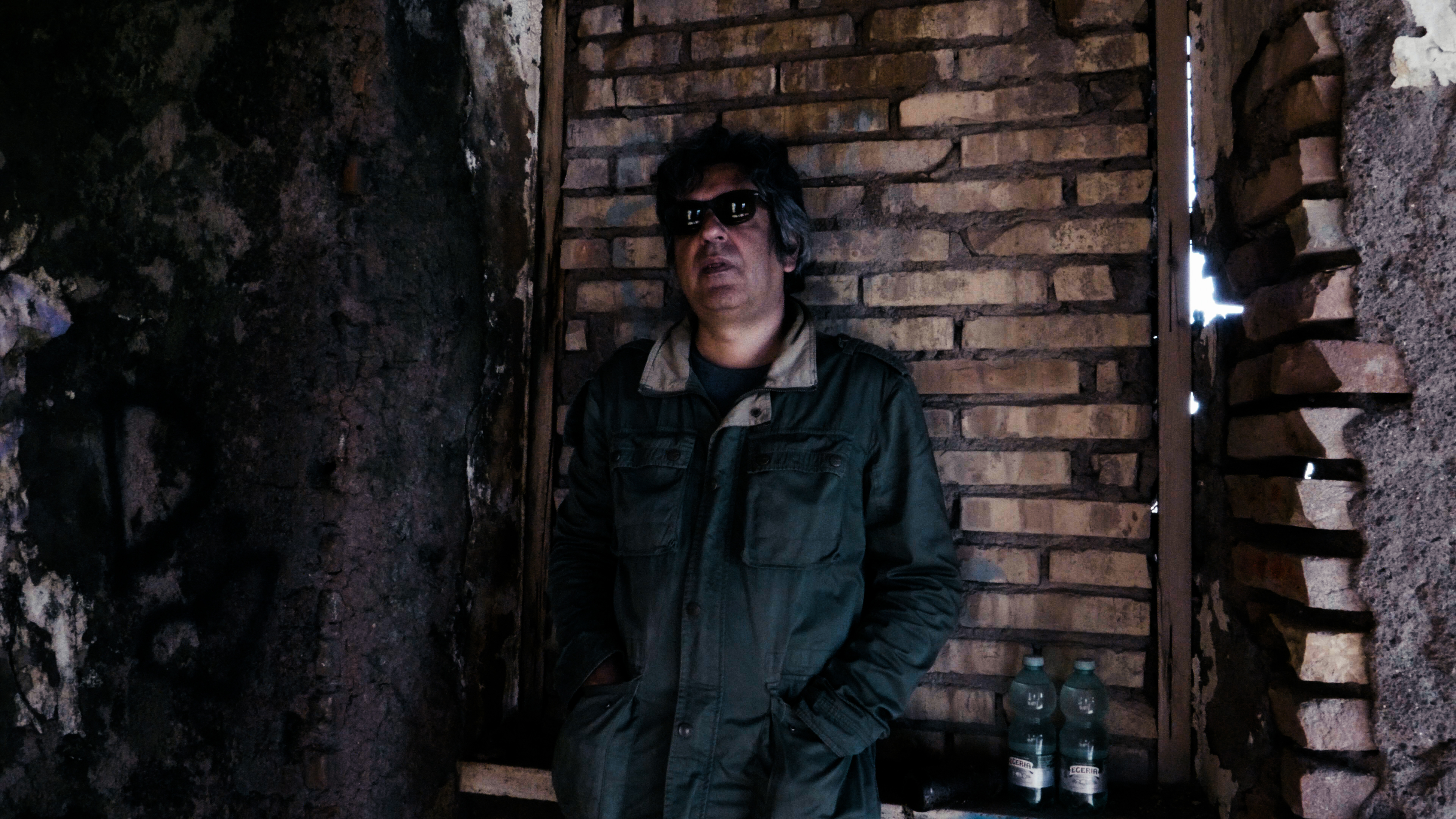
Drama, by Fabio Del Greco, Italy, 2024.
Dante Mezzadri wants to see an old friend, nicknamed the Iguana, whom he has lost sight of for many years, and who has managed to turn their shared youthful passion for poetry into a job, becoming a famous writer and poet. The man escapes from his bourgeois life and his wife to live homeless on the Roman coast, printing and trying to sell his poetry collections. At night he sleeps in a park of old carnival floats, inside a papier-mâché tank, and waits for the opportunity to meet his old friend, who however never shows up for appointments in the places they frequented when they were young, now in ruins. Dante's poetry books do not interest anyone and to support himself he is forced to "change product": he starts selling the infamous "cannibal pill" on behalf of young drug dealers, a new drug that sells like hot cakes and causes sensory and consumerist ecstasy. However, he realizes that this powerful drug is very dangerous for those who take it, he comes into conflict with his ethical conscience and throws all the pills into the sea. However, the dealers want to collect their money.
Shot over a period of 2 years, the film is a reflection on the cultural and artistic rubble of the society in which the protagonist lives, in an increasingly mechanized, consumerist and arid world. Dante Mezzadri is yet another human being who has renounced his inspiration and his creativity, but unlike many he is not willing to give his life to a system that distances him from his true identity. The physical world around him, however, seems constructed in such a way that it seems impossible to escape from this "invisible cage". The enthusiasm of the people he meets is ignited only by sensory gratification, by unreal visions of personal affirmation and success, by "metaverses" that offer an escape into an illusory and destructive reality. The poet's house on the coast, where he met with his friends as a young man, is just a pile of abandoned rubble. What happened to all those who wanted to become poets and ended up becoming something else? Are there internal forces with which that house can be "rebuilt"?
LANGUAGE: Italian
SUBTITLES: English, Spanish, French, German, Portuguese
Granada as a Wound
There is a specific quality of light in Granada in late afternoon, when the Alhambra turns the color of dried blood against a sky that seems to have been painted by someone who understood suffering. You do not visit that city so much as you are absorbed by it, the way a sponge takes water without ever becoming water itself. The stones hold memory in a way that most European cities have long since paved over, and what they remember is not triumph but erasure — the systematic, bureaucratic erasure of an entire civilization that once made this the intellectual center of the Western world.
Ian Gibson, whose decades of exhaustive biographical research into Lorca remain the most penetrating account of the poet’s formation, understood that Granada was not a backdrop but a wound that the city kept reopening on itself. The Reconquista did not simply end Muslim rule in 1492. It inaugurated a centuries-long project of cultural amnesia, forcing Moorish families to convert, to rename themselves, to forget the Arabic their grandparents had spoken, to whitewash the geometric patterns from their walls and replace them with the iconography of a God who demanded singular allegiance. The moriscos, those converted Muslims who were finally expelled entirely between 1609 and 1614, left behind a city that retained every physical trace of their presence while officially denying they had ever mattered. The Alhambra stood, incontrovertible and magnificent, while the people who built it were declared to have never truly existed as people worth remembering.
Heidegger called it Geworfenheit — thrownness — that condition of finding yourself already inside a world you did not author, a set of circumstances, inheritances, and historical sediments that precede your consciousness and will outlast your attempts to reason your way free of them. You are born thrown, landed inside a specific geography, a specific family’s wounds, a specific century’s unresolved violences. Lorca was thrown into Granada, which means he was thrown into all of this simultaneously: the Moorish ghosts who sang in the cante jondo, the Catholic machinery that policed desire and difference, the particular Andalusian genius for converting historical grief into art because there was no other available container for it.
Flamenco is not entertainment. Understand this before proceeding. It is the formalization of a grief that had nowhere else to go, the sonic record of people who had been stripped of their official history and found that their bodies remembered what the documents had been forced to deny. The deep song — cante jondo — that Lorca would analyze with extraordinary precision in a 1922 lecture alongside the composer Manuel de Falla carries within it the microtonal inflections of Arabic music, the modal structures of Sephardic Jewish lament, the rhythmic pulse of Roma communities who themselves knew something about systematic exclusion. It is a music of superimposed exiles, and Lorca heard in it something that went far beyond the folkloric. He heard the sound of what it costs to survive inside a culture that requires you to be both present and invisible.
He walked through Granada knowing all of this in his bones before he had the vocabulary for it. The city was his inheritance and his evidence, proof that beauty and cruelty could inhabit the same architecture indefinitely, that a civilization could be erased and yet continue to haunt every subsequent attempt at normalcy with its refusal to stay buried. The water channels of the Generalife still run. The geometric tilework still catches the afternoon light with a precision that modern design cannot replicate. The absence is everywhere present, which is the most destabilizing kind of absence, the kind that makes you question whether erasure ever truly succeeds or whether it merely teaches whatever it tried to destroy to speak in a different register, lower, more insistent, impossible finally to silence.

The Residencia and the Republic of Friends
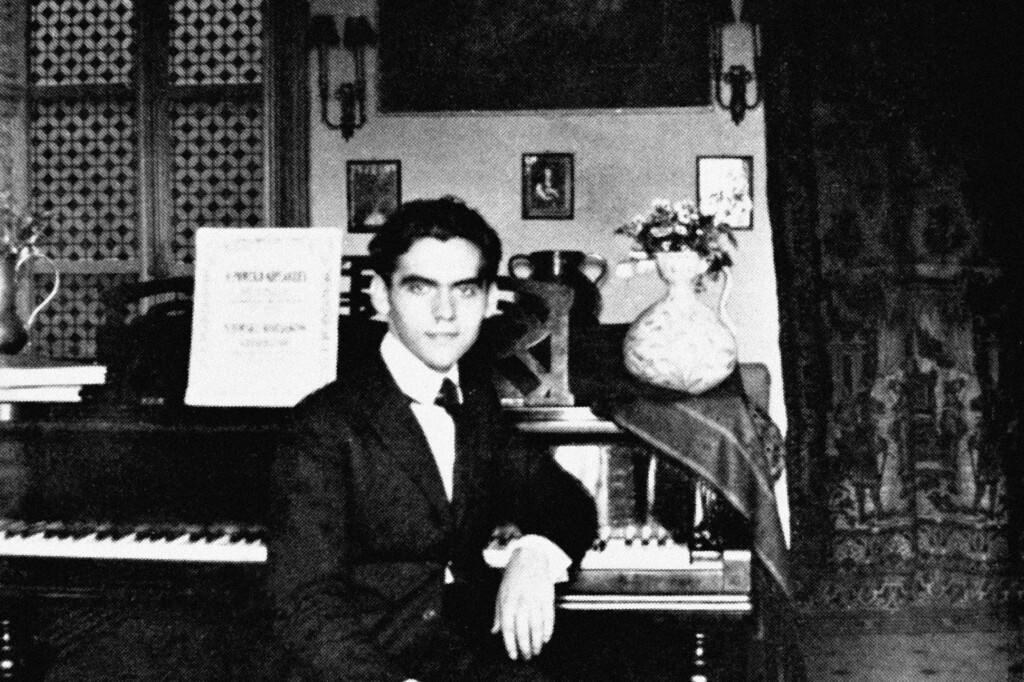
There is a courtyard you have probably never stood in, but you know it anyway — the kind of place where young men who believe they are about to change everything gather in the late afternoon, voices overlapping, someone playing guitar badly and someone else reciting worse poetry with complete conviction, and the air itself seems to crackle with the particular electricity of people who have not yet failed. Madrid in 1919 was that courtyard made into a city, and the Residencia de Estudiantes was its most combustible room.
Federico arrived there at twenty years old, carrying a suitcase and the manuscript of what would become his first published book, and what he found was not an institution so much as a fever. The Residencia had been founded in 1910 by the Institución Libre de Enseñanza as a deliberate experiment in European modernization — a place where Spanish intellectuals might breathe the air of free inquiry rather than the stale incense of a country still governed, in many of its instincts, by the sixteenth century. H.G. Wells lectured there. Albert Einstein gave a talk in 1923 that most of the young residents attended and none of them fully understood, which made it more exciting, not less. The building was austere, the gardens meticulous, and inside its corridors the future of Spanish culture was assembling itself from almost nothing, from hunger and ambition and the desperate need to matter.
Sociologist Randall Collins, in his 2004 work The Sociology of Philosophies, argues something that sounds counterintuitive until you feel it as true: intellectual movements do not emerge from ideas meeting ideas in the abstract. They emerge from bodies meeting bodies in specific rooms at specific moments, from what he calls interaction ritual chains — sequences of charged encounters that generate emotional energy, transmit it forward, and focus it into creative production. The idea alone, sitting in a drawer, dies. The idea inside a room where someone brilliant is laughing at it or stealing it or building something stranger on top of it — that idea ignites.
Federico met Salvador Dalí and Luis Buñuel in those corridors, and what happened between them was precisely this kind of ignition. Dalí was nineteen, arrogant in the way of people who are not yet sure their arrogance is justified, painting with a ferocity that suggested he was settling a private score with the entire history of Western art. Buñuel was physically enormous, sardonic, a man who seemed to view sentiment as a kind of weakness and yet was drawn, helplessly, to the person in any room who contained the most of it. Federico was that person. He sang. He played piano with a looseness that professional musicians found maddening and audiences found irresistible. He told stories that changed shape each time he told them, so that by the end you were not sure whether you had heard a poem or a joke or a confession, only that something had passed between you.
What they performed for each other was brilliance — competitive, tender, sometimes vicious. The energy Collins describes requires this ambivalence, this mixture of rivalry and desire, because pure admiration would simply confirm what you already know and pure competition would isolate you. The productive state is the unstable middle ground, where you want to destroy what the other person has made because you want to make something better, and where you also want to protect them because if they fail the whole project fails. They were young enough to live there, in that impossible middle ground, without understanding what it cost.
What it cost was the friendship itself, eventually, in ways none of them could see yet from inside the courtyard. But that reckoning belonged to later years, to a Spain that would tear itself apart faster than any of them imagined possible in those late afternoons when someone was always playing guitar badly and the air was still crackling.
Duende: The Knowledge That Cannot Be Taught
There is a moment in a flamenco performance — you may have witnessed it, or something close enough to it — when the singer’s voice does not do what voices are supposed to do. It does not soar. It cracks, buckles, drops into a register that sounds less like music than like something being torn. The audience goes very still. Not because the singer has failed, but because they have, without warning, arrived somewhere the rehearsal could never have prepared for. The throat opens and what comes out is not controlled. It is true.
Lorca called this duende. But he was ferociously careful about what the word meant, and what it did not. In his 1933 lecture delivered in Buenos Aires and Havana, he distinguished duende from the muse and from the angel — the muse who whispers formal inspiration, the angel who carries divine light — and positioned duende as something else entirely: a force that rises from the earth, that requires the proximity of death to function, that cannot be summoned by technique alone and in fact is most likely to arrive when technique breaks down. “All the arts are capable of duende,” he said, “but where it finds its greatest range is in music, dance, and spoken poetry, because these require a living body as their interpreter.” The living body, that is, as a body that will die. The presence of mortality not as subject matter, not as metaphor, but as the very atmosphere inside which real art breathes.
Georges Bataille, writing in the 1930s and gathered most forcefully in The Accursed Share and in his earlier essay “The Notion of Expenditure,” described something structurally related from a different angle: the idea that genuine experience requires the sacrifice of utility, the deliberate squandering of what could be preserved. Useful art, art that teaches or comforts or confirms, is for Bataille a form of accumulation, a hoarding of meaning. The transgressive moment — the moment that cannot be recuperated into function — is the moment that costs something real. Lorca’s duende operates on the same principle. The flamenco singer whose voice breaks at the wrong moment, precisely because it cannot be aestheticized or absorbed into prettiness, has spent something. The rupture is the expenditure. The wound is the proof.
Look at what the Romancero Gitano, published in 1928, actually does on the page. The Gypsy ballads are not charming portraits of Andalusian folk life. They are corridors into a world where the Civil Guard moves through villages like a death rite, where women’s bodies carry the marks of violence with the same matter-of-factness as moonlight, where the mythological and the historical crush together without resolution. The death of Antoñito el Camborio is not mourned — it is witnessed, which is something harder. Lorca does not console. He stands in the same room as the death and writes from inside that room.
And then New York happens. The poems written between 1929 and 1930, not published until 1940 after Lorca was already four years dead, push the duende into a register that has nothing to do with Andalusia. The city is a machine that processes human beings into abstraction, and the poet walks through it as a body that refuses abstraction, refusing to stop bleeding. “I want to sleep the sleep of apples,” he writes, “far from the tumult of cemeteries.” But there is no such sleep available. The duende does not allow it. It demands that you remain present to the dying, which in New York means the dying of everything — of nature, of dignity, of the particular human face.
What Lorca understood, and what the Buenos Aires audience in 1933 perhaps could not entirely absorb, is that you do not choose duende. It chooses the moment when your defenses are insufficient.
New York as Apocalypse
He arrived in June of 1929 with the particular hollowness of a man who has just learned that the person he loved most had chosen someone else. Emilio Aladrén, the sculptor whose face Lorca had carried like a wound for years, had announced his engagement to an English woman. The break was not clean. It never is when someone has functioned as both your desire and your self-understanding. Lorca boarded a ship for New York carrying that specific variety of devastation which feels less like grief and more like the sudden loss of the coordinates by which you had been navigating your own existence.
New York did not console him. It did something more useful and more brutal. It diagnosed.
What he found was not the city of ambition that immigrant mythology had been constructing for decades. He found a machine, an apparatus of such staggering indifference that it stripped the social performance away from every human being who moved through it. On the streets of Harlem, in the subway tunnels, in the financial corridors of Wall Street just months before the October crash that would hollow out the global economy, he saw what modernity actually looked like when it stopped pretending. The anonymity that Walter Benjamin had observed moving through the Paris arcades — that condition of being dissolved into the crowd, of becoming interchangeable, of losing the face that society requires you to maintain — had in New York reached its terminal acceleration. Benjamin, writing in the same decade, understood the crowd not as community but as the social form that capitalism had produced to replace community: a mass of individuals each encased in their private transaction, brushing against one another without contact. The man in the crowd is not alone among strangers. He is alone in the most modern sense, which is to say, alone in a structure specifically designed to make solitude feel like freedom.
Lorca walked those streets and understood something that his Andalusian formation had not prepared him to name but had somehow prepared him to feel. Marshall Berman, decades later building on Marx’s phrase, would describe modernity as precisely this condition: all that is solid melts into air, all that is sacred is profaned, and what remains is not liberation but a vertigo so constant it begins to feel like the ground itself. The skyscrapers were not monuments to human aspiration. They were monuments to the process by which human aspiration gets converted into capital and the human being left over is discarded. He watched Black workers and musicians in Harlem carrying a grief so ancient and so institutionalized that American culture had turned it into entertainment, had built an entire industry of joy on top of an unacknowledged catastrophe.
What emerged from those months is a collection of poems that has been repeatedly misread as surrealism, as personal crisis transmuted into difficult imagery, as the aesthetic experiment of a sensitive European bewildered by the New World. It is none of these things. It is one of the most radical political documents of the twentieth century, written in the only language precise enough for what it needed to say. The official vocabularies — journalistic, sociological, even conventionally political — had already been absorbed by the system they were trying to describe. Only a language that refused linear logic, that moved by rupture and collision and the nightmare’s own internal coherence, could get underneath the surface of what was actually happening. When he wrote of Wall Street as a place where geometry and anguish met, he was not being decorative. He was being exact.
The personal devastation and the historical catastrophe were not metaphors for each other. They were the same phenomenon at different scales: the individual reduced to an exchangeable unit, the interior life declared economically irrelevant, the body made to serve a structure that has no interest in whether it survives.
A vision curated by a filmmaker, not an algorithm
In this video I explain our vision
The Theatre as a Political Act

There is a woman standing at a window that looks onto a wall. Not a garden, not a street, not even an alley with some claim to movement — a wall. White, thick, absolute. She has stood there so many times that the light at different hours has become a kind of calendar, the only one available to her. This is not a metaphor Lorca constructed. It is the architecture of a specific social reality, and he understood it with the precision of someone who had lived adjacent to it his whole life, watching the women of Andalusia navigate a world that offered them enclosure as if it were protection.
His three great tragedies form a sustained argument disguised as fate. In the first, a bride flees her wedding with a man she was supposed to have stopped loving, and the two men who claim her die in a ravine, leaving only women and grief. In the second, a wife whose body wants a child and whose husband refuses to give her one deteriorates not into madness but into a kind of crystalline, terrible clarity — she sees exactly what is being done to her, and the seeing offers no exit. In the third, a matriarch locks her daughters inside a house of mourning for eight years after their father’s death, policing their sexuality with a cane and a vocabulary of honour, until one daughter hangs herself and the mother’s only response is silence and the insistence that her daughter died a virgin. These are not tragedies of fate. They are autopsies of societies that manufacture death and call it destiny.
Simone de Beauvoir, writing in 1949, described how patriarchal culture confines women to immanence — the realm of repetition, maintenance, the body, the enclosed — while reserving transcendence for men, the capacity to act upon the world, to project oneself into a future one has chosen. What Lorca had already staged, fifteen years before The Second Sex, was precisely this mechanism, rendered not in philosophical prose but in the sound of a door being bolted from outside. His women are not defeated by psychology or weakness. They are defeated by architecture, by economy, by the specific gravity of social expectation, which operates as reliably as any physical law. Yerma does not fail to become a mother because something is wrong with her desire. She fails because she exists inside a structure that has already decided what her desire is permitted to mean.
What makes this more than theatrical intuition is the context in which Lorca chose to stage these questions. From 1931, the year the Spanish Republic was proclaimed, he directed La Barraca, a travelling theatre company funded by the Republican government and made up of university students. They loaded plays onto trucks — Lope de Vega, Calderón, Cervantes, the classical Spanish tradition — and drove into villages that had never seen a stage, where agricultural labourers and their families sat on the ground or stood at the edges of improvised performance spaces and watched something happen that had been reserved, until that moment, for people who lived in cities and had money. Between 1931 and 1936, La Barraca performed across Spain with a fervour that was explicitly democratic in its logic: theatre was not a luxury delivered to those already comfortable, but a language that belonged to everyone, and withholding it was a political act, which meant restoring it was equally political.
This is the context in which his tragedies must be read. When Bernarda Alba’s daughter presses her face against a wall because the window shows only another wall, Lorca was not writing about one woman’s private suffering. He was writing it for an audience that included people who had never been permitted to see their own suffering given form, and form, as he understood it, was already the beginning of refusal.
The Spain That Killed Him
There is a bureaucratic logic to how certain people are made to disappear. Not passion, not even hatred in its pure form — something colder, more procedural. A name is written on a list. An order passes through hands that will never be called to account. A car moves through the dark outside Granada on a summer night in 1936, and a man who had spent his life turning the Spanish earth into language is taken to a hillside near Víznar and shot before dawn. His body was put in the ground without a marker, without a record, without a name attached to the place. It has never been found.
Federico García Lorca was arrested on August 16, 1936, less than a month after Franco’s coup began on July 17. He was killed, in all likelihood, on August 19. The speed is worth holding. Three days between arrest and execution. The Nationalist military machine, still in its opening weeks, still improvising the architecture of its terror, nevertheless found time — found priority — in the murder of a poet. Paul Preston, whose research into the political violence of the Spanish Civil War remains among the most precise historical accounting of those years, has documented how the Nationalist terror was not chaotic but selective: it targeted schoolteachers, labor organizers, intellectuals, anyone who had given a public shape to a different Spain. Lorca was all of these things simultaneously. He was famous. He was unmistakably queer. He had made art that reached ordinary people, that brought the marginalized into the center of Spanish cultural life. Ian Gibson, whose decades of biography work on Lorca constitute the most exhaustive portrait we have, confirmed that local Nationalist commanders in Granada knew exactly who they were killing. This was not a case of mistaken identity or bureaucratic accident. The order was specific.
Hannah Arendt, writing about Adolf Eichmann in Jerusalem in 1963, gave us the concept that has never lost its disturbing utility: the banality of evil. Her argument was not that atrocity is committed by monsters but that it is administered by functionaries — men who file papers, follow chains of command, and experience themselves not as perpetrators but as employees. The horror of Lorca’s murder is not diminished by this framework. It is clarified. Someone signed something. Someone drove the car. Someone held the shovel. None of them, in all probability, lost sleep over a poet. That is precisely the point. Beauty, when it belongs to the wrong body, when it speaks to the wrong people, when it refuses the straight lines of the state, becomes a category of threat. The Nationalists understood instinctively what they could not articulate theoretically: that Lorca’s work was a form of sedition because it made the dispossessed feel real.
What followed Franco’s death in 1975 extended the logic of that night near Víznar into the democratic era. The Pacto del Olvido — the Pact of Forgetting — was the informal agreement between Spain’s transitional political forces to leave the crimes of the Franco regime unexamined, to trade justice for stability. It was presented as pragmatism. It functioned as a second erasure. The unmarked grave was not merely a physical fact but a political structure maintained across decades. Spain did not begin serious legislative attempts to address the mass graves of the Civil War until the Law of Historical Memory in 2007, more than seventy years after the killings began. Lorca’s family, for their own complicated reasons, resisted excavation of the site where he may lie. The ground has remained closed.
What the Nationalists understood, and what the Pact of Forgetting preserved as institutional knowledge, is that the body without a name cannot speak. The work survives. The man who made it was reduced to an administrative erasure, a blank in the earth outside a city that still carries both his name and his silence.
What Survives the Unmarked Grave
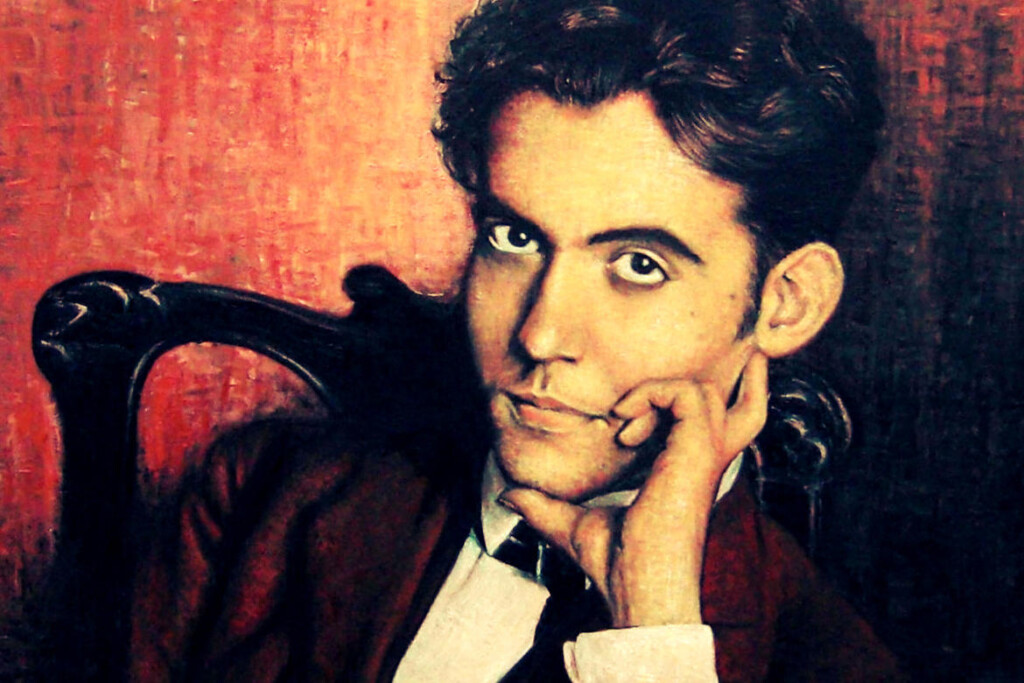
You are holding a page in a language you only half-know, and something in the third line breaks open in your chest before your mind has caught up with the translation. You don’t know exactly what the words mean. You know what they do. That gap — between understanding and being struck — is where a certain kind of survival lives, and it is not clean, and it is not comforting, and it has very little to do with the intentions of the man who wrote the lines or the state that erased him.
Lorca’s work exists in dozens of languages. His plays are performed in cities whose names he never spoke. His poems are memorized by people who could not find Granada on a map, who have no idea what a Civil Guard was, who have never tasted the particular silence of an Andalusian August. The Blood Wedding staged in Tokyo. The Gypsy Ballads translated into Arabic, into Japanese, into Polish, into Swahili. Duende as a concept imported into jazz criticism, into flamenco scholarship, into MFA workshops in American universities where the windows look out onto parking lots. This is survival, yes. But it is worth asking what kind.
Jacques Derrida, in his 1993 Specters of Marx, introduced what he called hauntology — a concept that lives inside a pun in French, hantologie sounding like ontologie, haunting folded into being itself. His argument was not that the dead return as ghosts, which is a comfortable metaphor that lets the living maintain a safe ontological distance. His argument was more disturbing: that the dead return as structural absences, as the shape of what is missing, as the pressure of an empty space that organizes everything around it. You feel the presence not of the ghost but of the hole the ghost left. And the hole is generative. The hole produces meaning. The hole is, in some sense, more powerful than any presence could be.
Lorca’s body was never recovered. The site near Viznar where he is believed to have been shot in August 1936 has been excavated multiple times, most recently in efforts following Spain’s 2007 Law of Historical Memory, and his remains have not been found. There is no grave to visit. There is no stone. There is a place where the ground holds nothing that can be confirmed, and around that nothing, an entire mythological architecture has been constructed — the martyred poet, the voice silenced by fascism, the queer saint of Spanish letters. The mythology is real. The absence at its center is also real. What Derrida understood is that these two things are not in contradiction. The mythology is built from the absence, not despite it.
This is what you are holding when you hold that page in a language you barely understand. You are holding the output of a structural hole. The poems traveled because their author could not. The work moved through the world precisely because the man was stopped, precisely because the unmarked ground near Granada refused to give him back. There is something deeply uncomfortable in recognizing that the destruction and the survival are not separate events but aspects of the same event. That the regime which shot him also, in some grotesque and unintended way, made him permanent. Martyrdom does to a poet what publication rarely can.
But this is also where the question becomes genuinely unanswerable. When a culture absorbs the mythology of someone it destroyed — teaches his poems in schools, names streets for him, celebrates his genius — it must be asked whether that constitutes reckoning or whether it constitutes a more sophisticated form of erasure. Whether honoring the wound is the same as healing it, or whether it is simply a way of aestheticizing the knife, of making the violence beautiful enough to live with, of turning an unmarked grave into a monument so that no one has to think too hard about who held the gun.
🌹 Voices of the Iberian Soul and Avant-Garde Spirit
Federico García Lorca stands at the crossroads of poetry, theatre, and surrealist imagination, drawing from the deepest wells of Spanish culture and tragedy. His work resonates across literature, the visual arts, and the theatre of the body — connecting him to a constellation of creative rebels who defied convention. Explore these related paths to deepen your understanding of the world Lorca inhabited and transformed.
Lope de Vega: Life and Works
Lope de Vega was the towering giant of Spanish Golden Age theatre, whose prolific output shaped the dramatic tradition that Lorca would later inherit and subvert. Understanding Lope’s popular, passion-driven theatre helps illuminate how Lorca fused folkloric energy with poetic tragedy. Their shared roots in Andalusian and Castilian soil make this connection both historical and deeply emotional.
GO TO THE SELECTION: Lope de Vega: Life and Works
Antonin Artaud’s Theater of Cruelty
Antonin Artaud‘s Theater of Cruelty, with its rejection of literary convention and its demand for a visceral, physical stage experience, shares a profound kinship with Lorca’s theatrical vision. Both sought to make the audience feel rather than simply understand, treating the stage as a space of ritual and transformation. Reading Artaud alongside Lorca reveals the international avant-garde current that united rebellious theatre-makers across borders.
GO TO THE SELECTION: Antonin Artaud’s Theater of Cruelty
The Spanish Golden Age: Literature and Culture
The Spanish Golden Age provided the cultural and linguistic foundation upon which Lorca built his own radical poetics, drawing from its rich literary heritage while shattering its conventions. The tensions between tradition and transgression that defined this era are deeply embedded in Lorca’s tragedies and verse. Exploring this period illuminates the historical depth behind Lorca’s seemingly timeless imagery.
GO TO THE SELECTION: The Spanish Golden Age: Literature and Culture
Stream of Consciousness in Literature and Cinema
Stream of consciousness as a literary and cinematic technique shares surprising resonances with Lorca’s surrealist poetry and his dreamlike play ‘If Five Years Pass,’ where time dissolves and the subconscious takes center stage. The fragmented, flowing interior voice that defines this movement mirrors Lorca’s refusal to separate waking reality from dream and desire. This connection places Lorca firmly within the broader modernist revolution in language and perception.
GO TO THE SELECTION: Stream of Consciousness in Literature and Cinema
Discover the Poets and Rebels of Independent Cinema
If Lorca’s visionary spirit moves you, Indiecinema streaming is the place to continue the journey — where independent films explore the same raw poetry, cultural memory, and human passion that defined his life and work. From avant-garde masterpieces to intimate explorations of identity and tragedy, the catalog awaits those who dare to look deeper.
👉 EXPLORE THE CATALOG: Watch Indie Films in Streaming
A vision curated by a filmmaker, not an algorithm
In this video I explain our vision

