The Hand That Commands Stone
You are standing too close. You know you should step back, find the proper distance that museums and art history textbooks have always prescribed, that measured remove which transforms an object into a concept and allows you to think clearly about what you are seeing. But you cannot move. The marble in front of you is doing something that marble has no right to do. It is exhaling. A woman’s fingers are dissolving into bark, her nails splitting as wood grain swallows them from below, her face tilted upward in an expression that refuses to choose between terror and surrender. The stone is mid-transformation, mid-scream, and you feel with absolute certainty that if you touched it, it would be warm.

This is not what sculpture is supposed to do. Sculpture is supposed to be still.
Gian Lorenzo Bernini understood stillness as the enemy. Born in Naples in 1598 and dead in Rome in 1680, he worked across eight papal reigns and outlasted nearly every contemporary who might have challenged his dominance of the Roman visual world. By the time he was twenty-three, he had already produced work that made older masters look like they had been practicing a different art entirely. Apollo and Daphne, completed around 1625, does not depict transformation. It detonates it. The god’s fingers graze flesh that is already becoming something else, and the mythology that should make the scene safe, should keep it at the comfortable distance of allegory, collapses entirely. You are not watching a story. You are interrupting one.
The philosopher Maurice Merleau-Ponty argued in his 1945 Phenomenology of Perception that the body knows the world before the mind does, that perception is always already a physical event, never a purely cognitive one. Standing before Bernini, this stops being a philosophical proposition and becomes something embarrassingly immediate. Your discomfort is not aesthetic. It is somatic. The work reaches past your training, past your vocabulary, and touches something that learned to read movement and urgency before it learned to read marble.
But this is precisely where the provocation begins, because genius of this magnitude never arrives clean. It arrives encrusted with the systems that made it possible and the systems that immediately put it to work. Cardinal Scipione Borghese commissioned Apollo and Daphne as a private pleasure, a spectacular object for a man who collected beautiful things the way other men collected debts. The Church that would later commission the Ecstasy of Saint Teresa was not interested in mystical experience for its own sake. It was interested in the Counter-Reformation’s project of making faith physically overwhelming, of using sensation to outmaneuver Protestant skepticism. Bernini was not separate from these systems. He was their most gifted instrument.
This does not diminish the work. It makes the work more honest, more interesting, more dangerous. Art produced entirely outside power is a fantasy that mainly comforts people who have never had to negotiate with power. Bernini negotiated constantly, and the negotiation left marks everywhere if you know where to look. The Ecstasy of Saint Teresa, unveiled in 1652 in the Cornaro Chapel, places a mystic’s transport on full theatrical display, framed by sculpted spectators watching from marble opera boxes, stage-lit by a hidden window that floods the scene with actual Roman sunlight. It is simultaneously the most sincere representation of divine experience in the Western tradition and one of the most elaborate pieces of institutional theater ever constructed. Both things are entirely true.
What Bernini understood, perhaps more viscerally than any artist before or since, was that the body is not a vessel for meaning. It is the meaning. And that the most radical thing you can do with stone is make it prove this, make it demonstrate the fact so forcefully that the viewer’s own body responds before they have decided whether or not to believe it.
Naples, 1598: A Child Born Into the Trade
You are seven years old and your father’s hands are already inside your hands. Not metaphorically — literally. He corrects your grip on the chisel before you have even decided to pick it up. The stone dust is on your clothes before you have chosen to wear them. In the Neapolitan workshop of Pietro Bernini, somewhere between 1598 and the early years of the new century, a child is learning that his gift belongs to someone else first.
Pietro was no minor craftsman. He was a sculptor of real accomplishment, trained in Florence, steeped in the Mannerist tradition, capable of producing marble work of genuine refinement. He knew exactly what he had fathered. And Pierre Bourdieu, writing nearly four centuries later in his 1979 study of distinction and social reproduction, would have recognized the mechanism immediately: cultural capital does not merely pass between generations like an inheritance in a will. It is actively installed, pressed into the body, rehearsed in the muscles long before it becomes conscious. What looks like natural talent is almost always embodied history. What reads as a prodigy is almost always a project.
The boy carved. He carved with a facility that stunned visitors to the workshop, and those visitors were not random passers-by. Pietro knew how to arrange an audience. He understood that a gifted child, displayed in the right moment before the right eyes, was a form of currency. This is not a cynical reading — it is a structural one. The Neapolitan craft world of the late sixteenth century was a network of patronage and obligation, and a father who positioned his son well was not betraying the son but investing in the only futures available. That the son happened to be extraordinary did not change the logic. It only raised the stakes.
When the family moved to Rome around 1606, Gian Lorenzo was approximately eight years old. Rome was not chosen arbitrarily. Pietro had received commissions there, and the city was the singular gravitational center of Catholic artistic ambition in Europe, a construction site of symbolic power that had been expanding since the Counter-Reformation had turned sacred art into theological argument. To arrive in Rome as a sculptor in the early seventeenth century was to enter a theater where the grandest roles were still being written. Pietro understood this. He brought his son like a card he intended to play.
The card was played before Cardinal Scipione Borghese, the nephew of Pope Paul V and one of the most voracious collectors and patrons of his era. Scipione did not simply admire young Gian Lorenzo. He absorbed him into a system of production and display that would define the next decade of the boy’s life. The early commissions — works executed while Bernini was still in his teens, including mythological sculptures of a technical virtuosity that experienced masters could not match — emerged from this relationship. They were not expressions of free creative will. They were demonstrations, produced for a specific collector, in a specific ideological and aesthetic context, for purposes that were simultaneously aesthetic, political, and devotional.
The sociologist Howard Becker, in his 1982 work on art worlds, argued that no artwork is ever the product of a solitary genius — it is always the output of a cooperative network, a web of conventions, resources, and relationships that make the work possible and give it meaning. Bernini at twelve, at fourteen, at sixteen, was already embedded in precisely such a network, one that stretched from his father’s correcting hand to Scipione’s hungry collecting eye to the papal court’s need for a new sculptural language capable of overwhelming the Protestant challenge to Roman authority.
What is most unsettling is not that Bernini was used. It is that he thrived inside being used, that the container shaped the thing contained so perfectly that the two became indistinguishable.

The Borghese Marbles and the Invention of the Instant
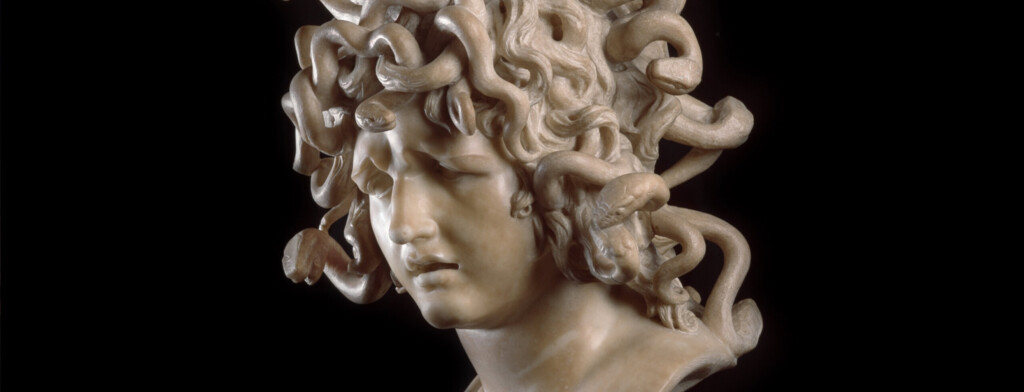
You have pressed your thumb into the bark of a tree and felt nothing give. That is the scandal Bernini committed against marble — he made you expect it to yield.
Between 1618 and 1625, working almost continuously for Cardinal Scipione Borghese, he produced four sculptures that together constitute something closer to a philosophical argument than a decorative program. The first, Aeneas carrying his father Anchises from burning Troy while the child Ascanius walks beside him, already announces the obsession: three bodies, three generations, three different qualities of flesh rendered in a single material. The old man’s skin sags. The boy’s is still unformed. The warrior’s is taut with effort. Marble does not have pores or elasticity or the memory of decades. Bernini made it remember.
But it is with the later three that the argument becomes undeniable. A god’s hand sinks into a woman’s hip, and the hip is already ceasing to be a hip — the fingers pressing into Proserpina’s thigh leave visible indentations, the skin depressing under divine force as though the stone were warmed flesh caught in a moment of violation. She weeps actual tears. He is already certain of his victory and already wrong, because the transformation underway is not hers alone. The myth is consuming itself in the act of being depicted.
Henri Bergson, writing in his 1889 doctoral thesis “Time and Free Will,” argued that conventional science and philosophy had committed a fundamental error: they treated time as a series of discrete spatial points, a line of frozen instants, when in reality time is experienced as continuous flow, what he called durée — duration as lived from inside. You cannot cut duration into moments without destroying what duration actually is. The instant is a fiction of measurement. Real time is pure becoming, perpetual transition, the state of always being between what was and what will be.
Bernini sculpted this impossibility. Not the before. Not the after. The irreducible between.
Look at what happens to Daphne. Her toes have already become roots burrowing into ground that the sculptor never needed to show, because you feel the earth pulling at her. Her fingers are extending into laurel branches, the tips already leafing. Her skin along the left side is beginning its bark, the texture changing mid-body in a single continuous surface. Apollo’s expression has not yet registered what his hand is about to discover — that what he reaches for is no longer reachable. He is in the last fraction of a second before comprehension, and she is in the first fraction of a second after escape, and these two different temporal positions exist simultaneously in the same stone. This is not a contradiction Bernini failed to resolve. It is the contradiction he set out to inhabit.
The David is perhaps the most extreme enactment of this philosophy. He is not preparing to throw. He is not having thrown. He is in the throw itself, the body torqued into that specific configuration that exists only during the act, that would be impossible to maintain for even a second longer without the stone continuing its arc. His face is clenched in effort that is already passing. The whole figure is the durée of a single gesture, the inside of an action that measurement would have to kill in order to describe.
Gilles Deleuze, building on Bergson in “Bergsonism” published in 1966, described becoming as a state that resists reduction to any fixed identity — it is neither A nor B but the movement between them, a movement that has its own irreducible reality. Bernini found this before the vocabulary existed. He did not depict transformation. He deposited transformation inside stone and sealed it there, and the stone has been vibrating with it for four centuries.
What you see when you stand in the Galleria Borghese is time made insoluble.
The Pope’s Architect, God’s Propagandist
You stand beneath it and your neck tilts back involuntarily, the way the body surrenders before the mind decides to. The bronze canopy rises twenty-nine meters above the papal altar, each of its four twisted columns spiraling upward with a confidence that feels almost biological, like something that grew rather than was built. The gilded bees worked into the base — hundreds of them, if you count — belong to the Barberini family crest. They are not decoration. They are a signature, a territorial mark pressed into sacred bronze, and once you see them you cannot unsee what the entire structure actually is: a monument to the man who paid for it disguised as a monument to God.
Maffeo Barberini became Urban VIII in 1623, and within weeks Gian Lorenzo Bernini had become something more precise than a court artist. He had become an instrument. The distinction matters enormously, and Hannah Arendt‘s thinking on the relationship between fabrication and power illuminates it with uncomfortable clarity. In “The Human Condition” (1958), Arendt distinguishes between action, which belongs to the political realm of free agents, and fabrication, which involves the production of objects according to a pre-existing model held in the mind of a superior. The artist who works for power is not acting. He is fabricating. He is executing a vision whose ultimate authorship belongs to the commissioner, whatever signature appears on the work. Bernini understood this arrangement perfectly and never complained about it publicly, which is itself a form of sophisticated intelligence.
The baldachin consumed eighty-five thousand kilograms of bronze, much of it stripped from the Pantheon’s portico on Urban’s orders — an act of such brazen spoliation that a Roman pasquinade accused Barberini of doing what the barbarians had not dared. But the scandal was absorbed, the way scandals always are when the result is magnificent enough. Magnificence is the oldest political silencer. When you produce something overwhelming enough, the question of how it was paid for, and at whose expense, quietly dissolves into admiration.
Bernini would wait through a difficult period after Urban’s death in 1644, navigating the hostility of Innocent X, who preferred other hands. But when Alexander VII arrived in 1655, the machine restarted. The colonnade of St. Peter’s Square, begun in 1656, is the most theatrical piece of urban planning in Western history, and it was designed with explicit political intention. Alexander wanted pilgrims approaching Rome to feel embraced — the arms of the Church reaching out, as Bernini described it, to receive Catholics, confirm heretics, illuminate infidels. The theological program was stated openly, without embarrassment. This was not art in service of a vague spiritual impulse. This was architecture as conversion technology, as crowd psychology deployed at urban scale.
What makes Bernini’s position so philosophically charged is precisely that he was not a propagandist in the diminished modern sense — a hack producing approved messages. He was a genuine visionary whose vision happened to be perfectly aligned with institutional necessity. The sociologist Pierre Bourdieu would call this the most efficient form of symbolic power: not coercion, but the consecration of existing hierarchies through beauty so persuasive that the hierarchy seems natural, inevitable, ordained. When the colonnade wraps around you and you feel small in a way that also feels correct, that feeling has been engineered. It was engineered by a man of extraordinary talent who never experienced its engineering as a compromise, because the Church’s cosmology was also his own.
This is not cynicism about Bernini. It is something more unsettling than cynicism. He believed. The genius and the institution were genuinely fused, which is precisely why the result is not propaganda in the way we recognize propaganda — cheap, coercive, transparent — but something far more durable. Something that still works on you, four centuries later, whether you believe any of it or not.
The Ecstasy and the Performance of the Sacred
There is a moment when you stand inside Santa Maria della Vittoria in Rome and realize you are not alone in looking. Stone figures lean forward from the side walls in carved theater boxes — men in various states of attention, some engaged, some distracted, one almost bored — and they are all watching a woman suspended in the air, her body collapsed in something that refuses to be named cleanly as pain or pleasure or prayer. The room is watching her. You are watching the room watching her. And somewhere above, hidden behind a cornice you cannot see, natural light pours in from a concealed window and falls on her body like a spotlight, like something arranged.
Bernini spent five years on this chapel, from 1647 to 1652, and what he built was not an artwork in any prior sense. It was a total environment — architecture, sculpture, painting, theater, and theology fused into a single experience that precedes the viewer’s conscious interpretation. The Cornaro family, who commissioned it, are present in effigy, watching from their boxes as an audience watches a stage. The angel who descends toward Teresa holds a golden arrow and wears an expression of almost disturbing tenderness. Teresa herself is unmistakably in a state of bodily transport, her habit falling open, her foot dangling loose, her face turned upward with closed eyes and parted lips. The question of whether this is mystical union or erotic sensation was scandalous when it was new and has never been fully settled. But the more unsettling question is structural rather than moral: Bernini did not invent this vision. Teresa of Ávila described it in her own words in the Libro de la vida, written in the 1560s, nearly a century before the marble existed. He sculpted someone else’s encounter with something he had never experienced himself. He rendered the interior into stone from the outside.
Guy Debord published La Société du spectacle in 1967, three centuries after Bernini completed the chapel, and argued that modern life had become a vast accumulation of spectacles — that lived experience had been systematically replaced by its representation, that what we consume is always the image of living rather than living itself. The diagnosis was meant to describe capitalism and mass media. But standing in the Cornaro Chapel, you cannot avoid the recognition that Bernini had already understood this at a structural level and made peace with it — or more accurately, had turned it into a theological proposition. The spectacle here is not a distortion of sacred experience. It is the mechanism through which sacred experience becomes transmissible, shared, repeatable. It exists so that you can have something like what Teresa had, without having it yourself.
This is either the most honest thing art can do, or the most cynical, and the chapel refuses to tell you which. The hidden light source is not a deception — it is an admission that transcendence requires staging. The audience in their boxes is not voyeuristic — it is a mirror of what you are doing the moment you enter. Bernini did not simulate a mystical experience for profit or propaganda, though the Counter-Reformation certainly extracted political value from it. He solved a genuine problem: how do you make the invisible convincing? His answer was to make everything else visible — the architecture, the witnesses, the light’s direction, the body’s surrender — and leave the invisible as the only remaining explanation.
Teresa wrote that the pain of the arrow was so sweet she wished it would never end. She was trying to describe something that had happened inside her. Bernini made the description into marble, which means he made it into something that does not end and cannot be questioned. What he could not do — what no material can do — is confirm that the original experience was real.
A vision curated by a filmmaker, not an algorithm
In this video I explain our vision
The Paris Failure and What Rome Could Not Forgive
He arrived in Paris in June of 1665 the way a sovereign arrives in a foreign capital — carried in a royal litter, greeted by crowds, installed in a residence fit for a visiting head of state. Louis XIV received him with gestures of almost theatrical deference, placing his own hat on Bernini’s head in a display of honor so calculated it bordered on ceremony. He was sixty-six years old, the most celebrated artist alive in Europe, and he had been summoned across the Alps to redesign the eastern facade of the Louvre, to give France a palace worthy of the Sun King’s self-conception. What happened in the months that followed is one of the most instructive disasters in the history of art.
Paul Fréart de Chantelou, the courtier assigned to accompany Bernini throughout his stay, kept a diary of the visit that reads today like a slow-motion collision between two entirely different civilizations of the eye. Chantelou recorded Bernini’s pronouncements, his impatience, his contempt poorly disguised as generosity, and the mounting resistance from French architects and administrators who found his proposals not magnificent but monstrous. Bernini submitted three successive designs for the Louvre facade. Each one was rejected. He returned to Rome in October, laden with honors, a portrait commission from the king, a pension promised for his son — and nothing built. Not a single stone of his vision would ever be laid.
What the official accounts called a diplomatic success was, in every architectural sense, a defeat. The French court had wanted the prestige of Bernini’s name without the reality of his imagination. They wanted a signature, not a building. And Bernini, who had spent his entire life in Rome where the patron’s will and the artist’s vision had always negotiated a workable marriage, could not read the difference.
The collision was not merely personal. It was structural. France in 1665 was in the process of constructing a very specific idea of itself — rational, ordered, measured, suspicious of excess. René Descartes had published his Discourse on the Method in 1637, and his influence on French intellectual culture had by mid-century become something close to atmospheric. The aesthetic that would eventually be codified under Colbert’s academies demanded clarity, proportion, legibility. Bernini’s designs, with their curved colonnades, their dramatic masses, their refusal to submit to the flat assertion of a facade, belonged to a world the French were actively trying to supersede. They did not reject him because he was insufficiently talented. They rejected him because he was too completely himself.
Norbert Elias, in his study of court society published in 1969, described how the French absolutist court operated as a machine for the production of a specific kind of human being — disciplined, self-monitoring, subordinate to the sovereign’s aesthetic as much as to his political will. In that machine, Bernini was not a genius to be accommodated. He was a disturbance to be managed. His Roman theatricality, his insistence on emotion as architectural material, his belief that a building should reach toward you the way a gesture does — all of this read in Paris not as greatness but as excess, which in the Cartesian vocabulary of the French court was another word for disorder.
There is something almost unbearable in the image of him in those Parisian rooms, explaining his drawings to men who had already decided against them. He had spent forty years reshaping Rome into his own image. He had built the canopy over the tomb of Saint Peter, had carved figures that seemed to breathe, had designed piazzas that held crowds the way arms hold a body. And here, in a city that had summoned him precisely because of all that, he was being politely, systematically, irrevocably ignored. The pension arrived. The flattery was impeccable. The foundation remained unbroken ground.
Rivalry, Collapse, and the Crack in the Bell Tower
The bell tower began to crack in 1641, and for years nobody wanted to say it aloud. The fissures spread quietly through the travertine of the new northern campanile at Saint Peter’s, that monument Bernini had proposed with such confidence, that he had sold to Urban VIII as the final crowning of the greatest church in Christendom. When Urban died in 1644 and Giovan Battista Pamphilj ascended as Innocent X, the silence around those cracks broke all at once and loudly, like the structure itself seemed about to do. Enemies Bernini had accumulated over decades — and there were many, because talent accumulates enemies the way skin accumulates scar tissue — stepped forward with reports, testimonies, architectural opinions. The tower had to be demolished. The foundation, they said, was inadequate for the weight. The marsh beneath the Vatican could not hold what Bernini had placed upon it. The commission that had celebrated him became the instrument of his public destruction.
This is what institutional collapse looks like from the inside. Not a dramatic confrontation but a slow withdrawal of warmth. Rooms that used to open now require waiting. Names that used to carry you forward now produce a pause, a faint hesitation in the eyes of the man across the table. Borromini, who had worked under Bernini for years in a subordination that corroded him visibly, now found his moment. The geometry of Roman patronage had shifted, and Borromini moved through that shift with the precision of someone who had been rehearsing for it his entire professional life. His church of Sant’Ivo alla Sapienza, completed in 1660, is everything Bernini’s architecture is not — restless, interior, almost anguished in its spiral, a form that seems to argue with itself. Where Bernini performed certainty, Borromini excavated doubt. That two such men occupied the same city, the same institutional world, the same moment in history, is one of those improbabilities that history produces without apology.
Nassim Nicholas Taleb, in his 2012 work Antifragile, distinguishes between systems that merely survive disorder and systems that require it — that grow stronger not despite stress but through it. But Taleb is careful, or should be, about romanticizing this property. Antifragility is not resilience with better marketing. The cost is real. The fractures are real. Bernini in the late 1640s lost commissions, lost the confidence of the new papacy, lost the symbolic position he had occupied so completely under Urban that the two men had become almost a single entity of will and stone. He was not replaced by Borromini in any clean narrative sense. He was simply made to wait, which for a man constituted entirely by production and visibility is its own particular form of erasure.
What he did during that waiting is telling. He returned to painting, which he had always practiced privately, and to theater, and to the small devotional sculptures that require no institutional approval. He made himself useful in registers that could not be taken from him. And he watched Borromini’s angular brilliance receive the attention that had been his, without — as far as the historical record suggests — destroying himself in bitterness. Perhaps because he understood something about the difference between a setback and an ending, a distinction that only becomes visible from inside the worst years of one’s working life.
The crack in the bell tower was real. It was not metaphor. The demolition of his campanile in 1646 was a public humiliation of a scale difficult to overstate in a city where architecture was political speech and the Vatican’s skyline was its loudest sentence. That Bernini survived it, and more than survived, tells you nothing reassuring about justice or merit. It tells you only that some people are built, or build themselves, to remain in the game long enough for the game to change again.
Old Age, the Blood of Christ, and the Unfinished Self
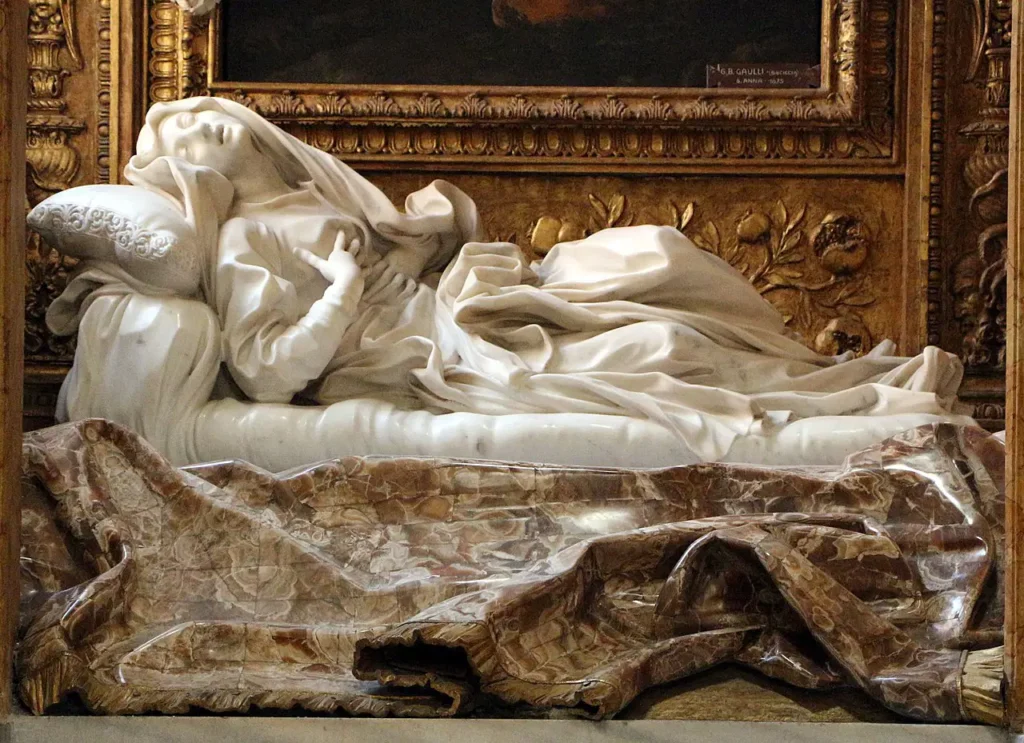
There is a moment, late in a life spent commanding marble, when the hand begins to tremble and the vision does not. Bernini in his final decade was that contradiction made flesh — a man whose interior world had never been richer, whose theological imagination had never pressed harder against the limits of what stone could say, and whose body was slowly, irreversibly withdrawing its cooperation. He worked anyway. Not out of stubbornness, though he had always possessed that in abundance, but because for him the cessation of work would have been the real death, the one that mattered.
His friendship with Christina of Sweden in those years was one of the stranger gifts his old age produced. The former queen, who had abdicated her throne in 1654, converted to Catholicism, and descended on Rome like an intellectual storm, found in Bernini something rare — a man who did not need to perform his faith for her approval, because his faith was not performance. She was electric, iconoclastic, fiercely curious, and she recognized in him a quality that the court sycophants around him could not name: that his piety and his ambition had always been the same thing, drawing from the same root. He had never made the distinction that polite religion requires, between the devotional and the desirous. For Bernini, wanting to glorify God and wanting to be the greatest sculptor who ever lived were not competing drives. They were one drive, and he had followed it without apology for eighty years.
The late devotional works carry a different weight than the theatrical triumphs of his middle period. There is less showmanship in them, though no less intensity. He worked on a Salvator Mundi in those final years, a figure of Christ in which the face holds something that the Ecstasy of Saint Teresa did not quite permit — a quietness, a looking directly back. The blood of Christ was on his mind constantly. He received communion daily. He told those close to him that he was afraid not of death but of dying badly, of arriving unprepared. This was not the fear of a hypocrite. It was the terror of a man who had spent his entire life caring about quality, and who understood that the final work, the one you could not revise, was the act of dying itself.
He suffered a stroke in the autumn of 1680 and died on November 28th of that year, eighty-one years old, having outlived enemies, patrons, rivals, and most of the century that had made him. The chisel had been in his hand, metaphorically if not literally, until nearly the end. He left behind a Rome that was in significant measure his invention — the piazza, the baldachin, the fountains, the angels lining the bridge to Castel Sant’Angelo, those strange hovering figures that seem to belong to neither air nor stone but to some intermediate substance he alone knew how to summon.
What remains after a life like his is the question that his biography cannot answer. The stone does outlast the hand. The colonnade still stands, still performs its embrace, still pulls tourists and pilgrims alike into its curving arms. But whether that permanence is consolation or something stranger — whether the survival of the work is a form of victory over time or simply evidence of how completely time swallows the person while leaving the object untouched — Bernini himself could not have told you, and neither can the marble. It holds its shape with perfect indifference, which is either the nature of great art or the nature of everything that has never been alive, and sometimes it is genuinely impossible to tell the difference.
🏛️ Baroque Art, Sculpture, and the Italian Masters
Gian Lorenzo Bernini stands as the supreme architect of the Baroque age, a sculptor and visionary who transformed Rome into a theater of divine drama. To truly understand his genius, it helps to explore the broader artistic and historical currents that shaped his world — from the Renaissance masters who came before him to the sculptural traditions that gave his work its extraordinary depth.
Titian: Life and Works
Titian was one of the towering figures of the Italian Renaissance whose mastery of color and sensuality set the tone for generations of Baroque artists, including Bernini. His ability to render flesh, fabric, and divine light with unparalleled painterly richness created a visual language that deeply influenced the emotional intensity Bernini would later achieve in marble. Exploring Titian’s life and works offers an essential foundation for understanding the aesthetic ambitions of the Baroque era.
GO TO THE SELECTION: Titian: Life and Works
Medieval Sculpture: History and Iconography
Medieval sculpture laid the groundwork for centuries of sacred artistic expression in Europe, developing iconographic traditions that Bernini would later push to their most theatrical and emotionally charged extremes. From the stylized saints of Romanesque portals to the increasingly naturalistic figures of Gothic workshops, sculptors gradually discovered how to make stone speak. This journey through the history of sculptural iconography illuminates how deeply Bernini was both heir to and revolutionary transformer of that long tradition.
GO TO THE SELECTION: Medieval Sculpture: History and Iconography
Memento Mori: History and Meaning
The Memento Mori tradition — art’s meditation on mortality and the transience of earthly life — runs as a quiet undercurrent through much of Bernini’s work, from funerary monuments to his profound late sculptures. Understanding this symbolic language helps decode the spiritual urgency that Bernini injected into marble and bronze, giving his figures their sense of suspended breath and imminent transcendence. This article traces the history and meaning of one of Western art’s most enduring and haunting themes.
GO TO THE SELECTION: Memento Mori: History and Meaning
Vanitas in Art: Symbolism and Meaning
Vanitas imagery, with its skulls, hourglasses, and wilting flowers, permeated the Baroque artistic world in which Bernini flourished, reflecting a culture obsessed with the tension between earthly beauty and divine eternity. Bernini himself engaged deeply with these themes, most famously in his tomb sculptures and his use of allegory to dramatize the soul’s passage beyond time. Exploring the symbolism and meaning of Vanitas in art provides a rich context for appreciating the theological depth embedded in Bernini’s greatest masterpieces.
GO TO THE SELECTION: Vanitas in Art: Symbolism and Meaning
Discover Great Cinema on Indiecinema
If the grandeur of Bernini’s vision — art as a total, immersive, and spiritually transformative experience — resonates with you, then independent cinema might be your next great journey. On Indiecinema streaming you’ll find films that share that same ambition: works that challenge, move, and illuminate the human condition with uncompromising creative courage. Explore our catalog and let yourself be surprised.
👉 EXPLORE THE CATALOG: Watch Indie Films in Streaming
A vision curated by a filmmaker, not an algorithm
In this video I explain our vision