
The Weight of Sicily
You are standing in a Sicilian piazza in 1950, and the heat is not weather — it is argument. The stones beneath your feet were laid by hands that knew better than to ask who ordered them laid, and the silence around you is not absence but architecture, a structure as deliberate and load-bearing as any cathedral. The old men near the fountain are not resting. They are watching. The woman who crosses the square without looking up is not modest. She is fluent in a language you were never taught, one that runs entirely beneath speech, that communicates through calibrated invisibility. You do not understand what is being said around you, and that is precisely the point. Sicily did not develop omertà as a pathology. It developed it as a rational response to five centuries of foreign domination — Arab, Norman, Aragonese, Bourbon — each successive power having demonstrated, with sufficient brutality, that speaking was the fastest way to disappear.

Leonardo Sciascia was born into this grammar on January 8, 1921, in Racalmuto, a sulfur-mining town in the province of Agrigento whose name derives from the Arabic rahal-mawt, the hamlet of death. The etymology is not incidental. It sits in the man’s biography like a root system, feeding everything that grew above it. Racalmuto was not a picturesque village of the kind that tourism would later invent for the island’s consumption. It was a working extraction site, its economy built on the labor of men who descended into the earth each morning unsure of returning, its social order reinforced by the mine owners’ interests, the landowners’ silence, and the church’s carefully calibrated ambiguity on the subject of justice. Sciascia grew up watching a landscape in which power was never where it claimed to be, in which institutions spoke one language publicly and administered another privately, and in which the gap between official reality and lived reality was so constant and so wide that navigating it became the basic cognitive skill of survival.
This is what geography does when it has been sufficiently politicized: it becomes epistemology. The Sicilian interior, with its treeless hills and its towns sealed against the horizon, taught Sciascia not a romantic regionalism but a structural skepticism. He would later write, in Le parrocchie di Regalpetra, published in 1956 under a fictional place name that fooled no one familiar with Racalmuto’s dimensions, about a world where the elementary school teacher — which he himself had become — occupied a position of almost absurd delicacy, caught between the state’s optimistic curricula and the children’s inheritance of total institutional distrust. The book was not nostalgia. It was forensics.
What made Sciascia irreducible to the category of regional writer, the comfortable box into which Italian literary culture would periodically attempt to seal him, was that he understood Sicily not as exception but as laboratory. The island’s relationship to power — its layers of conquest, its administrative cynicism, its judicial theater — was not a southern peculiarity lagging behind northern modernity. It was a compressed and clarified version of something universal, a place where the mechanisms that elsewhere operated with enough ambient noise to pass unnoticed ran in a silence so total you could hear every gear. Gramsci had already theorized the south as a structural problem of the Italian state rather than a cultural failure of its inhabitants, but Sciascia went further and quieter: he located in the Sicilian condition a kind of terrible lucidity, the lucidity of people who have never been permitted the luxury of believing in their institutions.
He began, then, not with literature but with a landscape that had already destroyed every comfortable abstraction before he was old enough to form one. The sulfur is still in the air over Racalmuto. The silence still carries information. And somewhere in that town, a child born in 1921 is learning that the truth is always somewhere other than where they tell you to look.
Crazy World
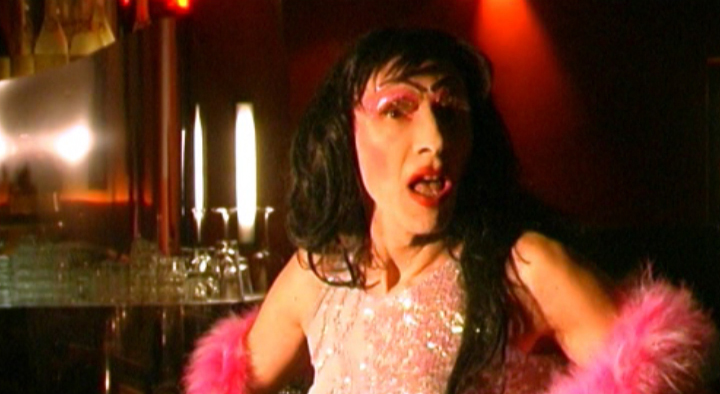
Drama, thriller, by Fabio Del Greco, Italy, 2010.
Luca is poor and works, precariously, as a waiter. He lives a problematic relationship with his girlfriend, and his life is full of doubts. One day Luca meets Chiara, a friend who had studied philosophy with him at university. She has realized her dream of opening a night and is now well-off. Luca leaves everything behind and starts a relationship with Chiara. He manages the nightclub with her and, thanks to the cocaine and call girls sold to politicians, he gets out of his hard economic situation. But Chiara does not manage to obtain the contract for an old furnace, so she blackmails Saverio, a member of the Parliament. Chiara owns a video in which Saverio has sexual intercourse with a transsexual.
LANGUAGE: Italian
SUBTITLES: English, French, Spanish, German, Dutch, Portuguese.
A Schoolmaster Who Read Too Much
You are standing at the front of a classroom in Racalmuto, Sicily, in the early 1950s, and the children watching you cannot yet read. Some of them will never fully learn. The chalk in your hand feels like the wrong instrument for what you are trying to do, and somewhere in your bag — under the lesson plans, under the attendance register — is a volume of Voltaire you will return to the moment the bell releases you.
Leonardo Sciascia spent nearly fifteen years as an elementary school teacher, from 1949 onward, in the same Sicilian town where he had been born in 1921. This is not a biographical footnote. It is the hinge on which everything else turns. He was not a university professor dispensing ideas to students already equipped to receive them. He was teaching children to form letters, children whose parents worked the sulphur mines or the dry fields, children for whom the written word was genuinely foreign territory. And every evening he was reading Diderot, Montesquieu, the Italian illuministi — Beccaria, Filangieri — men who had constructed magnificent rational architectures for human civilization, systems of law and justice and progress that glittered with geometric confidence.
The fracture this creates in a mind is not metaphorical. Cesare Beccaria published Dei delitti e delle pene in 1764, arguing with surgical clarity that punishment must be proportional, that torture is irrational, that the law exists to protect the citizen rather than the state. It is one of the most elegant texts the eighteenth century produced. Sciascia read it in a region where justice had for centuries operated on entirely different principles — where the law was an imported language nobody spoke at home, where power moved through silences and favors and threats that left no documentary trace. Beccaria’s precision did not dissolve when it met Sicilian reality. It sharpened. It became a blade.
What Enlightenment thought gave Sciascia was not optimism. That is the misreading that haunts his reception, the assumption that a man who loved the philosophes must have believed in progress. He did not. He borrowed from the Enlightenment its methods — doubt, analysis, the refusal to accept the given account — and left behind its faith in historical improvement. Voltaire’s Candide, published in 1759, is not actually an optimistic book; it is an optimism systematically destroyed from the inside, paragraph by paragraph. Sciascia recognized this as his own temperamental condition. He was someone who would always demand the rational explanation while suspecting that no rational explanation could survive contact with the world as actually organized.
Teaching sharpened this suspicion in a way that reading alone could not. When you watch a child struggle to decode a sentence, you understand something about the distance between the republic of letters and the republic as it actually exists — about who gets handed the tools of articulation and who does not, and what that distribution of literacy means for every claim that democratic institutions make about themselves. The Italian state had promised universal education; Sciascia was the person tasked with delivering that promise in a classroom where the gap between the promise and the delivery was measured in the silences of eight-year-olds who arrived hungry.
His first serious prose, Le parrocchie di Regalpetra, published in 1956, came directly out of those years. It is part local history, part sociological observation, part barely suppressed rage — written by a man who had spent years watching official language pass over the actual texture of life like oil over water. The title refers to Racalmuto, renamed with transparent irony. The book is not a nostalgic portrait of a community. It is a forensic examination of how a place gets administered, mythologized, and abandoned, written by someone who had been close enough to the ground to see what the official records would never say.

The Mafia as Epistemological Problem
You are handed a murder investigation with a perfect witness, a clear motive, a suspect whose guilt is not seriously in doubt, and you watch every mechanism of official knowledge grind to a halt. Not because the evidence is insufficient. Because the evidence is irrelevant.
When Sciascia published Il giorno della civetta in 1961, the Italian literary establishment received it as crime fiction, assigned it to a shelf, and largely closed the conversation there. This was itself a kind of institutional refusal, the same gesture the novel was diagnosing. Captain Bellodi, a northerner posted to Sicily, investigates the murder of a building contractor with the patience and logical rigor of a man who genuinely believes that truth, once assembled correctly, produces consequences. He assembles it correctly. The consequences do not follow. What collapses around him is not his reasoning but the entire architecture that was supposed to receive and act on that reasoning — the prosecutors who see what he sees, the politicians who receive his report, the apparatus of the state that absorbs his conclusions and metabolizes them into silence.
The philosophical argument here is not about corruption in the ordinary sense, the bad apple, the bribed official. It is far more unsettling than that. What Sciascia constructs is a portrait of refusal as a social institution, a shared and largely unspoken agreement that certain forms of knowledge will not be allowed to become official knowledge, not because they are doubted but precisely because they are not. To acknowledge Bellodi’s findings would require dismantling a set of arrangements that sustain too many people across too many registers of life — economic, familial, political, existential. The mafia in Sciascia’s novel is not primarily a criminal organization. It is an epistemological position, a collective decision about what can be known and what must remain in the condition of the merely suspected.
Hannah Arendt‘s Eichmann in Jerusalem appeared just one year after Sciascia’s novel, in 1963, and while the two works emerge from entirely different historical catastrophes, they share a diagnostic nerve. Arendt’s central provocation was not that Eichmann was a monster but that he was disturbingly ordinary, a bureaucrat whose evil was inseparable from his function, from the structure of roles and responsibilities that made moral thinking not just unnecessary but actively incompatible with professional competence. What she called the banality of evil was not a moral absolution but an epistemological diagnosis: systems can be organized so that the knowledge of what they are doing is distributed, diluted, and finally made inaccessible to the individuals operating within them. The machinery continues because no single node in it ever holds enough of the picture to experience the full weight of what it is producing.
Bellodi holds the full picture. And that, in Sciascia’s universe, is precisely what makes him powerless. Knowledge concentrated in one honest man is not power — it is exposure. It marks him as foreign to the system, as a body the system must quarantine rather than incorporate. The novel ends not with defeat in the conventional sense but with something harder to name: Bellodi returns north, alive, intact, carrying his correct conclusions inside him like an organ no one needs. The investigation is not closed or discredited. It simply stops mattering. That gradation — from irrelevance to invisibility to silence — is the actual violence the book is charting.
What makes this philosophically vertiginous rather than merely pessimistic is the precision with which Sciascia locates the mechanism. It is not that truth is suppressed by force in any crude sense. It is that the social world has developed finer instruments than force: the shrug, the reassignment, the bureaucratic delay, the promotion that moves a man sideways, the sympathy that means nothing. Societies do not generally need to lie about what they know. They only need to ensure that knowing it never arrives at the threshold where knowing requires a response.
Power Dressed as Virtue
You are sitting in a church that doubles as a bunker. The walls are thick enough to absorb confessions and crimes with equal indifference, and the men inside have learned to speak in a register that makes both sound like prayer. This is not metaphor — or rather, it is metaphor only in the way that all Italian political reality in the early 1970s was metaphor, which is to say it was the literal thing itself wearing a vestment.
By 1971, when Equal Danger appeared, Sciascia had moved beyond the Mafia as his primary anatomy of power. The target had shifted — or rather, had clarified — into something more insidious precisely because it wore a cross. The Christian Democracy party had governed Italy without interruption since 1948, a span of nearly three decades during which legitimacy had been so thoroughly fused with institutional Catholicism that to question one was to appear to attack the other. This was not an accident. It was an architecture. The novel’s investigator, a nameless functionary whose very anonymity signals his expendability, pursues a logic and finds himself punished not for failing but for succeeding — because the truth he uncovers implicates the structure that employed him to find it. The system does not fear disorder. It fears its own transparency.
Michel Foucault published Discipline and Punish in 1975, one year after Todo Modo, but the genealogical method he described there — the idea that power perpetuates itself not through brute force but through the normalization of categories, through the production of what counts as legitimate knowledge — illuminates Sciascia’s fiction with uncomfortable precision. Foucault argued that the modern state had replaced the spectacle of punishment with something far more efficient: the internalization of surveillance, the subject who disciplines himself because he has accepted the authority of the institution that watches him. What Sciascia was doing in narrative terms was the same operation applied to confessional Italy — showing how a population had been trained to read corruption as governance, and governance as moral duty, because the vocabulary available to them had been controlled at the source.
Todo Modo is the more savage of the two books, and deliberately so. A group of politicians and industrialists retreats to a Jesuit spiritual center for religious exercises — the title taken directly from Ignatius of Loyola’s Spiritual Exercises, that sixteenth-century manual for the systematic disciplining of the will toward institutional obedience — and murders occur among them with a regularity that never quite disrupts the liturgical schedule. The murders are almost beside the point. What Sciascia is dissecting is the ritual itself: the way power consecrates its own continuity by borrowing the grammar of the sacred. A politician who kneels is not humble. He is performing a transaction, purchasing moral credit to spend elsewhere, in rooms where decisions are made that will never appear in any confessional record.
The character known only as the Priest — a figure drawn with the cold precision of a clinical report — understands that faith and control have always been cognate operations in this specific historical tradition. This is not anticlericalism in any simple sense. Sciascia was too intelligent for the comforts of atheist polemic. What he was exposing was something more particular: the way a specific institution, in a specific country, across a specific and documented postwar period, had made virtue into a technology of domination. The spiritual retreat is not corrupt despite being religious. It is corrupt through the very mechanisms that make religion legible as authority — hierarchy, absolution, the assignment of guilt and its removal by a designated intermediary.
When the Italian state has already decided what innocence looks like, the investigator who finds a different shape for it becomes, automatically, a criminal. Sciascia understood that this was not a flaw in the system but its deepest feature, the one it could least afford to have named.
The Historical Inquisition as Mirror
You are sitting in an archive, sometime in the early 1960s, in a Sicilian library where the light comes in sideways and the documents smell of a damp that is older than any living memory. Leonardo Sciascia is doing the same thing, but he is not reading history. He is reading a mirror.
What he found in the sixteenth-century trial records of Fra Diego La Matina — the Dominican friar who killed his Inquisitor before being burned alive in 1658 — was not a curiosity from the past but a structural blueprint for the present. Death of the Inquisitor, published in 1964, is formally an essay, but it operates as something closer to a controlled detonation. Sciascia follows La Matina’s case with the obsessive precision of a defense attorney who already knows the verdict will not change. The Inquisition did not need guilt; it needed confession. The distinction between the two, in that courtroom as in many that followed it, was procedural at best and theatrical at worst. La Matina endured torture designed not to extract truth but to produce a document — a signed admission that could be filed, archived, and cited as proof of the institution’s legitimacy. The body was the medium. The confession was the message.
What makes this anatomical rather than historical is the precision with which Sciascia traces the mechanics rather than the morality. He is not interested in condemning the Inquisition on ethical grounds — that would be too easy, too distant, too safe. He is interested in how the machinery functioned, how denunciation became civic duty, how the accused was structurally denied the possibility of innocence because the very act of accusation had already constituted a kind of proof. The French philosopher Michel Foucault would map similar terrain in Discipline and Punish in 1975, tracing the genealogy of punishment from public torture to invisible surveillance — but Sciascia arrived at the wound from a different direction, through Sicilian parish records and Inquisitorial archives, through documents that nobody else thought to read as political theory.
A year before Death of the Inquisitor, The Council of Egypt appeared, set in late eighteenth-century Palermo under Bourbon rule and built around the figure of the Abbot Giuseppe Vella, a Maltese priest who fabricated an entire Arabic manuscript — the so-called Council of Egypt — and passed it off as a document proving the feudal rights of Sicilian barons were illegitimate. Vella’s forgery is spectacular in its audacity, but Sciascia is not fascinated by the crime. He is fascinated by the system that made the forgery not just possible but necessary. In a society where power is legitimized by documents, whoever controls the documents controls reality. Truth is not discovered; it is manufactured, certified, and then protected by the very institutions whose authority it was invented to confirm.
The reformist lawyer Francesco Paolo Di Blasi, who appears alongside Vella in the novel and is eventually executed for his Jacobin sympathies, represents something Sciascia regarded with both admiration and deep suspicion: the rational man who believes that reason alone can dismantle a system built on organized irrationality. Di Blasi’s failure is not accidental. It is structural. Enlightenment confidence — the belief that exposing a lie is sufficient to destroy it — collides with the older Sicilian understanding that institutions do not collapse under the weight of truth. They absorb it, reclassify it, and continue.
These two books, read together, form a kind of double helix in Sciascia’s thinking. One shows the Inquisition torturing a man until he produces the confession it requires. The other shows a forger producing the document that power requires. In both cases, the document outlasts the man. The archive survives. And the twentieth century, with its show trials and its fabricated testimonies and its courts that had already decided before convening, had not moved very far from the smell of that Sicilian library at all.
A vision curated by a filmmaker, not an algorithm
In this video I explain our vision
The Moro Affair and the Limits of Reason

You are reading a ransom letter while the man who wrote it is still alive. That is the precise temporal condition of L’affaire Moro, published in 1978 while Aldo Moro was still breathing in a Red Brigades prison somewhere beneath the surface of Rome. Sciascia did not wait for the outcome, did not wait for the body to be found in the trunk of a Renault on Via Caetani, positioned with grotesque symbolism equidistant between the headquarters of the Christian Democrats and the Communist Party. He read the documents as they emerged — the letters Moro wrote from captivity, the communiqués of the Red Brigades, the official responses of the Italian state — and he concluded, in real time, in print, that the Italian political establishment had chosen to let Moro die.
This was not a conspiracy theory in the cheap modern sense. It was a close reading, almost philological in its precision. Sciascia examined the language of Moro’s letters with the attention a literary critic brings to a disputed manuscript, and he found in them a man whose mind was intact, whose arguments were coherent, whose appeals to reason and historical precedent were being systematically dismissed as the product of psychological coercion. The official position — endorsed by figures across the political spectrum, including the Communist Party under Berlinguer — was that Moro’s letters were the words of a broken man, written under duress, not to be taken seriously. Sciascia found this convenient. He found it suspiciously convenient. A man arguing clearly for his own life was being declared mentally absent precisely because the clarity of his argument was politically inconvenient.
Primo Levi had written in I sommersi e i salvati, published in 1986 but developed across decades of testimony, about what he called the gray zone — that territory of moral ambiguity where victims become complicit in the machinery that destroys them, where institutions develop internal logics that protect the structure at the cost of the individual. Levi was thinking of the Sonderkommando in the camps, of those forced to administer suffering to their own people. Sciascia, without naming the parallel so bluntly, was describing its peacetime version: the democratic institution that sacrifices one of its founding members not because it cannot save him but because saving him would cost too much — would require negotiation with terrorists, would set a precedent, would reveal the fragility of a state whose authority depends on the performance of strength it does not actually possess.
What Sciascia understood, and what made his contemporaries furious, was that the Italian state’s refusal to negotiate was not moral clarity but institutional self-preservation wearing the costume of principle. The Christian Democrats and the Communists, locked in their historic compromise of mutual legitimacy, could not afford a Moro who returned alive and angry. Moro from captivity had written letters that named names, assigned responsibilities, settled old scores with the precision of a man who knew he had nothing left to lose. A living Moro was an unpredictable Moro. A dead Moro was a martyr, clean, silent, permanently useful.
The book cost Sciascia enormously. Friendships ended. His reputation as a reliable voice of the Italian left fractured. He was accused of playing into the hands of the Red Brigades by questioning the state’s firmness, of romanticizing a politician whose record hardly invited sympathy. None of his accusers engaged with the actual argument. They responded to the position’s political implications while leaving its evidentiary basis untouched. This is a reliable sign that someone has landed too close to something true.
The Professional Anti-Mafioso Scandal
You are sitting at a table in Palermo in the winter of 1987, and someone hands you a newspaper. The man across from you, a prosecutor you have heard praised for years as a hero of the Republic, is furious. Not because he has been called corrupt. Because he has been called something worse: theatrical.
Leonardo Sciascia published his piece in the Corriere della Sera on January 10, 1987, and the word he chose — professionista dell’antimafia, the professional anti-mafioso — detonated with a precision that only a novelist could achieve, because it named not a crime but a posture. He was not accusing magistrates like Paolo Borsellino of cowardice or incompetence. He was doing something the Italian public found structurally unacceptable: he was questioning the social economy of moral prestige, the way that danger, proximity to death, and institutional courage had been converted into a form of cultural capital that conferred immunity from scrutiny. Erving Goffman, in The Presentation of Self in Everyday Life from 1959, described the way social actors manage impressions to claim status — Sciascia was diagnosing exactly this mechanism operating inside the anti-Mafia establishment, where the performance of risk had become indistinguishable from, and occasionally more rewarding than, risk itself.
The fury that followed was not incidental. It was the proof. Intellectuals, politicians, magistrates, and journalists who had built entire public identities on their opposition to Cosa Nostra responded with a unanimity that should have been disquieting. Sciascia was accused of playing into the hands of the Mafia, of being naive, of being a traitor. Giovanni Falcone — whose tragic death in 1992 would make these debates unbearable to revisit — had already begun to feel the institutional hostility that Sciascia was partly describing: the way the anti-Mafia apparatus could protect certain careers while marginalizing the people actually doing the most exposed work. Falcone himself was passed over for the position he deserved at the Consiglio Superiore della Magistratura in 1988, in a vote where moral grandstanding and institutional politics proved entirely compatible. Sciascia had seen this coming. The article was the diagnosis; the vote was the symptom.
What the reaction exposed was a cultural reflex so deep it had become invisible: in Italian public life, virtue is not merely claimed — it is territorially defended. To question the authenticity of an anti-Mafia commitment is socially equivalent to expressing sympathy for the Mafia, because the entire system depends on the binary holding. Albert Hirschman, in The Rhetoric of Reaction published in 1991, would later catalog the logical maneuvers by which any critique of progressive institutions gets recast as reactionary sabotage — Sciascia encountered exactly this structure four years before Hirschman named it. The suggestion that anti-Mafia posturing served careerist ends was heard as a defense of organized crime, because no middle position was permitted to exist.
Sciascia was seventy-seven at the time of the polemic, ill with a blood disease that would kill him three years later, and he had spent five decades watching Sicily’s tragedies be narrated by people who had arrived after the bloodshed to claim the narrative. His novels — from Il giorno della civetta in 1961, where a captain from the north cannot make southern institutions confess what they already know, to Todo modo in 1974, where power and piety are architecturally identical — had always been about the way systems of representation colonize reality and replace it. The 1987 article was not a departure from his literary project. It was the moment the literary project walked directly into the public square and said the unsayable in the plainest possible Italian.
The scandal never resolved. It simply calcified. Sciascia never retracted a word, and the people who condemned him never examined why the condemnation came so fast, so total, and so structurally uniform — which is, of course, the only question that matters.
Writing as Forensic Act
You are reading a sentence that was written by a man who knew it would change nothing, and who wrote it anyway. That tension — between the futility of diagnosis and the compulsion to diagnose — is not a biographical curiosity about Leonardo Sciascia. It is the engine of everything he produced across four decades, from the early Sicilian chronicles to the scorched late essays gathered in the years before his death in 1989. His entire body of work constitutes a single sustained forensic examination, and its subject is never the criminal but always the structure that absorbs the crime, digests it, and returns a verdict that confirms what power had already decided.
René Girard, writing in “La Violence et le Sacré” in 1972, described the scapegoat mechanism as a social technology: a community under pressure selects a victim, loads onto that figure the weight of collective anxiety, expels or destroys them, and then experiences a temporary resolution that feels indistinguishable from justice. What Girard exposed was not pathology but architecture — the scapegoat is not a mistake the community makes, it is how the community reproduces itself. Sciascia arrived at the same structure from a different direction, not through anthropology but through dossiers, courtroom transcripts, and the particular silence that surrounds acquittals in cases where everyone knows who held the knife. His 1961 novel about a local notable who is murdered and then morally rehabilitated by the very institutions that failed to protect him showed a Sicilian village performing exactly this ritual — not cynically, but with genuine conviction, the way liturgy is performed.
The forensic impulse in Sciascia is precise in a way that literary fiction rarely permits itself to be. He names names when names exist in the public record. He cites dates, reproduces documents, follows chains of institutional responsibility until the chain disappears into a wall with no door. His 1976 examination of the Aldo Moro kidnapping, written while the case was still open, demonstrated with uncomfortable clarity that the Italian state’s handling of the crisis served functions other than rescuing the hostage — that the decision not to negotiate was also a decision about what kind of precedent Moro, alive and talking, might set. This was not conspiracy theory. It was institutional reading, the same practice a pathologist applies when the body on the table is a bureaucracy.
What his late essays — particularly those collected in “A futura memoria” published in 1989, the year of his death — finally admitted was that the forensic act carries its own contamination. Every act of naming and clarifying also aestheticizes. The sentence that makes injustice visible also makes it bearable to contemplate, gives it the consoling shape of argument, the satisfying click of a thesis proved. Sciascia grew suspicious of his own clarity. He had spent a career making Sicilian opacity legible to Italian readers and Italian opacity legible to Europeans, and he began to wonder whether legibility was a form of complicity — whether the elegant autopsy report, however accurate, ultimately serves the morgue.
Girard’s later work recognized the same problem from within his own system: once the scapegoat mechanism is named and known, it does not stop operating. Communities that have read the theory continue to perform the ritual. Consciousness of the trap is not the same as escape from the trap. Sciascia reached this recognition not as a theoretical proposition but as a lived condition — he had written twelve books and nine plays and countless essays, and Sicily had not become more transparent, Rome had not become more accountable, and the Mafia had not dissolved under the pressure of accurate description.
What remained, and what he left unresolved because it cannot be resolved, was whether writing that names the mechanism becomes part of the mechanism, or whether the naming, however absorbed and neutralized by power, leaves a residue — something lodged in the reader that power cannot fully retrieve.
🔍 Sicily, Power, and the Literature of Truth
Leonardo Sciascia spent his life mapping the hidden corridors of power, corruption, and moral ambiguity in Sicilian and Italian society. His work intersects with a broader tradition of writers who dared to expose the mechanisms of control and injustice through literature. These related articles trace the cultural and literary landscape that surrounds and illuminates his thought.
Eco’s The Name of the Rose: Meaning and Analysis
Umberto Eco‘s The Name of the Rose shares with Sciascia a deep fascination with labyrinths — both physical and intellectual — and with the dangerous act of seeking truth in systems designed to suppress it. The novel weaves together medieval mystery, semiotic inquiry, and institutional power, themes that resonate strongly with Sciascia’s noir investigations of Sicilian society. Reading Eco alongside Sciascia reveals how Italian literature of the twentieth century made the detective form a vehicle for philosophical and political questioning.
GO TO THE SELECTION: Eco’s The Name of the Rose: Meaning and Analysis
Umberto Eco: Life and Works
Umberto Eco as a public intellectual and theorist of signs provides essential context for understanding the Italian literary and cultural world in which Sciascia operated. Both writers shared a suspicion of ideological certainties and an appreciation for the open, interpretive text that refuses simple conclusions. Eco’s life and works offer a broader map of the intellectual climate that shaped postwar Italian literature.
GO TO THE SELECTION: Umberto Eco: Life and Works
Kafka and Bureaucracy: The Trial and The Castle
Kafka’s explorations of bureaucracy, guilt, and opaque institutional power in The Trial and The Castle find a powerful echo in Sciascia’s Sicily, where justice is perpetually deferred and the state operates as an inscrutable machine. The connection between Kafka’s existential nightmare and Sciascia’s juridical investigations illuminates a shared literary obsession with systems that entrap the innocent. Both writers transform the mechanics of power into a profound meditation on human dignity and resistance.
GO TO THE SELECTION: Kafka and Bureaucracy: The Trial and The Castle
Carlo Emilio Gadda: Life and Works
Carlo Emilio Gadda, like Sciascia, approached Italian society with a corrosive and analytical eye, using literary form to expose the contradictions and violence lurking beneath bourgeois respectability. His experimental language and refusal of narrative resolution place him in a tradition of disruptive Italian prose that Sciascia, in his leaner and more classical way, also inhabits. Together, Gadda and Sciascia represent two distinct but complementary modes of literary dissent in twentieth-century Italy.
GO TO THE SELECTION: Carlo Emilio Gadda: Life and Works
Discover Independent Cinema on Indiecinema
If the moral courage and intellectual depth of Sciascia’s writing have stirred your curiosity, Indiecinema is the place to continue the journey. Our streaming platform offers a curated selection of independent and auteur films that share that same unflinching gaze on power, truth, and the human condition. Explore our catalog and let cinema open the next door in your labyrinth.
👉 EXPLORE THE CATALOG: Watch Indie Films in Streaming
A vision curated by a filmmaker, not an algorithm
In this video I explain our vision

