
The Wreckage on the Desk
You have written the first sentence three times and deleted it each time. The page is still blank — not empty in the innocent way a fresh morning is empty, but blank in the accusatory way of something waiting to be filled with exactly the right words while you already know, somewhere behind your sternum, that the right words will not come. Not because you are incompetent. Because the thing you are trying to say is larger and more tangled than any sentence can honestly carry. The feeling presses against the inside of your skull like a fist, and language, when you finally attempt it, comes out reductive, a shrunken version of the original pressure. You write a sentence and it lies. You write another and it simplifies. You cross both out and sit there with the wreckage on the desk, and you begin to understand — not intellectually, but in your body — that this is not a personal failure. This is the condition.

Carlo Emilio Gadda spent the better part of his life sitting exactly in that place. Born in Milan in 1893 into a bourgeois family already quietly collapsing under debts his father concealed with the practiced dignity of the ruined middle class, Gadda grew into a man for whom the distance between interior experience and external expression was not a stylistic problem to be solved but a wound that would never close. He trained as an electrical engineer at the Politecnico di Milano, served in the First World War, watched his younger brother Enrico die in combat in 1918, and spent decades afterwards building an inner architecture of guilt, grief, and intellectual fury so dense and layered that it could not, structurally, be translated into conventional prose. The Journal of the War and in Captivity, which he began writing in 1915 and which would not be published in a complete form until 1955, is already legible as a document of someone trying to record reality and finding that every honest attempt to do so deforms it. He wrote around the truth, through the truth, into the truth — never cleanly at it.
What Gadda understood, instinctively before he understood it theoretically, was something that the philosopher of science Ernst Mach had articulated in The Analysis of Sensations in 1886: that the self is not a unified entity but a bundle of sensations, a shifting and contradictory collection of impressions that only the laziness of language makes us call a single “I.” For Gadda, this was not an abstract proposition. It was a lived catastrophe. The Mach-ian dissolution of the unified subject meant that every sentence written in the first person was technically a lie, because there was no stable first person to anchor it. Every attempt at narrative coherence was a falsification of the chaotic density of actual experience. And yet the alternative — silence — was equally intolerable, because the pressure did not go away simply because language failed it. So you write. Badly. Incompletely. With excess and distortion and rage at your own instruments. You write the way someone clears rubble, knowing the building cannot be rebuilt but unable to stop moving the stones.
This is the engine of everything Gadda produced. Not a literary style, exactly, though it generates one. An existential predicament that finds its only possible expression in what he called — borrowing from technical language he trusted more than aesthetic vocabulary — the pasticciaccio, the mess, the snarl. His most celebrated novels, That Awful Mess on the Via Merulana, published in its definitive form in 1957, and the earlier Acquainted with Grief, begun in 1938, are not experiments in obscurity designed to impress other writers. They are honest reports from someone who believed that to write clearly about a tangled world was to falsify it, and who chose the harder honesty of tangling the prose to match the tangle of the real. The sentence performs what it describes. The form does not contain the chaos — it enacts it.
The Smartphone Woman
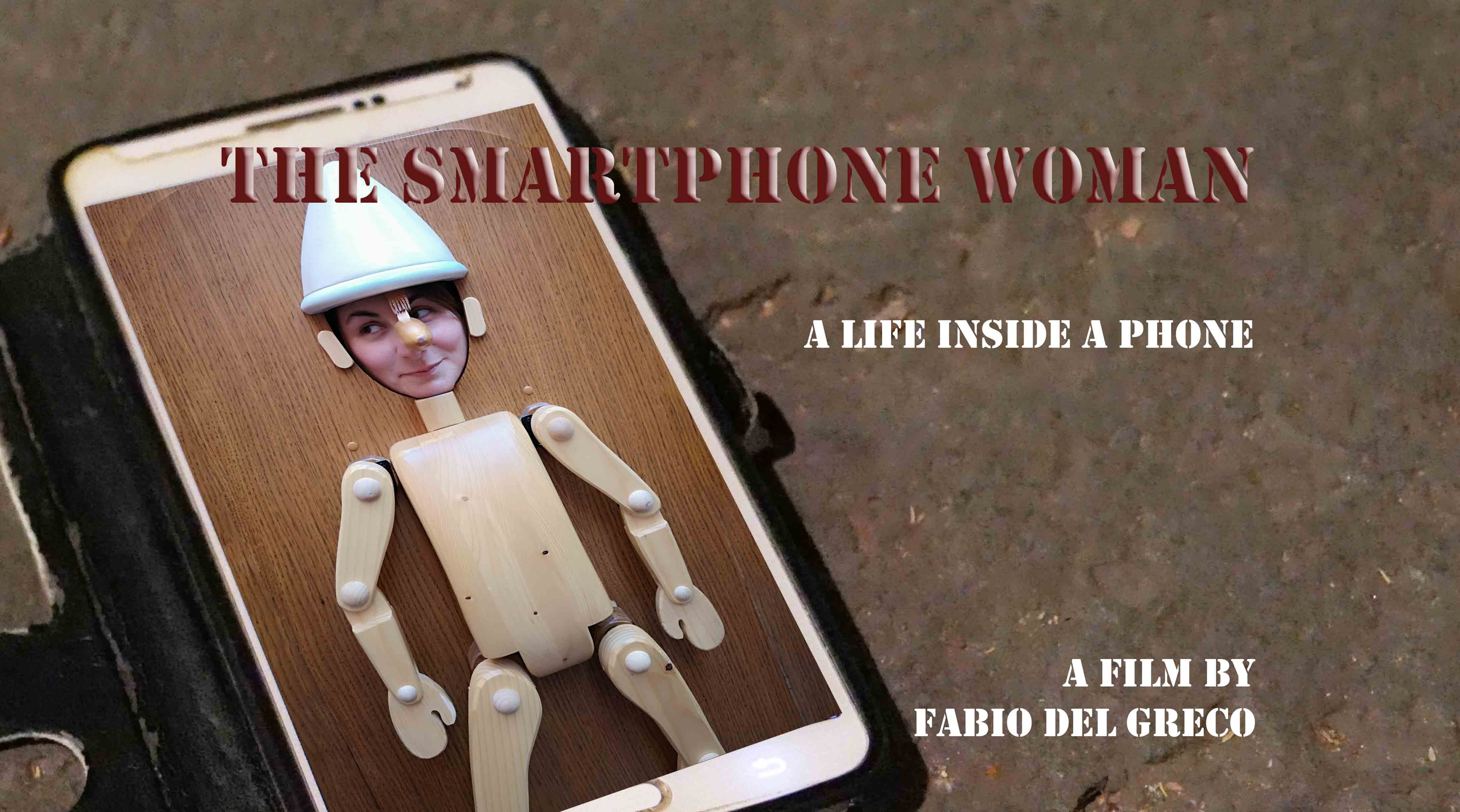
Drama, thriller, dark comedy, by Fabio Del Greco, Italy 2020.
On a bridge over the Tiber River, an elderly and severely ill man has decided to end his life, but an unusual discovery changes his mind: he comes across a lost smartphone. Intrigued, he decides to return home and watch the videos contained within it. On the screen, a series of videos unfold, telling the story of a woman who has emigrated from southern Italy to Rome to work as a teacher in schools and her struggles with integration in a social reality she cannot fully grasp.
"The Smartphone Woman" is a realistic tale of a woman's life and her complex relationship with an "infernal" city. It portrays the challenges she faces, her connection to her origins, the social discomfort she discovers in the outskirts, and the eerie presence of the ghosts of ancient Roman empire. Fabio Del Greco employs a fragmented style, using pieces of "real life" shot with the smartphone, to construct a narrative that ambiguously oscillates between fiction and truth. This creates a captivating exploration of the discomfort and alienation within the bustling city, contrasting with the peaceful village life from which the protagonist hails. The film is constructed with a variety of heterogeneous characters and situations, an emotional kaleidoscope, weaving between evenings of exploration in the Eternal City and daily struggles. Realistic smartphone-shot videos are alternated with a narrative thread reminiscent of film noir and, ultimately, surrealism in the finale. On screen, a succession of grotesque characters unfolds, representing the director's vision of a tumultuous humanity. The film's potency lies in the emotion it manages to convey and in the protagonist's naive perspective. "The Smartphone Woman" is a must-see for enthusiasts of independent and experimental cinema.
LANGUAGE: italian
SUBTITLES: English, French, German, Portuguese, Spanish
A Man Crushed by History
You are sitting at a table across from someone who cannot stop talking about something that happened thirty years ago. Not because they lack perspective, but because they never recovered — and more importantly, because what happened to them was not simply bad luck. It was structural. It was the century pressing its full weight onto one body. That body was Carlo Emilio Gadda’s, and the century did not lift itself off him until it had broken most of what was breakable.
He was born in Milan in 1893 into a bourgeois family that carried the specific anxiety of people who believe they belong to a class they cannot actually afford. His father died in 1909, and what followed was not mourning so much as financial dissolution. The family home, a villa at Longone al Segrino, had to be sold. His mother, Adele, managed this humiliation with the rigid performance of dignity that the Italian provincial bourgeoisie had turned into a kind of religion, and Gadda absorbed both the humiliation and the performance simultaneously, which is precisely the kind of double bind that does not resolve — it ferments. He enrolled at the Politecnico di Milano to study electrical engineering, a choice that reads less like vocation than like an attempt to construct a self that could not be taken away, something anchored in measurement and function when everything domestic had proven catastrophically unstable.
Then the war arrived. Gadda enlisted in 1915 with the kind of voluntarist enthusiasm that Benedetto Croce would later describe as characteristic of idealistic youth who had absorbed the nationalist rhetoric of the Risorgimento without examining its foundations. Gadda was captured at Caporetto in 1917, the same catastrophic defeat that broke the Italian front and cost over three hundred thousand casualties in a matter of days. He survived imprisonment. His brother Enrico did not. Enrico was killed in action, and this death functioned not as a wound that healed but as a fixed point around which everything else in Gadda’s interior life continued to orbit for the remaining decades of his existence. He kept a journal during and after the war, published posthumously in 1955 as the Giornale di guerra e di prigionia, which is not the document of a man processing grief but of a man cataloguing it, annotating it, cross-referencing it with rage directed partly at military incompetence, partly at historical necessity, and partly — with the kind of honesty that makes the reader flinch — at himself.
What the engineering training gave him, paradoxically, was not distance from this grief but a methodology for inhabiting it. The engineer’s instinct is to trace causality backward through a system until you locate the failure point, and Gadda applied this compulsively to his own life. The result, philosophically, anticipates what Gregory Bateson would later formalize in Steps to an Ecology of Mind in 1972 — the idea that any event is not a discrete occurrence but a node in a network of interdependent causes so vast and recursive that identifying a single origin is not simplification but falsification. Gadda arrived at this epistemologically before he arrived at it literarily, which is why when the literature finally came, it looked the way it did: sprawling, digressive, syntactically explosive, constitutionally incapable of the clean sentence because the clean sentence implies a world where causes are separable, where grief has an address, where a brother’s death can be mourned and filed and moved past.
He returned to engineering after the war and worked in Argentina, in France, across Italy. He published his first significant prose, La Madonna dei Filosofi, in 1931, when he was nearly forty. The delay matters. It was not the delay of a dilettante but of a man who needed to understand what language could and could not hold before he dared ask it to hold everything.

The Knot That Cannot Be Untied
There is a moment, familiar to anyone who has ever tried to explain a simple argument and found themselves three hours later still talking, still adding qualifications, still pulling threads that refuse to end, when the suspicion arrives that maybe the problem is not in the explanation but in reality itself. That the world does not, in fact, resolve. That what looks like a cause is always also an effect of something else, which is itself the effect of something older, and that the chain does not terminate in a first principle so much as it loops back, silently, into your own chest.
This was not a suspicion for Gadda. It was a conviction, arrived at through engineering, mathematics, and the systematic study of Gottfried Wilhelm Leibniz, whose Monadologie he engaged with directly in his philosophical notebook, the Meditazione milanese, written around 1928 though published only in 1974, long after the ideas inside it had already infected everything he touched. What Leibniz offered was the image of a universe in which every element is internally related to every other, not through simple causality but through a kind of infinite co-implication. No substance stands alone. Each one expresses, from its own angle, the totality. Gadda took this not as a metaphysical consolation but as a description of something vertiginous and, frankly, terrible: if everything is connected to everything else, then nothing can ever be fully explained, because a full explanation would require explaining everything simultaneously.
He called this the groviglio, the tangle. The word itself resists elegance. It is not a knot in the nautical sense, something you might undo with patience and the right technique. It is the kind of tangle you find in a drawer full of old cables, where pulling any single wire only tightens the grip of all the others. In his 1963 essay collection La cognizione del dolore and throughout Quer pasticciaccio brutto de via Merulana, first serialized in 1946 and revised into book form in 1957, Gadda returned obsessively to scenes that refuse to simplify. A crime cannot be solved not because the detective is incompetent but because the crime is entangled with the social history of Rome under Fascism, with the biography of every person who passed through the building, with the architecture of the neighborhood, with the psychology of desire and shame and inheritance. The crime is not a discrete event. It is a node in a web that extends, without theoretical limit, in all directions.
What makes this more than a literary mannerism is that Gadda was operating, intuitively but with genuine rigor, at the edge of what the biologist Ludwig von Bertalanffy was beginning to formalize in the 1940s under the name general systems theory: the idea that the behavior of a system cannot be derived from the sum of its parts, because the relationships between parts are themselves generative, causal, real. Gadda arrived at this not through biology but through his own broken life, his engineering training, and his refusal to grant anyone, including himself, the comfort of a clean account. His notebooks from the First World War, which he fought in and survived with a bitterness that never left him, are full of attempts to locate blame, to find the original error, the moment when things went wrong. Each attempt only multiplies the candidates.
This is why his prose cannot be read quickly. The syntax itself performs the groviglio. A single sentence will open a subordinate clause, inside which another opens, and another, until the grammatical subject is buried under so many qualifications that recovering it feels like archaeological work. The style is not obscurity for its own sake. It is a formal honesty: if reality does not simplify, then prose that pretends to simplify it is lying. What looks like excess is, in Gadda’s logic, the only accurate representation of what it actually feels like to stand inside a world where causes do not stop.
Dialect as Wound, Not Color
You know the feeling of hearing someone code-switch mid-sentence and sensing, before your brain has processed the grammar, that something urgent has just been revealed — not about the topic they are discussing, but about the pressure they are living under. Not performance. Pressure. The difference matters enormously, and it was Gadda who understood it more viscerally than almost any prose writer of the twentieth century.
When Gadda layered Roman dialect over Milanese bureaucratic register over archaic Lombard over the clotted Latin of ecclesiastical tradition, he was not decorating a page. He was enacting a theory of mind under siege. His novels do not use dialect the way a regional colorist uses it — to warm up a character, to signal authenticity, to give the reader the comfortable pleasure of local flavor. In Gadda’s architecture, dialect is the evidence of a wound that syntax has tried and failed to close. The famous opening sprawl of Quer pasticciaccio brutto de via Merulana, published in its complete form in 1957 after years of revision and partial serialization, throws the reader into a Roman vernacular so dense and historically specific that even native Italian speakers feel the ground shift beneath them. The effect is not quaintness. The effect is vertigo.
Mikhail Bakhtin, writing his foundational essay Discourse in the Novel in 1934 and 1935, argued that the novel as a form is constitutively heteroglossic — that is, it contains within itself not a single unified language but a stratified collision of social speech types, each one carrying the ideological freight of the class, institution, and historical moment that produced it. For Bakhtin, this was a structural feature of the genre, the novel’s great democratic weapon against the monologism of official culture. What Gadda does is radicalize this insight to the point of breaking it. In his prose, heteroglossia is not a formal richness to be celebrated. It is the direct transcript of how trauma fragments cognition, how class shame corrodes the self, how a person raised between bourgeois aspiration and economic precarity ends up speaking in tongues they cannot fully own or fully abandon.
Gadda’s personal history is inseparable from this. Born in 1893 into a Milanese family that performed respectability while sliding steadily toward ruin, he watched his brother die in the First World War and spent years as a prisoner, years as an engineer, years as a man of letters who kept the engineer’s contempt for imprecision and the prisoner’s memory of absolute helplessness. The languages that inhabit his prose carry the sediment of all of it: the technical jargon of someone who built things and measured things and was paid for precision, colliding with the dialectal residue of grief and humiliation that no standardized Italian could adequately hold. When his characters speak in Roman street vernacular, they are not being picturesque. They are demonstrating that certain emotions have no address in the official language, that the official language was in fact designed to make those emotions invisible.
This is what connects Gadda to Bakhtin’s deeper argument about the social battleground of speech: that every utterance arrives already contaminated by prior use, by the mouths it has passed through, by the purposes it has served. There is no neutral word. There is no stylistically innocent sentence. When Gadda’s prose shifts register without warning — from the legal to the obscene, from the lyrical to the bureaucratic, from high Latin to gutter Roman — it is mapping the actual structure of a consciousness that has been told, simultaneously and contradictorily, that it belongs to culture and that it must know its place. The multilingualism is not the subject matter. It is the wound itself, still open, still bleeding syntax across the page in patterns that no single interpretive grid can contain, because the damage was never singular either.
Quer Pasticciaccio and the Murder That Refuses to Be Solved
There is a body in an apartment on Via Merulana, and everyone in the neighborhood has a theory. The neighbors crowd the stairwell, the officers take notes, the bureaucratic machinery of the Roman questura cranks into motion — and then, systematically, magnificently, nothing gets resolved. Not because Gadda forgot to finish the novel. Not because the serialized publication in the journal Letteratura between 1946 and 1947, and the Garzanti edition of 1957, left the manuscript in some interrupted state of drafting. The absence of resolution is the argument. The murder of Liliana Balducci refuses its solution the way reality refuses the comfort of a clean ending, and to understand why Gadda constructed this refusal so deliberately, you have to understand what he had absorbed from Freud and turned into something far more aggressive than therapy.
Gadda had read enough of the Freudian corpus to know that the unconscious does not confess. It displaces, distorts, substitutes, buries the original wound under layers of behavior that seem entirely unrelated to it. What the Roman detective Ingravallo — that melancholy, intuitive Southerner stationed in the north of his own career — understands from the very first pages is that crimes do not have single causes. They have knots. Ingravallo even says it, in that murmured theorizing that Gadda gives him like a philosophical tic: every catastrophe, every disaster, arrives not from one cause but from a convergence, a tangle of causes that have been quietly accumulating long before anyone noticed. This is not a detective’s hunch. It is a structural diagnosis of how events actually work, and it is the single idea that makes the novel formally impossible to conclude.
Because the detective novel as a genre is a machine for producing certainty. From Poe’s Dupin through Conan Doyle’s Holmes, the form promises that intelligence, applied rigorously enough, can extract a single clean truth from the noise of appearances. The murderer is revealed, the mechanism is explained, order is restored. What Gadda recognized — and what makes Quer pasticciaccio brutto de via Merulana one of the genuinely subversive literary objects of the twentieth century — is that this promise is not just narratively convenient but ideologically indispensable. The fascist state under which he had lived for two decades was itself a machine for producing exactly this kind of false clarity: the strong explanation, the identified enemy, the resolved contradiction. To write a detective novel that delivers its promised solution would be, in that context, to replicate the cognitive structure of totalitarianism at the level of form.
Instead, Gadda multiplies suspects the way anxiety multiplies symptoms. The investigation expands outward through Rome’s social body — servants, merchants, petty criminals, provincial relatives, the whole humid texture of a city in the late 1920s — and the language itself participates in this expansion. The Roman dialect that floods the novel is not local color. It is epistemological resistance. Dialect refuses the standardized Italian that Mussolini’s regime had promoted as a sign of national unity, and in Gadda’s hands every deviation from standard syntax, every intrusion of regional phonetics and slang, is a small act of cognitive sabotage against the idea that one language, one voice, one explanation can contain the real. When the prose switches registers mid-sentence, folding bureaucratic Latin into vulgar invective into lyrical digression, it is performing precisely the kind of entanglement that Ingravallo theorizes but cannot untangle.
The novel ends — if ending is even the right word — with an act of violence that is more emotional explosion than narrative resolution, a detective losing control in a way that solves nothing and only deepens the knot. Gadda leaves you there, in the unresolved middle of a city and a crime and a century, because he understood something about the stories we tell ourselves to get through the day: the demand for resolution is not a sign of intelligence. It is a sign of how badly we need to be lied to.
A vision curated by a filmmaker, not an algorithm
In this video I explain our vision
Fascism, Order, and the Obscene Desire for Clarity

There is a particular kind of person who cannot tolerate a sentence that does not resolve cleanly, a room where things are slightly out of place, a history that refuses to yield a single villain and a single lesson. You have met this person. You may, on certain mornings, be this person. Carlo Emilio Gadda spent the better part of three decades anatomizing that intolerance, and what he found beneath it was not a political tendency but something far older and more shameful: a libidinal hunger, an erotic craving for the world to be simple.
Eros e Priapo, written largely in the 1940s and published in 1967 after years of hesitation and revision, is perhaps the most savage psychoanalytic pamphlet ever disguised as literary prose. Gadda’s argument is not that Mussolini was a tyrant — that would be too clean, too satisfying, too much like the kind of explanation fascism itself preferred. His argument is that the mass adhesion to fascism was a sexual event, a collective surrender to a figure who promised what the unconscious most desperately wants: the dissolution of ambiguity into a radiant, muscular, single image of the world. The Duce did not merely govern; he posed. And the crowd, Gadda insists with barely contained fury, wanted to be posed at. They wanted the drama of clarity. They wanted the sentence to end.
Gadda draws, implicitly and sometimes explicitly, on the psychoanalytic tradition that was reshaping European thought in precisely those decades. Freud had argued in Civilization and Its Discontents in 1930 that the demands of social life required the suppression of drives that do not disappear but accumulate, distort, and eventually erupt. What Gadda adds — and this is his specific ferocity — is that the eruption can wear the costume of order. The fascist aesthetic, with its straight lines and synchronized bodies and thunderous rhetorical periods, is not the opposite of chaos: it is repressed chaos performing itself as discipline. The hunger for a world without contradiction is the most dangerous contradiction of all.
This is why Gadda’s prose does what it does. The baroque spiraling of his sentences, the refusal to let any observation stand without qualification, the way a description of a Roman street can suddenly implode into etymology and class analysis and personal wound — all of it is a formal argument against the very structure of fascist cognition. He is not being difficult. He is being honest about what it costs to look at anything real. When he writes about the murder investigation in Quer pasticciaccio brutto de via Merulana, published in 1957, the crime cannot be solved not because Gadda is playing literary games but because a crime is never a single event with a single cause. It is a node in a web of accumulated failures, resentments, historical sediments, and ordinary human ugliness. To name one cause is to lie. Fascism specialized in that lie. Fascism was professionally that lie.
What makes Eros e Priapo genuinely disturbing, even now, is that Gadda refuses to locate the fascist reflex only in the obviously political. He finds it in the language of newspapers, in the architecture of public squares, in the way educated Italians spoke about national greatness, in the aesthetics of virility that crossed every class boundary. He finds it, in other words, in the structure of desire itself when desire is ashamed of its own complexity. Sigmund Freud had identified the mechanism; Wilhelm Reich, in The Mass Psychology of Fascism published in 1933, had begun to trace its social architecture. Gadda took that architecture and ran his hands along every beam, every false joint, every place where the structure was held together not by logic but by the need to believe it was holding. And what he kept finding, underneath the heroic narrative and the imperial syntax, was a kind of terror — the terror of a mind that has looked into its own mess and decided it cannot survive there.
The Engineer Who Distrusted Engineering
There is a particular kind of exhaustion that comes not from overwork but from competence — from doing a thing so well, for so long, that the thing itself begins to feel like a lie. Carlo Emilio Gadda knew this exhaustion intimately. He spent decades as a practicing engineer, drawing up electrical systems, supervising construction sites across Italy and Argentina, producing the clean schematics and load calculations that infrastructure demands. He was good at it. The blueprints did not lie, the circuits held, the buildings stood. And yet every night, or in the hours stolen between contracts, he was engaged in an enterprise that amounted to the systematic destruction of everything his professional life required him to believe: that the world could be described precisely, that complexity could be resolved into diagrams, that a system — if designed with sufficient rigor — would hold.
Hannah Arendt, writing in The Human Condition in 1958, distinguished between labor, work, and action as three fundamentally different modes of human engagement with the world. Work, for Arendt, is the fabrication of durable things — it belongs to what she called the homo faber, the maker of the world, the one who imposes form onto matter and produces objects that outlast the act of making them. There is a pride in this that Arendt understood as both noble and dangerous: the pride of the craftsman who believes that, because he can build, he can also govern, design, and order. The engineer is the purest modern version of this figure. Gadda was this figure by training and by paycheck. He spent the 1920s and 1930s constructing real things in real places — his work on hydroelectric and industrial plants left behind functional infrastructure while he was privately accumulating a body of experimental prose that refused every grammar of function. The irony is not superficial. It is the engine of everything he wrote.
What Gadda understood, with a ferocity that no amount of professional discipline could neutralize, is that the world does not behave like a blueprint. His philosophical notebooks from the 1920s, later published as the Meditazione Milanese, reveal a mind already at war with the very notion of the self-contained system. He wrote there that reality is a tangle, un groviglio — not a complication that awaits the right method to untangle it, but an ontological condition, a thing that is constitutively and irreversibly knotted. This is not pessimism. It is something more precise: a refusal of the engineering promise, voiced from inside the engineering life. He had seen too many circuits to believe in them metaphysically.
The professional and the literary did not merely coexist in Gadda — they conducted a permanent war, and the friction between them generated heat that lit his sentences from within. His prose style, the baroque accumulation of registers, dialects, technical jargon, and lyrical digression that made works like Quer pasticciaccio brutto de via Merulana nearly impossible to translate and genuinely difficult to finish, was not an aesthetic choice in the sense of a preference for ornamentation. It was a structural argument. Every sentence that refused to close, every investigation that multiplied suspects instead of identifying one, every paragraph that opened a parenthesis and then opened another inside it before the first had been resolved — these were formal enactments of what the blueprints could not say. The world does not deliver verdicts. Solutions are a professional fiction.
Arendt worried that the homo faber, drunk on his own capacity to make, would eventually try to fabricate politics, history, and truth with the same tools he used to fabricate buildings — and that the results would be totalitarian. Gadda’s answer to this danger was not political in the conventional sense. It was syntactic. He built sentences that could not be used as instruments, that resisted the clean transfer of force from intention to result, that performed, at the level of grammar, the very resistance to mastery that his engineering life spent every working hour pretending did not exist.
What the Tangle Costs You
There is a particular exhaustion that arrives not from ignorance but from understanding too much. You have been in a conversation where every time you tried to assign responsibility, someone added a complication, a prior cause, a systemic condition, a childhood wound, a historical pressure — until the original offense dissolved into a cloud of contributing factors so dense that holding anyone accountable felt like an act of bad faith. You walked away not enlightened but drained, carrying a kind of vertigo where clarity used to live. That experience, which most people treat as a failure of the conversation, was precisely what Carlo Emilio Gadda spent his entire literary life perfecting into a method.
His major works — the unfinished Quer pasticciaccio brutto de via Merulana, published in its final form in 1957, and La cognizione del dolore, worked on across the 1930s and 1940s — are not difficult books in the way that demanding books are usually difficult. They do not require specialized knowledge. They require the willingness to watch a center refuse to hold, repeatedly, across hundreds of pages, and to resist the reflex that demands it should. The murder mystery at the heart of the Pasticciaccio has no solution because Gadda understood that the genre’s promise — isolate the cause, name the guilty party, restore order — is a social fiction, a narrative sedative administered to keep the reader from noticing that causes never isolate, that guilt distributes itself across systems and histories and small inherited failures the way humidity distributes itself across a room. The resolution you were promised was always a lie you agreed to, and Gadda refused to honor the agreement.
This refusal has a philosophical lineage. Gottfried Wilhelm Leibniz, whose concept of the monad and the interconnectedness of all things Gadda engaged with seriously during his early studies in engineering and philosophy, provided a structural backbone for what might otherwise seem like mere stylistic chaos. For Leibniz, every entity in the universe expresses, in some way, every other entity. Gadda literalized this as narrative practice: pull one thread and the whole fabric of a family, a neighborhood, a regime, a language begins to unravel and implicate itself. His baroque accumulation of dialects, technical vocabularies, Latin, Spanish, Milanese, and Roman registers was not ornamental. It was ontological. The knot had to sound like a knot.
But lucidity has a cost that clarity does not. Freud, whose influence on European literature Gadda’s generation could not escape, described the ego as an organized fiction, a coherent story we tell about ourselves to manage the chaos of competing drives. Gadda demolished the literary equivalent of that fiction — the protagonist as stable center, the plot as moral architecture, the sentence as transparent container of meaning — and what remained was something closer to raw exposure than enlightenment. His own life, marked by the death of his brother Enrico in the First World War, by financial humiliation, by a relationship with his mother so contaminated by resentment and guilt that it became the psychological wound La cognizione del dolore refuses to let close, was not the biography of a man who found peace in complexity. It was the biography of a man who could not unsee it.
This is what his vision actually costs, measured not in critical terms but in lived ones: if the self is not a coherent protagonist, then suffering cannot be cleanly narrated, blame cannot be cleanly assigned, and the story you tell yourself about your own life loses the architecture that made it bearable. Most people, when they encounter this possibility, flinch and return to simpler stories. Gadda did not flinch. He built an entire literature in the place where the flinch should have been, and the question his work leaves open — whether that is the highest form of intellectual honesty or simply a more sophisticated way of remaining paralyzed inside the wound — is one he never answered, because answering it would have required exactly the kind of narrative resolution he spent his life proving impossible.
🌀 Labyrinths of Language, Reality, and Modern Thought
Carlo Emilio Gadda’s labyrinthine prose, obsessive syntax, and darkly comic vision of a world in perpetual disorder place him at the crossroads of literature, philosophy, and linguistic experimentation. These articles explore the themes most deeply intertwined with his work: the maze of consciousness, the chaos of modernity, and the Italian literary tradition he both inhabited and subverted.
Italo Calvino: Life and Works
Italo Calvino, like Gadda, transformed Italian prose into a laboratory of ideas, games, and structural experiments. His works explore multiplicity, narrative labyrinths, and the relationship between language and reality in ways that echo Gadda’s own restless interrogation of form. Reading Calvino alongside Gadda illuminates the richness and ambition of postwar Italian literature.
GO TO THE SELECTION: Italo Calvino: Life and Works
Umberto Eco: Life and Works
Umberto Eco shared with Gadda a passion for encyclopedic knowledge, linguistic complexity, and the labyrinth as both metaphor and narrative structure. Eco’s theoretical and fictional works frequently circle around questions of interpretation, semiotics, and the impossibility of a single, stable meaning. His life and thought offer a compelling counterpoint to Gadda’s own baroque excess and intellectual density.
GO TO THE SELECTION: Umberto Eco: Life and Works
Eco’s The Name of the Rose: Meaning and Analysis
The Name of the Rose stands as one of the great literary labyrinths of the twentieth century, weaving medieval history, semiotic theory, and detective fiction into an inextricable knot. Like Gadda’s Quer pasticciaccio brutto de via Merulana, it uses the form of the mystery novel to explore the ultimate unresolvability of truth. Both works suggest that reality itself is a maze with no guaranteed exit.
GO TO THE SELECTION: Eco’s The Name of the Rose: Meaning and Analysis
Stream of Consciousness in Literature and Cinema
Stream of consciousness as a literary technique finds one of its most tortured and original expressions in Gadda’s prose, which fractures syntax and perspective to mirror the chaos of the psyche and the world. This article traces how writers from Joyce to Woolf developed interior monologue as a way of capturing the unfiltered flow of thought. Understanding this tradition is essential to grasping what makes Gadda’s narrative voice so radically distinctive.
GO TO THE SELECTION: Stream of Consciousness in Literature and Cinema
Discover Independent Cinema on Indiecinema
If Gadda’s labyrinthine vision of reality resonates with you, Indiecinema is the streaming platform where that same restless spirit finds its visual form. Explore a curated selection of independent and avant-garde films that challenge narrative conventions and illuminate the hidden complexity of the world. Start your journey into independent cinema today on Indiecinema.
👉 EXPLORE THE CATALOG: Watch Indie Films in Streaming
A vision curated by a filmmaker, not an algorithm
In this video I explain our vision

