The Invisible Woman in the Room
You say something in the meeting. The idea lands in the room and then disappears, absorbed into the air like it was never spoken. Three minutes later, the man sitting two chairs to your left says almost exactly the same thing, and the room nods, the room leans forward, the room writes it down. You watch this happen. You have watched this happen before. There is no dramatic moment of confrontation, no villain twirling a mustache. There is only the quiet, almost bureaucratic erasure of your having spoken at all, and the strange doubling sensation of hearing your own thought returned to you as someone else’s invention.

This is not paranoia. It has been documented, measured, reproduced in controlled conditions. Victoria Brescoll’s research at Yale, published in 2011, demonstrated that women in positions of authority who spoke frequently were rated as significantly less competent and less suitable for leadership than men who spoke with equal frequency. The penalty for taking up intellectual space is not the same for everyone in the room. It never has been.
What makes this particular form of erasure so insidious is precisely its invisibility. It does not require malice. It does not require conscious intent. It operates through the accumulated weight of expectation, through the invisible architecture of who we are trained to recognize as a source of knowledge, of discovery, of authority. Erving Goffman, in his 1959 work on the presentation of self in everyday life, argued that social performance is always shaped by what an audience is prepared to see. If the audience is not prepared to see a woman as the author of a significant idea, the idea will migrate, effortlessly and without anyone noticing, to someone they are prepared to see in that role.
A woman spends years working in a laboratory that is not legally hers to enter through the front door. She works in a converted carpenter’s workshop in the basement, in a building at the back of a prestigious institute, because the director has agreed to let her use the equipment but the University of Berlin, in the early years of the twentieth century, does not formally admit women. She is not a student. She is not, at first, even paid. She is a presence that the institution has not yet found the proper category to contain. She works there anyway. She works with extraordinary precision and with a quality of intellectual hunger that her colleagues will later describe in terms that make it sound almost uncomfortable, almost excessive, almost unwomanly in its intensity.
She is not a fictional figure. She is not a composite or a symbol. She is a specific person who lived a specific life, and the machinery that would eventually strip her of the credit for one of the most consequential scientific discoveries of the twentieth century was already running before she had published a single paper. The machinery was not exceptional. It was ordinary. It was the same machinery that operates in the meeting room where your idea vanishes and reappears, three minutes later, in someone else’s mouth.
The philosopher Miranda Fricker, in her 2007 book on epistemic injustice, introduced the concept of testimonial injustice: the deflation of a speaker’s credibility due to identity prejudice. The wrong, Fricker argues, is done to the speaker precisely as a knower. Not as a woman, not as a person with feelings, but as a producer of knowledge. The injustice is epistemic in nature, which means it strikes at the deepest possible register, at the capacity to be recognized as someone whose understanding of the world counts.
This is where her story begins. Not with a discovery, not with a laboratory, not with the splitting of an atom. It begins in the room where she is already present and already, in every way that the surrounding world can arrange, being made to disappear.
Eve of the Irises

Documentary, by Isabel Russinova, Rodolfo Martinelli Carraresi, Italy, 2026
Eva of the Irises is a historical biographical docu-film about the scientist Eva Mameli Calvino, a botanist and pioneer of environmentalism in Italy, mother of the writer Italo, born in Sassari in 1886. The film, based on a multidisciplinary approach that combines several genres—such as theatre, documentary, cinema, and research—moves between memories, reflections on life, as well as the goals and missions the scholar still wished to achieve.
The multifaceted artistic sensibility of Isabel Russinova is expressed across many fields, from writing to acting, from directing to civic engagement, and finds one of its highest expressions in the docu-film Eva of the Irises, created with Rodolfo Martinelli Carraresi. The film blends scientific rigor and poetic refinement to portray the extraordinary figure of the botanist Eva Mameli Calvino, mother of Italo Calvino but above all an independent protagonist of 20th-century scientific culture. It is told through a combination of archival materials, interviews, and evocative staging capable of elegantly and profoundly conveying her intense human and professional story.
LANGUAGE: Italian
SUBTITLES: English, Spanish, French, Portuguese
A Mind Born in the Wrong Century
Vienna in 1878 is a city drunk on its own brilliance. The coffeehouses hum with argument, the concert halls tremble with ambition, the universities believe themselves to be the apex of human civilization. Into this world, on the seventh of November, Lise Meitner is born — the third of eight children in a Jewish family where her father, Philipp, is a lawyer who reads philosophy the way other men read newspapers, and where the assumption that his daughters might think seriously about the world is not considered eccentric but simply true. This is, in retrospect, an extraordinary accident of inheritance. Most girls of her generation in Vienna were not handed the assumption of their own intelligence as a birthright. Lise was.
And yet the city that fed her curiosity would spend decades trying to starve it. Austria did not permit women to attend university as full students until 1897, when Meitner was already nineteen. Before that threshold, a woman who wanted to learn physics had to find a professor willing to allow her into his lectures as an auditor — invisible, unofficial, present by permission rather than by right. You sit at the back. You take notes. You do not raise your hand. The knowledge enters you through a door that is held open just wide enough for your body to pass through, and the institution reserves the right to close it at any moment, for any reason, without explanation. This is not education. It is a performance of education staged for the benefit of those who believe that allowing someone to watch learning is the same thing as allowing them to learn.
Hannah Arendt, writing in The Origins of Totalitarianism in 1951, describes a particular kind of political violence that operates not through force but through erasure — the stripping away of the conditions that make personhood legible to the world. She is writing about statelessness, about what happens to human beings when no state claims them and therefore, in the logic of modern politics, they cease to exist as rights-bearing subjects. But the mechanism she identifies is older and more pervasive than the twentieth century’s specific catastrophes. What Meitner experienced as a young woman in Vienna is structurally identical: the institution does not say you are forbidden to think. It simply refuses to make your thinking official. It grants you proximity to knowledge while withholding recognition of your encounter with it. You are present but not counted. Visible but not seen.
Meitner passed her external Matura examination in 1901 — a test that compressed eight years of gymnasium education into a single brutal sitting, because women were not permitted to attend those gymnasiums either — and enrolled at the University of Vienna as one of its first female physics students. She studied under Ludwig Boltzmann, a man whose understanding of entropy and thermodynamics was rewriting the foundations of physics, and who was, by multiple accounts, genuinely indifferent to the sex of a student who could follow his reasoning. In 1906 she became only the second woman in the history of the University of Vienna to receive a doctorate in physics. She was twenty-seven years old and had spent her entire intellectual formation navigating a system designed, at every level, to make her doubt that she belonged inside it.
The double exclusion that would define her life — as a woman, as a Jew — was not experienced as two separate pressures but as a single, compound condition. Arendt understood that the person who belongs nowhere is not simply disadvantaged but rendered philosophically anomalous, a subject without a home in the categories through which society understands itself. Meitner was a physicist in a world that had not yet decided whether women could be physicists, and a Jew in a world that was quietly, then loudly, deciding that Jews could not be anything at all.

The Laboratory as Exile
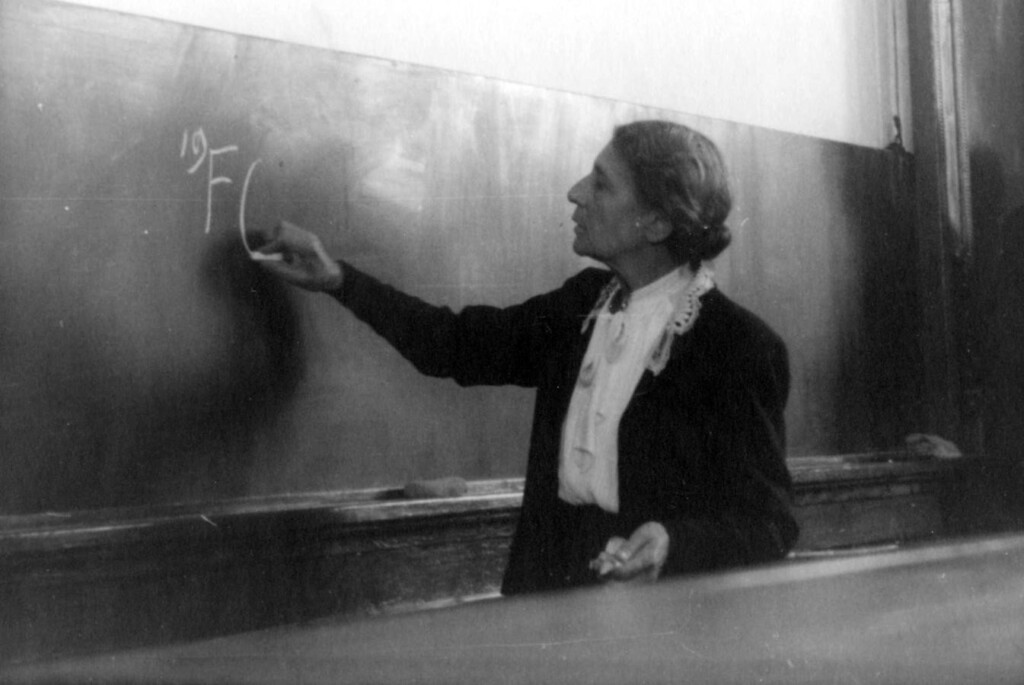
She arrived in Berlin in 1907 carrying a doctorate from Vienna and a letter of introduction from Ludwig Boltzmann, which in any just accounting of credentials should have opened doors without hesitation. What it opened instead was a basement. Not metaphorically — literally a converted carpenter’s workshop beneath the Chemical Institute on Hessische Strasse, where Otto Hahn had already established a small radiochemistry operation and where Meitner was permitted to work provided she used a separate entrance and never appeared in the upper floors where the male students and faculty conducted their science. The institute’s director, Emil Fischer, had spent years resisting the admission of women to German universities. He relented on Meitner’s presence with conditions that spatially encoded his reluctance: you may do the work, but you may not occupy the same space as the work’s recognition.
This is not a metaphor anyone constructed after the fact. The basement was real, the separate entrance was real, and the arrangement lasted until 1909 when Prussian universities were officially opened to women — at which point the physical segregation eased while the institutional one quietly persisted in other forms, more diffuse and therefore more durable. Erving Goffman, writing in Stigma in 1963, described how institutions manage what he called “spoiled identity” — the process by which a person who carries a mark of social disqualification learns to navigate spaces designed to remind them of their diminishment. The mark need not be visible. It can be architectural. It can be the fact that the entrance you use faces the alley rather than the street, that the room you work in has no windows, that your name appears second on publications even when the intellectual contribution preceded the technical one.
What Goffman grasped, and what Meitner’s years in that basement make viscerally legible, is that stigma is not primarily about individual prejudice. It is about the organization of space and procedure — the way institutions build their biases into floors and doorways and org charts so that no single person needs to make a discriminatory decision. The discrimination has already been made in the architecture. Fischer did not need to tell Meitner she was lesser. The entrance told her. The workshop told her. The decades told her.
And yet she stayed. For thirty years she stayed, working with Hahn through the slow accumulation of discoveries that would eventually arrive at the edge of something no one in physics had yet named. Their collaboration was genuinely mutual in ways that contemporary accounts, shaped by the institutional record, consistently underweighted. Hahn brought chemical precision. Meitner brought theoretical depth — she had trained under Boltzmann, who understood physics as a language for describing the invisible architecture of matter, and she carried that understanding into every experiment. The work they produced together between 1907 and the late 1930s was foundational in radioactivity research, including the identification of protactinium in 1917, which Meitner later described as her most important work before the discovery that would make her name and then be taken from it.
There is a particular exhaustion that comes from spending decades demonstrating competence in a system that will not update its assessment of you regardless of the evidence. It is not the exhaustion of failure. It is something closer to what the philosopher Miranda Fricker, in Epistemic Injustice published in 2007, called credibility deficit — the gap between the evidence a person provides and the credibility they are assigned, a gap that tracks not truth but social position. Meitner provided evidence continuously. The basement was the institution’s answer. The separate entrance was the institution’s answer. And when the evidence eventually became impossible to ignore — when the physics itself demanded acknowledgment — the institution found other architectures of invisibility, more sophisticated, less visible in brick and mortar, but no less structurally deliberate.
Thirty Years of Shared Work, One Name on the Prize
There is a particular kind of erasure that does not announce itself. It happens gradually, almost politely, the way a name migrates from the front of a sentence to the back, then to a footnote, then to silence. You do not notice it happening because each individual step seems reasonable, contextual, explicable. Only when you look at the photograph taken thirty years earlier do you realize that the face beside him has somehow grown fainter, as though the paper itself had decided to forget.
Lise Meitner and Otto Hahn began working together in Berlin in 1907, and for three decades they built something that can only be described as a shared mind. They were not collaborators in the polite institutional sense, two researchers occupying adjacent desks and occasionally sharing data. They inhabited the same intellectual problem simultaneously, approached it from different angles, and produced results that neither could have produced alone. She brought the theoretical precision, the ability to see what a decay series meant before the instrument had finished speaking. He brought the radiochemical technique, the patient material skill of a man who trusted his hands. Together, in 1918, they isolated protactinium, element 91, a discovery that required both of them in a way that was not rhetorical but structural. The isolation demanded chemical separation methods Hahn had spent years perfecting, and it demanded the physical interpretation that was Meitner’s territory. The paper bore both names. That seemed, at the time, like enough.
But Robert K. Merton, writing in Science in 1968, identified something that makes that “enough” look naive in retrospect. His Matthew Effect, named after the biblical principle that to those who have, more will be given, described how small initial advantages in scientific recognition compound over time into enormous disparities. The scientist who enters a collaboration with more institutional visibility will tend to accumulate more credit from that collaboration, not because anyone is consciously cheating, but because the system of attribution follows existing hierarchies rather than actual contribution. The effect is structural, not personal. It does not require malice. It requires only repetition and the ordinary human tendency to simplify a story that is genuinely complex into one that has a single protagonist.
What Merton described theoretically, Meitner lived chronologically. Through the 1920s and into the 1930s, the framing of their joint work began to shift, almost imperceptibly, in the way scientific discourse refers to discoveries once they have settled into textbooks and obituaries and prize nominations. Hahn’s name moved forward. Meitner’s name did not disappear, but it acquired a different grammatical weight, the weight of a collaborator rather than an originator, the weight of a supporting presence in someone else’s story. This is not a matter of dramatic falsification. It is subtler and therefore more durable. It is the difference between “Hahn and Meitner discovered” and “Hahn discovered, with Meitner’s assistance,” and that difference, repeated across enough documents and enough years, becomes indistinguishable from fact.
The photograph in question is not metaphorical. There were photographs, there were joint presentations, there were years of shared laboratory life in a building where she had initially been confined to the basement because women were not formally permitted in the institute above. She worked beneath the floor on which the science was officially happening. The spatial arrangement was, looking back, almost too precise as a symbol, but it was simply the condition. By the time the condition changed, the pattern had already been established in ways that the removal of a physical barrier could not undo.
What accumulates over thirty years of shared work is not only knowledge. It is the narrative architecture of who did what, and that architecture, once built, is extraordinarily resistant to renovation. You can add a plaque. You can correct a Wikipedia entry. You cannot reach back into the grammar of three decades and redistribute the subject of every sentence.
Flight and the Physics of Survival
The morning she left, she packed almost nothing. A few clothes, the barest minimum to suggest a short trip rather than a permanent disappearance, because anything that looked like flight could get you stopped at the border, questioned, arrested, returned to the machinery that was already deciding what category of human you belonged to. She had ten marks in her pocket. Ten marks and a diamond ring that a colleague had slipped from his own finger and pressed onto hers before she walked out — his mother’s ring, offered with the logic of someone who understood that sentiment is useless and jewelry can sometimes buy your way past a man with a uniform and a decision to make. That gesture contained everything: genuine tenderness and the quiet, devastating acknowledgment that he was staying while she was leaving. That he could stay while she could not.
Albert Hirschman, in his 1970 study “Exit, Voice, and Loyalty,” described the three responses available to someone inside a deteriorating system. You can leave — exit. You can speak, protest, organize, resist — voice. Or you can remain, endure, and hope — loyalty. What Hirschman’s framework reveals, when you press it against a situation like this one, is that these options are never distributed equally. Voice requires a system that will listen, or at least tolerate being spoken to. Loyalty requires that the system still recognizes you as a member worth retaining. When a state decides that certain people do not belong to it anymore — not through argument but through law, through racial classification, through the bureaucratic reclassification of human beings into categories of acceptable and disposable — it removes both options simultaneously. What remains is exit, stripped of any romance. Not a courageous departure. A survival maneuver.
She crossed the border on a document that was already technically invalid, because Germany had begun requiring exit visas for citizens it suspected might not return. A physicist who had spent thirty years building one of the most distinguished careers in European science walked across a checkpoint carrying almost nothing, hoping the ring would be enough if it came to that. It did not come to that. She passed through. But the fact that it might have — the fact that the entire plan rested on a piece of jewelry and the willingness of a border guard to look away — tells you something precise about what a civilization does when it starts sorting its own people.
What is lost in an exile is never only the person. It is the entire web of conditions that made the person possible: the colleagues, the equipment, the institutional memory, the accumulated trust of decades, the particular friction of a specific intellectual community that produces, through disagreement and proximity, ideas that would never have emerged anywhere else. She had built that web in Berlin across thirty years. She left it in an afternoon. The institute continued. The work continued. Her name was quietly removed from publications already in progress.
Hirschman was himself a refugee — he fled Nazi Germany in 1933, fought in the Spanish Civil War, escaped occupied France with Walter Benjamin‘s manuscript under his arm, reached safety while Benjamin did not. He knew, from the inside, what it meant when exit is not a choice but the only remaining option. His theoretical framework was not abstract. It was the intellectual sediment of a life spent watching systems destroy the people who built them.
The diamond ring made it across the border. The physics she carried in her memory made it across the border. The woman who had spent three decades earning the right to exist inside a scientific institution made it across. What did not make it — what cannot travel, cannot be packed, cannot be slipped onto someone’s finger for safekeeping — is the time.
A vision curated by a filmmaker, not an algorithm
In this video I explain our vision
The Letter That Split the Atom and Erased Her Name

The newspaper is on the table. Outside, Stockholm in December is the kind of cold that doesn’t negotiate. You pick it up and read about a discovery — a monumental rupture in the understanding of matter, the kind of announcement that reorganizes the world — and your name is not there. Not in the body of the text. Not in the acknowledgments. Nowhere. You set the coffee down. You read it again.
This is not a small forgetting. What happened in the weeks before that announcement was a correspondence so precise, so electrically alive with intellectual urgency, that it reads now as one of the densest epistolary exchanges in the history of science. Otto Hahn, working in Berlin, had performed a chemical experiment he could not explain: bombarding uranium with neutrons, he had produced barium. The result was chemically irrefutable and physically incomprehensible to him. He wrote to Lise Meitner in Stockholm, where she had arrived months earlier as a refugee, stripped of citizenship, working without salary, living in borrowed rooms. She was sixty years old. She had recently fled Germany with a diamond ring given to her by Hahn himself to bribe border guards.
She read his letter and understood immediately what he could not. Together with her nephew Otto Frisch, who visited her for Christmas in Kungälv, she worked through the mathematics on long walks in the snow. They applied Niels Bohr’s liquid drop model of the nucleus and calculated that the uranium nucleus, under neutron bombardment, could elongate, pinch, and split into two lighter elements — releasing, in the process, roughly 200 million electron volts of energy. This was not an interpretation of someone else’s result. This was the theoretical framework that made the result intelligible. Without it, Hahn had a chemical anomaly. With it, humanity had nuclear fission. Frisch borrowed the term from biology, from the division of living cells, and “fission” entered the language of physics.
Hahn published in January 1939, in Die Naturwissenschaften. Meitner’s name did not appear. Frisch published the theoretical explanation separately, with Meitner as co-author. The two papers existed in different journals, in different registers, and the world collapsed them into a single story with a single hero. In 1944, the Nobel Committee awarded the prize in Chemistry to Otto Hahn alone, for “the discovery of the fission of heavy atomic nuclei.” The theoretical work that explained what the discovery meant — that gave it meaning, gave it a name, gave it a mechanism — was treated as supplementary. As context. As background.
Simone de Beauvoir, writing in 1949, described the structure with brutal clarity: woman is not defined by herself but always as the Other, the negative space that gives man his contour. She is not the subject; she is what surrounds the subject to make him legible. The Second Sex is not a book about victimhood. It is a diagnosis of an epistemological architecture, the way knowledge itself is built to center a masculine subject and render feminine contribution as environment, atmosphere, precondition — never origin. What Meitner experienced in 1944 was not a clerical error or a committee oversight. It was that architecture functioning exactly as designed. She had been the negative space so long, and so successfully, that even she found it difficult to speak about the omission directly, referring to it in letters with a restraint that is itself a kind of testimony.
A man watches a building go up and says: I laid that foundation. The building stands as evidence. A woman watches the same building and understands, slowly, over years, that the foundation is what no one photographs. It is underground. It is load-bearing and invisible. The building would not stand without it, and that is precisely why no one mentions it. The building is the story. The foundation is just the ground.
What They Called Humility Was Something Else
There is a particular kind of smile that history mistakes for forgiveness. You have seen it — maybe worn it yourself — at the table where the person who wronged you sits opposite, comfortable in their version of events, and you do not correct them. You let the moment pass. You say something measured, something that allows everyone in the room to breathe again. Afterward, the people who witnessed it call you gracious. What they do not see, because they are not looking, is the calculation that happened in less than a second before you opened your mouth.
Lise Meitner reportedly said she bore no grudge against Otto Hahn. She said it more than once, in letters, in interviews, in the particular register of a woman who had learned very early that anger was a luxury she could not afford without cost. History received this as confirmation of her noble character. It filed her equanimity under sainthood and moved on. What it failed to do — what it almost never does with women who survive systemic dispossession — was ask what it actually took to say those words, and what it cost her each time she said them.
Judith Herman, in Trauma and Recovery published in 1992, describes with clinical precision a phenomenon that has since become one of the most quietly devastating observations in trauma literature: that survivors of prolonged systemic violence develop an elaborate capacity to accommodate their perpetrators, to perform stability, even warmth, because open confrontation within a system that does not protect you is not courage — it is suicide by another name. Accommodation is not the same as acceptance. Equanimity performed under conditions of powerlessness is not peace. It is a strategy, and a grueling one, requiring constant vigilance and the suppression of responses that would, in any fair world, be entirely legitimate.
Meitner was seventy years old when the Nobel Committee awarded the 1944 prize in chemistry to Hahn alone. She was living in Sweden, stateless, her Austrian passport voided by annexation, her German citizenship revoked by racial law, her name increasingly absent from the official story of nuclear fission — the story she had spent thirty years building in the same rooms, with the same equipment, through the same methodical, unrelenting intelligence. What exactly were her options at seventy, in 1944, as a Jewish woman without a country, watching the world she had built be handed to someone else in a ceremony she was not invited to attend? Rage is a resource. It requires ground beneath your feet. Meitner had very little ground left.
Think of a woman sitting across a table from someone who took something from her. She is smiling. Not because she has forgotten what was taken, not because she has arrived at some elevated spiritual state where the taking no longer registers. She is smiling because the smile is the price of remaining in the room. Because if she names what happened, she will be called difficult, unstable, bitter — and those words will become the story, replacing the other story, the one she actually lived. The smile is not weakness. The smile is the most expensive thing she owns.
What the historical record coded as Meitner’s humility was the practiced equanimity of a woman who had survived expulsion, erasure, and dispossession in sequence, and who understood — with the same razor intelligence she applied to nuclear physics — exactly what the ledger looked like. She knew what she had contributed. She knew what had been taken. She knew that the people with the power to restore it had already decided not to. Herman writes that one of the cruelest effects of sustained injustice is that it makes the victim responsible for managing the comfort of those who wronged them. Meitner managed that comfort until the end of her life, and we have spent decades mistaking the management for the feeling.
Element 109 and the Grammar of Belated Justice
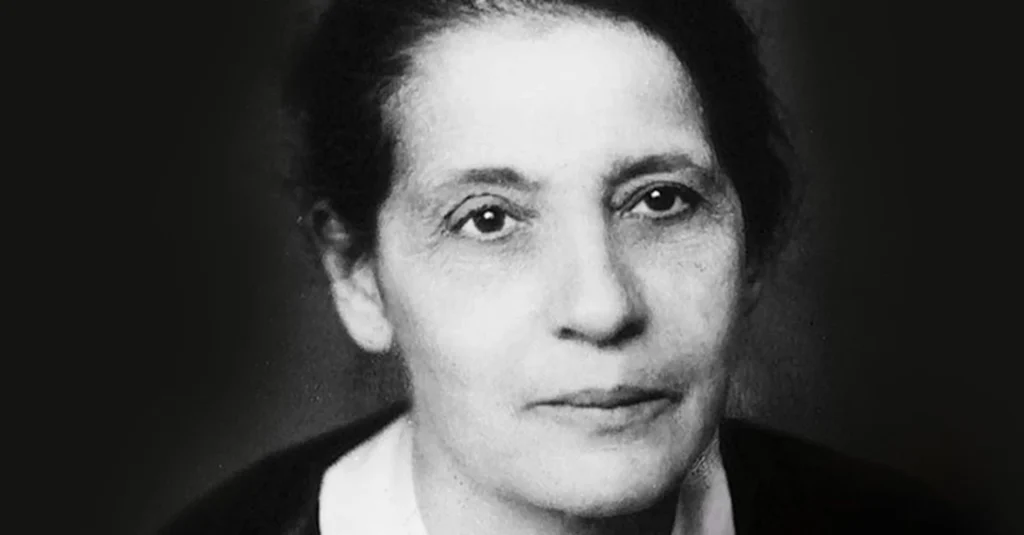
In 1997, the International Union of Pure and Applied Chemistry made official what had been pending for years: element 109 on the periodic table would be named Meitnerium. A synthetic, radioactive element, unstable by nature, existing only in laboratory conditions for fractions of a second before decaying into something else. The symmetry is almost too precise to be accidental. The heaviest thing science could offer her — a place in the fundamental grammar of matter itself — and it lasts, in its physical instantiation, for milliseconds.
She had been dead for nearly three decades by then. She never held a Nobel Prize. She never held a permanent academic position in Germany during the years when she did her most consequential work. She was, for most of her professional life, officially a guest in her own laboratory. And yet here, in 1997, her name was inscribed into the architecture of the universe — into the table that organizes all known matter, the closest thing science has to a sacred text. Meitnerium. The only element named exclusively after a woman who is not a mythological figure, not a queen, not a goddess borrowed from ancient narrative. A real woman. A physicist who worked in real rooms, with real instruments, in real fear, and produced real knowledge.
Walter Benjamin wrote, in his Theses on the Philosophy of History composed in 1940 — the same year he died fleeing the very regime that had expelled Meitner — about what he called Jetztzeit, now-time. Not the linear march of progress that official history loves to narrate, but the sudden rupture, the moment when a fragment of the past blasts open into the present with the force of something unfinished. For Benjamin, genuine historical recognition is not a smooth continuation of the past into the future. It is a collision. It is the moment when what was suppressed returns not gently but violently, not as resolution but as interruption.
Naming an element after Meitner in 1997 is a perfect Jetztzeit, except for the one detail that makes it unbearable: she cannot receive it. The grammar of belated justice is always written in a language the living cannot read. This is not incidental. It is structural. Institutions protect themselves from accountability by granting honors at the precise moment when accountability is no longer possible. The Nobel committees, the universities, the academies — they did not fail to recognize Meitner because they lacked the capacity for justice. They failed because justice would have cost them something. Posthumous recognition costs nothing. It costs less than nothing. It actually rehabilitates the institutions themselves, allows them to absorb her legacy as evidence of their own eventual correctness.
There is something particular about matter, though, that resists this laundering. An element is not a prize. It is not a building named after someone, not a lecture series, not a commemorative stamp. It is a fact about the structure of reality. Meitnerium exists — briefly, violently, in conditions that require extraordinary human effort to create — whether or not any institution chooses to remember why the name was chosen. The periodic table does not care about the Nobel committee’s record. It does not care about the University of Berlin’s policies on women in the early twentieth century. It holds the name the way physics holds a law: without sentiment, without revision, without the possibility of a footnote that softens the original error.
And yet Benjamin’s question remains open, lodged in the chest like something that cannot be swallowed. What does it mean to name the world after someone who was not permitted to fully inhabit it? What does it mean that the recognition comes in a form so permanent, so indifferent to human time, so utterly beyond her reach? Meitner once said that physics had given her many happy moments. She said this having been stripped of nationality, exiled from her country, and denied the prize that was half hers. The happy moments were real. So was everything that surrounded them.
⚛️ Women Who Reshaped Science and the World
Lise Meitner’s discovery of nuclear fission stands as one of the most transformative moments in modern science, achieved despite relentless institutional barriers and political persecution. Her story resonates deeply with those of other pioneering women who refused to be erased from the history of scientific thought. Explore these portraits of extraordinary minds who changed what we know about life, matter, and the boundaries of human knowledge.
Rosalind Franklin: Life and Discoveries
Rosalind Franklin‘s meticulous X-ray crystallography work was essential to unveiling the double-helix structure of DNA, yet her contribution was long overlooked and attributed to others. Like Meitner, she worked in an era when women scientists faced constant marginalization within academia. Her story is both a scientific triumph and a powerful testament to resilience in the face of systemic exclusion.
GO TO THE SELECTION: Rosalind Franklin: Life and Discoveries
Marie Curie: Life and Works
Marie Curie remains the most iconic figure in the history of women in science, having won two Nobel Prizes in different disciplines at a time when women were barely admitted to universities. Her relentless dedication to radioactivity research parallels Meitner’s own lifelong pursuit of nuclear physics. Together, their legacies form the twin pillars of modern radiochemistry and nuclear science.
GO TO THE SELECTION: Marie Curie: Life and Works
Barbara McClintock: Life and Discoveries
Barbara McClintock spent decades working in relative isolation before her groundbreaking discovery of genetic transposition was finally recognized with the Nobel Prize in Physiology or Medicine in 1983. Her patient, meticulous approach to maize genetics mirrors the quiet determination that defined Meitner’s scientific career. McClintock’s story invites reflection on how scientific communities often lag behind the visionaries within them.
GO TO THE SELECTION: Barbara McClintock: Life and Discoveries
Rita Levi-Montalcini: Life and Works
Rita Levi-Montalcini discovered Nerve Growth Factor under extraordinarily difficult conditions, conducting research clandestinely during World War II while in hiding as a Jewish scientist in fascist Italy. Her perseverance in the face of racial persecution echoes the experiences of Lise Meitner, who fled Nazi Germany in 1938 yet continued her research in exile. Levi-Montalcini’s life is a profound example of how intellectual courage can survive even the darkest historical circumstances.
GO TO THE SELECTION: Rita Levi-Montalcini: Life and Works
Discover Science, Art and Independent Thought on Indiecinema
If the stories of these pioneering women inspire you, Indiecinema is the streaming platform where intellectual curiosity meets independent cinema. Explore documentaries, author films, and editorial content that celebrate the minds who changed history — all in one place, far from the mainstream.
👉 EXPLORE THE CATALOG: Watch Indie Films in Streaming
A vision curated by a filmmaker, not an algorithm
In this video I explain our vision