
The Silence That Speaks
You walk into a room where a man sits cross-legged on a low wooden platform, and the first thing you notice is that everyone around you has stopped breathing in the ordinary way. They are present with a concentration you have never seen in a lecture hall or a cathedral or a courtroom — those spaces specifically designed to produce attention. Nothing here was designed. There is no altar, no podium, no amplification. The man on the platform has not spoken a single word in twenty-three years, and yet the room is saturated with something that functions, undeniably, as communication. You feel it before you can name it, and the fact that you cannot name it is the first uncomfortable thing this encounter asks of you.

Merwan Sheriar Irani, who would become known to millions as Meher Baba, observed a silence he declared on July 10, 1925, in Meherabad, a small settlement in Maharashtra, India, that he himself had founded. He was thirty-one years old. He would maintain that silence without a single public deviation until his death on January 31, 1969. Forty-four years. During that period, he communicated first through an alphabet board, pointing to letters to spell out words, and later through a unique system of hand gestures so fluid and precise that his close disciples could render full sentences from a movement of the fingers. He wrote books. He gave darshan to hundreds of thousands of people across India, Europe, and the United States. He directed the construction of communities, hospitals for the poor, and ashrams. He did all of this without producing a single sound from his vocal cords that could be called speech, and he never explained, to the satisfaction of any skeptic, exactly why — except to say that when he broke his silence, the word he spoke would circle the world.
What is worth examining is not whether you believe that or find it absurd, but rather what the absurdity reveals about where you have been trained to locate authority. Western epistemology, since at least the Enlightenment’s codification of reason as the supreme instrument of truth, has treated articulate speech as the medium through which valid knowledge travels. Jürgen Habermas spent decades building an entire theory of communicative rationality around the premise that legitimate consensus emerges from unconstrained rational discourse — from speaking, arguing, defending, refuting. The mouth is the organ of credibility. The person who cannot or will not speak is, in this framework, epistemically suspect: a mystic, a madman, or a manipulator. The silence of Meher Baba threatens this framework not because it is supernatural but because it demonstrably worked. People of sharp and trained intelligence — not only peasant farmers in rural Maharashtra but also writers, musicians, and philosophers in mid-century America and Europe — left encounters with him fundamentally altered, without having received a single spoken sentence.
The philosopher Charles Sanders Peirce, in his work on semiotics in the late nineteenth century, argued that meaning is not located in words but in the relation between signs and their interpreters. A sign is anything that stands for something else to somebody. Silence, in this framework, is not the absence of communication. It is a sign of extraordinary density, precisely because it refuses the normal economy of exchange. When someone speaks, they give you something to argue with. When someone maintains absolute silence across four decades, they give you nothing to deflect — only the mirror of your own expectation, your own hunger for the word that will finally explain things.
And that hunger is the real subject. Not Meher Baba’s silence, but the shape of the hole it exposes in people who encounter it — the sudden awareness that they have been waiting, without knowing it, for someone to say something that justifies everything they have endured.
I Am Nothing
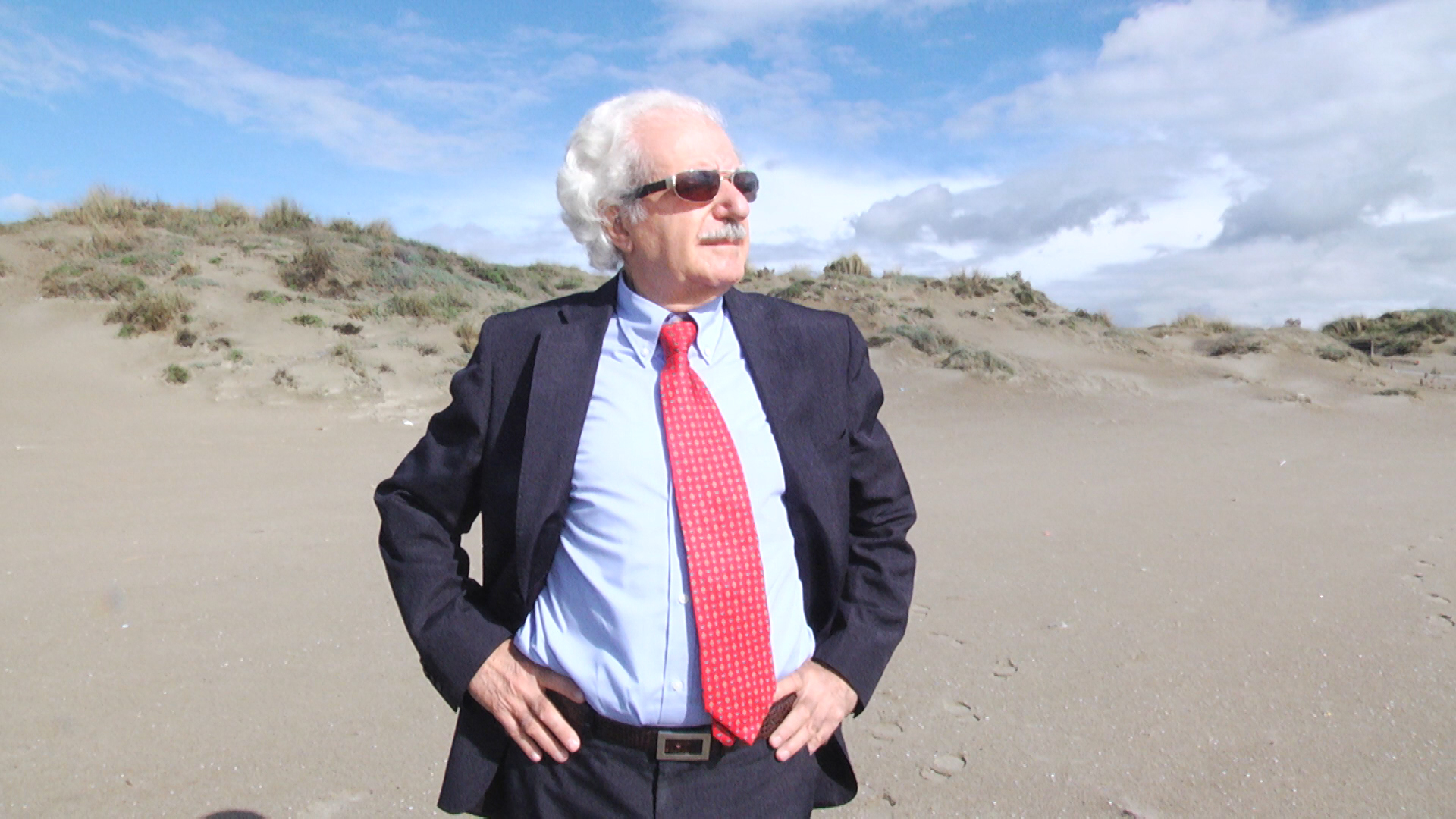
Drama, thriller, by Fabio Del Greco, Italy, 2015.
The story revolves around Vasco, a Roman builder who, at the age of 74, enjoys a life of absolute comfort. His human parable takes a dramatic turn when a mysterious encounter leads him to an ambush. Having survived, but marked by a long coma, Vasco wakes up with a new sensitivity, developing an intimate and poetic bond with nature. This new relationship with the world around him leads him to deeply explore himself, in an internal and external journey. through Italy, the United States and India, in search of a higher meaning and a cure. In parallel, the threat of a planetary cataclysm adds an epic dimension to the story.
I Am Nothing explores universal themes such as time, memory, oblivion and the connection with nature. Fabio Del Greco creates an existential drama full of food for thought. The director skillfully combines different visual materials, mixing archive images with nature photographs and dreamlike visions. This visual experimentation translates into an editing that captures the viewer's attention, guiding him through a cycle of creation and destruction. The sequences that alternate the buildings, Vasco's pride, with Indian landfills and natural landscapes create a hypnotic rhythm, underlining the beauty and fragility of life. Vasco's existential journey is a hymn to transformation and rebirth. The evolution of the protagonist, from unbridled luxury to the rediscovery of purity, represents a powerful metaphor on the meaning of life and the need to reconnect with authentic values. Io sono nulla stands out for its ability to combine introspection and visual experimentation, offering a suggestive and engaging narration. It is a film that invites us to reflect on the human condition, on our relationship with power and nature, and on the possibility of finding ourselves through change. A work that leaves its mark and lends itself to multiple readings.
LANGUAGE: Italian
SUBTITLES: English, Spanish, French, German, Portuguese
Merwan Sheriar Irani Before the Myth
He was born on February 25, 1894, in Pune, into a family that carried the particular weight of displacement with quiet dignity. His father, Sheriar Irani, had walked out of Persia as a young man with almost nothing — a Zoroastrian in search of something he could not name, crossing into British India and eventually settling into the modest life of a wine shop owner in Poona’s Sassoon Road quarter. The son who arrived into that household was not yet a symbol, not yet a silence, not yet a name repeated across three continents. He was simply Merwan, a boy who spoke Gujarati at home, attended St. Vincent’s High School run by German Jesuits, and showed the kind of restless intelligence that gets noticed by teachers and quietly envied by peers.
What tends to get erased in the biography of anyone later declared divine is precisely the texture of their ordinary formation — the specific intellectual pressures, the social contradictions, the years when nothing had been decided yet. Merwan Sheriar Irani enrolled at Deccan College in Pune around 1911, one of the oldest and most prestigious institutions in the Bombay Presidency, founded in 1821 when the idea of educating Indians in Western frameworks was itself a contested colonial experiment. He studied English literature there, and the records suggest a young man genuinely absorbed in poetry — Hafiz in particular, the fourteenth-century Persian mystic whose ghazals circulate around the annihilation of the self in love with an almost dangerous playfulness. It is not incidental that this was his literary inheritance. Hafiz did not write about transcendence as an escape from the world but as a kind of irreversible contamination by it. The student reading those verses in Pune was already being shaped by a tradition that treated intoxication and dissolution as epistemological states, not metaphors.
The encounter that would redirect everything came in 1913, when Merwan, still a college student, was introduced to Hazrat Babajan, an elderly Muslim woman who had been living under a neem tree near Char Bawdi in Pune for years, regarded by many as a majzoob — one so absorbed in divine reality as to be outwardly incoherent, ungovernable, beyond ordinary social logic. She kissed him on the forehead. According to every account that survives, including those given by Merwan himself decades later, that contact produced a state of radical interior disruption lasting months — what he described as a complete dissolution of normal consciousness. Whether one receives that account as mystical fact, psychological crisis, or the kind of transformative encounter that occasionally reorganizes a human being’s entire operating system, the biographical consequence is undeniable: he did not return to college in the same way, and he did not return to ordinary life at all.
The years between 1913 and 1921 were years of a different kind of education — moving between figures like Sai Baba of Shirdi and Upasni Maharaj of Sakori, absorbing frameworks that crossed Hindu, Muslim, and Zoroastrian cosmologies without belonging entirely to any of them. By 1921, he had gathered around him a small group of men who would remain with him for the rest of his life, forming what would later be called the mandali. These were not seekers browsing spiritual options. They were people who had, by whatever process, concluded that this particular human being was the axis around which they needed to organize their existence. The first core disciples included figures like Gustadji, Beheram, and Chanji — names that do not appear in general histories but matter here precisely because their presence confirms something historians tend to undervalue: that charismatic authority does not emerge in a vacuum but always crystallizes around very specific social and emotional configurations, at a specific historical moment, in a specific place.
Pune in 1921 was not a neutral backdrop.

The Architecture of Silence
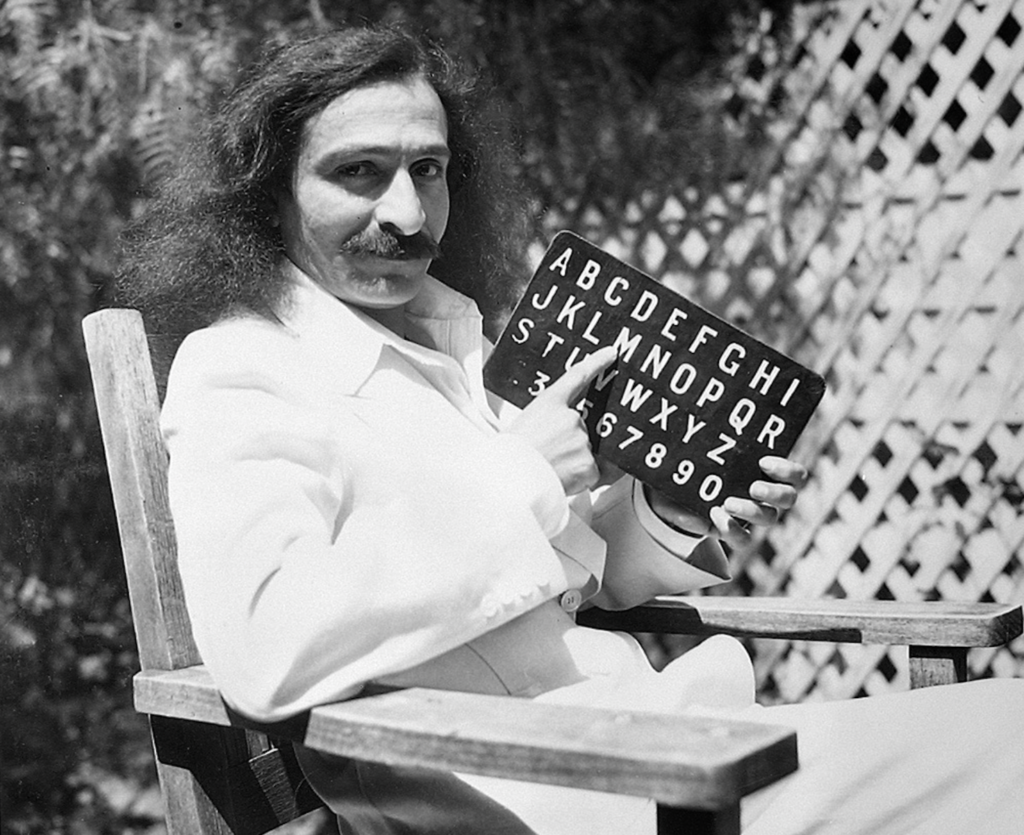
You are standing in a room with someone who has not spoken in forty years, and you realize, within the first few minutes, that you are the one who feels exposed.
There is something genuinely destabilizing about a person who refuses the primary instrument through which modern identity is performed and verified. Meher Baba stopped speaking on July 10, 1925, in Persia, and did not utter another word for the remaining forty-four years of his life. He communicated first through an alphabet board, later through a private gestural language developed with his closest disciples, and eventually through hand signs alone, signs so refined and rapid that trained interpreters could render entire philosophical expositions from them in real time. The silence was not symbolic in the theatrical sense — it was operational, daily, logistical. He directed communities, resolved disputes, gave spiritual instruction, and corresponded internationally without producing a single spoken syllable.
The difficulty is that Western intellectual culture, from Aristotle’s definition of the human as the animal endowed with logos onward, has bound rational authority to the act of speaking. Language, in this tradition, is not merely communication — it is the evidence of mind, the credential of presence. Jacques Derrida spent much of his career dismantling what he called the metaphysics of presence embedded in Western thought, the assumption that the spoken word carries an immediacy and authenticity that written or gestural meaning cannot — but even Derrida’s critique was itself delivered in lectures, in spoken seminars, in the very medium it interrogated. The cultural assumption runs so deep that even its most sophisticated critics could not fully step outside it. Meher Baba did not critique the assumption. He simply vacated it, for decades, in public, in front of thousands of people.
This matters differently when placed against the specific political texture of the twentieth century. The period between 1925 and 1969 was the high age of the commanding voice — Lenin’s orations, Mussolini’s balcony spectacles, Roosevelt’s fireside radio addresses, Churchill’s wartime broadcasts, the televised charisma of Kennedy, the preacher cadences of civil rights movements. Leadership during this era was acoustically constituted. The microphone was not merely an amplification device but a legitimizing technology. Power announced itself through sound. Into this landscape, a man with a global following, who traveled across continents, met heads of state, attracted philosophers, artists, and ordinary laborers alike, conducted his entire public existence in unbroken silence. The contrast is not incidental. It reveals how much of what passes for authority is actually performance of a very particular and historically contingent kind.
There is a clinical dimension here that goes unexamined. In most institutional contexts — psychiatric, legal, bureaucratic — a person who refuses to speak is presumed to be withholding, disturbed, or noncompliant. Silence reads as pathology or resistance when the speaking self is taken as the default condition of full personhood. William James, in The Varieties of Religious Experience published in 1902, documented the recurring testimony of mystics across traditions that the deepest states of awareness were precisely those most resistant to verbal articulation — not because they were ineffable in some romantic sense, but because the architecture of language itself imposes categorical distinctions that such states refuse. Meher Baba did not invoke this as theory. He simply lived inside the consequence.
What accumulated over those forty-four years was a body of followers who had learned, under sustained pressure, to receive meaning through attention rather than audition. They had been trained — involuntarily, structurally — to read posture, timing, proximity, and gesture with the same precision others gave to syntax. Whether this constitutes a spiritual practice or a radical reorganization of semiotic habit is a question that may not resolve into a clean answer, which is perhaps exactly what made the whole arrangement so difficult for observers who required one.
God-Man as Theological Provocation
You have probably sat across from someone who spoke about themselves with a certainty so absolute it made you uncomfortable, and your first instinct was not to engage the content of what they said but to diagnose the speaker. This is not a personal failing. It is the trained reflex of a civilization that, since at least the late nineteenth century, has routed all extraordinary self-claims through the machinery of clinical suspicion, producing a world where the only socially acceptable response to a man who says he is God is to call his psychiatrist.
Meher Baba’s declaration that he was the Avatar of the Age — the direct manifestation of God in human form, appearing cyclically across history as Zoroaster, Rama, Krishna, Buddha, Jesus, Muhammad, and now again — did not arrive as metaphor or spiritual ambition. It arrived as flat ontological statement, repeated without qualification across five decades, maintained through illness, through physical suffering, through the 1945 automobile accident in the Mojave Desert that shattered his hip and left him in permanent pain, through a second accident in 1956 near Satara that broke bones in both legs. The persistence of the claim under conditions that would have invited any ordinary person to reconsider is itself a kind of evidence, though not the kind Western epistemology knows how to process.
The concept he was invoking has a genealogy entirely legible within Hindu cosmological thought. The Bhagavata Purana, composed somewhere between the eighth and tenth centuries CE, systematizes what earlier Vedic literature had gestured toward: the doctrine of the avatar as God’s deliberate descent into the material world at moments of cosmic imbalance, when dharma has been so severely disrupted that only direct divine intervention can restore equilibrium. The Gita’s famous verse — “Whenever righteousness declines and unrighteousness rises, I manifest myself” — is not poetry in the tradition that produced it. It is a description of a recurring structural event in the architecture of time. Meher Baba placed himself within this architecture with complete seriousness, and the tradition he was drawing from had the philosophical vocabulary to receive the claim without treating it as self-aggrandizement.
The problem is that the dominant Western intellectual frameworks arrived at this claim carrying entirely different luggage. By the time Baba was making his statements publicly in the 1920s and 1930s, Freud had already published “The Future of an Illusion” in 1927, codifying what had been a creeping assumption into explicit doctrine: religious experience is wish fulfillment, and the grander the claim, the more severe the underlying pathology. What this framework cannot do, because it was not built to do it, is distinguish between a grandiose delusion and a claim that belongs to a theological tradition with coherent internal logic, historical precedent, and a community of serious practitioners who have tested it against their own experience for centuries.
The sociologist Peter Berger, writing in “The Sacred Canopy” in 1967, identified what he called plausibility structures — the social conditions that make a belief feel self-evidently true or self-evidently absurd. Baba’s claim about himself was not absurd within the devotional communities of Maharashtra or among the Zoroastrian traditions he grew up inside. It became absurd the moment it crossed into secular Western reception, not because the content had changed but because the plausibility structure had collapsed entirely. The same claim, landing on different soil, produces completely different cognitive reactions.
What this means is that the controversy surrounding Baba’s self-declaration is not primarily theological. It is a collision between incompatible epistemological frameworks, and the one currently holding institutional power — secular, clinical, post-Enlightenment — has the advantage of being able to name all competitors as primitive, deluded, or sick without ever having to actually argue with what they are saying. The avatar tradition does not need that argument settled to remain standing. It has been making the same case, in different mouths, across several thousand years of recorded thought, and the question it poses to its critics is one they have not yet found a clean way to answer: what exactly is your alternative account of what happened here?
The Mass Contacts and the Politics of Spiritual Access
You are sitting in a railway station in Andhra Pradesh in 1943, and a man whose lips have not moved in eleven years is kneeling in front of someone the rest of the platform treats as invisible. Not metaphorically invisible. Literally stepped over, avoided, the kind of human being whose proximity clears a radius of empty space the way a drain does. Meher Baba is washing this person’s feet.
Between 1941 and 1945, across Gujarat, Maharashtra, Andhra Pradesh, and Karnataka, Meher Baba conducted what his circle called the Mass Contacts — a systematic, logistically deliberate program of seeking out lepers, the mentally ill, the destitute, and the wandering sadhus who had fallen so far outside economic legibility that they did not register as citizens in any meaningful sense. The numbers documented by his mandali, the inner group of disciples who recorded these movements, run into the hundreds of thousands. Not hundreds. Hundreds of thousands of individual contacts, each accompanied by physical touch, gifts of cloth and food, and what Baba described through his alphabet board as the transmission of something that required no literacy to receive.
The sociologist Max Weber, writing in “The Sociology of Religion” published posthumously in 1922, drew a distinction between the religion of the virtuosi — those with sufficient leisure, education, and cultural capital to pursue soteriological refinement — and the religion of the masses, which he characterized as concerned primarily with magical efficacy and immediate relief. Weber was not contemptuous, exactly, but he was hierarchical. What Meher Baba’s Mass Contacts disturbed was precisely this taxonomy, because the choice was not pastoral charity extended downward from a summit of spiritual achievement. It was ontological claim-making. Baba’s insistence, repeated through intermediaries since he communicated nothing verbally, was that the mad and the afflicted were not spiritually behind the educated seeker — they were, in many cases, spiritually ahead of them, their suffering having burned away the ego-structures that the comfortable spent decades in meditation trying to dissolve.
This is where the political texture of the period becomes impossible to ignore. India in 1943 was not merely poor. It was undergoing the Bengal Famine, in which somewhere between two and three million people died while British colonial administration made decisions about grain exports that historians including Madhusree Mukerjee have documented as deliberate or at minimum catastrophically indifferent. The bodies Meher Baba was touching were bodies that empire had already decided were expendable. His movement’s geography — provincial railway lines, pilgrimage routes, the edges of towns where leper colonies were physically segregated — traced the exact outline of colonial abandonment.
There is something philosophically destabilizing in the recognition that spiritual access was being theorized, in this moment and by this figure, as inversely proportional to social standing. Not as a romantic inversion, not as the noble savage rebranded in Eastern garb, but as a structural claim rooted in his reading of the Sufi concept of fana — the annihilation of self that the mystics of the Chishti and Naqshbandi orders had described as the precondition of union with the divine. If fana required the ego’s collapse, then those whom suffering had already collapsed were not beginners. They were, by this logic, practitioners without knowing it, initiates without ceremony.
What the educated Western seekers who began arriving at his ashram in Meherabad during this same period encountered, then, was not simply a silent teacher. They encountered evidence that they had already been categorized — that their very capacity to seek, to travel, to read his books and write him letters, marked them as belonging to a spiritual demographic defined by what it still had to lose. The encounter with Baba’s hierarchy was not comforting to those who expected spiritual aspiration to correlate with spiritual proximity. He had already shown, in the red dust of Andhra Pradesh, where he thought the real congregation was.
A vision curated by a filmmaker, not an algorithm
In this video I explain our vision
Don’t Worry, Be Happy as Cultural Lobotomy

You are standing in a checkout line sometime in the late 1980s, and the song is playing again. It has been playing everywhere for months — in supermarkets, in dentist offices, in the background of television commercials selling things no one needs. The voice is unaccompanied, layered over itself through overdubbing, bright and almost childlike. You find yourself humming along before you have consciously decided to, which is precisely the point.
Bobby McFerrin’s recording reached number one on the Billboard Hot 100 in September 1988 and won four Grammy Awards, including Record of the Year and Song of the Year. It became one of the fastest-rising singles in American pop history, and its title — borrowed directly from a phrase Meher Baba had distributed on printed cards to his followers throughout the mid-twentieth century — entered the cultural bloodstream as a kind of permanent ambient instruction. The problem is not that the song was popular. The problem is what popularity required the phrase to shed in order to travel so far.
Meher Baba’s original formulation carried a specific metaphysical architecture. When he wrote “Don’t worry, be happy” — and he communicated it in writing because he had observed silence from 1925 until his death in 1969 — he was not offering a mood tip. He was describing the experiential consequence of what he called the annihilation of the ego-self, a state in which the ordinary anxious subject who performs worry has itself dissolved. The instruction was paradoxical by design: the entity capable of worrying is the same entity that must cease to exist for genuine happiness to emerge. This places the phrase in direct dialogue with traditions of ego-dissolution stretching from Vedantic non-dualism through the Sufi concept of fana, the annihilation of the self in divine presence, which Baba had absorbed through his early years with figures like Upasni Maharaj in Sakori, India. The happiness he gestured toward was not a feeling to be achieved but a condition revealed when the machinery of chronic self-concern breaks down entirely.
What the McFerrin phenomenon accomplished, with remarkable efficiency, was the surgical removal of that architecture while preserving the surface of the words. The phrase was detached from any anthropology of the self, any theory of consciousness, any claim about the nature of suffering, and redeployed as pure behavioral prescription: stop worrying, feel better. This is not a simplification of Baba’s meaning. It is its structural opposite. His version required the dissolution of the worrier. The pop version addressed the worrier directly, validated their existence, and asked only that they adjust their emotional settings. The self was not only preserved but centered and flattered.
Theodor Adorno, writing in his 1941 essay “On Popular Music,” described how the culture industry absorbs radical or dissonant material by standardizing its form until only the most frictionless element survives. What he could not have anticipated was how efficiently this process would work on explicitly spiritual content, where the most threatening idea — that the ordinary self is an illusion producing its own suffering — could be retained as a lyric while everything that gave it teeth was quietly dissolved in the production. The phrase survived. Its demand did not.
This dynamic is not unique to Baba, but his case makes the mechanism unusually legible because the distance between source and product is so measurable. Millions of people who have whistled that melody have never encountered the man who originated the words, the silence he maintained for forty-four years, or the cosmological framework in which those words functioned as an endpoint rather than a beginning. They received the sedative without the diagnosis. And a sedative administered without diagnosis does not heal anything — it simply makes the patient comfortable enough to stop asking what is wrong.
Love as Ontological Claim
You are sitting across from someone you love and you realize, with a quality of attention that borders on vertigo, that you do not actually know what is happening inside them. Not their history, not their surface preferences — something more structural than that. You do not know what it is to be them encountering you. This gap, which most people spend their lives papering over with habit and assumption, is precisely where Meher Baba chose to build his entire metaphysical architecture.
His claim was not sentimental and it was not therapeutic. When Baba stated, with the flat certainty he brought to cosmological declarations, that God is Love, he was not offering a consolation or a poetic substitution for more rigorous language. He was making an ontological assertion: that love is not a feeling which arises within existence but the actual substance from which existence is constituted. Matter, consciousness, the apparently brute fact of there being something rather than nothing — these were, in his framework, not prior conditions into which love subsequently appears, but love’s own unfolding toward self-recognition. The universe is not a place where love sometimes occurs. It is what love looks like from the outside.
Simone Weil arrived at something adjacent from an entirely different direction. Writing in the early 1940s, she argued in her notebooks — collected posthumously as Waiting for God in 1951 — that the highest form of love is not feeling but attention: a radical suspension of the self’s habitual projections, a willingness to ask another person “what are you going through?” and then actually wait for the answer without contaminating it with your own need. Weil’s attention is almost violent in its demands. It requires the erasure of the ego’s interpretive machinery, the refusal to make the other person into a mirror. What she called affliction — suffering in its most dehumanizing form — could only be met, she believed, by a witness who had learned to be fully present without flinching, without rescuing, without converting the other’s pain into something manageable for themselves.
Erich Fromm, working in the more empirical register of mid-century psychology, reached his 1956 argument in The Art of Loving through a different leverage point but arrived at a structurally similar problem. He identified what he called the modern confusion between falling in love and the practice of loving — the cultural insistence on treating love as something that happens to passive recipients rather than something that requires discipline, knowledge, and sustained effort. For Fromm, love is a capacity that must be developed, like musicianship or philosophical thinking, not a state to be found in the right person. The widespread disappointment of modern intimacy was, in his reading, a direct consequence of mistaking the former for the latter.
Where Baba’s framework diverges from both is precisely on the question of origin. Weil’s attention and Fromm’s discipline presuppose a self that chooses to practice, a will that can be turned toward the other. They describe love as something human beings can cultivate — arduously, partially, against constant resistance from their own psychology. Baba’s claim cuts beneath this. If love is the fundamental substance of reality and not an achievement of the evolved psyche, then what passes for human love — even in its most disciplined and attentive forms — is already that same love, obscured by the accumulated weight of ego, expressing itself imperfectly through instruments not yet clean enough to carry its full charge. The task is not construction but excavation. You are not building something new. You are removing what has been placed over something that was never absent.
This is where the teaching becomes genuinely difficult to hold, because it simultaneously validates every authentic impulse toward connection and renders the entire framework of spiritual achievement — the notion that you get closer to love by working harder — suspect at its foundation. The ground was always already there. The question is only what you have been standing on instead.
What Remains When the Avatar Is Gone
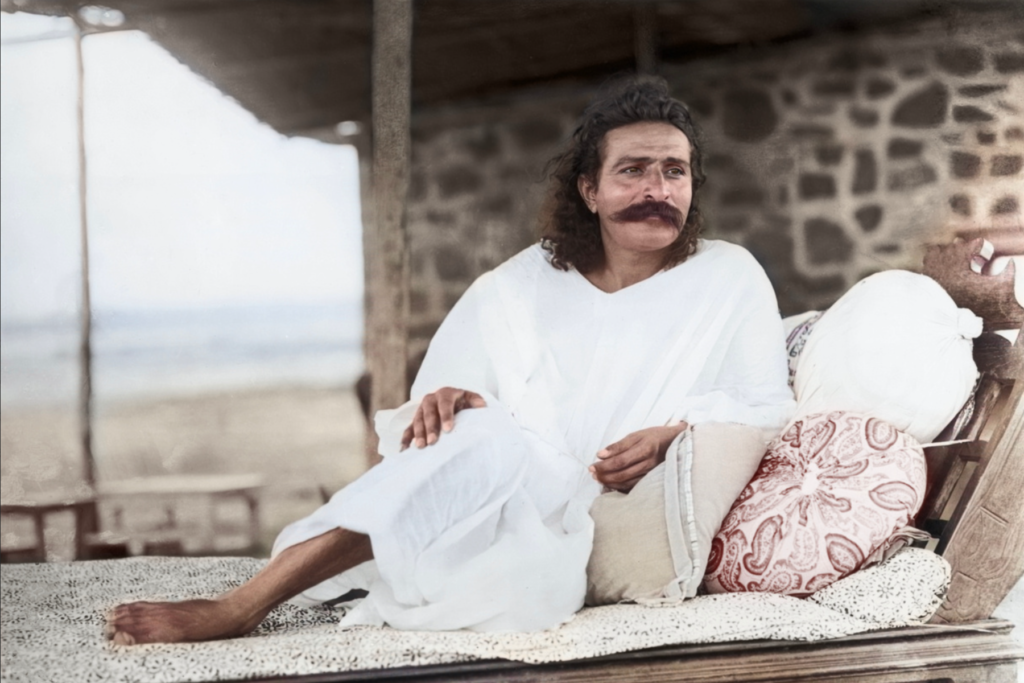
You drive for hours through the Maharashtra plateau, past sugarcane fields and dusty crossroads, and then the dome appears — white against a sky that seems too large for the land beneath it — and you understand, without anyone telling you, that you have arrived somewhere people come to feel the weight of an absence.
Meher Baba died on January 31, 1969, in Meherazad, having not spoken a single word aloud since July 10, 1925. He had communicated for decades through an alphabet board and then through hand gestures alone, and he had told his close ones that when he broke his silence, the sound would circle the earth. The silence was never broken in any audible sense. What was left behind was a tomb, a hillside in Ahmednagar district, a body of writing, and a question that has not stopped pressing itself on everyone who approaches the material honestly.
God Speaks, published in 1955, is the central theological document of what Baba produced. It is not a short devotional text. It is a systematic cosmology running to several hundred pages, mapping the evolution of consciousness through 7 planes of existence and 73 types of mental states, arguing that God descends into creation and laboriously ascends back through every form of life over millions of years to finally recognize Himself in the human being. The architecture is elaborate, almost scholastic in its precision, and it sits in unresolved tension with the most repeated assertion in Baba’s oral teaching: that intellectual understanding is the primary obstacle to real experience, that the mind’s craving to organize and categorize is exactly the cage it must eventually abandon. To produce a systematic theology and simultaneously insist that all systems are traps requires the reader to hold two incompatible things at once, and most readers resolve the contradiction too quickly, in one direction or the other.
The Meherabad trust, formally constituted under Indian law and operating with considerable organizational complexity, now manages pilgrimage infrastructure, archives, publications, and a community of permanent residents who live on the hill. Hundreds of thousands of visitors have made the journey since 1969. There is a guest registration system, a schedule of prayer times, a library, a medical dispensary continuing work Baba began with the poor and the mast-afflicted in the 1940s. The institution is real, functional, and by any sociological measure successful. Max Weber wrote in Economy and Society in 1922 that the death of a charismatic leader triggers what he called the routinization of charisma — the inevitable bureaucratic crystallization of the original living force into stable, reproducible, and ultimately manageable forms. Weber did not consider this a corruption so much as a structural inevitability, the way a river delta fans out when the single channel can no longer hold the volume. What he could not account for is what happens when the original teaching explicitly predicted its own institutionalization and named it as the primary spiritual danger.
Baba said repeatedly, in various formulations across decades, that he had come not to establish a new religion but to awaken love in human hearts, and that anything which hardened into doctrine, hierarchy, or ritual would be a betrayal of the impulse. He said this while simultaneously creating close circles, inner circles, mandali structures, rankings of proximity to himself, and a body of written law governing how his tomb was to be maintained after death. The devotee who tries to honor both the instruction and the institution finds no stable ground, and that instability may be precisely the point — or it may simply be the ordinary human failure to escape the shapes we inherit.
What remains when the avatar is gone is exactly what remains when any extraordinary human life concludes: the imperfect, devoted, sometimes self-serving effort of ordinary people to keep something alive that was, in its original form, inseparable from the particular presence that animated it.
🌿 Paths of the Spirit: Masters and Seekers
The life and teachings of Meher Baba invite us into a world where spiritual awakening, divine love, and inner silence converge. These related articles trace the broader landscape of mystics, sages, and contemplative traditions that share the same luminous terrain. Each path is unique, yet all point toward the same boundless horizon.
Paramahansa Yogananda: Life and Works
Paramahansa Yogananda brought the ancient science of kriya yoga to the Western world, weaving together devotion, meditation, and direct experience of the divine. Like Meher Baba, he emphasized the living presence of God within each soul and the transformative power of a realized master. His autobiography remains one of the most widely read spiritual classics of the modern era.
GO TO THE SELECTION: Paramahansa Yogananda: Life and Works
Ramana Maharshi: Life and Teachings
Ramana Maharshi, the sage of Arunachala, taught through radical self-inquiry and the transformative power of silent presence — qualities that resonate deeply with Meher Baba’s own use of silence as a spiritual instrument. His teaching of ‘Who am I?’ stripped away every layer of illusion to reveal the pure Self beneath. Both masters exemplified that the highest transmission often requires no words at all.
GO TO THE SELECTION: Ramana Maharshi: Life and Teachings
Jiddu Krishnamurti: the Man Who Refused to Be God
Jiddu Krishnamurti, like Meher Baba, was proclaimed by a major spiritual movement to be a world teacher, yet he walked a singular and often controversial path. His radical rejection of organized religion and spiritual authority challenged seekers to find truth without dependence on any guru or doctrine. The parallels and contrasts with Meher Baba’s approach to discipleship and divine manifestation make for profound reflection.
GO TO THE SELECTION: Jiddu Krishnamurti: the Man Who Refused to Be God
Sri Aurobindo: Life and Works
Sri Aurobindo developed a visionary synthesis of Vedantic philosophy and evolutionary spirituality, seeing human consciousness as a field of ongoing divine transformation. His concept of the supramental descent bears striking resonance with Meher Baba’s proclamation of a new spiritual dispensation for humanity. Together, these two figures represent the bold Indian mystical thought that sought to reshape the spiritual destiny of the modern world.
GO TO THE SELECTION: Sri Aurobindo: Life and Works
Discover the Cinema of the Soul on Indiecinema
If these spiritual journeys have stirred something within you, Indiecinema’s streaming platform offers a curated selection of independent and documentary films that explore mysticism, consciousness, and the search for meaning beyond the ordinary. Step into the infinite maze of cinema and discover stories that illuminate the invisible dimensions of human experience.
👉 EXPLORE THE CATALOG: Watch Indie Films in Streaming
A vision curated by a filmmaker, not an algorithm
In this video I explain our vision

