
The Boy Who Saw Through the Veil
You are standing in a room in Calcutta in 1893, and someone is dying in front of you. The air is thick with the particular heaviness of Bengali summer, the kind that presses against skin like a second body, and the adults around you have arranged their faces into the careful expressions people wear when they believe the worst thing imaginable is happening. But you are a child, perhaps eight years old, and you are not afraid. You are looking at the dying person — a relative, someone whose face you know as well as your own hands — and what you feel is not grief and not terror but something closer to recognition, as though you have witnessed this precise transition before, as though the boundary everyone else in the room is mourning does not, from where you are standing, appear to exist at all.

This child was born Mukunda Lal Ghosh on January 5, 1893, in Gorakhpur, in the United Provinces of British India, the fourth of eight children of Bhagabati Charan Ghosh, a disciplined Bengal Nagpur Railway executive with deep ties to the Kriya Yoga lineage of Lahiri Mahasaya. The household was prosperous, orderly, shaped by a father who kept a photograph of his guru above his desk and a mother who, by multiple accounts, possessed an interiority so vast and still it disturbed people who expected mothers simply to manage. Yogananda would later write in his 1946 autobiography that his mother’s death when he was eleven functioned as a kind of arranged rupture, a deliberate spiritual severance engineered by forces operating above the level of ordinary cause and effect. Whether one accepts that framing or not, the biographical fact itself is stark: the child who felt no fear at deathbeds lost his mother before adolescence and did not collapse into the void she left. He turned toward it.
What is often misread as mystical precocity in the young Mukunda was something considerably more unsettling: a sustained refusal to accept the consensus description of ordinary life. The late nineteenth century in Bengal was a period of violent epistemological contest. Colonial modernity was not merely extracting resources; it was doing the slower, more intimate work of installing a particular architecture of the real — one in which matter was primary, consciousness was derivative, and any claim to direct spiritual perception was evidence of either fraud or pathology. The Bengal Renaissance, that extraordinary mid-century ferment that produced Rammohan Roy’s monotheist reformism and later Swami Vivekananda‘s electrifying 1893 address to the Parliament of the World’s Religions in Chicago — a speech delivered the very year Mukunda was born — was in large part a negotiation with this colonial epistemology, an attempt to render Indian spiritual traditions legible and defensible in terms the West had already approved. Yogananda would eventually inherit that project and exceed it in ways that made his inheritors uncomfortable.
But at eight, ten, twelve years old, the child was not negotiating. He was simply operating from a different set of perceptual premises than the people around him, and the friction this produced was not the friction of rebellion — it was something quieter and more corrosive. He was not rejecting the world. He was seeing it as it was constituted before the agreements that made it manageable. The agreements that told you death was an ending, that the body was the boundary of the self, that the sacred was a category segregated safely from the Tuesday morning.
The life that would follow — the wandering toward Himalayan masters, the eventual discipleship under Sri Yukteswar Giri in Serampore, the decades in America, the institution-building, the teaching — all of it was downstream of this early refusal to be epistemologically tamed. Not a journey toward something. A sustained insistence on something already seen.
I Am Nothing
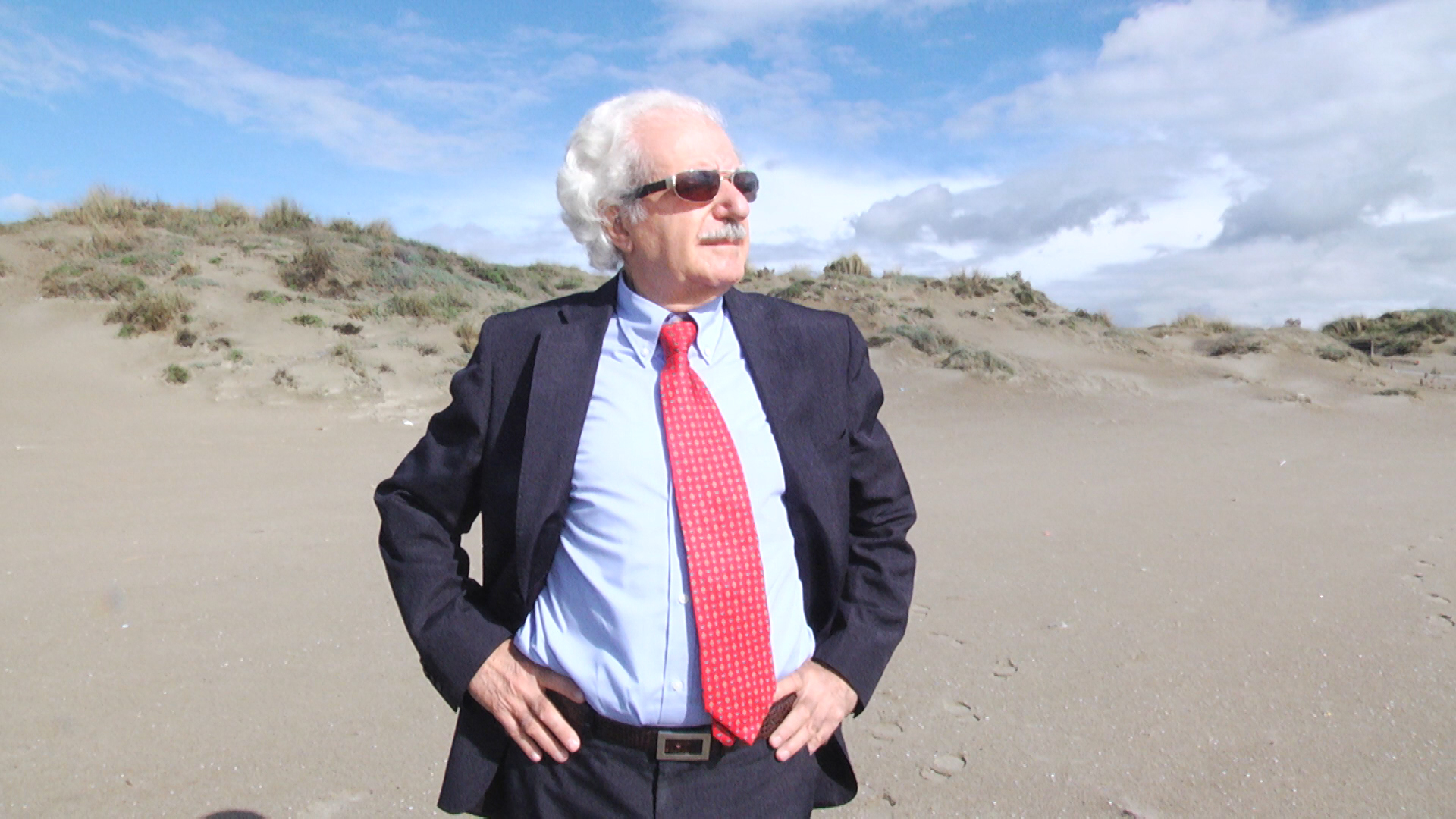
Drama, thriller, by Fabio Del Greco, Italy, 2015.
The story revolves around Vasco, a Roman builder who, at the age of 74, enjoys a life of absolute comfort. His human parable takes a dramatic turn when a mysterious encounter leads him to an ambush. Having survived, but marked by a long coma, Vasco wakes up with a new sensitivity, developing an intimate and poetic bond with nature. This new relationship with the world around him leads him to deeply explore himself, in an internal and external journey. through Italy, the United States and India, in search of a higher meaning and a cure. In parallel, the threat of a planetary cataclysm adds an epic dimension to the story.
I Am Nothing explores universal themes such as time, memory, oblivion and the connection with nature. Fabio Del Greco creates an existential drama full of food for thought. The director skillfully combines different visual materials, mixing archive images with nature photographs and dreamlike visions. This visual experimentation translates into an editing that captures the viewer's attention, guiding him through a cycle of creation and destruction. The sequences that alternate the buildings, Vasco's pride, with Indian landfills and natural landscapes create a hypnotic rhythm, underlining the beauty and fragility of life. Vasco's existential journey is a hymn to transformation and rebirth. The evolution of the protagonist, from unbridled luxury to the rediscovery of purity, represents a powerful metaphor on the meaning of life and the need to reconnect with authentic values. Io sono nulla stands out for its ability to combine introspection and visual experimentation, offering a suggestive and engaging narration. It is a film that invites us to reflect on the human condition, on our relationship with power and nature, and on the possibility of finding ourselves through change. A work that leaves its mark and lends itself to multiple readings.
LANGUAGE: Italian
SUBTITLES: English, Spanish, French, German, Portuguese
A Lineage Built on Rupture
You are sitting across from a man who has not asked you a single question about your ambitions, your past, or your readiness. He has simply looked at you. Sri Yukteswar Giri, seated in the courtyard of his Serampore ashram in the early years of the twentieth century, regarded the young Mukunda Lal Ghosh with an attention that most people would find unbearable — not because it was cruel, but because it was complete. What passed between them was not an interview. It was a verdict. And the young man who would become Yogananda accepted it, which tells you something crucial not about devotion, but about the specific grammar of power that governs how spiritual knowledge moves from one body to another.
Michel Foucault, writing in the 1970s about genealogy as a historical method, insisted that every system of knowledge is simultaneously a system of force. He argued in Discipline and Punish and later in his lectures at the Collège de France that authority does not descend from truth — rather, it produces truth, carves it, selects it, and grants it permission to circulate. This observation, developed against the backdrop of European institutions, cuts just as cleanly through the lineage Yogananda inherited. The chain running from the semi-mythic Mahavatar Babaji, undated and deliberately unverifiable, through the householder-saint Lahiri Mahasaya in Varanasi in the 1860s, and then through Yukteswar to Yogananda, was not simply a relay of techniques. It was a carefully managed authorization — a structure that decided who could speak, who would be believed, and what would be suppressed in the transmission.
Lahiri Mahasaya himself is a fascinating rupture within that structure. He was an accountant for the British government, a man embedded in colonial administrative machinery, who nonetheless taught Kriya Yoga in his private rooms to students from across caste lines, including non-Hindus. This was not a small transgression in 1870s Bengal. The Brahmanical gatekeeping of esoteric practice was not merely tradition — it was property law, in the sociological sense that Pierre Bourdieu developed in his concept of symbolic capital, where religious knowledge accrues value precisely through its controlled scarcity. Lahiri’s decision to distribute Kriya without caste restriction drained the currency of that exclusivity deliberately, and it produced resentment in exactly the quarters one would expect.
Yukteswar carried this rupture forward but formalized it differently. His 1894 text The Holy Science attempted something audacious for its moment: a structural comparison between Hindu cosmological cycles and Christian scripture, arguing their underlying unity. This was not syncretism born of softness. It was a polemical move aimed squarely at two audiences simultaneously — the colonial missionaries who held Christian revelation to be singular and superior, and the Hindu revivalists who were busy constructing a purified, bounded Hinduism in response to that colonial pressure. Yukteswar refused both defensive postures. In doing so, he created the intellectual scaffolding his student would carry to the West, but he also revealed the paradox lodged inside any lineage that defines itself against institutions: it must establish its own authority to argue against authority, which is to say it must become, in some measure, the thing it opposes.
Yogananda understood this paradox with a lucidity he rarely stated directly. When he founded the Self-Realization Fellowship in Los Angeles in 1920, incorporating it legally in 1935, he built an institution with bylaws, hierarchies, initiatory levels, and a formal body of authorized texts. The very transmission he had received outside the walls of colonial religion and Brahmanical gatekeeping he now housed inside a nonprofit organization registered with the state of California. This was not hypocrisy. It was the oldest problem in the sociology of charisma, the one Max Weber identified when he traced how every movement born from personal spiritual force eventually faces the demand to survive its founder — and discovers that survival requires exactly the structures the founder escaped.

1920 and the Invention of the Spiritual Immigrant
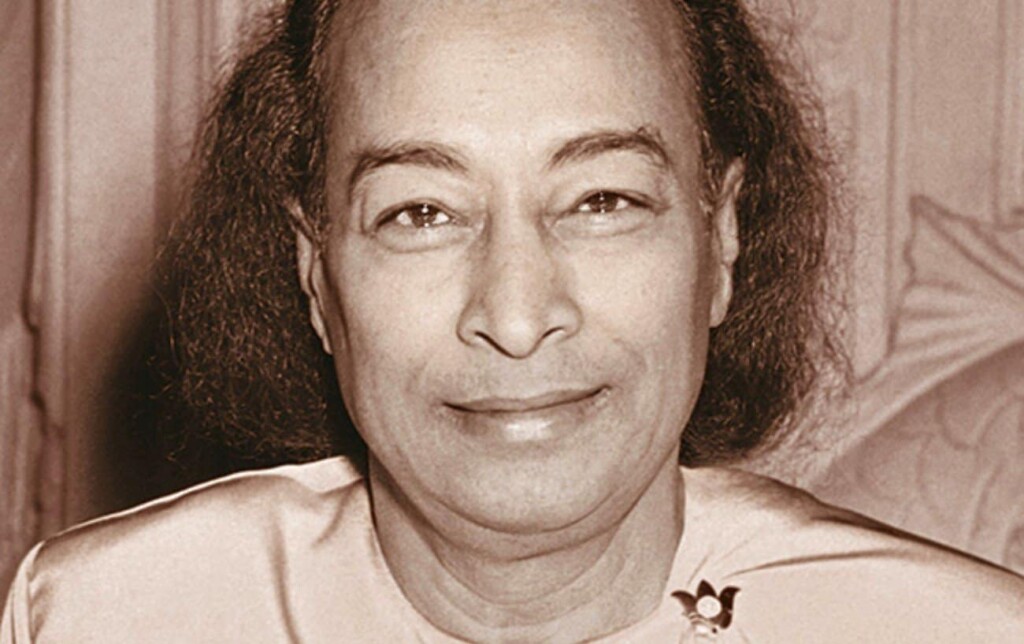
You are on a ship crossing the Atlantic in 1920, and you carry with you something that has no customs category, no tariff, no legal classification. Not goods, not labor, not disease. Something the officers at the dock cannot confiscate because they have no name for it yet.
Mukunda Lal Ghosh — who had taken the monastic name Yogananda two years earlier at the request of his guru Sri Yukteswar — arrived in Boston in September 1920 as a delegate to the International Congress of Religious Liberals. The invitation had come from the Unitarian church network, and it gave him a platform that circumstance alone could not have engineered. He was thirty-seven years old by Western reckoning, trained in the rigorous meditative lineage of Kriya yoga, and he arrived in a country that had just made his permanent presence legally impossible. The Immigration Act of 1917, passed over Woodrow Wilson‘s veto, had created the Asiatic Barred Zone — a geographic exclusion encompassing virtually all of South and Southeast Asia, designed to prevent what legislators openly called the contamination of American racial stock. A man from Bengal had no legal pathway to remain. And yet the hall in Boston was full, and people leaned forward when he spoke.
This is the fracture that most accounts of Yogananda’s life either romanticize or quietly skip. The dominant narrative prefers the metaphysical: a master comes West, the West awakens. What it suppresses is the political obscenity of the arrangement — that the same civilization presenting itself to him as spiritually hungry was simultaneously encoding his biological presence as a threat to its integrity. The 1924 Johnson-Reed Act would sharpen this further, establishing national-origin quotas that reduced Indian immigration to a numerical near-zero. Yogananda navigated this terrain not through confrontation but through a maneuver that deserves more serious examination than it typically receives: he made himself categorically difficult to place.
Max Weber, writing in “The Sociology of Religion” published in German in 1922, had already described the tension between the religious virtuoso and the institutional structure that simultaneously needs and suspects him. The virtuoso produces something the institution cannot manufacture internally — genuine pneumatic authority, the kind that does not derive from office or ordination — and so he is useful, celebrated, and kept structurally marginal. Yogananda stepped into exactly this position, and he seems to have understood it with a clarity that his serene public face rarely advertised. He founded the Self-Realization Fellowship in 1920, the same year he arrived, giving his teaching a corporate and institutional skin that could interface with American legal and financial structures. The monk became an organization. The organization could hold property, issue publications, receive donations. The man who could be deported had built something that could not be.
What the 1920s American spiritual marketplace could not absorb cleanly was the fact that Yogananda was not offering exoticism as such. The market had accommodated Hindu-adjacent figures before — Swami Vivekananda‘s appearances at the 1893 World’s Parliament of Religions had been received with a mixture of fascination and condescension that preserved the audience’s sense of superiority. Yogananda disrupted that transaction. He was not presenting India as a reservoir of mystical atmosphere available for Western aesthetic consumption. He was presenting a technical system — pranayama, meditation, the specific physiological mechanics of Kriya yoga — and arguing, without apology, that Western Christianity had lost access to precisely these techniques and was spiritually impoverished as a result. This was not a compliment dressed as a lecture. It was a diagnosis delivered to people who had not asked to be examined.
The audience kept coming back. By the mid-1920s, his lectures in Carnegie Hall were drawing crowds in the thousands. The legal apparatus said he should not exist here. The cultural apparatus said he should remain decorative. He had decided, apparently, to be neither.
The Autobiography as a Philosophical Weapon
You pick up the book expecting a life story and find yourself, somewhere around the third chapter, no longer certain what kind of reading you are doing. The prose is lucid, the English impeccable, the narrative voice warm and self-deprecating in ways that feel almost Victorian — and then a saint levitates, or a dead guru appears in a hotel room in Bombay with a physical body that leaves impressions on the bed, and the text does not flinch, does not lower its voice, does not ask your permission to continue. You are already inside it before you have decided whether to believe it.
This is the structural trick that makes Autobiography of a Yogi, published in 1946 by the Self-Realization Fellowship in Los Angeles, something other than a memoir. Georges Gusdorf argued in his 1956 essay that autobiography as a literary form is itself a Western philosophical artifact — it presupposes a self that is singular, continuous, and meaningfully separate from the world it moves through. The confession narrative, from Augustine to Rousseau, is built on the assumption that interiority is the site of truth, that examining one’s own life yields knowledge unavailable through other means. Yogananda inherited this form consciously, even strategically. He trained in English, lived in Boston, lectured to crowds in Carnegie Hall, and understood that the first-person narrative of spiritual seeking was the one container the Western reader would open without suspicion.
What he poured into that container was a cosmology organized on entirely different metaphysical premises — one in which the self is not singular but layered across five sheaths described in Vedantic philosophy, in which causality flows through planes of existence that Western empiricism had declared nonexistent by methodological fiat long before anyone had seriously investigated them. The miracles in the book are not decorative. They are load-bearing. Each one performs the same operation: it places the reader in a position where the text’s internal coherence is high, the prose’s credibility is established, the narrator’s reliability has been earned — and then it presents an event that the reader’s epistemology cannot accommodate without breaking. The reader must either break their epistemology or break faith with the text. Most readers, Yogananda calculated correctly, will not break faith with a text that has already made them feel something true.
William James had already identified this mechanism in The Varieties of Religious Experience in 1902 — the noetic quality of mystical states, meaning that they feel like knowledge, carry the conviction of knowledge, and resist being processed as mere emotion after the fact. What Yogananda added was a delivery system. James studied the phenomenon from the outside, cataloguing testimonies with the careful distance of a Harvard psychologist. Yogananda embedded the phenomenon inside a first-person narrative that moved at novelistic pace, populating itself with eccentric characters, comic situations, and a protagonist whose self-doubt made him sympathetic. By the time Kriya yoga is introduced as a technical system with physiological and metaphysical claims, the reader has already been softened into a different relationship with the possible.
The book sold over four million copies in its first decades and remained in print continuously. Steve Jobs requested that it be among the few items loaded onto the memorial iPad distributed at his funeral in 2011 — not as nostalgia, but as a document he had returned to repeatedly. That detail is worth sitting with not because of who Jobs was, but because of what it suggests about the kind of reader the book consistently produces: people who work at the edge of what is thought possible, who have developed a professional suspicion of received limits. Yogananda’s text does not convert its readers to Hinduism. It does something more unsettling — it converts them to doubt about the adequacy of whatever framework they arrived with, and then leaves them standing in that doubt with no instruction manual for what comes next.
Kriya Yoga and the Body as Argument
You have probably sat in a chair, spine curved, shoulders forward, breathing shallowly without knowing it, and felt nothing unusual about the arrangement. The body disappears when we stop interrogating it. This is not laziness — it is the inheritance of a philosophical tradition that taught the Western mind, with extraordinary thoroughness, that the body is merely the vehicle, the container, the meat that carries the real thing somewhere else. That tradition has a precise historical address: a French mathematician writing in a heated room in 1637, dividing existence into two substances so cleanly that the wound has never fully healed. What Paramahansa Yogananda brought to the West was not a rebuttal to that tradition in language — it was a rebuttal in breath, in posture, in the deliberate movement of energy along the spine. Kriya Yoga is not a technique in the way that a recipe is a technique. It is an argument, and the body is the medium in which the argument is made.
The practice itself centers on pranayama sequences and precise spinal concentration, designed to accelerate what Yogananda described in his 1946 “Autobiography of a Yogi” as the circulation of life current between the lower chakras and the brain. He claimed, drawing on the lineage of his guru Sri Yukteswar and the deeper tradition of the Yoga Sutras of Patanjali, that this circulation corresponded to a literal reversal of the life-energy’s ordinary downward and outward dissipation — a kind of evolutionary acceleration compressible, in his formulation, into years of practice what would otherwise require centuries of ordinary incarnation. Whether or not one accepts that metaphysics, the epistemological claim embedded within it is the part that survives skepticism: that the body, when trained with sufficient precision and intention, becomes a site of knowing, not merely a site of doing.
William James had already stood at the threshold of exactly this problem in 1902, when he delivered the Gifford Lectures at Edinburgh that would become “The Varieties of Religious Experience.” James identified what he called the noetic quality of mystical states — the insistence of those who had undergone them that the experiences were not merely emotional but were revelatory, that they carried the character of knowledge, that something had been disclosed and not merely felt. James, the father of American pragmatism and a trained physician, took this claim seriously precisely because he could not dismiss the functional evidence: these states altered behavior, reoriented lives, produced what he called fruits of the spirit measurable in their real-world effects. But James could not resolve the question of mechanism. He could describe the phenomenology with extraordinary sensitivity, could defend the epistemic seriousness of the claim, but he had no practice to hand the reader, no physiological address for the experience he was cataloguing.
Yogananda gave that address. His entire system presupposes that the spine is not metaphor but instrument, that the brain’s higher centers are not awakened by belief or by doctrinal assent but by the actual, physical movement of prana through specific neural and energetic corridors. This is why Kriya Yoga demands a living teacher, why Yogananda established the Self-Realization Fellowship in Los Angeles in 1920 specifically as a transmission lineage and not a publishing house for ideas. The body cannot be argued into transformation. It must be shown, corrected, trained. The noetic quality that James described as the distinguishing feature of genuine mystical experience is, in Yogananda’s system, not a spontaneous gift but the natural consequence of a discipline applied to the very substrate James was too cautious, or too culturally constrained, to name directly.
What unsettles about this is not the mysticism — it is how rigorously somatic the claim is. The spirit, in this framework, has a posture. And most of us have been sitting in the wrong one for a very long time without anyone telling us it was a choice.
A vision curated by a filmmaker, not an algorithm
In this video I explain our vision
The Self-Realization Fellowship and the Trap of Institution

You are sitting in a building in Los Angeles, 1925, and the man at the front of the room has crossed an ocean to be here. He has left behind everything that made him legible — his language, his lineage, his geography — and what he carries now is not a doctrine but an experience, specific and unverifiable, the kind that cannot be handed from one person to another like a printed pamphlet. And yet here is the pamphlet. Here is the building. Here is the organization, registered and structured, with a name and a mailing address and a board.
Max Weber, writing in Economy and Society in the early twentieth century, identified what he called the routinization of charisma — the process by which the raw, destabilizing force of a genuinely transformative figure becomes, through institutional necessity, something manageable, reproducible, and therefore diminished. The prophet becomes the priest. The living transmission becomes liturgy. What was once an earthquake is filed under procedure. Weber was not mourning this process; he was describing it as structurally inevitable, the moment any movement must survive its founder. But the tragedy he traced is not simply organizational. It is epistemological. The institution does not just reduce the teaching — it replaces the kind of knowing the teaching demanded.
Yogananda founded the Self-Realization Fellowship in 1920 in Boston, five years before the Mount Washington headquarters in Los Angeles formalized its permanent shape. The decision to build in California was not incidental. California in the 1920s was already a landscape of reinvention, populated by people who had shed one identity and were hungry for another — and the hunger itself was the problem. An institution that feeds hunger does not eliminate it; it schedules it, manages it, gives it a regular meeting time. What Yogananda was attempting to transmit — the direct, technique-based apprehension of consciousness described in texts going back to Patanjali’s Yoga Sutras, composed somewhere between 400 BCE and 200 CE — was not designed for weekly attendance. It was designed to be a rupture in a person’s relationship to their own perceiving mind.
The Kriya Yoga at the center of his teaching was a specific pranayama-based practice, and Yogananda described it in the Autobiography of a Saint published in 1946 as a method capable of accelerating spiritual evolution in a way that ordinary devotional practice could not. The claim is extraordinary, and what makes it worth taking seriously is precisely that it resists institutionalization — it is a practice requiring initiation, lineage, and a quality of personal transmission that an organization, by its nature, must simulate once the original transmitter is gone. The organization inherits the map and calls it the territory.
What is genuinely strange is that Yogananda seemed to understand this. His letters and informal talks, preserved in the Fellowship’s archives and later published in collections like Man’s Eternal Quest, show a man in repeated tension with his own structure — insisting on the primacy of direct experience while simultaneously constructing the apparatus that would, after his death in 1952, become the gatekeeper of access to that experience. He built the institution and then spent decades warning his students not to confuse the institution for the thing it pointed toward. This is not hypocrisy. It is something more uncomfortable — the clear-eyed decision to accept structural tragedy because the alternative, allowing the teaching to evaporate with its source, seemed worse.
But the choice carries a cost that compounds across time. By 1950, the Fellowship had centers across multiple continents, a correspondence course distributed to tens of thousands, and a bureaucratic complexity that any mid-century American nonprofit would recognize. The living rupture had become a curriculum. The man who had arrived in America in 1920 at a conference on religious liberalism — arriving, as he later wrote, with no money and no return ticket — had, by the logic of institutional survival, become a brand that could be preserved, protected, and administered long after the body that generated it had ceased to breathe.
Celebrity, Surrender, and the American Hunger
You are sitting in the Philharmonic Auditorium in Los Angeles, 1925, and there are three thousand people around you who came because something in their chest would not stop moving. Not grief exactly, not ambition — something older and less nameable, the sensation of having arrived everywhere and still being somehow nowhere near the thing that matters.
Yogananda filled rooms of that size and larger not because he was a performer, though he was magnetic, but because he had located with surgical precision the specific wound of the American psyche. He understood, perhaps intuitively, perhaps through rigorous observation during his decade of immersion in the country, that the United States had produced a citizen who was technically free and existentially stranded. Alexis de Tocqueville had diagnosed this condition nearly a century earlier in Democracy in America, published in two volumes in 1835 and 1840, noting that the equality of democratic life paradoxically intensifies private restlessness — when no social ceiling exists above you and no inherited floor supports you, the soul must generate its own coordinates, and most souls are not equipped for that labor. What Tocqueville called inquiétude, that jittery displacement of the democratic individual who cannot rest inside any achievement because the next one is always theoretically available, was not a failure of character but a structural consequence of the system itself.
Yogananda did not argue against that system. He was never an ideological insurgent. He owned a car, wore tailored robes for photographs, corresponded with industrialists, and understood the grammar of American self-presentation with an ease that baffled those who expected a renunciant to perform poverty. His friendship with Luther Burbank, the California horticulturalist who had spent fifty years breeding over eight hundred new varieties of plants, was not a curiosity or a public relations gesture — it was a genuine intellectual kinship between two men who believed that latent potential, whether in a plant or a human nervous system, could be deliberately cultivated rather than merely inherited or awaited. Burbank, not a conventionally religious man, called Yogananda one of the few people he had met who understood what life actually is. That endorsement carried weight in precisely the social stratum Yogananda needed to reach: the educated, the accomplished, the materially successful people who had done everything correctly and found the result mysteriously insufficient.
The Self-Realization Fellowship, formally incorporated in California in 1935, was in part a structural response to this demographic. It offered technique rather than doctrine, practice rather than belief, a systematic engagement with interiority that did not require anyone to abandon their professional identity or confess to theological conviction. The Kriya Yoga methods Yogananda transmitted, which he traced through a lineage including his guru Sri Yukteswar and the near-legendary Mahavatar Babaji, were presented as a science — a word chosen deliberately for an audience that trusted empirical process more than revealed authority. In the 1946 publication of Autobiography of a Yogi, the framework was explicit: these are verifiable methods, the laboratory is your own body and attention, the results are reproducible.
What Yogananda had read in the American crowd was the distance between what a culture promises and what it can deliver. The promise was self-determination; the delivery was self-determination, which turns out to be a strenuous and sometimes terrifying gift. The hunger in those three thousand bodies at the Philharmonic was not for escape from freedom but for a use of it that felt commensurate with its weight. They had been told they were free, and they believed it, and now they needed to know what freedom was actually for — whether it pointed toward something or simply expanded indefinitely into more of itself, like a room in which every wall keeps receding and no one ever finds the floor warm enough to sit down on for good.
Death as the Final Teaching
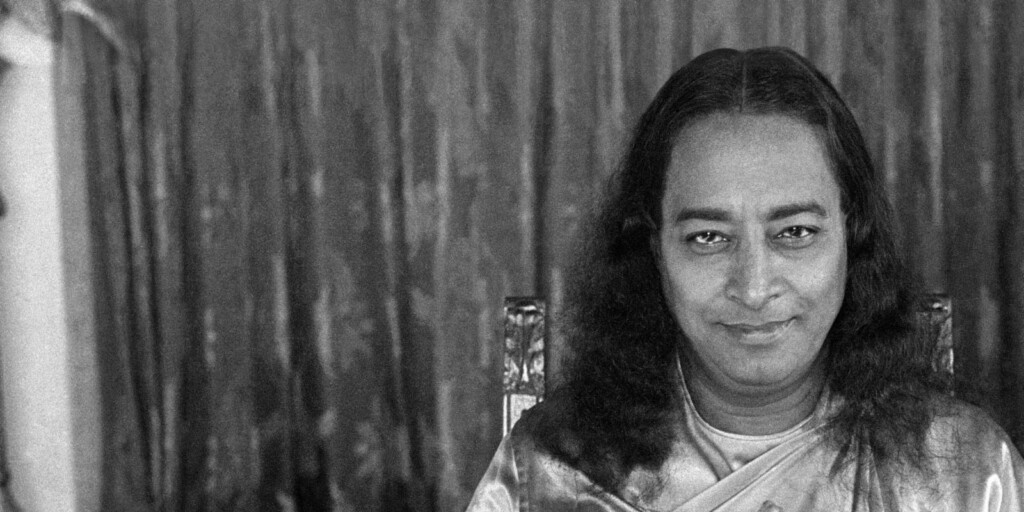
You are standing in a hotel ballroom in Los Angeles on the evening of March 7, 1952, and a man has just finished speaking. He recited a poem about India, looked upward, and his body folded into itself with what witnesses described as complete composure. No convulsion, no cry. Paramahansa Yogananda was seventy-nine years old, and within minutes the room understood that something had ended — though what precisely had ended, and what had not, would take weeks to become the kind of problem that neither science nor theology could comfortably absorb.
What followed entered the official record not through devotional literature but through the signed statement of Harry T. Rowe, director of Forest Lawn Memorial Park in Glendale, California, a man whose professional relationship with death was entirely administrative. Rowe documented that for twenty days after death, Yogananda’s body exhibited no visible signs of physical deterioration — no odor, no mold, no discoloration, no desiccation of the skin. This was not a mystical report. It appeared in the mortuary’s files. Forest Lawn was not a monastery. Rowe had no theological stake in the outcome. His statement, dated May 1952 and later reproduced in official publications of the Self-Realization Fellowship, describes the condition of the body as, in his words, “the most extraordinary case in our experience.”
The temptation of modernity is to solve this immediately — to reach for embalming chemistry, for unusual humidity, for some atmospheric variable that explains the deviation without disturbing the framework. But Rowe explicitly noted that no embalming had taken place in the standard sense, and that the phenomenon resisted the explanations his staff ordinarily applied. What is interesting is not the supernatural claim itself but the institutional embarrassment surrounding it: a secular bureaucracy confronted with data it generated and could not interpret. Empiricism, as a method, is extraordinarily good at measuring what it has already decided to look for. It has no instrument calibrated for the question Rowe’s statement actually raises.
William James, writing in The Varieties of Religious Experience in 1902, proposed that states of consciousness inaccessible to ordinary waking life were nonetheless real in their effects — that dismissing them on the grounds of their origin was a category error, not a scientific conclusion. He was not arguing for the supernatural. He was pointing out that the boundary between the explicable and the inexplicable is itself a cultural artifact, redrawn in every century according to what a given civilization has decided it needs to be true. The twentieth century needed death to be a clean, verifiable biological threshold. Yogananda’s body, according to Rowe’s account, declined to perform that function on schedule.
Yogananda had spent decades teaching that the body was not the fundamental unit of a person, that consciousness preceded matter rather than arising from it, and that death was a transition navigated by those who had trained themselves to navigate it. The Autobiography of a Yogi, published in 1946, six years before his death, describes techniques for withdrawing the life force from the body systematically — kriyas, pranayama sequences, states of samadhi in which metabolic activity slows to a degree that baffles standard physiological measurement. Whether one accepts the metaphysics or not, the training program was internally coherent, and it produced, in at least one documented instance, a physical outcome that Harry T. Rowe could not explain using the resources of his profession.
What a civilization cannot explain, it usually ignores, then mythologizes, then absorbs into commerce. The Autobiography of a Yogi has never gone out of print. It has been translated into dozens of languages and placed by Steve Jobs, by his own instruction, on the devices of every mourner at his memorial. A man who built his life on the premise that technology could solve every human problem chose, as his last gift to those he loved, a book written by someone who seemed to have solved the problem technology cannot reach.
🕉️ Seekers of the Infinite: Mysticism and Spiritual Paths
Paramahansa Yogananda’s life and teachings represent one of the most luminous bridges between Eastern spirituality and the Western world. His journey echoes the quests of other great souls who surrendered themselves entirely to the search for divine truth. These related articles illuminate the spiritual landscape from which Yogananda emerged and the kindred figures who walked similar paths.
Ramana Maharshi: Life and Teachings
Ramana Maharshi stands as one of the most revered sages of modern India, whose silent presence and method of self-inquiry — ‘Who am I?’ — attracted seekers from every corner of the globe. Like Yogananda, he represented a living embodiment of the Vedantic tradition, pointing beyond rituals to the direct experience of the Self. His life offers a profound complement to Yogananda’s devotional and kriya-based approach to liberation.
GO TO THE SELECTION: Ramana Maharshi: Life and Teachings
Jiddu Krishnamurti: the Man Who Refused to Be God
Jiddu Krishnamurti began his spiritual journey as a figure chosen by the Theosophical Society to be the World Teacher, yet he famously dissolved that role and urged seekers to abandon all external authority. His radical insistence on choiceless awareness and the freedom from psychological conditioning places him in fascinating dialogue with Yogananda’s emphasis on guru-led discipleship. Exploring both figures reveals the full spectrum of twentieth-century spiritual inquiry.
GO TO THE SELECTION: Jiddu Krishnamurti: the Man Who Refused to Be God
American Transcendentalism: History and Thought
American Transcendentalism, with its luminaries Emerson and Thoreau, created the intellectual and spiritual climate that made Yogananda’s reception in the West possible. The movement’s celebration of the Over-Soul, intuition, and the divinity within nature resonated deeply with the Vedantic philosophy Yogananda brought from India. Understanding Transcendentalism enriches our grasp of why Yogananda’s message found such fertile ground in America.
GO TO THE SELECTION: American Transcendentalism: History and Thought
Lev Tolstoy and Spiritual Conversion
Lev Tolstoy‘s dramatic spiritual conversion in later life shares striking parallels with the inner transformations described by Yogananda in his Autobiography of a Yogi. Both men turned away from worldly success and social prestige to pursue an uncompromising commitment to spiritual truth and universal love. Tolstoy’s crisis and awakening illuminate the universal human hunger for transcendence that Yogananda addressed across cultures and continents.
GO TO THE SELECTION: Lev Tolstoy and Spiritual Conversion
Discover the Cinema of the Spirit on Indiecinema
The search for the infinite does not end with a book or a biography — it unfolds also through images, sound, and the singular language of independent cinema. On Indiecinema you will find a curated selection of films that explore mysticism, consciousness, and the deepest questions of human existence. Let the journey continue on screen.
👉 EXPLORE THE CATALOG: Watch Indie Films in Streaming
A vision curated by a filmmaker, not an algorithm
In this video I explain our vision

