
The Man Who Wakes Up and Does Not Know Who He Is
There is a moment, just before full waking, when you do not know your name. Not in any dramatic sense — no trauma, no crisis — simply the ordinary gap between sleep and consciousness where the machinery of selfhood has not yet restarted. You lie there, aware of light through a window, aware of breath moving in your chest, but the architecture of who you are has not yet assembled itself around you. The room is familiar and alien simultaneously. The ceiling exists. You exist. But the connection between those two facts is momentarily, mercifully severed.

Most people cross that threshold in seconds and spend the rest of the day pretending it never happened. Gustav Meyrink spent an entire novel living inside it.
Published in 1915 after appearing in serial form in Die Weissen Blätter, Der Golem arrived as one of those rare books that does not describe an experience so much as reproduce it neurologically in the reader. Meyrink had been working toward this for years — a man who had survived a near-suicidal crisis in his twenties, turned to theosophy, alchemy, yoga, and the heterodox spiritual currents flooding Central European intellectual life at the turn of the century. He was not writing fantasy. He was writing the most honest account he could manage of what consciousness actually feels like when you stop pretending it is stable.
Athanasius Pernath wakes up in possession of someone else’s hat. This is where it begins — not with a philosophical proposition, not with a dramatic confrontation, but with the quiet wrongness of an object that does not belong to you sitting where your object should be. A hat. The kind of detail that would slide past you in any other book, dismissed as scene-setting, atmosphere, the furniture of historical fiction. Here it is the entire problem. The hat is the first crack in the mirror of identity, and once you notice that crack, you cannot stop seeing it spread.
He does not know, or cannot fully trust, who he is. His past comes to him in fragments, his memories have the texture of things half-remembered from another person’s account, and the city he moves through — the Jewish Quarter of Prague, the Josefstadt, a labyrinth of crooked alleys and buildings that seem to breathe with autonomous malevolence — reflects his interior state with a precision that feels less like literary symbolism and more like diagnosis. William James, writing in his Principles of Psychology in 1890, described the self as a stream, not a substance — a continuous flowing rather than a fixed container. What Meyrink understood, perhaps more viscerally than James’s Harvard office could accommodate, is what happens when that stream becomes a whirlpool, when it folds back on itself and you catch glimpses of a current running beneath your current, older, stranger, not entirely yours.
The Prague Meyrink renders is not a setting in any conventional sense. It is an externalized psyche, a geography of the unconscious drawn with the precision of someone who has walked those streets at three in the morning and felt them looking back. The Josefstadt had been physically demolished and rebuilt between 1893 and 1913, its medieval warren replaced with broad avenues and respectable bourgeois architecture, but Meyrink writes the old quarter back into existence as though demolition were merely a rumor, as though certain spaces refuse to be erased because they correspond to something in the structure of human interiority that modernization cannot touch. Carl Jung, who was developing his theories of the collective unconscious in precisely these same years, would have recognized the mechanism immediately — the way a place can become a psychic container, holding what individuals cannot hold alone.
And at the center of this city that is also a mind, a man wakes up not knowing who he is, picks up a hat that is not his, and walks forward into a story that will refuse, until its final pages, to tell him — or you — the difference between dreaming and remembering.
Venetian Arcanum
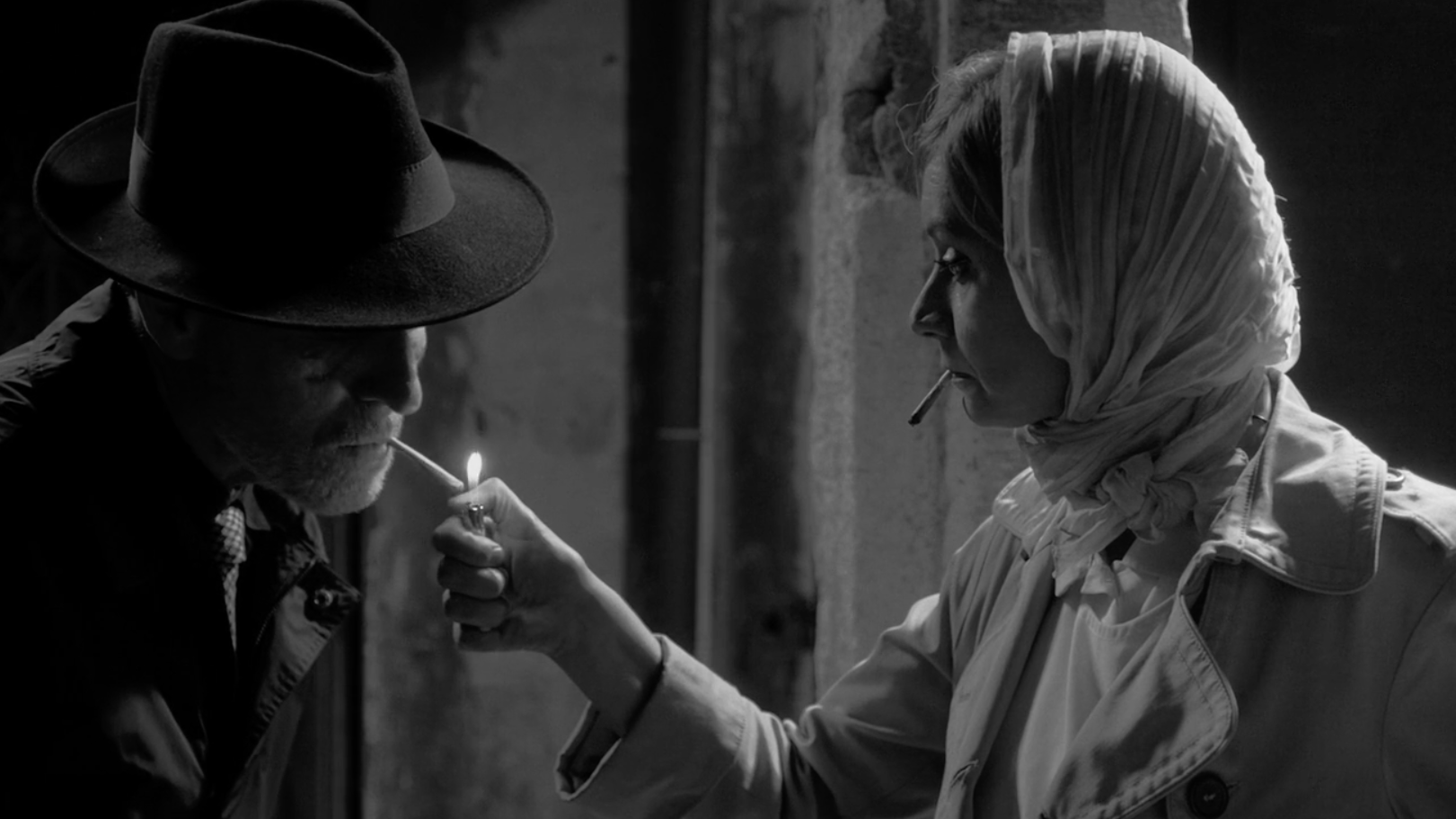
Thriller, by Serge Turgeon, Italy, 2025.
In Venice, a mysterious presence appears once every century or two, haunting the canals and hidden corners of the city. Driven by a sense of destiny, a woman decides to search for it. Following its elusive traces, she is drawn deeper and deeper into the city’s arcane secrets. Reality and myth begin to blur, and Venice itself transforms into a labyrinth of dangers.
LANGUAGE: Italian
SUBTITLES: English
Prague as a Body That Breathes and Digests Its Inhabitants
There are cities you visit and cities that visit you. Prague is the second kind, and its Jewish quarter — that compressed labyrinth of lanes so narrow two people could not walk abreast without touching — was never merely a place where things happened. It was a system with its own metabolism, its own hunger, its own way of processing the human beings who moved through it like food moves through an organism. When Athanasius Pernath wanders those streets in a state between sleep and waking, he is not lost in an unfamiliar district. He is being digested.
Meyrink wrote his novel in installments between 1913 and 1914, at the precise historical moment when the Josefov quarter — the old Jewish ghetto of Prague — was completing its own erasure. The demolition had begun in 1893 under the euphemistic municipal banner of “sanitation,” and by 1913 the process had consumed most of what had stood for centuries: the crooked alleys, the buildings that leaned against each other like old men sharing a secret, the hidden courtyards that opened into other hidden courtyards in an architecture of perpetual interiority. Roughly twelve thousand residents were displaced. The city planners called it urban renewal. What they dismantled was a world that had learned to survive by turning inward.
This matters because Meyrink’s Ghetto is not a reconstructed document. It is a wound that has learned to speak. The streets he describes — Hahnpassgasse, Altschulgasse — are already half-phantom when he writes them, existing more in collective memory and urban legend than in any navigable reality. He is writing about a place that was disappearing in real time, and the disappearance becomes the architecture. The walls in his novel seem to breathe because they were, in a very literal historical sense, dying.
Henri Lefebvre argued in The Production of Space, published in 1974, that space is never neutral, never simply a container for human activity — it is itself a social product, shaped by power, trauma, and the accumulated pressure of lived experience. The Josefov of Meyrink is exactly this: a space so saturated with centuries of confinement, of forced residency, of legal exclusion, that its very geometry has become psychological. The ghetto walls that were legally enforced from the sixteenth century onward did not only contain bodies. They produced a particular kind of interiority — a way of turning the world inward when the outward world was sealed against you.
A man walks down a corridor he knows well and finds it longer than it should be. He reaches a door he has opened a hundred times and finds it leads somewhere else. This is not symbolic in the literary sense — it is the experiential logic of a place that has absorbed too much history to remain stable. The architecture refuses linearity because the lives lived within it refused linearity. Survival inside the ghetto required a kind of spatial intelligence — knowing which passage opened unexpectedly, which wall concealed a second wall, which threshold was actually a trap. That knowledge, accumulated over generations, has seeped into the stones themselves.
Gaston Bachelard wrote in The Poetics of Space in 1958 that the house is the first universe of a human being, that its corners and corridors are not merely physical but psychic — they hold the shape of our fears and our shelters simultaneously. Meyrink extends this logic to an entire district. The Ghetto is a collective psyche made navigable. Its impossibilities — its staircases that ascend to sealed floors, its rooms that appear and vanish — are not surrealist decoration. They are the spatial form of what it means to live for centuries in a place that was simultaneously home and prison, sanctuary and cage.
The organism preserves. The organism also traps. And it does not always know the difference.

The Golem as the Self You Cannot Own
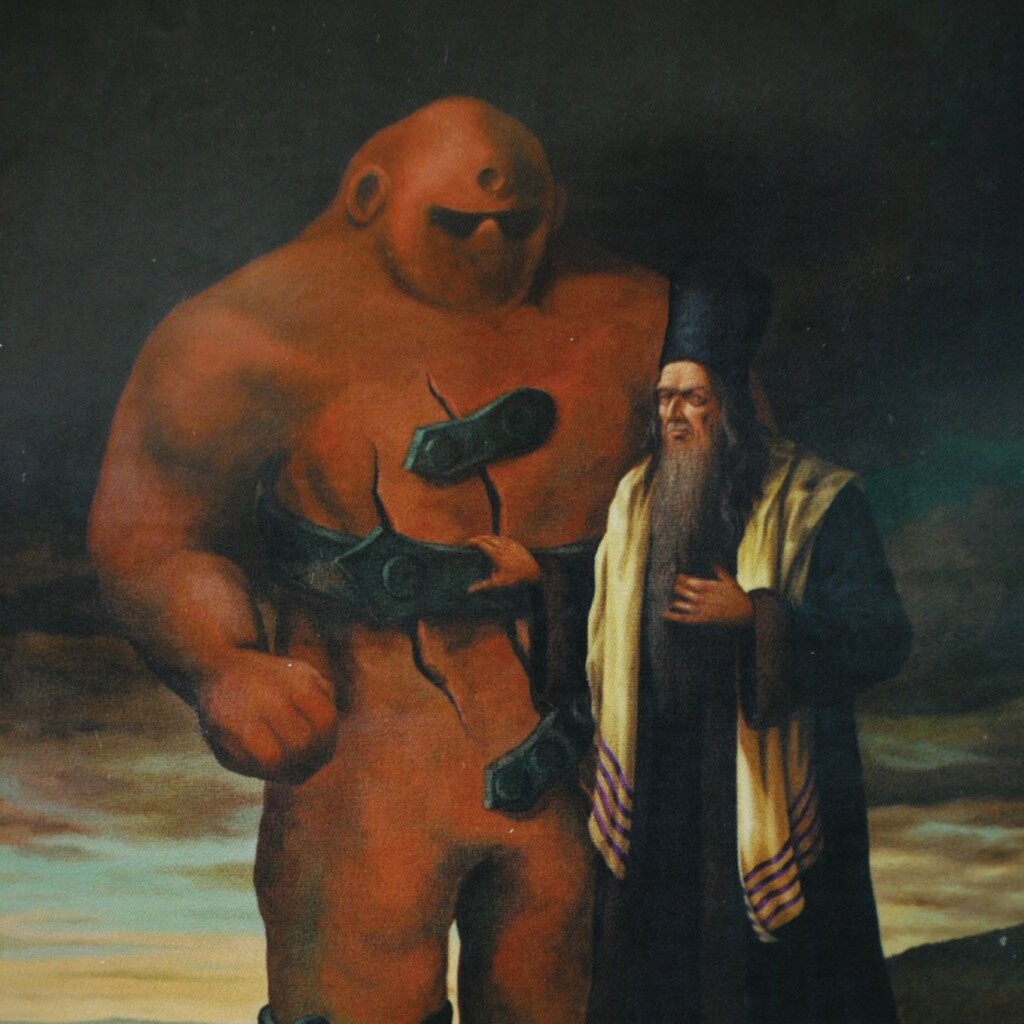
There is a moment when you catch your reflection in a dark window at night and do not recognize yourself for a fraction of a second. Not because anything has changed, but because the ordinary contract between your face and your sense of self briefly dissolves. The glass gives back something that looks like you, moves when you move, and yet carries an expression you cannot claim. That fraction of a second is where Meyrink’s Golem lives.
The creature in the novel is not a monster assembled from clay, not the mechanical servant of older legend. It appears without warning in the narrow lanes of the Ghetto, faceless in the sense that its features seem to belong to no particular human history, wearing clothes from another era, walking with the slightly wrong rhythm of something that has learned locomotion from observation rather than from the inside. What makes it unbearable is not its strangeness but its familiarity. The people who encounter it do not run from it the way one runs from a predator. They freeze, they feel nauseated, they feel recognized.
Carl Gustav Jung, writing around the same years Meyrink was completing his novel, described the shadow as the sum of everything the conscious self refuses to integrate — not only the violent or the shameful, but the unlived, the suppressed, the potential that was foreclosed. In the Collected Works, volume nine, he is precise about this: the shadow does not vanish when you ignore it. It consolidates. It develops a kind of autonomous weight. And eventually it finds a way to stand in the room with you. The Golem is exactly this standing. It is not what the Ghetto’s inhabitants fear from outside. It is what they have sealed inside the architecture of their own communal life, generation after generation, and what that architecture can no longer contain.
Sigmund Freud‘s essay on the uncanny, published in 1919, gives the phenomenon its clinical coordinates. Das Unheimliche — the unhomely, the not-at-home — arises specifically when something that should have remained hidden returns to visibility. Freud is careful to distinguish it from simple fear. What triggers the uncanny is not the alien but the familiar-made-strange: the doll that seems to breathe, the double that knows your secrets, the house you grew up in that now feels threatening. The repressed does not return as memory, he argues, because memory has been successfully neutralized by narrative. It returns as presence, as an intrusion into lived space that bypasses the mind’s editorial control entirely.
The Golem returns every thirty-three years. The number is not arbitrary decoration. Thirty-three years is roughly the length of a generation — long enough that the living have no direct memory of the last eruption, short enough that its traces are still embedded in the stones and the stories that no one quite tells directly. Each generation inherits the repression without inheriting the event. They carry the sealed room without knowing what was sealed inside it. And then the presence simply appears on the street, wearing its wrong clothes, and everyone who sees it feels the specific dread of something that was supposed to stay buried.
Athanasios Athanasiadis, the protagonist who cannot fully distinguish his own memories from those of another man entirely, is himself a figure of failed psychological ownership. The novel’s most disturbing proposition is that the self is not a sovereign territory. You do not own your interior life any more than the Ghetto’s residents own the creature that walks among them. Both are constituted by what they cannot acknowledge, animated by what they believe they have left behind, haunted by a presence that is neither foreign nor entirely theirs to claim.
The Golem does not come for you. It comes because you are already it, and the thirty-three years between appearances is simply the time it takes to forget that.
Identity as a Room With Someone Else’s Furniture
You pick up a hat that is not yours. This is how it begins — not with a dramatic rupture, not with the announcement of crisis, but with something as mundane as a mix-up at a coat stand. Someone has taken your hat by mistake, left theirs in its place, and when you put it on, it does not quite fit. The brim sits differently on your skull. And yet you wear it into the street. And yet the world receives you as you always were.
What Pernath discovers, slowly and with the particular horror of someone watching a wall dissolve rather than collapse, is that the hat was not an accident. The hat was an invitation. The moment he placed it on his head, another man’s memories began to surface in him — not visions exactly, but a pressure from inside, a knowledge he could not have earned. His past is not his past. His name sits on him like borrowed clothing. He moves through the Prague ghetto performing a continuity of self that has no actual foundation beneath it, and the ghetto itself seems to know this, its crooked architecture mirroring the crooked geometry of a psyche built on someone else’s floor plan.
Sartre wrote that bad faith is the lie we tell ourselves about our own freedom — the waiter who performs being a waiter so completely that he forgets he chose this, that he could choose otherwise, that the role is not the man. But Pernath’s predicament is darker than Sartrean bad faith, because he cannot even locate the original freedom beneath the performance. There is no authentic self waiting to be recovered. There is only the sediment of roles, of names, of hats that fit imperfectly and were nevertheless worn until they shaped the skull beneath them.
Goffman, writing in 1959, gave us the most precise sociological vocabulary for this condition: the self as performance, identity as a front stage construction, the individual as an actor who has rehearsed so thoroughly that even backstage he cannot stop performing. The Presentation of Self in Everyday Life is not a cynical book, but it is an uncomfortable one, because it strips away the assumption that somewhere behind the performance there is a performer with a fixed essence. What Goffman describes is a world in which the furniture of selfhood — the gestures, the vocabulary, the professional demeanor, the way a person holds a fork — is almost entirely inherited from social scripts written long before the individual arrived. You did not choose the role. The role was waiting for you in the room, arranged as if it had always been yours.
Pernath’s fractured memories function exactly as this furniture does — present, functional, load-bearing, and belonging to someone else. He can sit on the chair. He can sleep in the bed. He moves through the apartment of his identity with the fluid competence of long habitation. But there are moments — standing in a particular doorway, touching a particular object — when the wrongness of it surfaces, when the scale of the room seems slightly off, when the view from the window does not match any window he remembers choosing. The self he has been living is coherent from the outside and illegible from within.
This is not a pathology unique to Pernath. It is the condition Meyrink is using him to illuminate. The Prague ghetto, with its streets that seem to rearrange themselves at night, its houses that cannot be found twice in the same place, is the spatial metaphor for an interior topology that most people spend their lives not examining. We inherit our desires, our fears, our sense of what we deserve, our very grammar of selfhood, from parents and classes and centuries — and then we defend this inheritance as if it were discovery, as if the furniture had grown from us rather than us having grown, quietly and without noticing, around it.
The Mystical Tradition as a Map of the Interior
There is a moment when language fails you. Not because you lack words, but because the words that exist were built to describe surfaces, and what you are trying to name lives beneath every surface you have ever touched. You reach for clinical vocabulary and it slides off. You try metaphor and it approximates but does not arrive. Then someone hands you a map drawn in symbols centuries old, and suddenly the territory becomes legible — not because the symbols are literally true, but because they were made precisely for this kind of navigation.
This is what Kabbalistic tradition does inside Meyrink’s novel, and it would be a serious misreading to treat it as atmosphere, as the exotic furniture of a Prague ghost story. The Sefirot, the ten emanations of divine energy in Kabbalistic cosmology, are not decorations scattered across the narrative. They function as a genuine structural grammar for states of consciousness that Western rationalism had no vocabulary to map. The Sefirot describe a vertical architecture of being — from Kether, the crown of pure undifferentiated awareness, down through the successive contractions and densifications toward Malkuth, the material world of ordinary waking life. Athanasius Pernath’s journey through the novel traces exactly this axis, moving not forward through plot but downward and upward simultaneously through registers of experience that cannot be linearized. You do not progress through this book. You descend and ascend, sometimes without knowing which direction you are travelling.
The Golem itself carries the full weight of the clay-animation tradition, but Meyrink strips it of its folkloric simplicity. In the original legends, the Golem of Rabbi Loew — created in Prague in the late sixteenth century, according to the tradition Meyrink would have known intimately — was animated by the word emet, truth, inscribed on its forehead, and destroyed by erasing the first letter to leave met, death. What Meyrink understood, and what gives his novel its psychological density, is that this is not a story about a rabbi’s practical problem with sabbath labor. It is a story about the creation and destruction of identity itself. The clay is you. The word inscribed is the fiction of continuous selfhood you carry without examination.
Then there are the Ibbur and the Dybbuk, two distinct traditions of spiritual attachment that Meyrink braids into Pernath’s experience of possession and invasion. The Dybbuk is a restless spirit of the dead that cleaves to a living body, displacing the host’s own will. The Ibbur is something stranger and more ambivalent — a righteous soul that attaches to a living person not to harm but to complete unfinished work. The difference between invasion and visitation, between contamination and transmission, maps almost perfectly onto the phenomenology of what we would now recognize as traumatic intrusion against creative inspiration. Meyrink does not distinguish neatly between them, because neither does lived experience.
He had reasons that were entirely personal for trusting this language over any other. In 1891, at twenty-four, he stood at the edge of suicide, and instead of dying he encountered something — he described it differently at different points in his life, but always with the quality of an encounter rather than an insight. He spent the following decades inside serious occult study: Theosophy, Rosicrucianism, Buddhist texts, the practical Kabbalah. By the time he began writing the novel that would be published serially starting in 1913 and collected in 1915, he had accumulated not a hobby but a working epistemology. Mysticism was not, for him, the opposite of rigorous investigation. It was the only investigative method honest enough to admit that consciousness, at its edges, refuses the categories of the laboratory.
What rationalism refuses to name does not thereby cease to exist. It simply waits, patient and indifferent, until someone arrives with the right instruments.
A vision curated by a filmmaker, not an algorithm
In this video I explain our vision
The Dream That Is More Real Than Waking

There is a moment in Meyrink’s novel where you realize you have been reading two consciousnesses simultaneously without knowing it. The text gave no warning. The prose simply continued, the sentences maintained their rhythm, and somewhere in the middle of a paragraph the ground shifted beneath the narrator’s feet and beneath yours. Athanasius Pernath wakes, or believes he wakes, and the room around him belongs to someone else’s life, someone else’s accumulated years, and the terror is not the unfamiliarity itself but the smoothness of the transition — the way one existence folded into another without seam or rupture, the way the dream did not announce itself as dream.
This is Meyrink’s most radical formal gesture, and it is also his most philosophically precise. Henri Bergson argued in Matter and Memory, published in 1896, that consciousness does not move through time the way a clock measures it. Duration, what Bergson called durée, is the lived experience of time as a continuous flowing that cannot be cut into discrete moments without falsifying it entirely. Memory does not store the past like a filing cabinet. It survives in the present, layered inside perception, so that what you see is always saturated with what you have seen, and the border between remembering and experiencing is structurally unstable. Meyrink builds his entire novel on this instability. Pernath does not simply have flashbacks or visions. His consciousness is constitutively porous, and the reader is made to inhabit that porosity from the inside.
Consider the man who sits in a room that he slowly recognizes is not his own — the furniture wrong, the smell wrong, the mirror showing a face that takes too long to match the face he expects. The recognition is not sudden. It accumulates with the dread logic of something that has always been true. He does not break down or scream. He simply waits, with the patience of someone who has lived at the border of dissolution long enough to know that panic resolves nothing. That patience is itself the symptom. When the boundary between interior and exterior collapses enough times, you stop fighting the collapse and begin to move through it as through familiar weather.
Trauma does precisely this. Judith Herman, in Trauma and Recovery from 1992, describes how traumatic experience suspends linear time and returns the sufferer not to a memory of the event but to the event itself, re-entered with full sensory and emotional presence. The past is not past. It is a room you keep waking up inside. Meyrink’s Prague functions this way for Pernath — the ghetto is not a historical location he inhabits, it is a psychic structure he cannot exit, and the Golem’s appearances are not supernatural intrusions into a stable reality but eruptions of a deeper layer of time pressing upward through the surface of the present.
The nested consciousnesses in the novel — the frame narrative of the dreamer who dreams he is Pernath, who himself moves through states indistinguishable from dreaming — create a vertigo that the reader cannot resolve by choosing one level as the real one. A woman sits beside a sleeping man and watches his face move through expressions she cannot interpret, emotions belonging to a life she has never witnessed. She does not know whether to wake him. The question of whether waking would help, whether it would even constitute a rescue, is one the novel refuses to answer, because Meyrink understands that the distinction between sleeping and waking is not a fact but a convention, and conventions are precisely what the Golem’s Prague exists to dissolve.
The reader who finishes a chapter and cannot precisely reconstruct what happened, who spoke, what was real — that reader is not confused. That reader is, for once, reading accurately.
Suffering as Initiation, or the Violence of Becoming
There is a moment when the floor gives way beneath you — not metaphorically, not in the language of self-help memoirs, but genuinely, structurally, when the architecture of what you believed yourself to be simply stops holding weight. You have felt it. Everyone who has survived a real collapse — not a setback, a collapse — knows the particular silence that follows, the way ordinary objects look slightly foreign, as if you had arrived in your own life from somewhere else. Meyrink’s novel locates its entire spiritual argument inside that silence. The disintegration Athanasius Pernath undergoes is not presented as misfortune to be overcome but as the very mechanism of transformation. The ego does not grow into awakening. It dissolves into it.
This is an old claim. The initiatory traditions of virtually every major esoteric lineage — from the Hermetic orders Meyrink studied obsessively to the Kabbalistic schools whose symbolism saturates every chapter of his novel — insist that the self must be unmade before it can be remade. René Guénon, writing in the same decades as Meyrink, described the distinction between the lesser mysteries and the greater mysteries precisely in these terms: the lesser work purifies the human individual, while the greater work annihilates it. The Sufi concept of fana, the dissolution of the self in the divine, maps almost perfectly onto what happens to Pernath across the novel’s fractured timeline. Meyrink was not inventing this structure. He was translating it into the specific grammar of the Prague Ghetto, which meant translating it into the grammar of historical violence.
And here the question that the novel does not ask loudly enough — but that presses against every page — becomes impossible to defer. A man wanders the labyrinthine streets of Josefov, loses his memory, encounters visions, suffers social disgrace, is imprisoned on accusations he cannot fully understand or refute. His ego shatters. Meyrink frames this shattering as grace. But the Prague Jewish Quarter, the real one, the one that existed in physical space before the Asanierung — the brutal urban clearance that demolished most of the ghetto between 1893 and 1913, just years before the novel was published — was not a spiritual laboratory. It was a place where poverty was structural, where disease mortality rates were documented as catastrophically higher than in surrounding districts, where the social marginalization of its inhabitants had material consequences that no amount of mystical reframing could dissolve.
There is a scene where a man sits in a courtroom, accused, surrounded by faces that have already decided his guilt, and he understands with perfect clarity that language itself has failed him — that the machinery of judgment was never constructed to hear what he might say. That experience, repeated across centuries of European Jewish life, is not an initiatory ordeal in any spiritually legible sense. It is persecution. To call it a threshold rather than an atrocity requires a perspective available only from a position of sufficient safety, sufficient distance from the actual consequences.
This is the fracture line running through Meyrink’s entire project, and it is worth sitting with rather than resolving. The novel’s aesthetic genius lies precisely in its capacity to hold suffering as meaningful, as generative, as oriented toward something. But that capacity is also a class position, a religious position, an ethnic position. Franz Fanon understood this when he wrote in 1952’s Black Skin, White Masks that the colonized subject’s psychological disintegration was not a mystical initiation but a wound administered by a system — and that aestheticizing that wound served the system more than the wounded. The Golem, written by a non-Jewish German-speaking author about a Jewish quarter he observed from a position of curious outsider, carries this tension without fully acknowledging it.
What the Golem Leaves Behind When It Disappears

The locked room at the center of the Ghetto has no key anyone can find, and yet everyone knows it exists. You have lived near rooms like that — not literally, but in the architecture of your own thinking, in the parts of yourself that surface only in fever or in the strange lucidity that comes just before sleep, in the moments when you catch your reflection and do not recognize the face looking back with quite the certainty you expected. Meyrink understood that this is not pathology. It is the human condition wearing its most honest face.
When the Golem disappears from the novel — and it disappears more than once, it keeps disappearing, which is itself the point — it does not resolve anything. It leaves behind a city that still stands, stones still fitted together in the same cramped geometries, the same narrow alleys conducting the same damp cold. The people remain. Their fears remain. What has changed is something interior and unverifiable, a shift in the quality of attention that Pernath carries but cannot fully explain even to himself. This is not the transcendence of the mystic who returns from the mountain with a doctrine. It is something quieter and more disturbing: the sense that something has passed through you and rearranged the furniture, and you can no longer be certain which objects were always yours.
Carl Gustav Jung, writing in the early decades of the twentieth century about individuation, described the integration of the unconscious not as a triumph but as an ongoing negotiation, a process that never concludes because the psyche is not a problem to be solved but a living system that continues to generate new depths the moment you believe you have plumbed the last one. Pernath’s journey enacts this with a precision that no theoretical framework quite captures, because Meyrink understood — as a man who had genuinely passed through the door of his own dissolution and come back changed — that the end of the story is never the end of the experience. The reader closes the novel and the Golem’s question remains open inside them like a wound that has healed on the surface but still pulls when the weather changes.
There is a man shown in extreme old age, sitting at a window overlooking a courtyard he has looked at for decades, and he realizes with absolute calm that he does not know if the life he remembers is the one he actually lived or the one he constructed in the long labor of remembering it. There is no horror in his face, only a kind of vast, still attention, as if the question itself has become sufficient company. This is the emotional register Meyrink reaches in his final pages, and it is rarer in literature than it has any right to be.
What the Golem leaves behind, then, is precisely this: the impossibility of a clean account. The stories we tell to survive are never quite accurate, and Meyrink, unlike most writers, refuses to pretend otherwise. Pernath ascends, or seems to, reaches something that resembles resolution, and the narrative frame promptly reminds you that what you have been reading was already a kind of dream reported by a man who may not be who he believes himself to be. The promise of awakening is made and then quietly, mercilessly qualified. Not retracted — qualified. There is a difference, and it is everything.
The Golem endures not because it offers answers about identity or liberation or the soul’s capacity to free itself from what imprisons it, but because it has the honesty to show you the exact shape of those questions without flinching, and to leave you holding them, which is the only serious thing a work of genuine literature has ever been able to do.
🌀 The Labyrinth of Soul, Myth, and Hidden Worlds
Gustav Meyrink‘s The Golem plunges the reader into a dreamlike Prague where identity dissolves, mystical forces reign, and the boundary between the self and the Other collapses. These articles explore the same labyrinthine territories: alchemy, Kabbalah, the unconscious, and the esoteric traditions that haunted Central European modernism. Follow the thread deeper into the maze.
Alchemy and Kabbalah: Esoteric Correspondences
Alchemy and Kabbalah share a profound symbolic kinship that surfaces unmistakably in the world of Meyrink’s Golem, where the Jewish mystical tradition of Prague saturates every page. This article traces the historical and esoteric correspondences between the two traditions, illuminating how the Sefirot and the alchemical stages mirror each other as maps of inner transformation. Understanding these connections is essential for reading Meyrink’s novel not merely as fantasy, but as a coded initiatory text.
GO TO THE SELECTION: Alchemy and Kabbalah: Esoteric Correspondences
Jungian Alchemy: Jung and Alchemical Psychology
Carl Gustav Jung devoted years to the study of alchemical texts, discovering in them a precise symbolic language for the processes of the unconscious and psychological individuation. This article explores how Jungian alchemy reinterprets the Great Work as an inner journey toward wholeness—a reading that resonates deeply with the fragmented, dreamlike consciousness of Meyrink’s nameless protagonist. The Golem itself can be seen as a Jungian shadow-figure, a projection of the repressed collective psyche of the Prague ghetto.
GO TO THE SELECTION: Jungian Alchemy: Jung and Alchemical Psychology
Spiritual Alchemy: Inner Transformation and Symbolism
Spiritual alchemy, at its core, is not about transforming lead into gold but about the radical metamorphosis of the human soul through symbolic death and rebirth. This article examines the inner dimension of the alchemical tradition, tracing how concepts like nigredo, albedo, and rubedo map onto spiritual crises and awakenings. Meyrink’s Golem is steeped in precisely this symbolism, as its protagonist moves through darkness, dissolution, and the terrifying threshold of self-transcendence.
GO TO THE SELECTION: Spiritual Alchemy: Inner Transformation and Symbolism
Jungian Individuation and the Great Work
Jung’s concept of individuation—the lifelong process of integrating the unconscious into a unified self—finds its most vivid alchemical expression in the idea of the Great Work, or Magnum Opus. This article explores how the stages of the alchemical process correspond to the psychological journey toward wholeness, confronting the shadow, the anima, and the Self. Meyrink’s Golem enacts this same drama in literary form, as its protagonist’s identity dissolves and reconstitutes itself through encounters with uncanny doubles and ancestral memory.
GO TO THE SELECTION: Jungian Individuation and the Great Work
Explore the Inner Labyrinth on Indiecinema
If Meyrink’s visionary Prague awakened something in you—a hunger for stories that dig beneath the surface of reality—Indiecinema is the streaming space you’ve been looking for. Discover independent films that dare to explore myth, consciousness, and the hidden architecture of the soul. Step inside: the maze goes deeper than you think.
👉 EXPLORE THE CATALOG: Watch Indie Films in Streaming
A vision curated by a filmmaker, not an algorithm
In this video I explain our vision

