
The Grammar of Coincidence
You are standing on a platform you almost missed, holding coffee you almost didn’t stop for, when someone turns and the whole architecture of your life seems to tilt slightly on its axis. It happens in a fraction of a second — the recognition, or what feels like recognition, the sense that this moment was already written somewhere in a language older than words. You don’t question it. Why would you? The feeling is too clean, too symmetrical, too precisely fitted to the shape of your longing to be anything other than meaningful. And that, precisely, is the problem.

What you experienced on that platform was not fate revealing itself. It was your brain performing an act of retrospective narration so swift and seamless that you never caught the edit. The psychologist Daniel Kahneman, in his 2011 work Thinking, Fast and Slow, spent considerable effort documenting the mind’s compulsive hunger for causality — the way System 1 thinking, that fast, automatic, associative machinery running beneath conscious awareness, constructs stories of coherence from raw noise before the slower, deliberate mind even has time to ask a question. Coincidence doesn’t feel like randomness because the brain was never designed to let randomness feel random. It was designed for survival, and survival demanded pattern.
But the more unsettling claim is not neurological — it is cultural. Coincidence, as a felt experience, is not a universal constant. It is a technology, historically contingent and ideologically shaped. The anthropologist Claude Lévi-Strauss observed in his structural analyses of myth that every culture constructs what he called a “grammar” of meaningful events — a syntax of signs through which random occurrence gets absorbed into narrative order. What changes between cultures is not the frequency of coincidence but the grammar used to read it. A Bororo elder in the Brazilian Mato Grosso and a secular professional in contemporary Berlin may both experience a startling encounter with a stranger, but the machinery they deploy to process it — ancestors, spirit logic, probability, psychological projection — produces entirely different metaphysical conclusions from identical raw material. The encounter itself is neutral. The meaning is imported.
Western romantic culture, in particular, has built an extraordinarily elaborate import system. The 19th century produced what might be called the industrialization of fate — Romantic literature, from Goethe’s Die Leiden des jungen Werthers in 1774 through the full arc of Victorian sensation fiction, systematically trained readers to expect that significant strangers arrive by design, that love is recognized rather than constructed, that the self has a complement somewhere in the world toward which life is secretly navigating. This was never innocent entertainment. It was a pedagogy, instilling in its audience an emotional grammar so deeply internalized that by the 20th century, it no longer felt like a learned language at all. It felt like perception itself.
The sociologist Eva Illouz, in her 1997 study Consuming the Romantic Utopia, traced precisely how the experience of romantic fate became commodified — not merely reflected by consumer culture but actively produced by it. The candle-lit dinner, the chance meeting at a cultural venue, the meaningful glance across a crowded room: these are not archetypes retrieved from human nature. They are formats, manufactured and sold, which then retroactively organize memory and desire so thoroughly that people genuinely cannot distinguish between what they felt and what they were told to feel. The grammar of coincidence, in this sense, is not written in the stars. It is written in advertising copy, film scores, and the architecture of spaces designed to make certain kinds of encounter feel inevitable.
Which means the question is not whether fate exists in any metaphysical sense. The question is far more destabilizing than that: what does it mean to live inside a story you did not write, to feel its sentences as your own breath, and to call that freedom?
Beyond Our Lives
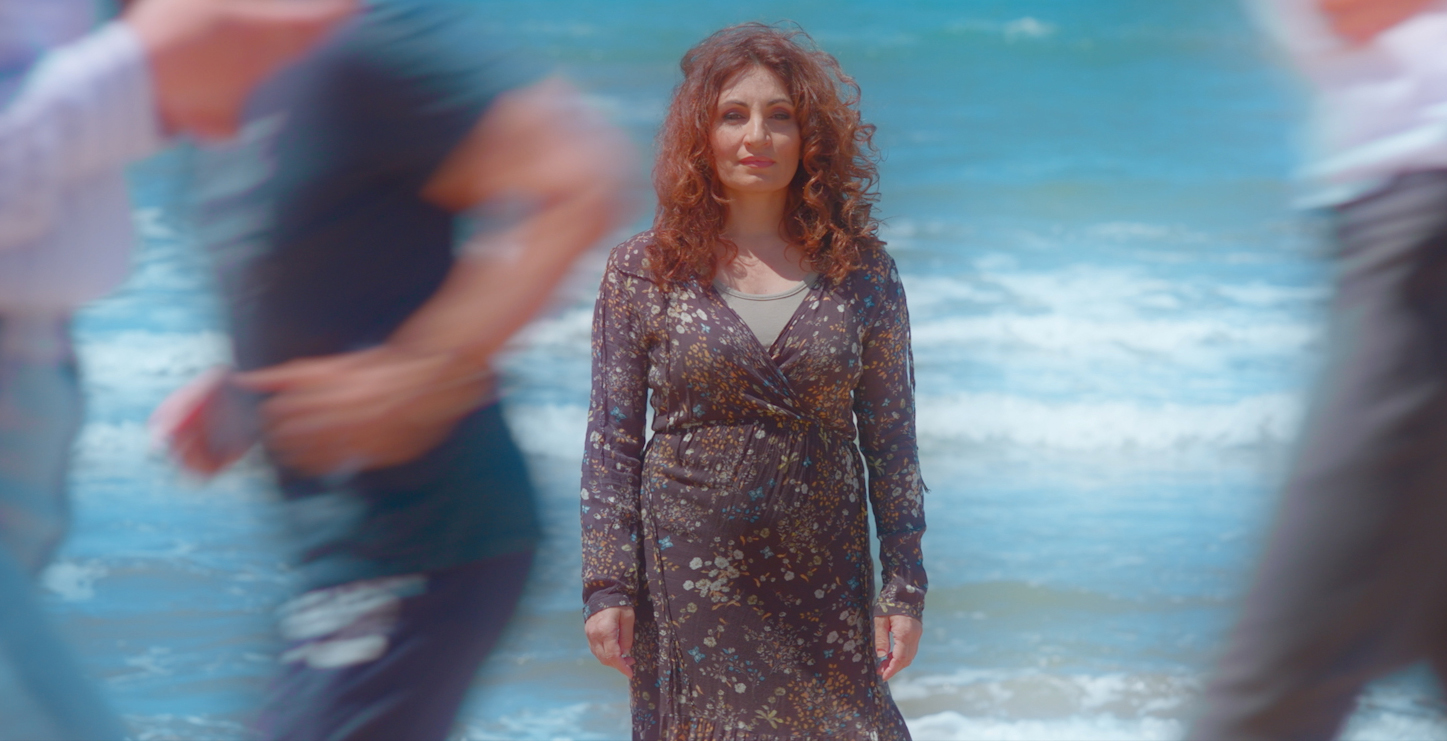
Drama, noir, by Fabio Martorana, Italy, 2021.
Alex and Claire have something in common, between recurring nightmares and restless memories; only time will allow them to understand what is happening. Where is the truth hidden? Perhaps in a time that the two protagonists don't even imagine. A sweet and complicated, painful and troubled love story, between a psychoanalyst and a woman who must fight a tough battle against herself and her introspective fears. Two soul mates that fate brought together after reliving distant experiences over time.
Dedicated to the world of noir, where lighting rich in chiaroscuro, the contrast between light and shadow symbolically represents the conflict between good and evil, the feature film tells of a sweet and complicated, painful and troubled love story. The film was shot between the provinces of Rome and Latina in the splendid settings of Circeo and Doganella di Ninfa.
LANGUAGE: Italian
SUBTITLES: English, Spanish, French, German, Portuguese
Determinism Before It Had a Name
You are walking through a market in third-century BCE Athens when a man stops you and asks whether the stone you are about to trip on was always going to be there. Not placed by a god, not arranged by fate in any theatrical sense — simply there, as the inevitable consequence of every prior event in an unbroken chain stretching back before memory. You feel the question as an irritation at first, then as something that refuses to leave.
Chrysippus of Soli, who became the third head of the Stoa around 232 BCE and produced, by ancient account, over seven hundred works — almost none surviving intact — was not interested in mysticism. His concept of heimarmene, usually translated as fate, was in his hands a strictly logical proposition: that the cosmos operates as a single rational structure in which every event follows necessarily from prior causes, and that this chain is not imposed from outside nature but is identical with nature itself. The logos — the ordering principle running through all things — was not a deity issuing decrees. It was what we would now recognize as a claim about physical causality stated without the vocabulary of physics. Chrysippus was doing metaphysics in the only language available, but the architecture of the argument was already recognizable to anyone who would later read Pierre-Simon Laplace’s 1814 formulation in the Essai philosophique sur les probabilités, where a hypothetical intellect knowing the position of every particle in the universe could compute both the past and future in a single calculation. The demon Laplace imagined was Chrysippus’s logos wearing a mathematician’s coat.
What this means, taken seriously, is that determinism was never primarily a religious intuition. The cultures that surrounded the Stoics were saturated with oracles, omens, and divine intervention, and the Stoics deliberately refused that grammar. Their fate was impersonal, structural, and — crucially — knowable in principle, even if not in practice. This is the detail historians of philosophy tend to underplay: Stoic determinism was an epistemological claim as much as a metaphysical one, asserting that the universe is the kind of place where knowledge of causes, if complete, would dissolve all appearance of contingency. The randomness you experience is not real randomness. It is ignorance wearing the mask of chance.
The Stoic argument forced a problem that neither they nor anyone since has cleanly resolved: if every event follows necessarily from prior causes, then the moment two people meet — on a road, in a city, through a chain of introductions neither of them initiated — that meeting was already inscribed in the structure of prior events with the same necessity as the orbit of a planet. The encounter feels chosen, felt, alive with personal meaning. But under the Stoic account, its occurrence was never in question. Only your awareness of it was ever uncertain. The intimacy you attribute to the meeting, the sense that it was somehow meant, is not wrong — it is simply pointing at a real necessity while misunderstanding its source.
What quantum mechanics introduced in the twentieth century, specifically through the Copenhagen interpretation formalized in the late 1920s by Niels Bohr and Werner Heisenberg, was the first serious scientific challenge to this structure: indeterminacy not as ignorance but as an irreducible feature of physical reality. If the electron has no definite position until measured, then Laplace’s demon cannot exist even in principle, and Chrysippus’s chain of necessity has a gap in it at the most fundamental level. Whether this gap is large enough to matter for human-scale events — whether quantum indeterminacy actually propagates upward into the causal texture of a conversation, a choice, an accidental meeting on a street — remains genuinely unresolved, a question that physics has opened without closing.
The strange inheritance of the Stoic framework is that even those who reject it remain inside its logic the moment they ask why something happened.

The Theological Hijacking of Chance
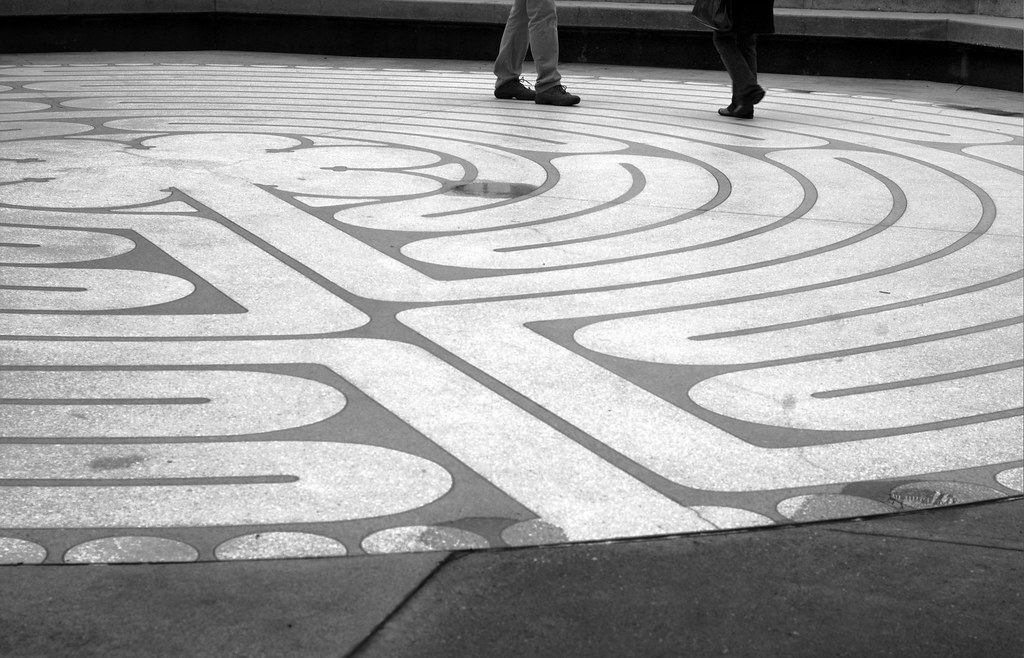
You have felt it before, in the specific silence that follows meeting someone who will change everything — that retrospective certainty, arriving too late to be useful, that this was always going to happen. What you did not notice was the machinery already installed in your nervous system to produce exactly that feeling on cue, regardless of the actual circumstances.
Augustine of Hippo, writing in 397 CE in his Confessions, was arguably the first thinker in the Western tradition to transform this psychological reflex into institutional architecture. His doctrine of predestination, elaborated with far greater violence in De Dono Perseverantiae around 428 CE, proposed that God had selected — before time, before creation, before any human act — the precise souls who would receive grace and those who would not. This was not merely a theological position. It was a sorting mechanism. Encounters, relationships, conversions, the sudden recognition of another person as significant: all of these became legible as evidence of prior selection. The feeling of fate ceased to be a private emotional event and became a public claim about one’s standing in a cosmic ledger.
What Calvin did in Geneva between 1536 and 1564 was take this Augustinian architecture and wire it directly into social organization. His Institutes of the Christian Religion, first published when he was twenty-six years old, codified predestination not as a theological mystery to be endured but as a framework for reading worldly success. If your encounters were fruitful, if your alliances prospered, if the right people entered your life at the right moments, this was no longer luck or effort or coincidence — it was legible grace. The logical inversion was equally brutal: if your life was marked by failed connections, wrong turns, and the wrong people, this too was meaningful. Damnation left traces. The fated encounter stopped being a romantic notion and became a tool of moral stratification.
Max Weber identified the psychological consequence of this with extraordinary precision in The Protestant Ethic and the Spirit of Capitalism, published in 1905. The unbearable uncertainty of not knowing whether one was among the elect produced, he argued, a compulsive need for worldly signs of confirmation. Prosperity, ordered relationships, the right marriages and business partnerships: these became the evidence believers searched for to quiet the existential terror of potential reprobation. What looks, from the outside, like the birth of modern capitalism is also, from the inside, the birth of a culture that cannot tolerate the genuinely random encounter — one that leads nowhere, confirms nothing, and belongs to no narrative of election.
The structural consequence is something most people are still living inside without knowing it. When a relationship fails, the reflex is not to conclude that two people were simply incompatible in ordinary, remediable ways. The reflex is to conclude that it was not meant to be — which is, at its core, a secularized form of reprobation. The person left behind is not merely someone whose life went in a different direction; they are someone whose encounter did not belong to the story of election. The language of fate in romantic life is not a rejection of Calvinist theology. It is Calvinist theology wearing different clothes, having forgotten its own name.
Historians of emotion, including Barbara Rosenwein in her 2016 work Generations of Feeling, have traced how certain emotional scripts persist across centuries by migrating from religious to secular registers while preserving their original function. The script that converts retrospective emotional intensity into evidence of cosmic significance is one of the oldest and most durable of these migrations. It does not require belief in God. It requires only the need — which the theological tradition spent centuries cultivating and normalizing — to believe that what feels significant must have been selected.
Free Will as a Political Invention
You sign the contract without reading it. Not because you are careless — you have read contracts before, you know the ritual — but because somewhere in the architecture of that moment, the pen is already moving before the decision has fully formed. And yet the law will hold you to every clause, because the law requires that you were free when you signed, that the will behind your hand was sovereign and undivided.
This is not a minor legal technicality. It is the load-bearing wall of an entire political order. Kant, writing in 1781 in the Critique of Pure Reason, confronted what he called the third antinomy: the irreconcilable contradiction between causal determinism — every event produced by a prior cause in an unbroken chain — and the freedom necessary for moral agency. His solution was not to resolve the contradiction but to quarantine it. Freedom, he argued, belongs to the noumenal realm, the world as it is in itself, beyond empirical observation. Causality governs the phenomenal world, the world as we experience it. The human being straddles both. This was philosophically elegant and politically indispensable, because it preserved the one thing modern governance cannot function without: a subject who can be held responsible.
The architecture Kant built was not designed to liberate anyone. It was designed to make culpability coherent. Before a court can sentence, before an institution can punish, before a bureaucracy can assign blame, it must first establish that the person before it could have done otherwise. Free will is not a gift handed to individuals — it is a requirement placed upon them. The citizen who possesses free will is simultaneously the citizen who can be prosecuted, taxed, conscripted, and condemned. Remove free will from the equation and the entire apparatus of modern governance loses its justification overnight. Prisons become warehouses for the unlucky. Contracts become theater. Elections become pageantry. The state needs you to be free the way a creditor needs you to be solvent.
Hannah Arendt, working in a different register entirely, introduced the concept of natality in The Human Condition in 1958 — the idea that each birth represents a genuine beginning, an irruption of the new into the world, a capacity to initiate action that cannot be fully predicted or determined. For Arendt, this was the ground of political freedom, the fragile and irreducible fact that human beings can begin something. But even this profound and generous idea carries within it the same structural demand: the one who begins is the one who owns what follows. Natality as radical openness collapses, in practice, into accountability for outcomes. The child born into poverty who initiates a life of crime began something — and will answer for it, in a courtroom built by people who began something entirely different, under conditions no one chose.
What neither framework can absorb is the sheer density of circumstance that precedes every act. By the time a person makes a choice, ten thousand unchosen variables have already narrowed the corridor to near-invisibility. Class, language, neurological wiring, the particular texture of early attachment, the historical moment of birth — 1890 or 1990, Kabul or Copenhagen — none of this registers inside the legal fiction of the freely willing subject. The sociologist Pierre Bourdieu spent decades mapping this, most precisely in Distinction, published in 1979, showing how what feels like personal taste, personal ambition, personal decision is almost always the internalized grammar of a social position occupied before consciousness could object. The chooser and the chosen are not separate events; they are the same event, described from two different vantage points that the culture refuses to merge.
And so the philosophical problem of free will turns out to be less a metaphysical puzzle than a political settlement — one that was always going to favor those with the power to define what freedom means and who gets to have it.
The Neuroscience That Nobody Wants to Accept
You are in a meeting, mid-sentence, and something shifts in your chest before you finish the thought — a decision already made, arriving in your awareness the way a letter arrives after it has already been opened by someone else. You didn’t choose in that moment. You discovered what had already been chosen.
In 1983, Benjamin Libet attached electrodes to the scalps of volunteers at the University of California and asked them to flick their wrists whenever they felt like it, noting the precise moment on a clock face when they first felt the urge to move. What he found cracked something foundational: the brain’s readiness potential — the electrical buildup preparing the motor cortex to act — began approximately 550 milliseconds before the movement itself. The conscious awareness of wanting to move arrived only 200 milliseconds before execution. The math is brutal. The brain had already committed to the action roughly 350 milliseconds before the person knew they had decided anything. Published in Brain under the title “Time of Conscious Intention to Act in Relation to Onset of Cerebral Activity,” Libet’s data did not refute free will outright — Libet himself resisted that conclusion, positing a narrow veto window — but it did something arguably more disorienting: it moved the seat of initiative out of consciousness entirely, locating it somewhere anterior, somewhere the narrating self cannot see.
What followed in academic philosophy and neuroscience was not a reckoning but a negotiation. Critics questioned the experimental design. Others argued that readiness potential was not specific to voluntary action. Daniel Dennett spent considerable energy in Consciousness Explained and later Freedom Evolves constructing interpretive scaffolding that might preserve the intuition of agency, essentially arguing that the temporal sequence was being misread. These are not dishonest responses. But when you watch the accumulation of counterarguments that emerged specifically around Libet’s findings — replicated and extended by multiple labs across three decades — you notice something sociologically telling: the intensity of intellectual resistance to this particular data is not proportional to its methodological weaknesses. It is proportional to its cultural inconvenience.
The inconvenience is this: entire architectures of moral life rest on the assumption that the moment of decision is transparent to the person making it. Criminal law in virtually every Western jurisdiction requires mens rea — the guilty mind — as a condition for culpability. Insurance models, medical ethics, democratic participation, romantic commitment, the entire grammar of apology and forgiveness: all of them presuppose that you were present at your own choices in a way that made those choices genuinely yours. Libet’s milliseconds don’t just challenge that assumption philosophically. They locate its vulnerability at the level of neural timing, which is harder to poetically reframe than a Kantian categorical imperative.
What actually happened to this data culturally is that it was placed in a category of knowledge that educated people are aware of but do not apply — like statistics on human memory reliability that nobody considers when trusting their own memories, or research on implicit bias that nobody uses to reinterpret their own most recent hiring decision. The information circulates. It does not transform behavior or narrative. This quarantine is not accidental. Societies maintain it because the alternative — actually reorganizing the moral grammar around what neuroscience shows about the timing of intention — would require dismantling punishment-based justice, renegotiating personal responsibility in relationships, and sitting with the genuinely vertiginous possibility that the story you tell yourself about your choices is a story told after the fact, assembled by a consciousness that arrives late to its own life and claims credit for a departure it didn’t plan.
The romantic mythology of the predestined encounter depends almost structurally on this late-arriving narrator, who looks back at the moment of meeting and reports an overwhelming sense of recognition, of something clicking into place — and who has no access whatsoever to the neural events that preceded that report by fractions of a second, or perhaps by years.
A vision curated by a filmmaker, not an algorithm
In this video I explain our vision
Romantic Mythology and the Predestined Other

You have probably felt it — that specific vertigo when someone walks into a room and something in your nervous system makes a decision before your conscious mind has finished forming a thought. The culture you were raised in has a name for this: fate. It has songs, films, novels, and entire industries built around confirming that the feeling is real, that it points toward something, that the person who triggered it is your person. What the culture does not tell you is that this architecture of recognition was not designed to help you love anyone. It was designed to help you suffer beautifully.
Denis de Rougemont spent years tracing this architecture back to its foundations, and what he found in Love in the Western World, published in 1940, was not a celebration of romantic love but an autopsy of it. The Tristan and Iseult myth, which he treated as the founding document of Western romantic consciousness, is not a story about two people finding each other. It is a story about two people who require obstacles — the king between them, the ocean between them, the sword laid symbolically across the bed — because without the obstacle, without the obstruction, the passion itself would dissolve. De Rougemont’s argument was precise and uncomfortable: Western romantic love is structurally dependent on separation and impossibility. What we call love in this tradition is often the intoxication produced by an obstacle, mislabeled as connection to a specific irreplaceable human being.
The implications of this reach further than literary history. If the mythology is built on obstruction as the engine of feeling, then what happens in the absence of obstruction is not fulfillment but flatness. Couples who remove every obstacle, who achieve stability and proximity and daily life together, often find themselves confusing the loss of anguish for the loss of love. They become convinced they have chosen wrong, that the person in front of them cannot be the one because the one was supposed to generate a feeling that does not survive domesticity. The mythology wins. The relationship fails. The search for the next obstacle begins.
What is particularly insidious is that this pattern does not announce itself as mythology. It arrives wearing the vocabulary of psychology — attachment, chemistry, compatibility — and borrows enough from genuine emotional experience to feel empirical. The person who consistently pursues unavailable partners does not experience themselves as re-enacting a medieval European narrative about the nobility of doomed passion. They experience themselves as unlucky, or misunderstood, or simply not yet having found the right person. The distance between those two self-descriptions is the distance between blindness and sight.
The predestined other, the concept of the one, functions not as a description of a person who exists in the world but as a description of a feeling the self generates under particular conditions of tension, uncertainty, and narrative. Human beings are extraordinarily good at constructing the sensation of recognition — of feeling known, seen, arrived — and then locating the cause of that sensation in the external person who happened to be present when the internal conditions were right. This is not cynicism about love. It is an observation about the mechanisms by which love gets hijacked into something that serves the self’s relationship with longing rather than the other person’s concrete existence.
What remains when this architecture is examined is not the death of intimacy but the possibility of a different question. Instead of asking whether someone is destined for you, which is a question that points entirely inward and backward, toward feeling and mythology, one might ask what is actually being built between two specific people in real time — which is a question that has no predetermined answer and therefore no guarantee, and therefore requires something that the myth of the predestined other was specifically designed to make unnecessary.
Structural Encounters and the Illusion of Election
You did not find them. The field found you both, sorted you into the same coordinates, and handed you the script you would later call destiny.
Pierre Bourdieu spent the better part of his career demonstrating that social life is not a collection of free agents moving through neutral space but a series of overlapping fields — the academic field, the artistic field, the economic field — each with its own internal logic, its own hierarchy of legitimate moves, and its own gravitational pull on the bodies that inhabit it. What he described in “The Logic of Practice” in 1980 and refined with Jean-Claude Passeron in “Reproduction in Education, Society and Culture” was not simply that society has classes, but that those classes produce people who feel, desire, and recognize each other in ways that appear entirely spontaneous. The habitus — that durable system of dispositions acquired through early experience — does not announce itself. It operates below the threshold of deliberation, inclining you toward certain rooms, certain registers of speech, certain silences that signal comfort. When two people with compatible habitus meet and feel an immediate, wordless recognition, they are not experiencing the metaphysical; they are experiencing the social made flesh.
The statistics are brutal in their precision. Studies of marriage and partnership formation across France, the United States, and Germany consistently show that educational homogamy — the tendency to partner with someone of equivalent educational attainment — has not declined in the age of dating apps and global mobility; in several countries it has intensified. A 2017 analysis published in “Proceedings of the National Academy of Sciences” by Christine Schwartz documented that assortative mating by education in the United States has been rising since the 1960s, contributing measurably to income inequality across households. The person you believe fate delivered to your door overwhelmingly holds a degree from an institution in the same tier as yours, grew up within a similar income bracket, and encountered you in a space that was itself the product of institutional sorting — a university, a professional conference, a neighborhood whose rent functions as an entrance exam.
Geography compounds this in ways that feel invisible precisely because they are so total. You do not typically experience your city as a filter; you experience it as the world. But the sociologist William Julius Wilson, writing in “The Truly Disadvantaged” in 1987, showed how residential segregation restructures not just where people sleep but who they are capable of meeting, which aspirations survive contact with reality, and which social networks remain permanently inaccessible. The fateful encounter that changes a life is also, always, an encounter that did not happen — the connection across a class boundary, the introduction that was never made because the two people occupied different cities within the same city.
What fate-language accomplishes in this landscape is not innocent. It converts a structured outcome into a personal narrative, transforming the work of institutions into the work of providence. The man who meets his business partner at a private school reunion and calls it serendipity is not lying; he genuinely feels the surprise. But the surprise is available to him because the school did its sorting decades earlier, quietly, in the language of merit and excellence. The woman who meets her husband at a specific cultural event in a specific arrondissement and describes the encounter as written in the stars is reaching for the only vocabulary her culture has given her for experiences that feel overwhelming and unearned. Fate is the word you use when the social machinery has been so thoroughly internalized that its operation becomes imperceptible — when the field has done its work so completely that you experience its output as grace.
What remains genuinely difficult to answer is whether the feeling of recognition itself — that visceral sense of having met someone already known — is diminished by understanding its manufacture, or whether it intensifies, the way a magic trick becomes more astonishing once you understand how precisely the illusion had to be engineered to fool you so completely.
The Vertigo of Authorship
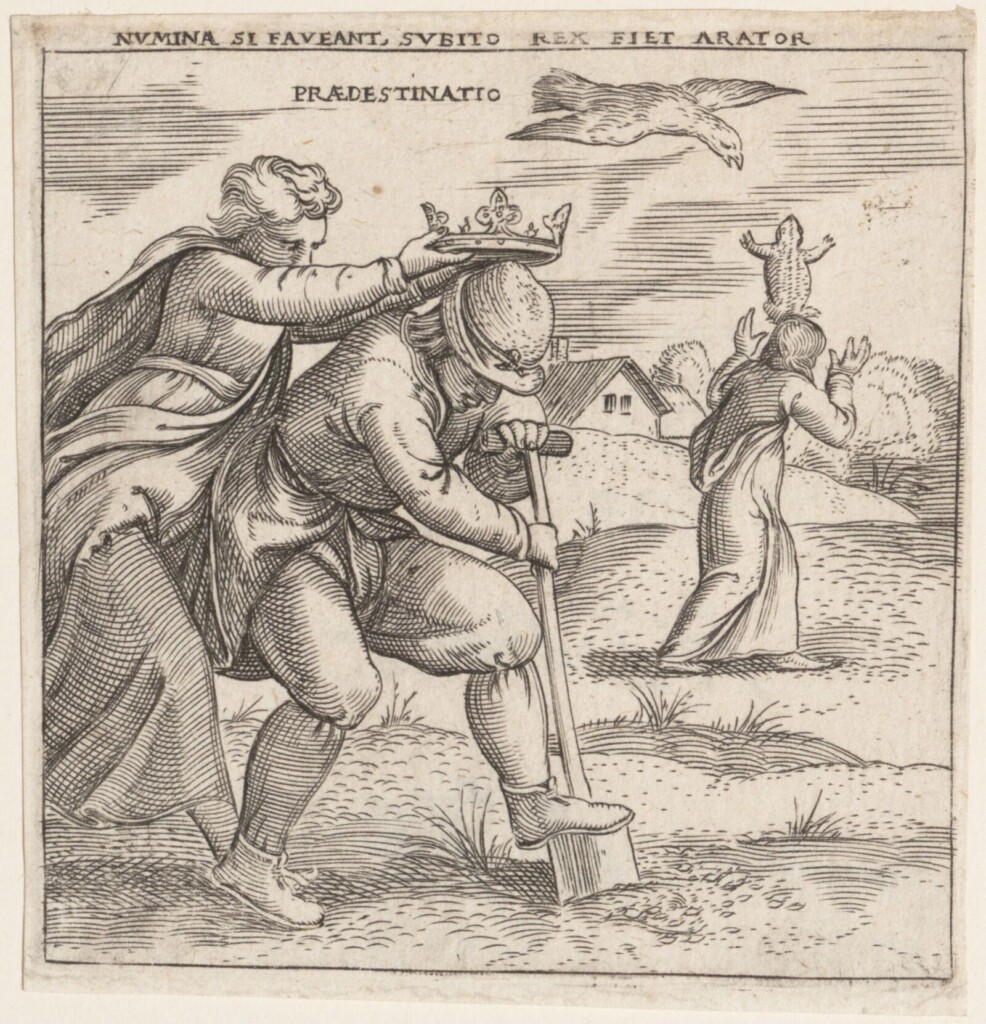
You are standing in a room where you chose nothing — not the country, not the language pressed into you before you could refuse it, not the face that would one day unhinge you — and yet you are expected, by some unspoken cultural contract, to narrate all of it as though it were always leading here.
The vertigo that follows from Sartre’s position in “Being and Nothingness” is not intellectual. It is somatic. When he insists that existence precedes essence — that there is no prior nature, no script, no metaphysical blueprint into which your encounters slot themselves — he is not offering liberation. He is describing a condition most people experience as intolerable and spend considerable energy disguising. The encounter you call fated, the meeting you describe as inevitable in retrospect, is one you are radically responsible for having pursued, prolonged, interpreted, and elevated into meaning. The word “fate” is not a discovery. It is a construction erected after the fact to distribute the weight of that authorship across something larger than yourself.
What makes this particularly difficult to sit with is that the retrospective imposition of narrative feels like perception, not invention. Cognitive scientists studying what Daniel Kahneman formalized in 2011 as the distinction between System 1 and System 2 thinking have repeatedly documented how the mind stitches discontinuous events into causal sequences with the fluency of someone reading rather than writing. The story feels found. This is precisely why narrative retrojection — the act of reading the present backward into the past until the past looks inevitable — is so difficult to catch in the act. It happens at the speed of emotion, not analysis, and it happens most forcefully in the domain of love, where the stakes of authorship are highest and the desire for innocence most acute.
There is a specific terror in owning an encounter completely. To say that you chose this person not because the universe arranged it but because something in you, formed by accidents you did not choose, recognized something in them that your particular history had made you capable of recognizing — that is a statement that closes off the exit of destiny entirely. Simone de Beauvoir, writing in “The Ethics of Ambiguity” in 1947, identified the flight from freedom as a fundamental human tendency, a willed bad faith that manifests not in dramatic self-deception but in the quiet daily refusal to acknowledge that one is the source of one’s own meaning. The couple who insists they were meant to find each other is not simply being romantic. They are performing an ethical retreat from the discomfort of having been the authors of every step.
What complicates this further is that the contingency Sartre describes does not make encounters less significant — it makes them more so, in a way that is harder to metabolize. A meeting that was inevitable costs you nothing. A meeting that was utterly unnecessary, that could have not happened with the alteration of a single small decision weeks or months before, that arrived from nowhere and became everything — that demands a different kind of reckoning. The meaning was not there waiting. You made it. And you made it under conditions you did not control, with materials you did not select, in a language handed to you before you could speak. The authorship is real and the freedom is genuine, and neither of them is clean.
Perhaps the most honest thing one can say about predestined encounters is that the predestination is always written in the past tense, by a hand that was already there before the story began to feel like a story, which means the question of whether fate is real has always been less interesting than the question of what it costs to need it to be.
🌀 Threads of Destiny: Philosophy, Choice & the Invisible Hand
The question of whether our encounters are written before we arrive has haunted philosophers, theologians, and storytellers across every culture. From ancient myths of fate to modern existential thought, the tension between predetermination and radical freedom shapes how we understand love, guilt, and the meaning of coincidence. These articles trace the deepest intellectual roots of that enduring question.
Chance or Destiny: Who Really Pulls the Strings of Our Lives
Few questions cut closer to the bone of human experience than whether chance or destiny guides our most pivotal encounters. This article examines the philosophical, psychological, and cultural frameworks that compete to explain why certain meetings feel inevitable — and what is truly at stake in that feeling. It is an indispensable companion for anyone drawn to the mystery of predestined connection.
GO TO THE SELECTION: Chance or Destiny: Who Really Pulls the Strings of Our Lives
Søren Kierkegaard and the agony of moral choices
Søren Kierkegaard built his entire philosophy around the agonizing gap between what we choose and what we cannot escape, making him one of the most urgent voices in any conversation about fate and free will. His concept of the three existential stages illuminates how human beings oscillate between deterministic despair and the terrifying leap of authentic choice. Reading Kierkegaard is to stand at the crossroads where destiny and decision become impossible to separate.
GO TO THE SELECTION: Søren Kierkegaard and the agony of moral choices
Friedrich Nietzsche, the eternal return and the weight of the past
Nietzsche’s doctrine of the eternal return is perhaps the most radical philosophical test of whether a human life can be truly willed or whether it is condemned to repeat its own necessity. By asking whether we would choose to live the same life infinitely many times, Nietzsche transforms the abstract debate about free will into a visceral, existential challenge. This article unpacks the weight that the past exerts on every present encounter, fated or otherwise.
GO TO THE SELECTION: Friedrich Nietzsche, the eternal return and the weight of the past
Sartre’s Being and nothingness: when love becomes a delusion of control
Sartre’s landmark work Being and Nothingness reveals how the very desire to possess another person can become a mirror of our own ontological anxiety — a desperate attempt to fix, through love, what freedom makes perpetually unfixed. His analysis of the ‘look’ between two subjects exposes how predestined connection can be simultaneously liberating and annihilating. This article is essential reading for understanding how philosophical notions of fate play out in the intimate theater of human relationships.
GO TO THE SELECTION: Sartre’s Being and nothingness: when love becomes a delusion of control
Discover the Cinema That Dares to Ask the Deepest Questions
If these ideas about fate, free will, and the mystery of human encounter move you, independent cinema is where they come alive on screen with uncompromising honesty. On Indiecinema you will find a carefully curated selection of films that explore predestination, choice, and the invisible threads binding human lives — films that mainstream platforms overlook and that deserve your full attention.
👉 EXPLORE THE CATALOG: Watch Indie Films in Streaming
A vision curated by a filmmaker, not an algorithm
In this video I explain our vision

