
The Republic Before the Myth
You have heard of Rome the way you have heard of your own country’s founding — as a story that arrived already finished, already moral, already inevitable. The Senate in white togas. The citizen-farmer setting down his plow to answer the republic’s call. The incorruptible magistrate who sentenced his own son to death for breaking military discipline. These images carry the texture of memory, but they were never recorded by anyone who was present. They were written by men who lived centuries after the events they described, men who were frightened by what Rome had become and desperately needed to believe it had once been something purer.

Livy began his monumental history, Ab Urbe Condita, around 27 BCE, just as Augustus was dismantling the last procedural fictions of republican government. The timing was not accidental. Writing across what would eventually span 142 books, Livy admitted in his own preface that he could not vouch for the accuracy of events before the Gallic sack of Rome in 390 BCE, since most records had been destroyed. He wrote anyway, and with extraordinary emotional conviction, because his project was never really historiography. It was diagnosis by nostalgia. The early republic he conjured — disciplined, selfless, governed by ancestral custom — was a mirror held up to an Augustan present he found morally bankrupt, which meant the mirror was constructed entirely from the anxieties of the man holding it.
Cicero performed the same operation from within the dying republic itself. In De Re Publica, written between 54 and 51 BCE as civil war gathered at the edges of Roman political life, he placed his ideal constitutional arguments in the mouths of Scipio Africanus the Younger and his circle, men who had died a century before Cicero was born. This was not a rhetorical device. It was a confession that the values Cicero claimed were Rome’s original inheritance could not actually be located in living Roman political culture. They had to be ventriloquized through the dead, attributed to an era just far enough away to be unverifiable, close enough to feel like memory.
The structural problem with this retrospective idealization is that the actual Roman Republic between its traditional founding date of 509 BCE and the social conflicts of the second century BCE was defined by grinding aristocratic violence, systemic exclusion, and what modern historians like Mary Beard, writing in SPQR in 2015, have described as a state perpetually in negotiation with its own internal contradictions. The early struggle between patricians and plebeians — resolved only gradually through legislation like the Licinian-Sextian laws of 367 BCE — was not the story of a balanced constitution perfecting itself. It was a slow, coerced redistribution of power extracted through threat of secession, debt rebellion, and institutional paralysis.
What Livy and Cicero did was take the endpoint of that violent negotiation and project it backward as origin. The mixed constitution that Polybius had analyzed with genuine analytical interest in the second century BCE — the balance between consuls, Senate, and popular assemblies — became, in later Roman hands, not a fragile and contested achievement but an inherited moral essence, a founding gift from ancestors whose virtue was simply superior to the present. This transformation from political history into moral mythology served an immediate function: it made current failure feel like decline rather than exposure, a falling away from greatness rather than a revelation that the greatness had always been partly imaginary.
The republic Rome remembered was built on top of the republic Rome actually endured, and the mortar between the two was literary. Every subsequent civilization that reached for Rome as a model of republican virtue — the American founders citing Cincinnatus, the French revolutionaries invoking Brutus — was reaching not for history but for a text, and not even for the text itself but for the political emotions of the men who wrote it when they were losing.
Bruto
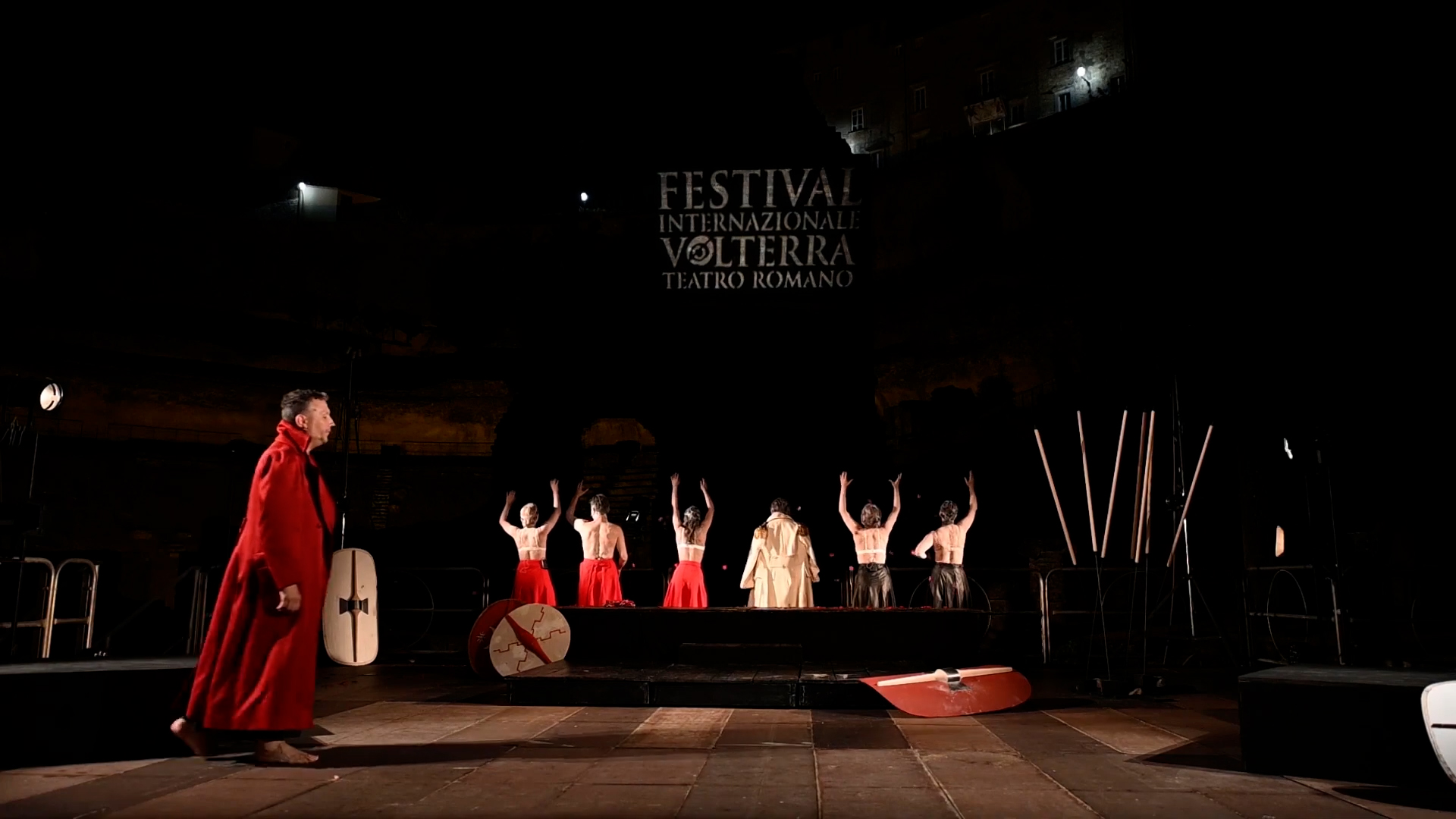
Theatrical show, by Nicola Fano e Simon Domenico Migliorini, Italy, 2022
The protagonist is Brutus, the celebrated instigator, along with Cassius, of the conspiracy of the Ides of March in 44 B.C., the assassin of Caesar. He enters the stage calling loudly for Cassius, his alter ego: we find ourselves in Philippi, where both conspirators have already fought and lost against the troops of Marcus Antonius, who has become the guarantor of justice towards Caesar and Rome. The story written in books materializes on stage with the words of Shakespeare, infinite, immortal, eternal words. The spectator listens, a symbolic battlefield and dead bodies appear before him, on which Brutus, defeated, wounded, almost dying, crawls and invokes and looks around bewildered, shocked at the appearance of the ghost of Caesar.
Brutus is Simone Migliorini, who speaks, moans, shouts, modulates those phrases of Shakespearean tragedy and makes them his own, as they have been generated, also in the adaptation from Shakespeare's "Julius Caesar" by the playwright Nicola Fano, who worked on the text focusing on the most controversial figure, that of the leader of the conspirators, the assassin of Caesar, specifically for Migliorini, who has studied and deepened the text and characters. But here Brutus, as the show unfolds, also becomes Macbeth, also Henry V, both tyrants, both assassins, soldiers, courageous or cowardly, great or infamous, in a flow of words and famous phrases, spoken, planted, recited, whispered, shouted by Simone Migliorini who with this performance confirms himself as a high-level interpreter. What strikes is the protagonist's ability to transform himself, from time to time, from Brutus into other characters, even into Marcus Antonius. A change of costume is enough for him, on stage. And it is here that Brutus looks into Antony's eyes and Antony scrutinizes Brutus, doubled by the same actor in a virtuosity that is extremely congenial to him. The actor is capable of being, at the same time, the one who kills and the one who exalts the killed; the one who is prey to doubts and remorse but is proud of his love for Rome and its freedom, and the one who exalts and celebrates the slain Caesar before the people, holding his will in his hand, in the famous Oration that has always been the flagship of the greatest actors.
LANGUAGE: Italian
SUBTITLES: English, Spanish, French, German, Portuguese
Virtus and Its Exclusions
You have been told, at some point in your education, that the Romans built their republic on virtue. The word arrives in your mind scrubbed clean, universal, almost geometric — a quality theoretically available to any soul willing to discipline itself. What you were not told is that the Latin word hiding behind that translation, virtus, carries embedded inside its syllables the word vir, meaning man, and not man in the loose contemporary sense of human being, but man as a precise social category: freeborn, propertied, Roman by blood and by standing. The virtue was never abstract. It was a deed of possession before it was a deed of character.
Polybius, writing in the second century BCE as a Greek captive trying to decode why Rome had conquered the Mediterranean world in under fifty-three years, identified the Roman governing class’s capacity for self-sacrifice and civic discipline as the mechanical secret of their dominance. His Histories, composed around 150 BCE, are almost admiring in their clinical precision: Rome worked because its elite genuinely believed that the city’s continuation mattered more than their individual survival. But Polybius was also recording a performance staged for a specific audience. The virtus he observed was inseparable from the census classes that Servius Tullius had institutionalized centuries earlier, a system in which military obligation, voting weight, and social honor were calibrated against property ownership. A man who owned nothing could not perform virtus in any politically legible way, because the republic had no apparatus for recognizing his performance.
Women occupied a stranger and more suffocating position inside this architecture. They were not excluded from virtue in the abstract — Roman literature is dense with praised women, Cornelia mother of the Gracchi, Lucretia, Claudia Quinta — but the virtues assigned to them were systematically domestic, passive, and defined entirely by their relationship to male citizens. A woman’s excellence was pudicitia, chastity, and pietas toward her household gods and her husband. When Livy writes Cornelia in the early first century BCE, he uses her as a vessel through which her sons’ greatness is retroactively explained. Her mind, her education, her political intelligence — all of which were historically documented and genuinely exceptional — collapse into the single achievement of having produced Tiberius and Gaius Gracchus. The Republic needed its women to be the soil in which Roman men grew, not Roman persons themselves.
The ethnic boundary of virtus was drawn with equal precision and rather less literary softening. The Social War of 91 to 87 BCE broke out partly because Italian allies who had bled for Roman legions for generations, who had shared every military risk and contributed to every territorial expansion, were denied the civic standing that would have allowed their courage to count as virtus in the republican sense. They were brave, disciplined, effective — and categorically invisible inside the moral accounting of the Roman state. When citizenship was finally extended after that war, it arrived not as a recognition that the principle had always been too narrow, but as a pragmatic concession to prevent total collapse. The ideology did not correct itself. It absorbed the Italians and redrew its exclusion further out, toward Gauls, toward Africans, toward the permanent category of those whose courage would always be noted and never fully counted.
What makes this ideological architecture durable across centuries is not that people failed to notice its contradictions. Slaves who performed extraordinary acts of loyalty were occasionally granted manumission. Foreign soldiers rose through auxiliary ranks. The contradictions were visible and the system accommodated them individually, precisely to avoid confronting them structurally. Each exception was framed as a gift from the republic’s generosity rather than evidence of the rule’s injustice, which meant that every exception reinforced the hierarchy it appeared to soften.

The Senate as Controlled Oligarchy
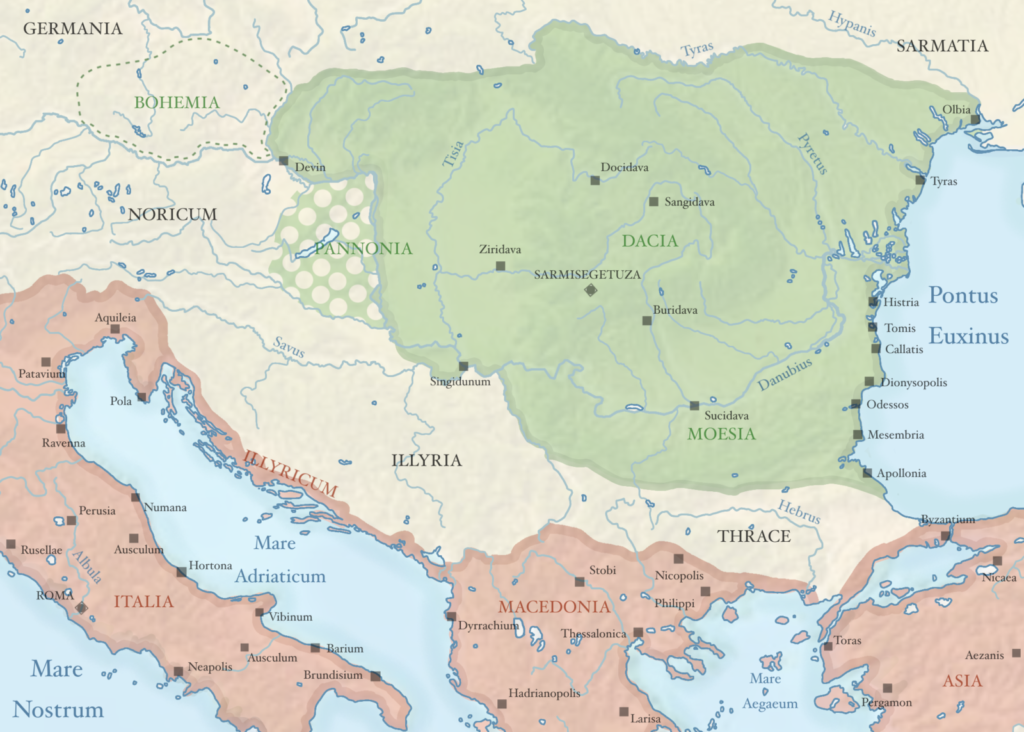
You have probably been taught that the Roman Senate represented something noble — a chamber of wise elders deliberating in the interest of the republic, a model so admired that the founders of the American constitutional order inscribed its ghost into their own architecture. The word “senate” itself carries that freight: senex, the old man, the experienced one, the one who has earned the right to speak. What this etymology conceals is that the right to speak had never been earned through wisdom. It had been inherited, purchased, or seized.
The Senate of the middle Republic, roughly from the fourth century BCE through the Gracchan crisis of 133 BCE, was not a deliberative body in any meaningful democratic sense. It was an enrollment of approximately three hundred men whose inclusion was controlled by the censors, themselves elected from the senatorial class, creating a circularity of selection that could sustain itself across generations without ever needing to openly exclude anyone. Exclusion happened upstream, at the level of wealth qualification, family connection, and the invisible consensus of those already inside. Polybius, writing in the second century BCE in his Histories, famously described the Roman constitution as a balanced mixture of monarchy, aristocracy, and democracy — the consuls representing the first, the Senate the second, the popular assemblies the third. He meant this as praise. What he was actually describing was a system in which each element neutralized the destabilizing potential of the others while leaving the structural advantages of the aristocratic component entirely intact.
The so-called Conflict of the Orders, which stretched across nearly two centuries before its nominal resolution in 287 BCE with the Lex Hortensia, is routinely narrated as a democratic struggle — plebeians pushing back against patrician monopoly, winning tribunates, winning the consulship, eventually winning the principle that plebiscites held the force of law. Textbooks present this as Roman democracy maturing. But the families who led the plebeian cause, the Licinii, the Genucii, the Publilii, were themselves wealthy landowners whose primary grievance was exclusion from offices that their economic position already entitled them to occupy. The nobiles who emerged from this settlement were not a broadened political class. They were a merged oligarchy, patrician and plebeian bloodlines now intertwined through strategic marriage, sharing magistracies with the efficient rotation of men who all fundamentally agreed on the same question: that land, slaves, and provincial tribute should remain concentrated in the hands of those already holding them.
What makes this mechanism sophisticated rather than merely cynical is that it required genuine competition to function. Senatorial families competed ferociously — through electoral canvassing, through the cultivation of client networks reaching deep into Italian towns, through the financing of public games and building projects that translated private wealth into public visibility. The Latin word ambitio, from which “ambition” descends, originally meant the physical act of going around, the candidate walking through the forum soliciting votes. This competition was real. Men lost elections, reputations collapsed, families fell into obscurity across a generation. But competition for access to a structure is categorically different from competition over the structure’s fundamental design. The Senate never debated whether senatorial authority should exist. It debated, sometimes violently, who among the qualified should exercise it.
Cicero, defending this arrangement in De Re Publica in 54 BCE, argued that the best state was one in which the best men governed — optimates, the best ones, a word that had already become a partisan label for the senatorial conservatives of his day. The candor inside that argument is almost startling: governance justified not by consent or procedure but by the quality of the governors themselves, quality being measured by the same class that produced the governors.
Res Publica and the Grammar of Belonging
You have been told, at some point in your life, that citizenship is a gift. The Romans were the first civilization to make that gift come with a bill attached, and the bill was always higher than the gift was worth.
The phrase res publica — the public thing, the common affair — sounds generous on its surface, the suggestion of a political space held in common by those who inhabit it. Cicero, in De Re Publica, written around 54 BCE, defined it as res populi, the affair of the people, bound together not merely by proximity but by shared agreement on law and mutual interest. What he did not say plainly, though the architecture of Roman law made it unmistakable, was that this shared agreement was structured as a pyramid, and agreement at the bottom looked considerably different from agreement at the top.
Roman citizenship expanded in waves that each generation of historians has been tempted to read as progress. The Social War of 91 to 87 BCE ended with the Lex Julia and the Lex Plautia Papiria extending full citizenship to the Italian allies who had bled for Roman legions for decades — not as a recognition of their humanity, but as a response to their armed revolt. Enfranchisement was the cost of suppressing the uprising. The Senate did not open the gates of the city; it opened the gates of obligation. Every new citizen gained the right to vote in assemblies that were already architecturally designed, through the centuriate and tribal structures, to dilute the weight of poorer and more distant voices. Max Weber, analyzing Roman social stratification in his posthumous Economy and Society, noted that Roman civic inclusion functioned less as a leveling mechanism than as an absorption strategy — it imported subjects into a legal framework that had been calibrated, from its origins, to produce soldiers and taxpayers first, and political participants only incidentally.
The word civis carried within it the expectation of military service in a way that no modern equivalent of citizen quite replicates. The Roman census — conducted every five years, the last republican one recorded by Livy as reaching nearly one million registered citizens by the late republic — was not primarily a democratic instrument. It was a military and fiscal inventory. A man was counted so that the state could calculate how many legions it could field and how much tribute it could extract. His legal personhood, his capacity to contract, to own property, to seek redress in court, was inseparable from his position in a hierarchy of classes that the census itself determined. To be seen by Rome was to be made available to Rome.
The Edict of Caracalla in 212 CE extended citizenship to virtually all free inhabitants of the empire, a gesture that historians since Edward Gibbon have struggled to interpret without anachronism. By that point the rights attached to citizenship had been progressively hollowed out, and what was being distributed was less a political identity than a tax status — specifically, the obligation to pay inheritance taxes previously applicable only to citizens. The gift arrived fully loaded, as it always had, except now the wrapping was thinner.
What this produces, across six centuries of republican and imperial adjustment, is something more unsettling than simple exploitation. It is the grammatical structure of belonging itself — the way inclusion in a category simultaneously defines who you are in relation to the category’s demands. To be Roman was not merely to be protected; it was to be enrolled in a narrative whose author was the state, whose plot required your productive and military function, and whose conception of virtue — gravitas, pietas, virtus — was precisely the qualities that made a man useful to the machinery before they made him anything else.
Pietas as Social Control
You perform the ritual before you understand why. The grain is scattered, the words are spoken in the correct order, the animal falls at the correct moment — and somewhere in the doing of it, before any thought has formed about whether you believe or what you believe, the act has already shaped you. This is how pietas worked in the Roman Republic, and it is worth sitting with the precision of that mechanism rather than smoothing it into something more comfortable, like faith or civic pride.
The Latin word carries a weight that the English “piety” cannot hold. Cicero, in De Natura Deorum written in 45 BCE, was careful to distinguish pietas from superstitio — the former a disciplined recognition of obligations owed, the latter an anxious excess. The distinction reveals everything: pietas was never primarily about feeling. It was about the correct execution of duty toward the gods, toward parents and ancestors, toward the patria. What made it a structuring force rather than a personal virtue was the simultaneity of those obligations. You could not satisfy one while defaulting on another. The man who honored Jupiter but dishonored his father had failed at both, because the familial and the divine were not separate registers of loyalty but the same hierarchy expressed at different scales.
Roman children did not choose to enter this framework any more than they chose their family name. The patria potestas — the legal authority of the father extending in principle until his death — meant that the first social unit a Roman ever inhabited was already a miniature republic, with its own rituals, its own ancestral busts lining the atrium, its own expectations of deference and performance. Georg Wilhelm Friedrich Hegel, in his Lectures on the Philosophy of History delivered in Berlin between 1822 and 1831, observed that Roman legal personhood was constituted through relation rather than through individual interiority — you were a Roman citizen as son, as soldier, as magistrate, never as a bare self standing prior to those roles. What this produced was a subject for whom the very grammar of selfhood was institutional. Dissent, under those conditions, could not be articulated as personal conscience opposed to external demand. It could only appear as failure — failure of nerve, failure of duty, failure to be fully Roman.
This is not a subtle mechanism. When Titus Manlius Torquatus executed his own son in 340 BCE for winning a battle in violation of a direct command — an act the ancient sources record without condemning him, indeed with a kind of austere admiration — what was being demonstrated was that pietas to the state consumed pietas to the family, and that this consumption was itself the highest expression of Roman virtue. The son had acted bravely. He had acted wrongly. The father wept, and then he gave the order. The story was told and retold not because it was exceptional but because it was exemplary. It taught that the self which might resist, the self which might say this is my son and I will not, was precisely the self that pietas required you to have already surrendered.
The sociologist Pierre Bourdieu spent much of his career describing how social structures reproduce themselves not through explicit coercion but through the internalization of categories that make certain thoughts literally unthinkable. His concept of the habitus, developed at length in The Logic of Practice published in 1980, describes a disposition toward the world so thoroughly absorbed that it operates below conscious choice. The Roman cult of pietas was a civic habitus engineered over centuries, and its most effective feature was that it never needed to threaten anyone. By the time a Roman was old enough to refuse, he had already been formed by decades of ritual, genealogy, and spectacle into a person who experienced the refusal of duty not as an act of freedom but as a kind of self-annihilation — a falling out of the only story in which he had ever been a legible self.
A vision curated by a filmmaker, not an algorithm
In this video I explain our vision
The Violence Beneath the Constitution

You are watching a man beaten to death by senators in the Forum, his body dragged through the streets and thrown into the Tiber, and the institution that ordered this describes itself, in the same breath, as a republic of laws. Tiberius Gracchus died in 133 BCE not at the hands of a mob but at the hands of colleagues, men who held the same magistracies, walked the same marble floors, and quoted the same ancestral precedents. His brother Gaius followed twelve years later, in 121 BCE, killed in a coordinated operation that left three thousand of his supporters dead in a single afternoon. The Senate did not suspend the constitution to accomplish this. It used it.
The instrument was the senatus consultum ultimum, a decree that declared a state of emergency and effectively suspended the protections of Roman citizenship for anyone the Senate designated as an enemy of the republic. It was constitutional in the narrowest technical sense, meaning that it emerged from legitimate deliberation among legitimately appointed men. What it produced was licensed massacre. Cicero would invoke the same mechanism in 63 BCE to execute the Catilinarian conspirators without trial, an act he celebrated for the rest of his life as the salvation of civilization and which cost him his political career when the citizen body decided it cared, however inconsistently, about the precedent. The constitution was not a restraint on power. It was a vocabulary through which power explained itself to itself.
This matters because the standard account of Roman republicanism treats violence as a rupture, something that arrived with Marius or Sulla in the late first century BCE and shattered an otherwise functioning civic order. Sallust, writing in the 40s BCE, constructed this narrative explicitly in his Bellum Iugurthinum, locating the origin of Roman moral collapse in foreign conquest and the greed it unleashed. It is a seductive story because it assigns the republic a golden period, an era of genuine virtue against which decline can be measured. But the execution of the Gracchi predates Sulla’s march on Rome by four decades. The legal lynching of reformers was not a symptom of decay. It was the republic operating as designed, protecting the property arrangements and political monopolies of the senatorial class against anyone, however legal their methods, who threatened them.
Roman expansionism did not merely fund this system. It generated the human raw material through which domestic order was enforced and demonstrated. By the second century BCE, Rome was processing tens of thousands of enslaved people annually through markets at Delos and Puteoli, a supply chain built on military conquest that simultaneously enriched the aristocracy, displaced the free peasantry whose land losses the Gracchi tried to address, and created the latifundia worked by slave labor that became the economic foundation of late republican power. The violence was not incidental to the constitutional order. It circulated through it, financing the elections, staffing the estates, maintaining the social distances without which the elaborate theater of republican equality could not function.
What the citizen standing in the Comitium experienced as civic participation was inseparable from what the enslaved person in the silver mines of New Carthage experienced as annihilation. These were not parallel systems. They were the same system, viewed from positions the system itself made it nearly impossible to occupy simultaneously. Polybius, the Greek historian writing in the mid-second century BCE, produced his famous analysis of the Roman mixed constitution, the balance of consuls, Senate, and popular assemblies, as an explanation for Rome’s extraordinary stability and military success. He was not wrong about the mechanics. What his framework could not accommodate was the question of what exactly was being stabilized, and for whom, and at what cost denominated in bodies that the constitution never counted.
Republican Decline as Internal Logic
You already know the ending before the historians tell it to you. The Senate chamber, the assassins, the civil wars bleeding into one another across two generations — you absorb these as tragedy, as corruption, as a fall from grace. But tragedy requires a deviation from a prior order, and what Rome demonstrates instead is something colder: a system arriving at its own logical conclusion, a machine that worked exactly as designed until the design consumed it.
The Republic was never a democracy misfiled under the wrong label. It was an aristocratic competition engine, calibrated to produce winners. The cursus honorum — that rigid sequence of offices through which any ambitious Roman man was required to climb — was not a civic safeguard but a sorting mechanism, and like all sorting mechanisms its implicit promise was that the best competitor would eventually stand alone at the top. Polybius, writing in the second century BCE, admired the Roman constitution precisely for its balance of consular power, senatorial authority, and popular assemblies, but his admiration was archaeological even as he expressed it. The balance he described had already begun corroding by the time his ink dried. What he called equilibrium was in fact a controlled tension that could only hold as long as no single Roman accumulated enough military glory, enough client networks, enough grain to distribute, to make the tension permanent in his favor.
The year 133 BCE does not mark a beginning of crisis — it marks the moment the crisis became legible. Tiberius Gracchus was not a revolutionary in the modern sense; he was a Roman aristocrat using exactly the tools Roman ideology had always honored, popular appeal and military prestige and ancestral authority, to pursue land reform. The Senate had him killed for it, which tells you more about the Senate’s interests than about Gracchus’s methods. His brother Gaius followed twelve years later and was also destroyed. What the Gracchan episode exposed was that the Republic’s vaunted mixed constitution had no mechanism for resolving genuine conflicts of material interest between classes. It had only violence, which it had always had, and which it had previously exported to foreign territories with considerable success.
That export is the part of the equation that rarely receives its full weight. The Roman economy of the middle Republic ran on conquest. Slave labor from defeated populations underwrote the estates of the senatorial class, destabilized the smallholder economy, and pushed displaced rural citizens into an urban proletariat that was simultaneously politically volatile and militarily available. The sociologist Michael Mann, in his work on the sources of social power, identifies this kind of imperial feedback loop as a structural accelerant rather than an accident: the more successful the military expansion, the more it undermines the domestic conditions that originally made military expansion possible. Rome was not betrayed by its generals. It was consumed by the appetites it had deliberately cultivated in them over centuries.
Marius reformed the legions in 107 BCE and in doing so made the transition from Republic to personal rule not merely possible but structurally overdetermined. When soldiers owed their land grants not to the state but to the commander who had promised them, loyalty ceased to be a civic virtue and became a transactional bond. Sulla marching on Rome in 88 BCE was not a monster; he was a Roman aristocrat operating according to exactly the values the Republic had encoded: personal honor, military supremacy, the refusal to accept political defeat. The Republic had spent five centuries teaching its best men that winning was the only thing that mattered, and then expressed horror when one of them decided that a city was worth less than a career.
Augustus understood that he could not abolish the competition. He could only become the permanent winner of it, and call that peace.
The Republic We Keep Reinventing
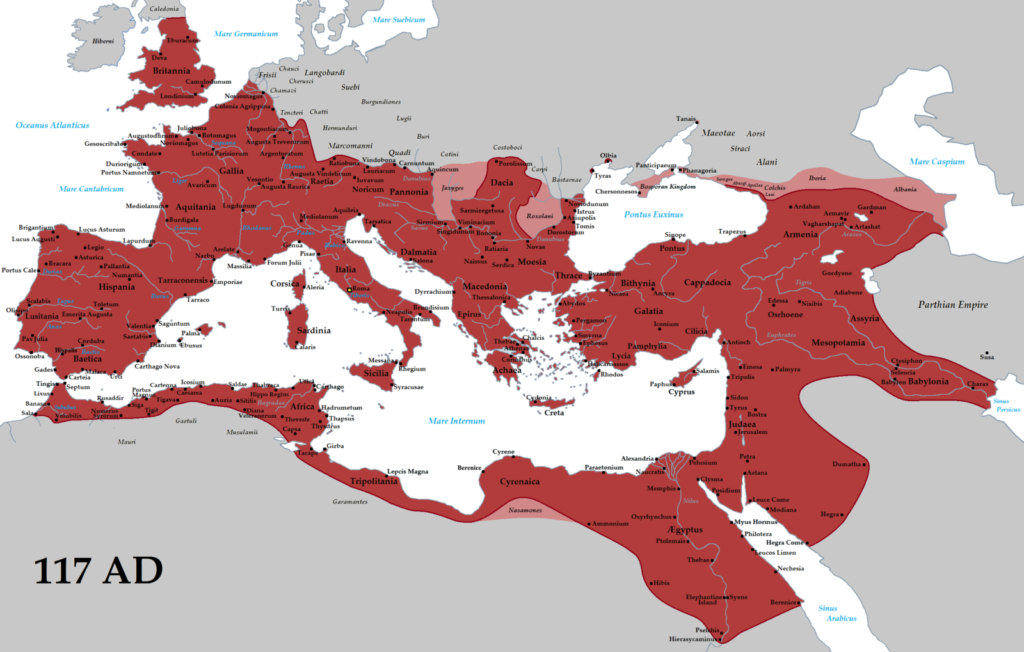
You are sitting in a civics classroom somewhere, fourteen years old, and the teacher draws three boxes on the board — legislative, executive, judicial — and tells you this is how power is divided so that no single person can hold too much of it. The diagram feels self-evident, almost natural, like a law of physics rather than a choice made by specific men with specific interests in a specific room in Philadelphia in the summer of 1787.
What that teacher almost certainly did not mention is that the diagram was borrowed, selectively and strategically, from a civilization that had collapsed under the weight of its own contradictions roughly eighteen centuries earlier. Montesquieu, writing in 1748 in The Spirit of the Laws, looked at the Roman Republic and saw what he wanted to see: a machinery of equilibrium, consuls checking tribunes, senate checking assemblies, each organ of power restrained by another. He extracted from Roman history a principle of separation that the Romans themselves had never cleanly theorized, and then handed that extracted principle to the generation that would build the modern West’s governing architecture. The Rome that actually existed — brutal, slaveholding, perpetually expanding its territory through organized violence, governed by an oligarchy that managed popular pressure rather than responded to it — was left behind in the quarry.
Madison, in Federalist No. 51, did not even pretend to be speaking to everyone. The famous line about ambition counteracting ambition was a frank acknowledgment that the system was being designed for a world in which most people could not be trusted with power — not because the Framers were cynical in some simple sense, but because they genuinely believed that property ownership was a precondition for the kind of rational independence that citizenship required. Roman census classes, which had assigned political weight to citizens in direct proportion to their wealth, offered a respectable classical precedent for a republic that would constitutionally protect the interests of those who already had something to protect. The language was universal; the architecture was not.
This is the persistent grammar of republican revival: ancient Rome provides the aesthetic legitimacy, the marble vocabulary, the tragic grandeur of a civilization that tried and fell, and in exchange the revivers get to present their particular arrangements as belonging to a long human tradition of ordered self-governance rather than to a particular moment of class consolidation. Every courthouse column, every toga in a neoclassical painting, every reference to the senate in a modern legislature’s formal title is doing this work quietly, continuously, asking you to feel that the present arrangement is the culmination of something deep and tested rather than one option among many that happened to win.
Political theorist Hannah Arendt, in On Revolution published in 1963, noticed something stranger still: that the American founders were haunted by the Roman Republic not only as a model but as a warning, specifically the warning of its end. They feared Caesar not because autocracy was unfamiliar to them but because they understood, reading their Polybius and their Cicero, that republics generate their own gravediggers — that the same competitive ambition the system channels also, over time, produces figures who learn to use the system’s own instruments against it. Their solution was more mechanism, more counterweight, more procedural friction. The possibility that the problem was not procedural but structural — that a republic built on exclusion carries its own dissolution inside it from the beginning — was not a thought the architecture had room for.
What gets called balance in these traditions almost always turns out, on examination, to be the stabilization of a particular distribution of advantage. Rome did not fall because it forgot its republican values. It fell, in part, because those values had always been the property of a minority disciplined enough to share them with each other and ruthless enough to deny them to everyone else.
🏛️ Power, Law, and the Foundations of Western Civilization
The Roman Republic did not emerge in a vacuum — it was part of a long conversation about governance, civic virtue, and the nature of political power that continues to shape Western thought. These related articles explore the philosophical, literary, and political threads that connect ancient Rome to the ideas we still wrestle with today.
John Locke: Life and Works
John Locke‘s political philosophy owes a profound debt to the Roman Republican tradition, particularly in its insistence on the rule of law, the separation of powers, and the social contract as the foundation of legitimate government. His Second Treatise of Government can be read as a modern reformulation of ideas first practiced in the Roman Senate and codified in Roman law. Understanding Locke means understanding how Rome’s political legacy was reborn in the Enlightenment.
GO TO THE SELECTION: John Locke: Life and Works
Thomas Hobbes: Life and Political Thought
Thomas Hobbes developed his theory of sovereignty in direct dialogue with the collapse of ancient republics, including Rome, arguing that without a strong central authority human life descends into chaos and war. His Leviathan is in many ways a meditation on what went wrong in the Roman Republic’s final years, when civic virtue gave way to civil war and the ambitions of individual men. Hobbes forces us to ask whether republican ideals can ever truly restrain the darker impulses of political power.
GO TO THE SELECTION: Thomas Hobbes: Life and Political Thought
Niccolò Machiavelli: Life and Political Thought
Niccolò Machiavelli was perhaps the first modern thinker to take the Roman Republic seriously as a political model, dedicating his Discourses on Livy to a sustained analysis of its institutions, its virtues, and its fatal contradictions. His admiration for Rome’s capacity to balance liberty with power shaped the entire tradition of republican political thought that followed. To read Machiavelli is to see the Roman Republic through the eyes of someone who mourned its loss as a living tragedy.
GO TO THE SELECTION: Niccolò Machiavelli: Life and Political Thought
Rousseau’s The Social Contract: Analysis
Jean-Jacques Rousseau‘s Social Contract is deeply indebted to the Roman Republican ideal of civic participation, collective sovereignty, and the subordination of private interest to the common good. Rousseau explicitly invoked Roman institutions such as the comitia and the tribunate as models for a legitimate democratic order. His work represents one of the most passionate attempts in modern philosophy to resurrect the republican spirit of ancient Rome in a new political form.
GO TO THE SELECTION: Rousseau’s The Social Contract: Analysis
Explore History and Ideas on Indiecinema
If these historical and philosophical themes have sparked your curiosity, Indiecinema is the streaming platform where ideas come alive on screen. Discover independent documentaries and films that explore the great questions of civilization, power, and human values — all in one place, waiting for you.
👉 EXPLORE THE CATALOG: Watch Indie Films in Streaming
A vision curated by a filmmaker, not an algorithm
In this video I explain our vision

