
The Kami in the Mud
You are standing at the edge of a gravel path that leads nowhere you can name. There is a torii gate ahead of you, its vermillion paint slightly chipped at the base where the wood meets the earth, and you realize with a small, uncomfortable jolt that you do not know what you are supposed to feel. You have been inside cathedrals where the architecture itself issues instructions — look up, be small, the divine is above and you are below. You have read religious texts that open with commands and promises. But here, at this particular threshold in a forested hillside somewhere in Japan, with the sound of a stream running behind the cedar trees and a crow landing on the rope of a suspended bell, there is no doctrine waiting for you. No creed has been posted at the entrance. No congregation is assembled to tell you the correct interpretation of what you are about to enter. The silence is not empty. That is what unsettles you. It is full, dense, pressing back.

Shinto is among the oldest continuously practiced religious traditions on earth, and it has survived precisely because it never consolidated itself into the kind of institutional theology that Western observers expected to find. The word itself — a Chinese rendering of the Japanese kami no michi, meaning roughly “the way of the kami” — was not widely used until the sixth century CE, when Japanese scholars needed a term to distinguish indigenous practice from the Buddhism arriving from the continent. But the practices the word eventually labeled were already ancient, layered into the Japanese archipelago across millennia of agricultural and animistic life before any written record could fix them in place. The earliest Japanese chronicles, the Kojiki of 712 CE and the Nihon Shoki of 720 CE, compiled under imperial order during the reign of Empress Genmei, do not read like scripture in any familiar sense. They read like cosmological gossip — chaotic, sensual, sometimes comic, filled with gods who quarrel and weep and make catastrophic errors of judgment.
What those texts describe is a universe in which the sacred is not located in a separate realm accessible only through death or enlightenment or the mediation of a priestly class. The kami — the central concept around which everything orbits — are not gods in the Abrahamic sense, not transcendent creators standing outside creation issuing judgments upon it. The scholar Motoori Norinaga, writing in the eighteenth century in his monumental commentary on the Kojiki, the Kojiki-den, struggled to define kami and ultimately concluded that the category was irreducibly open: anything that provokes a sense of awe or unusual power — a mountain, a fox, a dead emperor, a particularly ancient tree, the feeling you get at the exact moment a storm breaks — qualifies. This is not vagueness. It is a precise philosophical claim about the nature of reality, a claim that the sacred has no address.
The implications of this are more radical than they first appear. In a tradition where the divine is not elsewhere but here — embedded in rock, in weather, in the specific quality of light on a particular afternoon — the entire structure of longing that underlies most religious practice becomes unnecessary. You do not need to escape the body to reach the sacred. You do not need to purify yourself of the material world. The material world is already saturated. The mud at the edge of the shrine path, the moss on the stone lanterns, the damp smell of cedar after rain — none of this is the obstacle to the holy. It is the holy, presenting itself without announcement.
This is what makes Shinto so difficult for a modern secular mind to absorb, and so easy to misread as mere nature worship, as something charming and pre-rational that serious thought has long since surpassed.
Ugetsu
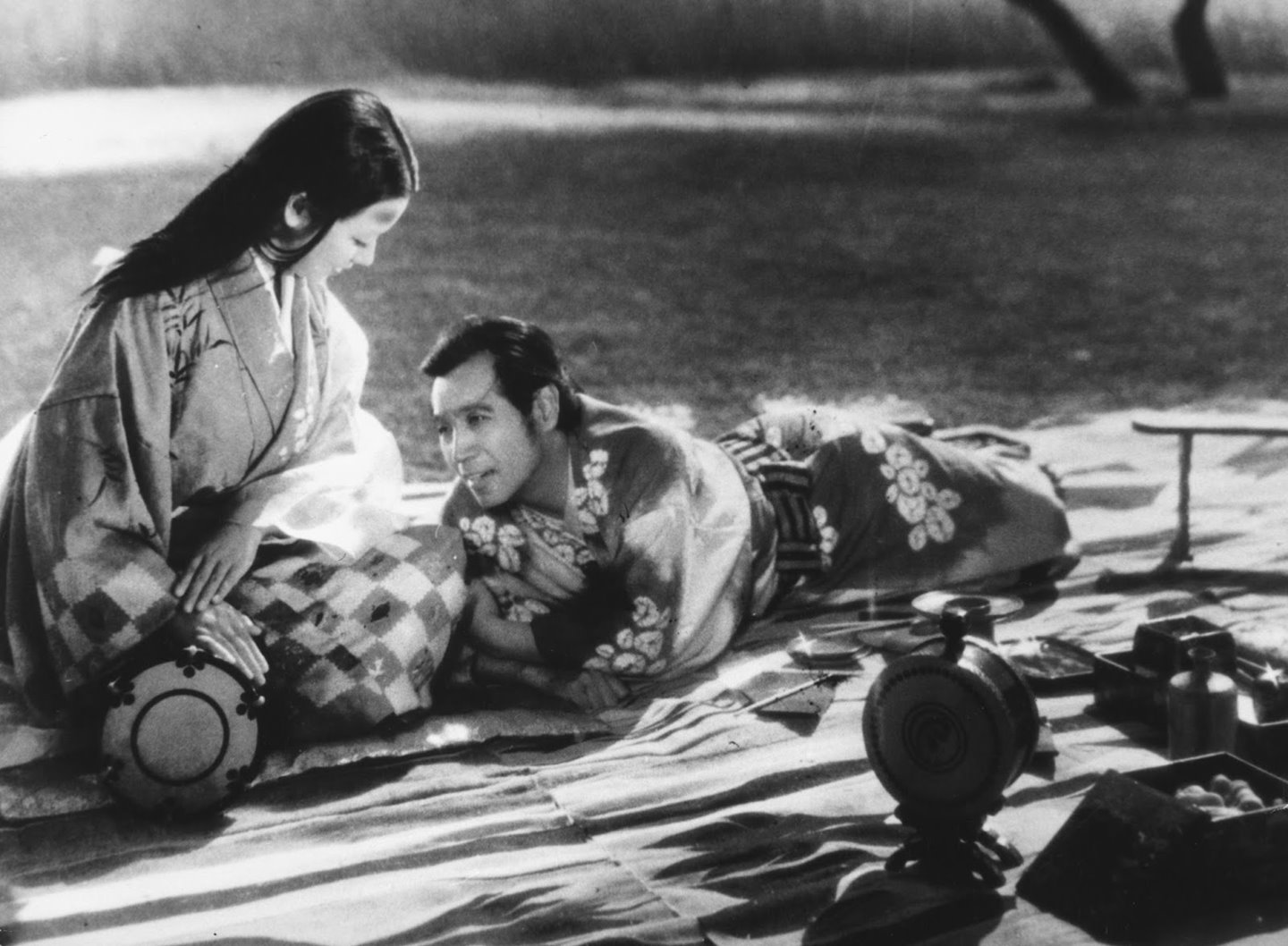
Drama, fantasy, by Kenji Mizoguchi, Japan, 1953.
Japan, late 16th century: the potter Genjurō and his brother Tobei live with their wives Miyagi and Ohama in a village in the Omi region; Genjurō, convinced that he can earn a lot of money by selling his goods in the nearby city, goes to the county of Omizo with Tobei, who joins him with the sole purpose of being able to become a samurai. Back home with a good income, the two work hard to make even more money; Tobei, increasingly obsessed with the ambition of becoming a samurai, needs the money to buy an armor and a spear while Genjurō, overcome by greed, tries to cook a batch of crockery with his brother in just one night. Legend and innovation of cinematic language, a wonderful world next to a brutal and cruel world. Mystery film that opens a discourse with the invisible planes of existence, ghosts and forays into the fantastic, made by Kenji Mizoguchi in a Japan still frozen by the two atomic bombs dropped on Hiroshima and Nagasaki. Fundamental work by Mizoguchi, recognized as one of the greatest expressions of the Seventh Art. A lofty lesson in directing that creates wonder with a dramatic tale of greed and lust for possession. A woman who is a tempting demon and a wife abandoned to a fate of war and misery, Mizoguchi uses the camera to enter "another world".
Food for thought
According to ancient Eastern traditions there are other non-physical planes beyond the physical plane. The etheric plane envelops the physical body, gives it vital energy and acts as an intermediary with the higher levels. Beyond the etheric plane there is the astral plane where entities may exist that have not been able to resign themselves to the loss of their body and wander in search of sensations. They are what are commonly referred to as "ghosts". These entities are looking for bodies that have unbalanced etheric planes to "hook up" to in order to experience sense satisfaction through them.
LANGUAGE: Japanese
SUBTITLES: English, Spanish, French, German, Portuguese
Before Religion Was a Word
You are standing at the edge of a rice paddy somewhere in the Japanese archipelago around 300 BCE, and the man beside you is not praying. He is not performing a ritual in any sense you would recognize by that word. He is listening. To what, exactly, is difficult to say — the movement of water through the channels he has spent weeks carving into the earth, the specific quality of silence that precedes a particular kind of rain, the presence he feels radiating from the gnarled pine on the hill above the field. He has no name for what he is doing because the act of naming it would imply it was separable from everything else he does, and it is not.
The Yayoi culture that began displacing and absorbing the earlier Jomon populations across the archipelago from roughly 300 BCE onward brought wet-rice agriculture, bronze, and a relationship with the natural world that was organizational rather than merely spiritual — if that distinction even holds. Communities oriented themselves around sources of water, around mountains that determined weather patterns, around coastlines that fed them, and the forces animating these features were understood as kami: presences, energies, something closer to the charge in a room after an argument than to the bearded deity of Mediterranean religion. The scholar Motoori Norinaga, writing in the eighteenth century in his monumental Kojiki-den, noted that kami resisted systematic definition — that anything possessing an extraordinary quality, whether a person, an animal, a stone, or a wave, could be understood as kami. This was not theological vagueness. It was a precise description of a world in which sacred presence was distributed rather than concentrated, ambient rather than architectural.
There was no word for Shinto because there was no concept of religion to push against. The anthropologist Talal Asad argued in his 1993 Genealogies of Religion that the category of religion as a discrete domain of human life — separable from politics, economics, and daily practice — is itself a historical artifact, a product of post-Reformation European thought that was then exported globally as a universal framework for sorting cultures. When European missionaries and later colonial administrators encountered practices that did not fit Protestant assumptions about what religion looked like — a creed, a scripture, an institution, an interior belief — they either dismissed those practices as superstition or forced them into the category of religion by violence. Japan was never formally colonized in that sense, but it faced a version of this categorical pressure from within, in the sixth century CE, when Buddhism arrived from the Korean peninsula carrying everything Shinto did not have: texts, iconography, institutional hierarchy, a philosophy capable of articulating itself in the abstract registers that literate courtly culture required.
It was precisely this contact that produced the word. Shinto — written with the Chinese characters for “the way of the gods” — appears in the Nihon Shoki, the second oldest chronicle of Japan, completed in 720 CE, and its appearance is diagnostic. You do not name something until you need to distinguish it from something else. The Nihon Shoki uses the term not to define a religion but to mark a distinction: between the indigenous practices organized around kami and the imported system Buddhism represented. The naming was defensive, a way of asserting continuity in the face of transformation. But the act of naming changed the thing named. What had existed as an undifferentiated texture of life — seasonal observances, the maintenance of sacred spaces, the acknowledgment of presences in landscape — was suddenly a category, a side in a conversation it had never asked to join.
What gets lost in that translation is not merely academic. A practice that had no separation between the sacred and the agricultural, between worship and irrigation, between ritual and the correct way to enter a forest, becomes legible to outside systems only by amputating most of what made it coherent on its own terms.

The Kojiki’s Dangerous Cosmology
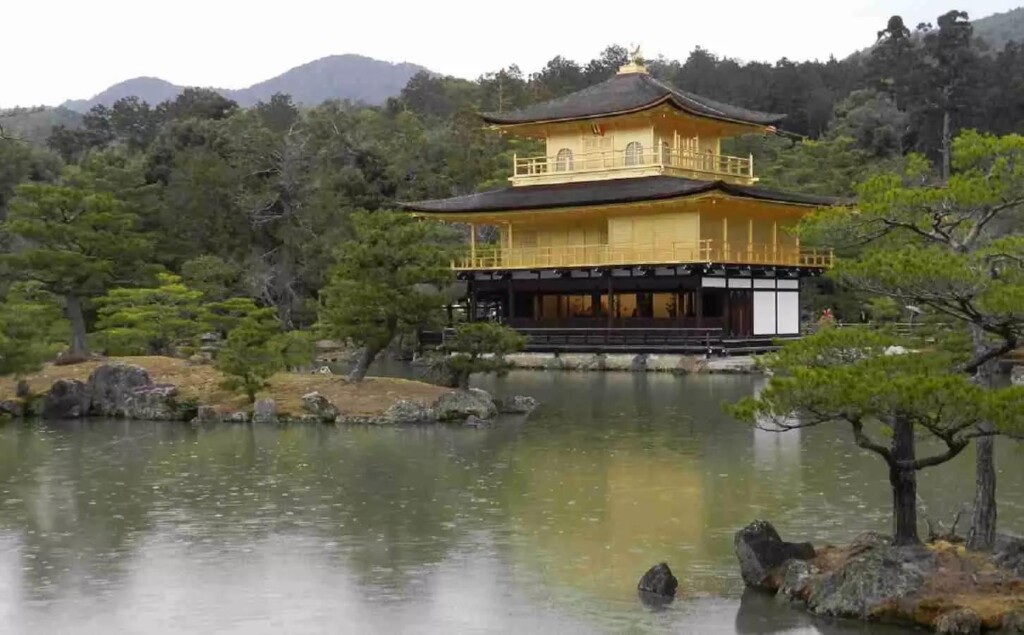
You open the Kojiki and you are told, from the very first lines, that the world began with a sound — a stirring in the primordial chaos, a reed shoot pushing upward — and that from this emergence came gods, and from those gods came more gods, until eventually one goddess looked into a mirror and from her reflected light was born an archipelago and then a dynasty. This is not poetry offered to you as poetry. It was composed in 712 CE under direct imperial commission, structured by Ō no Yasumaro, and presented to Empress Genmei as historical record. The distinction matters enormously, because a poem asks you to feel, while a chronicle asks you to obey.
The Kojiki’s central operation is one of ontological suturing — the fusing of political authority to divine origin so completely that no seam remains visible. Amaterasu, the sun goddess, does not merely bless the imperial line from a distance. She is its direct ancestor. Emperor Jimmu, the mythological first emperor dated by the text to 660 BCE, descends from her in an unbroken genealogical thread. This means that to question the legitimacy of the emperor is not to engage in political philosophy. It is to argue against the structure of the universe itself. The Kojiki does not threaten dissenters. It simply renders dissent cosmologically incoherent.
Michel Foucault, in Discipline and Punish, described how power becomes most effective when it no longer needs to announce itself — when it has colonized the interior of those it governs so thoroughly that enforcement becomes redundant. The Kojiki achieves exactly this, but eight centuries before Foucault’s guillotines and prison towers. The text does not say the emperor must be obeyed. It says the emperor is what the sun gave to the earth, and since you live beneath the sun and eat from the earth, the argument is already inside you before you have had time to examine it.
What makes this architecture particularly durable is its deliberate ambiguity between mythology and historiography. The compilers of the Kojiki were sophisticated enough to know that a text presenting itself purely as sacred scripture could be cordoned off as religion, debated, even privately disbelieved. But a text presenting itself as the oldest historical record of a nation — as the Kojiki explicitly does in Yasumaro’s own preface — colonizes the category of fact. By the time the Meiji government formally reinstated State Shinto in 1868 and declared the emperor a living god, they were not inventing something new. They were simply removing the centuries of Buddhist overlay that had partially obscured a claim the Kojiki had embedded in Japanese political consciousness for over a thousand years.
Consider what this means for the individual subject living inside such a system. Claude Lévi-Strauss argued in Structural Anthropology that myth functions not to explain the world but to make irresolvable contradictions livable — to paper over the gaps between what a society believes and what it experiences. The Kojiki’s contradiction is the basic one of all theocratic texts: that human beings, flawed, mortal, and observable, are asked to locate divinity in other human beings who are equally flawed, mortal, and observable. The text resolves this by displacing the divinity backward into an unverifiable origin, into a moment before writing, before witness, before the possibility of counter-testimony. You cannot dispute Amaterasu’s gift because no one alive was there to record a different version.
This is the move that makes the Kojiki’s cosmology genuinely dangerous rather than merely archaic — not that it claims divine origin for power, which nearly every ancient political system does in some form, but that it places that claim at a temporal depth where archaeology cannot reach and doubt cannot find footing.
Buddhism’s Collision and the Art of Absorption
You are standing at a harbor in 552 CE — or 538, depending on which chronicle you trust — and a diplomatic delegation from the Korean kingdom of Baekje has just delivered a gilded bronze Buddha statue and several scrolls of sutras to the Yamato court. Nobody in that room calls it an invasion. Nobody reaches for a weapon. The court looks at this foreign object and begins, almost immediately, to wonder where it fits.
What followed was not a war of religions. It was something far stranger and, in retrospect, far more revealing about the nature of Shinto itself. The tradition that had no founder, no canonical scripture, no systematic theology, and no single organizing institution did not raise doctrinal barriers against Buddhism because it had no mechanism for doing so. Shinto was not a wall. It was a membrane — permeable by design, or perhaps by the sheer accident of having never needed to be otherwise. Buddhism arrived with monasteries, philosophical complexity, a written canon spanning centuries, and institutional ambitions that would eventually reshape Japanese statecraft. Shinto absorbed it the way water absorbs dye: completely, and without losing the ability to be called water.
The formal name for what emerged is shinbutsu-shūgō, the combinatory fusion of kami worship and Buddhist practice, and by the Nara period of the eighth century it had become the governing religious logic of the archipelago. Honji suijaku, the doctrinal framework that accompanied this fusion, held that the kami were local manifestations of universal Buddhas and bodhisattvas — that Amaterasu, the solar deity of the imperial lineage, was an avatar of Vairocana, the cosmic Buddha of the Kegon school. This was not a compromise forced upon a defeated tradition. It was a theological reframing that Shinto practitioners largely accepted, and in some cases actively promoted, because Shinto’s relationship to doctrinal identity had always been loose enough to accommodate it. The scholar Allan Grapard, in his 1992 work “The Protocol of the Gods,” documented how Buddhist temples and Shinto shrines physically merged across this period, sharing precincts, priests, and ritual calendars — a cohabitation so intimate it became structurally inseparable for over a millennium.
Here is where the cost becomes visible. Radical adaptive porosity is not the same as resilience. It is a survival strategy that preserves form at the potential expense of content. When a tradition survives by continuously incorporating the frameworks of others, the question of what it actually is — independent of those frameworks — becomes genuinely difficult to answer. By the Heian period, some of the most sophisticated theological thinking about kami was being conducted by Buddhist monks who had no particular allegiance to Shinto as a distinct entity. The tradition was thriving institutionally while becoming philosophically dependent on a guest vocabulary. Emile Durkheim argued in “The Elementary Forms of Religious Life” in 1912 that religion coheres through collective ritual and shared symbolic boundaries — and Shinto had the rituals in abundance, but its symbolic boundaries had become radically porous to the point of near-invisibility.
What this reveals is not a weakness unique to Shinto but a pattern recognizable in any tradition that defines itself primarily through practice rather than proposition. When you have no creed to defend, you cannot be beaten on doctrinal grounds — but you also cannot easily articulate where you end and the other begins. The kokugaku nativist scholars of the eighteenth century, figures like Motoori Norinaga, would eventually attempt a kind of archaeological excavation to recover a Shinto purified of Buddhist accretion, insisting there was an original stratum beneath the centuries of synthesis. But the act of excavation itself required categories and methods that were products of the very historical entanglement they were trying to undo, which means the question of what Shinto looked like before Buddhism arrived is not simply a historical question — it is a question about whether the concept of a “before” is even coherent for a tradition that may have always been defined by
State Shinto and the Machine of Sacred War
You are standing in a schoolroom in Osaka in 1932, and the teacher is not exactly teaching. He is conducting. Every child in the room recites the same words at the same moment, faces turned toward a small wooden cabinet mounted near the ceiling in the front corner — a cabinet containing a photograph of the Emperor. The words are not a prayer in any recognizable sense. They are an oath of structural loyalty, a daily reinscription of a hierarchy that reaches from the child’s body upward through the nation to a divine figure who is, by official decree, the living descendant of Amaterasu, the sun goddess. The children do not experience this as ideology. They experience it as morning.
What they are enacting had been engineered with extraordinary precision over the previous six decades. The Meiji Restoration of 1868 did not simply restore imperial power — it manufactured a usable past, selecting from Shinto’s fluid and regionally diverse traditions precisely those elements that could be formalized into a coherent state apparatus. Scholars working at the direct instruction of the new government produced what they called kokugaku, or national learning, a movement that had actually begun in the eighteenth century with figures like Motoori Norinaga, whose monumental thirty-volume commentary on the Kojiki positioned ancient Japanese myth as the supreme expression of a unique national spirit. The Meiji architects took this romantic philology and gave it teeth — institutional, administrative, military teeth.
The separation of Buddhism from Shinto, decreed almost immediately in 1868 through the shinbutsu bunri edicts, was not a theological clarification. For over a millennium the two traditions had been so thoroughly intertwined that most Japanese practiced both simultaneously without experiencing any contradiction, a syncretic arrangement scholars now call shinbutsu-shugo. The sudden forced separation — which in some regions produced violent anti-Buddhist riots, the destruction of temples, and the burning of statues — was a political surgery. Buddhism carried cosmopolitan, pan-Asian associations that complicated the new state’s need for an exclusively Japanese sacred genealogy. It had to be excised so that Shinto could be sutured directly onto the Emperor’s body and, through that body, onto the nation-state itself.
The 1890 Imperial Rescript on Education is the document most historians identify as the conceptual spine of what followed. Read aloud in schools across Japan every morning for the next fifty-five years, it declared filial piety and loyalty to the Emperor as not merely civic virtues but cosmic obligations derived from the eternal will of the Imperial ancestors. It transformed ethical behavior into theological compliance. By 1900, the government had also formally classified Shinto not as a religion — and this distinction was crucial — but as a set of national customs, which meant that participation in shrine rituals and Emperor veneration was not subject to constitutional protections for religious freedom. Citizens could believe whatever they wished privately. In public, they performed the rites. No exemption existed.
The machinery accelerated as Japan expanded militarily through Manchuria in 1931, through China from 1937, and across the Pacific from 1941. Soldiers died not merely for the nation but as offerings to it, their spirits literally enshrined at Yasukuni, a Tokyo shrine established in 1869 specifically to enshrine the war dead as kami. Death in imperial service became a form of apotheosis, a ritual transformation. The promise was not metaphorical. Young men flew aircraft into warships carrying the sincere institutional belief that their sacrifice was sacred, that the Emperor for whom they died was a god, that the nation they were defending was the material expression of divine will. This was not fanaticism emerging from below. It was theology manufactured from above, installed into bodies through decades of daily ceremony, and then ignited.
What makes this historical episode so difficult to metabolize is not its horror but its legibility — the way it demonstrates how completely the sacred can be reconstructed, redistributed, and weaponized when the people performing the reconstruction control the schools, the shrines, and the silence around both.
A vision curated by a filmmaker, not an algorithm
In this video I explain our vision
The Occupation’s Erasure and What Remained

You are standing at the entrance to a shrine in the winter of 1946, and the priest inside is performing the same cold-morning purification rites he performed in 1944, when the state paid his salary and the emperor’s divine lineage was constitutional fact. Nothing about the gesture has changed. The water is the same temperature. The words are the same words. The only thing that has been removed is the framework that was supposed to explain why any of it mattered.
The Shinto Directive, issued by General Douglas MacArthur’s Supreme Commander for the Allied Powers on December 15, 1945, was one of the most precise acts of ideological surgery ever performed on a living culture. It abolished state funding for shrines, prohibited Shinto instruction in public schools, stripped the imperial household of its theological authority, and banned the government from any formal participation in shrine affairs — all within a single administrative document. What had taken the Meiji oligarchs decades to construct, threading nationalist mythology through educational curricula and military ceremony after 1868, was legally dissolved in weeks. The directive was designed to sever the connection between religious practice and political power, and in its stated objectives it largely succeeded. State Shinto, as a bureaucratic apparatus, ceased to exist almost overnight.
What the authors of the directive could not account for was the extent to which the tradition had already migrated beneath the institutional layer. Ruth Benedict’s “The Chrysanthemum and the Sword,” published that same year in 1946, attempted to map Japanese cultural psychology for an American readership, and despite its ethnographic limitations — she never visited Japan — Benedict identified something real: that obligation, hierarchy, and ritual purity had been so thoroughly absorbed into daily social conduct that removing their official justification did not remove the behavior. The bow at the shrine gate, the offering of coins before a festival deity, the seasonal rhythm of matsuri tied to rice agriculture and community boundary — none of these required state endorsement to continue. They had been ordinary life long before Meiji ideology conscripted them.
This is the paradox the directive inadvertently exposed: a tradition can survive the destruction of its theology. What persisted after 1945 was not Shinto belief in any doctrinal sense but Shinto as a texture of inhabited time and space. Scholars of religion have long distinguished between explicit belief — the conscious affirmation of propositions — and what Pierre Bourdieu called “habitus,” the embodied, pre-reflective dispositions through which a culture reproduces itself without thinking. Japanese shrine attendance in the postwar decades did not require that participants hold firm views on the nature of kami or the cosmological order. Most did not. Survey after survey conducted between the 1950s and 1990s showed that a majority of Japanese respondents simultaneously identified as having no religious belief and as regularly participating in Shinto and Buddhist rites — a statistical contradiction that dissolves only when you stop treating practice as evidence of belief.
The shrines that lost government support did not disappear. Approximately 80,000 of them were consolidated under the newly formed Association of Shinto Shrines, a private religious corporation established in 1946 precisely to manage this transition. They became, formally, one religious option among others in a pluralist constitutional order. But in lived experience, the shrine at the neighborhood boundary, the hatsumode visit at New Year’s drawing millions to Meiji Jingu and Ise, the omamori tucked into a university student’s bag before entrance exams — these were not experienced as sectarian choices. They were experienced as the unremarkable furniture of being alive in a particular place.
What the occupation dismantled was the state’s claim to own what had never entirely been the state’s to begin with. The rituals that predated Meiji nationalism by centuries simply continued, now without a flag attached, which meant they also continued without anyone needing to decide whether they believed in them.
Purity, Pollution, and the Social Body
You are told, at some point early enough that you cannot remember the telling, that certain things make you dirty. Not morally failed, not ethically wrong — dirty. The distinction matters more than it appears, because moral failure invites correction while contamination invites removal.
Kegare, the Shinto concept usually translated as ritual pollution, operates precisely in that register of the body rather than the conscience. It attaches to death, to blood, to childbirth, to illness — to the biological facts that every human being shares and none can escape. Yet the genius of the system, if genius is the right word for a mechanism that destroys lives, is that while kegare touches everyone in theory, it comes to rest permanently on some people in practice. The purification rite of harae exists to cleanse the temporarily polluted, to restore someone to a state of ritual fitness. What harae cannot clean, by definition, is the person whose entire existence has been coded as a source of contamination rather than a temporary carrier of it.
The Burakumin — Japan’s largest discriminated minority, numbering by most estimates between one and three million people today — descended from occupational groups who handled the materials of kegare: animal carcasses, leather, execution, burial. These were not chosen roles but assigned ones, yet the logic of purity inverted the causality with devastating efficiency. The work did not simply carry pollution; the workers became pollution. By the Edo period, codified in the rigid social architecture of the Tokugawa shogunate’s four-tier system, this population had been legally designated as below the social order entirely, designated by terms that transliterate roughly as filth and nonhuman. The Meiji government formally abolished these categories in 1871, but the structural anthropologist Mary Douglas, writing in Purity and Danger in 1966, offers the mechanism that explains why legal abolition changes so little: categories of pollution are not primarily about hygiene but about protecting the borders of a social classification system. Once a group has been encoded as matter out of place, no administrative decree reassigns it to the inside.
What makes the Shinto framework specifically useful to interrogate here is that it aestheticizes this exclusion. Kegare is not punishment handed down by a morally judgmental deity; it is disturbance of a natural harmony, a disruption of the clean order that the cosmos prefers. Discrimination enacted in the name of divine justice can at least be argued against on moral terms. Discrimination enacted in the name of cosmic cleanliness presents itself as pre-ethical, as simply the recognition of how things are arranged. The sociologist Emile Durkheim, in The Elementary Forms of Religious Life published in 1912, argued that the sacred and profane are not qualities residing in objects but in the social agreements that classify them. Shinto’s operational genius — and its historical catastrophe — was to make that agreement feel like perception.
The policing does not stop at class. The same logic of kegare extended to menstruating women barred from sacred spaces, to the sick excluded from communal rituals, to anyone whose body deviated from the norm of productive, contained, non-leaking flesh. The body that bleeds without wound, that hosts death inside it, that crosses the membrane between inside and outside in the wrong ways at the wrong times — this body threatens not the individual soul but the collective field. Shinto’s primary anxiety is never personal; it is always about contamination spreading outward, about one compromised node corrupting the network. This makes it an extraordinarily powerful instrument for social cohesion and an extraordinarily efficient machine for producing outcasts, because the very intensity of communal belonging it generates requires, structurally, a population that embodies what the community refuses to be.
The Shrine as Mirror
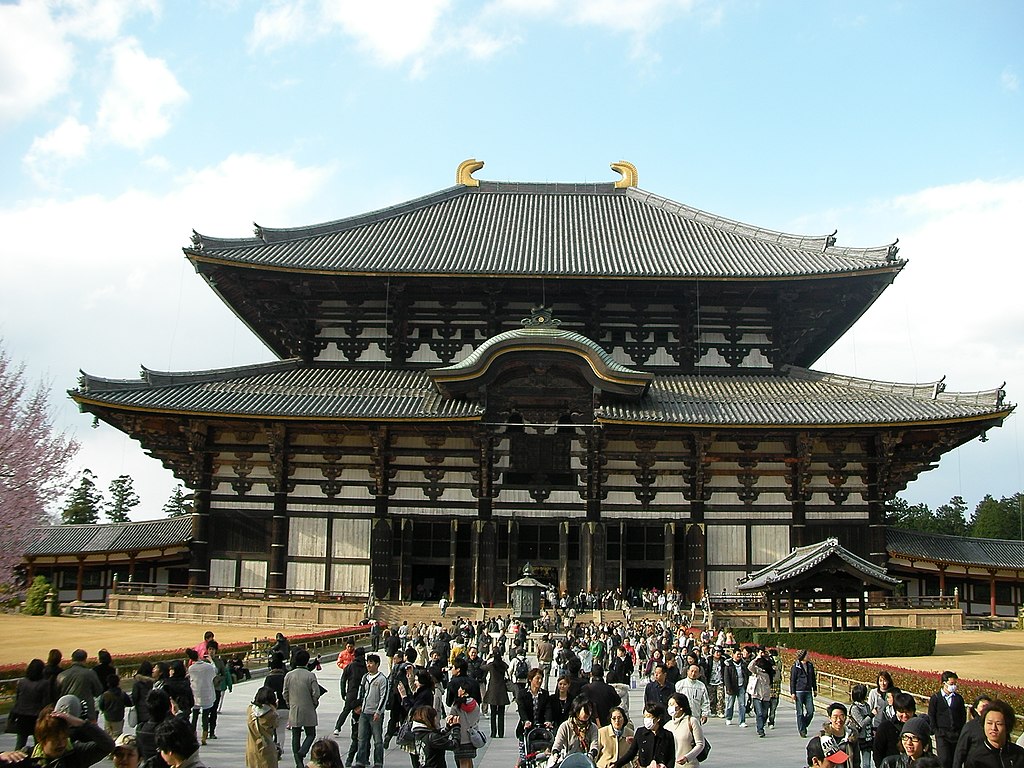
Picture a carpenter in his fifties, kneeling on fresh hinoki cypress shavings at Ise, fitting a bracket he will never see installed. His hands know the joint before his mind names it — the same joint his teacher’s teacher cut, and the one before that, in an unbroken chain of repetition that stretches back to roughly 690 CE, when the Emperor Tenmu first codified the Shikinen Sengu, the ritual dismantling and complete reconstruction of the Grand Shrine at Ise every twenty years. He is not restoring anything. There is nothing to restore. The previous shrine was deliberately taken apart, its sacred timber distributed to subsidiary shrines across Japan as spiritually charged material. What he is building has never existed before, and yet it is, by every theological and aesthetic measure, the same shrine it has always been.
Western metaphysics has spent centuries trying to solve the Ship of Theseus paradox — if every plank is replaced, is it still the same ship? — and arriving at no satisfying answer because the question assumes that identity requires material continuity. Shinto does not assume this. The kami enshrined at Ise is not housed in the wood; the wood is simply the current occasion for the kami’s presence. When the philosopher Motoori Norinaga spent decades in the eighteenth century developing his concept of mono no aware, the bittersweet recognition that all things pass, he was not counseling resignation. He was pointing toward something far more destabilizing: that impermanence is not a flaw in the structure of reality but its very engine, the mechanism by which meaning perpetuates itself without calcifying into monument.
The Ise cycle makes this viscerally architectural. Two adjacent plots of land are maintained simultaneously — one bearing the standing shrine, one lying empty, covered only by a small wooden hut protecting a single post called the shin no mihashira, the central sacred pillar. Every two decades the roles reverse. The empty ground receives the new structure; the old structure disappears. An entire generation of craftsmen must be trained for each cycle, because the techniques are too subtle and numerous to preserve through manuals alone — they live only in hands, in the muscle memory of people who learned by watching and doing. If a generation were skipped, the knowledge would die, and with it the shrine’s capacity to renew itself. Continuity here is not stored; it is performed, or it ceases to exist.
What this exposes about the self is quietly devastating. The Shinto conception of the human person contains no doctrine of an immutable soul watching experience pass by from a fixed interior vantage point. What a person is, in this framework, resembles the shrine far more than it resembles the Western self — a configuration that must be actively maintained through ritual, through relationship, through repeated acts of purification and participation, or it disperses. The sociologist Émile Durkheim argued in 1912, in The Elementary Forms of Religious Life, that ritual does not express a pre-existing community; it constitutes one, calling it into being each time bodies gather and act in concert. Shinto shrines have been living proof of this argument for over a millennium before he wrote it.
There is something Ise refuses to let you hold onto, and it is not merely the timber. Every twenty years, the craftsman’s bracket disappears, and every twenty years a new hand cuts the same joint in new wood, and the kami remains, untroubled, because the kami was never in the wood. The shrine, in this sense, is not a place you visit to encounter something ancient and preserved. It is a place you enter to watch continuity being made, in real time, out of chosen destruction — and to recognize, if you are paying close enough attention, that this is also what you have been doing every day of your life without a name for it.
🌿 Sacred Paths: Spirit, Myth, and Ancient Belief
Shintoism invites us into a world where nature, ritual, and divine presence are inseparable — a vision shared by many spiritual and philosophical traditions across history. These related articles explore the deep currents of sacred thought, from Eastern mysticism to the universal longing for meaning and transcendence.
Eliade’s The Sacred and the Profane: Analysis
Mircea Eliade‘s foundational work distinguishes between the sacred and the profane as two fundamental modes of being in the world. His analysis of ritual space and sacred time resonates deeply with Shinto concepts of kami, shrine, and the sanctification of natural places. Reading Eliade alongside Shinto thought reveals how humanity universally seeks to dwell within a consecrated cosmos.
GO TO THE SELECTION: Eliade’s The Sacred and the Profane: Analysis
Eliade’s The Myth of the Eternal Return: Analysis
Eliade’s exploration of cyclical time and the eternal return offers a compelling lens through which to understand Shinto festivals, purification rites, and the renewal of shrines. The idea that sacred time abolishes ordinary duration connects powerfully with Shinto ceremonies like the Shikinen Sengu, where ancient structures are ritually rebuilt. This article illuminates how myth and repetition sustain the living bond between humans and the divine.
GO TO THE SELECTION: Eliade’s The Myth of the Eternal Return: Analysis
Swami Vivekananda: Life and Works
Swami Vivekananda‘s life represents one of the most significant encounters between Eastern spirituality and Western modernity, paralleling the global rediscovery of indigenous sacred traditions like Shintoism. His insistence on the direct experience of the divine and the sacredness of nature echoes key Shinto sensibilities around purity and immanent spirit. Exploring his thought enriches our understanding of how Eastern religions have shaped and challenged Western spiritual consciousness.
GO TO THE SELECTION: Swami Vivekananda: Life and Works
Buddhism and 3 Documentaries to Understand it
Buddhism and Shintoism have coexisted and intertwined in Japan for over fourteen centuries, shaping a unique spiritual landscape known as shinbutsu-shūgō. This article and its accompanying documentaries offer an accessible entry point into Buddhist thought, allowing readers to better appreciate the complex dialogue between the two traditions. Understanding Buddhism is therefore essential to grasping the full depth of Shinto’s historical and cultural significance.
GO TO THE SELECTION: Buddhism and 3 Documentaries to Understand it
Explore the Sacred on Indiecinema
If these spiritual journeys have stirred something within you, Indiecinema streaming is home to a rich selection of independent films that explore myth, ritual, mysticism, and the hidden dimensions of human experience. From contemplative documentaries to visionary art cinema, Indiecinema invites you to keep searching — one extraordinary film at a time.
👉 EXPLORE THE CATALOG: Watch Indie Films in Streaming
A vision curated by a filmmaker, not an algorithm
In this video I explain our vision

