
The Fog Before the Shutter Clicks
You are standing at the gate of something that should not still be standing. The iron has gone the color of dried blood, the stone pillars on either side have begun their slow collapse into the briars, and the house at the end of the overgrown drive is visible only as a suggestion — a darker shape against the failing light, windows empty as pulled teeth. You came here with a camera because someone told you the place was interesting, or because you saw a photograph once that made your chest feel strange, or because you have always been drawn to the edges of things without quite being able to say why. But standing here now, in the particular quality of Irish dusk that seems less like the absence of light and more like the presence of something else entirely, you notice that the sensation is not what you expected. It is not fear. It is something closer to recognition, as though the ruin has been waiting for you specifically, as though the long grasses and the collapsed roof and the single surviving chimney have arranged themselves into a composition that was always meant to include you, the observer, the witness, the trespasser.

Simon Marsden spent roughly four decades chasing precisely that sensation across the estates, abbeys, graveyards, and decayed great houses of Britain, Ireland, and eventually the whole of the European continent. Born in 1948 into English aristocracy, he understood instinctively the specific grief of inherited grandeur in collapse — not as a tourist of ruin but as someone for whom the crumbling country house carried a personal frequency, a memory that was also a warning. His first major published collection, In Ruins: The Once Great Houses of Ireland, appeared in 1980 and announced immediately that he was not interested in the picturesque in any conventional sense. These were not photographs designed to mourn tastefully from a safe aesthetic distance. They were images that seemed to have been taken from inside whatever feeling the buildings themselves were broadcasting.
The technical choice was inseparable from the intention. Marsden worked almost exclusively in infrared film, a medium that renders living foliage white and skies dark, that makes the familiar landscape look as though it has been photographed from a frequency the human eye cannot normally access. Grass becomes luminous, clouds become bruised, and the solid stone walls of a Georgian ruin seem to pulse with an energy that conventional photography would simply suppress. The infrared image does not document a place so much as it reports on the place’s condition — its charge, its residue, its insistence on being seen as something other than mere real estate awaiting development.
What Marsden was assembling, book by book through the 1980s and 1990s, was not a catalogue of interesting architecture but something far more difficult to classify. The Haunted Realm, published in 1986, extended the project geographically and thematically, moving through Scotland, England, and Ireland to record spaces where the boundary between historical fact and atmospheric suggestion had become, for various reasons, permeable. This was followed by Visions of Poe in 1988, in which he turned the same infrared eye on sites associated with Edgar Allan Poe‘s imagination, and then by volumes devoted to the supernatural landscapes of Brittany, Scandinavia, and Central Europe. By the time he had finished, the body of work ran to more than twenty published books, each one a further argument that certain places hold their histories in a form that is not accessible through conventional documentation.
That argument was never purely mystical, though Marsden was entirely willing to speak of ghosts in literal terms. The more uncomfortable claim embedded in the work is that the camera, under certain conditions, with certain films, in certain light, does not simply record what is there but participates in surfacing what will not leave.
Simon Marsden’s Haunted Life In Pictures
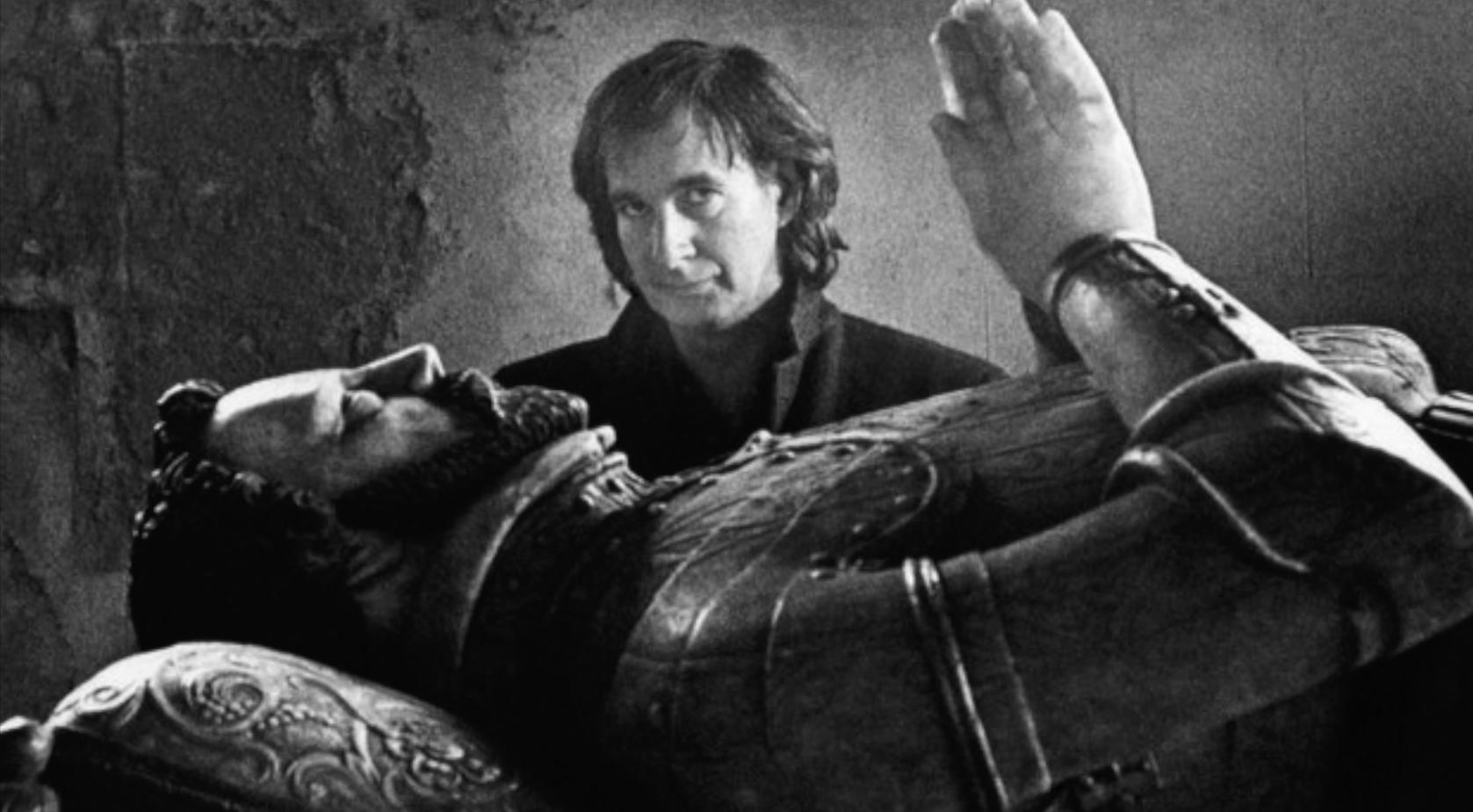
Documentary, by Jason Figgis, United States, 2019.
This documentary retraces the life and work of Simon Marsden, widely regarded as one of the foremost photographers of the supernatural. Premiered at the British Film Institute in London, the film offers a fascinating journey into his creative universe, appealing not only to photography enthusiasts but also to scholars, teachers, students, and anyone intrigued by the mysteries of the unseen. Through evocative imagery and first-hand accounts, it explores the artistic path of a photographer whose work has appeared in books, on U2 album covers, and in museum exhibitions around the world.
Although convinced of the existence of ghosts, Marsden never claimed to capture them directly with his camera. Instead, he used black-and-white infrared film to record the atmosphere and the invisible traces that, in his view, spirits left imprinted upon places. From the landscapes of Ireland to the vast expanses of Russia, passing through Venice and the American Southwest, he transformed historic buildings, ruins, and haunting locations into deeply evocative images capable of suggesting dark and unsettling stories. His photographs continue to captivate the imagination, demonstrating how the most powerful works of art can leave a lasting impression on those who behold them.
LANGUAGE: English
SUBTITLES: Spanish, French, German, Portuguese
What the Victorian Dead Left Behind
You have stood in a house that had not been lived in for forty years, and you already knew, before anyone told you, that something irreversible had happened there. Not violence, not haunting in any theatrical sense — simply the particular gravity of a space from which all economic purpose has been drained, leaving the architecture to bear witness alone.
The houses Simon Marsden photographed were not abandoned by accident or by grief. They were abandoned by arithmetic. David Cannadine, in his 1990 study of the British aristocracy’s long dismemberment, documented with forensic precision how death duties — first introduced at eight percent in 1894 under Sir William Harcourt’s Finance Act, then scaled upward through successive Liberal and Labour budgets until they reached sixty-five percent on the largest estates by 1939 — functioned less like a tax and more like a slow execution. A family that lost its patriarch in 1916, then a son at the Somme, then a second son by 1940, could be required to pay death duties three times within a single generation, each levy assessed against the full market value of land and property at the moment of death. Cannadine calculated that some estates paid more than their entire annual income in duties within a twenty-year window. The house did not fall because the family stopped loving it. The house fell because the state had quietly decided that hereditary accumulation of this scale was a social problem, and priced it out of existence.
Between 1945 and 1955, an average of one country house per week was demolished in England alone. The architectural historian John Martin Robinson later put the total demolitions in the twentieth century at over fifteen hundred significant country houses, many of them structures that had stood since the seventeenth century. What Marsden walked into with his Hasselblad and his infrared film was not the aftermath of neglect but the physical residue of a fiscal policy — Gothic Revival towers rotting not because their builders lacked vision but because their inheritors lacked liquidity. The Gothic Revival itself, that mid-Victorian fantasy of pointed arches and heraldic stone, had been an attempt to translate aristocratic legitimacy into permanent architectural form. Augustus Pugin believed that the pointed arch was morally superior to the Roman arch, that Gothic was not a style but a theology. What he could not have anticipated was that within a century of his death in 1852, the theology would be insolvent.
Marsden’s infrared film did something technically precise to these spaces: it rendered chlorophyll-rich vegetation as near-white, reversed the tonal relationships of the visible spectrum, and produced skies of near-black even in daylight. The effect was not applied for atmosphere in any casual sense. Infrared photography sees what the eye refuses — it bypasses the reassuring surface of things and records the thermal and spectral frequencies that human vision has evolved to ignore. When Marsden turned this method on a roofless Palladian wing strangled by ivy, he was not dramatizing decay. He was making the building confess to what standard photography would have softened into picturesque melancholy.
The post-war country house exists in a peculiar historical position: too recent to be comfortably mythologized as medieval ruin, too old to be absorbed into the bureaucratic language of heritage management without remainder. When the National Trust began accepting houses in lieu of death duties from the 1940s onward, it institutionalized the aristocracy’s dispossession as tourism. The family portraits remained on the walls, the four-poster beds were roped off, and the guided tour replaced the dinner party. What Marsden photographed were the houses that never completed this transition — the ones that fell through the institutional net and were left to negotiate their own ending with the weather.

Infrared and the Lie of the Visible
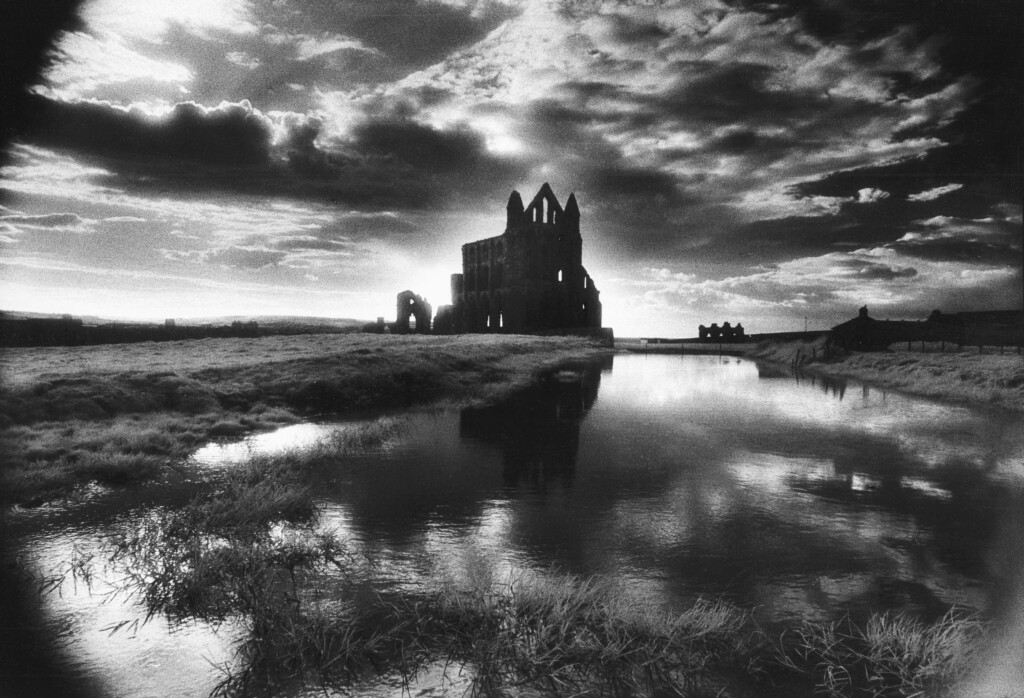
You are standing in front of a photograph of a ruined abbey, and something is wrong with the light. The trees surrounding the collapsed nave blaze white, incandescent, as though the chlorophyll in every leaf has caught fire from within. The sky above presses down like a slab of slate, almost black, and the stone — centuries-worn, mortared by hands long since returned to soil — glows with an unnatural pallor, as if it has absorbed every shadow the world ever cast and is now returning it all at once. You assume this is darkroom manipulation, some theatrical trick of the developing tray. It is not. The film itself is doing this to reality.
Infrared photography captures light at wavelengths between roughly 700 and 900 nanometers, beyond the threshold of human perception. What the eye refuses to register, the sensitized emulsion absorbs and converts. Chlorophyll in living plant tissue reflects infrared radiation with extraordinary intensity, which is why Marsden’s foliage burns white — not because it has been bleached or overexposed, but because it is alive, aggressively, invisibly alive in a spectrum we cannot access without technological mediation. The sky darkens because atmospheric moisture scatters infrared weakly, leaving the upper registers of the frame hollow and heavy. Every element of what we would call a “normal” photograph — every assumption about where the brightness falls, where the darkness gathers — is structurally inverted. The living world looks spectral. The dead stone looks luminous. This is not a filter applied to experience. This is a different physics of seeing.
The question this raises is one that Susan Sontag pressed against in On Photography in 1977, though she was pressing from the opposite direction. Her argument was that the photograph carries an ideological disguise sewn into its own mechanism: it presents itself as evidence, as capture, as the thing itself rather than a rendering. The camera, she wrote, does not translate experience — it appropriates it, flattens its duration into a single frozen instant, and then offers that instant as proof of something that happened. Generations of viewers have treated photographs as documents, as testimony, as legal and emotional fact, precisely because the photograph conceals the choices behind it: the angle, the light, the fraction of a second, the frame that excludes everything just outside its edge. The lie is structural, not intentional. The machine promises objectivity and delivers a very specific, very interested version of the visible.
Marsden’s infrared work is interesting precisely because it refuses that concealment. When you look at one of his images and the trees are white and the sky is the color of iron, you cannot pretend you are looking at the world as it is. The manipulation is visible, which means it is honest. It announces itself as a rendering, a translation, a choice made about which light to receive and which to suppress. In doing so it strips photography of its most comfortable and most dangerous pretension — the claim to be a window rather than a painting. Every photograph has always been a painting. Marsden simply made that fact impossible to ignore.
What follows from this is stranger still. If the conventional photograph lies by appearing not to lie, then perhaps the image that openly distorts comes closer to a kind of truth — not factual truth, but perceptual truth, the truth of what a particular place feels like when history has soaked into its foundations and the air above it carries a weight that daylight and color film cannot register. The ruins Marsden photographed were not simply old buildings. They were sites where time had accumulated in visible layers, where the conventional grammar of the present — bright, saturated, legible — had already broken down before the camera arrived. The infrared film did not impose strangeness on these places.
Cathnafola - A Paranormal Investigation
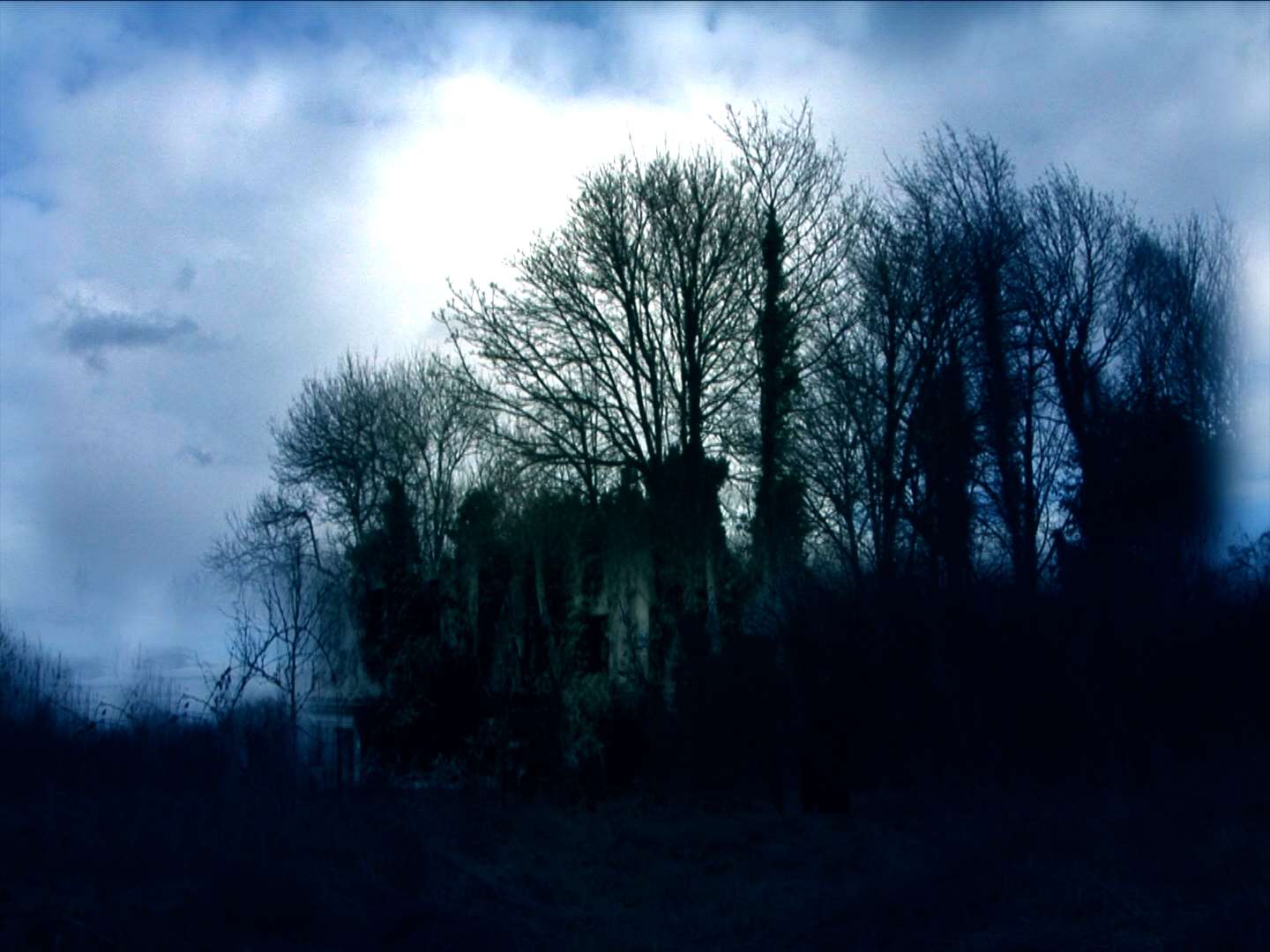
Documentary, horror, by Jason Figgis, USA, 2014.
In "Cathnafola", everything begins when renowned paranormal investigator Chris Halton of Haunted Earth UK receives footage filmed by three teenagers at the ruins of Cathnafola House in Ireland. Determined to unearth the truth behind the location’s bloody past, Halton embarks on a nighttime exploration of the infamous ruins—and soon uncovers terrifying and disturbing revelations.
LANGUAGE: English
SUBTITLES: Spanish, French, German, Portuguese
The Ghost as Cultural Symptom
You have stood in a house where something terrible happened decades before you were born, and you felt it — not as a metaphor, not as imagination running decorative loops, but as a pressure in the chest, a reluctance in the feet. You did not believe in ghosts, and yet you stayed closer to the door.
That sensation is not primitive. It is not a failure of rationality waiting to be corrected by better education. Avery Gordon, in Ghostly Matters published in 1997, made an argument that cut cleanly against the condescension embedded in secular modernity’s relationship to haunting: she proposed that ghosts are the form taken by what a society has refused to finish grieving. They are not the irrational residue of pre-Enlightenment minds. They are the precise shape of an unresolved social debt, returning with the insistence of anything that has been denied proper acknowledgment. The ghost, in Gordon’s formulation, is a social figure — it tells you something went wrong here that was never accounted for, and the accounting is still outstanding.
When Simon Marsden released The Haunted Realm in 1986, followed by Phantoms of the Isles in 1990, Britain was not a country at peace with its own history. The postwar dismantling of empire had produced no ceremony of reckoning, no structured national confrontation with what those centuries of extraction and administered violence had actually been. The great houses stood — many of them, in fact, precisely the crumbling aristocratic estates Marsden was photographing — as physical monuments to accumulated wealth that had never explained itself. The infrared grain of his images did not invent the unease latent in those structures. It made visible what the architecture had always been quietly broadcasting.
There is something specific about the late twentieth century that made ghost imagery culturally urgent in a way it had not been at the height of Victorian spiritualism, when the dead were summoned because industrialization had made grief logistically impossible — the body moved too fast through the city, the funeral rite compressed into a bureaucratic minimum. By the 1980s, a different displacement was operating: not the grief of individual deaths outpacing ritual, but the grief of entire social orders that had vanished without being named as losses. The English countryside that Marsden haunted with his camera was not simply picturesque decay. It was the material residue of a feudal and then colonial order whose collapse had been treated as administrative transition rather than cultural wound.
This is what separates genuine haunting from aesthetic nostalgia, and it is a distinction Marsden’s work forces you to make. Nostalgia softens the past, rounds its edges, makes its losses bearable by making them beautiful. Haunting does the opposite — it insists on sharpness, on the wrongness still lodged in the stone, the wrongness that beauty cannot metabolize. The ruins in his photographs are not romantic. The moss and the collapsed rooflines and the statues with their faces eroded into blankness are not inviting you to mourn something sweet. They are closer to an indictment that has not yet found its court.
Sociologists of collective memory, including Paul Connerton in How Societies Remember from 1989, have traced how communities manage continuity by selectively forgetting — not through individual repression but through structured institutional silences, ceremonies that omit, archives that exclude. The ghost is what fills the space left by those omissions. It is the return not of the supernatural but of the historically suppressed, pressing back through whatever material form happens to be porous enough to hold it: a photograph, a ruin, the inexplicable weight you carry out of a room you had no personal reason to fear.
Marsden’s lens was, in this reading, a kind of sociological instrument — not despite its irrationality, but precisely because of it. Infrared film registers what conventional emulsion dismisses, light in frequencies the human eye cannot consciously process, and what it returned from those sites was not fantasy but the residue of what had been systematically left unwitnessed.
Aristocratic Ruins and the Aestheticization of Violence
There is a photograph — not Marsden’s specifically, but indistinguishable in grammar from his entire body of work — of a figure standing at the edge of a gutted ballroom, shot through a broken window so that the jagged glass frames the silhouette like a wound frames a memory. The parquet floor has buckled and rotted into abstract sculpture. The ceiling plasterwork, once ornamented with mythological scenes commissioned at enormous cost, hangs in partial collapse, revealing the structural timber beneath like bone through skin. The image is genuinely beautiful. That is precisely the problem.
The country houses of Ireland and Britain are not neutral ruins. They are the physical residue of a specific and documented system of extraction. The Enclosure Acts, consolidated between 1750 and 1850, dispossessed somewhere between six and eight million rural people from common land in England alone, converting subsistence farmland into private estates and sending the dispossessed into industrial cities or emigrant ships. The grand houses those enclosures financed were built on the arithmetic of cleared villages and collapsed tenancies. In Ireland, the calculus was even more explicit: the Ascendancy houses that Marsden photographed so obsessively throughout his career — the subject of his 1980 book “The Haunted Realm” and the recurring obsession of his subsequent decades — were the literal headquarters of a colonial administration that managed the conditions producing the Famine. These are not metaphors. They are architectural facts, stone ledgers recording where the money came from.
What the elegiac photographic gaze does to such a building is structurally equivalent to what the pastoral tradition did to the English countryside in the eighteenth century. Raymond Williams, writing in “The Country and the City” in 1973, demonstrated how the poetry of rural England systematically rendered invisible the labor that produced the landscapes being celebrated. The hedgerows in a Thomson or Goldsmith poem are beautiful because the poem refuses to see the hands that planted them or the dispossessions that cleared the land they border. Marsden’s camera operates inside the same tradition, except the invisibility now falls not on labor but on the system the building itself enforced. The rotting chandelier becomes an aesthetic object. The collapsed library becomes a meditation on transience. The violence that purchased both of them evaporates into atmosphere.
This is not a failure of artistic intention. It may be the inevitable structural consequence of beauty itself when it turns toward damaged power. Susan Sontag argued in “On Photography” in 1977 that the camera, regardless of the photographer’s politics, tends toward the aestheticization of its subject — that the act of framing something as worth photographing confers on it a dignity that survives the content being framed. A photograph of a burning village and a photograph of a burning autumn tree operate inside the same visual grammar of the sublime. The frame does not distinguish between them. What Marsden’s work adds to this dynamic is a specific layer of mourning: the photographs do not merely aestheticize these spaces, they grieve them, and grief for a ruined estate implies that the estate’s existence was something worth preserving, which implies a relationship to what generated it that the grief never interrogates.
The question is whether the viewer of such an image is being invited to feel loss or to feel history. They are not the same emotion. Loss is personal, atmospheric, portable — it attaches to the image and travels with the viewer into their emotional life. History is specific, demanding, and uncomfortable — it asks you to account for what you are looking at and why its decay might be, from certain vantage points, something other than tragedy. Marsden’s photographs are extraordinarily skilled at producing the first feeling and structurally incapable of producing the second, because the second requires exactly what the camera, pointed at beauty, cannot help but omit.
A vision curated by a filmmaker, not an algorithm
In this video I explain our vision
The Market for Melancholy

You pay for the ticket, walk through the iron gate, and the estate opens before you — the moss-covered urns, the collapsed orangery, the walled garden going quietly to seed. There is a caption on a laminated card near the entrance that tells you the house was abandoned in 1923, and something in you relaxes. That date is the entire point. The ruin has been measured, catalogued, and placed at a safe remove from anything you might still be required to feel responsible for.
Simon Marsden built his career inside that particular relaxation. His infrared images of crumbling abbeys and overgrown graveyards were not underground art — they moved through the most conventional channels of British cultural commerce. Thames and Hudson published him. Weidenfeld and Nicolson published him. These were not small operations hedging on an eccentric; they were major houses betting, correctly, that a significant portion of the British reading public wanted exactly what Marsden was selling: a darkness that had been aestheticized into safety. His books sold in the gift shops of the very properties he photographed, which is a commercial arrangement so perfectly circular it almost constitutes a philosophical argument on its own.
The 1980s and 1990s in Britain produced a specific hunger for Gothic imagery that was inseparable from the political and economic conditions of the period. Margaret Thatcher‘s heritage agenda — funnelled through bodies like English Heritage, formally constituted in 1983 — was simultaneously dismantling the industrial present and enshrining a version of the past as the nation’s true identity. The past being enshrined was carefully selected: aristocratic, rural, architecturally picturesque. Patrick Wright examined this phenomenon with surgical precision in On Living in an Old Country, published in 1985, arguing that the heritage industry did not preserve history so much as it aestheticized class relations, converting the evidence of inequality into objects of communal nostalgia. Marsden’s photographs fit this machinery with troubling ease. A crumbling Georgian manor, photographed in ghostly infrared, becomes not a record of a family’s extraction of wealth from tenant labour and colonial trade but an elegy for beauty itself.
The numbers confirm the appetite. By the mid-1990s, heritage tourism was generating over four billion pounds annually for the British economy, a figure that would climb to an estimated £4.2 billion by the early 2000s, drawing on a network of castles, abbeys, and country houses that collectively functioned as a permanent stage set for a national myth. This was not fringe commerce. The English country house alone — tracked by organisations like the Historic Houses Association — represented hundreds of properties open to visitors paying entrance fees, buying postcards, and acquiring coffee-table books in which ruin and melancholy had been rendered gorgeous and therefore purchasable.
What happens to melancholy when it is packaged is not that it disappears but that it inverts. It stops being a condition that unsettles the present and becomes instead a guarantee that the present is secure. The reader who buys a Marsden volume and sets it on the sitting-room table has not confronted death or decay — they have acquired a controlled dose of both, enough to feel cultured and sensitised without being actually disturbed. The sociologist Colin Campbell, writing in The Romantic Ethic and the Spirit of Modern Consumerism in 1987, traced this mechanism through the long history of Romantic aesthetics, arguing that modern consumption is fundamentally emotional rather than utilitarian — we buy feelings, particularly the feeling of longing, because longing experienced in safety is a form of pleasure. Gothic imagery on a printed page, in a warm house, with a glass of something on the side table, is longing with the exit door clearly marked.
Marsden was talented enough that he probably knew this, and commercially astute enough that he proceeded anyway. The ghost, after all, is only frightening so long as you believe it can reach you.
What the Camera Cannot Outlive
You can rehearse dying a thousand times and still not be ready for it. Marsden spent four decades pressing his shutter release in places where the dead had left their most legible marks — roofless abbeys, flooded crypts, the moss-eaten faces of stone angels — and somewhere in that repetition there was surely a private logic that had nothing to do with ghost stories sold to publishers. He died in January 2012, leaving behind a body of work that is, in the strict technical sense, closed. No more negatives will be developed. The archive has a final frame, and that finitude does something strange to every image that preceded it: it retrospectively makes each one a self-portrait.
Roland Barthes, writing in Camera Lucida in 1980 while processing the death of his mother, identified two modes of photographic impact. The studium is what you understand — context, composition, the cultural information a photograph carries and that you receive with trained competence. The punctum is what gets you. It is the unintended detail, the stray element that escapes the photographer’s control and lodges itself in the viewer’s body like a splinter. Barthes was careful to note that the photographer does not place the punctum there; it arrives uninvited, almost against the image’s stated intentions. In Marsden’s case, the stated intention was atmosphere, the Gothic mood, the suggestion of presences hovering at the threshold of visibility. But look at the images long enough and something else begins to press through the surface — not a ghost but a man, somewhere just outside the frame, who is trying to decide whether death is bearable.
The infrared technique he used did more than render the visible world strange. Infrared film responds to wavelengths the human eye cannot process; it records a reality that exists but that consciousness, in the ordinary sense, never encounters. Living foliage appears white, almost incandescent, because chlorophyll reflects infrared light intensely — a living tree photographed in infrared looks, paradoxically, like something already translated into another register of existence. This is not a metaphor Marsden reached for consciously. It is a physical property of the medium he chose, and it means that every tree in every one of his images was already, at the level of optics, performing a kind of death. He found a technology that could make the living look posthumous and then spent his career pointing it at ruins.
What accumulates across an archive of that scale — roughly fifteen books, produced between 1980 and his final publications, covering Ireland, Britain, France, Italy, the Baltic states — is not documentation but something closer to what the psychoanalyst Nicolas Abraham described as the phantom: a foreign presence installed in the self by an unmourned loss, speaking through behavior and compulsion rather than memory. Marsden had lost a brother in childhood. He rarely discussed it publicly, but the biographical record contains the fact. A grief that cannot find its object does not dissolve; it finds projects, obsessions, methodologies, reasons to return again and again to the geography of absence.
Every photographer is, in Barthes’s formulation, a subject who feels himself becoming an object at the moment the shutter is pressed — fixed, finalized, turned into evidence. Marsden reversed the transaction. He was consistently behind the lens, consistently the one doing the fixing. He accumulated thousands of images of places where something had ended, as though keeping count. And the punctum in his work — the detail that wounds the attentive viewer — is never the skull, never the crumbling tower, never the suggested specter. It is the quality of attention itself: the feeling that the person operating the camera has been to these coordinates before, in some interior geography that predates the trip, and is returning not to discover but to confirm what he already, privately, could not stop knowing.
The Haunting That Has No Audience
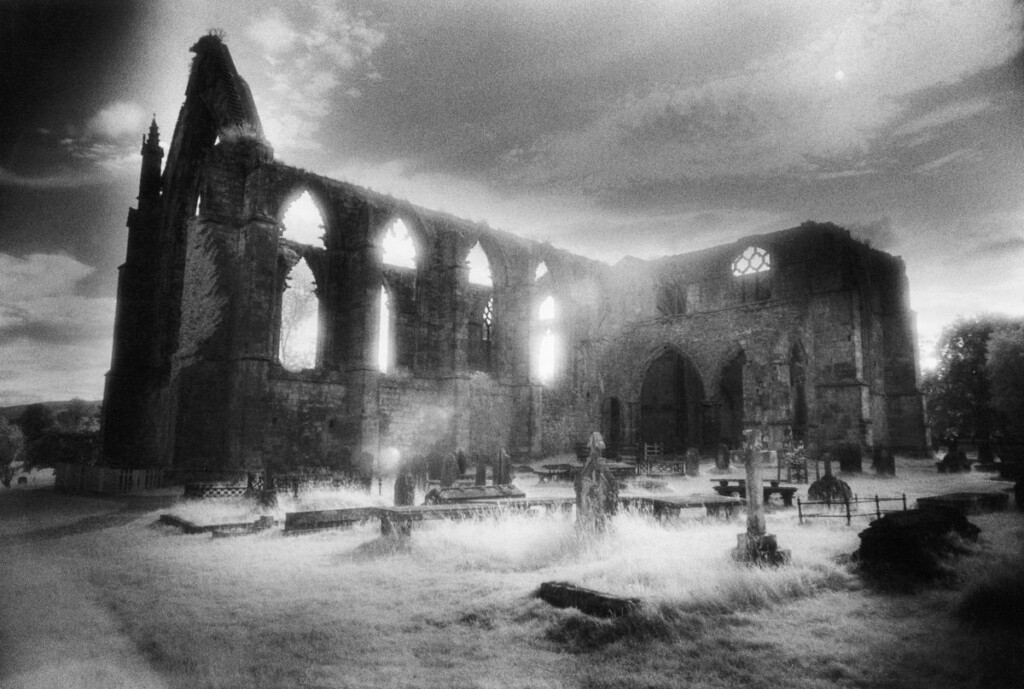
You are standing in a room where someone died, and the room does not know you are there. That is the sensation Marsden’s photographs finally produce when you sit with them long enough — not the thrill of the uncanny, not the decorative shiver of gothic aesthetics, but something colder and more structural: the realization that you, the witness, are a contingency. The haunting does not require your presence. It was already happening before you arrived, and the image makes no promises about what will remain when you are gone.
This is where the philosophical stakes of Marsden’s entire project become impossible to avoid. Walter Benjamin, working through the immense unfinished ruin of the Arcades Project in the years before his death in 1940, developed the notion of the dialectical image — a moment in which past and present collide in a sudden flash of legibility, not as continuous history but as something more like an explosion. The image does not illustrate time passing; it arrests time, holds two irreconcilable moments in the same frame, and in that suspension something true becomes briefly readable. Benjamin believed this flash was the only honest way to encounter history, because linear narrative always domesticates what was actually catastrophic and strange. Marsden’s photographs operate exactly on this threshold. A crumbling estate photographed in 1985 is not simply a document of decay — it is a collision between the moment of the building’s construction, the moment of its abandonment, the moment of the photograph’s creation, and the moment you are looking at it now. Four temporal strata locked in a single frame of legibility.
What Benjamin could not fully account for — what perhaps no theory of images can fully account for — is the question of the witness’s own mortality. The dialectical image assumes a present that can receive the flash, a consciousness standing at the threshold capable of recognizing the collision. But the archive of absence Marsden spent his life assembling now faces a horizon that has nothing to do with the ruins he photographed. The houses he documented are continuing to collapse or have already been demolished. The Ireland and Scotland and England he traversed with infrared film and a patient eye have changed in ways both visible and invisible. And the generation that first held his books — that felt the specific texture of Ghost Story of an Old House or This Transient Life in their hands and recognized something in those silvered skies — is thinning.
Photography has always carried this recursive wound inside it. Roland Barthes understood in Camera Lucida, published in 1980, that the photograph is structurally a certificate of death — it says this was, not this is, and in that tense everything mortal is already implied. But Barthes was writing about portraits, about faces, about the ache of recognizing a specific person’s absence. Marsden’s photographs have no faces. They are absences photographed in the locations where absence lives, which means the wound is not located in any single lost person but distributed across entire landscapes, entire centuries, entire ways of inhabiting the world that have no surviving practitioners.
The question that this produces cannot be answered by looking more carefully at the photographs. It is structural, almost logical in its coldness: if a haunting requires a witness to register it, and if the act of registration is itself an act of haunting — the photographer disturbing what was silent, the image lodging in a viewer’s nervous system like something that will not settle — then what is the haunting doing when no witness remains? What does the dialectical image flash into when there is no present standing at the threshold to receive it? Marsden’s infrared skies will survive in archives and collections long after the last person who felt genuinely unsettled by them has closed their eyes, and the ruins he loved will keep their silence either way, indifferent to whether they are witnessed, utterly unchanged by the fact of having once been seen.
👻 Between the Living and the Dead: Photography, Ghosts & the Uncanny
Simon Marsden spent decades wandering ruined abbeys, forgotten cemeteries, and cursed landscapes in search of what lies beyond the visible world. His infrared photography transformed decay into poetry and silence into a language of the spectral. These articles explore the cultural, artistic, and philosophical territories that border his haunted vision.
Du Maurier’s Don’t Look Now: Analysis
Daphne du Maurier‘s unsettling novella ‘Don’t Look Now’ shares with Marsden’s work a profound obsession with the thin membrane between the seen and the unseen. Set in the labyrinthine canals of a fog-draped Venice, the story uses physical space as a mirror of psychic dread. Like Marsden’s photographs, du Maurier’s prose transforms the atmosphere of a place into something alive with presences that refuse to be dismissed.
GO TO THE SELECTION: Du Maurier’s Don’t Look Now: Analysis
Venetian Legends and Ghosts of the Lagoon
Venice has long been a city haunted by its own reflection, its crumbling palaces and still waters generating centuries of ghost stories and spectral legends. This article explores the folklore of the lagoon, where the boundary between the historical past and supernatural presence dissolves into mist. Marsden himself photographed Venetian sites with the same reverence he brought to Irish ruins, sensing in the city’s decay a persistence of unquiet souls.
GO TO THE SELECTION: Venetian Legends and Ghosts of the Lagoon
Arthur Machen: Life and The Great God Pan
Arthur Machen, the Welsh author of ‘The Great God Pan,’ was one of the founding voices of a tradition that locates the supernatural not in fantasy but in the hidden depths of the real world. His work, like Marsden’s photography, insists that ancient and terrifying forces persist beneath the surface of the ordinary landscape. Both men were drawn to the rural and the archaic, convinced that certain places retain a charge of the inexplicable.
GO TO THE SELECTION: Arthur Machen: Life and The Great God Pan
The Literary Fantastic: Todorov and the Theory of the Fantastic
Tzvetan Todorov‘s foundational theory of the literary fantastic provides essential tools for understanding why images like Marsden’s produce such a powerful and disquieting effect on the viewer. The fantastic, Todorov argues, is born in the hesitation between a rational and a supernatural explanation for what we perceive, and it is precisely this hesitation that Marsden’s infrared lens cultivates. His photographs refuse resolution, holding us permanently in that liminal trembling between the natural and the otherworldly.
GO TO THE SELECTION: The Literary Fantastic: Todorov and the Theory of the Fantastic
Discover the Cinema of the Invisible on Indiecinema
If Marsden’s ghost-hunting lens has awakened your appetite for the uncanny, Indiecinema is the streaming platform where independent cinema explores those same shadowed territories — films that dare to look at what lies beyond the frame. Join us and discover a curated world of visionary, daring, and hauntingly original cinema that mainstream platforms would never show you.
👉 EXPLORE THE CATALOG: Watch Indie Films in Streaming
A vision curated by a filmmaker, not an algorithm
In this video I explain our vision

