
The Itch That Has No Name
You are sitting in a room where nothing is wrong. The heating works. The light is soft. Somewhere in the next room a familiar sound — a kettle, a television, the low hum of a life that has been carefully arranged to require nothing more of you. And yet there it is. Not anxiety exactly, not grief, not the identifiable weight of a problem that could be named and solved. Something else. A vibration beneath the sternum, an almost cellular insistence that this — all of this — is not quite it. You shift in your seat. You check your phone. You get up for no reason and stand at the window looking at a street you have looked at a thousand times, and the looking does not help. Nothing is wrong, and that is precisely the problem.

Bruce Chatwin spent the better part of his adult life trying to give this feeling a name. Not a metaphor for it, not a spiritual framework into which it could be folded and made bearable, but a genuine biological and anthropological account of why the human animal, alone among the creatures that built cities and wrote laws and developed elaborate systems for staying put, cannot quite manage to believe that staying put is enough. The Songlines, published in 1987, is the record of that search — part travel narrative, part philosophical notebook, part something that resists every category it inhabits. It is a book about Australia’s Aboriginal people and their extraordinary system of invisible pathways mapped in song across an entire continent, but it is really a book about the itch that has no name. The one you felt just now, in the comfortable room.
What Chatwin understood, and what most of his readers resist understanding even as they feel it, is that restlessness is not a dysfunction. It is not the symptom of a modern malaise, not the product of consumer dissatisfaction or attention fragmentation or any of the other contemporary explanations we reach for when the stillness becomes unbearable. It is older than any of that. The evolutionary biologist Jonathan Kingdon, whose work on African human origins Chatwin read with near-obsessive attention, argued that Homo sapiens spent the overwhelming majority of its existence as a migratory creature, following seasonal rhythms across landscapes, never remaining in one place long enough for the place to become a cage. We are, in the most literal physiological sense, walking animals who learned to build walls and then forgot that the walls were the anomaly. The settlement — the city, the suburb, the apartment with the working heating — is the experiment. The road is the default.
This is not romanticism. Chatwin was too rigorous, too intellectually restless himself, to indulge in the fantasy of the noble wanderer. He knew that the Aboriginal songlines were not poetry in the decorative sense — they were navigational technology, legal architecture, the encoded memory of a people held in rhythm and melody because the landscape itself was the library. When an elder walked a songline, he was not escaping anything. He was fulfilling the deepest available form of belonging. The paradox Chatwin spent his life circling is this: that true belonging, for the human animal, may require movement. That the act of staying may be the most radical form of estrangement from what we actually are.
And so you sit in your comfortable room, and the itch persists, and you have learned to distrust it because everything around you insists it should not be there. Every structure of modern life — the mortgage, the schedule, the praised virtue of rootedness — is, in some sense, a long argument against the body’s oldest knowledge. Chatwin did not invent that argument. He simply refused, with unusual stubbornness, to pretend he could not hear it.
Chatwin’s Wager: The Book That Refused to Be a Book
There is a particular kind of restlessness that announces itself not in what a person says but in how they arrange their desk. Chatwin’s desk, by every account of those who knew him, was a surface perpetually in transit — notebooks half-opened, fragments of manuscript mixed with artifacts, a piece of carved bone lying beside a paragraph about Aboriginal Australia. The form of his thinking was visible before you read a single word.
When The Songlines appeared in 1987, reviewers reached instinctively for the label of travel writing and found it kept slipping away. They tried the novel and found it didn’t fit either. Some settled on “hybrid,” which is the critical term for a form you haven’t understood yet. What they were encountering was not a formal experiment for its own sake — not the kind of generic border-crossing that signals ambition in the absence of necessity — but something more uncomfortable: a thesis that had eaten its own container.
The book’s argument, pursued across its narrative passages and then again through the long collage of notebook entries that occupies its second half, is that human beings are constitutionally migratory, that the settled life is not civilization’s achievement but its pathology, that restlessness is not a symptom to be treated but the baseline condition of the species. You cannot make that argument inside a form that is itself an act of settlement. The novel, with its requirements of character development, psychological interiority, narrative resolution, is precisely the aesthetic expression of the bourgeois sedentary imagination that Chatwin was trying to diagnose. To write a conventional novel about nomadism would have been like writing a manifesto against property on privately owned paper.
This is why the notebook section — those dense, associative pages where Lévi-Strauss collides with Konrad Lorenz, where a fragment about Rimbaud’s abandonment of poetry sits beside a passage about Mongolian herders — is not a failure of editorial discipline but the argument’s truest form. Chatwin had understood something that most literary theorists learn only abstractly: that form is never neutral, that the container shapes the thought even as it carries it.
His years at Sotheby’s in the early 1960s had given him an education in the violence objects do to meaning through displacement. He had handled things — Etruscan bronzes, African masks, Paleolithic tools — that had been wrenched from their contexts of use and frozen into the category of the collectible. He understood, viscerally and before any theoretical framework was available to him, that the moment an object stops moving it begins to lie. Its stillness is a form of falsification. This insight preceded his intellectual engagement with nomadism by a decade, and it gave that engagement its peculiar urgency, its refusal to remain decorative.
His subsequent training in archaeology at Edinburgh reinforced this. Archaeology, at its most honest, is the discipline of reading movement through what remains when movement has stopped — the scatter pattern of tools, the direction of migration routes, the negative space where a body once was. It trained him to see settlement not as the natural terminus of human history but as one data point in a much longer story, and mostly a late and provincial one.
So when he sat down to write The Songlines, the formal restlessness was not a stylistic decision. It was the only epistemologically honest position available to him. A book that argued against fixed forms while itself inhabiting one would have refuted itself at the structural level before the first sentence was finished. The notebooks, the fiction, the travel writing, the philosophical fragments — these are not mixed because Chatwin couldn’t decide what he was writing. They are mixed because he had decided, with more precision than most of his critics gave him credit for, exactly what he needed to say and what kind of container would betray it.

The Map That Sings: Aboriginal Songlines as Radical Ontology
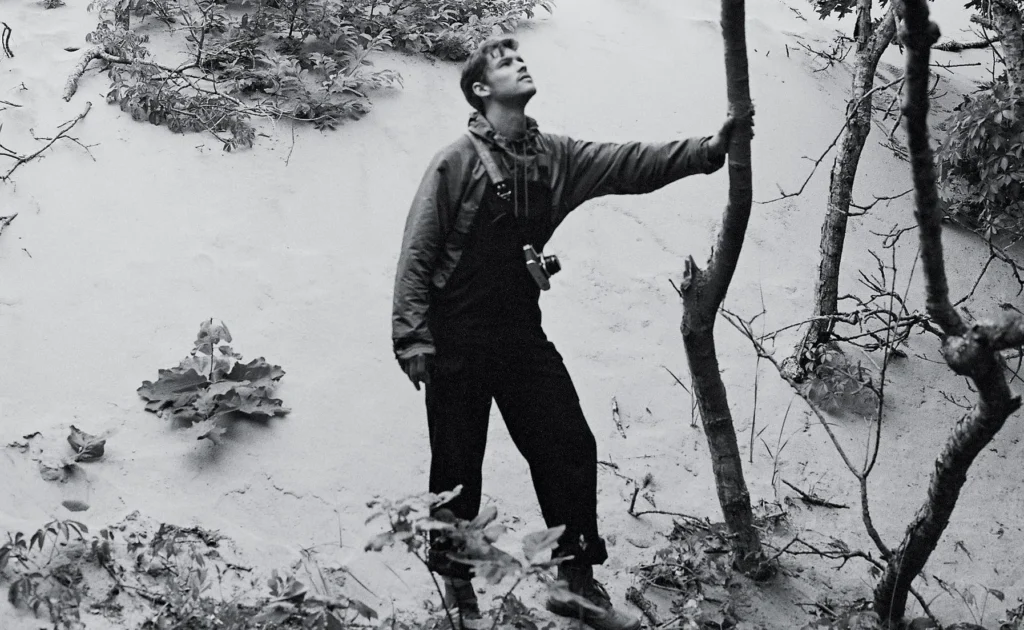
There is a moment in the Australian desert when a man begins to sing and the ground beneath his feet becomes a road. Not metaphorically. Not spiritually, in the diluted Western sense where spiritual means vaguely uplifting and essentially private. Literally: the song is the path, the path is the song, and without the singing the land itself — in some sense that resists the grammatical structures we have available — ceases to be fully real.
This is not mysticism. It is ontology. And the distinction matters enormously, because mysticism can be safely admired from a distance, framed in a museum vitrine, reduced to aesthetic wonder. Ontology cannot. Ontology makes a claim about the nature of existence itself, and when a competing ontology arrives with sufficient coherence and internal logic, it does not merely offer an alternative worldview — it indicts the one you already hold.
W.E.H. Stanner, the Australian anthropologist who delivered his landmark lectures on Aboriginal religion in 1953, understood this danger with extraordinary clarity. His concept of “the Dreaming” — which he was careful to distinguish from the English word dream, with its connotations of sleep and unreality — described a mode of being in which the ancestral past is not behind us but beneath us, constantly present in the physical world, accessible through ritual, song, and movement. The Dreaming, Stanner insisted, is not a belief about the world. It is the world, structured differently. His lectures, later published as White Man Got No Dreaming in 1979, represent one of the few moments in twentieth-century Western scholarship where a thinker had the intellectual courage to say: this is not superstition dressed in unfamiliar clothes. This is a complete metaphysics, and it is more coherent than several we currently accept without examination.
Chatwin absorbed Stanner’s argument and pushed it further, toward a conclusion that is genuinely radical. The Songlines — those invisible pathways threading across the entire continent, each one corresponding to an ancestral journey sung into existence in the Dreaming — are not maps of territory. They are maps of meaning. The distinction demolishes, quietly but completely, the Western assumption that the purpose of human presence on earth is to settle, claim, transform, and ultimately own what lies beneath your feet.
In the Western legal and philosophical tradition, from Locke‘s Second Treatise of 1689 onward, the argument for ownership has rested on labor: you mix your work with the land and it becomes yours. This argument underwrote colonialism with philosophical respectability, and it continues to underwrite, with barely a vocabulary change, every contemporary debate about development, resource extraction, and indigenous land rights. But the Songlines propose a different question entirely. Not what have you done with this land, but what do you know about it. Not who has transformed it, but who can sing it. Custodianship, not ownership. Responsibility to a living network of meaning, not dominion over inert matter.
A man walks a route that his ancestor walked before him, singing the same notes in the same sequence, and in doing so he maintains the world. He is not traveling through space. He is performing existence. The land does not exist independently of this performance in the way a Western property exists independently of whether anyone thinks about it. Remove the song and something is genuinely lost — not sentiment, not memory, but ontological coherence. The path unravels.
You cannot hold this idea in one hand and your ordinary assumptions about progress and civilization in the other. They are not compatible. The Songlines do not add a spiritual dimension to a world we already understand. They propose that the world we think we understand — bounded, ownable, silent — is itself a kind of impoverishment so profound and so ancient that we have long since stopped noticing the absence.
Nomadism as Diagnosis, Not Nostalgia
The apartment is perfect. You know this because everyone tells you so. The light falls correctly through the west-facing windows in the late afternoon, the bookshelves are full, the kitchen smells of something that took time to prepare. You have arrived, in every sense the culture recognizes. And yet there is something in you, some low-frequency hum beneath the contentment, that will not settle. You have mistaken this for ingratitude. Your therapist has mistaken it for anxiety. The people who love you have mistaken it for a failure of commitment. The possibility that none of you are right — that the hum is not a symptom but a signal — is the thing Chatwin spent his entire literary life trying to say without being dismissed as a romantic fool.
He was dismissed anyway. The most persistent misreading of The Songlines treats it as elegy, as a sophisticated form of nostalgia — the educated European gazing at Aboriginal Australia and mourning a lost Eden, projecting onto darker skin and older practices the paradise his own civilization burned down. This reading is comfortable because it contains Chatwin safely within the tradition of the noble savage, which is itself a sedentary fantasy, a way of admiring wildness from a distance without having to reckon with what it indicts. But Chatwin is not mourning. He is diagnosing. The distinction is everything.
Deleuze and Guattari, writing in A Thousand Plateaus in 1980, developed the concept of the war machine as something fundamentally exterior to the State apparatus — not militarism, but a mode of existence that resists capture, that operates through movement rather than territory, through becoming rather than being. The nomad, in their framework, does not travel between fixed points. The nomad is defined by the between itself, by the refusal to let any point become an endpoint. What the State cannot tolerate is not the nomad’s violence but the nomad’s indifference to the very categories the State requires for its operation: property, identity, permanence, the legible self. Chatwin’s notebooks — those small black Moleskines he ordered in bulk from a Parisian stationer and described as indispensable travel companions, the physical form his thinking required — were themselves a kind of war machine in miniature. Structured around movement, resistant to conclusion, filled with fragments that refuse synthesis into doctrine.
There is a man who appears in a certain story who has constructed a life of extraordinary material comfort and cannot stop dismantling it. He moves cities, moves relationships, moves careers — not because each new arrangement fails him but because each one succeeds, becomes solid, becomes a container. Those around him read this as self-destruction. The camera — the story’s gaze — stays close enough to his face that you see something they do not: not the panic of someone running from something, but the alertness of someone who has learned, at cellular level, what happens when the container seals. His restlessness is not pathology. It is the only form of intelligence his body has retained.
This is precisely Chatwin’s diagnostic claim. Sedentary civilization does not merely inconvenience the species. It costs it something structural, something that was built into the organism across millions of years of African walking, and the cost is paid in ways we have medicalized, moralized, and taxonomized into personal failure. The neurologist and psychoanalyst Wilhelm Reich, writing decades before Chatwin, argued that chronic muscular armoring — the body’s learned rigidity — was civilization’s primary symptom, the somatic record of everything the social order required us to suppress. Chatwin arrives at the same territory from the outside, from the feet rather than the musculature, from the landscape rather than the consulting room.
The Songlines does not propose a return to the savannah. It has no interest in proposing anything. What it does instead is hold the sedentary arrangement up to the light and ask you to look at what passes through it.
The Notebook Within the Book: Chatwin’s Philosophical Raid
You know the feeling. You are sitting under fluorescent light, filling in a form that asks you to describe, in the space provided, the nature of your request. The space provided is a rectangle approximately four centimeters tall. Your life, reduced to a rectangle. You write. You cross out. You write again. Somewhere in the building a phone rings and is not answered. You have been here forty minutes and the person at the desk has not looked up once. Something in you — not metaphorically, but physically, in the muscles of your legs and the back of your jaw — wants to stand up and walk out the door and keep walking. You don’t. You fill in the rectangle.
That impulse you suppressed is what Bruce Chatwin spent the second half of his life trying to name.
The Notebooks section of The Songlines arrives like a detonation in the book’s architecture. Critics who wanted a travel narrative found it bewildering, even evasive. What Chatwin assembles there — fragments, quotations, half-arguments, sudden lyrical bursts — looks at first like a failure of form, a writer who ran out of story and started emptying his pockets. Read it again. It is the book’s most honest gesture precisely because it refuses the comfort of narrative. The journey is over. What remains is the argument in its raw state, stripped of the anecdote that carries it.
The argument is this: the human animal was shaped for movement. Shaped across millions of years of walking, of following animals and seasons, of never staying long enough in one place to accumulate grievance. Civilization — and here Chatwin means the settled, property-owning, bureaucratic variety — is not humanity’s natural state. It is an experiment, roughly ten thousand years old, that the species is still failing to adapt to. And the failure is not psychological. It is biological. Pascal, writing in 1670 in the Pensées, located the source of all human misery in precisely this incapacity: the inability to sit quietly in a room alone. He saw it as a spiritual failure, a restlessness that drove men toward war and gambling and distraction. Chatwin reads the same symptom and inverts the diagnosis. The restlessness is not the disease. The room is.
Konrad Lorenz, whose 1963 work On Aggression traced the hydraulic logic of violence in social species, gave Chatwin the ethological spine for this intuition. Lorenz argued that aggression is not an aberration but an energy that accumulates and seeks release — and that the conditions of modern sedentary life are precisely those most likely to generate its explosive discharge. Lorenz was writing about fish and geese but he was also, unmistakably, writing about the office, the suburb, the form in the rectangle. Chatwin reads Lorenz and sees the Aboriginal songline as a kind of counter-technology: a civilization built not to contain movement but to institutionalize it, to give the walking body a sacred grammar. The Dreaming tracks are not primitive infrastructure. They are a solution to the problem that Pascal identified and Lorenz explained, a solution that Western modernity never found because it never admitted the problem.
This is what the Notebooks enact formally. They are themselves a refusal to sit still. They dart between a passage from Osip Mandelstam and a note on the Bedouin, between a line from Rimbaud and a study of nomadic infant development. There is no thesis that settles. The form performs the argument. Chatwin is not digressing. He is demonstrating, through the texture of the prose itself, that meaning moves — that thought, like the species that generates it, is constitutionally unsuited to enclosure.
The rectangle on the form is four centimeters tall. You filled it in. And the thing you wrote there bore almost no relation to what you actually needed.
A vision curated by a filmmaker, not an algorithm
In this video I explain our vision
Ownership as the Original Fiction

There is a moment when you return to a place where you once lived — not your childhood home, but somewhere you inhabited deeply, where the walls held your specific silence — and you find it belongs entirely to someone else now. Not emotionally, not symbolically. Legally. The locks have changed, the garden has been rearranged, and a man stands at the window who has every right to be there and every right to ask you to leave. The violence of this is quiet. It does not announce itself. It settles over you the way weather does, gradually, until you realize you are soaked through and there is nowhere to stand that is not already someone else’s ground.
This is what Chatwin’s Songlines keeps pressing against without quite naming it directly: the question of whether ownership of land is a natural fact or an extraordinarily recent and extraordinarily brutal fiction dressed up as common sense. The Aranda elders do not dispute borders because they are naive about power. They dispute them because the entire conceptual architecture of the dispute — land as property, territory as something transferable, exchangeable, purchasable — belongs to a worldview that arrived on their continent approximately two centuries ago and called itself civilization.
Karl Polanyi argued in 1944 that the idea of land as a commodity was not an evolution but a rupture. In The Great Transformation, he traced how the market economy required the deliberate dismantling of older arrangements in which land was embedded in social relationships, in obligation, in use and memory rather than in abstract legal title. What we call the natural order of ownership, Polanyi demonstrated, was in fact an engineered transformation, accomplished within a few generations through enclosures, evictions, and a systematic redefinition of what land could mean. The commons were not abandoned. They were seized. And the seizure was then narrated as progress.
David Graeber and David Wengrow pushed this further in The Dawn of Everything, published in 2021, a book that marshaled decades of archaeological and anthropological evidence to dismantle what they called the “standard narrative” of human development: the idea that hunter-gatherers were simple and nomadic, that settlement produced complexity, and that property and hierarchy were the inevitable price of civilization. What they found instead was extraordinary flexibility. Human societies across millennia moved between modes of organization, were fully aware of alternatives, and often chose arrangements that Western modernity would struggle to categorize. The equation of humanity with permanent settlement, with ownership, with the legal fixing of persons to plots — this is not the story of our species. It is the story of one episode within it, inflated into destiny.
Chatwin’s nomads carry something that unsettles this inflation. The Songlines do not merely represent an alternative relationship to land. They expose the contingency of the dominant one. If a man can own a stretch of desert because a document says so, but cannot sing a single line of what that desert is, what has he actually possessed? He has possessed the legal mechanism. He has possessed the violence behind the mechanism, the capacity to enforce the document with courts and guns and the entire machinery of a state. But the place itself — its deep time, its routes, its embedded intelligence — remains outside him, untouched by his title deed.
There is a scene in which a man sits in what was once his kitchen, now emptied by someone else’s right, and understands that ownership was always a performance requiring witnesses, requiring enforcement, requiring the constant renewal of collective agreement to pretend that an abstraction is a fact. Remove the witnesses, remove the enforcement, and the land simply continues to exist, indifferent to who holds the paper.
Chatwin understood that this indifference was not a failure of the land. It was the land’s oldest and most patient form of truth.
What the West Forgot It Knew
There is a particular kind of walking that happens after midnight in any large city. Not the purposeful stride of someone coming home from a late shift, not the conspicuous stumble of someone leaving a bar. This is quieter and more unsettling to witnesses: a person moving through streets for no legible reason, not heading anywhere, simply unable to remain still. You have probably done this yourself at some point, or recognized the impulse even when you suppressed it. And you will know that the world does not receive this kind of movement with neutrality. A passing police car slows. A neighbor watching from a window reaches a quiet conclusion. The diagnostic vocabulary is already assembling itself around you: troubled, unstable, a person to be concerned about.
What is almost never entertained is the possibility that the walker is doing something correct. That the body, in its refusal of the fixed point, is remembering something the architecture around it has systematically tried to make it forget.
Chatwin’s most unsettling implication in the long notebooks at the center of his inquiry is not that Aboriginal Australians possess a wisdom the West lacks. That reading flatters the Western reader too easily, allows them to admire from a safe anthropological distance. The deeper provocation is something else entirely: that the West once knew this, and chose, or was made, to unknow it. The forgetting was not innocent. It was enforced, institutionalized, rewarded. And the restlessness that now reads as pathology is, in this light, not a deficiency of character but a form of memory — somatic, inarticulate, persistent. The body carrying what the mind has been disciplined to discard.
James Hillman, writing in 1996, described what he called the acorn theory of the soul: the idea that each life contains within it an original image, a form pressing toward expression from the beginning, which the culture around it may nurture or suppress but cannot ultimately erase. The soul, in Hillman’s framework, is not constructed by experience. It arrives with its own insistence. What Chatwin locates in the Songlines is something structurally similar at the species level: not an individual destiny but a collective one, encoded not in text or institution but in motion itself, in the act of traversing terrain and singing it into coherence. The West did not lose this capacity. It buried it under property law, under the theology of the fixed domicile, under the moral equation of settlement with virtue and movement with vice.
Nietzsche’s distinction between active and reactive forces offers a different vocabulary for the same recognition. The reactive life is one organized around the negation of impulse, the chronic subordination of what the body knows to what the social order requires. The active life is not the absence of constraint but the capacity to move from one’s own center rather than in perpetual anxious response to external demand. The midnight walker, read by the culture as disordered, may in fact be exhibiting the only active force available to someone whose entire spatial existence has been organized to prevent precisely this kind of unscripted movement.
Walter Benjamin saw the flâneur as a figure haunted by this contradiction: someone attempting to recover, within the grid of commodity exchange, some remnant of the older freedom of purposeless traversal. The arcade, the boulevard, the crowd — all of it a degraded substitute for a relationship to space that capitalism had rendered economically irrational and therefore morally suspect. Benjamin understood that the melancholy of the flâneur was not personal. It was historical. It was the grief of a body that remembers a world the mind has been told never existed.
The person walking at midnight is not sick. They are inconvenient. And the distance between those two verdicts is precisely where Chatwin’s entire argument lives.
The Song Continues After the Singer Stops
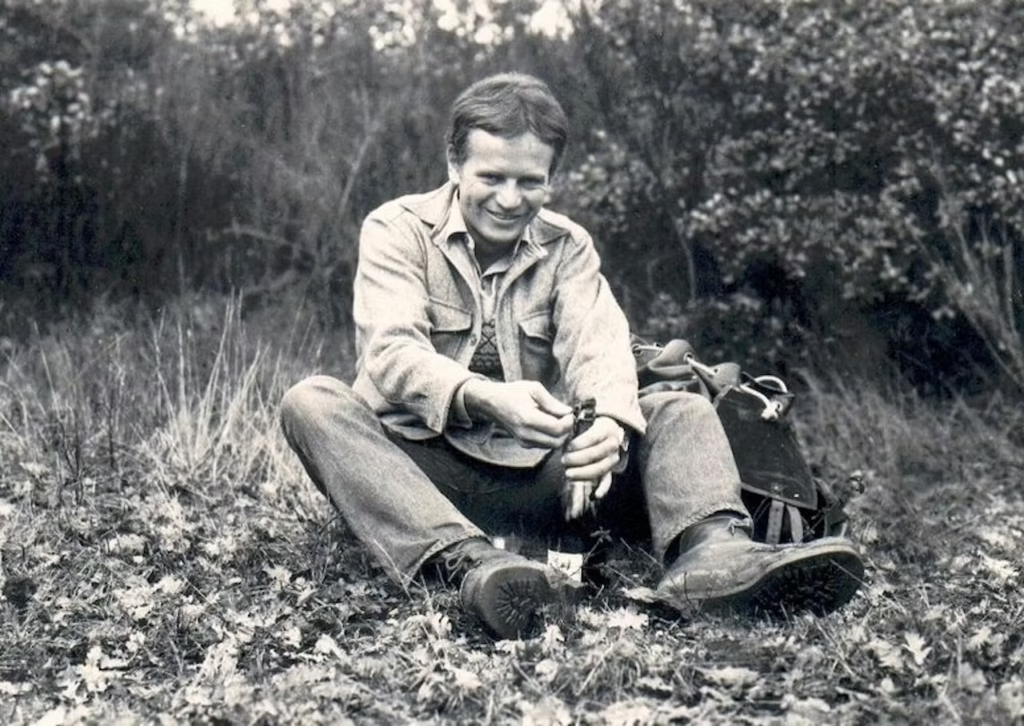
There is a moment — you have probably lived something like it — when you return to a book you read years ago and find that it has continued without you. The pages have not changed, but you have, and so the text moves differently now, opens onto rooms you did not know were there. Something in the book kept walking while you were away from it.
Bruce Chatwin died in January 1989, in the south of France, at forty-eight years old. The Songlines had been published two years earlier, in 1987. He had told different stories about his illness — a rare bone marrow infection, a Chinese fungus, a condition contracted in the Yunnan province — and the evasions were themselves a kind of movement, a man refusing to be fixed to a single narrative. He had spent his life arguing that the sedentary instinct was the root of human pathology, and perhaps he extended that argument even to the way he was dying, declining to settle into the one story that would make him stationary, knowable, finished. The lie, if it was a lie, had the shape of his deepest conviction.
What remains now is the book. And if the Aboriginal metaphysics that Chatwin spent those pages circling is taken seriously — not as anthropological curiosity but as philosophical proposition — then what remains is not a memorial but a living path. The Songlines describes a world in which the song and the route are identical, in which singing a sequence of notes is indistinguishable from walking a sequence of terrain. The song does not represent the land; it is the land, acoustically. And crucially, the song does not belong to the singer. It passes through the singer. When a man dies having sung his stretch of Songline, the stretch does not die with him. The path continues. The next custodian picks it up, or the land holds it in waiting.
Walter Benjamin, in his 1936 essay “The Storyteller,” argued that the art of storytelling was dying precisely because modern life had severed the connection between experience and transmissible wisdom. The storyteller, for Benjamin, was never an author in the Romantic sense — a sovereign individual generating meaning from his unique interiority. The storyteller was a conduit, someone through whom accumulated experience moved toward others. The story outlived the teller because it was never entirely the teller’s in the first place. Chatwin had read Benjamin carefully. He knew this argument. And The Songlines is structured, in its deepest grammar, as a vindication of it — a book that dramatizes the priority of the path over the person walking it.
This creates a strange pressure on the concept of authorship. We are trained, especially since the Romantic period consolidated its ideology in the early nineteenth century, to think of a book as an emanation of a self. Roland Barthes declared the death of the author in 1967, but the declaration remained largely theoretical, a gesture made inside institutions that continued to organize themselves entirely around the figure of the author. In practice, we still read books as if they were confessions, as if the text were an extended self-portrait of the person who signed it. But what happens when the person who signed it was arguing, from the first page to the last, that the self is a fiction generated by movement, that identity is not a possession but a trajectory, and that the deepest thing we are is the path we trace rather than the one who traces it?
The book then becomes its own best evidence. Chatwin is gone. The Songlines is not. Whatever he put into motion in those pages — the argument, the question, the long restless reaching toward a truth he could feel but never quite name — continues to move through whoever picks it up, changes them slightly, sends them forward into their own terrain carrying something they did not carry before.
🗺️ Wandering Voices: Landscape, Myth, and the Journey Within
Bruce Chatwin‘s The Songlines weaves together nomadic philosophy, Aboriginal myth, and the deep human need to move through space as a form of knowing. These articles explore the ideas that orbit Chatwin’s work most closely — from the sacred geography of myth to the phenomenology of place, from the structure of narrative to the memory embedded in landscape.
Mircea Eliade and the Myth of the Eternal Return
Mircea Eliade‘s concept of the eternal return offers a profound framework for understanding how sacred space and mythic time transform ordinary geography into living cosmology. Chatwin’s songlines resonate deeply with Eliade’s notion that archaic peoples inhabit a world constantly renewed through ritual repetition. Both thinkers locate in landscape a grammar of the sacred that precedes and survives written language.
GO TO THE SELECTION: Mircea Eliade and the Myth of the Eternal Return
The Labyrinth of Knossos: History and Myth of the Minotaur
The Labyrinth of Knossos stands as one of Western culture’s most enduring metaphors for the maze-like complexity of space, myth, and the journey toward meaning. Like the songlines that crisscross the Australian continent, the labyrinth encodes a sacred itinerary that must be walked to be understood. Its myth of the Minotaur reminds us that at the heart of every landscape lies something primal and untamed.
GO TO THE SELECTION: The Labyrinth of Knossos: History and Myth of the Minotaur
Situationist Psychogeography: The City as Lived Space
Situationist psychogeography reimagines the city as a lived, emotionally charged territory navigated through drift and desire rather than rational planning. This approach shares with Chatwin’s vision of the songlines an insistence that space is not neutral but deeply shaped by the bodies and stories that move through it. The dérive, like the Aboriginal walkabout, is an act of resistance against the reduction of place to mere geography.
GO TO THE SELECTION: Situationist Psychogeography: The City as Lived Space
Claude Lévi-Strauss: Life and Thought
Claude Lévi-Strauss revolutionized the study of myth by revealing the deep structural logic underlying the stories that indigenous peoples use to organize their world. His structural anthropology provides an essential intellectual backdrop for reading Chatwin’s encounter with Aboriginal song-maps, which function as mythic grids laid over the physical earth. Understanding Lévi-Strauss sharpens our sense of why Chatwin treats the songlines not as folklore but as a total system of knowledge.
GO TO THE SELECTION: Claude Lévi-Strauss: Life and Thought
Discover Films That Walk the Edge of the World
If these ideas about wandering, myth, and the sacred dimensions of place have moved you, Indiecinema is the streaming space where cinema takes the same risks. Explore independent films that dare to follow their own songlines — stories built not on formulas but on the honest search for meaning. Begin your journey on Indiecinema today.
👉 EXPLORE THE CATALOG: Watch Indie Films in Streaming
A vision curated by a filmmaker, not an algorithm
In this video I explain our vision

