
The City That Watches Back
You are moving through a city at night and nothing has happened yet. That is the first thing to understand. The threat is not behind you — you have checked. It is not ahead, because the street is empty for another hundred meters, pooled in amber from lights that seem placed not to illuminate but to isolate, to divide the pavement into chambers of visibility separated by soft absolute dark. The buildings on either side are too tall for the hour and too close for comfort, and their windows are either dead black or lit in that particular way that suggests someone has just moved away from the glass. Your footsteps are returning to you off the concrete facades half a beat too slow, which your nervous system registers before your mind does. You have not been threatened. You are simply inside an architecture that has decided to be hostile, and the decision was made long before you arrived.

This is the founding sensation of the urban thriller, and it has almost nothing to do with plot. The genre’s most durable achievement is not the chase, not the revelation, not the body discovered in the wrong room. It is the sustained demonstration that space itself possesses intention, that a city can be arranged to produce fear as efficiently as a weapon can. The great photographers understood this before filmmakers did. Weegee — Arthur Fellig — was working the streets of New York in the 1930s and 40s with a Speed Graphic and a police scanner, and what his images reveal is not crime as event but crime as environment. The wet asphalt, the fire escapes cutting shadows across brick, the crowd gathered at the perimeter of some yellow-lit disaster: these elements are not incidental. They are the argument. His 1945 collection “Naked City” gave a name to a way of seeing that recognized the metropolis as a system actively producing its own casualties.
Architecture theorists have a term for what Weegee was photographing instinctively: spatial syntax. The phrase belongs to Bill Hillier’s 1984 work “The Social Logic of Space,” which demonstrated through quantitative analysis that the configuration of streets and buildings statistically predicts patterns of movement, encounter, and avoidance — that the geometry of a city is also a grammar of behavior. When a thriller positions its protagonist at the bottom of a stairwell looking up, or at the end of a corridor where the perspective lines converge too aggressively, it is not deploying metaphor. It is accurately describing how designed space generates physiological response, how the built environment can place a human body into a condition of readiness that precedes and exceeds any rational cause.
What photography makes visible that the literary thriller can only approximate is the simultaneity of the threat. A photograph of a city at night holds the danger and the witness in the same frame, gives them equal weight, refuses the hierarchy of prose. The empty street is not described — it simply exists in the image with the patience of a predator, and the viewer is trapped in the present tense of looking at it. Walker Evans understood this asymmetry when he rode the New York subway between 1938 and 1941 with a camera hidden under his coat, capturing passengers who did not know they were being watched. The ethical discomfort of those images is not merely about consent. It is about the city’s fundamental condition: that to be in urban space is to be simultaneously observer and observed, hunter and hunted, without ever knowing clearly which role you currently occupy.
The thriller, at its most precise, is the genre that takes this condition seriously as subject matter rather than treating it as atmosphere to be evoked and then dissolved once the human drama takes over.
Urban Traffik
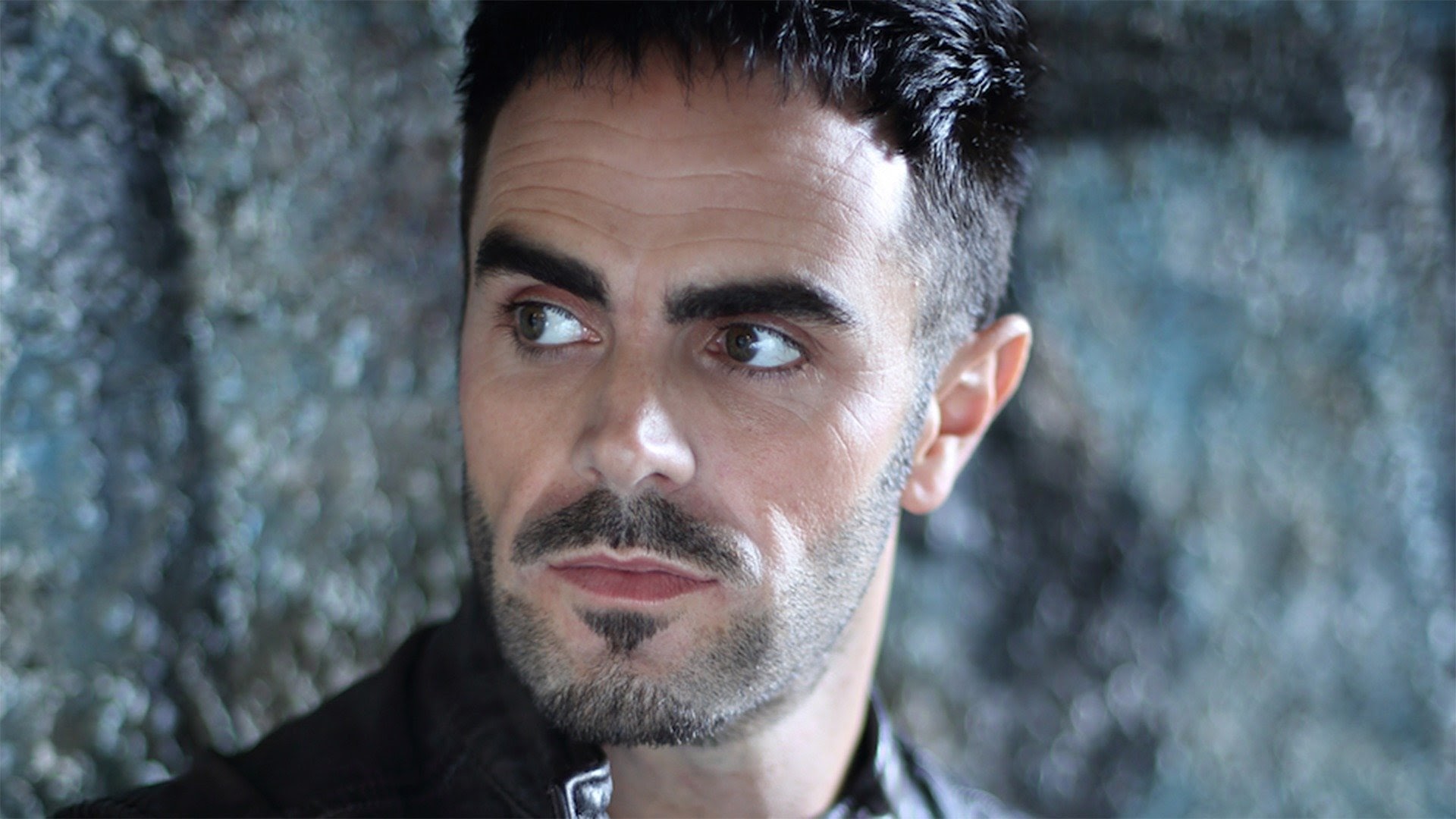
Thriller, by Jason Figgis, United States, 2017.
In the heart of a dark and hidden Dublin, Adam appears to be a kind-hearted man when he offers shelter to Sue, a lonely and vulnerable young woman who has just arrived in the city. The reality, however, is far more tragic: Adam serves as bait for a ruthless human trafficking ring led by the cold and calculating Dan and managed by his partner, Alex. Their chilling scheme is simple: lure defenseless young women and sell them into the international sex trade. But this seemingly perfect criminal enterprise is about to unravel. As disturbing family secrets linking Dan to Adam's sister come to light, and Adam desperately tries to break free from a brutal world he can no longer endure, the lives of everyone involved spiral into uncontrollable violence.
Directed by acclaimed independent filmmaker Jason Figgis, Urban Traffik leaves horror behind to embrace the raw, tense, and hyper-realistic territory of urban crime drama, recalling the visceral intensity of British cult films such as London to Brighton. The film's greatest strength lies in its outstanding performances: thanks to its razor-sharp screenplay, the cast succeeds in making viewers empathize even with its darkest and most morally ambiguous characters. Visually, the film is a noir gem. Alan Rogers' striking cinematography captures Dublin's hidden and ghostly side, transforming neglected alleyways and bare interiors into landscapes of palpable despair. Avoiding easy moralizing, Urban Traffik offers a hypnotic, intimate, and uncompromising look at the inner workings of organized crime.
LANGUAGE: English
SUBTITLES: Spanish, French, German, Portuguese
Photography as Urban Autopsy
You are standing in front of a photograph of a street you have never visited, taken at night, and you feel it before you understand it — the specific quality of that lamplight on wet pavement, the half-open door at the frame’s edge, the suggestion of a figure that may simply be a shadow. Nothing has happened in this image. Nothing will. And yet your body registers something it cannot name, a low-frequency wrongness, as though the picture is asking you to testify about an event you did not witness.
Roland Barthes spent the final years of his intellectual life trying to account for exactly this sensation. In Camera Lucida, published in 1980 just months before his death, he distinguished between the studium — the culturally legible content of a photograph, what we recognize and can discuss — and the punctum, the detail that punctures the viewer without warning, the element that was not composed but simply happened to be there when the shutter closed. The punctum, crucially, is not beautiful or meaningful in any conventional sense. It is disturbing in the oldest etymological meaning: it disturbs the arrangement, it puts the composition slightly out of alignment, it makes the image refuse to settle. And what Barthes understood about the punctum — what his grief over his mother’s photograph allowed him to see clearly — is that it is always about time. The photograph does not show you something dangerous. It shows you something that has already happened to a world that no longer exists.
This is the precise mechanism the thriller hijacks. The city photographed is not the city as it stands. It is the city as it stood at 3:47 in the morning on a Tuesday in October of some year you cannot recover. The wet street has dried. The half-open door has either closed or opened further. The person who might have been a shadow was a person, and they walked somewhere, and whatever followed their walking is inaccessible to you. The frame is always a crime scene you are arriving at late, without jurisdiction. Every urban photograph is, at its structural core, a document of the interval between something happening and someone finding out.
Photographers who worked the mid-twentieth century understood this viscerally rather than theoretically. Weegee — Arthur Fellig — built an entire practice around arriving at Manhattan crime scenes before the police, his Speed Graphic camera turned toward bodies still warm under streetlight. What made his images unbearable was not the violence explicitly depicted but the geometry of the surrounding city, utterly indifferent, the building facades continuing their architectural business, the fire escapes and storefronts maintaining their rigid order while the human figure crumpled at the base of a stoop dissolved into the pavement. The city in Weegee’s photographs does not react. It absorbs. This is the threat the thriller needs — not a city that threatens, but a city that accommodates, that folds violence into its ordinary visual logic without a visible seam.
When a thriller frames a city corner, a fire exit, a parking structure stairwell, it is making a claim about vision itself: that you have already looked at thousands of images like this and registered nothing, which means that the threat was always structurally present in what you chose to read as neutral. The danger does not enter the familiar urban image from outside. It was manufactured inside the frame at the moment of composition, and the viewer’s failure to see it is precisely what the genre wants to make you feel in your chest. You have been trained, by decades of visual culture, to look at cities and see background. The thriller’s argument is that this training was a form of managed blindness, and that the photograph — still, silent, temporally fixed — is the instrument that can begin to undo it.

The Grid as Ideology Made Stone
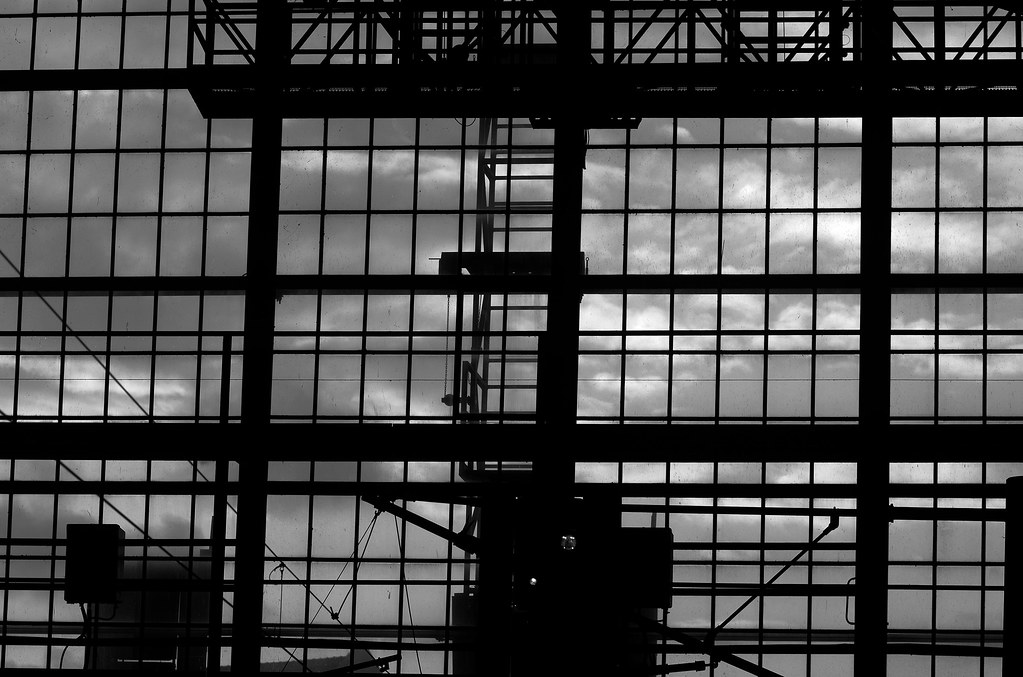
You are walking down a boulevard so wide it feels less like a street than a declaration. The buildings on either side rise to identical heights, their facades mathematically aligned, and there is nowhere to turn that does not expose you further. The geometry itself is the threat.
When Georges-Eugène Haussmann began demolishing medieval Paris on behalf of Napoleon III in 1853, he was not beautifying a city — he was debugging one. The old Paris of narrow, labyrinthine streets had been, for the revolutionary working class, a tactical advantage: barricades could be built in minutes, soldiers could be ambushed in alleys too tight for cavalry. Haussmann’s solution was architectural. He tore out roughly sixty percent of the existing urban fabric and replaced it with wide, straight boulevards radiating outward from central nodes, creating unobstructed sightlines and, crucially, unobstructed fields of fire. The cannon could now be pointed down a street and see its target from five hundred meters. The city was remade as a suppression engine, and this transformation took less than two decades and displaced approximately 350,000 working-class Parisians from the city center in the process.
Walter Benjamin spent much of the 1930s excavating the psychological residue of this transformation in his unfinished Arcades Project, intuiting that the Haussmannian boulevard was not merely infrastructure but ideology pressed into stone — a space that taught the body how to move, how visible it was, how permanently it was being seen. The flâneur Benjamin describes was never truly free; he was a figure who had learned to aestheticize his own exposure, to convert surveillance into leisure because he had no other available response. The thriller inherits this bargain almost without alteration. When a cinematographer places a figure at the far end of a long Parisian or Chicago or São Paulo boulevard and holds the shot, they are not making a compositional choice — they are restoring the original political function of that architecture. The sightline that the urban planner designed to expose rebellion becomes the sightline that exposes guilt, flight, or fear.
What makes this inheritance so durable is that it operates below the level of conscious recognition. The viewer does not think about Haussmann when they feel the dread of an exposed figure shrinking down a wide empty street at night. The geometry has already done its work. Michel Foucault, developing Jeremy Bentham‘s panopticon in Discipline and Punish in 1975, argued that power becomes most effective when it is internalized — when the watched subject begins to police themselves because visibility itself has become synonymous with vulnerability. Haussmann’s boulevards achieved exactly this on an urban scale. The city stopped needing guards at every corner because the openness of the space made every citizen a potential guard, every passerby a potential witness. Thriller cinematography literalizes this latent structure: the camera becomes the eye that the architecture always promised was there.
The long lens compresses that boulevard further, flattening the distance between pursuer and pursued, making escape look geometrically impossible even when it is not. This is not a distortion of reality — it is a clarification of the political logic already embedded in the space. When the thriller relocates to Chicago’s grid, or to the axial boulevards of Brasília, designed by Lúcio Costa and Oscar Niemeyer in 1956 and built as a monument to rational urban order, it finds the same grammar waiting. Brasília was constructed entirely from aerial photographs and modernist planning theory, a city designed before it was inhabited, which means its sightlines were pure intention before they were ever walked by a human body. There is no accident in that geometry, no alley that survived because someone needed it.
The thriller does not impose paranoia onto the city — it simply makes legible the paranoia that the city was always designed to produce.
Anonymity as Both Freedom and Sentence
You walk through a crowd of ten thousand faces and remember none of them. This is not failure — it is the first competency the city demands of you, the cognitive tax you pay for belonging to it. Without that selective erasure, the sensory volume of metropolitan life would be clinically unbearable, and Georg Simmel understood this in 1903 with an acuity that most urban theorists have spent the following century merely annotating. In “The Metropolis and Mental Life,” he identified what he called the blasé attitude not as moral indifference but as a neurological adaptation — the mind protecting itself from overstimulation by flattening the emotional register, treating each new face, each new stimulus, as roughly equivalent in value to every other, which is to say roughly equivalent to nothing. The city does not make you cold. It teaches you coldness the way a language teacher drills vocabulary: through repetition until the response becomes automatic, until the lesson disappears inside you and operates without your consent.
The thriller as a form has always understood that this trained numbness is not a social inconvenience but a structural resource — not a bug in the urban system but its most exploitable feature. What Simmel described as survival strategy, the genre reframes as operational cover. The killer, the stalker, the figure who moves through crowds with purpose concealed beneath the ordinary shuffle of transit — these characters are not exceptional. They are simply more deliberate students of the lesson every city dweller has already absorbed. They do not need disguise because the crowd has already agreed, collectively and unconsciously, to provide it.
Consider what this means architecturally. A city generates millions of micro-encounters per day, each lasting between one and three seconds, each resolved by the blasé reflex into a neutral non-event. The infrastructure of subway cars, pedestrian crossings, elevator lobbies, and coffee queues is designed to facilitate exactly this: efficient non-recognition. Security researchers call it security theater when the visible apparatus of surveillance fails to produce actual awareness in bystanders — and the data bears this out. A 2013 study at the University of Utah demonstrated that 97.5 percent of people cannot effectively multitask, yet urban environments demand precisely that fragmentary, divided attention at all times. The perceptual gaps this creates are not incidental. They are enormous, consistent, and exploitable in ways that no amount of CCTV infrastructure fully compensates for, because cameras record what humans have already decided not to see.
This is where photography in the thriller earns its philosophical weight. The still image arrests a moment that the crowd has already discarded as unremarkable. Someone was seen — registered by a lens, by a single eye behind it — in the very fraction of a second that every other witness had already processed and erased. The photograph in this context functions as an accusation against collective blindness, and the tension it generates derives precisely from the gap between what was visible and what was perceived. The city offered the evidence freely, in broad daylight, to anyone present. No one was present in any meaningful sense.
What the thriller ultimately reveals through this mechanism is that anonymity is not a condition that requires darkness or isolation to function. It operates most efficiently in full exposure, in density, in the exact conditions that should theoretically make concealment impossible. The figure lost in a crowd is not hidden — they are legible, present, even photographable. The protection they enjoy comes from the collective agreement, enforced by sensory overwhelm and Simmel’s blasé reflex, to render them meaningless before the act of looking is even complete. Urban freedom and urban sentence turn out to be the same contract, signed without reading, the moment you learn to stop really seeing the face beside you on the train.
Light Pollution and the Noir Inheritance
You are standing at your window at two in the morning, and the building across the street is a grid of lit and unlit squares, and you realize, with a discomfort you cannot immediately name, that you do not know whether you are watching or being watched, whether the light means safety or exposure.
Weegee understood this before anyone had language for it. Arthur Fellig, who renamed himself after the Ouija board because he seemed to arrive at murder scenes before the police, spent the late 1930s and early 1940s dragging a 4×5 Speed Graphic through the streets of lower Manhattan with a synchronized flash unit locked in the trunk of his Chevrolet. The images he produced — published in Naked City in 1945 — did something no photojournalist had consciously theorized yet: they made artificial light morally suspicious. The flashbulb did not illuminate crime scenes so much as it accused everyone in the frame simultaneously. The victim, the bystanders, the curious child pressing through the crowd — they all received the same flat, merciless brightness, the same shadowless exposure. Weegee’s flash refused to distinguish between the guilty and the innocent, which meant, in practice, that it treated them identically.
This visual logic migrated directly into the cinematography of American noir between 1944 and 1958, a period during which the interplay of municipal streetlight, neon signage, and domestic lamp became the primary grammar of moral uncertainty in the thriller. Cinematographers like John Alton, who described his approach in the 1949 manual Painting with Light, understood that the thriller’s architecture of guilt required not darkness but partial revelation — the face half-submerged in shadow not because the camera cannot reach it but because the light source itself has already judged how much truth this city is willing to show. Alton argued that the position of a lamp in a room communicated character before a single line of dialogue was spoken. He was not speaking metaphorically. He meant that urban illumination had become a system of values encoded in watts and angles.
What this produced, culturally and psychologically, was a permanent contamination of the lit window. Before noir, artificial light in Western visual culture carried the residual symbolism of the Enlightenment — knowledge, civilization, the banishment of the dangerous dark. After Weegee’s flash and Alton’s strategically placed practicals, the lit window in a thriller frame became a fundamentally ambiguous sign. It could mean warmth. It could mean surveillance. It could mean that someone inside is watching the street below and has been watching it for longer than is comfortable. The thriller as a genre trained two generations of urban viewers to read illumination as potential threat, to feel the glow of a neighbor’s apartment not as evidence of shared humanity but as the first element of a geometry that might, at any moment, become accusatory.
This inheritance did not stay inside cinema. Lewis Mumford, writing in The City in History in 1961, observed that the modern city’s lighting infrastructure had fundamentally altered the psychological relationship between interior and exterior space, between private life and the street’s perpetual visibility. He could not have anticipated how precisely noir had already dramatized what he was diagnosing — that the city at night is not divided between safe interiors and dangerous exteriors, but is instead a continuous field of partial, unreliable, morally loaded illumination in which every source of light is simultaneously a source of exposure. The streetlamp does not protect the pedestrian below it. It makes the pedestrian legible to whoever is watching from above.
Contemporary light pollution — that orange atmospheric wash that now makes true darkness impossible in any major urban center — has completed this process in a way that is almost too neat to be coincidental. We have built cities that never go dark, and we have called this progress, and what we have actually constructed is a condition in which no one is ever entirely unseen.
A vision curated by a filmmaker, not an algorithm
In this video I explain our vision
The Second Scene: The Photograph That Should Not Exist

She has been staring at the print for forty minutes when she finally sees it. Not the figure in the foreground, not the couple arguing beneath the overpass, not the vendor whose cart blocks the lower left quadrant — but the man standing at a precise forty-five-degree angle to the camera’s axis, partially occluded by a pillar, facing not the street but her. Facing, that is, whoever held the camera. The photograph was taken in a crowd, in full daylight, in one of those urban moments so saturated with ordinary life that nothing in it should require explanation. And yet here is this man, and the longer she enlarges the image — grain blooming, pixels fracturing into abstraction — the more certain she becomes that he is not coincidentally present.
This is the precise terror that photography has always threatened to deliver and only occasionally does: not the terror of the monstrous or the hidden, but the terror of the visible that was never meant to be read. Walter Benjamin, writing in 1931 in his “Little History of Photography,” identified what he called the optical unconscious — the idea that the camera records what the eye, governed by intention and habit, systematically fails to see. He meant it partly as wonder, a celebration of the medium’s capacity to reveal texture, motion, the hinge of a wrist mid-gesture. But the optical unconscious is morally indifferent. It captures the beautiful and the incriminating with identical fidelity. The crowd in any given urban photograph from the twentieth century onward is not background. It is testimony without a witness stand.
What the enlargement does — and this is the act that transforms a document into evidence — is not add information. It removes the noise that made information bearable. The crowd functioned as camouflage not through conspiracy but through sheer density. Georg Simmel argued in 1903, in his essay “The Metropolis and Mental Life,” that the urban dweller develops a blasé attitude as a defense mechanism against the overwhelming stimulation of city life. The photograph operates on the same principle in reverse: it freezes the moment in which every person in that crowd was exercising their blasé immunity to one another, and then it denies the viewer that same immunity. You cannot look away. You cannot process the man by the pillar and move on.
The deeper implication is that the act of looking harder does not produce innocence. Every enlargement is also an act of interpretation, and interpretation is always already a form of commitment. To identify the figure, to assign him significance, is to make a choice about what the image means — and that choice implicates the viewer in whatever narrative emerges. Gareth Stedman Jones, in his historical work on the nineteenth-century London poor, traced how photography was deployed by social reformers such as John Thomson in the 1870s to render the urban underclass legible to middle-class audiences. The legibility was never neutral. To be photographed in a crowd was to be potentially extracted from it, categorized, fixed. The reformers believed they were documenting; they were also accusing.
The woman enlarging the photograph is doing something structurally identical. She is not simply discovering a figure. She is producing one — lifting him out of the democratic blur of public space and investing him with singularity, with intent, with the retrospective weight of everything that came after the shutter closed. The crowd, in this sense, is not where evidence hides. The crowd is where evidence waits to be created by the first person willing to look long enough to need an explanation. And that need, that hunger for coherence in an image that originally offered none, is itself a kind of violence done to the ordinary, to the forty other people in the frame who will never be enlarged, never be suspected, never be seen at all.
Dead Zones and the Architecture of Complicity
You have stood in a parking structure at 2 a.m., your footsteps multiplying off concrete pillars, the fluorescent tubes humming their particular frequency of institutional indifference, and felt — before any rational thought arrived — that this place did not belong to anyone. Not to you, not to the city, not to whatever authority painted the yellow lines on the floor. That feeling was not paranoia. It was accurate perception.
Michel de Certeau, writing in “The Practice of Everyday Life” in 1980, drew a distinction that cuts directly to the nerve of this sensation. The planner, the administrator, the urban theorist — anyone who has ever looked at a city from the top of a tower — sees a legible text: grids, zones, flow patterns, jurisdictions drawn in clean lines. The pedestrian walking through that same city experiences something else entirely, a practice that generates its own logic beneath the official map, one that no satellite image will ever capture. The thriller understands this epistemological gap with an almost clinical precision, and it builds its most dangerous architecture precisely in the spaces that exist in the gulf between the two perspectives.
These are the dead zones: the service corridor connecting a hotel’s kitchen to its loading dock, the underpass where a highway overruns a neighborhood that once had a name, the maintenance tunnel beneath a stadium that appears on no tourist map and on no emergency services diagram. They are not accidents of urban planning. They are its necessary consequences, produced by the same administrative logic that creates the legible zones precisely by rendering other spaces illegible. Every jurisdiction requires a boundary, and every boundary produces a shadow. The thriller camera knows this and moves toward the shadow with the confidence of someone who has read the city’s unconscious.
What makes these spaces cinematically and morally complex is that their danger is not incidental to their design — it is structural. The parking structure offers minimal surveillance because surveillance was never the point; revenue extraction was the point, and the geometry of maximum vehicle capacity produces, as a byproduct, sightlines that belong to no one. Giorgio Agamben‘s concept of the state of exception — the zone where law is suspended precisely so that the broader legal order can function — translates with uncomfortable literalness into poured concrete. The thriller doesn’t invent the threat; it photographs the existing condition and refuses to look away.
There is a sociological dimension that the genre sometimes grasps and sometimes fumbles. The people most familiar with dead zones are not thriller protagonists. They are the workers who use service corridors because they are not permitted to use the main entrance, the unhoused people who understand which underpasses offer the best protection from wind, the delivery drivers whose entire working day unfolds in the architectural negative space that the official city pretends does not exist. When a thriller moves its protagonist through these spaces as if they were exotic territory — unknown, dangerous, off the map — it is inadvertently confessing a class position. The spaces are only unmapped to those who have never needed them.
What the best urban thrillers accomplish, in their most honest moments, is a photography of complicity rather than menace. The parking structure is frightening not because something monstrous has been placed there by narrative convenience but because it reveals what the city actually consented to build: a structure optimized for profit with danger distributed evenly to anyone who cannot afford to avoid it. The camera that lingers on the sightline, on the dead angle, on the stairwell door with its small wire-reinforced window is documenting an agreement the city made with itself and then forgot — or preferred to forget. The thriller’s insistence on returning to these spaces is a kind of forensic memory, a refusal to accept the planner’s view from above as the complete account of what the city has made and what it has permitted to happen inside the architecture of its own omissions.
The City After the Image
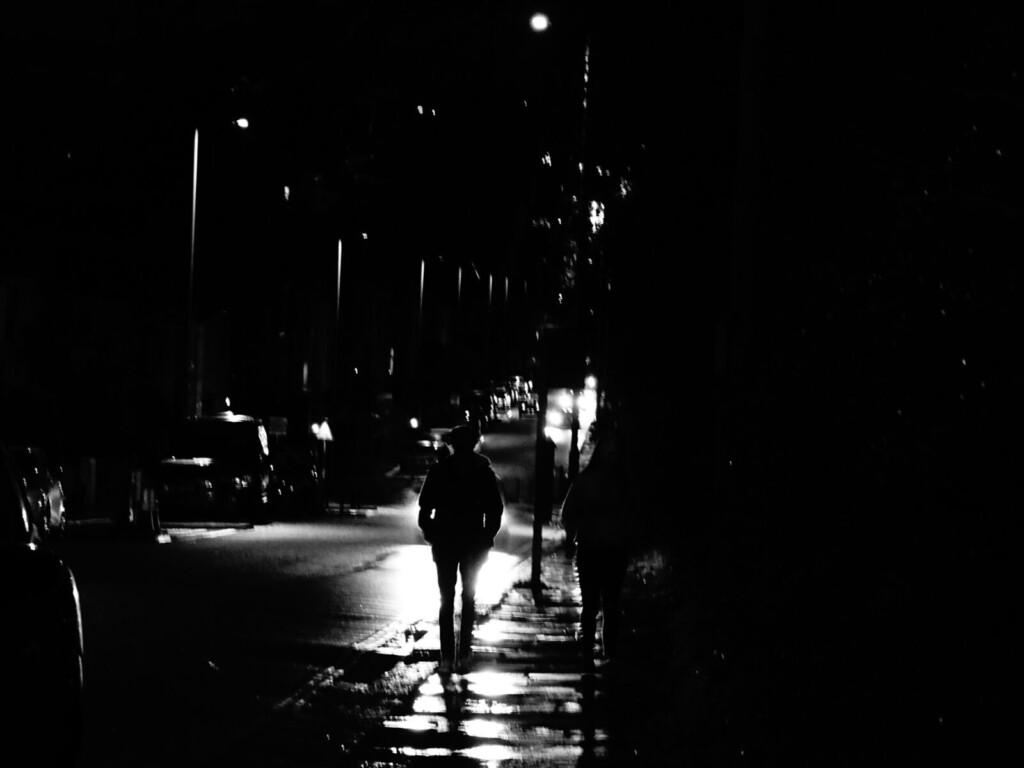
You have walked a street you have never visited. Not in dream, not in memory — in the unblinking scroll of a camera mounted to a car roof, capturing asphalt and facades and the occasional blurred pedestrian caught between one moment and the next, their face smeared into abstraction by an algorithm designed to protect them from a visibility they were already subject to. Since 2007, that system has logged over ten million miles of navigable road surface, which means that the architectural unconscious of the thriller — the alley that could conceal, the corner that withheld its secret until the protagonist turned it — has been methodically archived, cross-referenced, and made available at zero latency to anyone with a browser. The city that once withheld itself has been forced into total confession.
What this produces is not safety. The assumption that visibility and safety are synonymous belongs to a particular strain of Enlightenment optimism that Jeremy Bentham literalized in 1791 with the panopticon — a structure whose disciplinary genius lay not in actual surveillance but in the prisoner’s inability to know when they were being watched, which eventually made constant watching unnecessary. Michel Foucault spent a substantial portion of Discipline and Punish, published in 1975, demonstrating that this architecture migrated outward from the prison into the school, the hospital, the factory floor. What no one in that tradition anticipated was the inversion: a system so comprehensive that the watcher is also watched, that the camera logging the street also logs the person standing in front of their own door, and that the knowledge of this produces not behavioral correction but a slow, structureless anxiety with no object precise enough to confront.
The thriller understood this shift before theory did, because the thriller has always been less interested in danger than in the feeling that precedes identified danger — the sensation of being perceived before you have located the perceiver. When every street exists as a file that can be retrieved, studied, and navigated remotely, the question of who has already walked your block without walking it becomes genuinely unanswerable. Stalking, in its contemporary form, often begins in this archival space: a perpetrator who knows the sight lines from your window, the distance between your door and the nearest intersection, the shadow geometry of your building at a given hour — all without having generated a single footprint on your actual pavement. The city after the image is one where physical presence is no longer the threshold of trespass.
This is the dread that has no architectural solution, because architecture has always responded to threat by rearranging solid matter — higher walls, better locks, guarded gates. But a threat that routes around the physical, that colonizes the representation of space rather than space itself, cannot be answered by anything a contractor can build. The thriller, persisting and in fact intensifying under total visibility, has registered this with formal accuracy: its tension no longer depends on what the camera cannot show, but on the surplus of what it has already shown to someone the protagonist cannot identify. The unknown is no longer located in darkness. It lives inside the completely illuminated image.
There is a specific texture to this dread — different in kind from the fear produced by fog or shadow or the unlit stairwell — because it offers the victim the same tools it offers the threat. You can look up your own street. You can see your own door as a stranger sees it. And in that moment of looking, something shifts irrevocably: you have become the stranger. You have occupied the surveilling position, turned it on yourself, and discovered that the view from outside your life is perfectly, clinically available. The thriller does not need to invent a new monster for this condition. It only needs to hand you the camera and wait for you to realize what you are looking at.
🏙️ The City as Labyrinth: Space, Gaze, and Suspense
The thriller has always found its most powerful ally in the urban environment, transforming streets, corridors, and facades into instruments of dread and disorientation. From the fog-laden alleys of noir to the hyper-lit surveillance cities of contemporary cinema, the metropolis becomes a maze of hidden meanings. These related articles explore the aesthetic, philosophical, and photographic dimensions that give the city its uncanny power.
Situationist Psychogeography: The City as Lived Space
Situationist psychogeography reimagined the city not as a neutral backdrop but as an emotional and political landscape capable of shaping human behavior. Guy Debord‘s concept of the dérive — the unplanned drift through urban space — anticipates the thriller protagonist’s disoriented wandering through hostile environments. Understanding this theory unlocks a deeper reading of how urban geography becomes psychological pressure in suspense cinema.
GO TO THE SELECTION: Situationist Psychogeography: The City as Lived Space
Susan Sontag and Photography: The Gaze as Power
Susan Sontag‘s foundational analysis of photography as an exercise of power offers essential tools for reading the surveillance aesthetics at the heart of the urban thriller. The camera lens, like the thriller’s gaze, simultaneously reveals and controls, turning the city into a space of the watched and the watchers. Her argument that every photograph is also an act of domination resonates deeply with the paranoid visual grammar of the genre.
GO TO THE SELECTION: Susan Sontag and Photography: The Gaze as Power
Georg Simmel and the Metropolis: The Metropolis and Mental Life
Georg Simmel‘s landmark essay on the metropolis and mental life diagnosed the modern city as a place of sensory overload, anonymity, and psychological defense mechanisms. His figure of the blasé urban dweller — detached, suspicious, perpetually calculating — is the spiritual ancestor of the thriller’s isolated, hypervigilant protagonist. The city in Simmel is never just architecture; it is a force that reshapes interiority itself.
GO TO THE SELECTION: Georg Simmel and the Metropolis: The Metropolis and Mental Life
Franz Kafka and Urban Alienation
Franz Kafka‘s literary cities — labyrinthine, bureaucratic, and impenetrable — established a visual and narrative template that thriller filmmakers would inherit for generations. Urban alienation in Kafka is not merely social but metaphysical: the city refuses to yield its logic, mirroring the genre’s structure of pursuit without resolution. Reading Kafka alongside the thriller reveals how urban space can function as the architectural embodiment of dread.
GO TO THE SELECTION: Franz Kafka and Urban Alienation
Discover the City Through Independent Cinema
If these urban labyrinths have sparked your curiosity, Indiecinema streaming is the place to go deeper. Our curated selection of independent and auteur films explores the city as few mainstream productions dare — raw, oblique, and cinematically uncompromising. Come wander the streets of independent cinema with us.
👉 EXPLORE THE CATALOG: Watch Indie Films in Streaming
A vision curated by a filmmaker, not an algorithm
In this video I explain our vision

